19 Tropical Luau Centerpieces With Fresh, Unexpected Style

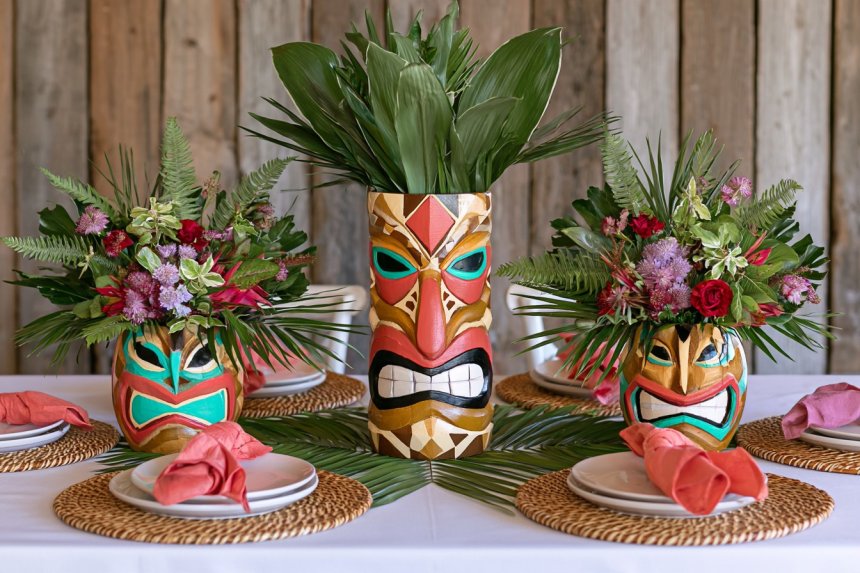
A luau centerpiece can feel vibrant and tropical without relying on plastic palm leaves, novelty tiki props, or the same pineapple arrangement repeated down the table. The strongest designs often use natural texture, sculptural fruit, layered greenery, flowers, water, woven materials, and height to create a richer atmosphere. A centerpiece can feel playful, elegant, rustic, or almost architectural depending on how those elements are combined. These ideas focus on tropical party styling with a more thoughtful visual approach, using materials that can be adapted for birthdays, summer dinners, poolside gatherings, and Hawaiian-inspired celebrations while keeping the table practical enough for food, conversation, and real guests.
1. Build a Low Monstera and Orchid “Island”
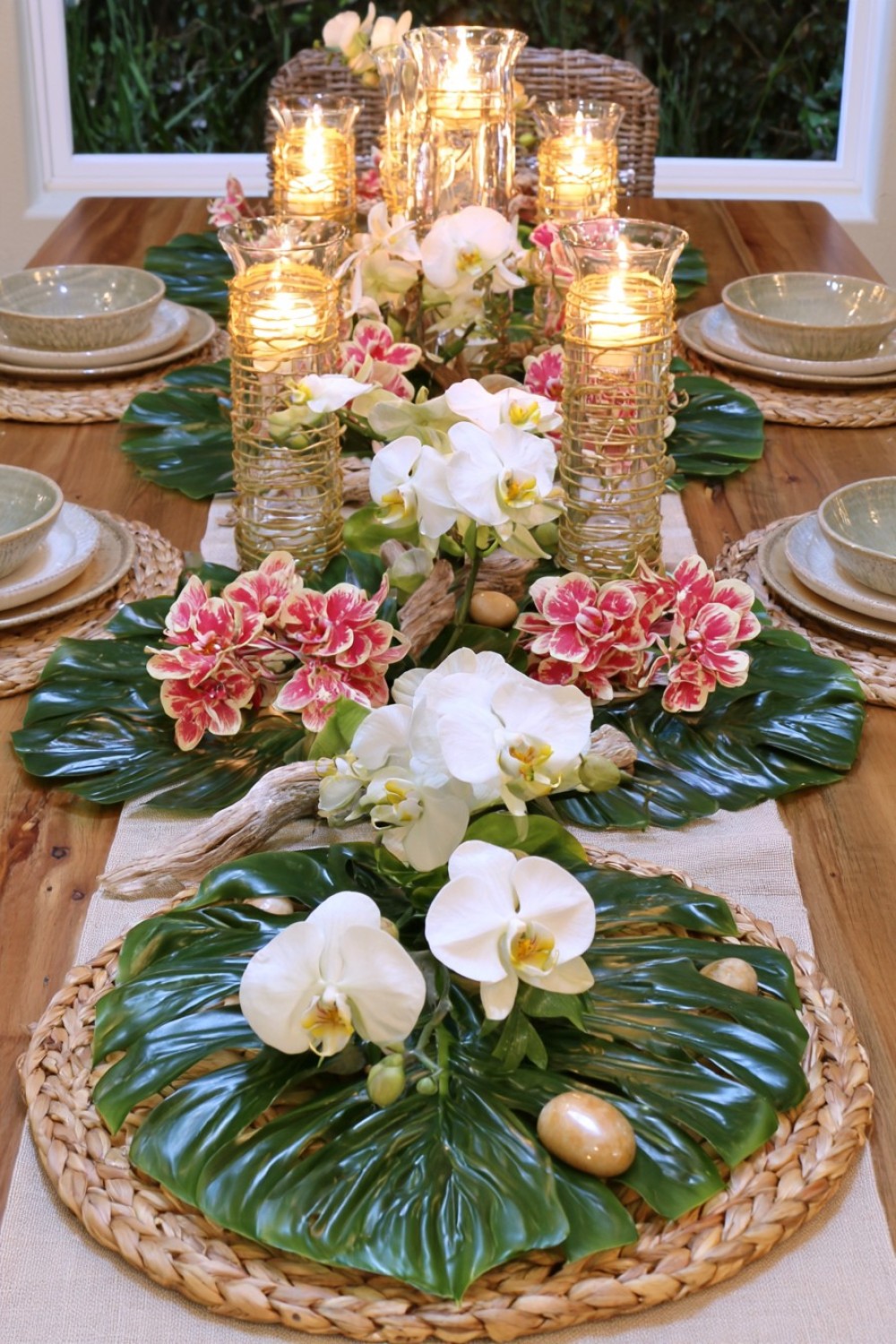
Instead of arranging flowers upright in a vase, create a low botanical island across the center of the table.
Use one or two broad monstera leaves as the base, then place small water-filled floral tubes beneath white or coral orchids so the flowers appear to grow directly from the leaves.
Add a few polished river stones or pieces of driftwood for extra texture.
The result stays below eye level, which makes it practical for dining while still feeling lush.
For a more refined palette, keep the greenery deep and the flowers mostly one color.
This arrangement works especially well on long tables where several smaller botanical islands can repeat at intervals rather than forming one massive centerpiece.
2. Turn Papaya Halves Into Edible Floral Bowls
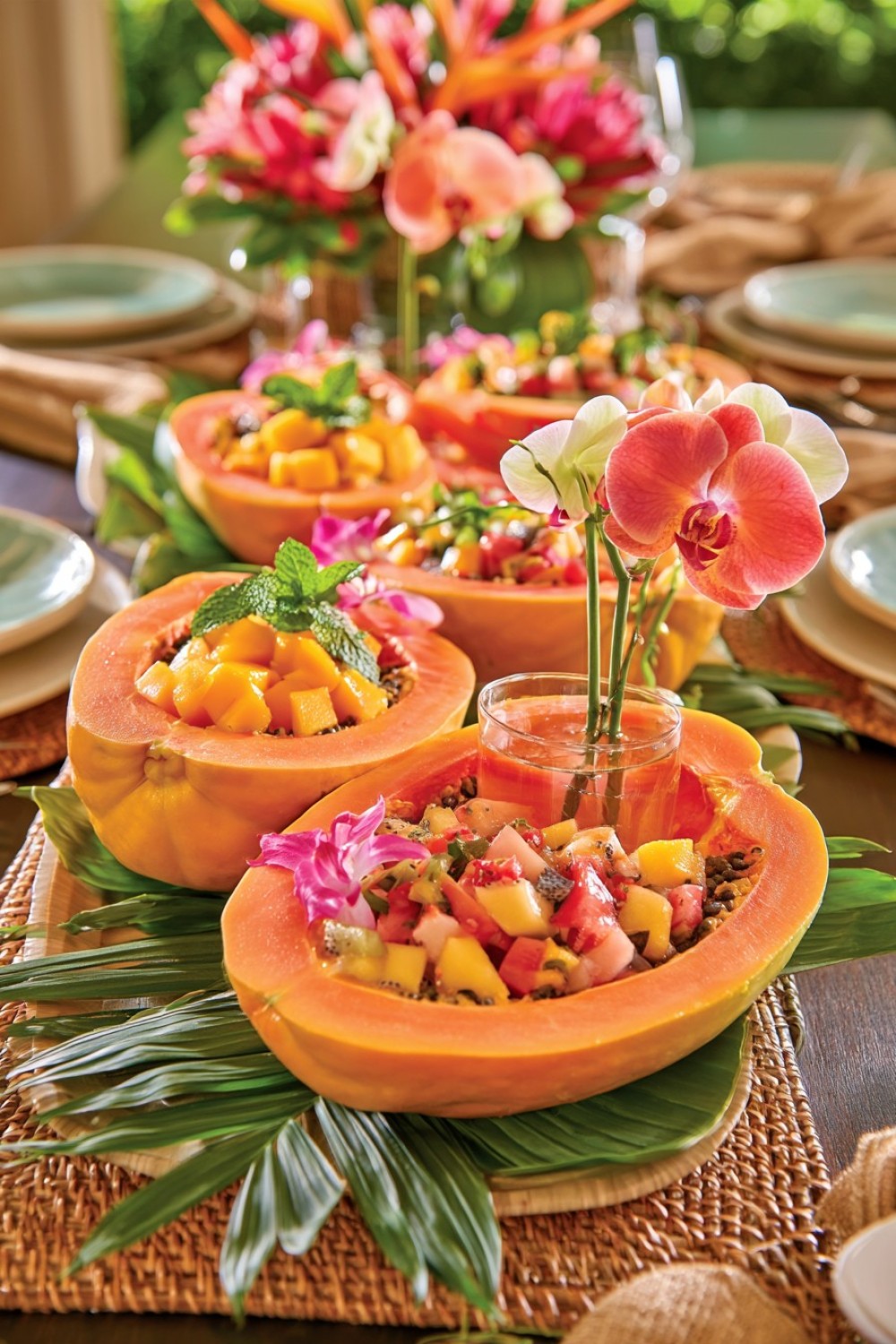
Papaya can become both a centerpiece and part of the food presentation.
Cut ripe papayas in half, remove the seeds, and use the cavities to hold tropical fruit, edible flowers, or small sealed floral cups.
One papaya might contain mango cubes and mint while another holds a few orchids in a hidden water vessel.
Place the fruit on banana leaves or a woven runner so the arrangement feels grounded.
Because the centerpiece is partially edible, it creates color without introducing unnecessary decor.
Prepare the fruit close to serving time and keep it appropriately chilled if it will be eaten.
This works beautifully for brunches, outdoor lunches, or smaller luau-style gatherings.
3. Create a Pineapple Leaf Sculpture Without the Pineapple
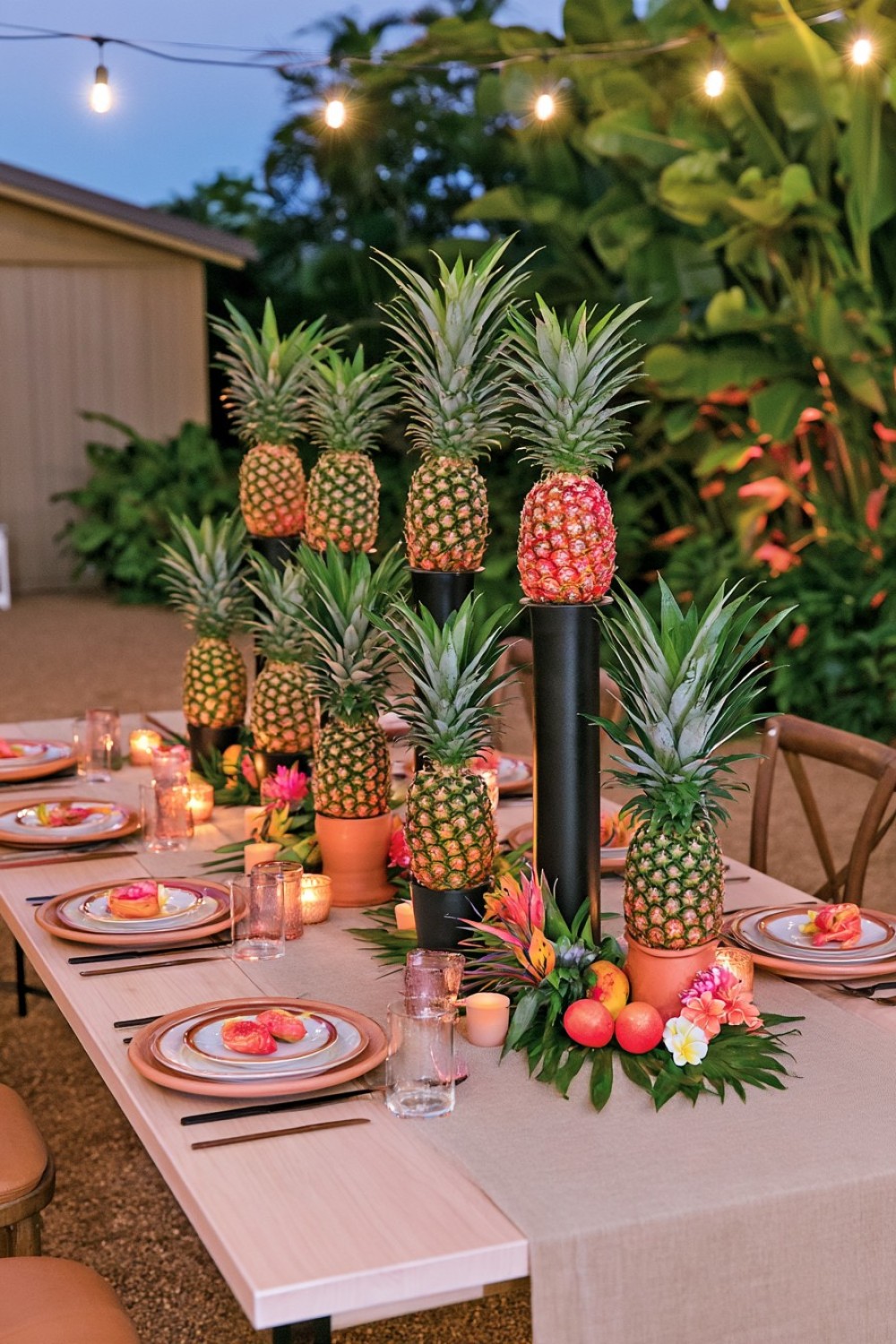
Instead of using the whole pineapple as the predictable centerpiece, focus on its crown.
Collect several intact pineapple tops, clean them, and arrange them vertically in narrow dark vessels at different heights.
The spiky leaves create a strong sculptural silhouette that feels modern rather than themed.
Pair them with one or two low tropical flowers or bright fruit around the base.
For an even more dramatic effect, use matte black, terracotta, or stone-colored containers rather than clear glass.
The contrast between the rigid leaf structure and soft flowers makes the arrangement more interesting than a standard hollowed pineapple vase.
4. Build a Tropical Fruit Gradient Down the Table
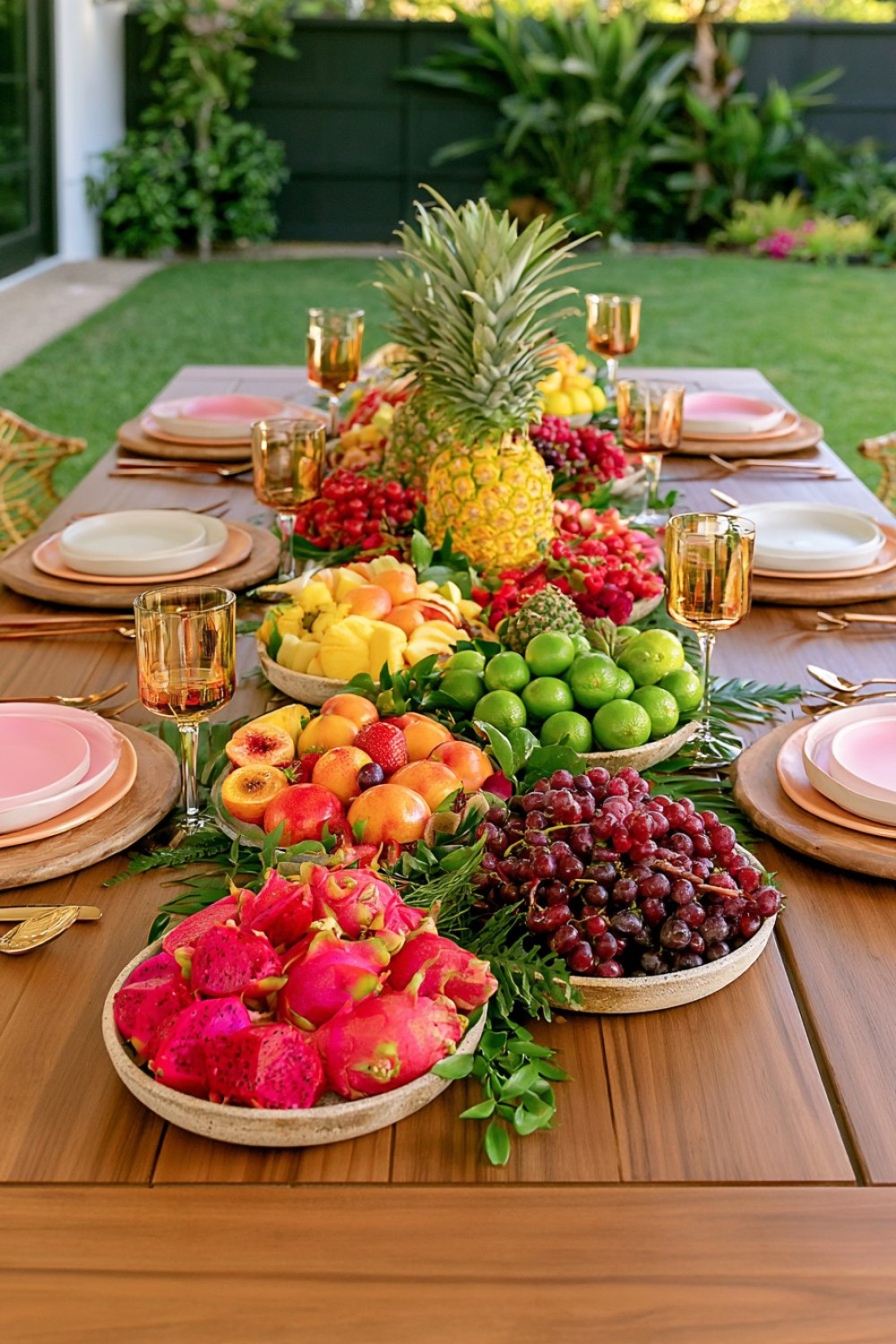
Use fruit as color rather than as filler.
Create a gradual progression using red dragon fruit, papaya, orange, yellow pineapple, green lime, kiwi, and deep purple passion fruit or grapes.
Keep the fruit whole and arrange it in shallow stone or wooden trays.
The gradient can move along one long centerpiece or be split into small grouped sections.
Add only minimal greenery so the color transition remains visible.
This idea feels playful but still designed, especially when the serving ware stays neutral.
It also allows much of the centerpiece to be eaten later rather than discarded.
5. Make a Floating Hibiscus Water Bowl
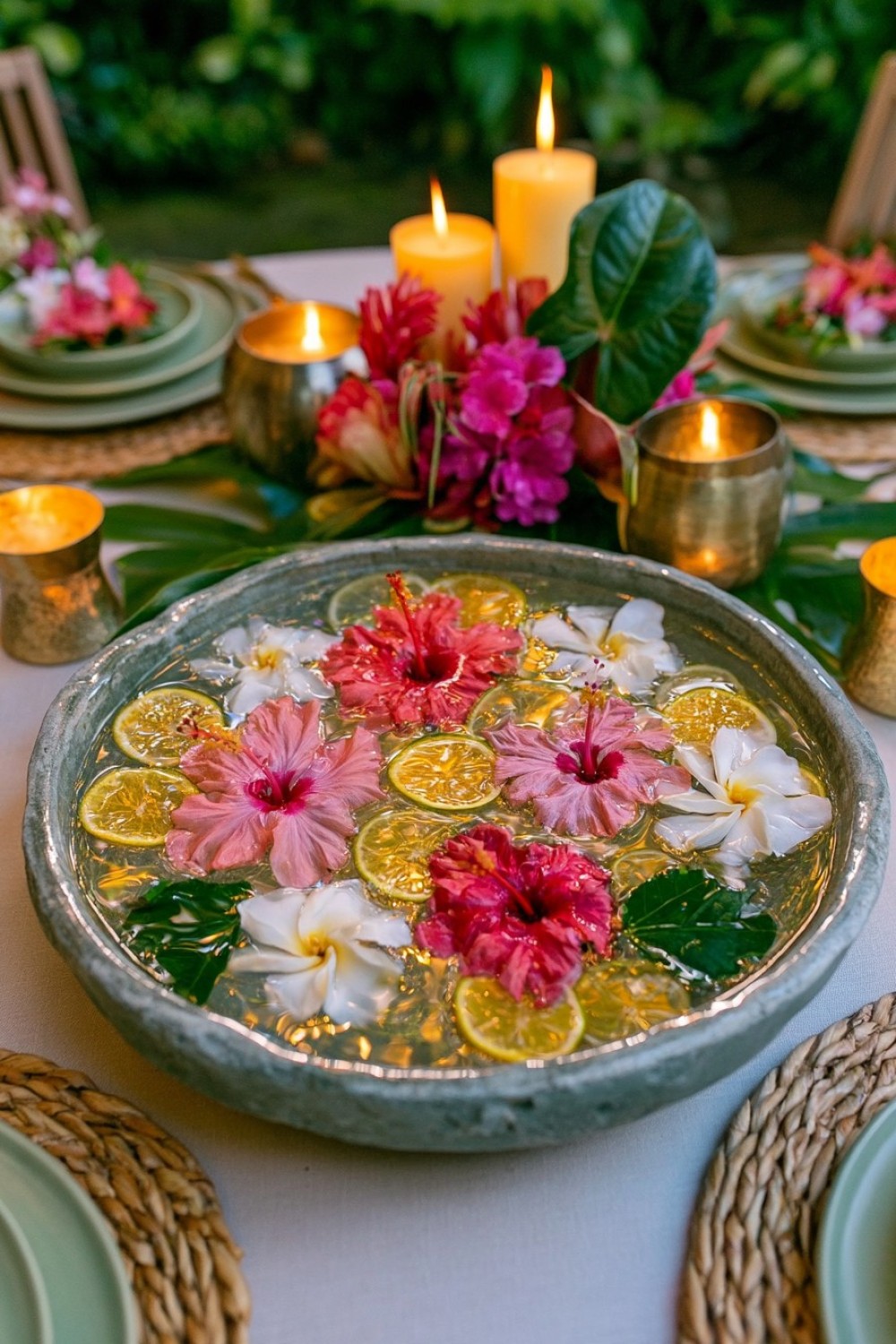
A broad shallow bowl filled with water can create a calmer tropical focal point.
Use a ceramic, stone, or metal bowl with a wide opening. Float fresh hibiscus, gardenia, or other suitable flowers on the surface along with a few citrus slices or broad green leaves.
Keep the composition sparse so the water remains visible.
A dark bowl can make bright flowers appear especially vivid, while white stone creates a softer resort-like look.
This centerpiece works best on round tables where guests can see it from every direction.
Use clean water and replace flowers as needed so the arrangement continues to look fresh throughout the event.
6. Build a Centerpiece From Stacked Coconut Shells
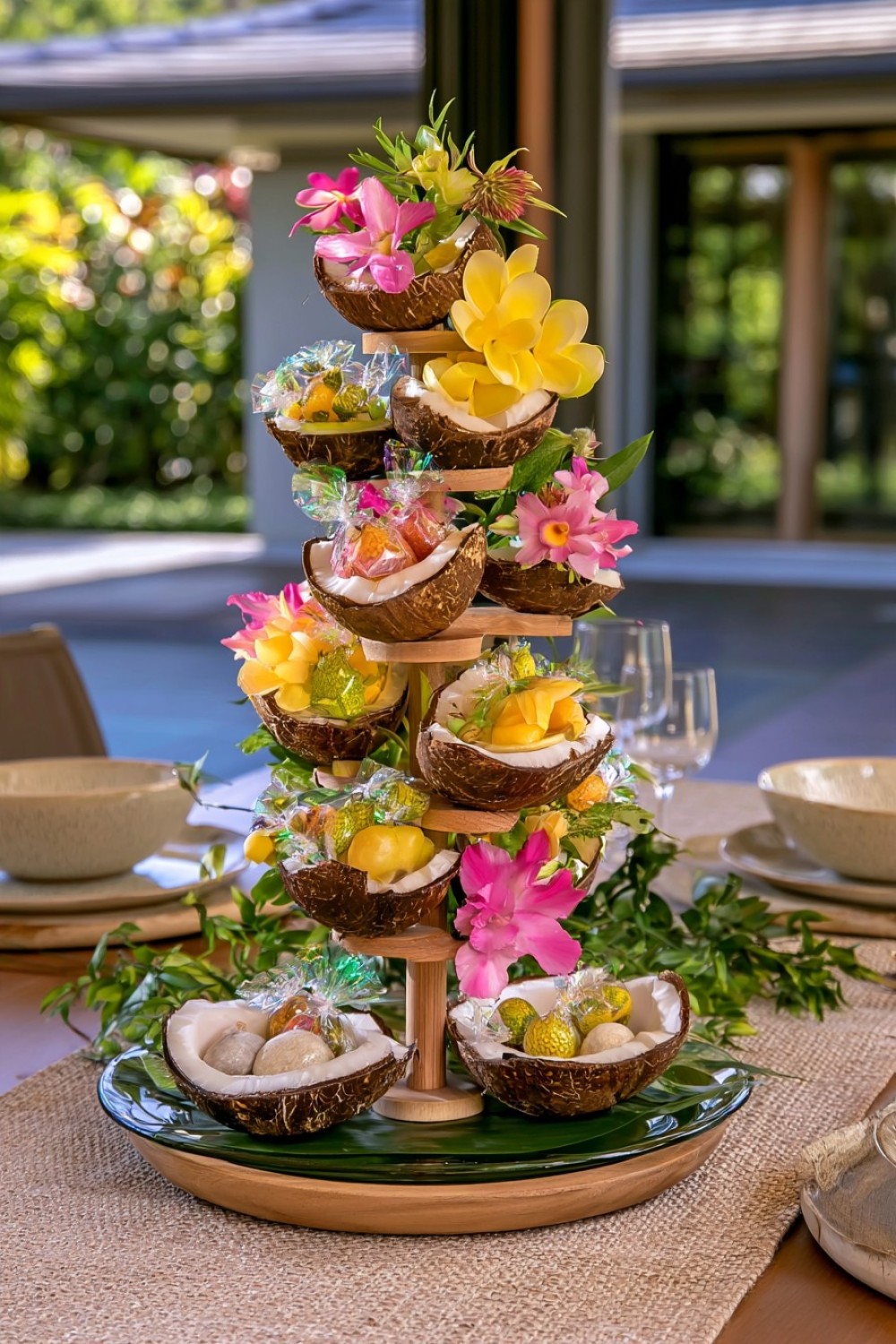
Instead of placing coconuts casually on the table, turn cleaned shells into a sculptural vertical arrangement.
Use several coconut halves, small wooden spacers, and a stable base to create a staggered tower.
Some shells can hold flowers, while others contain wrapped sweets, fruit, or decorative stones.
For a DIY version, drill and fasten the shells to a concealed central dowel so they remain stable.
Keep the finished piece relatively low unless the table is decorative rather than used for dining.
This approach makes the coconut texture part of the design instead of treating it as a novelty prop.
7. Use Woven Palm Trays as Layered Platforms
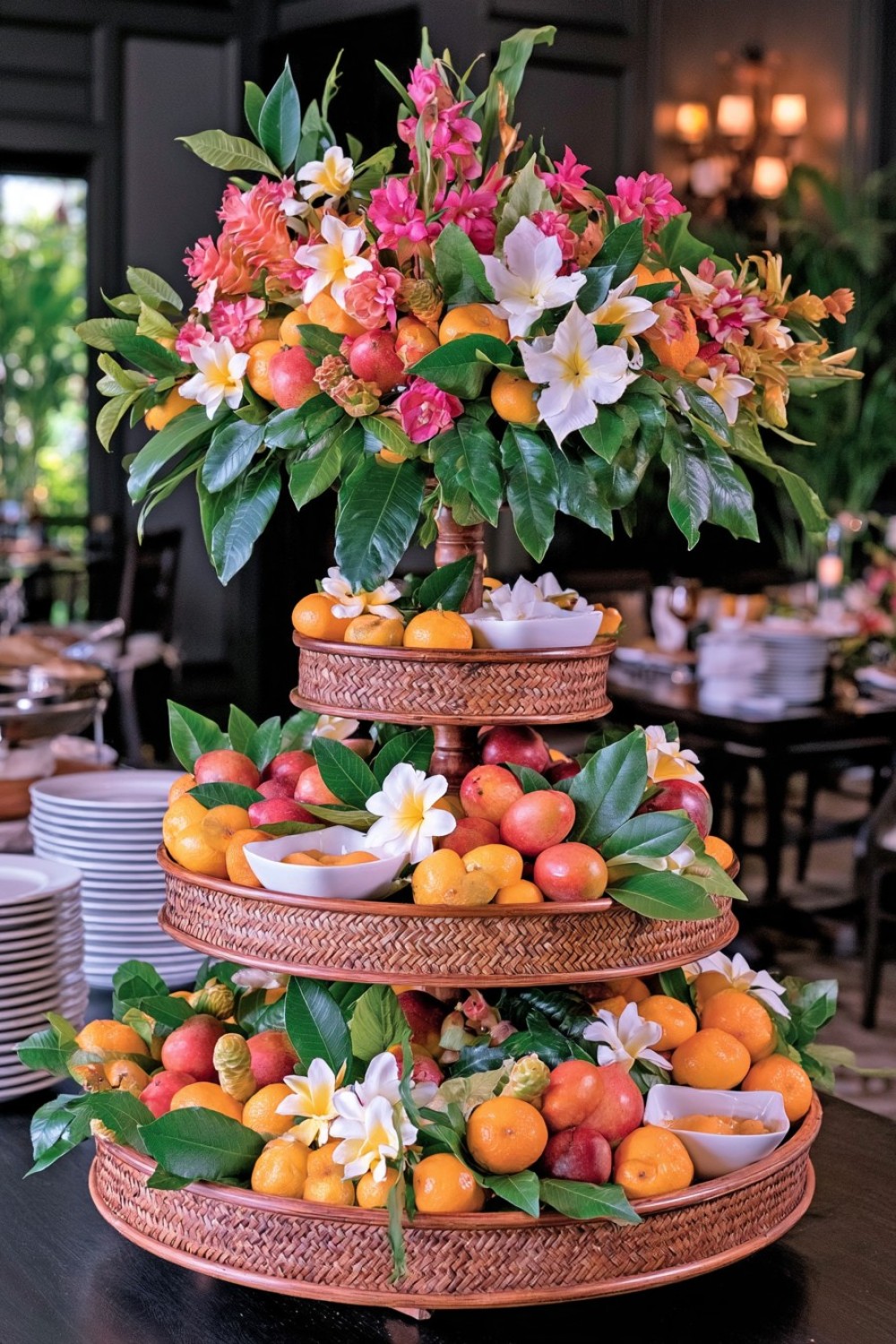
A centerpiece can gain depth without using tall vases.
Stack two or three woven palm or rattan trays at slightly different heights using hidden wooden blocks beneath them.
Place fruit, flowers, small serving bowls, or leaves across each level.
The woven texture brings warmth while the tiered construction makes the table feel more dimensional.
Keep the palette simple—green foliage, orange fruit, and white flowers are often enough.
For a DIY version, use existing woven trays and removable risers so the pieces can be reused after the party.
This concept works especially well on buffet tables where guests can see the centerpiece from several angles.
8. Create a Mini “Volcanic” Stone Arrangement
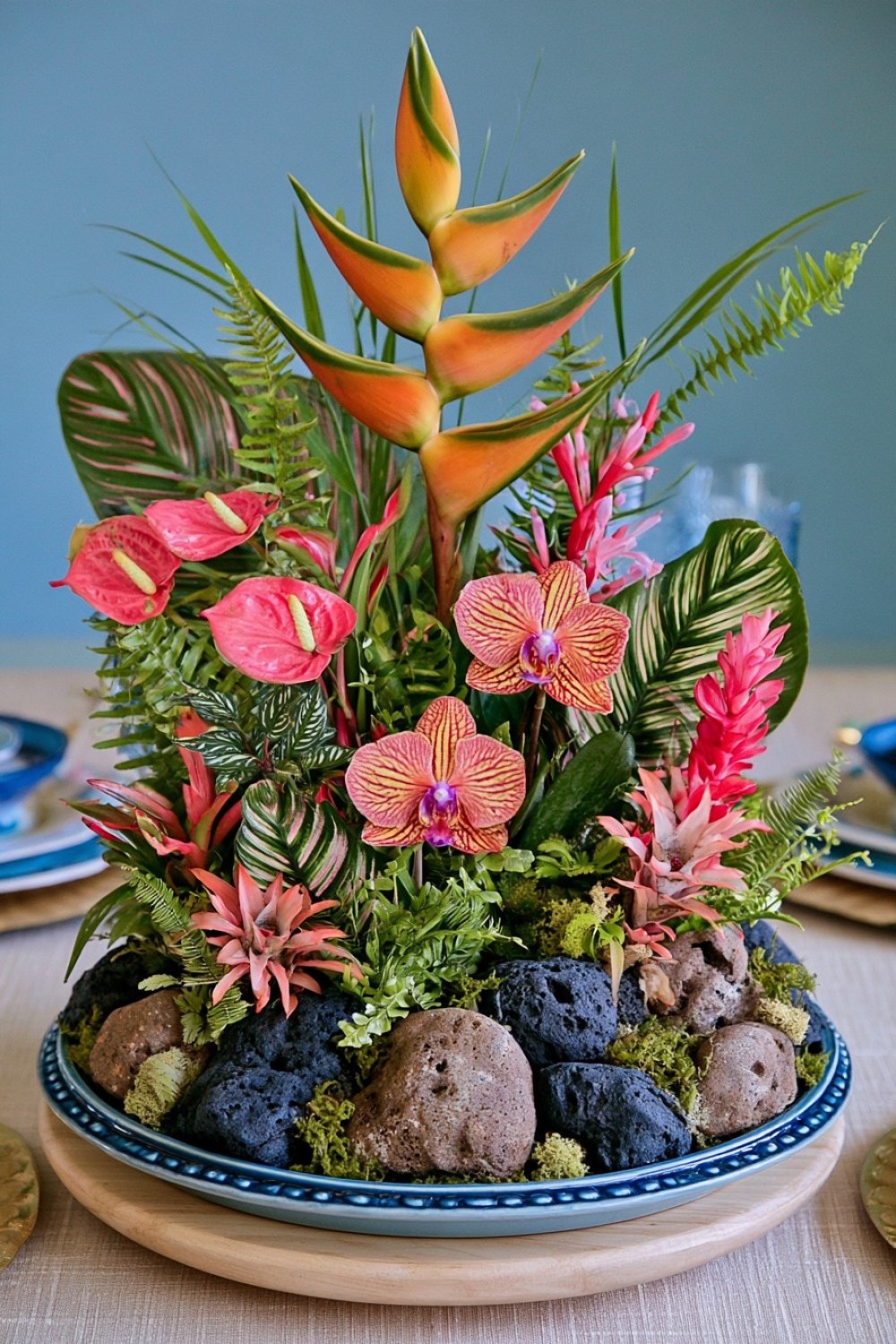
A tropical table does not have to rely entirely on bright color.
Use rough black lava-like stones or dark volcanic-style decorative rock as the base for a moody centerpiece.
Nest small tropical flowers, ferns, or moss between the stones so the greenery appears to emerge naturally from them.
For a more dramatic effect, add one warm-toned flower—orange heliconia, red ginger, or coral orchid—as the focal point.
The contrast between black stone and saturated color creates a much stronger visual statement than a typical floral bouquet.
Keep the rocks in a shallow tray to protect the table and make cleanup easier.
9. Build a Bamboo Tube Flower Grid
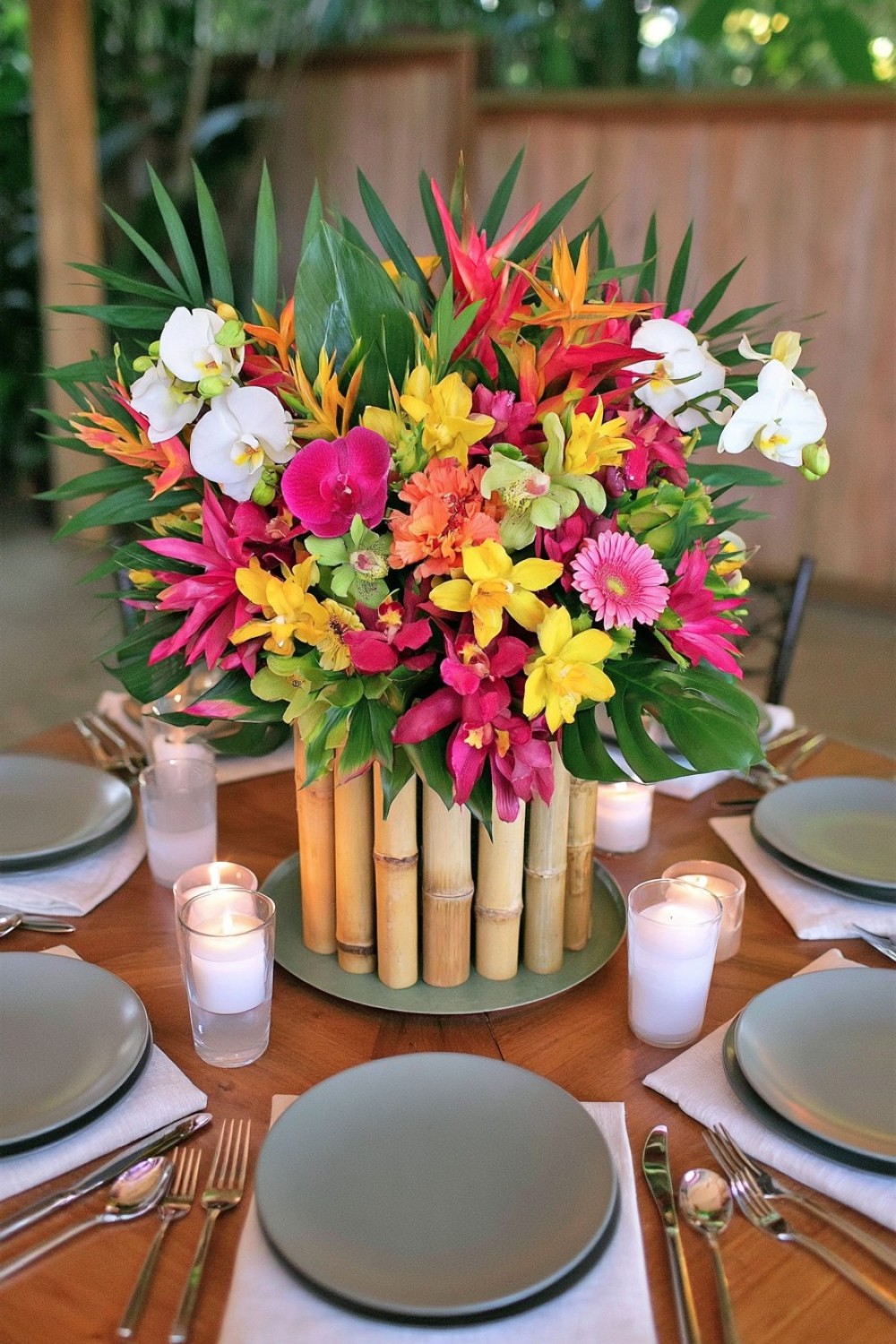
Instead of one vase, create a series of short bamboo tubes arranged like an architectural grid.
Cut bamboo into sections of different heights, sand the edges, and place waterproof floral tubes or small inserts inside.
Arrange the tubes closely on a stable tray.
Each opening can hold one flower, one leaf, or a short stem.
The result feels structured while still using natural materials.
For a monochrome version, fill every tube with the same flower. For something more playful, alternate bright tropical colors.
Because untreated bamboo and water can be a difficult combination, use internal waterproof inserts rather than filling the bamboo itself.
10. Turn Banana Leaves Into Sculptural Folded Forms
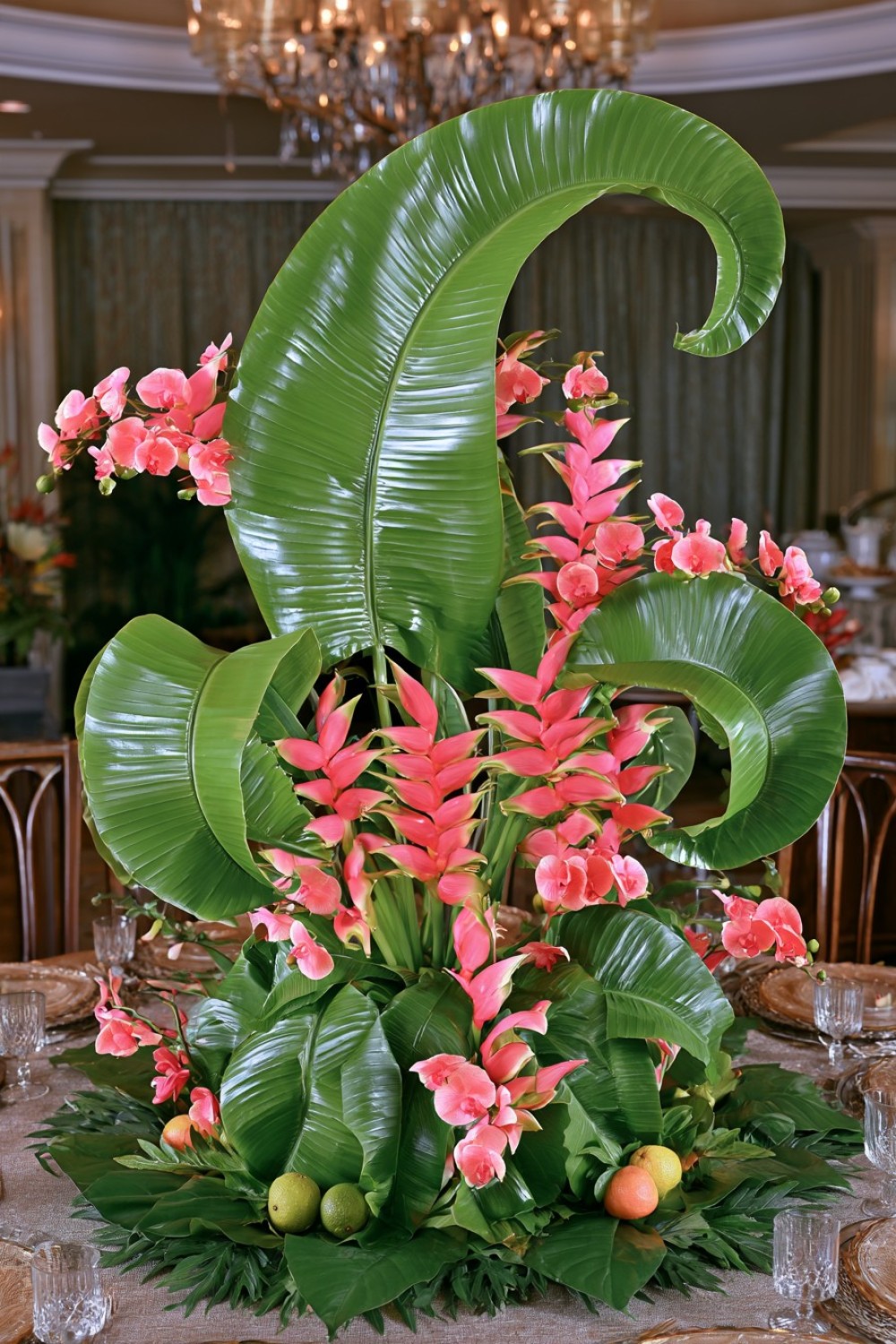
Banana leaves can do more than lie flat beneath plates.
Fold or curve sections of leaf into large sculptural shapes and secure them around hidden floral mechanics or lightweight frames.
The broad glossy surfaces catch light beautifully and can make a centerpiece feel much larger without using many flowers.
Pair the leaf forms with only a few tropical blooms or fruit.
For a more modern result, keep the composition asymmetrical and let one folded leaf dominate.
This works particularly well on large tables where the centerpiece needs visual scale but should not become overly busy.
11. Create a Tropical “Market Table” Centerpiece
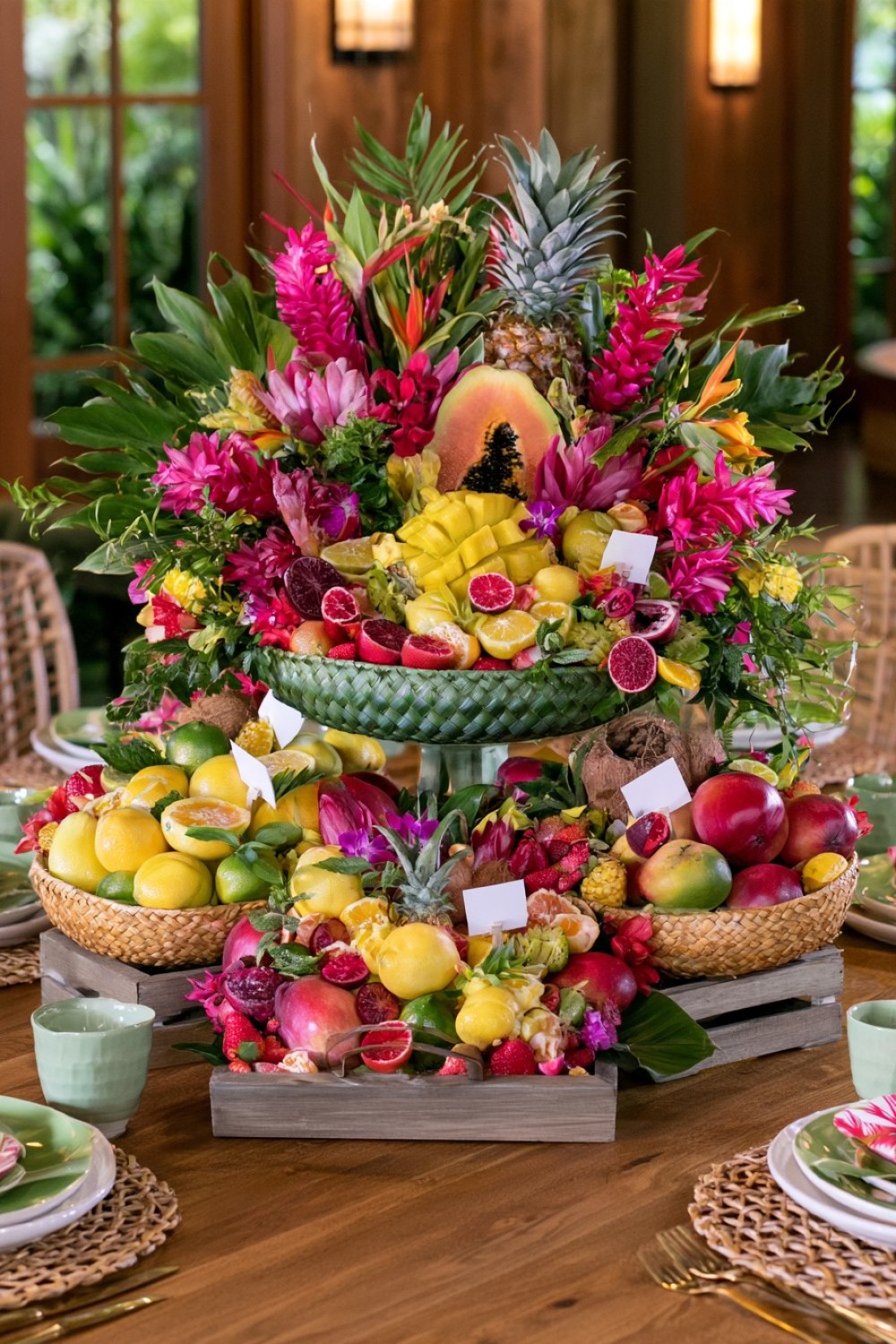
Instead of building a traditional floral arrangement, style the center like a small island produce market.
Use low baskets or wooden crates filled with citrus, mangoes, papayas, herbs, coconuts, and flowers.
Keep the containers shallow and vary their shapes rather than stacking everything high.
A few handwritten-style produce tags or small menu cards can add personality if desired.
This idea feels especially natural at lunch or brunch events where the food itself is part of the visual experience.
The arrangement can also transition into serving: fruit can be cut and used later rather than remaining decorative only.
12. Build a Transparent Tropical Terrarium Centerpiece
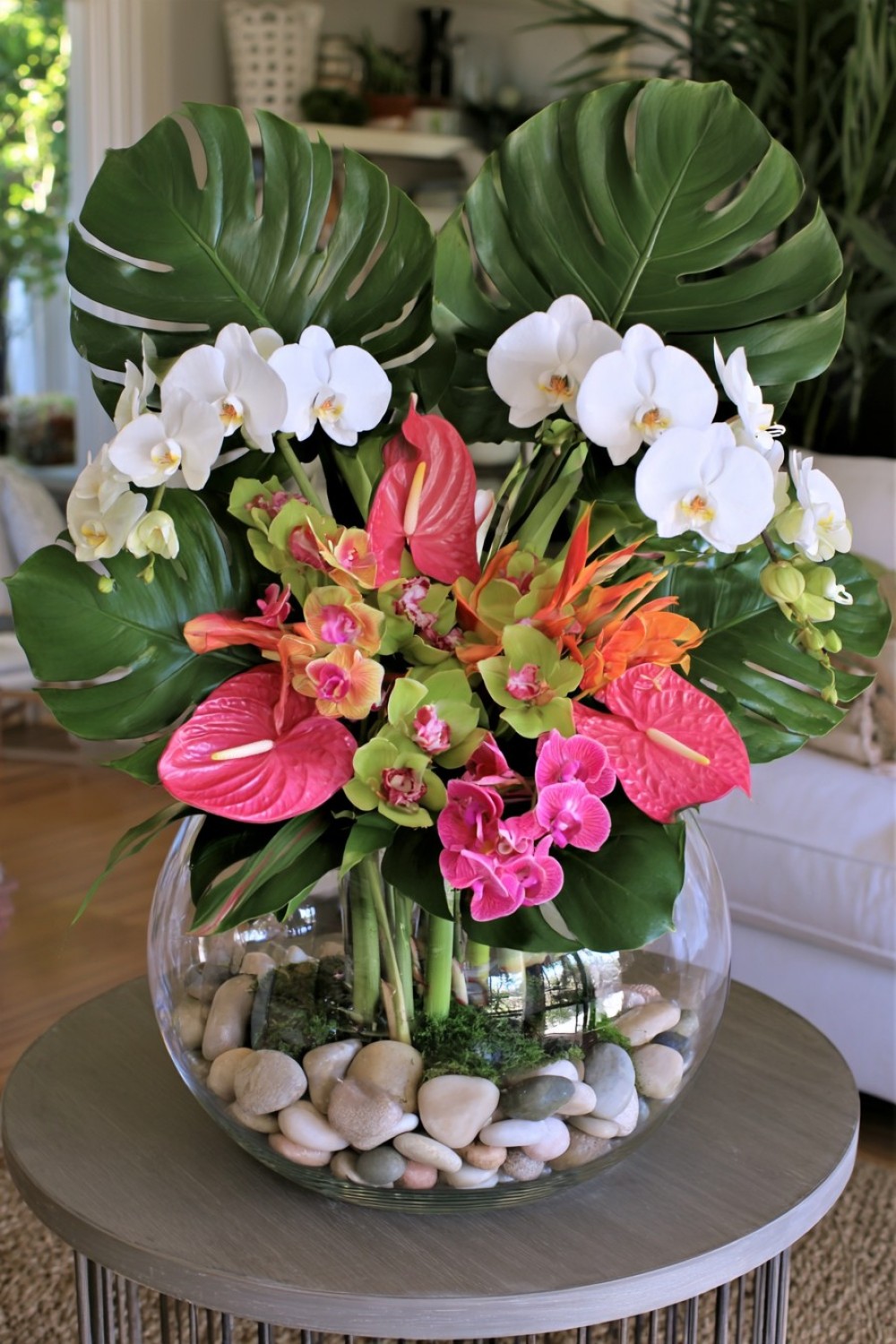
Use a large clear glass cylinder or bowl and create a layered arrangement inside it.
Place broad green leaves against the glass, add a few flowers, and use stones or moss-like decorative material at the base.
The key is keeping the arrangement partially open so it does not look like a sealed terrarium.
A transparent container lets guests see stems, roots, and layering from every side, which makes the structure part of the display.
For a more contemporary look, use only one plant type and one flower color.
This works particularly well on round tables or cocktail tables where the centerpiece is viewed from all directions.
13. Create a Candle-Free Tropical Glow With Reflective Fruit
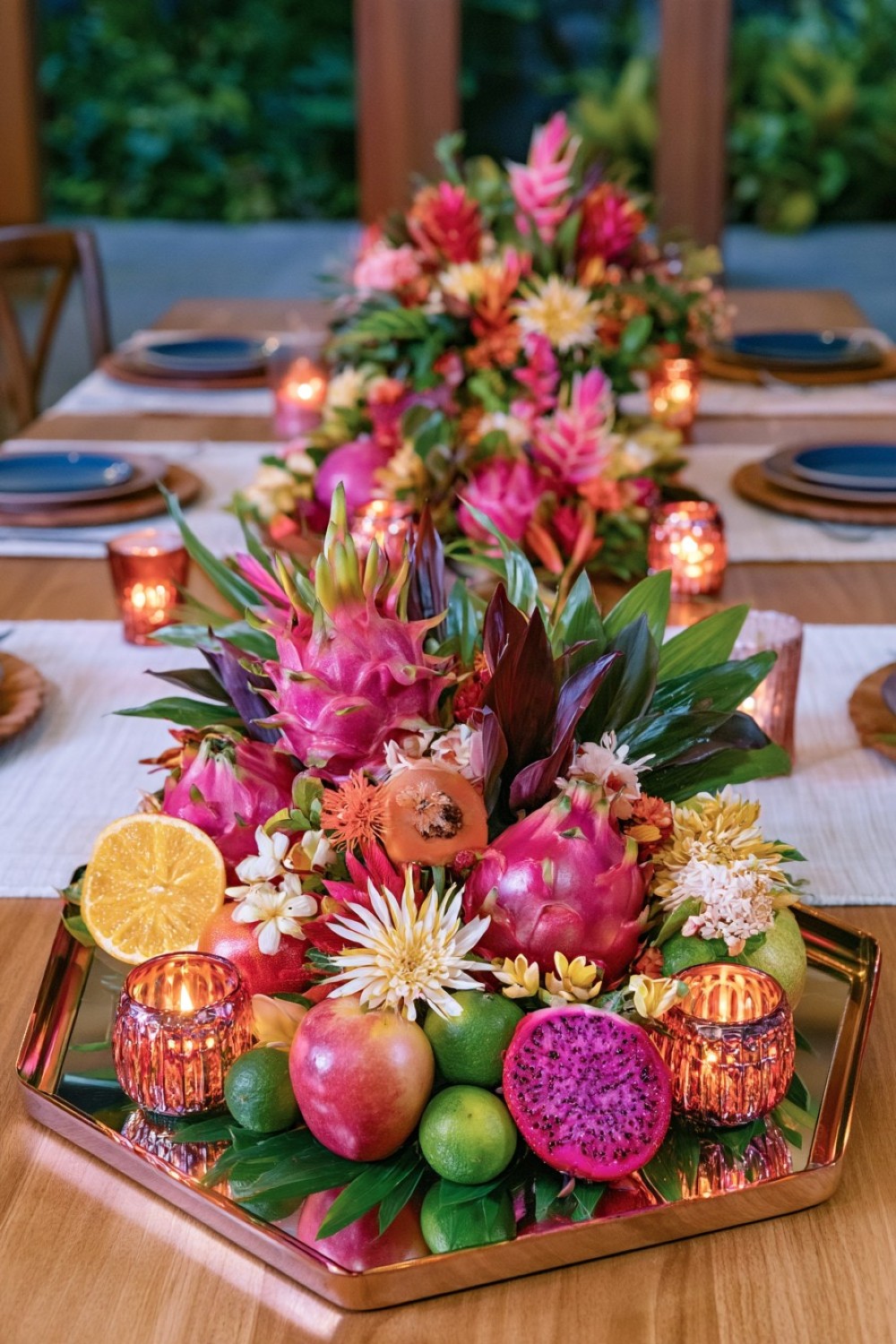
Instead of adding flames, use reflective surfaces to create an evening atmosphere.
Place polished stainless-steel trays or small mirror tiles beneath tropical fruit and flowers. The reflections visually double the arrangement and catch surrounding light.
Dragon fruit, citrus, limes, and glossy leaves work especially well because their surfaces already reflect highlights.
Keep the mirrored pieces small and irregular rather than covering the whole table.
The effect feels more sophisticated than adding many candles and works well for venues where open flames are restricted.
14. Build a “Wave” Centerpiece With Blue Glass and White Flowers
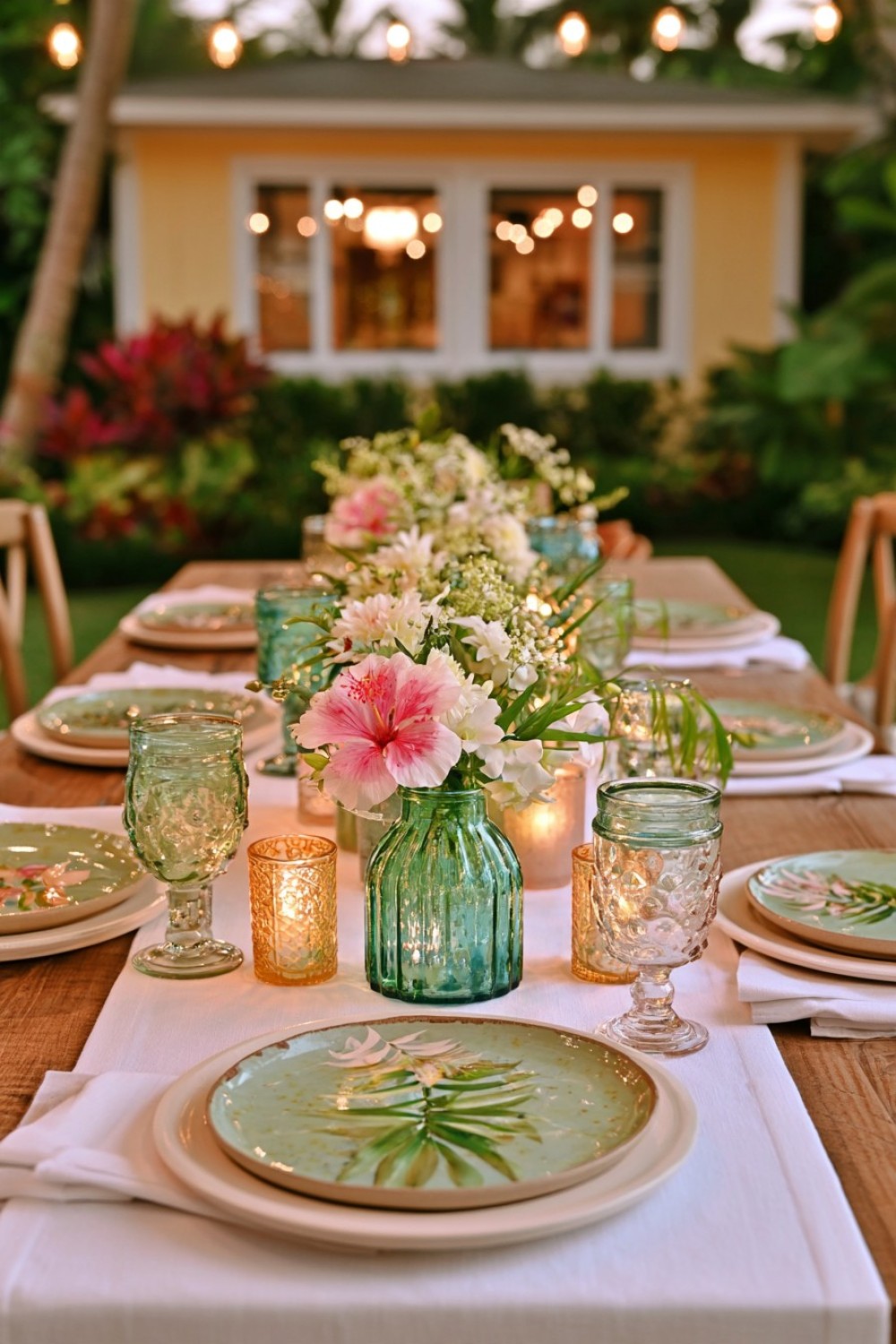
Take inspiration from water without using literal beach decor.
Arrange low blue and aqua glass vessels in a flowing curved line down the table.
Fill them with white flowers, pale green leaves, or very small tropical stems.
The varying glass heights create the impression of a wave while the flowers keep the palette light.
Avoid shells, anchors, or other obvious coastal motifs if you want the result to stay refined.
This is especially effective on white or natural wood tables because the glass colors remain clear and luminous.
15. Use Tropical Flowers by Shape, Not Color
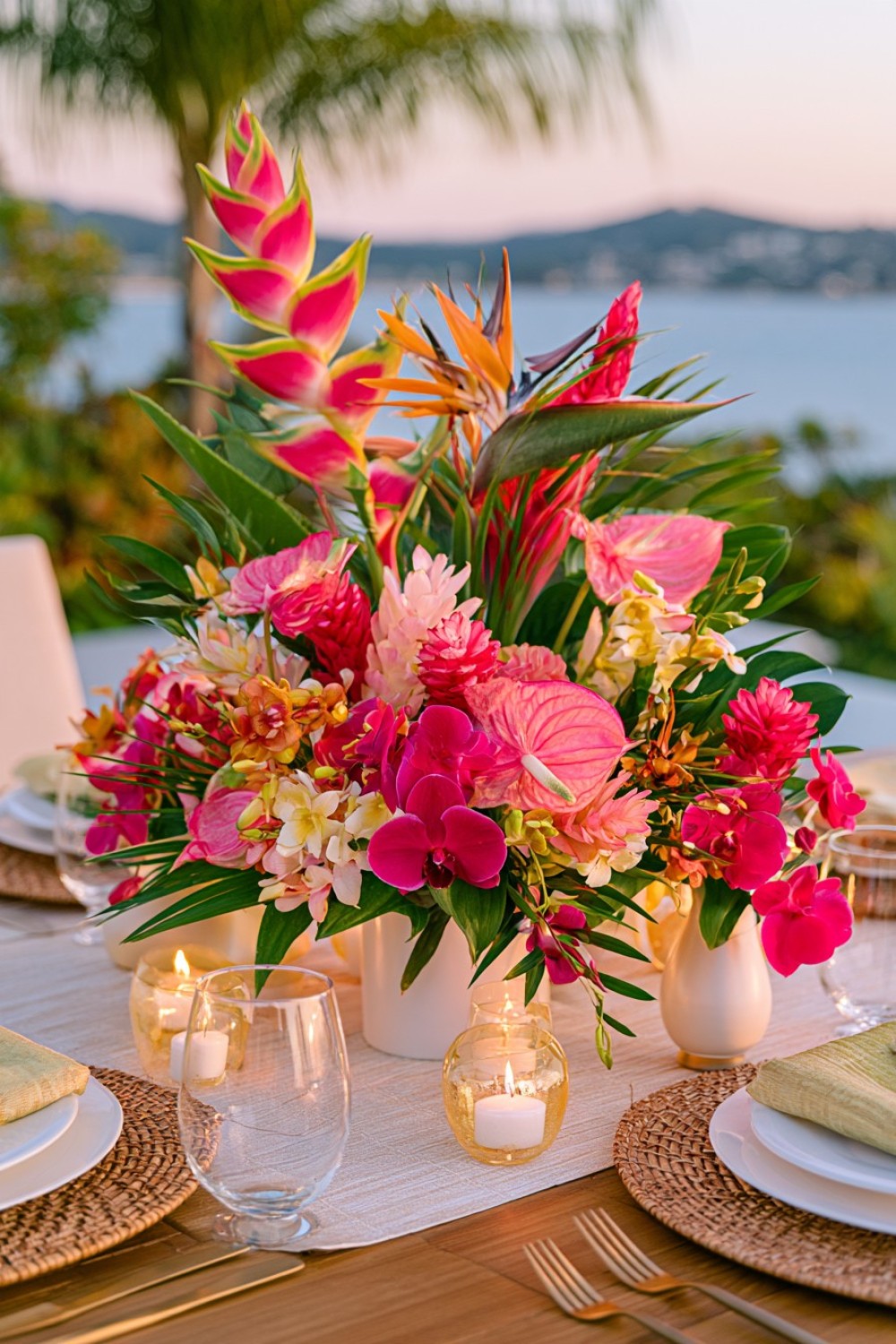
A more design-focused centerpiece can group flowers according to silhouette.
Use a series of sculptural tropical forms such as heliconia, anthurium, orchid, ginger, and bird-of-paradise, but keep them within one narrow color family.
For example, use only red and coral tones or only white and green.
Each flower shape remains distinct while the limited palette keeps the arrangement cohesive.
Place them in separate bud vases or low holders rather than mixing them into one dense bouquet.
The result feels more like a botanical study than a traditional centerpiece.
16. Create a Suspended Leaf Canopy Over the Table
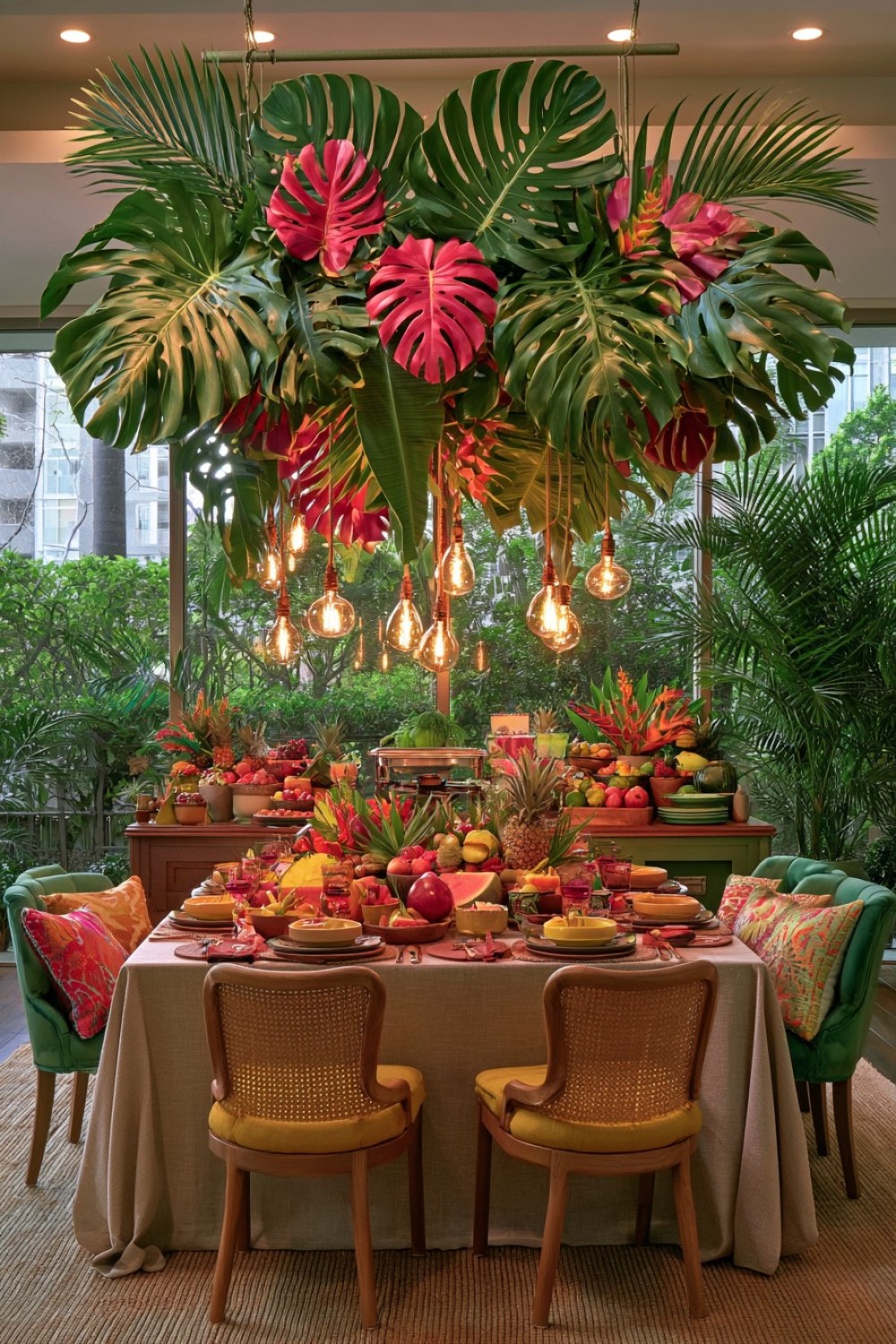
Move the centerpiece partially overhead.
Suspend lightweight tropical leaves or convincing artificial botanicals from a narrow frame above the table so the center surface remains free for food and drinks.
Keep the hanging foliage sparse and let a few leaves descend lower than the rest.
The effect can make guests feel as though they are sitting beneath a tropical canopy.
For safety, any overhead frame should be properly secured, kept clear of lighting and sprinklers, and positioned well above head height.
For home events, a smaller suspended installation above a buffet or side table can achieve the same visual effect with less complexity.
17. Make a Coconut-and-Orchid Table Runner
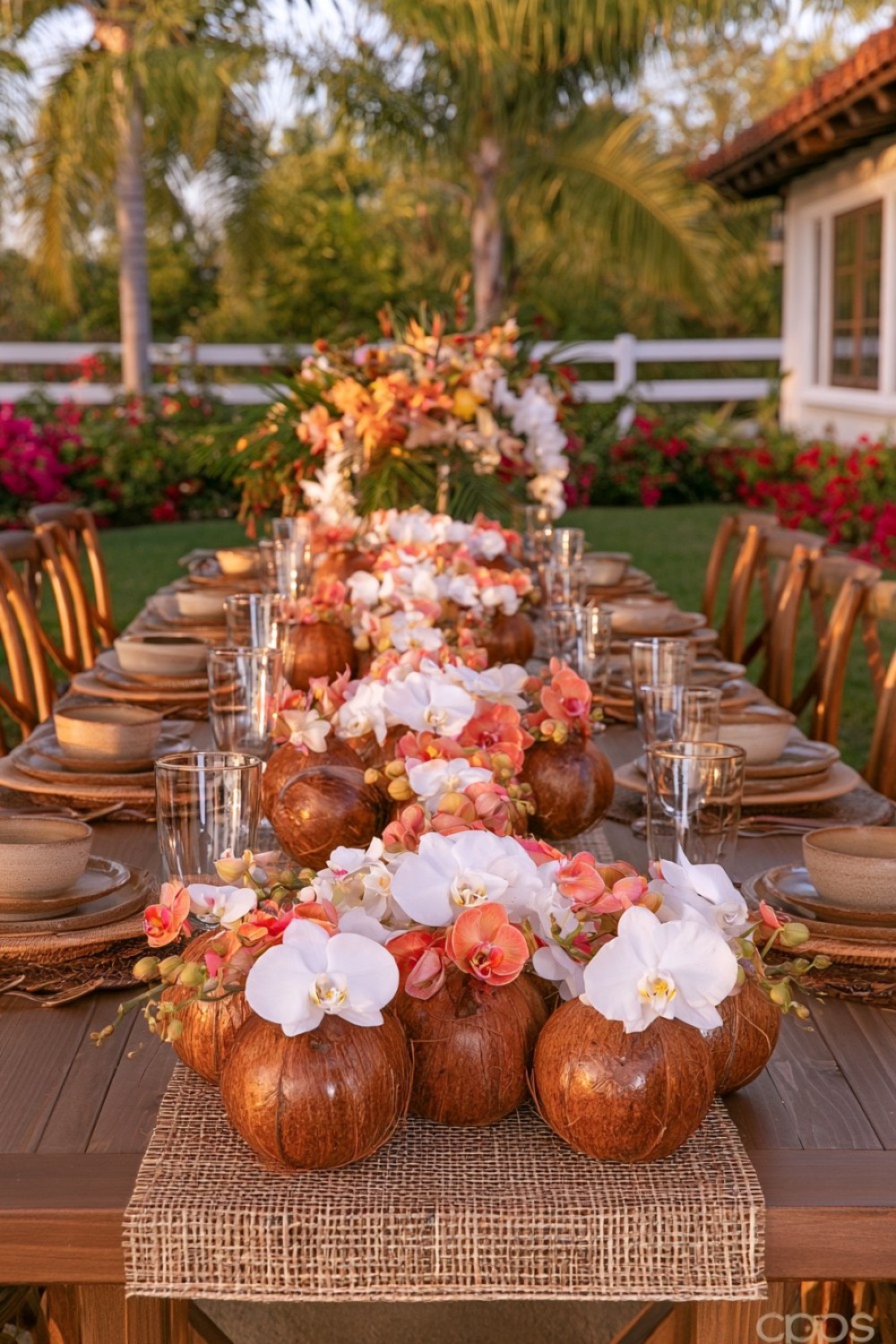
Instead of one centerpiece, create a repeated rhythm using whole coconuts and small orchid arrangements.
Alternate natural coconuts with low floral vessels down the middle of the table.
Keep the orchids in one color so the sequence feels intentional.
A woven neutral runner beneath them can help connect the pieces visually.
The mix of rough coconut texture and delicate flowers creates a stronger contrast than using either material alone.
This works especially well on long communal tables.
18. Build a Layered Centerpiece From Transparent Colored Acrylic
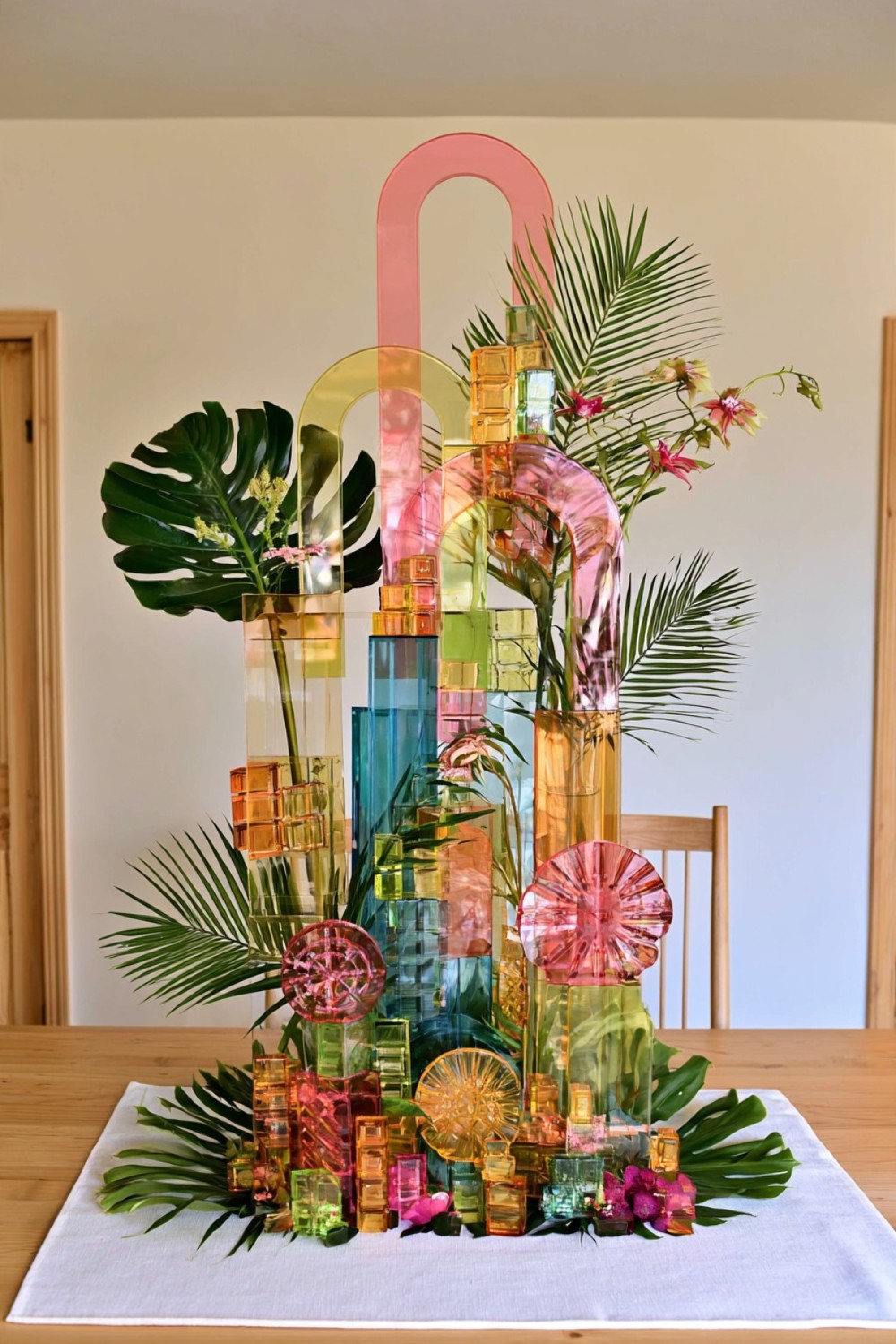
For a more modern tropical table, use translucent acrylic shapes in coral, aqua, lime, and amber.
Cut or purchase small panels, arches, or geometric blocks and arrange them vertically in a low base.
Place a few flowers or leaves between the shapes.
As light passes through the acrylic, overlapping colors create new tones.
This turns the centerpiece into a small color installation rather than a floral arrangement.
Use smooth finished edges and keep the pieces stable, especially if the table is in active use.
19. Create a “Sunset Table” With Color That Changes Across the Centerpiece
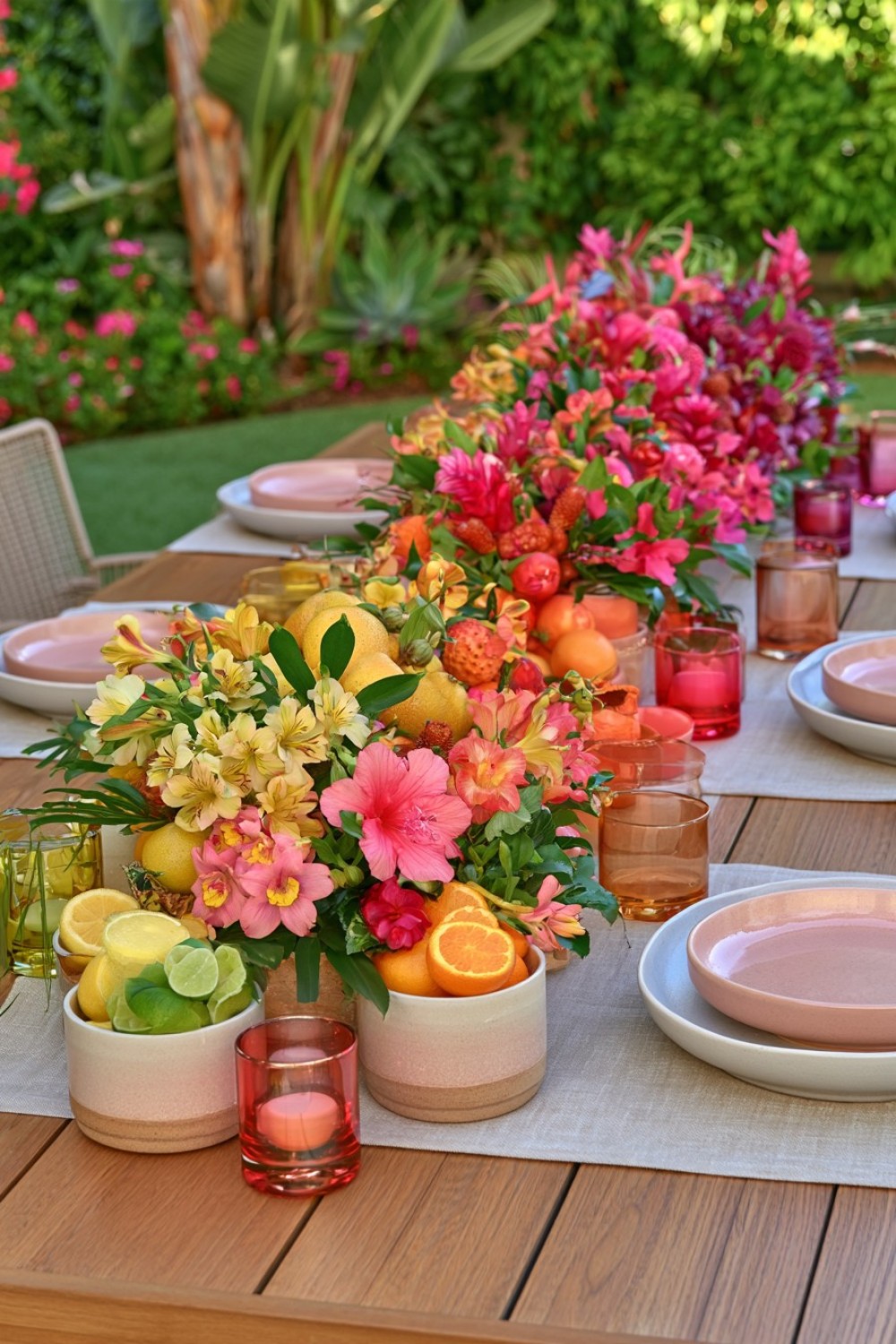
Instead of using all tropical colors at once, build the centerpiece around a sunset progression.
Start with pale yellow flowers and citrus, move into orange and coral, then deepen toward red, magenta, and plum.
The color shift can happen through flowers, fruit, glassware, or fabric.
Keep the vessels simple and repeat their shapes so the gradient remains easy to read.
This works especially well for evening events because the palette becomes richer as natural light fades.
Rather than looking like a generic luau centerpiece, the table feels connected to a specific tropical moment—the colors of sunset.
Making Tropical Centerpieces Feel More Designed
A distinctive luau centerpiece usually begins with one strong visual idea rather than a collection of tropical symbols. A fruit gradient, bamboo grid, floating hibiscus bowl, volcanic stone arrangement, or suspended leaf canopy can communicate a tropical mood without relying on plastic props or visual clichés.
Natural materials also create stronger contrast. Glossy leaves look more vivid against rough coconut shell, flowers appear brighter beside black stone, and colored glass introduces tropical color without adding another floral layer.
Keep sightlines and food service in mind as well. Low centerpieces are easier for conversation, while taller or suspended arrangements work better on buffet tables or decorative surfaces.
When the materials, height, palette, and table function are planned together, the centerpiece feels like part of the event design rather than a decoration placed in the middle at the last minute.
MORE IDEAS


Share
What's Your Reaction?
 Like
0
Like
0
 Dislike
0
Dislike
0
 Love
0
Love
0
 Funny
0
Funny
0
 Angry
0
Angry
0
 Sad
0
Sad
0
 Wow
0
Wow
0