
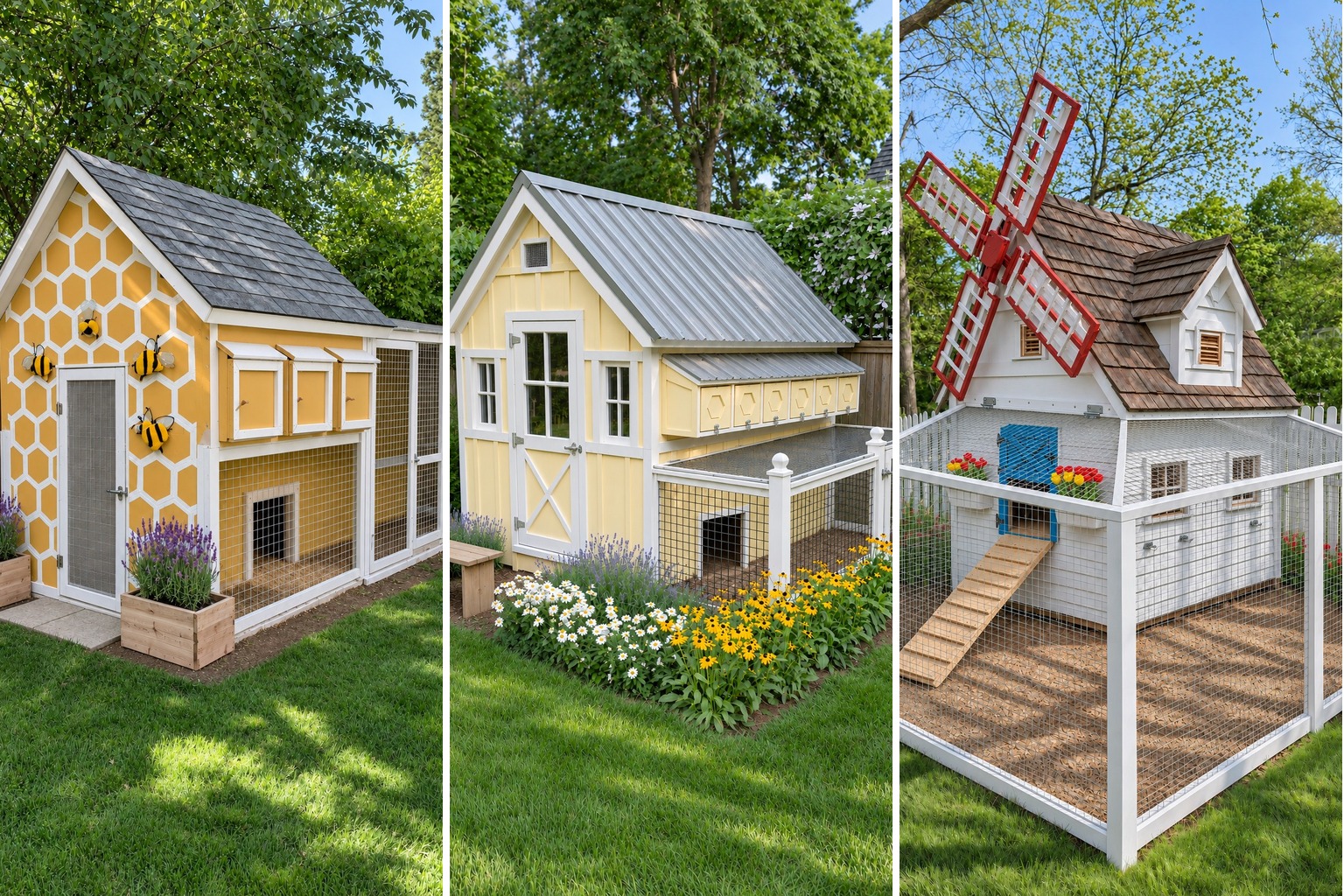
A chicken coop is one of the few backyard projects that has to please two very different clients. Your hens want a dry roost, a quiet nest box and a run that nothing can dig under, chew through or reach into. You want a coop that is quick to clean, simple to collect eggs from and pleasant enough to look at every time you glance out of the kitchen window. The best builds manage both, and very few of them need fancy materials to get there.
The 45 coops and runs below are grouped by style, from painted cottages and garden coops to hoop houses, side yard runs and roomy walk in enclosures. Read the building notes first. The lumber, the mesh and the roof you choose will matter far more over the years than the paint color, whichever design you end up copying.
Table of Contents
- How to Plan and Build a Coop That Lasts
- Size it for the flock you want
- Start with a level, dry base
- Choose lumber and fasteners with care
- Build easy cleaning into the plan
- Use hardware cloth, not chicken wire
- Frame doors and runs so they stay square
- Roofing, light and fresh air
- Glue, primer and paint
- Small upgrades that save daily work
- Painted Cottage and Storybook Coops
- Butter Yellow Board and Batten Cottage
- Primary Color Playhouse Coop
- Honeycomb Coop with Bee Accents
- Lavender Cottage with a Sunburst Gable
- Blush Pink Shed Roof Coop with Painted Wildflowers
- Rainbow Fairytale Coop
- Dutch Windmill Coop
- Painted Wagon Coop with Folk Art Scrolls
- Western False Front Coop
- Old Plastic Playhouse Turned Coop
- Coops That Share Space with the Garden
- White Coop Inside a Covered Run
- Kitchen Garden Coop with a Nasturtium Arch
- Rose Covered Pergola Entry
- Strawberry Planters on the Run Wall
- Raised Coop Beside a Fenced Vegetable Patch
- Sedum Green Roof Coop
- Corrugated Metal Skirt and Hanging Baskets
- Long Garden Run with Poultry Netting
- Clear Roof Walk In Run with Front Planters
- Pergola Style Run with a Coral Screen Door
- Hoop Coops, Arches and Curved Roofs
- Hoop Coop with Bucket Nest Boxes
- Black Steel Arch Tunnel Run
- Quonset Coop in Corrugated Steel
- Hoop Run Beside a Sage Green Coop
- Coastal Hoop Run with a Seashell Door
- Curved Metal Roof Over a Hoop Run
- Mini Quonset Coop with an Angled Door Run
- Barrel Coop on Timber Cradles
- Long Runs, L Shapes and Movable Coops
- Narrow Side Yard Run with Lift Up Lids
- Patio Coop with a Lidded Run
- Movable Chicken Tractor on Wheels
- Long Run with a Covered Feeding Station
- L Shaped Run Following the Fence Line
- Zigzag Run with a Chevron Door Coop
- Forest Green Coop with a Wraparound L Run
- Diamond Door Coop with a Straight Run
- Octagon Run Beside a Barn Red Coop
- Walk In Runs and Farmhouse Coop Pairs
- Greenhouse Frame Turned Walk In Run
- Sage Board and Batten Coop with an Awning Window
- Timber Frame Run with a Sunburst Door
- Tall Walk In Run with a Kite Painted Coop
- Gray Run with Diamond Rail Accents
- White Farmhouse Coop with a Cedar Dutch Door
- Raised Coop Under One Long Roof
- Slate Blue Coop with a Covered Run
- Choosing the Coop That Suits Your Yard
- Safety Notes Before the Hens Move In
How to Plan and Build a Coop That Lasts
Size it for the flock you want
A standard size hen that spends her days in a run needs about 3 to 4 sq ft (0.3 to 0.4 m²) of floor inside the coop and around 8 to 10 sq ft (0.75 to 0.9 m²) of run. Give each hen 8 to 10 in (20 to 25 cm) of roost bar and plan one nest box about 12 in (30 cm) square for every three or four hens. Set the roost higher than the nest boxes, otherwise the hens tend to sleep in the boxes and soil them. As a guide, a run 8 ft (2.4 m) wide and 12 ft (3.7 m) long gives ten hens close to 10 sq ft each, and the same plan scales up or down easily.
Start with a level, dry base
Pick a spot that drains well and gets some afternoon shade. If the ground stays soggy in spring, raise it a little before anything else goes in, then spread 3 to 4 in (8 to 10 cm) of sand over the run floor. Sand drains quickly, rakes clean and dries fast after rain. On smaller builds, concrete deck blocks or pavers under each corner post keep the timber off wet soil.
Choose lumber and fasteners with care
Use pressure treated lumber rated for ground contact only where wood touches soil, such as corner posts and bottom plates, and build the rest from untreated framing lumber or cedar. Roost bars and nest boxes should always be untreated wood, because hens peck at whatever they stand on. Modern treated wood corrodes plain steel, so buy screws, nails and hangers labeled for treated lumber. Running 4x4 corner posts straight up through the coop body, instead of perching the coop on short legs, is one of the simplest ways to stop a raised coop from racking. A framing nailer holds parts square in seconds, and backing those joints with exterior screws makes the frame much stiffer. If you side the coop with grooved exterior plywood, space the wall studs 24 in (61 cm) on center so every sheet seam lands on a stud, and rest the sheet on rigid foam board while you cut out window openings so the saw has support all the way through.
Build easy cleaning into the plan
Raise the coop floor just high enough for the front edge of a wheelbarrow to slide under the door. You can then rake old bedding straight into it, lean in comfortably from the hips and still crawl underneath to retrieve a hen that hides from you. Leaving out the bottom plate across the door opening and under the nest boxes removes the lip that traps litter in the corners. An angled roost with a droppings board below keeps the floor clean and leaves the front wall free for double doors. Each morning, pull the droppings off the board into a bucket set just below its edge, using a simple scraper made from a plywood offcut glued and screwed to a scrap handle. A sprinkling of a granular odor control mineral on the board dries the droppings, and the scraper glides over it, so most of the mineral stays behind for the next day. Inside, many keepers spread an odor absorbing mineral and about 2 in (5 cm) of sand over the floor, while others prefer the deep litter method with pine shavings. Both work well as long as the coop stays dry.
Use hardware cloth, not chicken wire
Chicken wire keeps hens in, but it does little to keep raccoons, dogs or weasels out. Galvanized hardware cloth with half inch (12 mm) openings, usually 19 gauge, is the standard for runs, windows and vents. Add horizontal nailers between posts so every edge and overlap lands on solid wood, fix the mesh with a heavy duty or pneumatic stapler, then trim the excess with wire cutters, tin snips or an angle grinder. Around the outside, bury a strip of hardware cloth about 12 in (30 cm) wide along the base and set large rocks over the edge, so a digging animal hits wire instead of soil. The same rocks add weight that helps an unanchored run stay put in strong wind. If the coop is raised, close in the space underneath with mesh too, and the hens gain a shady corner of run.
Frame doors and runs so they stay square
Build each door about 1 in (2.5 cm) narrower and shorter than its opening so it still swings freely once the wood moves with the seasons. A diagonal brace or a half lap X on the back of the door stops it from sagging. For the run, posts or studs about 3 ft (90 cm) apart with angled braces in the corners resist wind and racking. A run roof that slopes away from the coop loses height as it goes, so a longer run means a lower far end; with a moderate pitch, a 12 ft (3.7 m) run can still leave standing room for a 6 ft (1.8 m) adult at the back. Making the run a couple of feet wider than the coop gives the flock extra room on winter days when they avoid the snow. Rafters made from 2x4 lumber are fine under light metal roofing on runs up to about 8 ft (2.4 m) wide. In snowy regions, step up to 2x6 rafters and brush heavy snow off before it builds up.
Roofing, light and fresh air
Metal roofing goes on quickly and sheds rain well. Clear corrugated polycarbonate brings light into a run, but it expands and shrinks with temperature, so predrill holes slightly larger than the screw shank and fix it through the raised crowns with screws that carry rubber sealing washers. Fresh air matters more than insulation in a coop. Aim for roughly 1 sq ft (0.09 m²) of high, screened opening per hen, placed above roost level so ammonia and moisture escape without a draft blowing over sleeping chickens. Windows on two different walls bring in light and a cross breeze. Small shed windows are inexpensive, and salvaged sashes work too; you could also browse our repurposed old window ideas before deciding what to use.
Glue, primer and paint
Most of a coop is held together with screws and nails, but where you glue trim, nest box dividers or decorative cutouts outdoors, choose a waterproof PVA wood glue that meets the ANSI Type I standard, such as Titebond III. Spread it on clean, dry wood, clamp or screw the joint for about 30 minutes and give it a full 24 hours before the piece is stressed or soaked. Seal all bare wood with an exterior primer before painting, cut ends of trim included, then finish the outside with a good exterior acrylic latex. For the coop floor, a porch and floor paint stands up to scraping far better than ordinary wall paint. Choose low VOC products for anything inside, let every coat dry as the label directs and air the coop for several days until no smell remains before the hens move in.
Small upgrades that save daily work
A light sensing automatic pop door opens at dawn and closes at dusk, so the flock is shut in safely even on evenings you come home late. Exterior nest box lids let you collect eggs without stepping inside, and a ramp with small cleats every few inches helps heavier breeds climb into a raised coop.
Painted Cottage and Storybook Coops
Butter Yellow Board and Batten Cottage
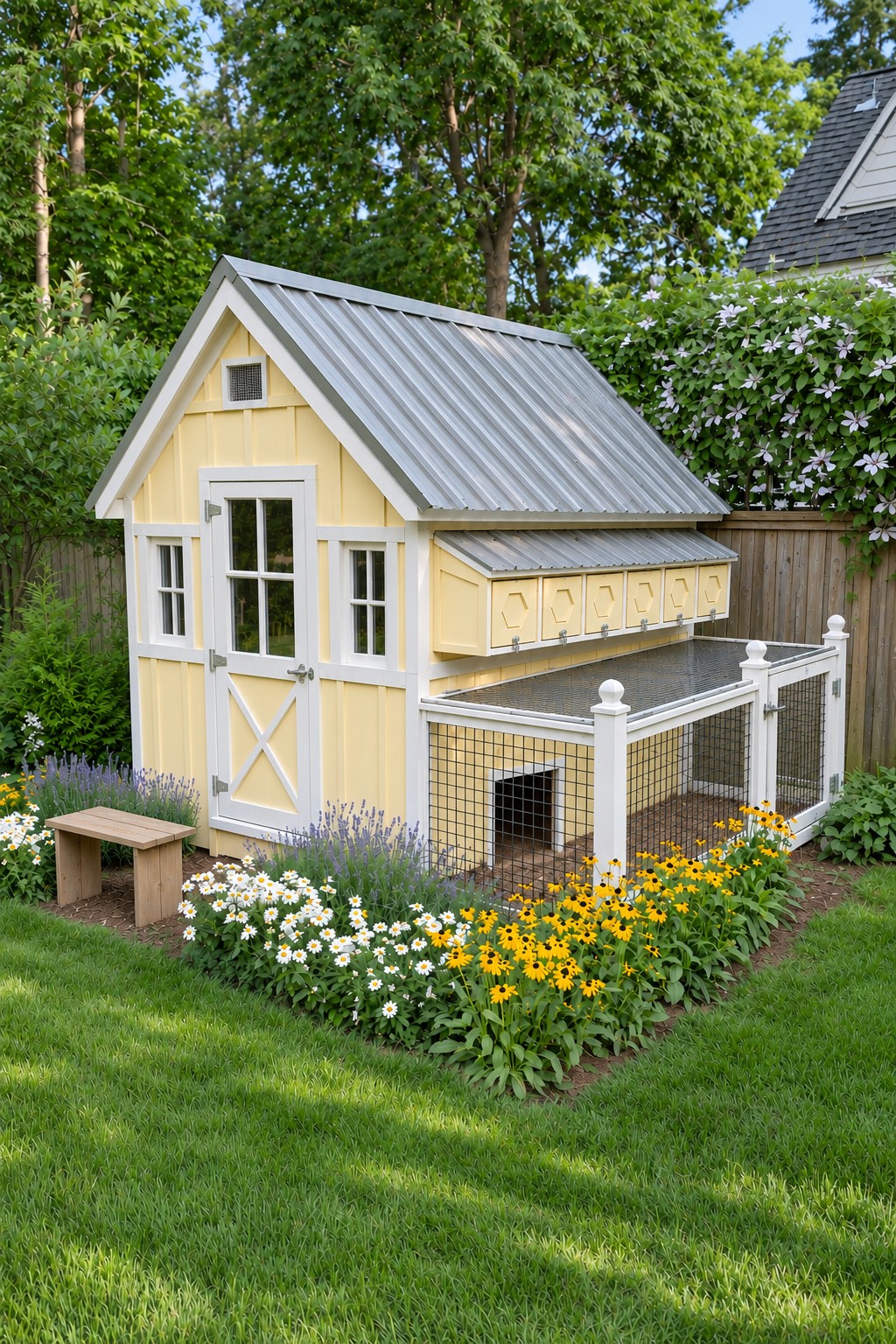
Soft yellow board and batten siding with crisp white trim makes this coop look like a tiny farmhouse rather than a shed. Battens are easy to add over plywood siding: rip strips about 2 in (5 cm) wide, space them evenly and nail them through into the studs so they stay put when the plywood moves. The ribbed metal roof and the long exterior nest box, which has its own small roof and hexagon details on the front, keep the main wall tidy and let you lift a lid to gather eggs.
Square white posts topped with ball finials frame the little attached run and tie it to the style of a house. A low border of white daisies, rudbeckia and lavender planted outside the hardware cloth, plus a simple bench, turns the coop into a garden feature you will actually want to sit beside.
Primary Color Playhouse Coop
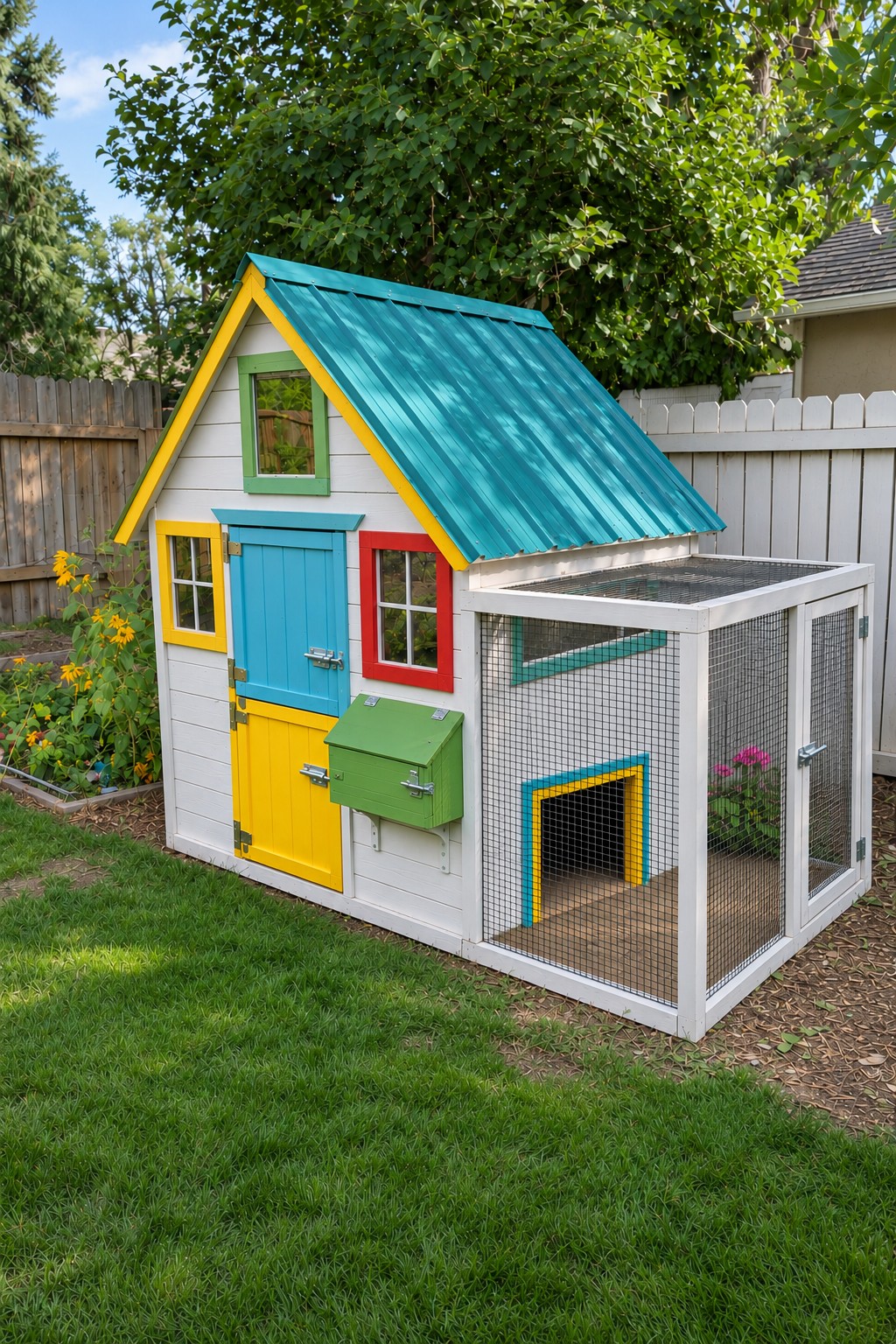
Red, yellow, blue and green trim against white siding makes this coop look like a child's drawing brought to life. Every window and door frame is a different color, and the Dutch door splits into a blue top and a yellow bottom, so on hot days you can open only the upper half for air. A teal metal roof carries the bright palette right up to the ridge.
Paint trim boards before you fix them and touch up the nail holes afterward; it is far easier than cutting in neat lines against the wall. The pop door gets its own two tone frame, and a green nest box with a sloping lid hangs on the front where small helpers can reach it.
Honeycomb Coop with Bee Accents
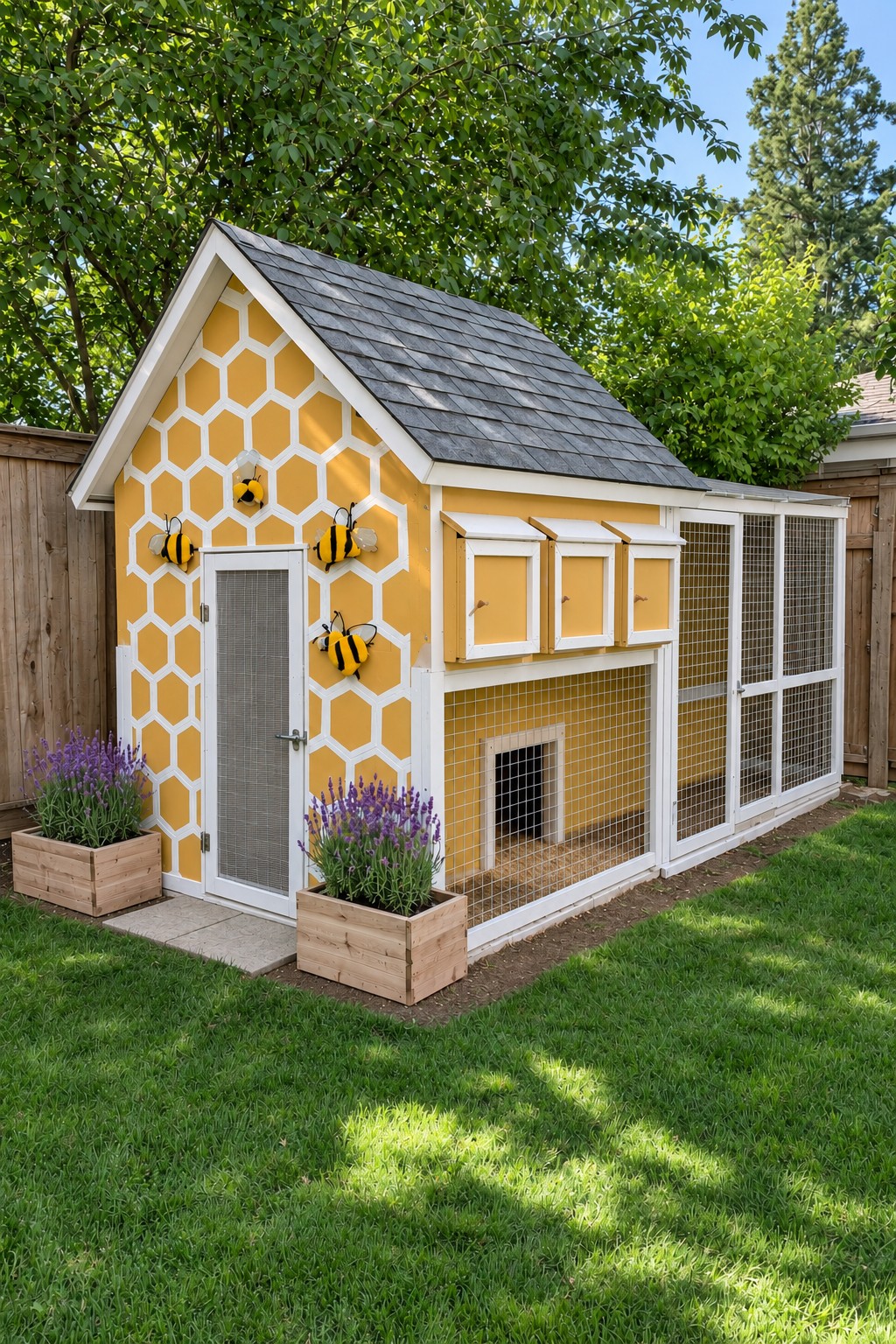
Mustard yellow walls covered in a white hexagon grid turn an ordinary gable coop into a beehive. The pattern is simpler than it looks. Cut one hexagon template from card or thin plywood, trace it in staggered rows, then paint the lines between the shapes white with a small brush. Several cheerful bee figures, a row of three exterior nest boxes with lift up lids and a slate gray shingle roof finish the theme.
Wooden planters of lavender on either side of the screen door bring real bees to the scene and soften the entrance. Keep planters like these outside the run, because hens will happily dig them out.
Lavender Cottage with a Sunburst Gable
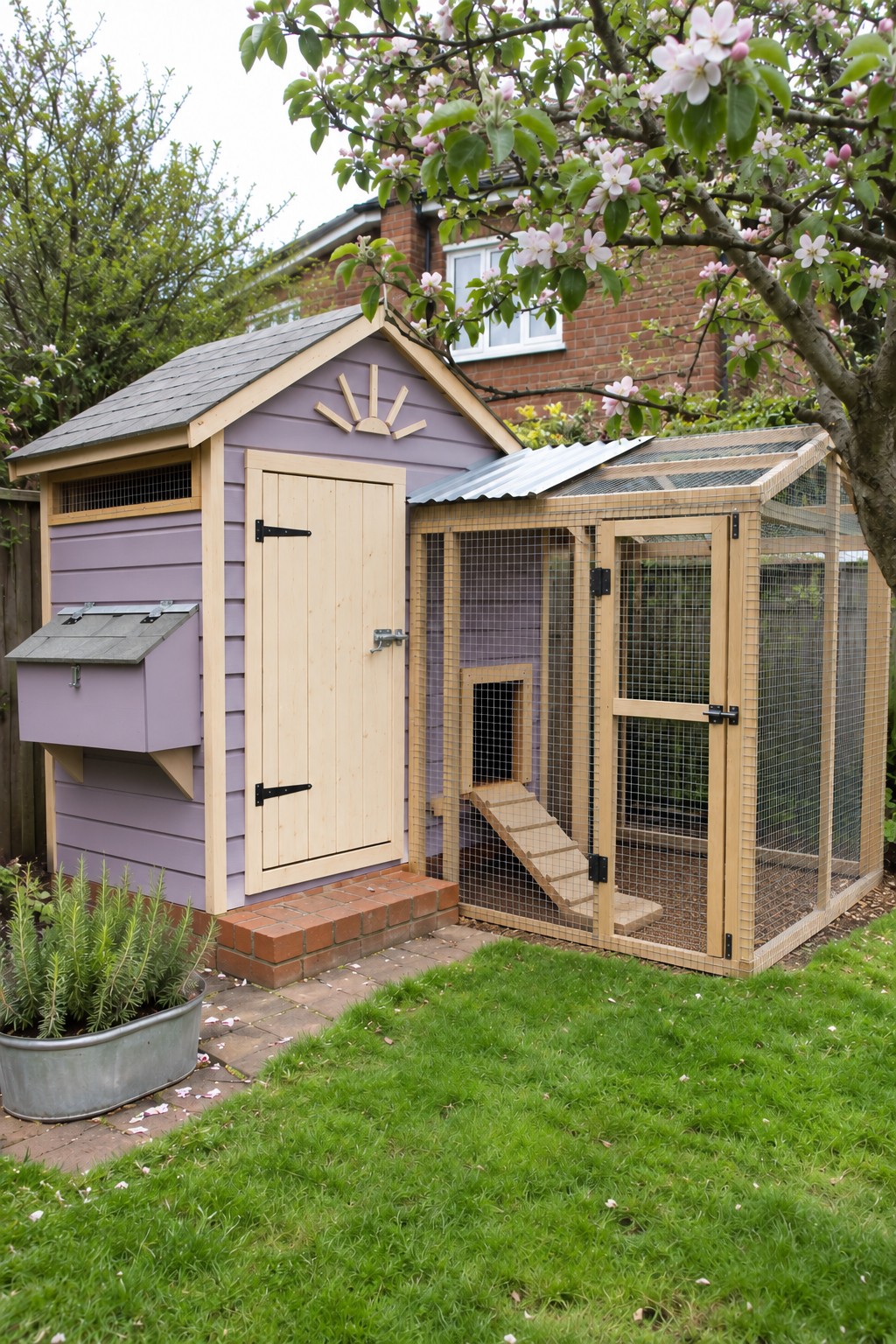
A soft lavender coop with cream trim and black strap hinges looks completely at home beneath a blossoming fruit tree. The sunburst on the gable is just a half circle and a handful of tapered slats cut from scrap wood, glued with waterproof wood glue and pinned with brad nails. A screened vent strip runs high under the eaves, letting warm, stale air escape well above the roost.
The small run beside it is roofed half in corrugated metal and half in wire, so the hens get a dry corner and a sunny one. A brick step at the door and a galvanized tub of rosemary make chores feel more like a stroll in the garden. Old tubs like this one have plenty of other uses, and our upcycled vintage garden decor collection is full of them.
Blush Pink Shed Roof Coop with Painted Wildflowers
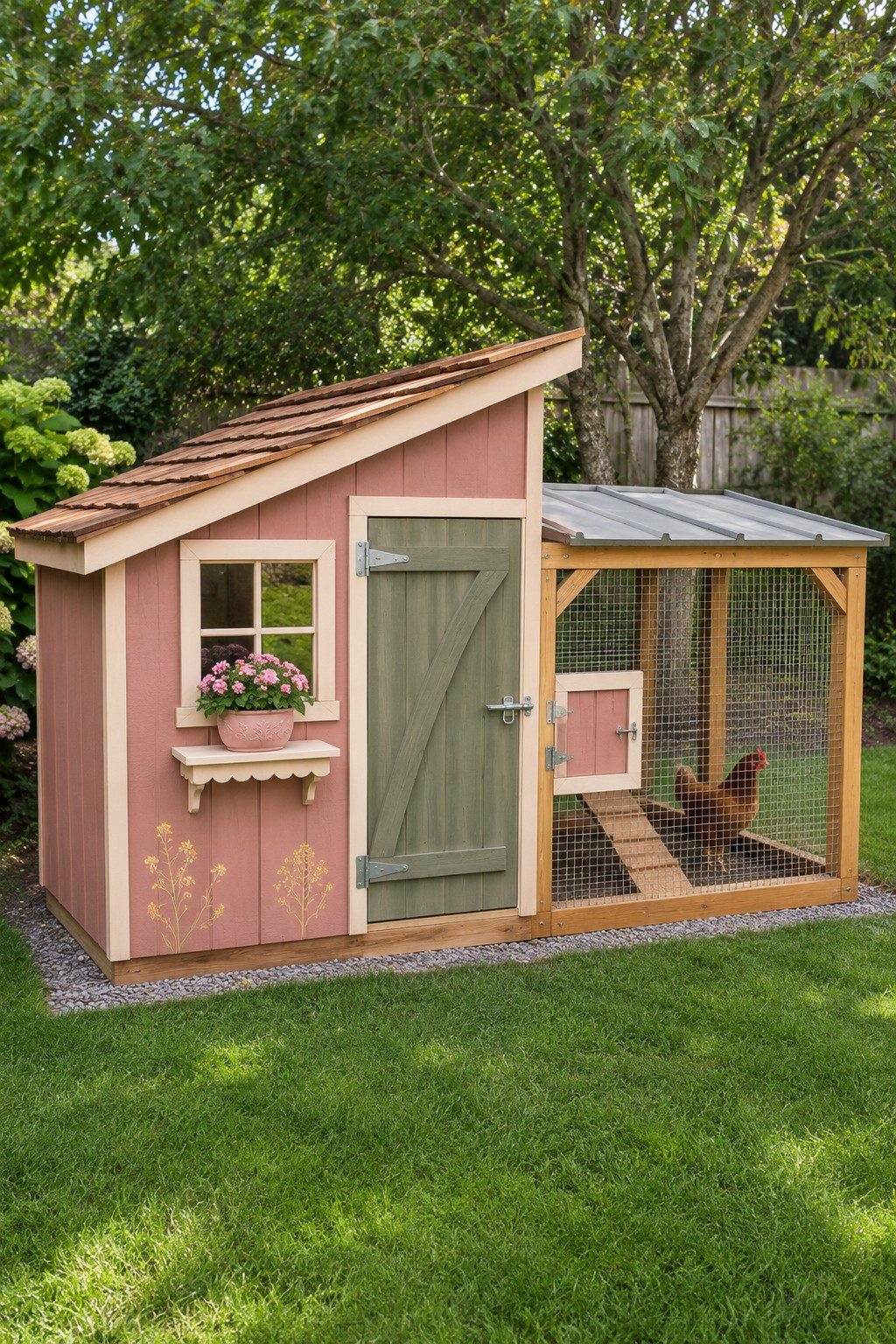
A single sloping roof finished in cedar shingles throws rain to one side and leaves a tall front wall with room for a full height door. Sage green on the Z braced door, cream trim and a small window with a scalloped shelf for a flower pot all sit comfortably against the blush pink walls. Simple painted wildflower sprigs near the base break up the large plain surface.
For motifs like these, use exterior acrylic paint over the fully dry base coat and seal them with a clear water based exterior topcoat. The run beside the coop is framed in natural wood under a metal roof, and a gravel border around the whole structure keeps splashing mud off the paint.
Rainbow Fairytale Coop
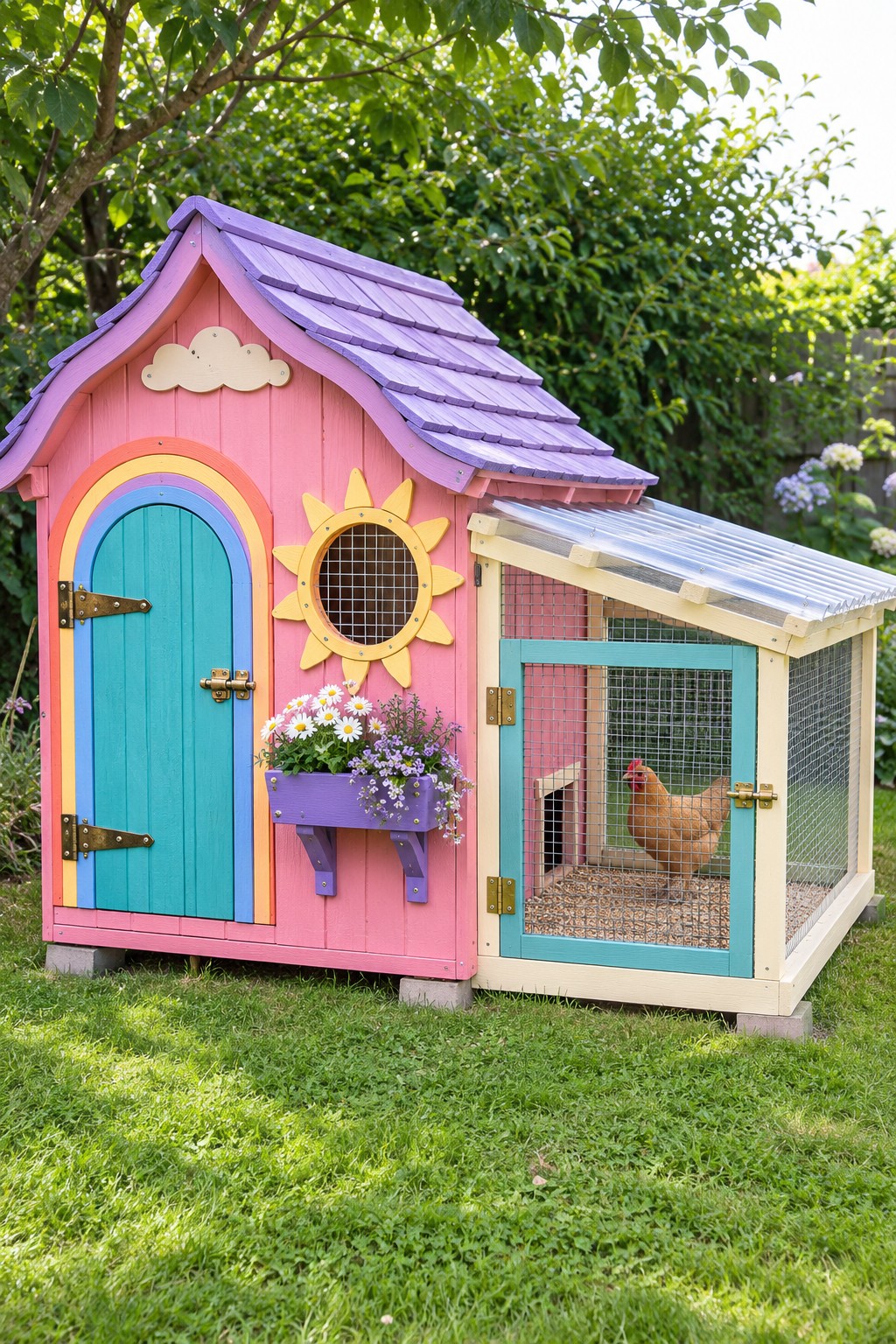
This pink coop leans fully into whimsy, with lilac shingles cut to a wavy edge, an arched teal door framed by painted rainbow bands, a cloud cutout and a round vent shaped like a sun. The sun is a practical touch dressed up as decoration: the round opening is backed with hardware cloth and sits high on the wall, exactly where ventilation does the most good.
Brass strap hinges, a purple window box and a small run with a clear roof complete the storybook look, and concrete blocks keep the painted base off damp grass. If the children in your home love this kind of project, our DIY backyard ideas for kids are full of other playful builds.
Dutch Windmill Coop
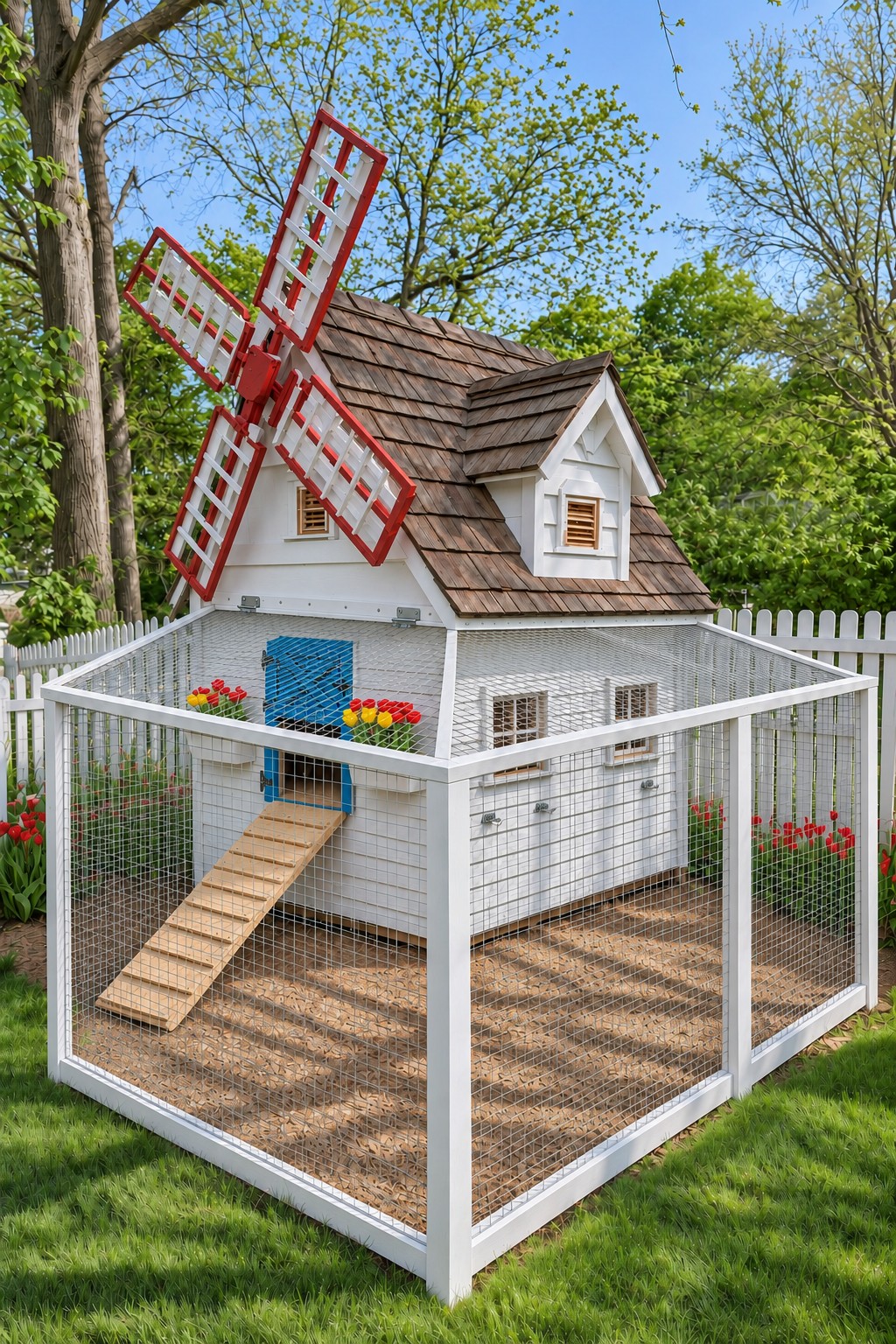
Red and white windmill sails on the gable make this white coop a talking point for everyone who walks past. The sails are lightweight ladder frames of thin strips bolted to a central hub. Fix them firmly, or mount them on a proper bearing if you want them to turn; a loose sail that knocks in the wind will rattle all night and unsettle the flock. A cedar shake roof, a dormer with a louvered vent and a blue pop door add old world charm.
The run is a white painted frame wrapped in hardware cloth and set close around the coop, so the hens step straight down the ramp into it. The tulips in the window boxes look lovely, but tulips are among the plants that can make chickens ill. In your own build, keep them in beds outside the run and fill boxes within reach with nasturtiums or marigolds instead.
Painted Wagon Coop with Folk Art Scrolls
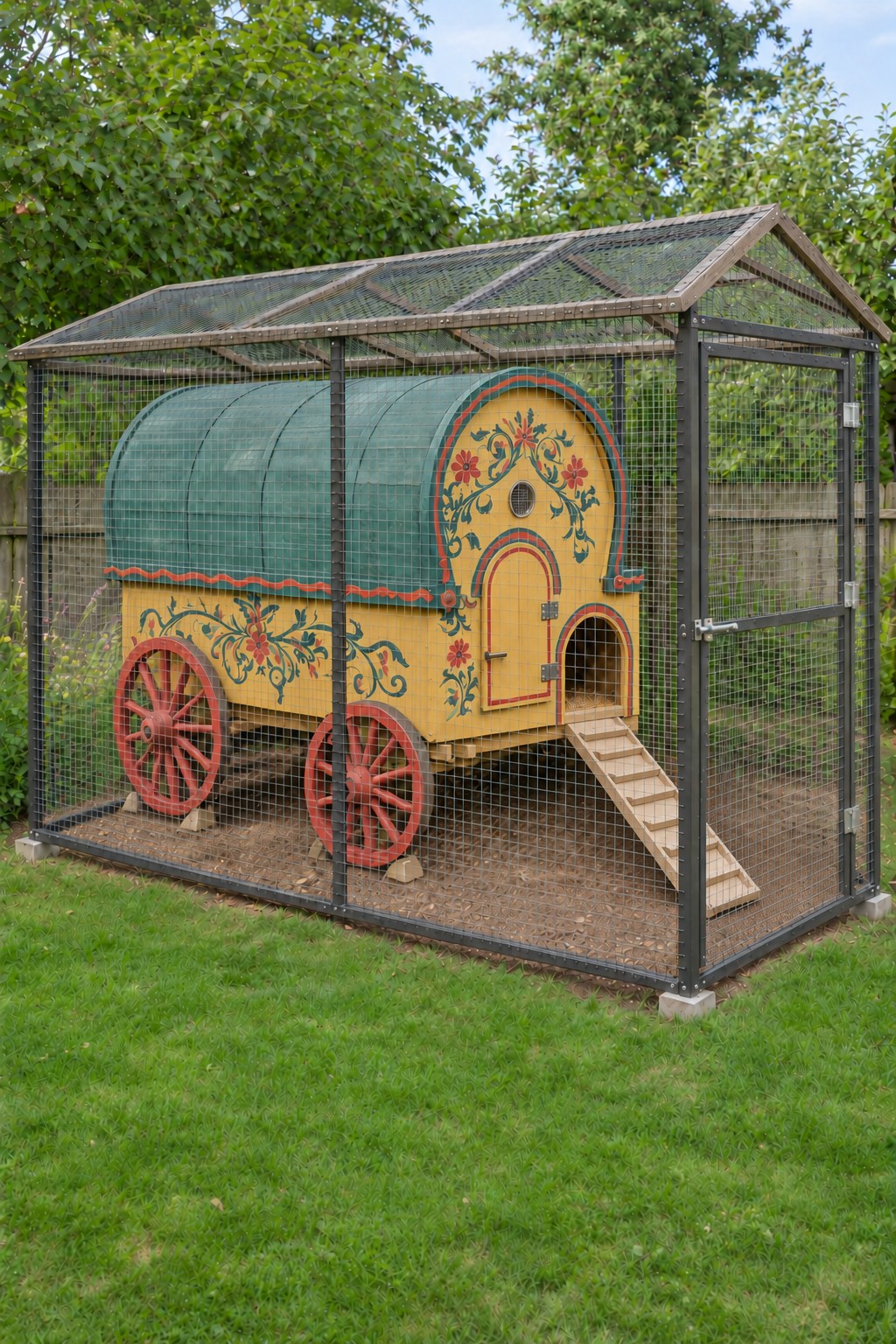
A mustard yellow wagon with red and teal folk art scrolls, a rounded green roof and big red spoked wheels serves as the coop inside a tall steel framed run. A curved roof like this can be formed by bending thin flexible plywood over arched rafters and then covering it with painted metal or heavy canvas. Because the wheels are decorative, small wooden chocks wedged under them keep the wagon level so it cannot shift when hens jump in and out.
Placing a small coop inside a larger covered run is a clever layout for any style. The wire roof keeps hawks out, the hens can stay in the run all day, and the coop itself can remain compact. Hand painted motifs last longest under two coats of clear exterior varnish.
Western False Front Coop
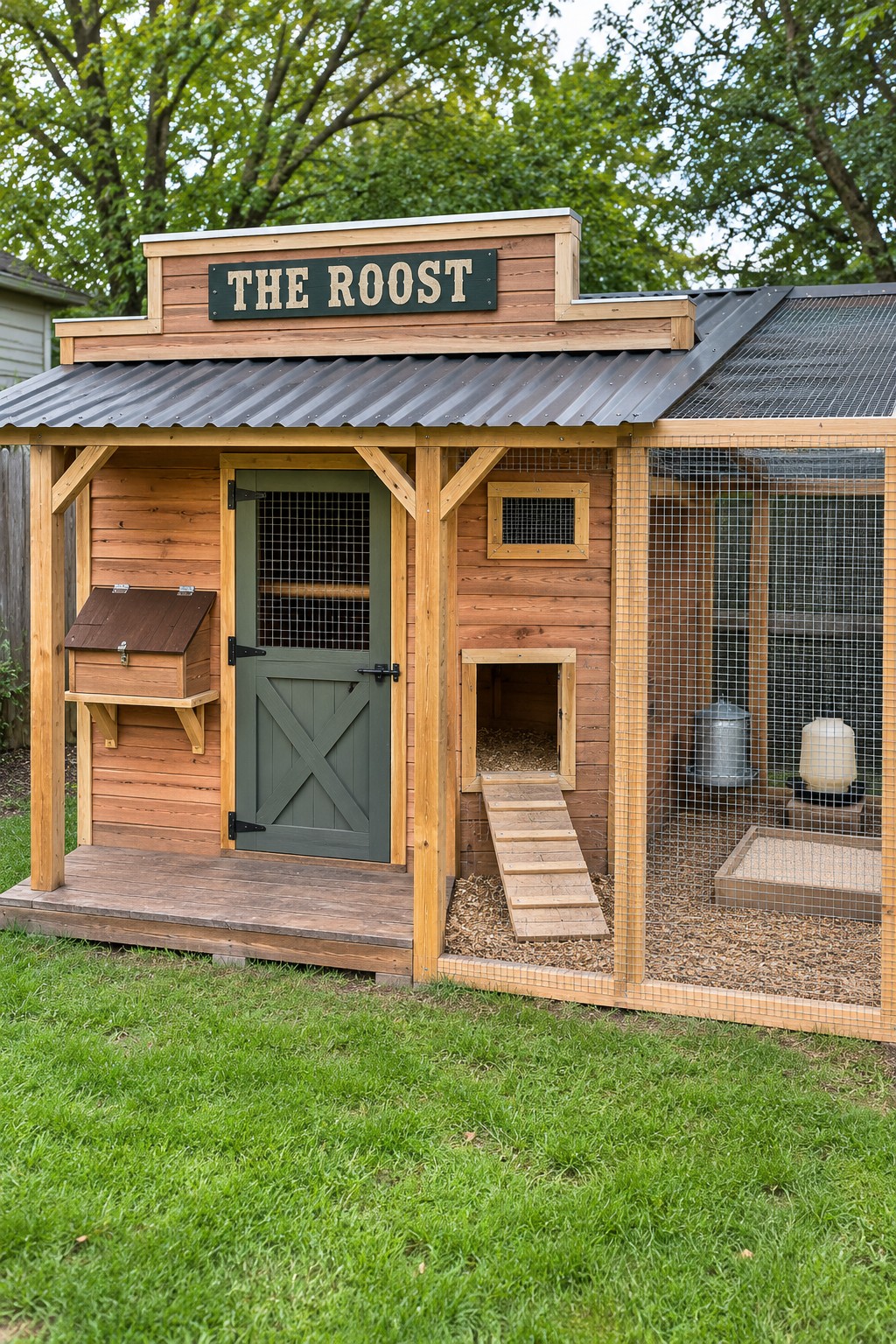
A tall false front with a lettered sign turns this cedar coop into a frontier storefront. The facade is simply a flat panel of boards screwed to a frame that rises above the roofline, so it adds character without changing the structure. Rough sawn cedar, a dark corrugated roof, a porch of deck boards and a green Dutch door with a screened top complete the saloon look.
Inside the attached run there is a galvanized feeder, a waterer and a shallow framed box of sand. Hens dust bathe to keep mites and lice under control, and a framed box keeps the sand exactly where you want it.
Old Plastic Playhouse Turned Coop
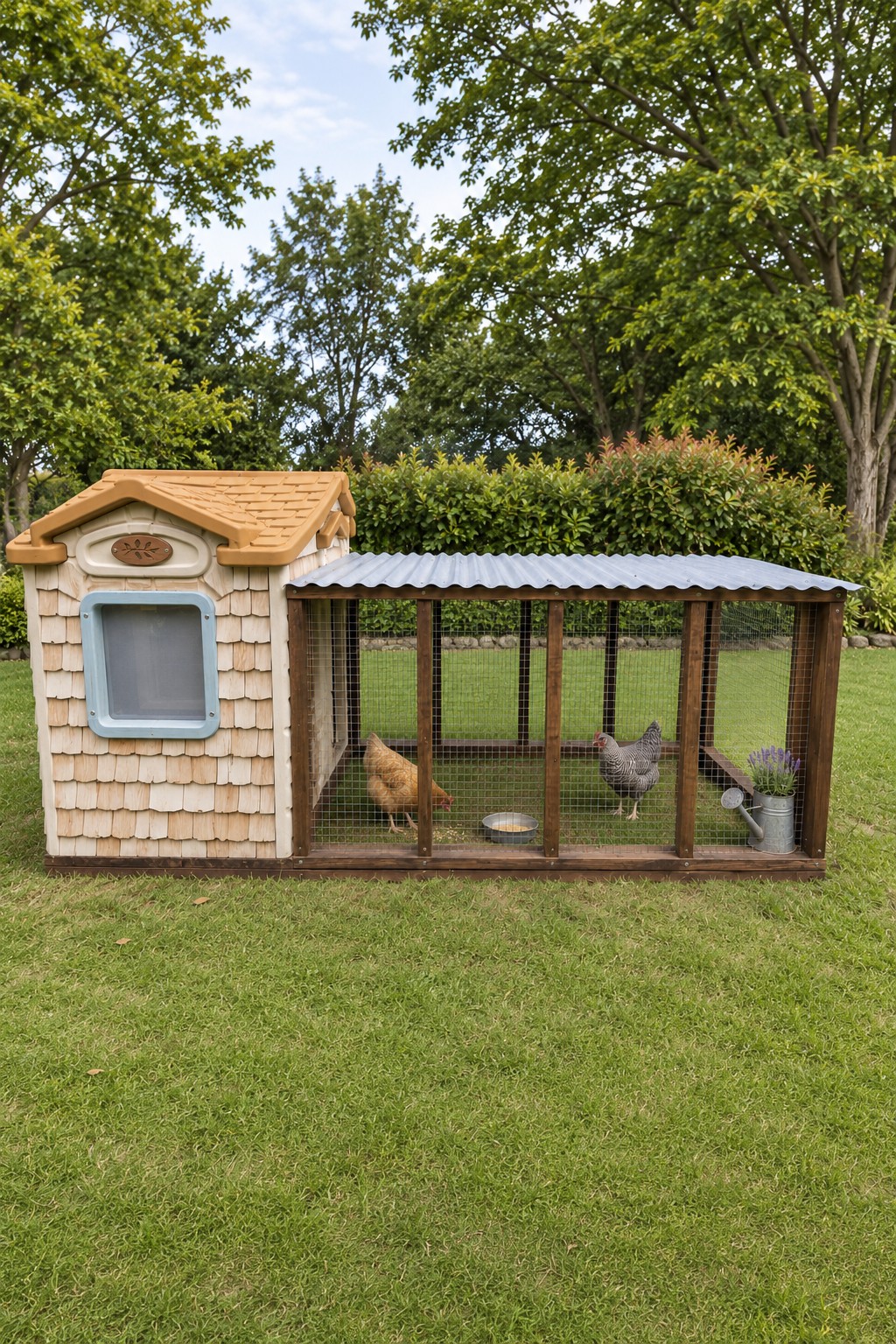
An outgrown plastic playhouse with molded shingle siding makes a quick coop that is very easy to clean. Plastic does not rot, hoses off in minutes and never needs paint. The trade off is heat, because molded plastic warms up fast in direct sun. Cut extra vents high on the walls, cover every opening with hardware cloth held by bolts and fender washers, and place the playhouse where it gets afternoon shade.
Here it joins a run framed in dark stained wood under a corrugated metal roof. Attach the run with galvanized or stainless bolts rather than screws, which tend to strip out of thin plastic walls.
Coops That Share Space with the Garden
White Coop Inside a Covered Run
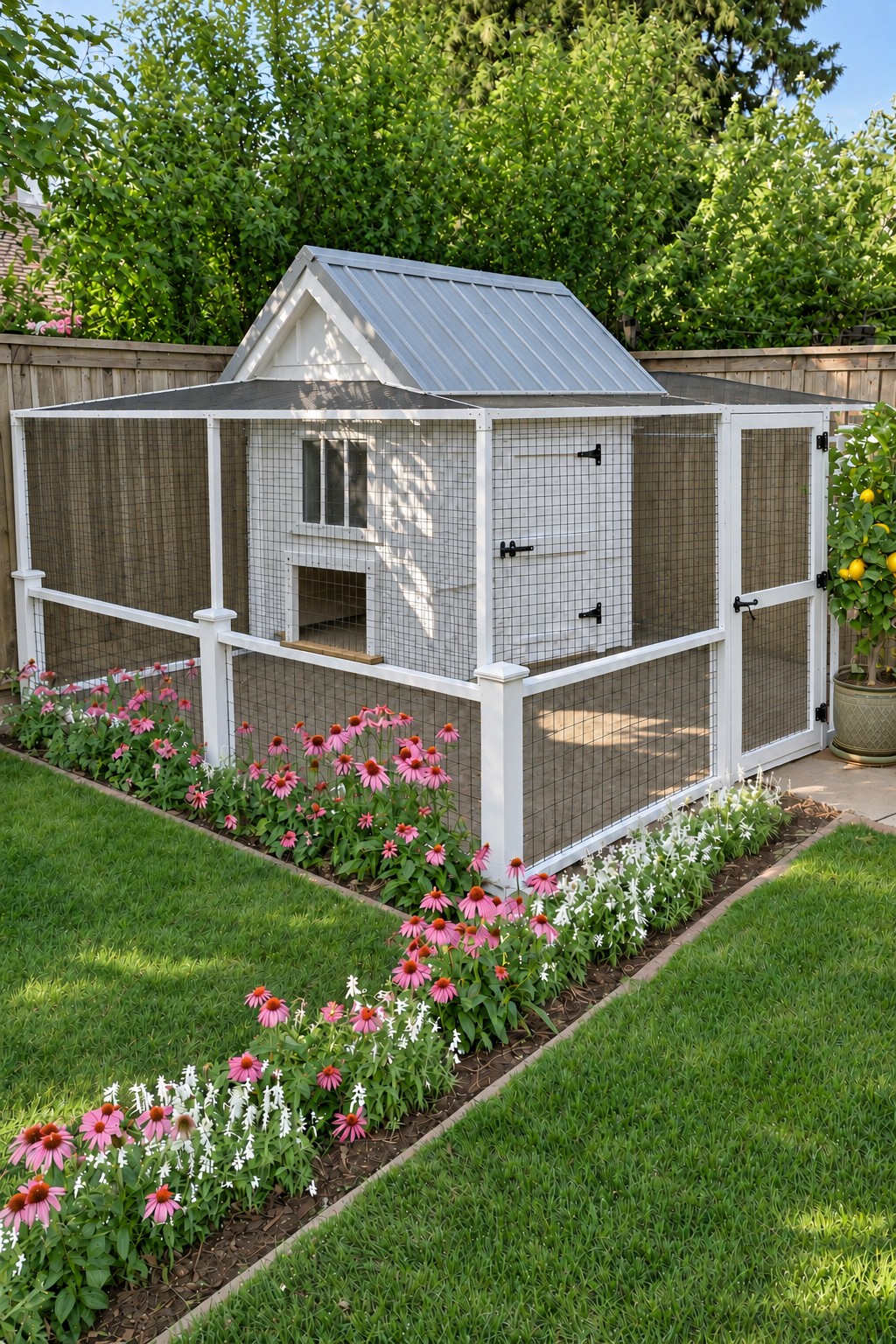
Here the whole coop sits inside a roomy run framed with white posts and newel style caps, with its own low roof wrapping around the main metal roof of the coop. The hens get the entire footprint during the day and the coop itself stays small and tidy. A large side door with black strap hinges opens wide for cleaning.
A deep border of pink coneflowers and white salvia follows the outline of the run and softens all that wire, while a potted lemon tree marks the gate. Leave a narrow mulched strip between plants and mesh so you can walk around and check the apron and staples each season.
Kitchen Garden Coop with a Nasturtium Arch
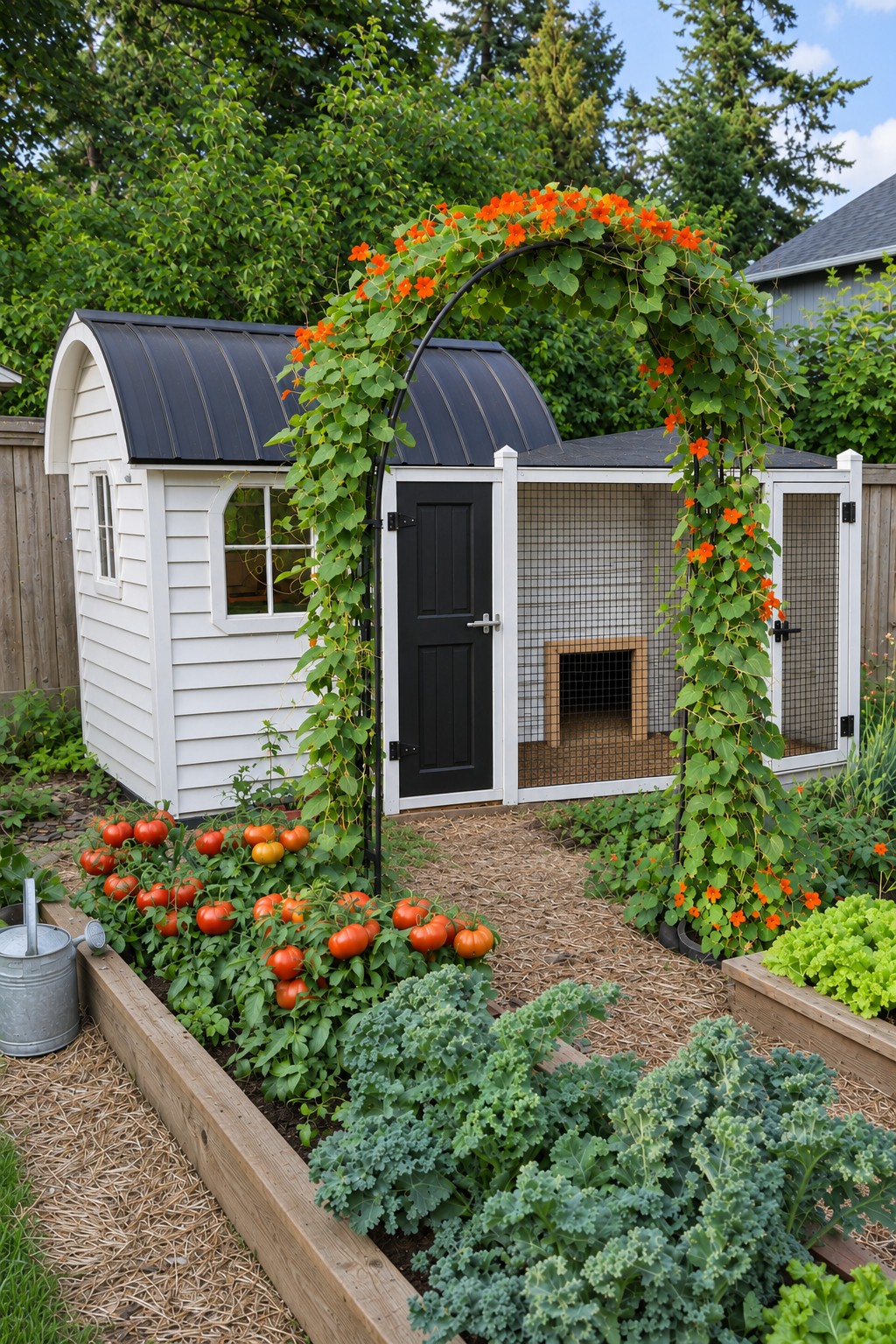
Setting the coop at the edge of the vegetable garden makes daily chores efficient: weeds and spent greens go straight to the hens, and composted bedding goes back on the beds. A metal arch covered in orange nasturtiums frames the path to this white coop with its curved black metal roof, and nasturtium flowers and leaves are safe for hens to nibble.
Tomato plants are a different story. Their leaves, stems and unripe fruit contain solanine, so keep tomato beds well outside the run, just as the raised beds here stand apart from the coop. A straw mulched path between the beds keeps boots clean on wet mornings.
Rose Covered Pergola Entry
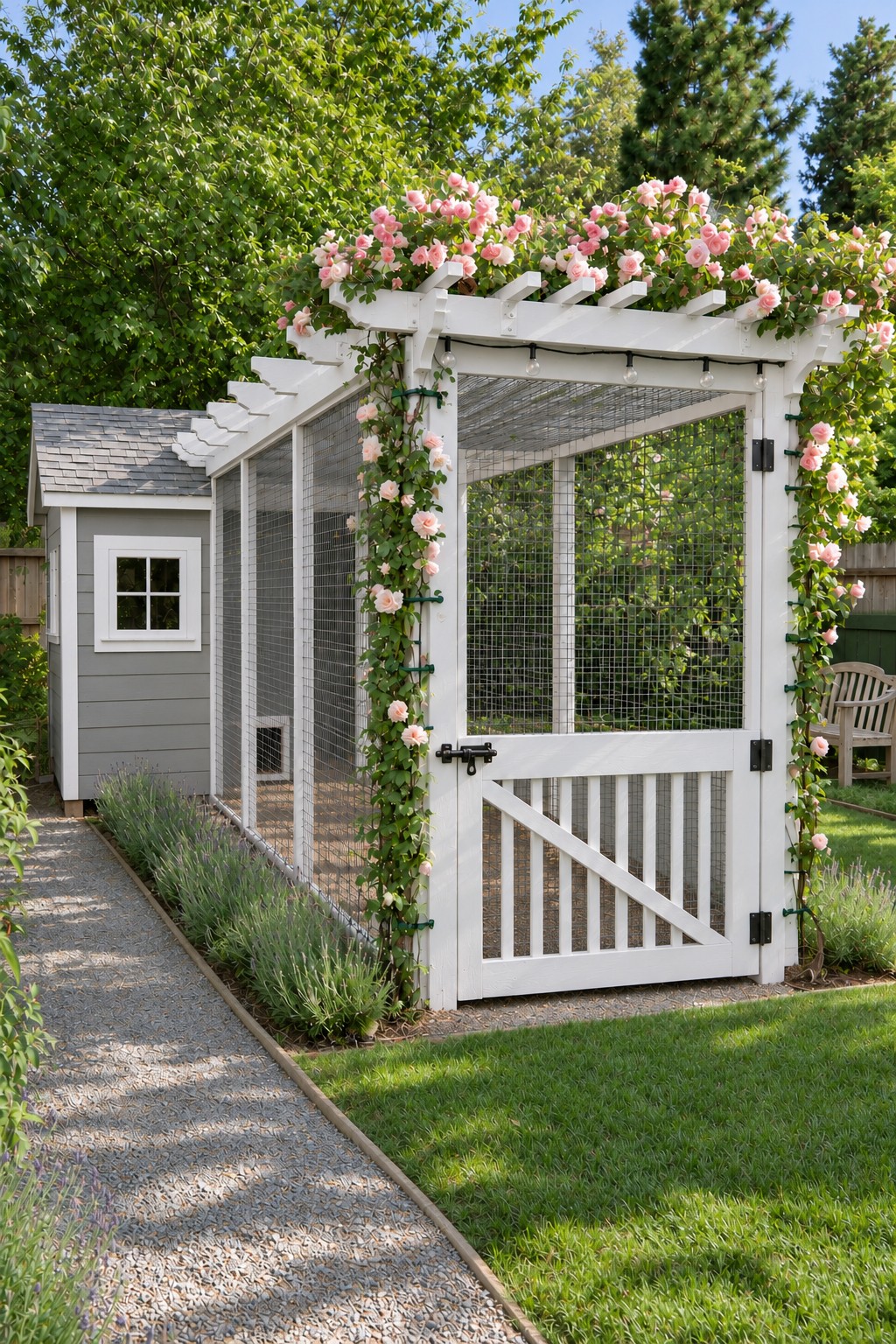
A white pergola top with shaped rafter tails, wrapped in climbing pink roses, makes the run door feel like a garden gate. Below it, a white picket style gate backed with welded mesh keeps the cottage look while stopping hens from slipping through the gaps. The long run connects to a gray shed style coop, and lavender lines the gravel path beside it.
Climbing roses need firm support, so tie the canes to the posts with soft ties and keep thorny growth trimmed back from the latch. If you string lights along the pergola as shown here, run every cable outside the mesh where curious beaks cannot reach it.
Strawberry Planters on the Run Wall
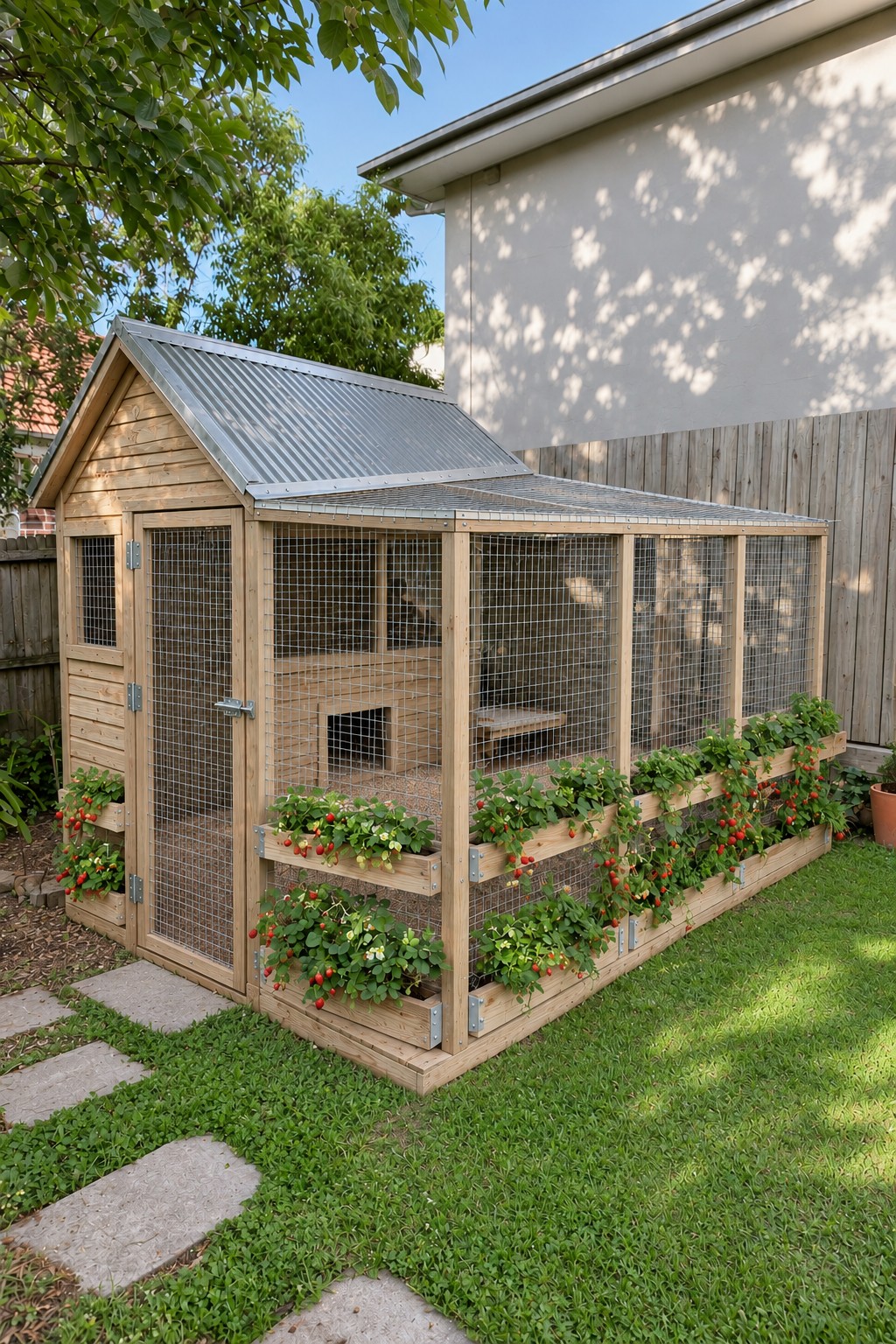
Long planter boxes screwed to the outside of the run turn the walls of this natural wood coop into a strawberry patch. The boxes are fixed at two heights, so the fruit stays mostly out of reach while the leaves shade the lower part of the run. Drill drainage holes in each box and line it with landscape fabric so wet soil never sits against the frame.
The coop is built from untreated pine with a corrugated galvanized roof, and stepping stones lead to the walk in door. Expect hens to reach through the mesh for any berry that dangles inside, so keep the boxes on the outer face and guide runners away from the wire.
Raised Coop Beside a Fenced Vegetable Patch
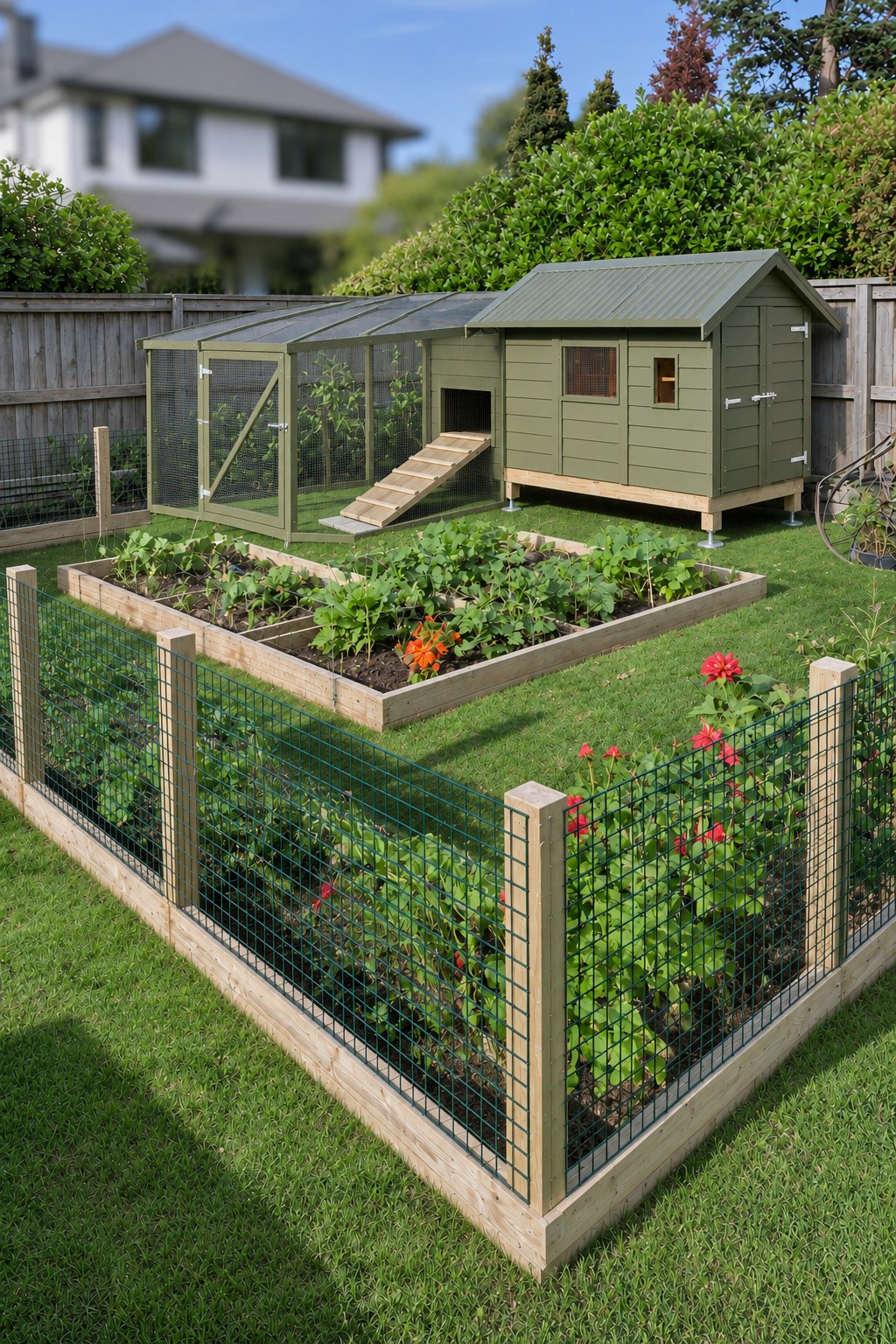
This sage green coop stands on legs with metal post bases, a cleated ramp leading down into a long, low run. In the foreground, raised vegetable beds sit inside their own fence of green coated welded wire on wooden posts, the simplest way to grow food and keep chickens in the same yard. The hens cannot scratch up seedlings, yet you can let them in to clean up the beds at the end of the season.
Lifting the coop off the ground keeps the floor dry and gives hens a shaded spot underneath. Close that space in with hardware cloth so it becomes part of the run instead of a hiding place for rats.
Sedum Green Roof Coop
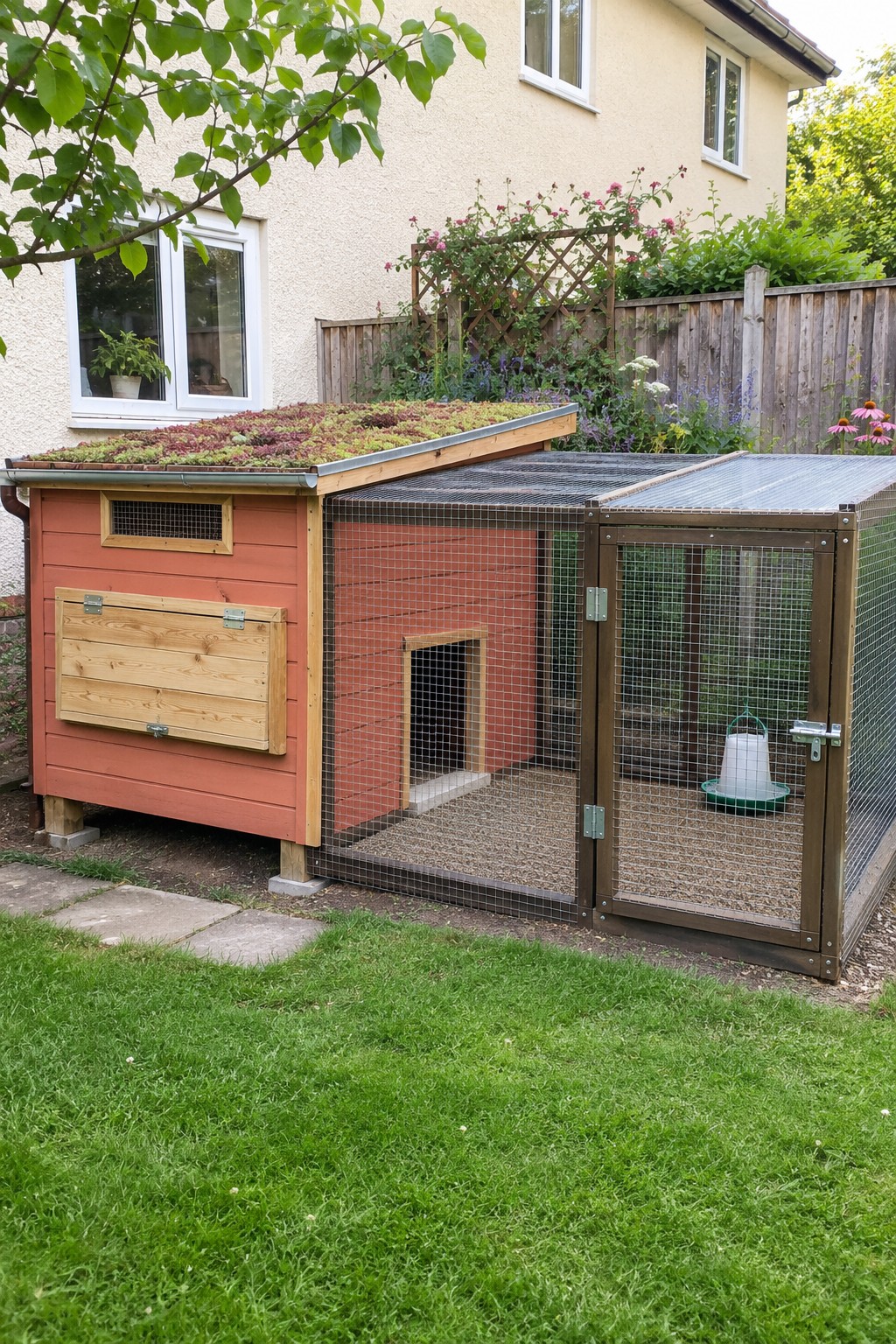
A living roof of sedum on a red painted coop softens the view from the house and slows rain runoff. A green roof is heavy when soaked, roughly 8 to 30 lb per sq ft (40 to 150 kg/m²) depending on depth, so size and space the rafters for that load before you start. Lay a waterproof EPDM or pond liner membrane, a protective fleece, a thin drainage layer and pregrown sedum mats, and finish the edges with a metal trim and gutter like the ones on this coop.
A wide wooden hatch on the side lifts for cleaning, and a screened vent sits high below the roof. The attached run has a clear roof panel to keep the floor dry. Water the sedum through its first summer until the roots take hold; after that it needs very little care.
Corrugated Metal Skirt and Hanging Baskets
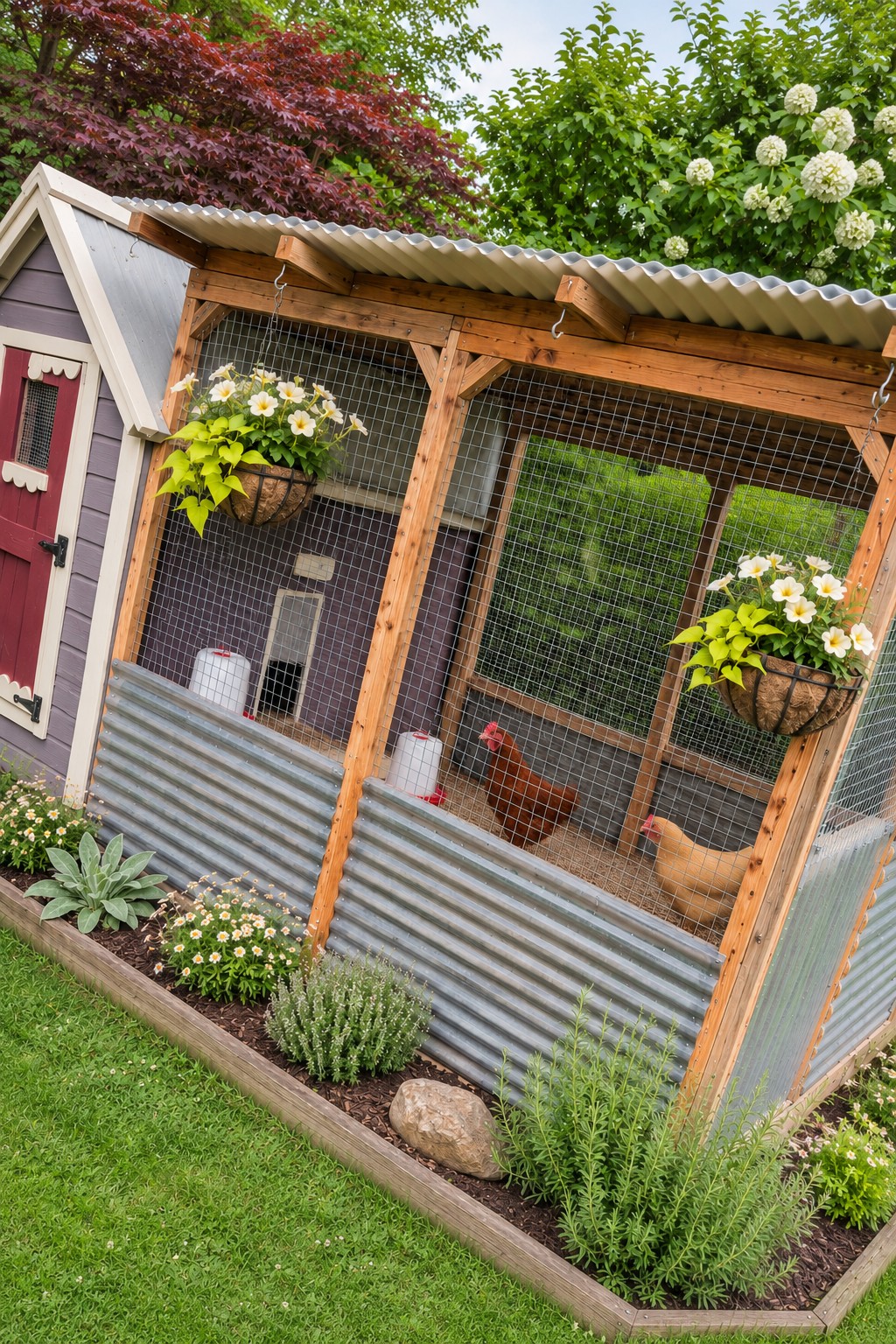
Galvanized corrugated metal fixed along the lower part of the run walls blocks wind and rain splash at hen height and keeps a passing dog from staring the flock into a panic. Above it, hardware cloth keeps the air moving, and cedar toned posts with a corrugated roof carry two hanging baskets of trailing white flowers.
File or cover the cut edges of the metal, because they are sharp enough to slice hands and feet. A border of herbs and silver leaved plants hides the base of the skirt. Hang baskets on the outside of the frame or high enough that no hen can reach them, so you can water them without opening the run.
Long Garden Run with Poultry Netting
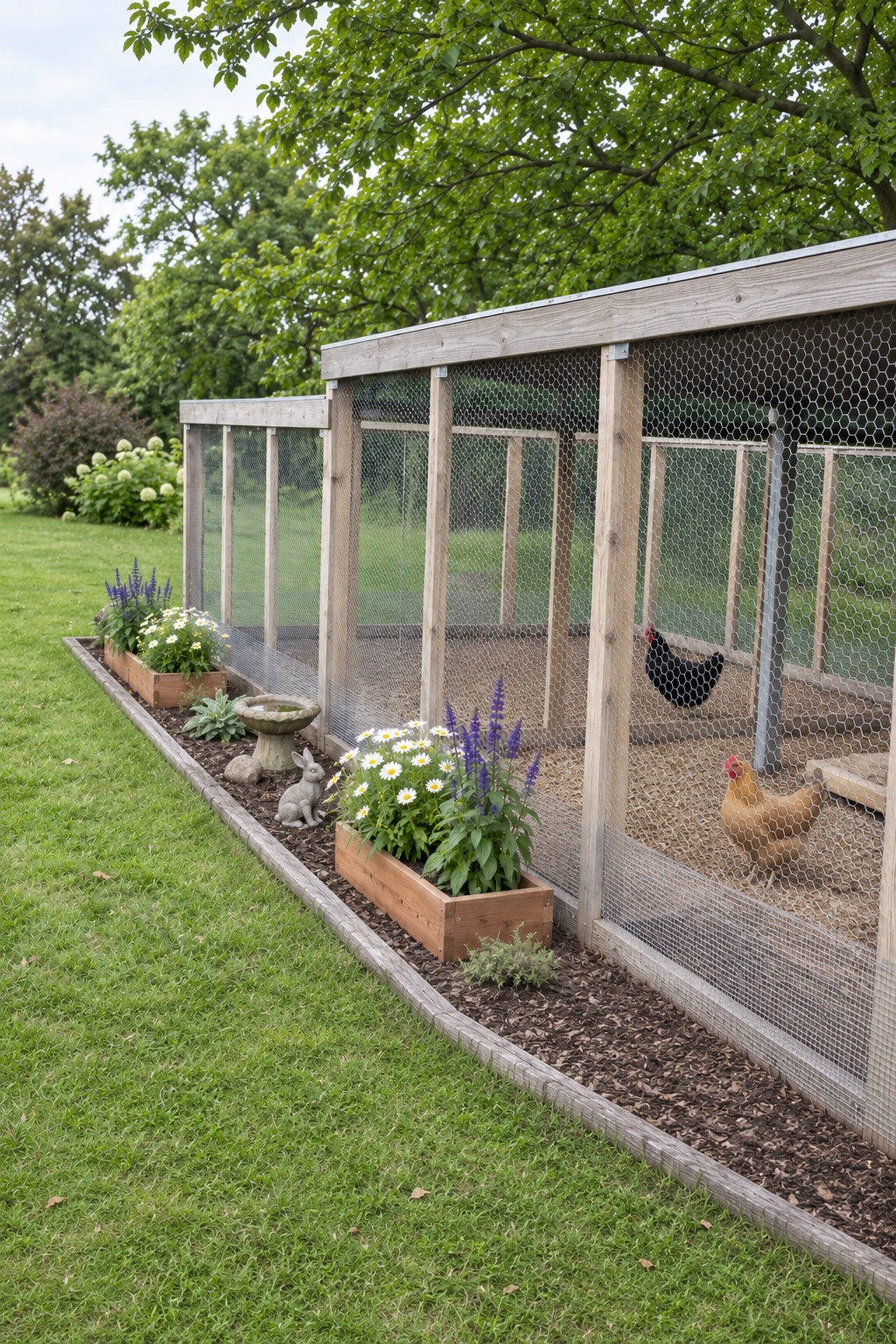
This long weathered wood run stretches across the lawn like a covered walkway, giving the flock lots of room to roam. Its walls are hexagonal poultry netting, which looks soft and old fashioned but is easy for raccoons and dogs to tear open. If you love the look, back the lowest 2 to 3 ft (60 to 90 cm) with hardware cloth and shut the hens into a secure coop every night.
Planter boxes of daisies and blue salvia, a pedestal water basin and a mulch bed edged with timber make the outside of the run feel planned rather than leftover. A long, narrow run is also easy to clean, since you can work along it with a rake and a wheelbarrow.
Clear Roof Walk In Run with Front Planters
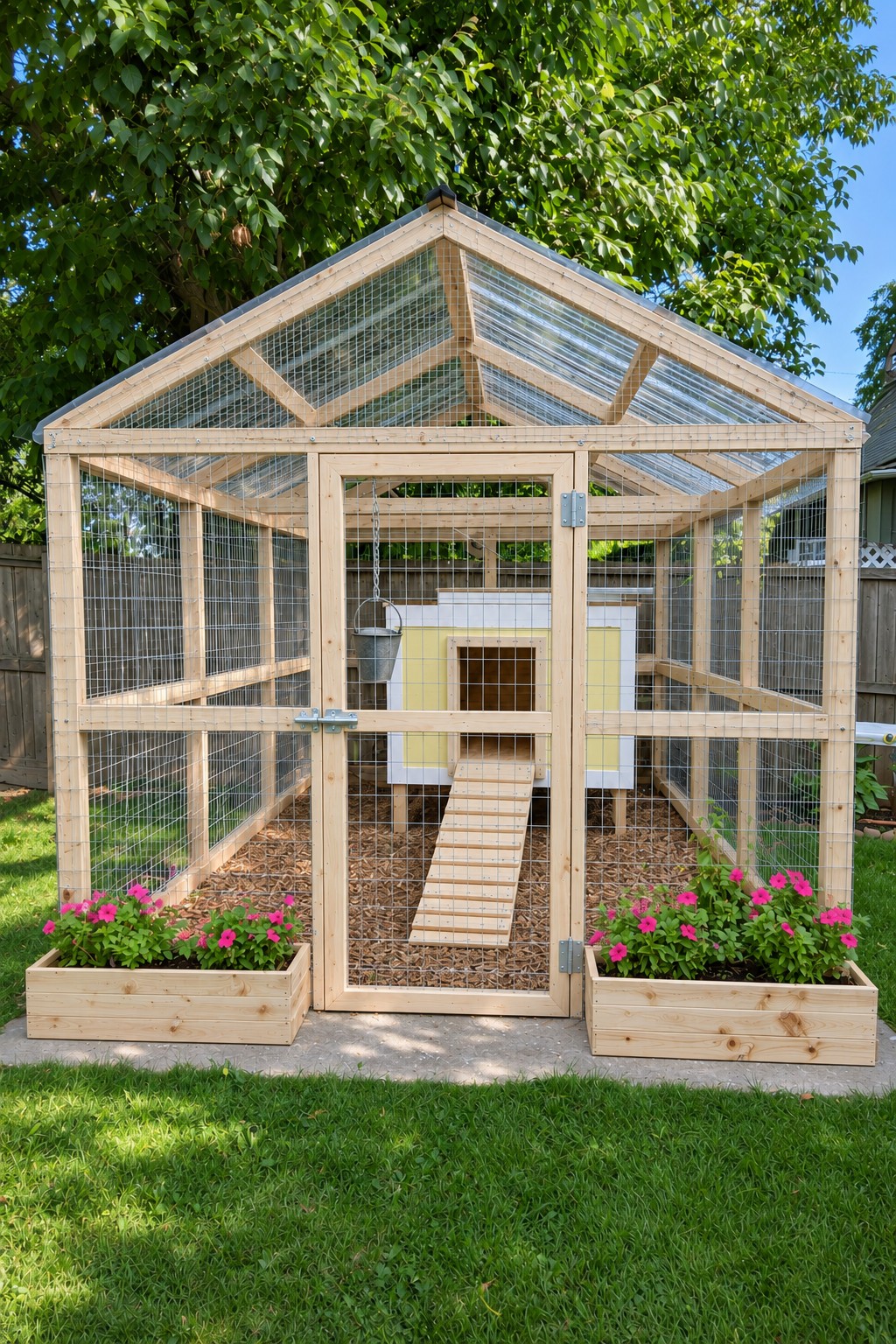
A gable run of natural pine with clear corrugated roof panels lets daylight in while the floor stays dry, and a small yellow and white coop stands on legs inside. Diagonal braces in the gable triangles stiffen the roof frame. A galvanized feeder hangs on a chain at about the height of a hen's back, which keeps feed clean and out of the bedding.
Planter boxes of pink vinca on both sides of the door add color at the entrance. A clear roof can make a run hot at midday, so keep a piece of shade cloth ready to stretch over part of it in summer.
Pergola Style Run with a Coral Screen Door
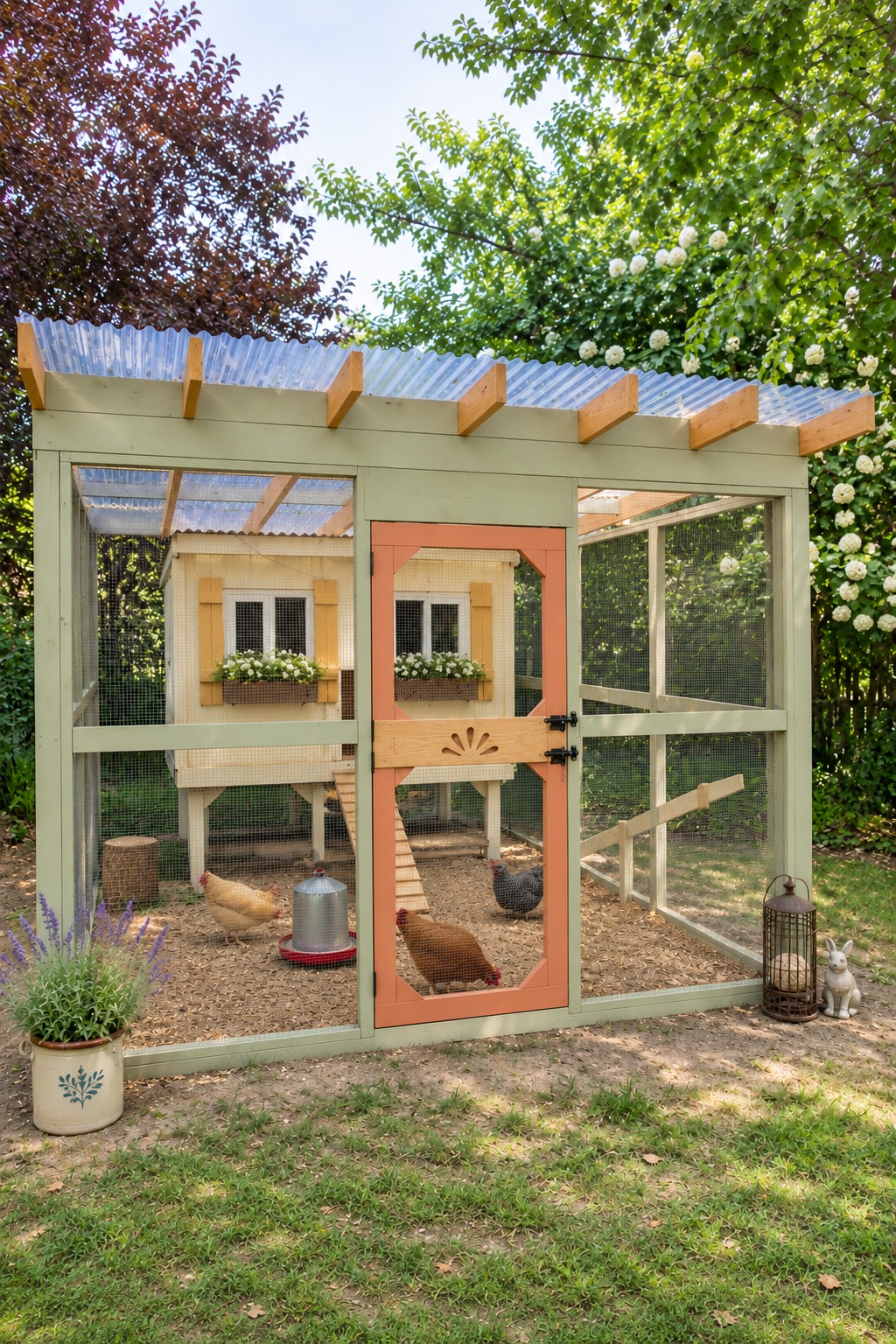
Sage green framing, a clear corrugated roof on rafters with exposed tails, and a coral screen door with a fan bracket turn this run into a garden room. Inside, a cream coop with yellow shutters and window boxes stands on legs, so the hens use the shade underneath on hot afternoons.
Extra perches make a run more interesting. A stump and a long sloping perch bar give the chickens places to hop up and stretch. A crock of lavender by the door and a lantern style treat feeder complete the cottage feel.
Hoop Coops, Arches and Curved Roofs
Hoop Coop with Bucket Nest Boxes
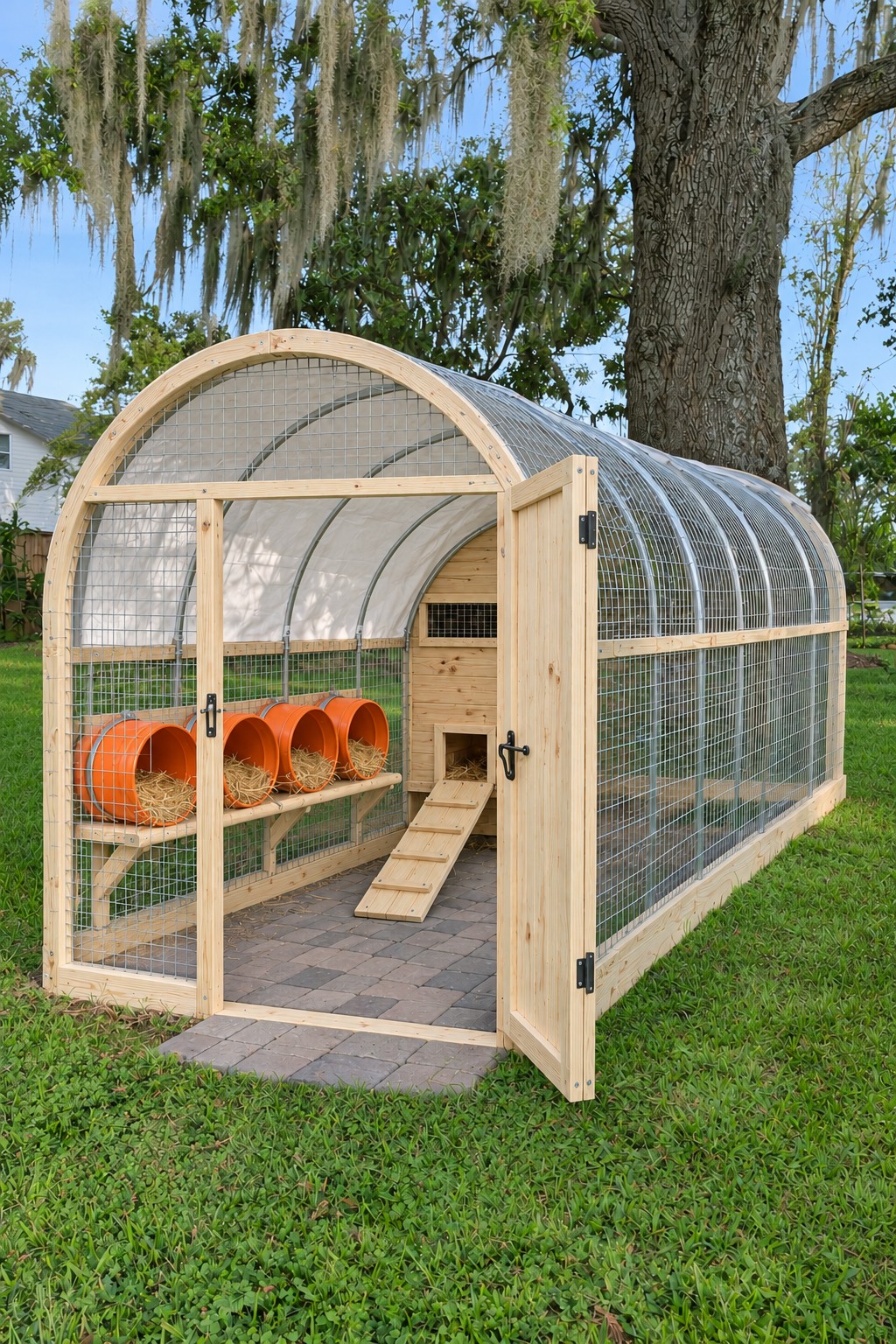
Arched wooden end frames, metal hoops covered in welded wire and a white tarp over the upper half create a long, airy hoop coop that is affordable and easy to extend. A similar shape can be made by bending 16 ft (4.9 m) cattle panels over a wooden base; on an 8 ft (2.4 m) wide base the arch reaches roughly 5 to 6 ft (1.5 to 1.8 m) high. Join the panels with hog rings, fix them to the base with fence staples and cover the sides with hardware cloth, since panel openings alone will not stop predators.
Plastic buckets laid on their sides on a lipped shelf make cheap, washable nest boxes. A paver floor that sweeps clean and a small wooden roost house with a ramp at the back finish the build. Drape the tarp over the side that faces the prevailing wind and afternoon sun, and leave the ends open for air.
Black Steel Arch Tunnel Run
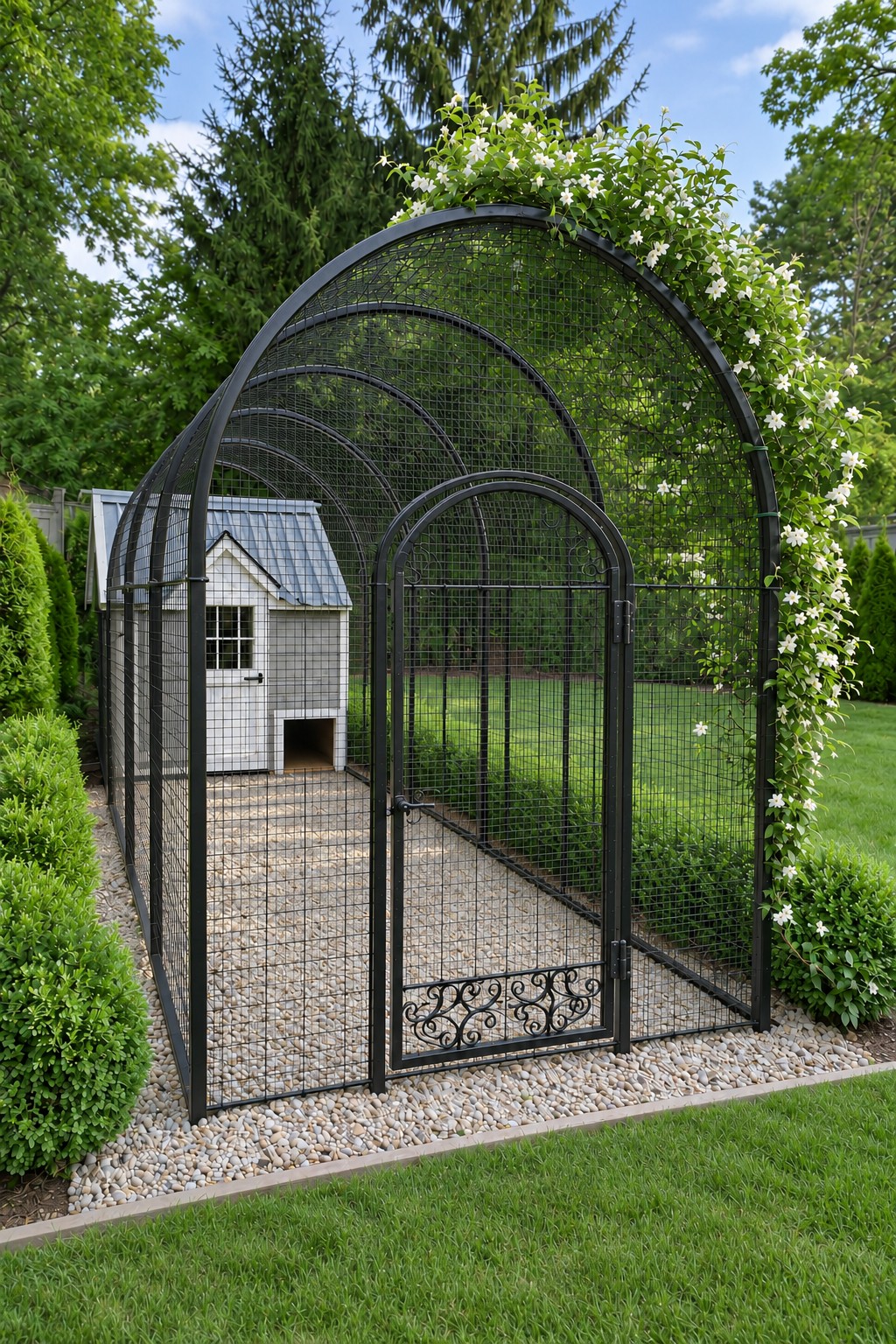
Black powder coated steel arches joined with welded mesh form a tunnel run that looks like a formal garden walk. A gate with a scrolled lower panel opens straight onto a gravel floor that leads to a small gray coop at the far end. White star jasmine climbing over the first arch makes the whole structure read as garden architecture rather than livestock housing.
Check the gaps around ornamental gates and along the bottom of the frame, since decorative ironwork often leaves openings wider than a raccoon's paw. A strip of hardware cloth fixed behind the scroll panel and an apron buried under the gravel edge close those weak points.
Quonset Coop in Corrugated Steel
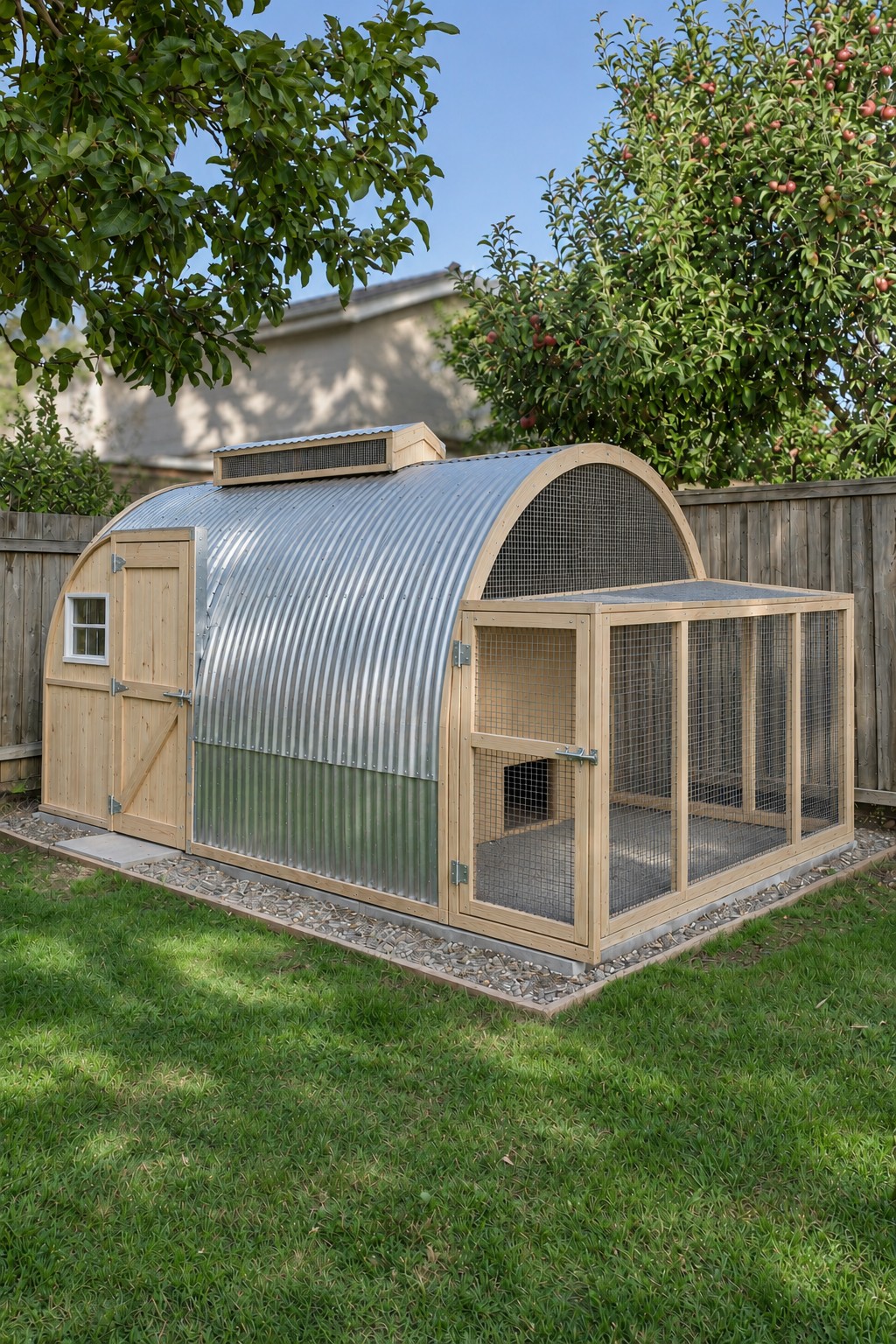
Curved sheets of corrugated galvanized steel fixed over arched wooden ribs give this coop its Quonset hut shape. A band of clear corrugated polycarbonate along the lower curve lets in daylight, and a raised ridge vent with mesh releases hot air from the top. Wooden end walls hold a Z braced door and a small window.
Ease the metal sheets over the ribs gently, starting at one side and screwing as you go, using roofing screws with sealing washers. The attached run sits on a gravel pad that drains quickly and keeps the timber base dry.
Hoop Run Beside a Sage Green Coop
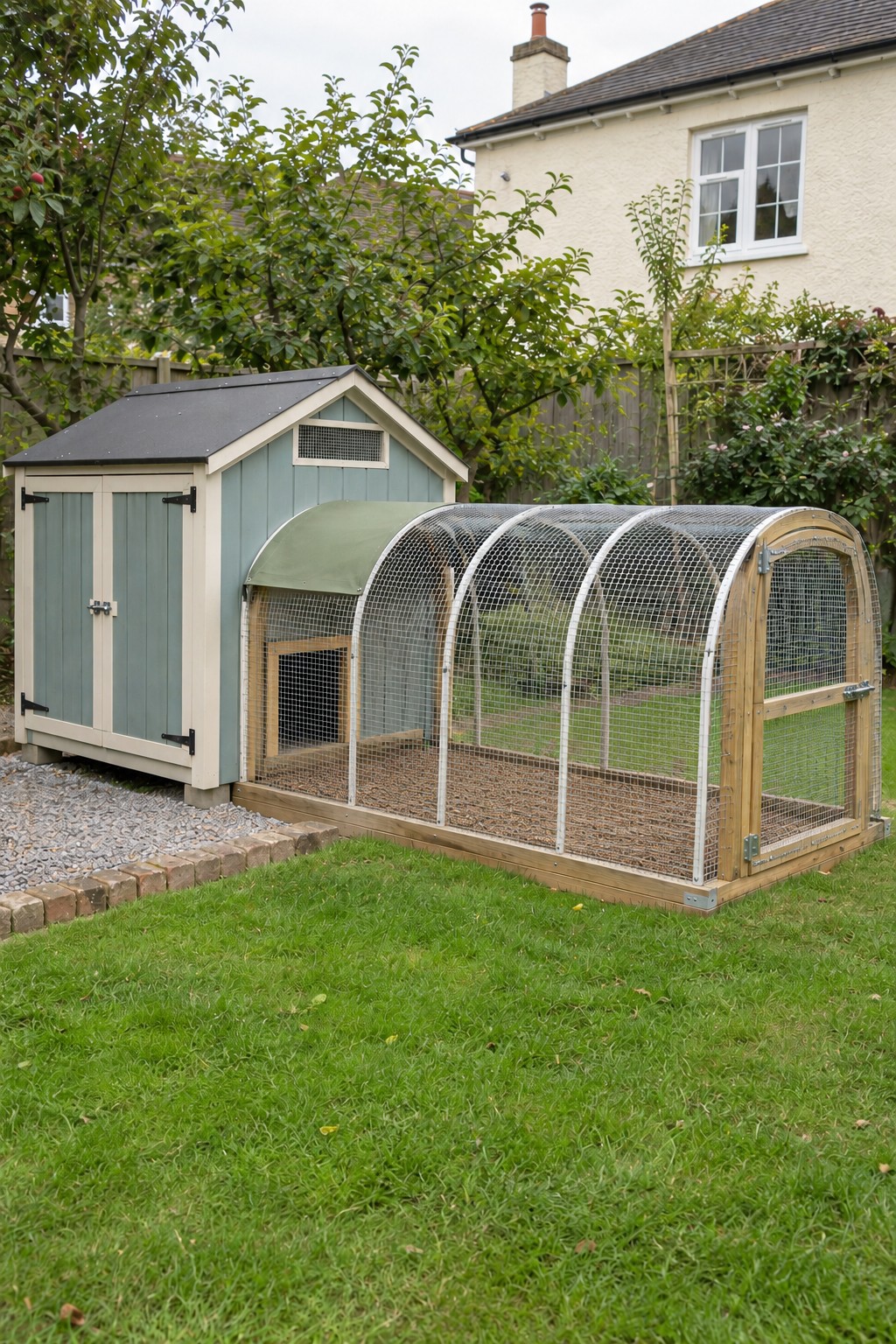
A row of white arches fixed into a timber base creates a low hoop run beside a sage green shed style coop with double doors. Hoops like these can be bent from metal tubing or rigid conduit and then wrapped in hardware cloth. A green canvas cover over the end nearest the coop gives shade and rain shelter right where the hens come out of the pop door.
The coop sits on a gravel pad edged with brick, so its base stays dry while the run rests flush on the lawn. A hinged door in the wooden end frame makes it easy to reach in with a rake.
Coastal Hoop Run with a Seashell Door
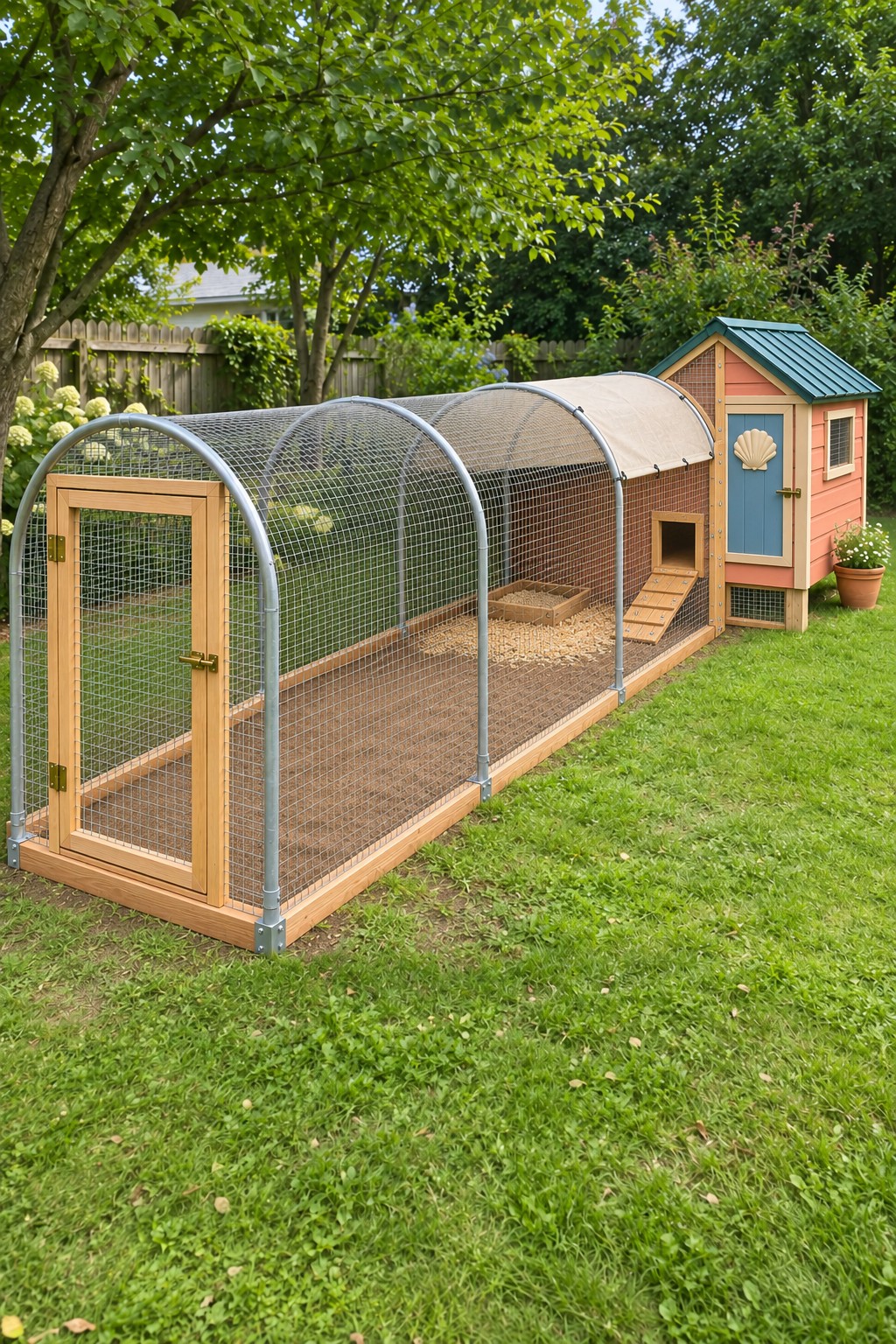
Galvanized metal hoops over a wooden base form a long tunnel run that ends at a coral coop with a teal metal roof and a blue door crowned by a carved seashell. A fabric shade sail stretched over the hoops nearest the coop keeps that end cool, while the front of the run stays open to the sun.
For a coastal look, keep the palette to coral, teal and natural wood, and add a dust bath box and a small ramp inside. Fix the foot of each hoop to the timber frame with pipe straps so the arches cannot lift in a strong wind.
Curved Metal Roof Over a Hoop Run
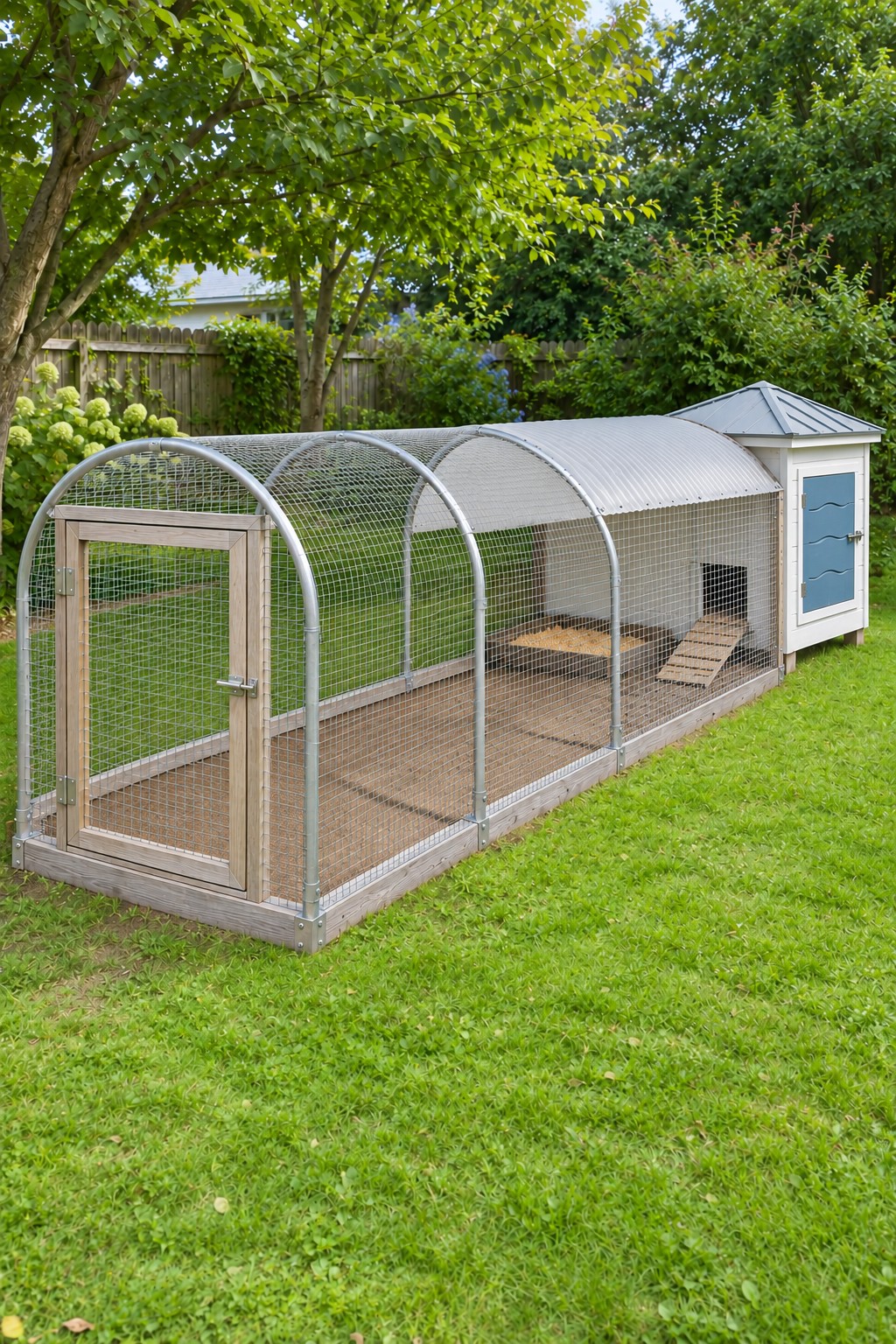
Instead of fabric, this hoop run carries a curved corrugated metal roof over the half closest to the coop, giving the hens permanent rain cover while the open half catches the sun. The small white coop with a hip roof and a blue door carved with waves stands at the end on short legs.
Corrugated sheets follow a gentle curve when they are screwed to each hoop in turn, but tight curves need sheets that come pre curved from the supplier. Fix them through the crowns with sealing washers and let the lower edge overhang the mesh so rain drips outside the run.
Mini Quonset Coop with an Angled Door Run
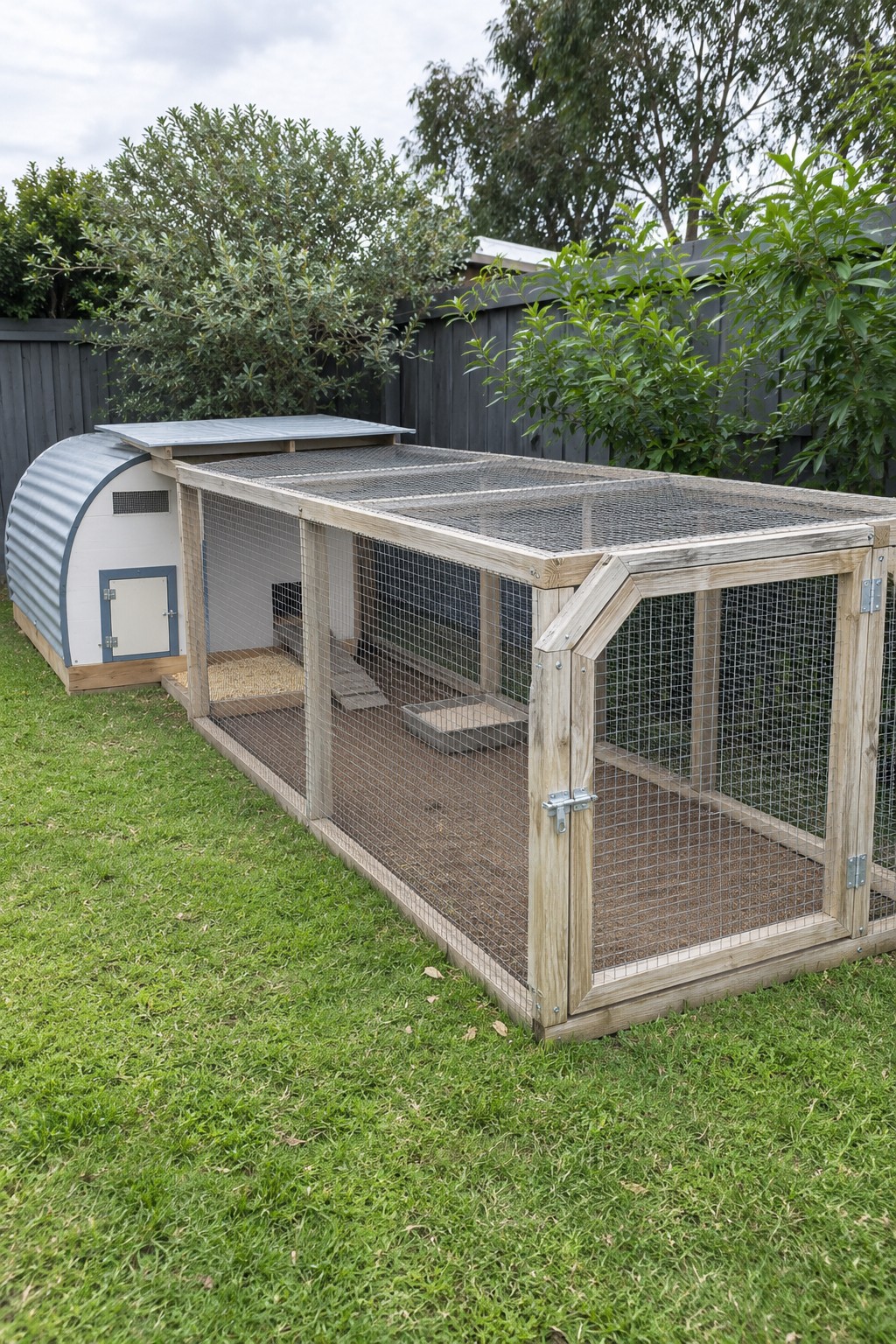
A small half round coop with gray corrugated sides and a white end wall makes a neat house for a few hens. The run beside it is built from gray washed lumber, and one detail changes the whole look: the door frame has clipped upper corners, a shape you can make with two simple 45 degree cuts.
Mesh panels across the top keep predators out without blocking light, and a solid section near the coop shelters the pop door. A gray stain blends new and old lumber and suits a dark modern fence.
Barrel Coop on Timber Cradles
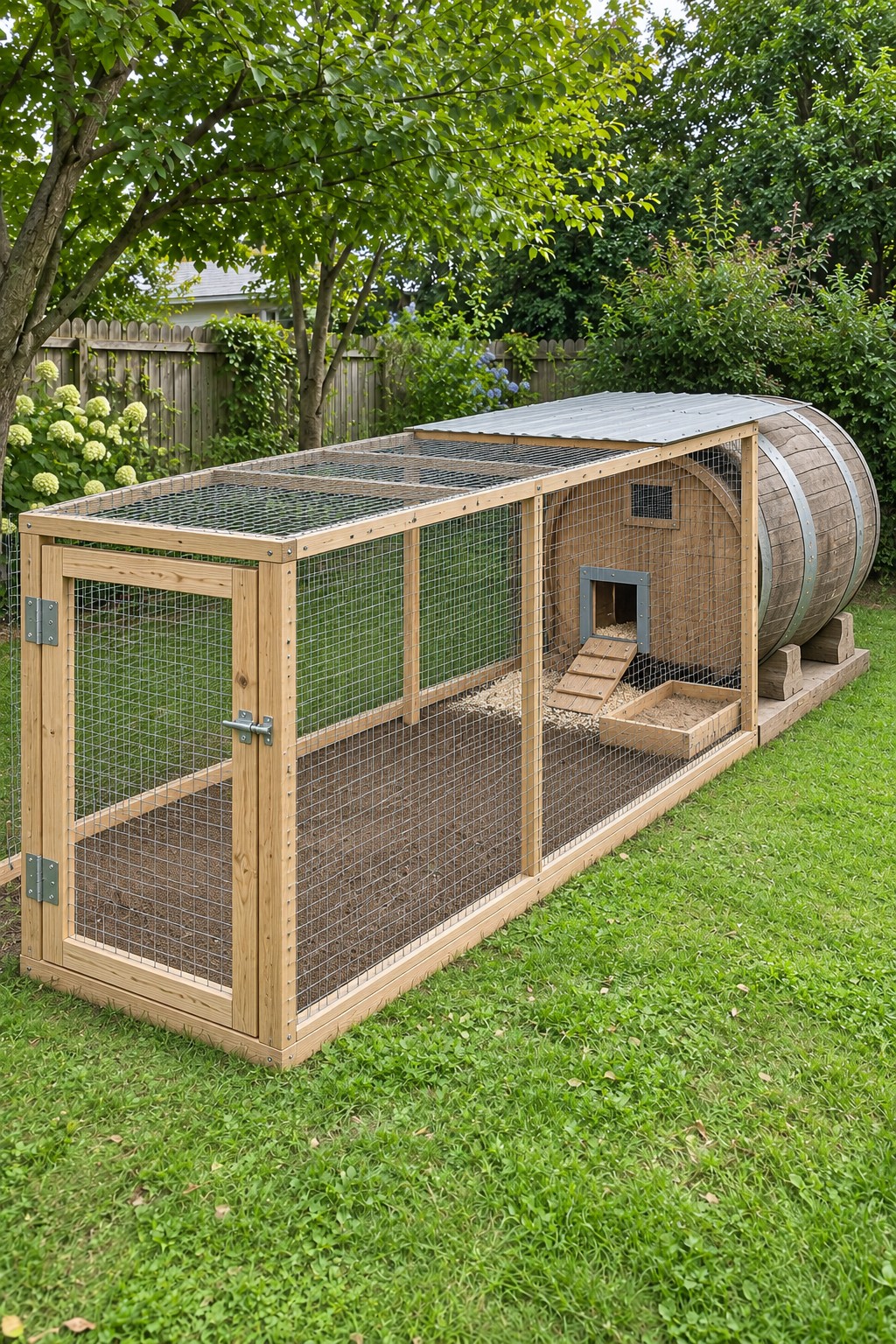
A large wooden barrel bound with steel hoops rests on shaped timber cradles to become a snug round coop. The cradles stop it from rolling and lift the staves off wet ground, while a gray framed pop door and a screened vent near the top handle access and airflow. If you build one, fix a flat floor across the lower staves so the hens have a level surface inside.
An attached run of natural pine with a partial metal roof and a dust bath box completes the setup. If curved staves catch your eye, our wine barrel projects show more ways to use them around the yard.
Long Runs, L Shapes and Movable Coops
Narrow Side Yard Run with Lift Up Lids
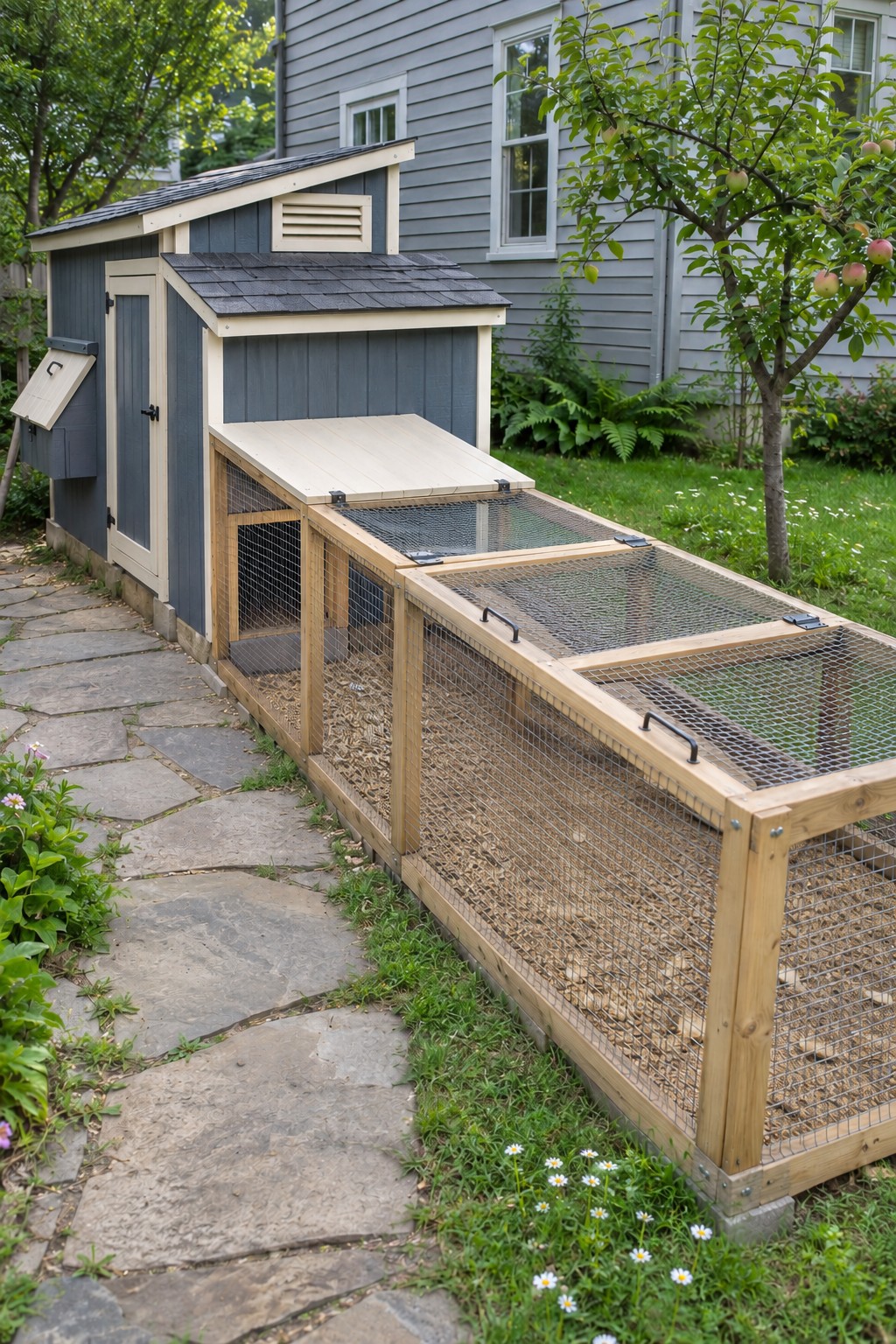
A long, low run beside a flagstone path fits a strip of yard that is too narrow for almost anything else. Hinged mesh lids with handles open from above, so you can reach every corner without a walk in door, and one solid panel near the coop gives shade. The coop itself is a navy shed style building with a louvered gable vent and an exterior nest box.
Low runs like this suit small flocks that free range for part of the day. Add a chain or stay so the lids cannot slam down on your fingers, and use latches a raccoon cannot flip open.
Patio Coop with a Lidded Run
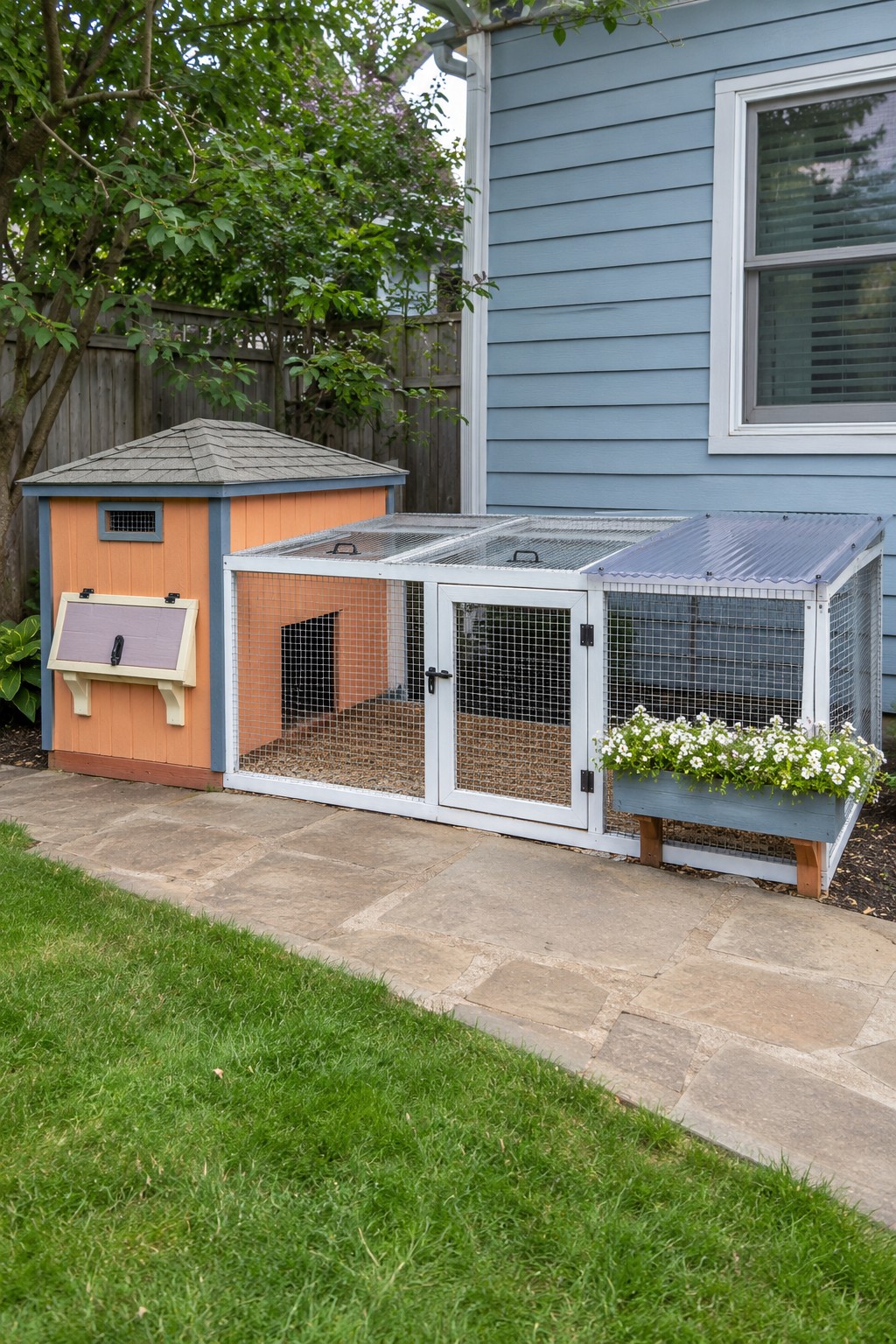
A compact peach coop with a gray hip roof and blue trim sits at the edge of a stone patio beside the house, joined to a low white run whose lids open on hinges. One lid is clear polycarbonate, so part of the run stays dry, and the rest are mesh. A planter box of white flowers at the far end hides the corner of the run from the patio.
With paving this close, a thick layer of wood shavings inside the run keeps dust and scratched up soil off the stone. A hinged hatch on the front of the coop lifts for quick egg checks.
Movable Chicken Tractor on Wheels
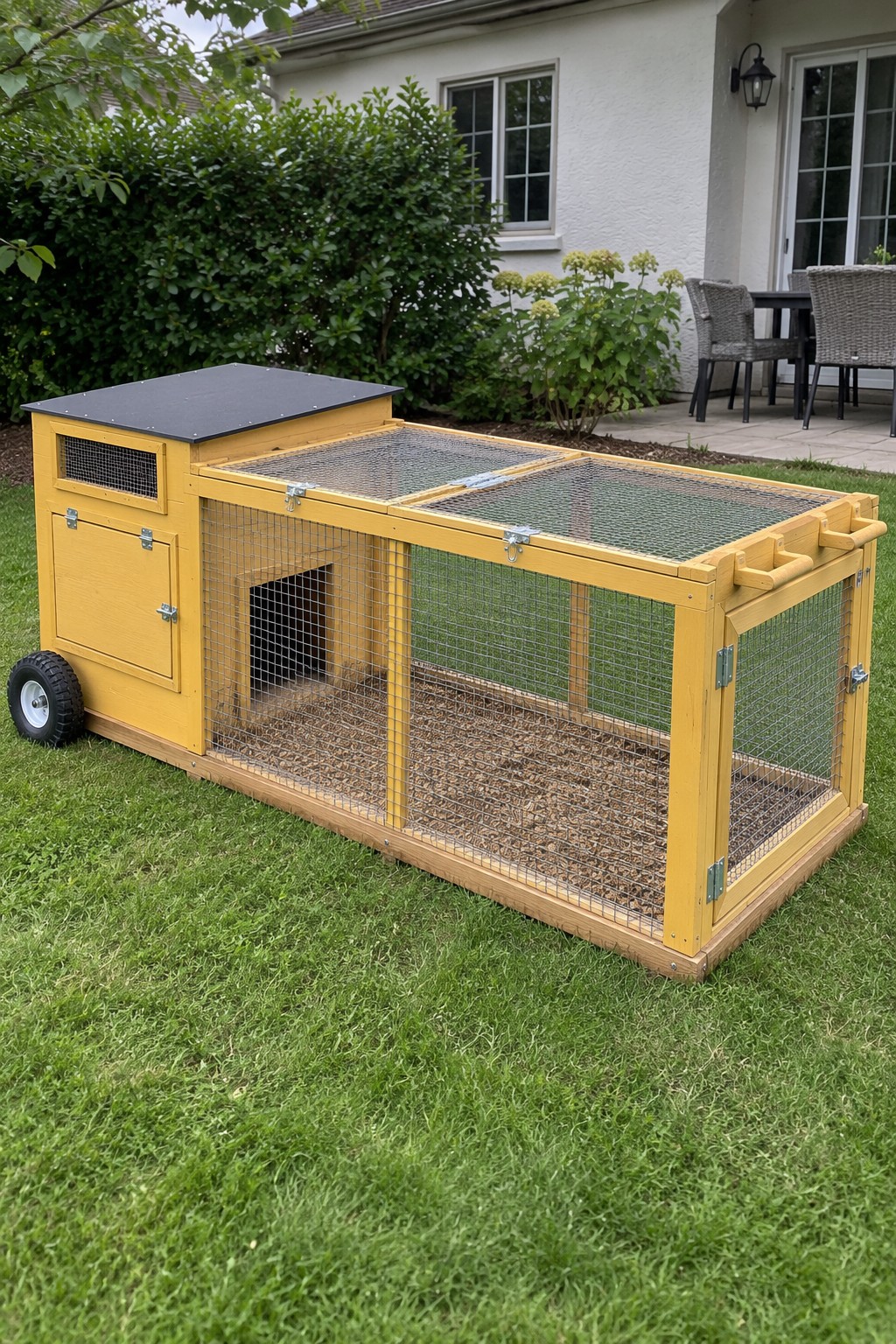
A floorless mustard yellow run with a small coop at one end and wheels on the coop side becomes a chicken tractor that rolls to fresh grass. The hens trim the lawn, eat insects and spread manure as they go, and you move the frame before the patch beneath turns bare. Handles at the open end let one person lift and push.
Keep a tractor light by using slim framing and hardware cloth, and choose air filled wheels for soft lawns. When it is parked, the frame must sit flat on the ground so nothing can squeeze underneath, which is why some builders fit the wheels on a lever that lifts them clear after a move.
Long Run with a Covered Feeding Station
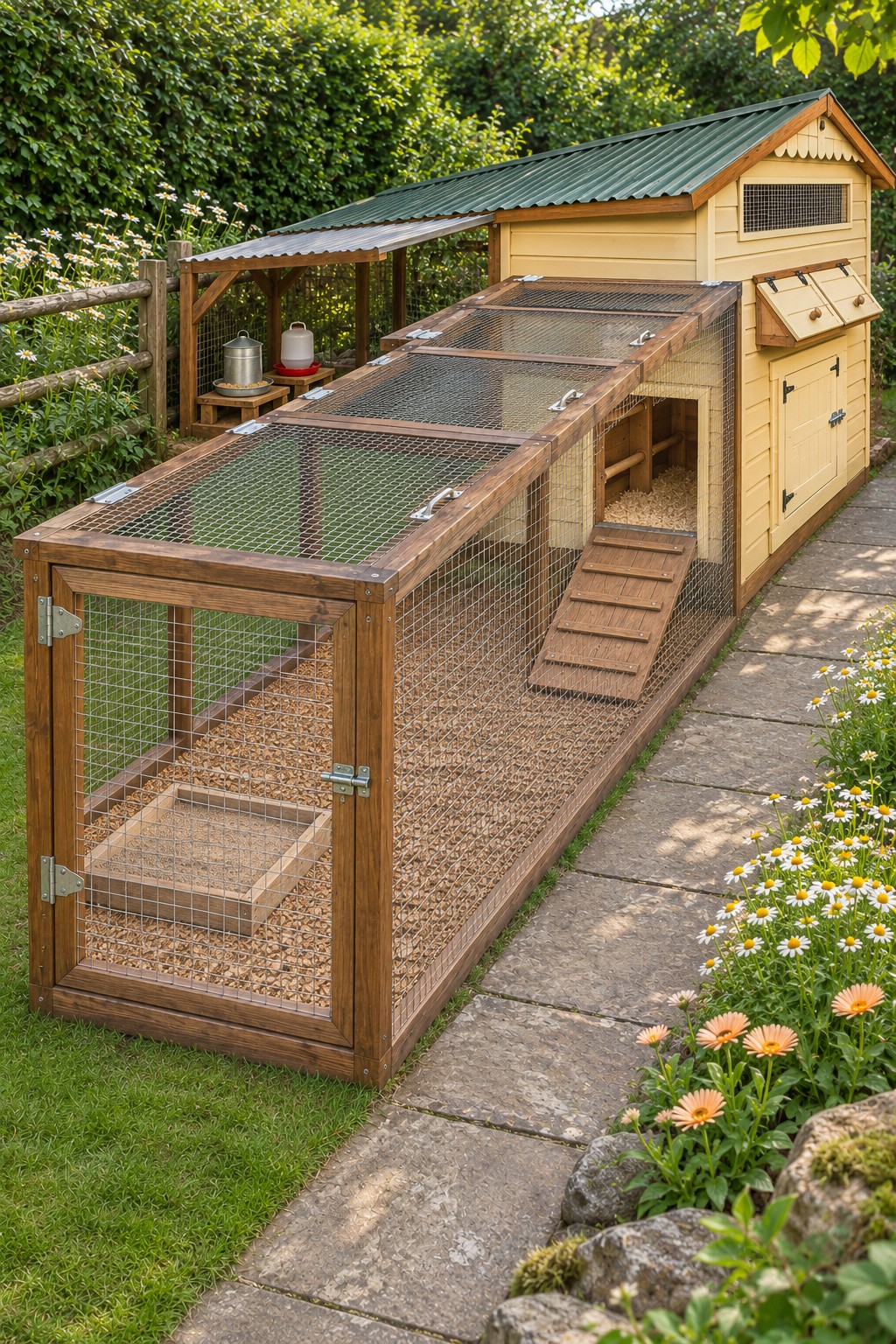
This long run of stained wood with hinged mesh lids follows a stone path to a pale yellow coop with a green corrugated roof and scalloped gable trim. Beside the coop, a mesh enclosed lean to with its own roof shelters a galvanized feeder and a waterer on low stands, so feed stays dry and pests cannot raid it.
A cleated ramp climbs from the run to the raised coop, and a double exterior nest box with lift up lids sits on the end wall. A shallow box of sand near the run door gives the hens a ready dust bath.
L Shaped Run Following the Fence Line
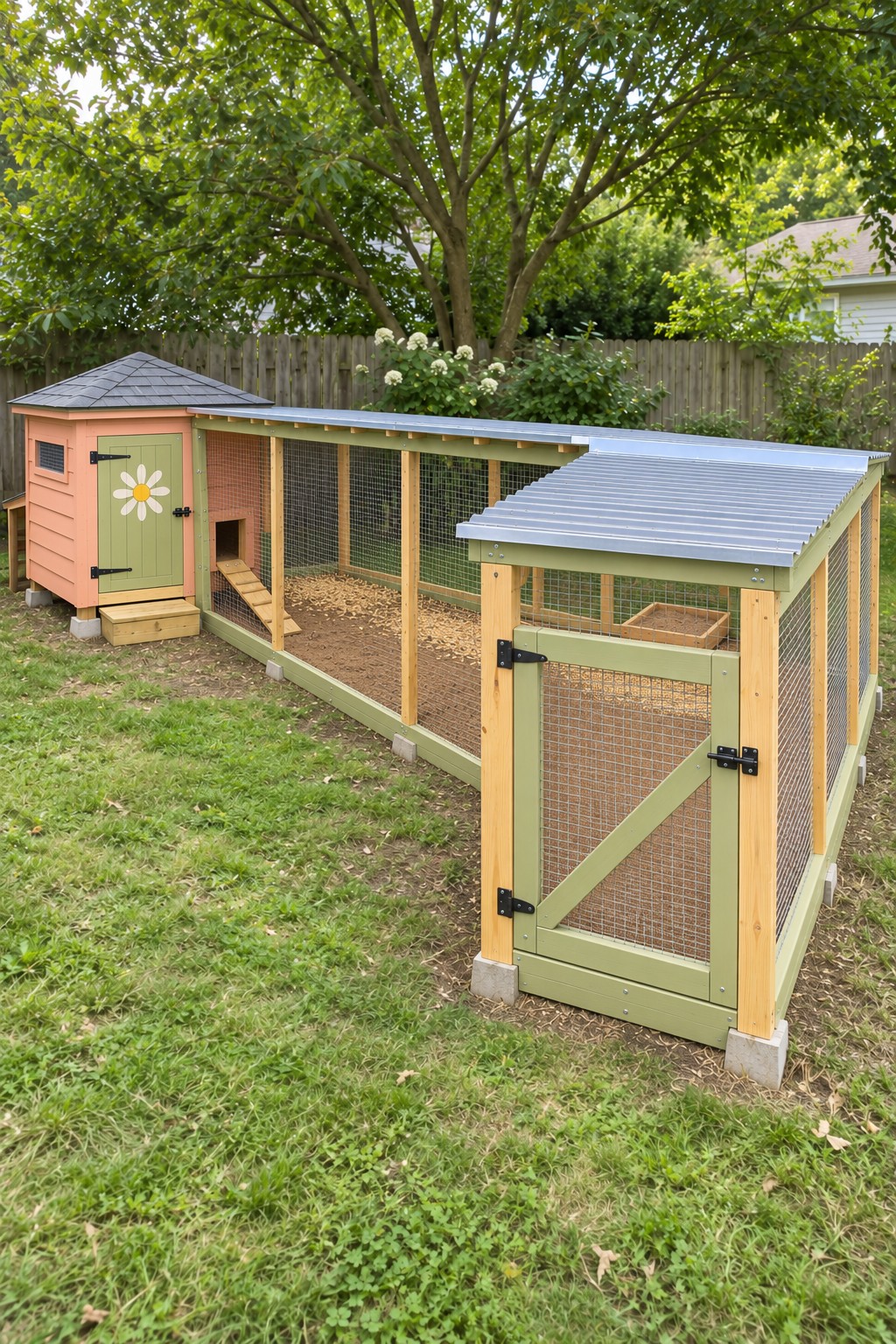
An L shaped run lets a long setup follow two sides of the yard instead of cutting across the lawn. Here a pink coop with a daisy painted door and a gray hip roof opens into a run trimmed in sage green, and the short leg ends at a braced door. Both legs carry a metal roof, so the hens have cover along the whole run, bend included.
Every post stands on a concrete deck block, a fast foundation for runs on uneven ground. Level the blocks first with a long straight board and a spirit level, and the frame will go together square.
Zigzag Run with a Chevron Door Coop
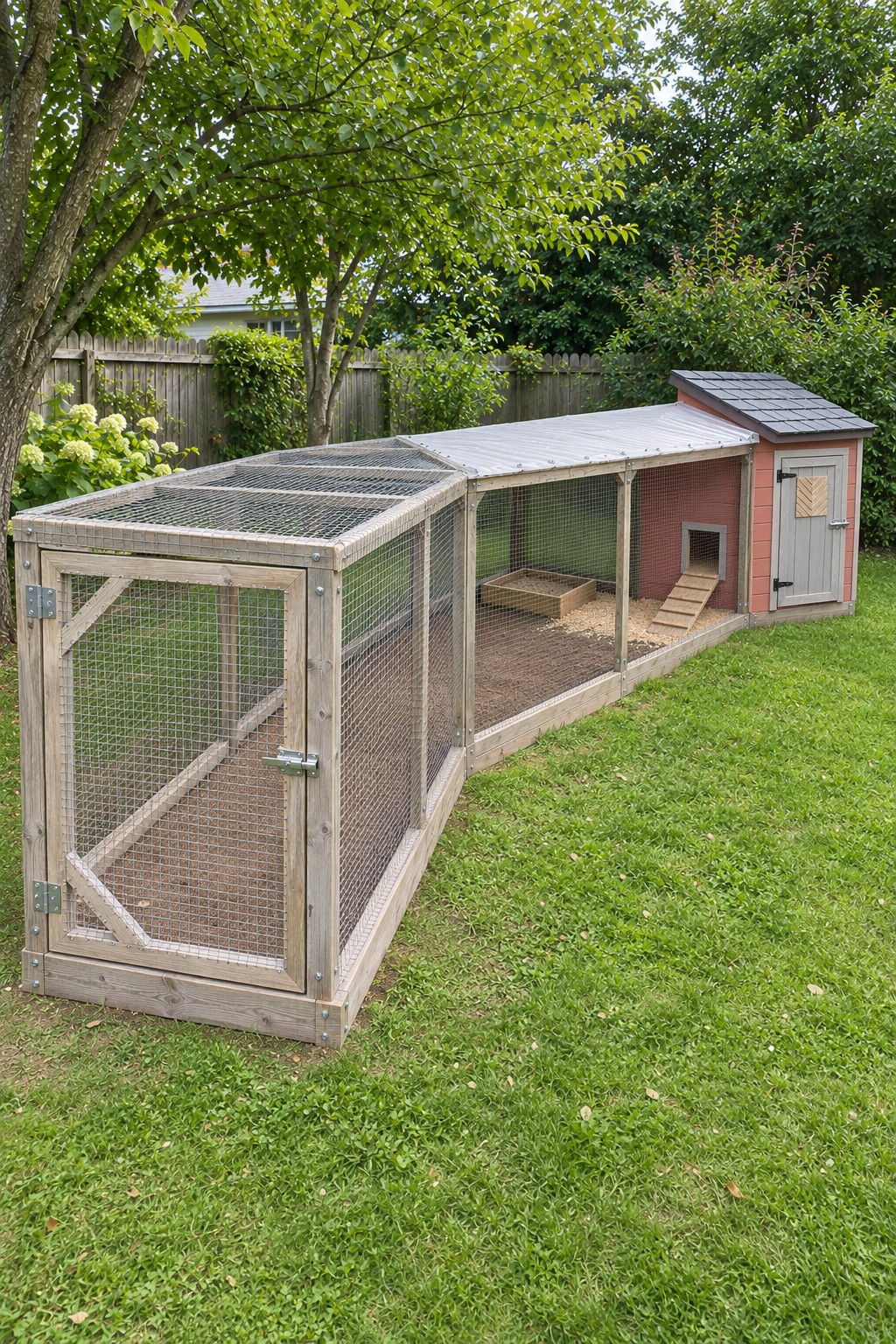
Built from short modular sections that meet at slight angles, this weathered gray run bends around the yard rather than forcing a straight line. Part of the roof is a translucent panel and the rest is mesh. At the end stands a small coral coop with a gray door decorated in a chevron pattern.
Modular sections are easier to build and move. Make each panel on a flat surface, then bolt neighboring frames together through their posts, and run hardware cloth across every joint so no gap opens at the angles.
Forest Green Coop with a Wraparound L Run
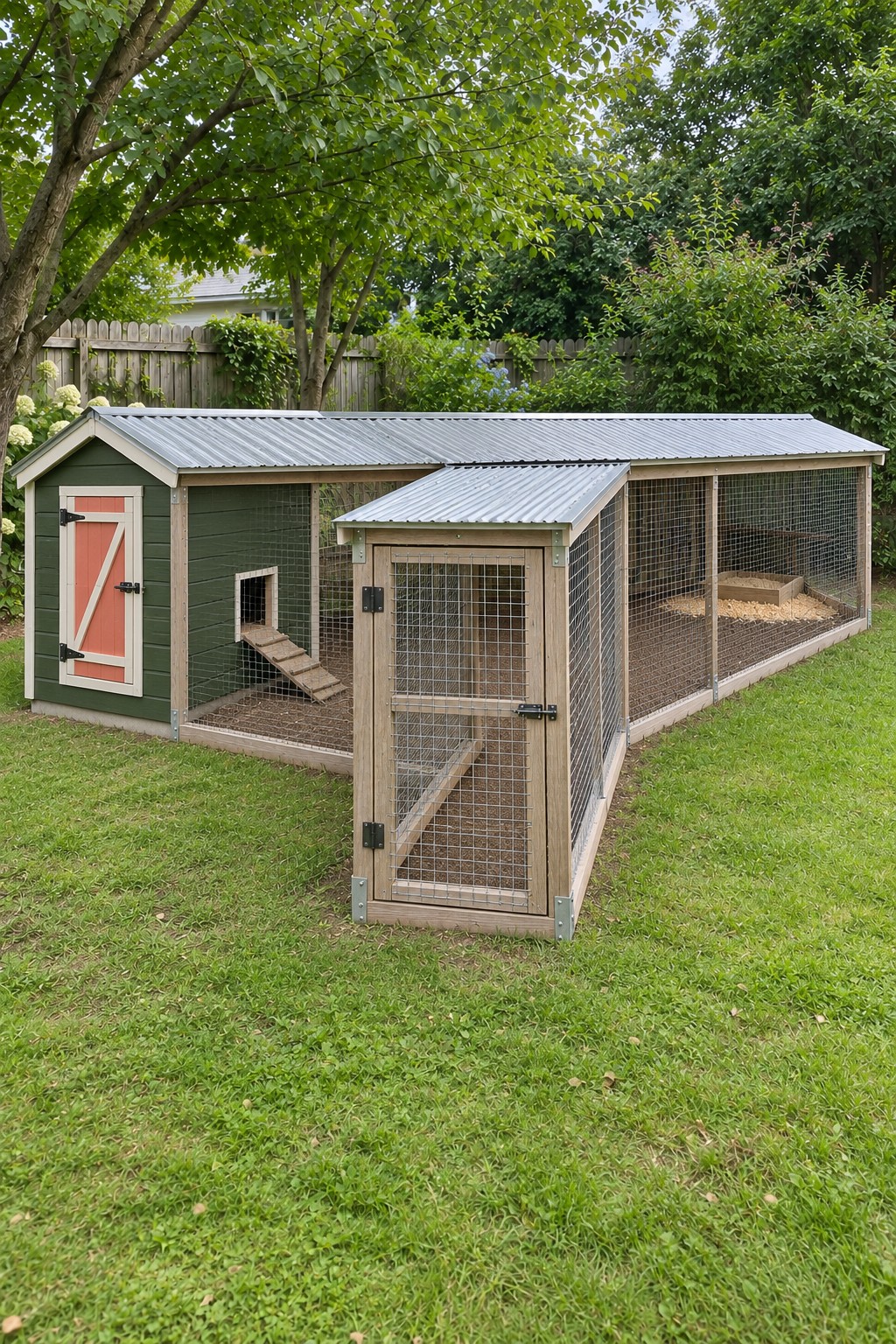
A dark green coop with a coral Z braced door and white trim anchors an L shaped run framed in gray washed lumber. One continuous corrugated metal roof covers both legs of the run, so the hens stay dry wherever they wander.
Where two roof slopes meet at the corner, a strip of valley flashing under the panels stops rain from dripping inside. The door at the end of the short leg is braced diagonally, a detail that helps it stay square for years.
Diamond Door Coop with a Straight Run
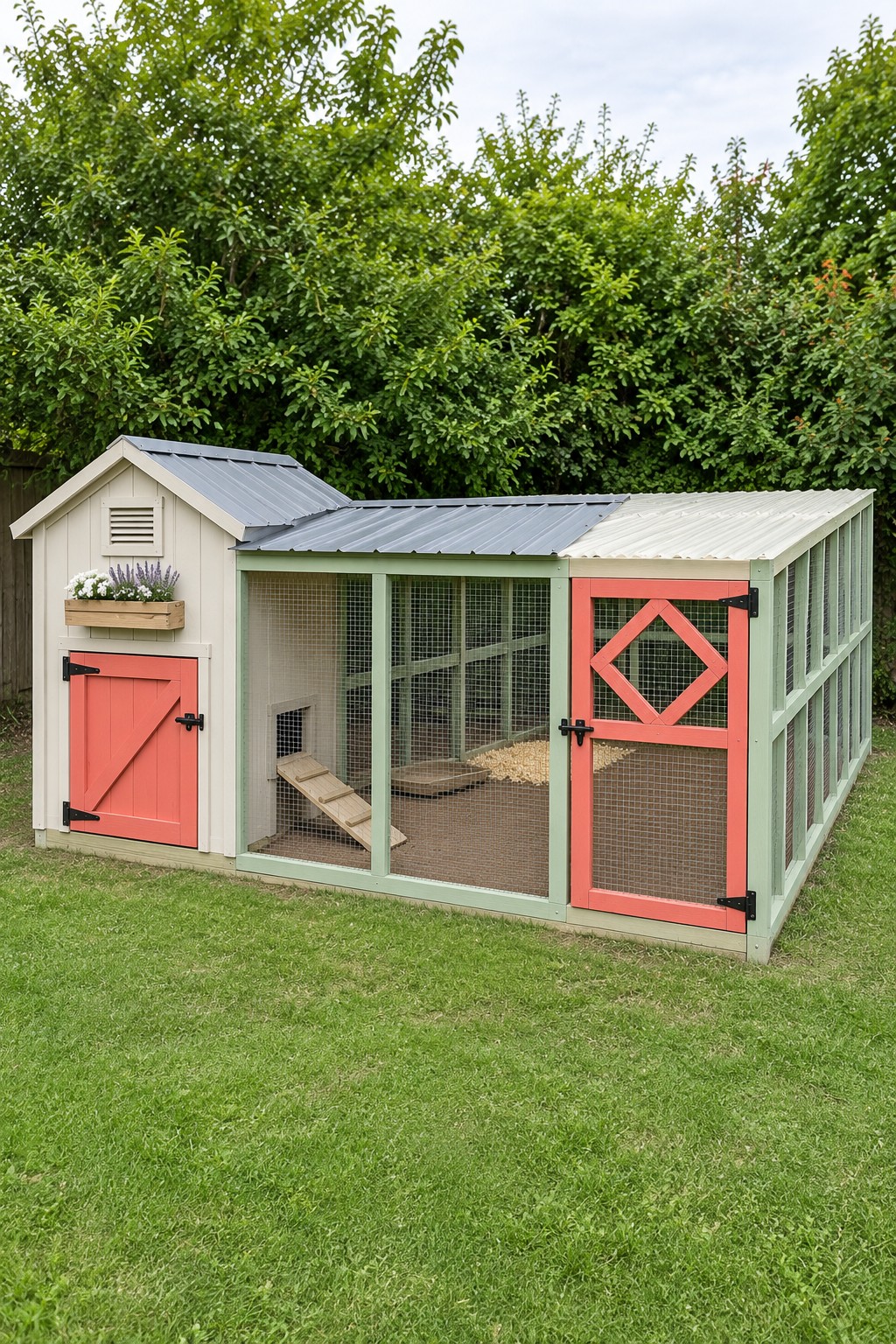
Coral doors against sage green framing give this cream coop and its run a cheerful, almost Scandinavian character. The coop door carries a simple Z brace, while the run door has a diamond inlay cut from the same boards as its frame and joined with half laps where the pieces cross, which also stiffens the door. A window box of lavender and white flowers sits on the coop wall above the small cleanout door.
The straight run follows the hedge under a roof that is metal at the coop end and translucent at the far end, and a louvered gable vent high on the coop lets warm air out. Painting only the doors in a strong color is an easy way to give a plain coop personality.
Octagon Run Beside a Barn Red Coop
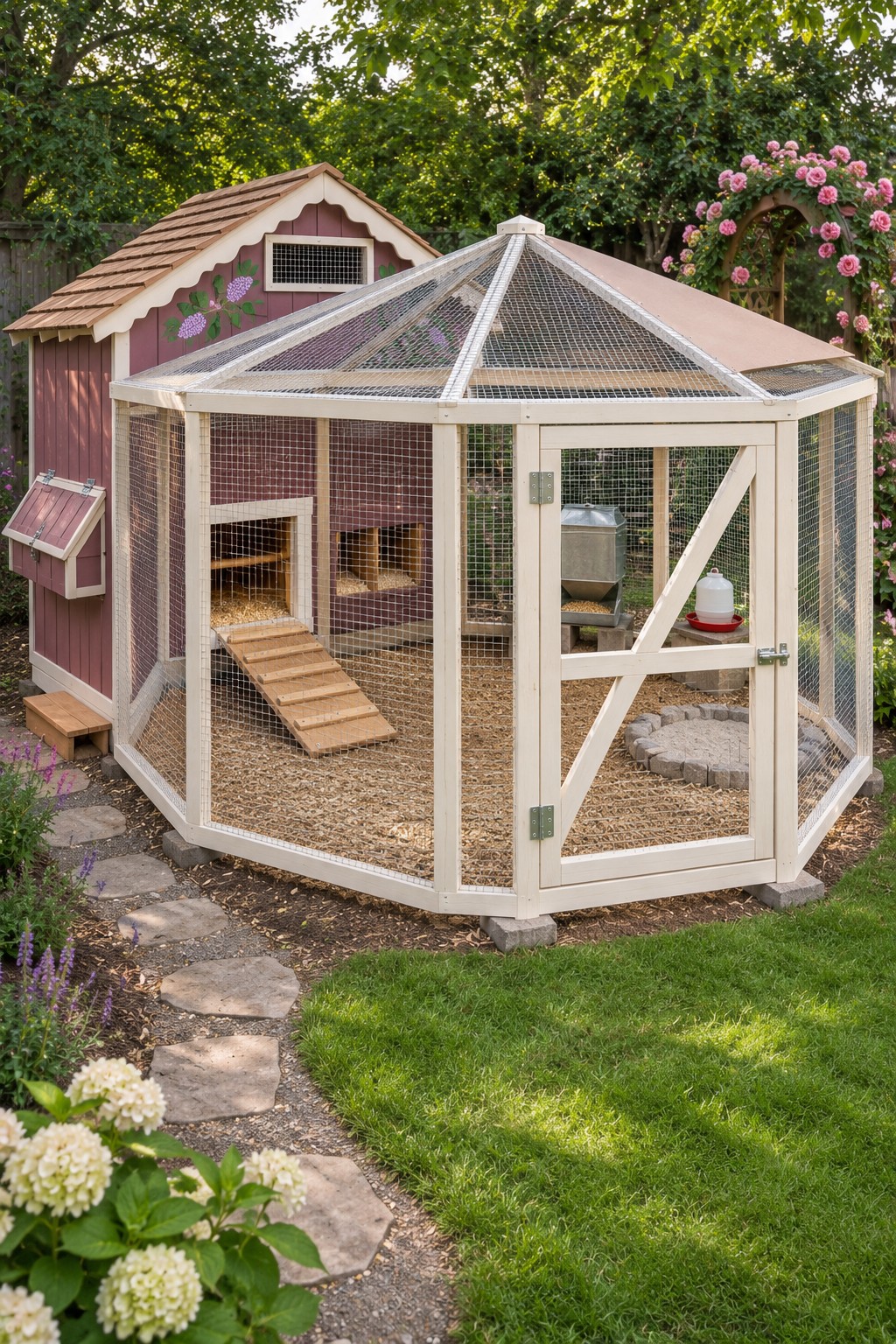
A many sided run shaped like part of an octagon, with a mesh roof and a solid cap at the center, sits against a barn red coop with gingerbread trim and painted lilac sprigs on the gable. On an octagon layout each panel end is cut at 22.5 degrees, so build one side panel as a template and copy it for every side you need.
Inside, a ring of bricks holds a sand dust bath, a galvanized feeder sits on blocks and a ramp climbs to the pop door. Concrete blocks under the corners keep the cream frame level, and a stepping stone path through hydrangeas leads to the door.
Walk In Runs and Farmhouse Coop Pairs
Greenhouse Frame Turned Walk In Run
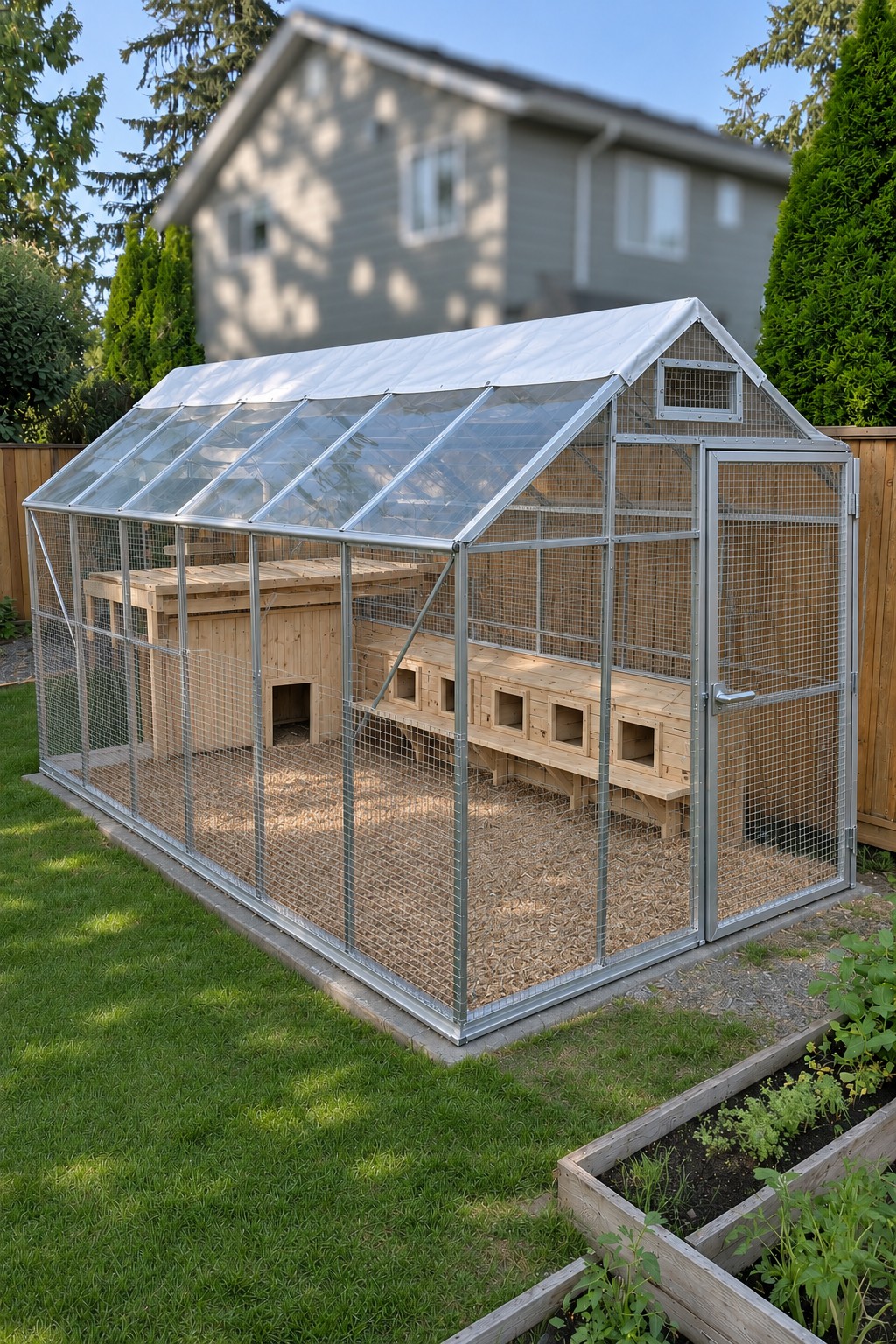
A metal greenhouse frame with a clear gable roof becomes a tall, rust resistant walk in run once the walls are clad in welded wire. Inside, a wooden coop and a row of nest boxes on a bench sit above deep wood shavings, and a low concrete curb around the base keeps the bedding in and digging animals out.
Greenhouse roofs trap heat quickly, so leave the gable vents open, add shade cloth over part of the roof in summer and keep one corner shaded at all times. Raised vegetable beds just outside make good use of the composted bedding.
Sage Board and Batten Coop with an Awning Window
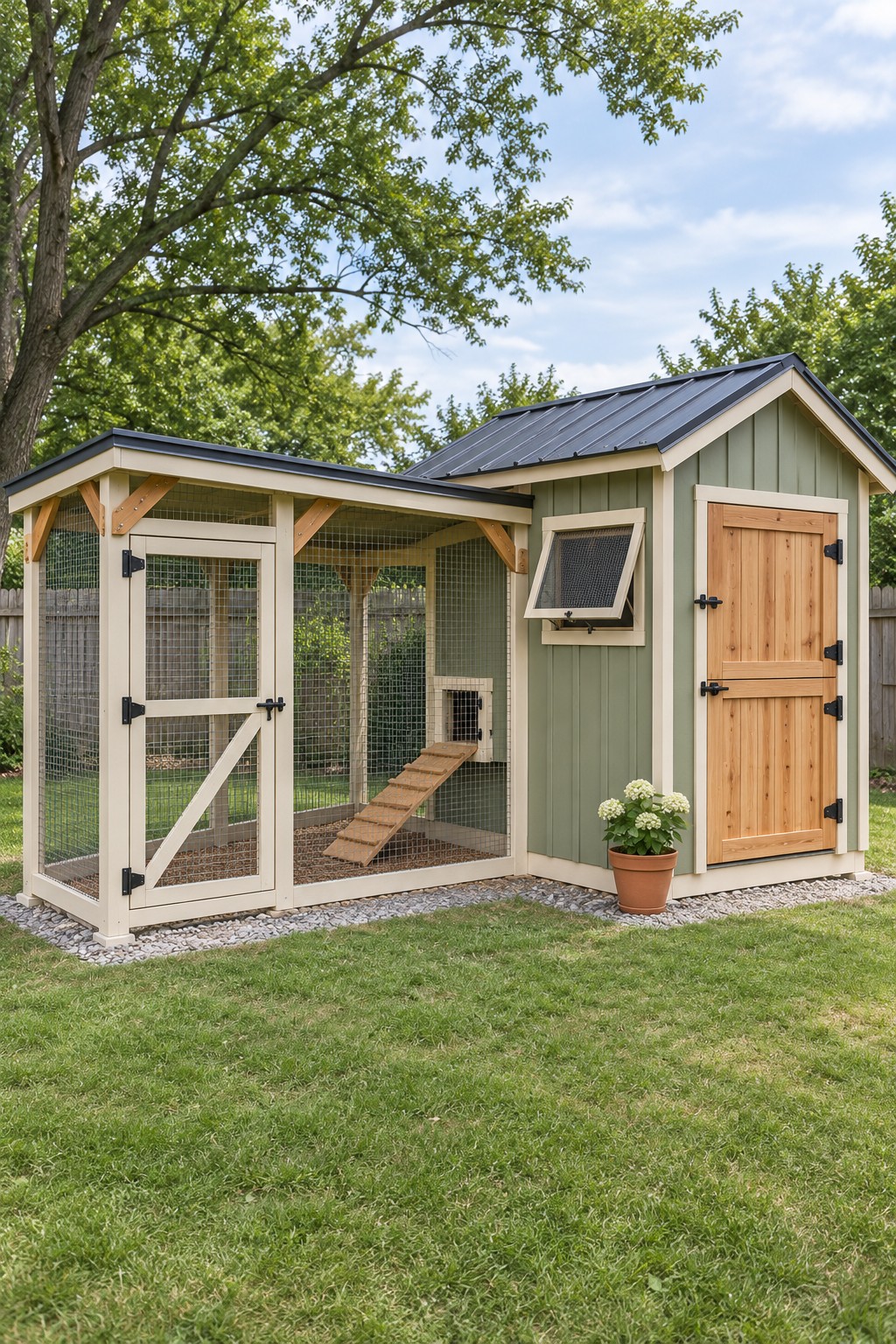
Sage green board and batten walls, a black standing seam roof and a natural cedar Dutch door give this coop classic farmhouse proportions. The awning window hinges at the top and props open with a stay, so it keeps the rain out even while open; screen it with hardware cloth and it can stay open all summer.
The covered run at the side has knee braces at each post, cream trim and a braced door, and a gravel strip around the base catches drips from the roof. Matching the run trim to the coop trim makes the two parts read as one building.
Timber Frame Run with a Sunburst Door
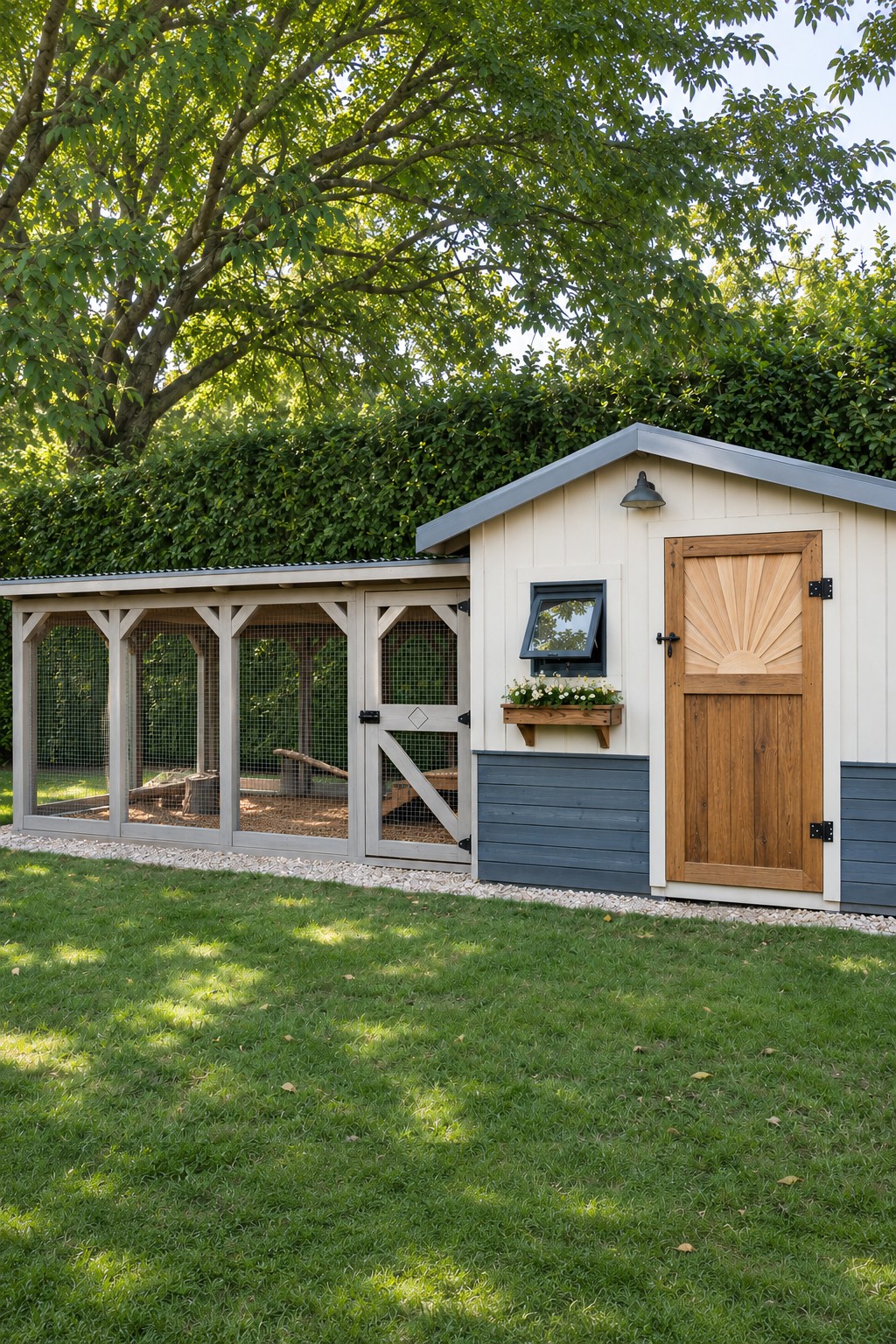
Gray washed posts joined by angled knee braces make this long run look like a small timber frame barn. The coop beside it pairs white board and batten above navy lap siding, with a barn light, an awning window, a window box and a wooden door inlaid with a sunburst pattern.
Knee braces are not only decorative; they stop a long run from leaning sideways. Cut them at 45 degrees and fix them into both post and beam with structural screws.
Tall Walk In Run with a Kite Painted Coop
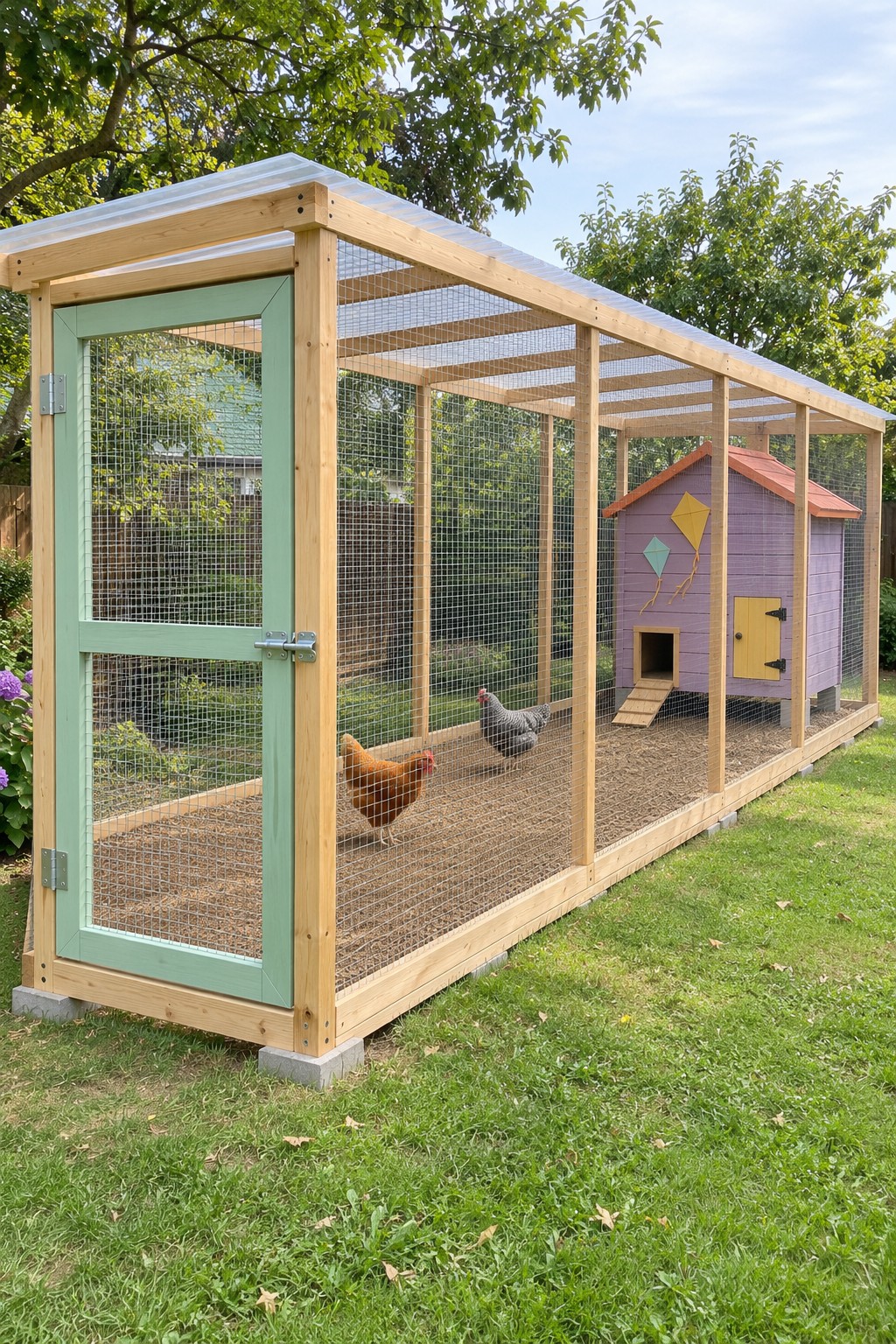
A tall run of natural lumber topped with clear roof panels gives plenty of headroom, and a mint green door at the front makes coming in easy even with a full feed bucket. Inside, a lavender coop with a red roof and painted kites stands on blocks, a short ramp leading to the pop door.
Placing a small coop inside a large covered run means the coop can be very simple, since the run already does the work of keeping predators out. Fix the base board to a deck block at every post and run the hardware cloth all the way down to the ground and out as an apron.
Gray Run with Diamond Rail Accents
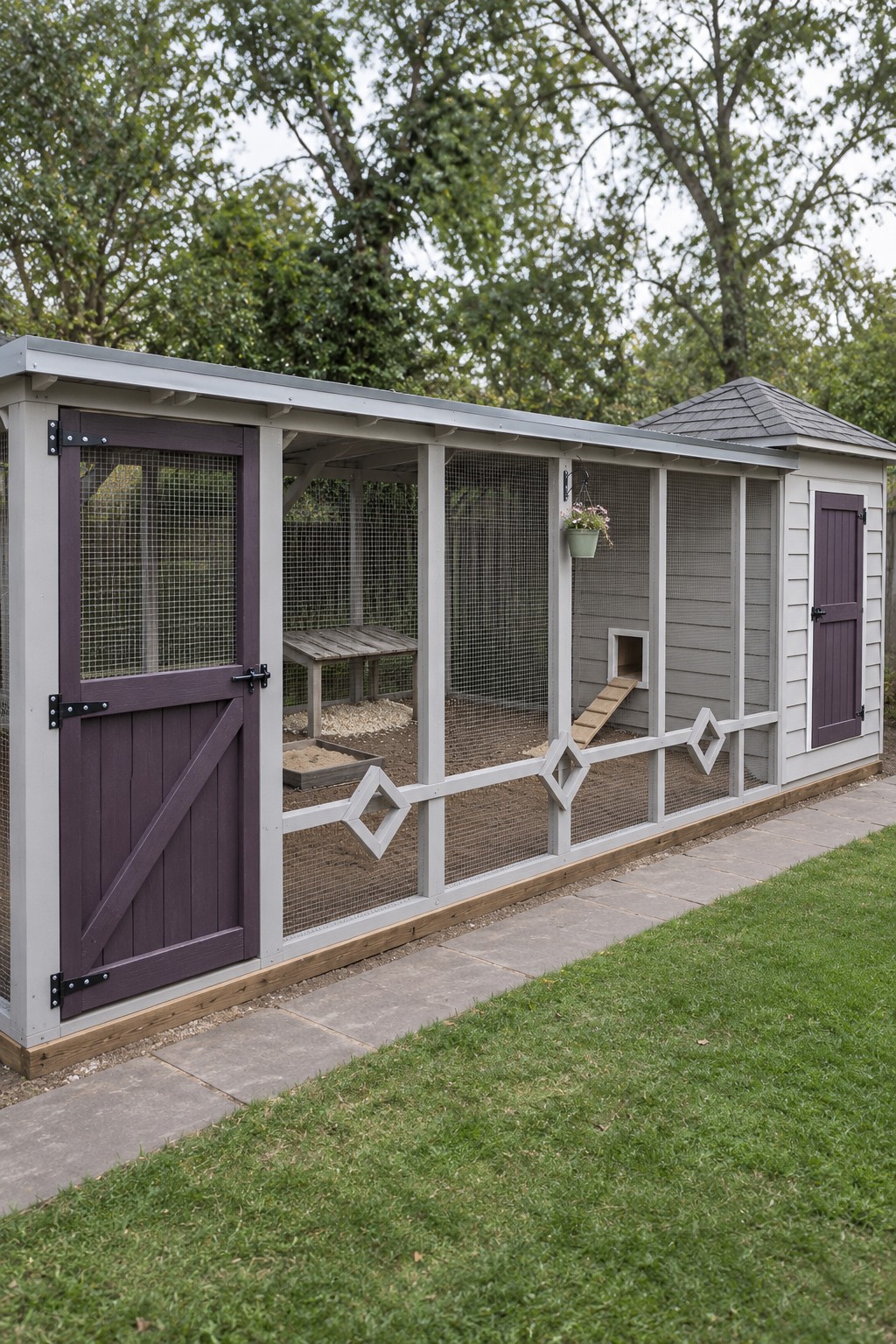
A gray coop with plum colored doors connects to a long covered run beside a paved path. The middle rail of the run carries small diamond frames at intervals, a simple trick that makes a long wall of mesh look designed. Inside there is a wooden bench perch, a sand box and a ramp to the pop door, and a hanging planter adds a little green.
Plum toned doors look elegant against soft gray paint. Cut each diamond from narrow boards with 45 degree miters and fix it over the rail with waterproof glue and brad nails.
White Farmhouse Coop with a Cedar Dutch Door
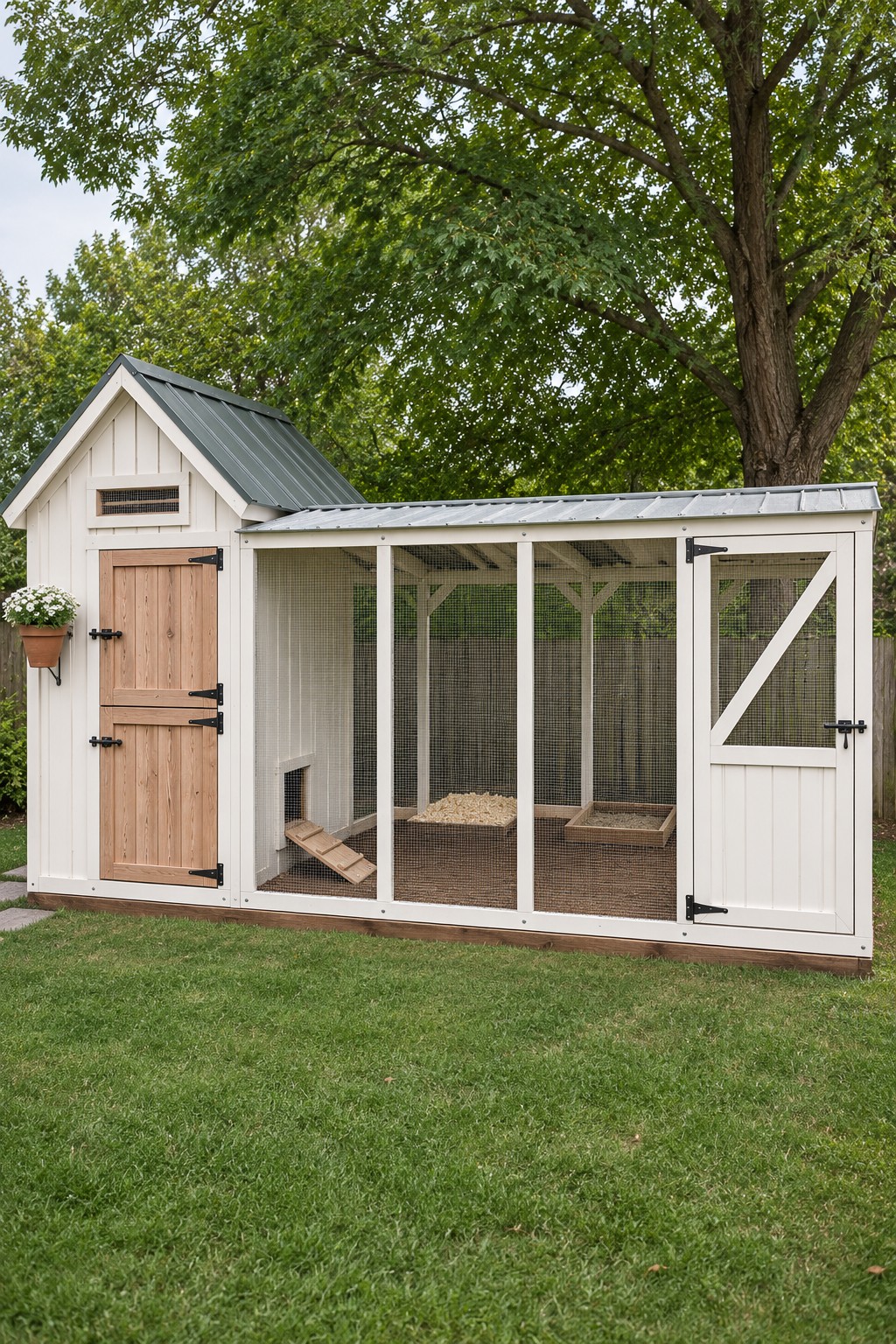
Crisp white board and batten, a green metal roof and a natural cedar Dutch door give this coop the simplicity of an old dairy barn. The run under a single sloping roof is framed in white with a Z braced door, and inside two shallow framed boxes hold sand and straw.
A Dutch door is practical as well as pretty: open the top for air while the bottom stays shut so hens cannot rush out. Seal unpainted cedar with a clear exterior oil so it weathers evenly.
Raised Coop Under One Long Roof
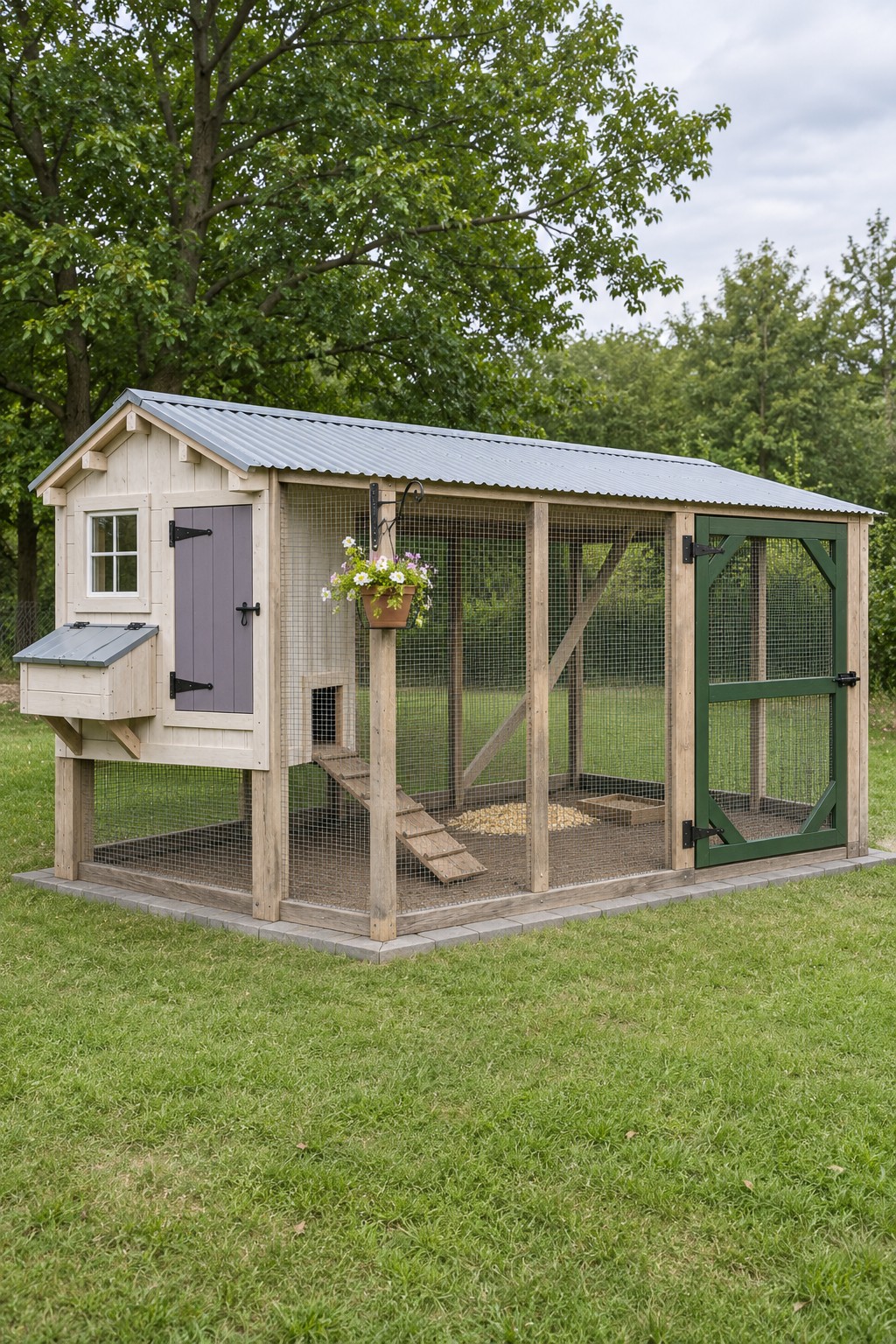
Here the coop and the run share one corrugated metal gable roof, with the coop raised on posts at one end and a tall walk in run filling the rest. Because the coop floor sits well off the ground, the run continues underneath it as a shady retreat. A purple coop door, an exterior nest box with a metal lid and a dark green run door add color to the natural wood.
A single roof over both parts is simpler to build and keeps feed, bedding and you dry during chores. A hanging basket at the corner and a paver edge around the base finish it neatly.
Slate Blue Coop with a Covered Run
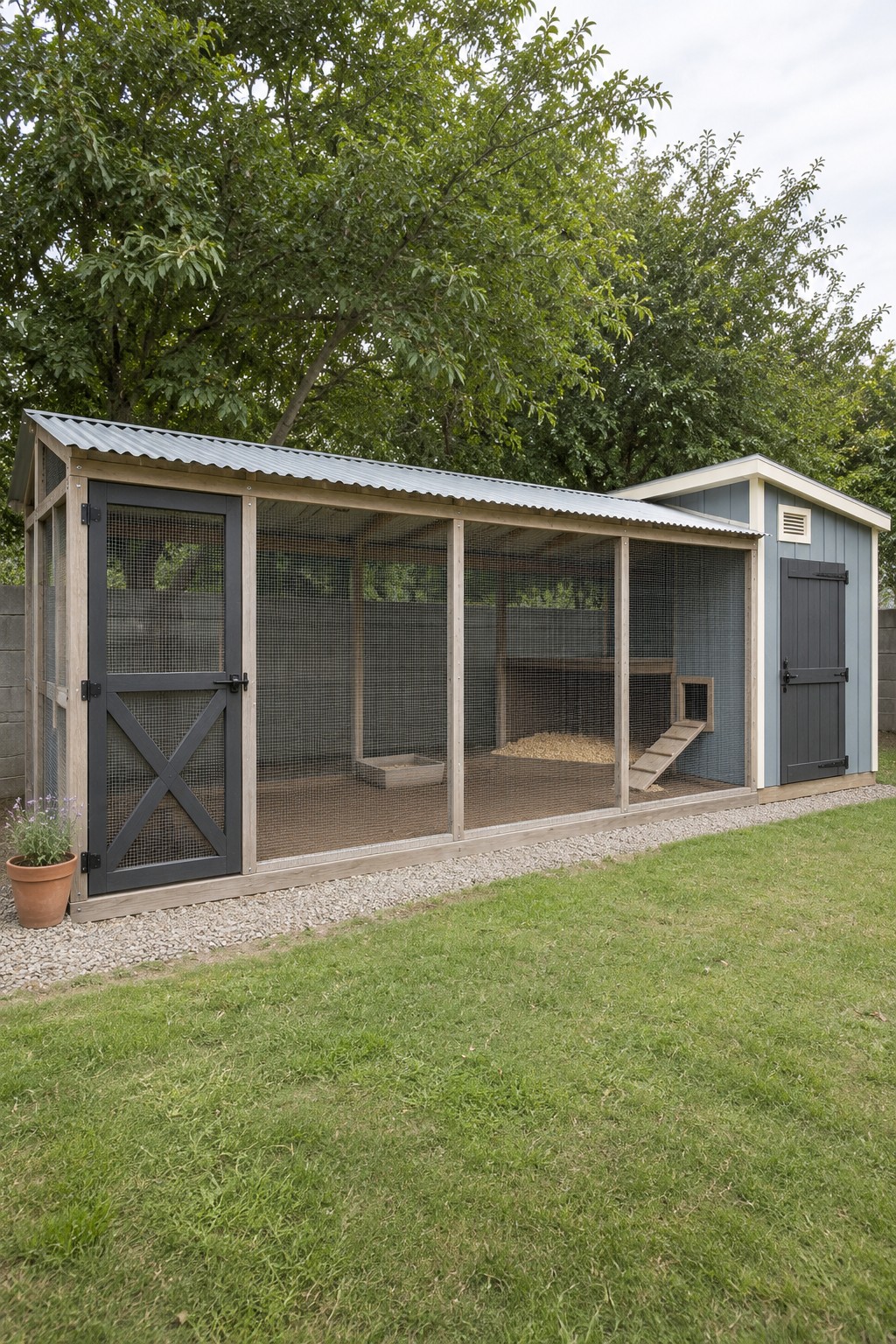
A slate blue coop with charcoal doors and a long, gray washed covered run makes a calm, modern pairing. The run door uses a classic X brace, and inside a raised bench perch, a sand box and a ramp give the hens different levels to use.
Dark doors hide scuffs and dirt far better than white ones, and gray washed lumber blends easily with weathered fences. A gravel strip along the front catches roof runoff and keeps mud from splashing onto the paint.
Choosing the Coop That Suits Your Yard
Start with the space you actually have. A narrow side yard suits a low run with lift up lids, a corner of the vegetable garden suits a coop that trades greens for compost, and an open lawn can take a hoop run or a tractor that moves every few days. Then let the style follow your house, so the coop looks like it belongs rather than like an afterthought.
Whatever look you choose, the details nobody photographs are the ones that matter most: hardware cloth instead of chicken wire, a dry base, high ventilation and doors placed so cleaning takes minutes. Get those right and the paint, the trim and the flowers become the fun part. For more weekend builds outside, our backyard project ideas are a good next stop.
Safety Notes Before the Hens Move In
- Wash your hands with soap and water after touching hens, eggs, feeders or anything inside the coop, even when the hens look perfectly healthy, because poultry can carry Salmonella without showing any sign of it. Avoid kissing or cuddling hens close to your face, and help young children wash up after every visit to the flock.
- Wear gloves and a dust mask when scraping droppings or changing bedding, keep coop boots and tools outside the house, and clean feeders and waterers outdoors rather than in the kitchen sink.
- Use safety glasses and hearing protection with saws and nailers, and wear a dust mask when cutting treated lumber. Never burn treated offcuts or use them for firewood.
- Leave old painted boards from salvage out of the coop unless you know the paint is lead free, since hens peck at flaking paint.
- Finish painting and gluing before the hens arrive, and keep the coop open to the air until every trace of smell has gone.
- Chickens cope with cold far better than heat and start to struggle above about 90°F (32°C). Clear roofs, metal shells and plastic playhouses warm up quickly, so give every design shade, high vents and fresh water in summer.
- Tomato leaves, vines and green fruit, along with plants such as tulips, foxglove, rhododendron and yew, can make chickens ill. Grow them where the flock cannot reach.
- Cut edges of hardware cloth and corrugated metal are sharp. Fold them back, file them or cover them with a trim board so neither you nor the chickens get hurt.
- Check that the structure can carry its load before adding a living roof or facing a snowy winter, and hold down light runs with stakes or heavy stones so a storm cannot lift them.
- Shut the flock into the coop every night. Even a well built run can be tested by a determined predator, and an automatic door makes this habit effortless.





Leave a Reply