

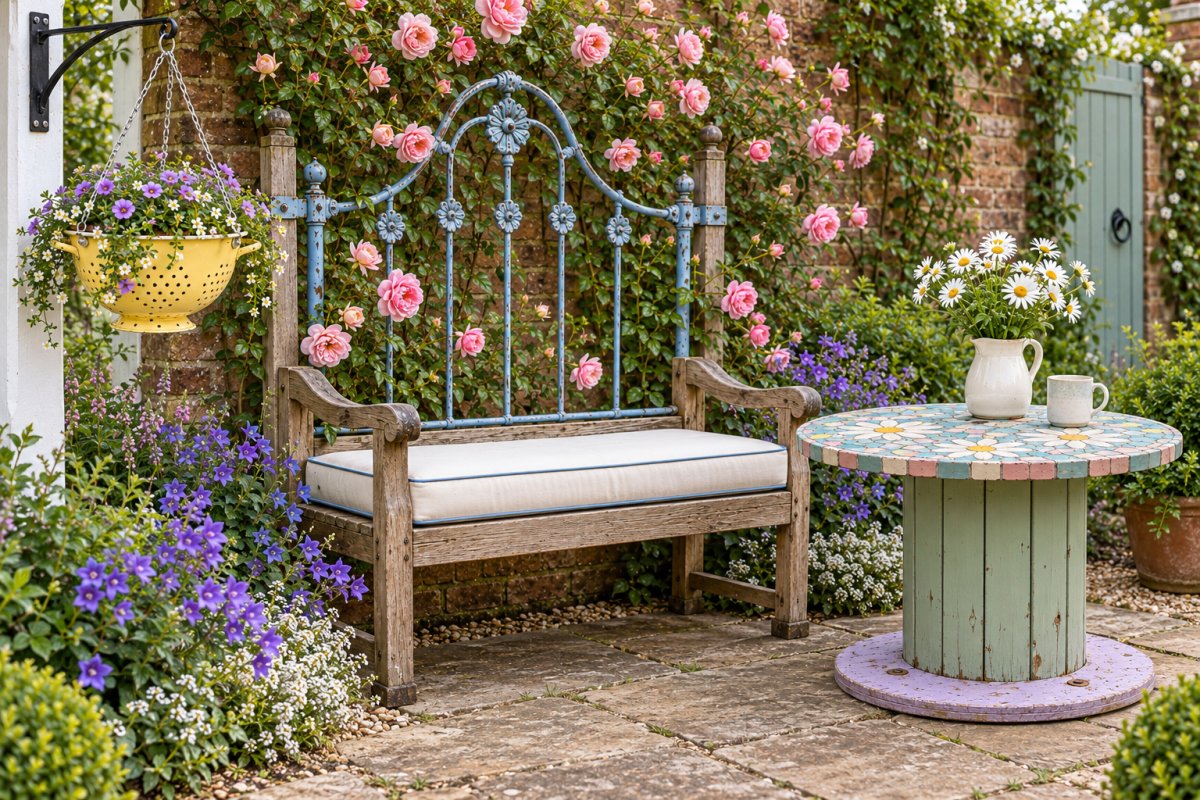
Upcycled vintage garden decor works best when a reclaimed object's shape contributes something useful to the garden. A broad bench invites a pause, an upright sled gathers flowers into a narrow footprint, and a patterned tabletop gives a quiet corner a clear center. The aim is to preserve recognizable details while making space for watering, walking, and the changing size of living plants.
These 28 ideas are for small yard owners, renters, and gardeners who want to work with secondhand pieces before buying more outdoor furniture. The order begins with seating and architectural salvage, moves through decorative containers and vertical arrangements, and finishes with garden ornaments and a covered porch cabinet. Each section explains the visible materials, the reason for the arrangement, a way to recreate it, and an adjustment for limited space or money. The planning notes address drainage, planting conditions, and the connections that deserve closer attention before a heavy object becomes part of everyday garden life.
Table of Contents
- Make Vintage Garden Finds Work Outdoors
- Plan the View and the Walking Route
- Match Containers to Roots and Rain
- Let the Plants Set the Location
- Resolve Weight and Weather Before Decorating
- 1. Roses Beside a Blue Headboard Bench
- 2. A Patio Counter Framed by Red Shutters
- 3. Lavender Auricula Theater
- 4. Succulent Rosettes in a Mosaic Sink
- 5. Fuchsias Inside a Green Fireplace Surround
- 6. Floral Mosaic Patio Rug
- 7. Yellow Colander Basket
- 8. Daisy Mosaic Spool Table
- 9. A Burgundy Suitcase Filled with Marigolds
- 10. Blue Enamel Box and Petunias
- 11. Chimney Pot Flower Pedestals
- 12. Pink Baby Bath and Fuchsias
- 13. Petunias Spilling from a Mint Mailbox
- 14. Lavender Chandelier and White Flowers
- 15. A Painted Flowerpot Inside a Yellow Birdcage
- 16. Coral Tea Cart and Floral Teapot
- 17. Mint Balance Scale and Daisy Pots
- 18. Coral Screen and Tulip Containers
- 19. Enamel Troughs on an Upright Wooden Sled
- 20. Blue Carriage with Begonias and Lobelia
- 21. Fan Blade Daisy and Marigolds
- 22. A Flower Basket Framed by Ornate Molding
- 23. Yellow Coat Stand and Woven Baskets
- 24. Mint Plant Stand and Colanders
- 25. Tennis Racket Sweet Pea Trellis
- 26. Mushroom Ornaments Made from Colanders
- 27. A Flower Wagon Beneath a Gingham Canopy
- 28. Grandfather Clock Plant Cabinet
- Where to Start
Make Vintage Garden Finds Work Outdoors
Plan the View and the Walking Route
Place the largest object before arranging smaller pots. A headboard bench needs an unobstructed approach; a wheeled carriage needs room that its handle and wheels will not interrupt. Repeat a flower color or painted finish across nearby objects, but leave enough undecorated ground for their outlines to remain readable. Open doors and pull out chairs before settling the arrangement.
Match Containers to Roots and Rain
Inspect the bottom of a reclaimed container before planting. Drainage openings, root space, and access for watering matter more than an attractive rim. If a decorative vessel cannot release water, grow in a removable pot and empty water collected in the outer vessel. This is a growing method to plan, not an assumed feature of every container. The University of Maryland's container advice explains drainage and why a layer of gravel cannot replace an outlet.
Let the Plants Set the Location
Observe sunlight across the proposed position before deciding on flowers. A porch cabinet and an open lawn offer different growing conditions, even when both look bright. Group plants by moisture needs, allowing for mature spread. Succulent rosettes and thirsty flowering plants should not share a watering routine simply because their colors work together. Protect seasonally tender plants according to the species and local climate.
Resolve Weight and Weather Before Decorating
Wet potting mix adds weight to hooks, shelves, and stands. Inspect wood for rot, metal for rust holes, and joints for movement under gentle pressure; visible fasteners alone cannot establish load capacity. Identify old paint before sanding or drilling, following EPA advice on lead paint dust. Reserve fragile indoor finishes for a covered position and inspect outdoor mosaics after freezing weather.
1. Roses Beside a Blue Headboard Bench
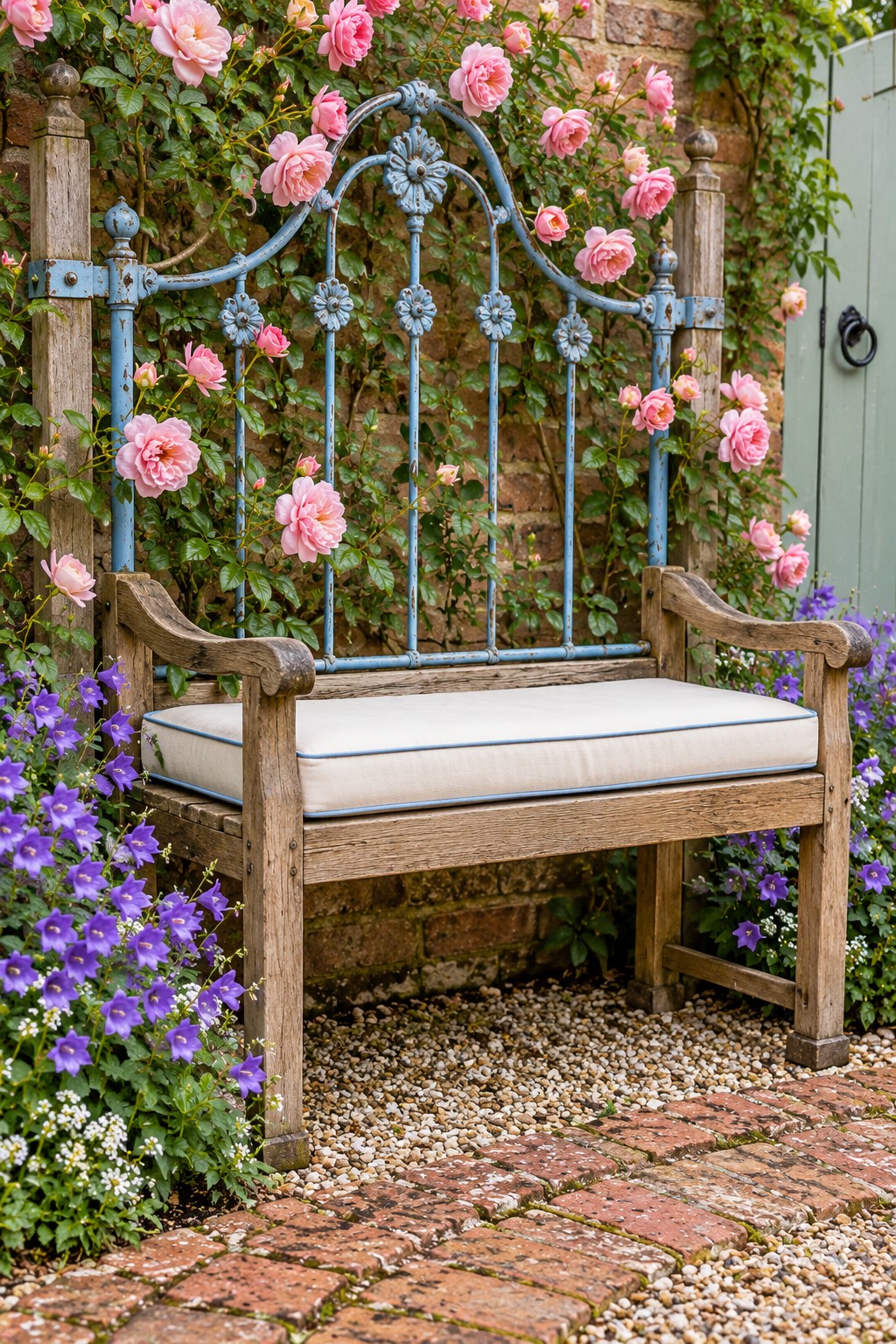
A blue metal headboard forms the back of a wooden bench with a white cushion, while pink roses and purple flowers soften the tall posts. The open headboard lets the brick wall remain visible, so the bench feels defined without closing the corner. Combine a reclaimed headboard with a wooden bench whose seat and arms do not wobble when pressed. Rose stems need pruning away from the cushion and the space occupied by a seated person. Shorten the bench for a small courtyard while retaining the blue headboard and pink roses as the main accents.
2. A Patio Counter Framed by Red Shutters
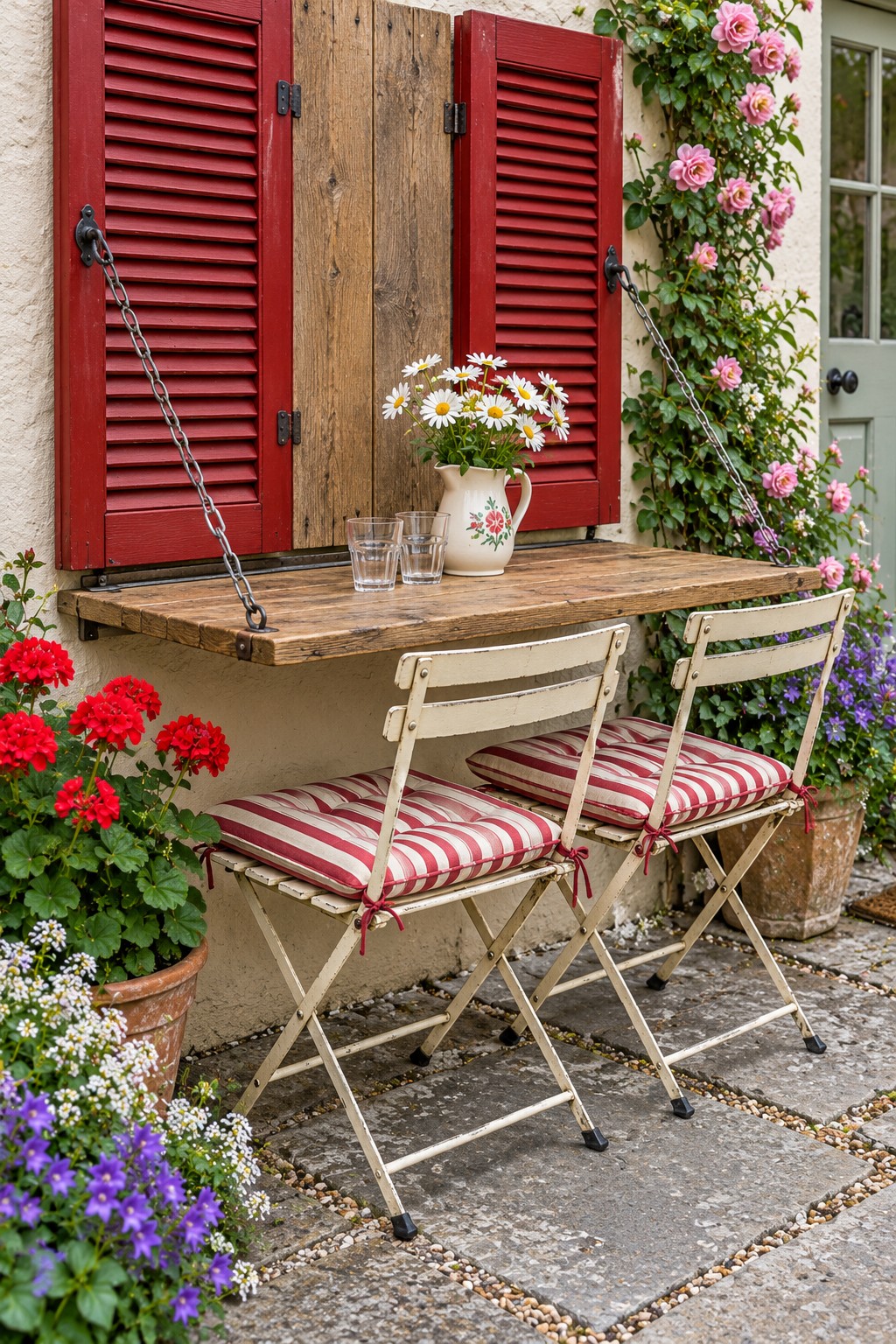
Red shutters frame a wooden counter, with cream folding chairs and red striped cushions arranged along the paving. Repeating red in the cushions connects the seating to the shutters, while the plain wooden surface leaves room for a floral pitcher and drinking glasses. Paint reclaimed shutters, then hinge a wooden counter to the wall beneath them and support its outer edge with taut chains. An installer should assess the hinges, chain attachments, and wall connections before anyone leans on the counter. Narrow the counter for a compact patio while retaining enough depth for the pitcher and glasses.
3. Lavender Auricula Theater
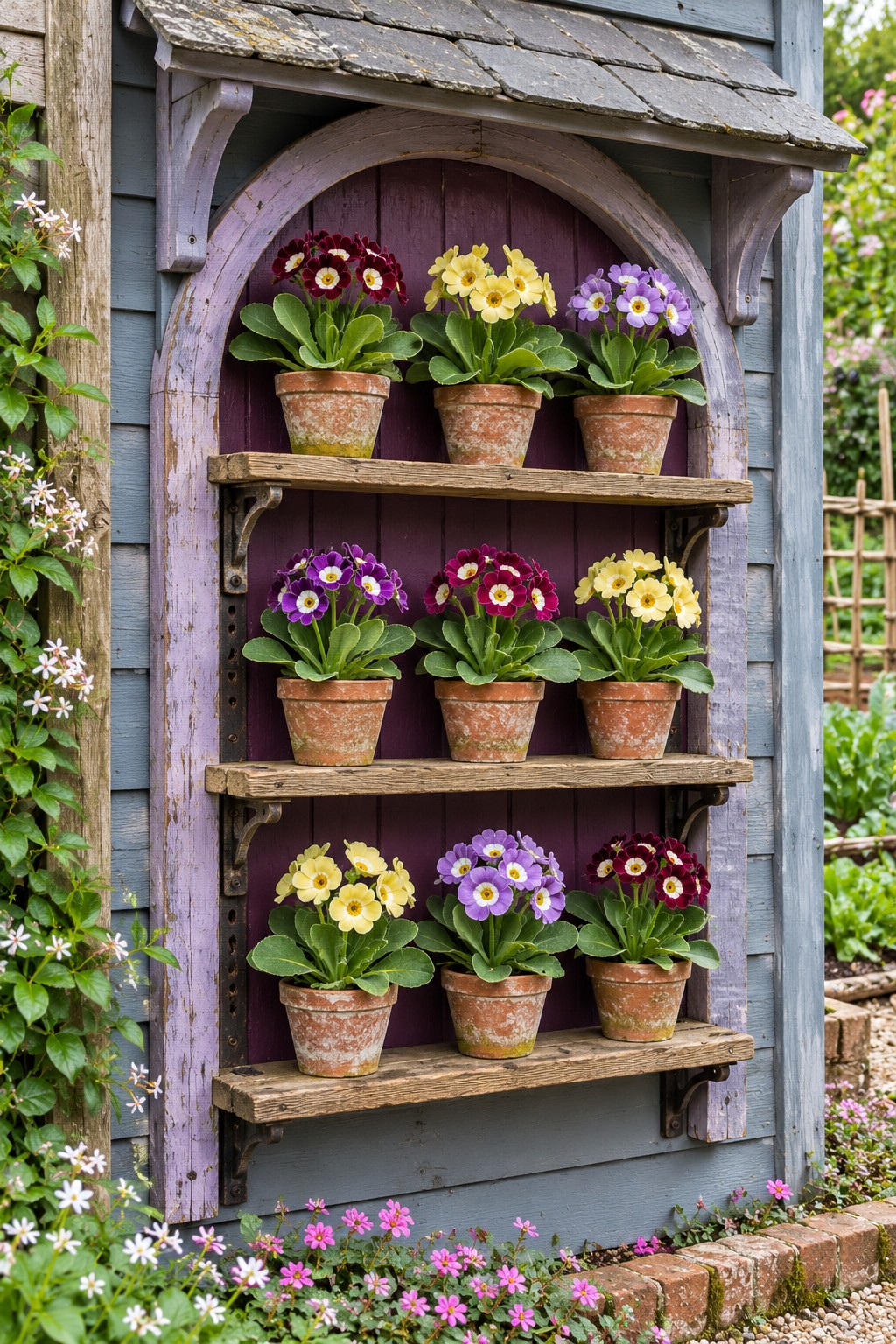
A lavender auricula theater arranges terracotta pots of yellow, purple, and burgundy auriculas against a plum backing. An auricula theater is a set of display shelves that presents individually potted auriculas in rows. Matching pots and repeated spacing emphasize the flowers instead of competing with their colored centers. Build the wooden arch, shelves, and small roof with brackets fixed into wood that has no soft or rotten areas. The roof helps with the protection from rain and strong summer sun that the RHS auricula growing guide recommends, although the RHS itself suggests a cold frame, an unheated greenhouse, or shade for show plants. Reduce the theater to a single shelf for a small collection, preserving the lavender surround and plum background.
4. Succulent Rosettes in a Mosaic Sink
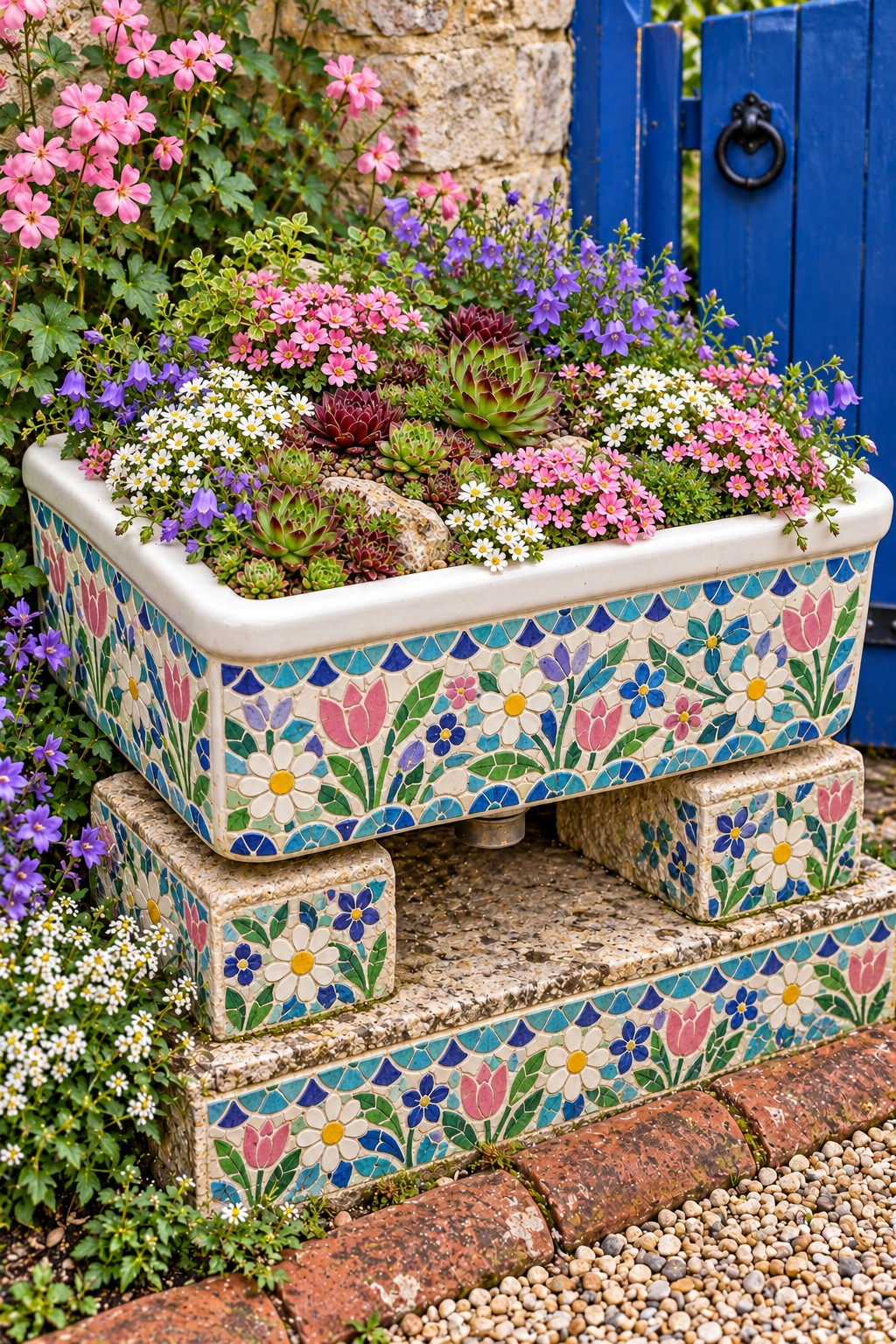
A floral mosaic sink contains green and burgundy succulent rosettes, small pink and white flowers, and purple bell shaped flowers. Blue, pink, and cream mosaic pieces repeat the planting colors, while the plain white rim gives the busy decoration a clear boundary. Begin the decorative work with a sink that has no cracks, concentrating the mosaic on the outer surfaces and preserving the drain. For growing conditions, follow RHS guidance on houseleeks and plan a succulent planting separately from flowers needing frequent watering. Limit the design to a smaller sink and a simpler floral border when weight or tiling time is a concern.
5. Fuchsias Inside a Green Fireplace Surround
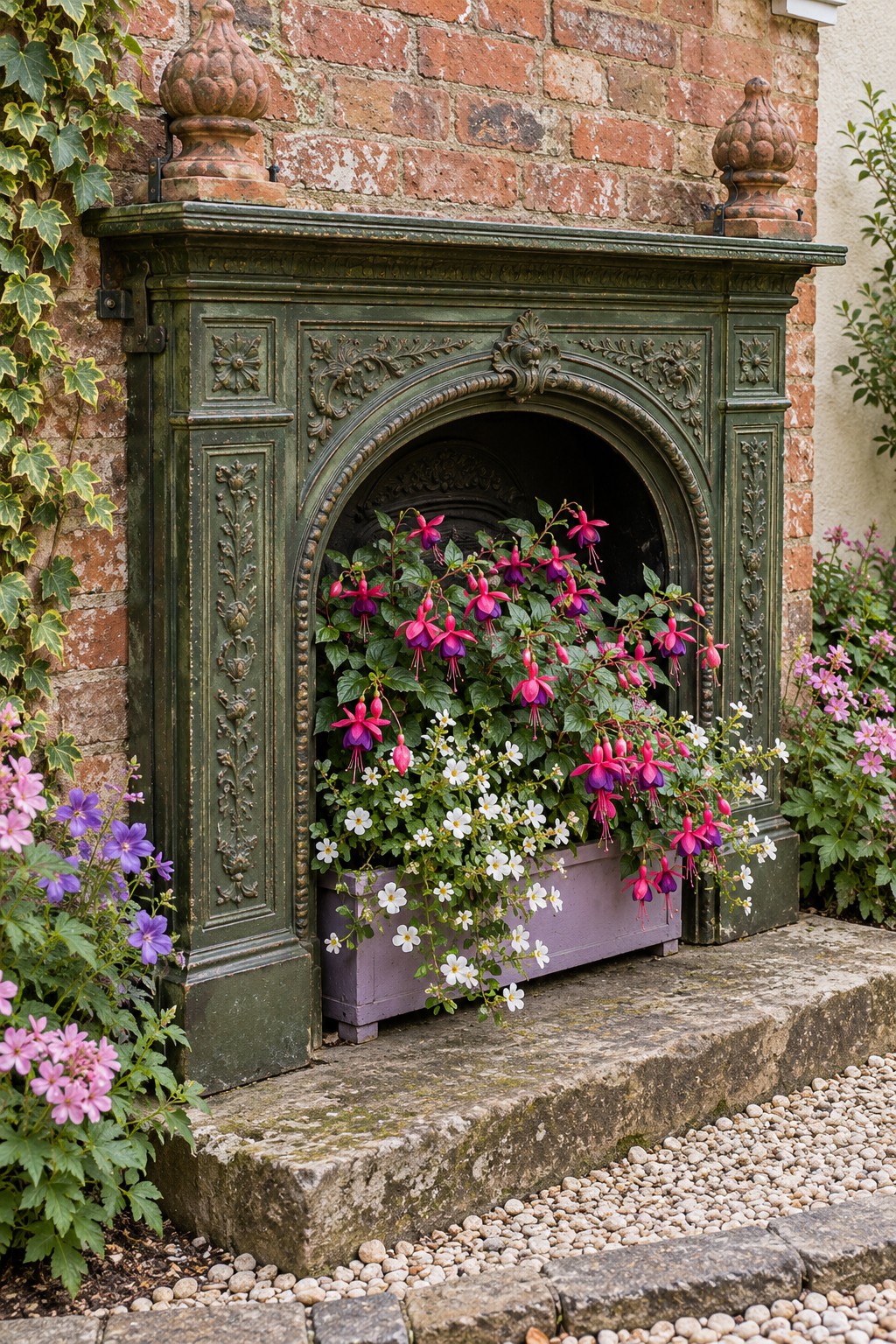
An ornate green fireplace surround frames pink and purple fuchsias growing from a lavender flowerbox with trailing white flowers. The dark fireplace opening makes the pendant blooms easier to distinguish against the surrounding brick. Anchor an empty fireplace surround to masonry and position a flowerbox on the stone base inside the fireplace opening. Have the masonry attachments assessed before placing a heavy surround where it could fall forward. Scale the flowerbox to fit a smaller surround, leaving a visible green border around the fuchsias rather than filling the entire opening.
6. Floral Mosaic Patio Rug
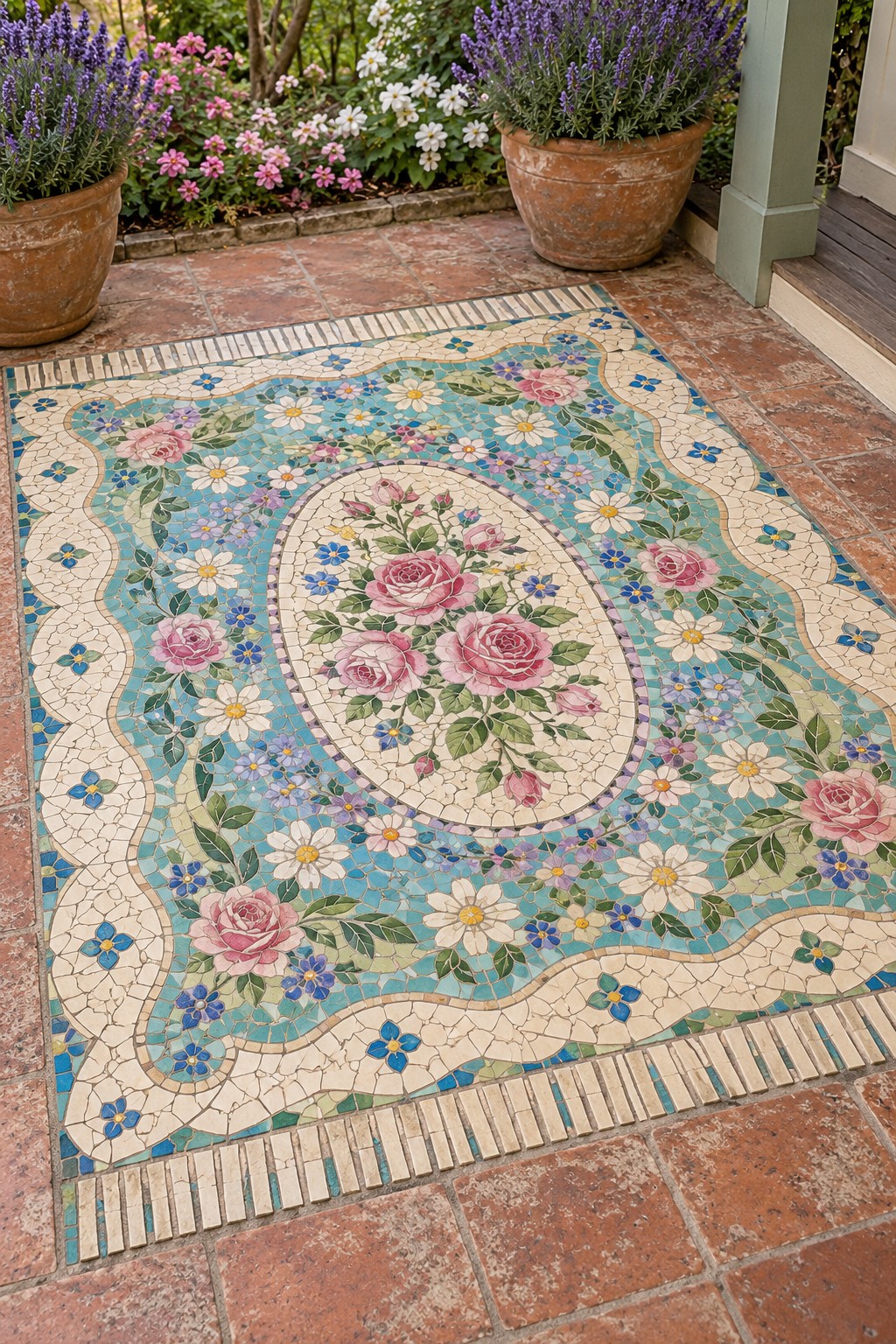
Pink roses, white daisies, and turquoise borders form a floral mosaic patio rug surrounded by terracotta tiles. A mosaic rug means a pattern laid into paving to define an area without a loose floor covering. Sketch the cream border and floral center before selecting tile for outdoor foot traffic. Follow LATICRETE’s exterior installation advice on waterproofing and freeze and thaw protection, and keep the mosaic level with the surrounding paving. Shrink the mosaic to a small rectangular accent on an existing patio, using fewer floral shapes so the turquoise and cream borders remain clear.
7. Yellow Colander Basket
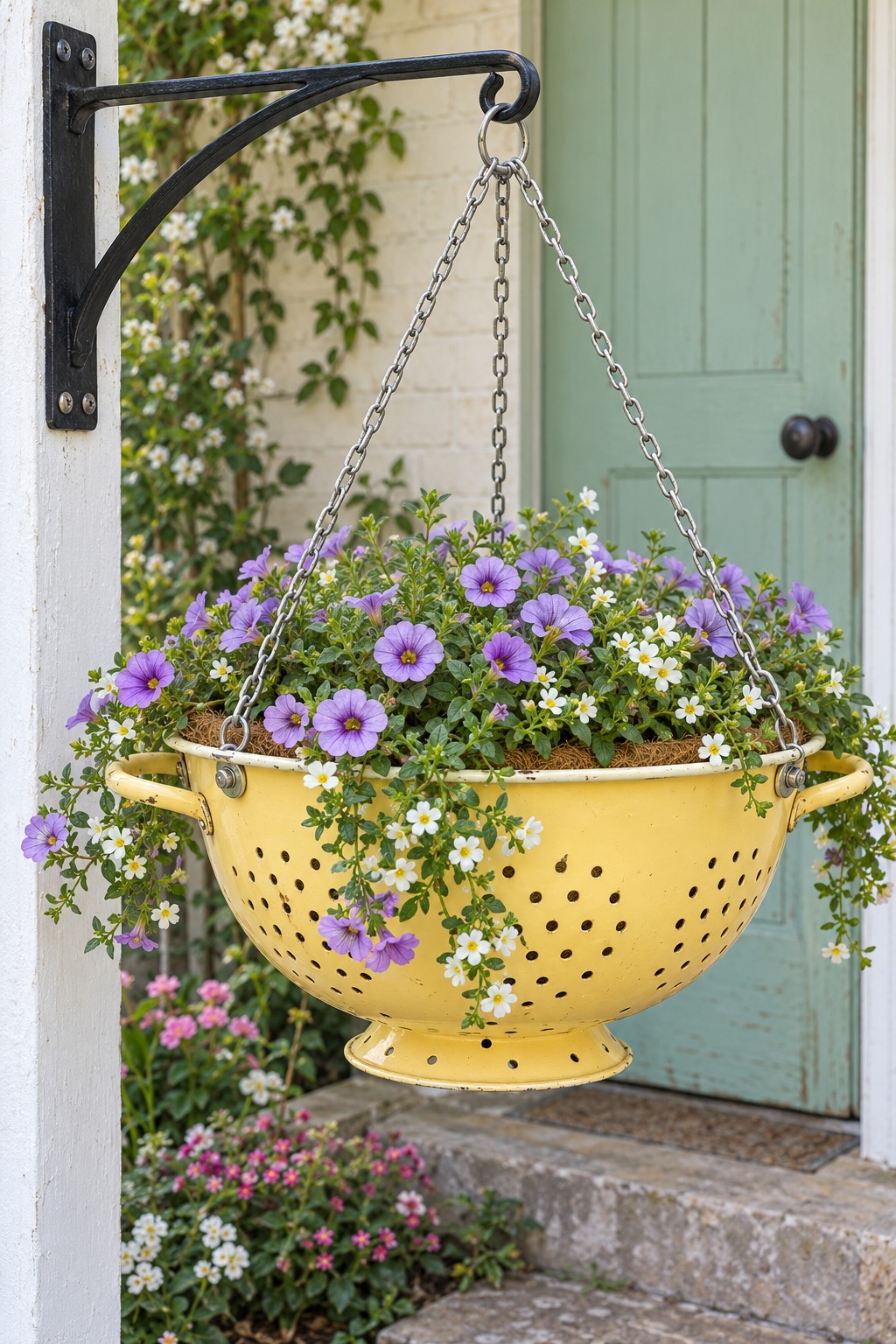
A yellow enamel colander serves as a hanging basket for purple trumpet flowers and small white blooms, suspended from chains on a black bracket. Yellow metal remains visible below the foliage, giving the soft trailing stems a clear outline. Fit a colander that has no rust holes with a permeable liner and chains connected through reinforced attachment points. The bracket, chains, and fasteners need assessment for the weight of saturated planting before the basket is hung. Suspend a smaller colander near a planted border when a porch has little space for containers on the ground.
8. Daisy Mosaic Spool Table
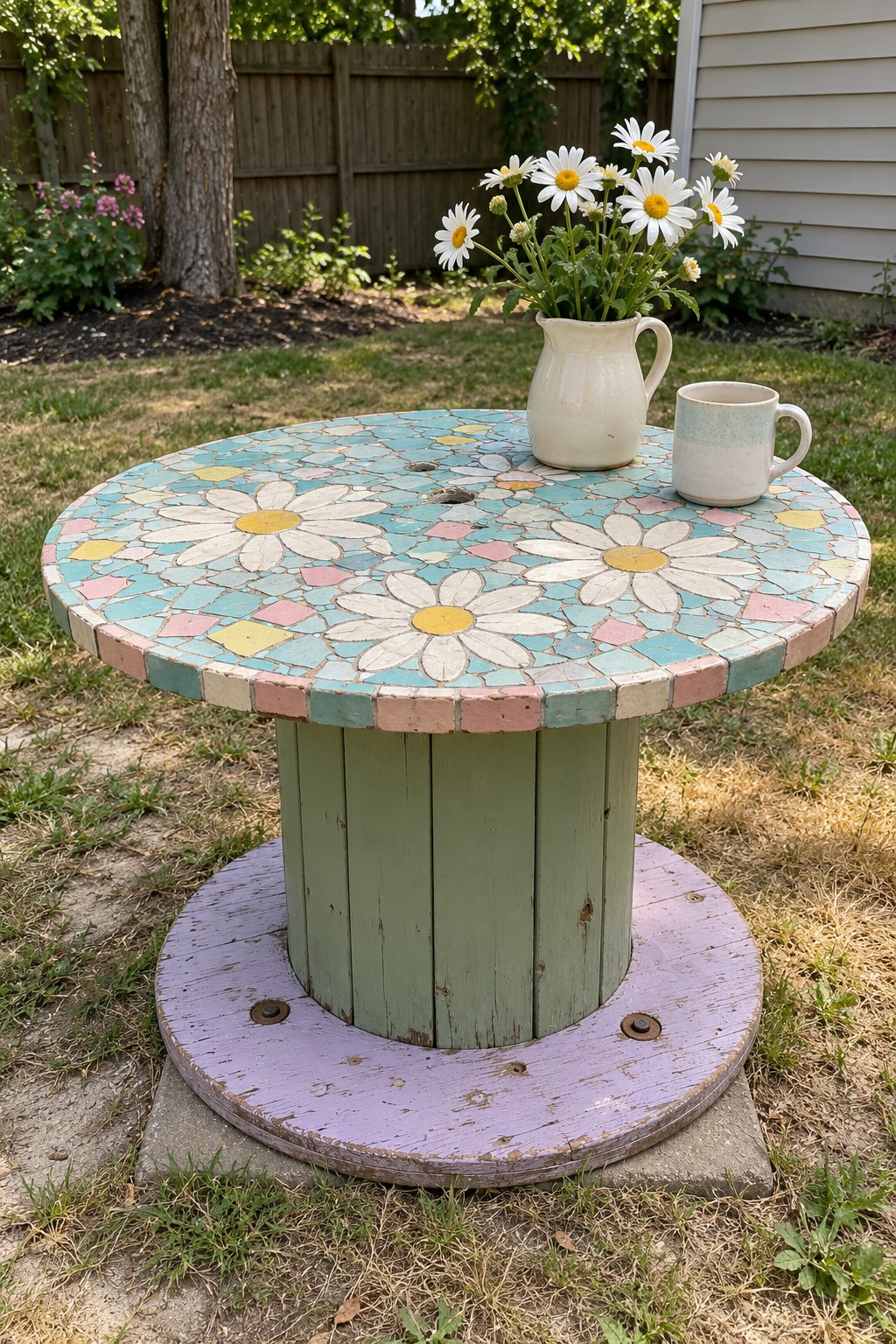
White daisy shapes cover a turquoise mosaic tabletop on a green wooden cable spool with a lavender base. The daisy mosaic connects the spool table to the white flowers in the pitcher without hiding the spool's broad circular outline. Paint an unrotted spool green and lavender, then plan the mosaic around the existing tabletop shape. A tile installer should assess how the mosaic will accommodate timber movement before the surface is finished. Reserve the spool table for a small garden's main seating corner, allowing the green base and lavender foot to remain visible instead of surrounding them with more containers.
9. A Burgundy Suitcase Filled with Marigolds
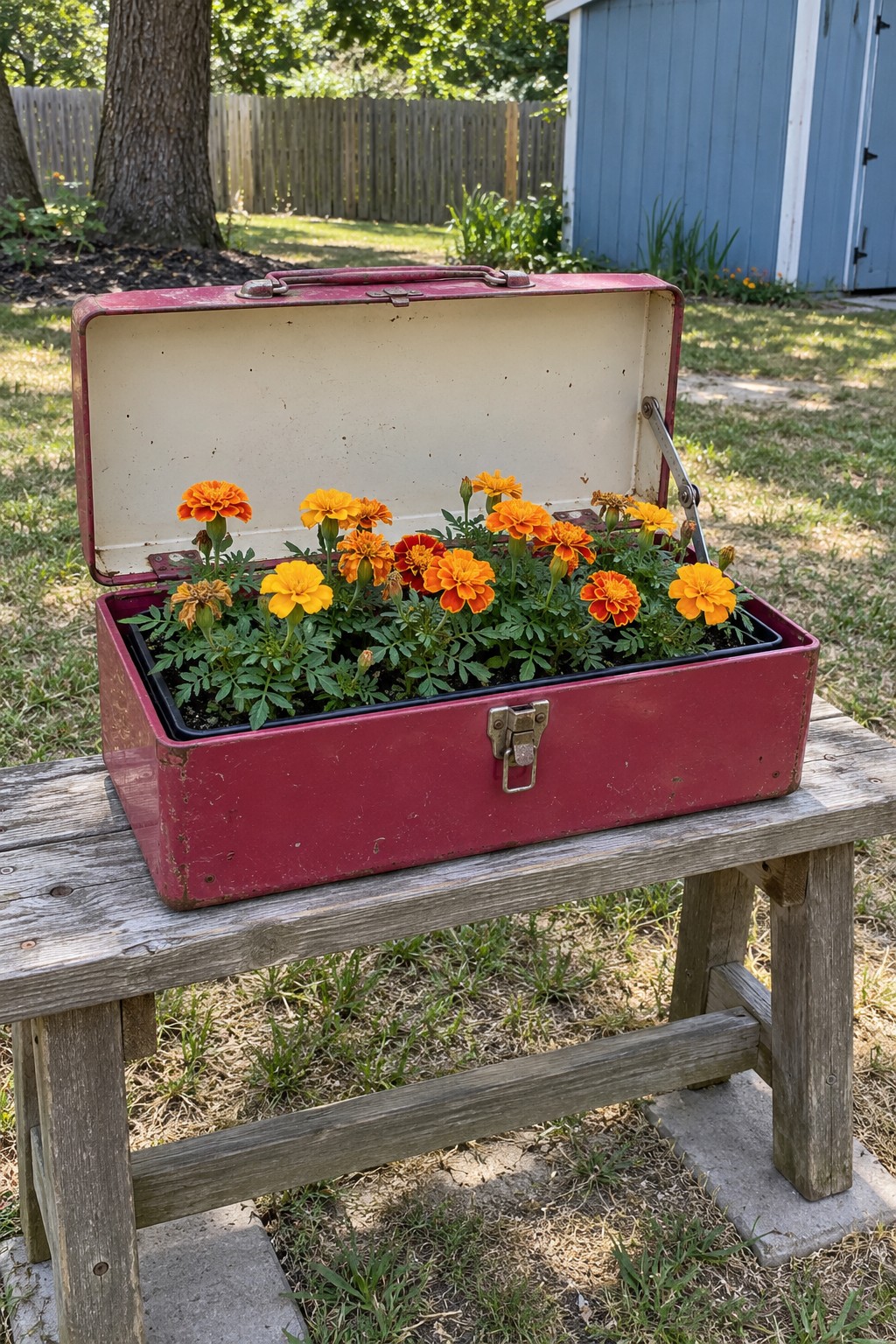
Orange and yellow marigolds fill a black tray inside an open burgundy suitcase resting on a wooden bench. The suitcase's cream inner lid gives the flower heads a quiet background, contrasting with the darker burgundy case. Fit a retired suitcase with a tray that slides inside without forcing the lid hinges or covering the front latch. Hold the suitcase lid open with its working lid stay, and protect moisture sensitive case materials from rain. Select a smaller suitcase for a short bench, leaving some wooden seating visible so the flowers do not overwhelm the furniture.
10. Blue Enamel Box and Petunias
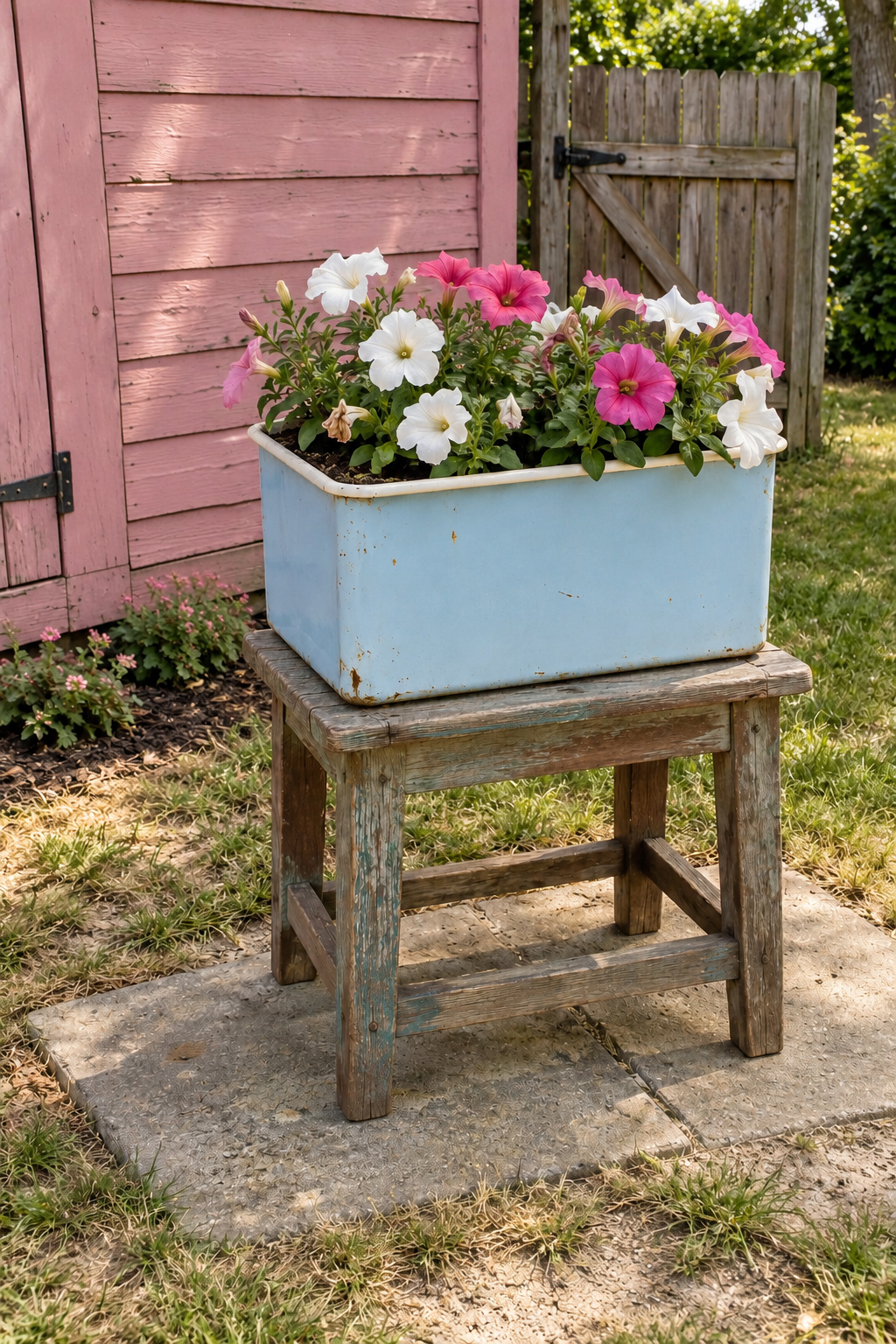
Pink and white petunias fill a blue enamel box resting on a weathered wooden stool beside a pink shed. The blue enamel introduces a cool accent, while the pink flowers repeat the shed color without matching every surface. Pair a box whose rim has no sharp chips with a stool whose joints do not shift under pressure. Center the enamel box on the stool so no edge overhangs, and resolve drainage before adding the petunias. Lower the arrangement for a small patio by selecting a shorter wooden stool, maintaining a clear outline around the blue box and flowering stems.
11. Chimney Pot Flower Pedestals
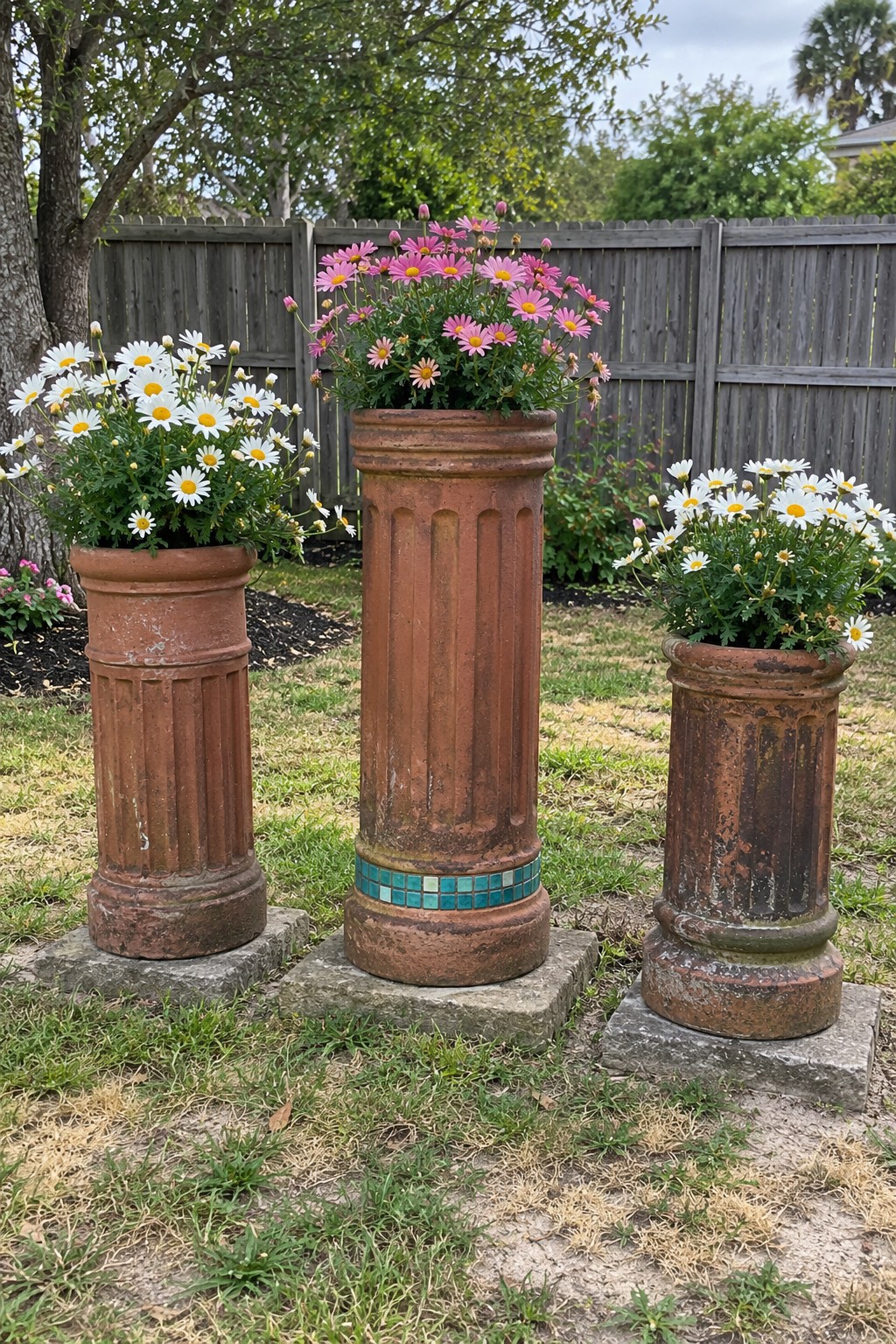
Terracotta chimney pots become flower pedestals for pink and white daisies, with a turquoise mosaic band circling the tallest pot. The changing heights give the repeated fluted shapes a rhythm that a row of identical containers would lack. Check each chimney pot for cracks, then set intact pots on level paving. Wrap a weather resistant strap around each tall pot and secure it to a firmly anchored ground stake to reduce the risk of tipping, especially where children might pull the flowers. Arrange shorter chimney pots in a compact triangle to bring the same varied silhouette into a smaller garden.
12. Pink Baby Bath and Fuchsias
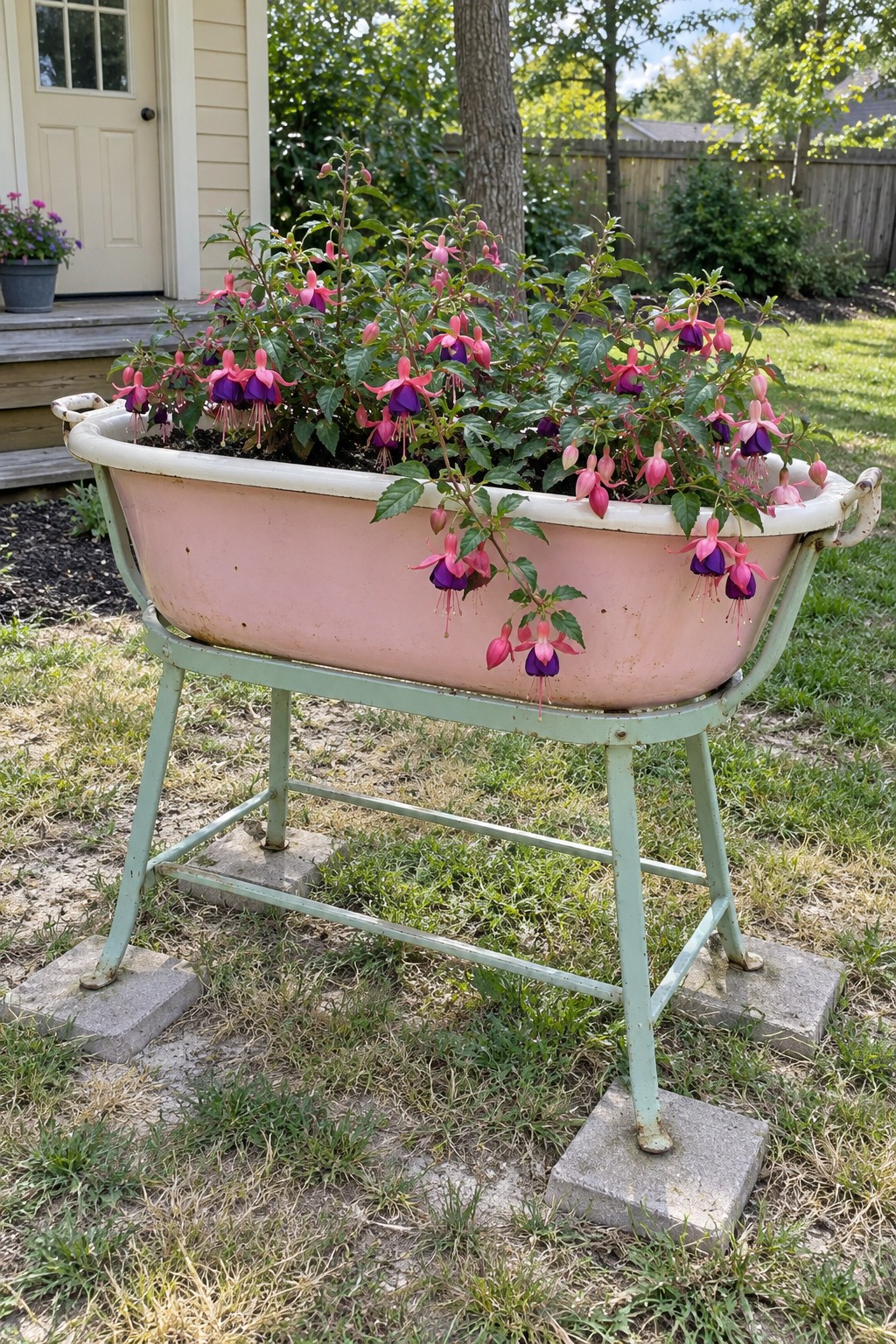
A pink enamel baby bath carries arching fuchsias on a pale green metal stand, with the pendant flowers extending beyond the white rim. The long bath suits the spreading stems, and the open space between the stand legs preserves a light appearance. Bring together an enamel bath free of rust holes and a stand whose joints remain rigid under pressure. Before planting, have the stand assessed for the combined weight of the bath and watered flowers. Substitute a smaller baby bath for a narrow yard, preserving the pink enamel and pale green stand as distinct areas of color.
13. Petunias Spilling from a Mint Mailbox
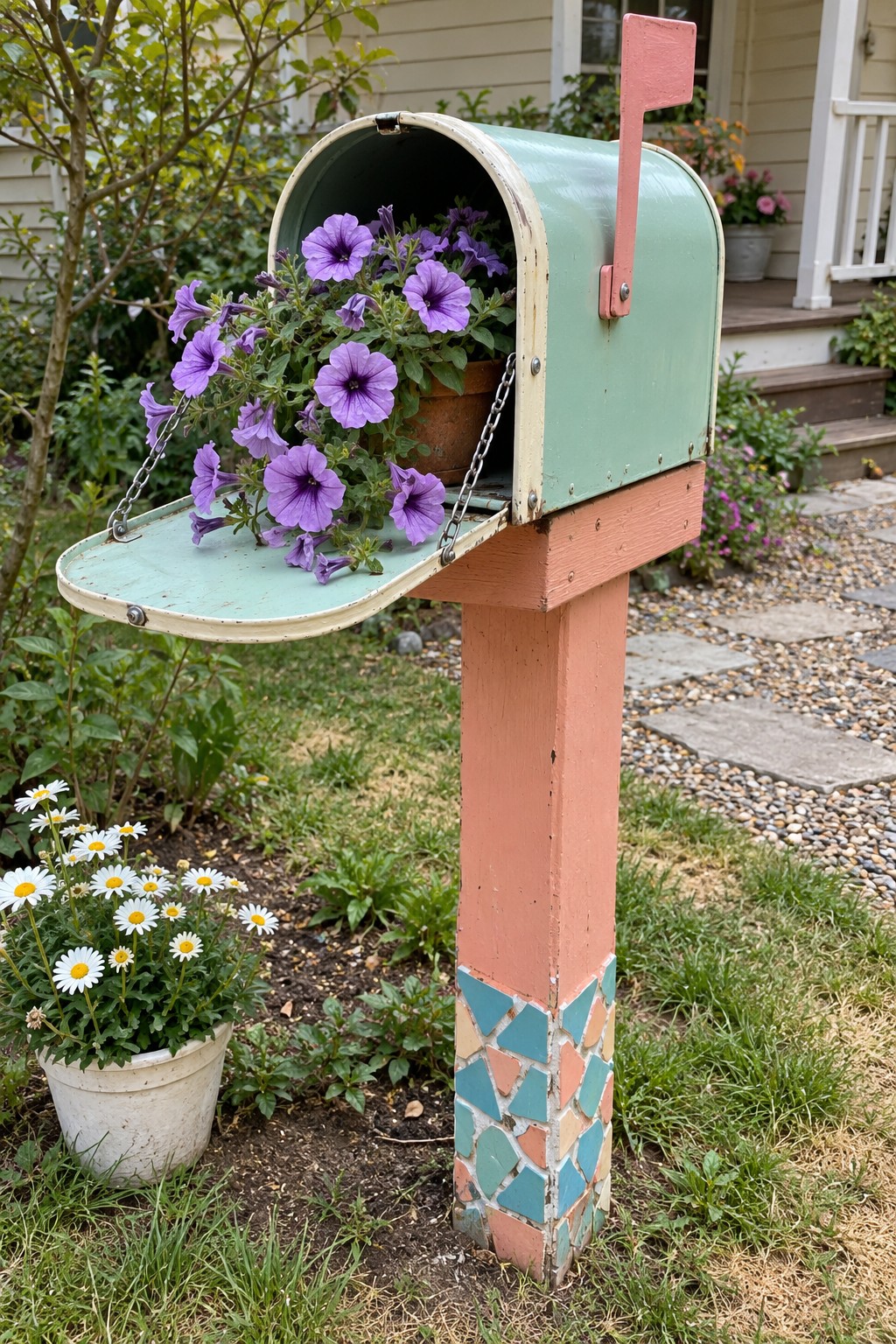
Purple petunias spill from a mint mailbox on a coral wooden post decorated with blue and cream mosaic. The mailbox door opens forward, exposing the flowerpot while the pale mint metal contrasts with the purple blooms. Repaint a retired mailbox for the garden ornament, retaining the working hinges and the chains supporting the open door. Secure the coral post so the mailbox does not move when its door is opened. Mount a smaller mailbox on a shorter post for a compact flower bed, retaining the purple petunias rather than adding several competing flower colors.
14. Lavender Chandelier and White Flowers
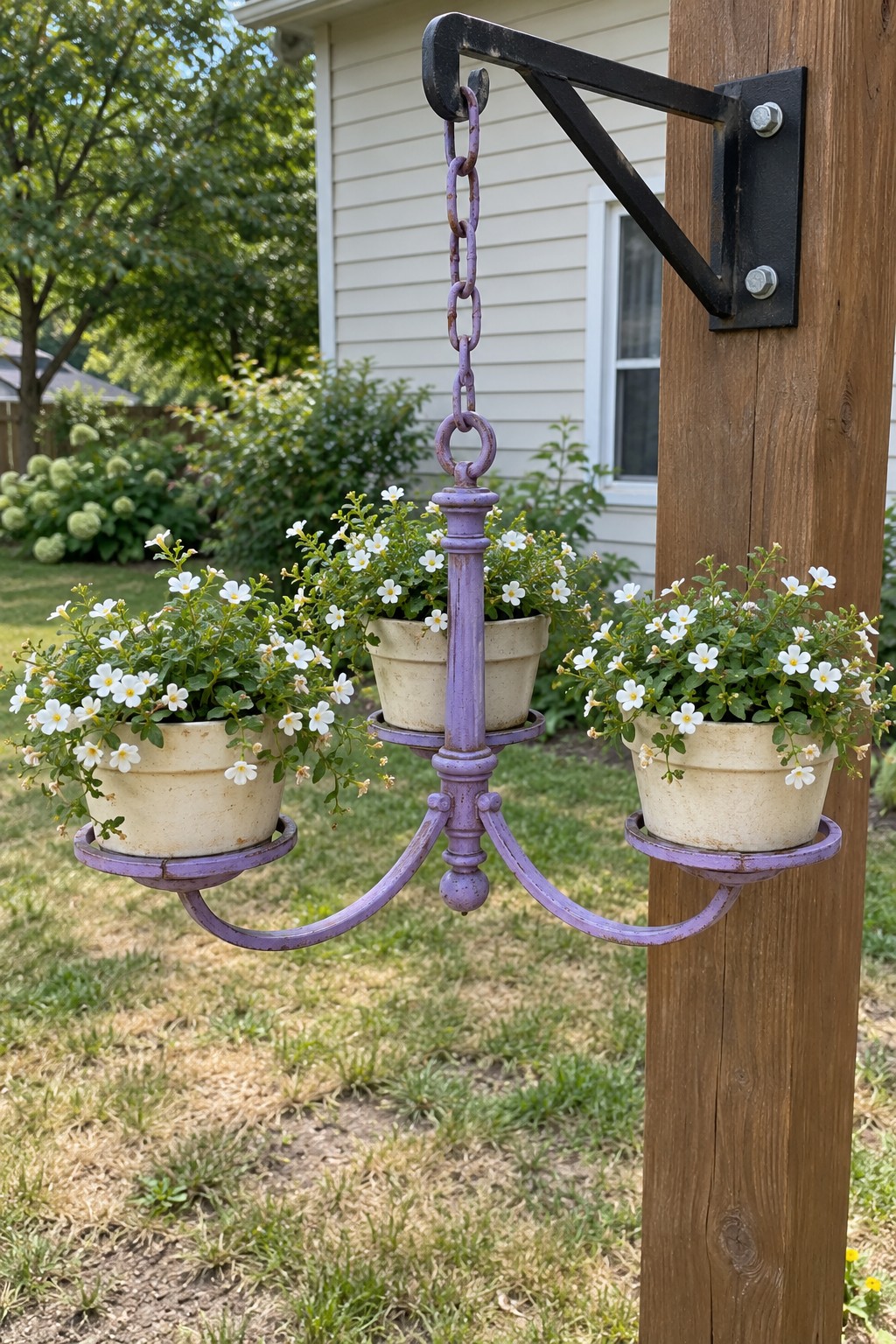
Cream pots of white flowers sit on a lavender chandelier hanging by a chain from a black bracket on a wooden post. The repeated cream containers make the curved chandelier arms easier to read, while the white blooms soften their outlines. Adapt a retired chandelier with pots whose bases sit fully within the circular metal cups. A former light fixture must be permanently disconnected from power and its arms, chain, bracket, and post connections assessed for watered plant loads before hanging. Use a smaller chandelier in a small garden, keeping the lavender metal and cream pots as its main details.
15. A Painted Flowerpot Inside a Yellow Birdcage
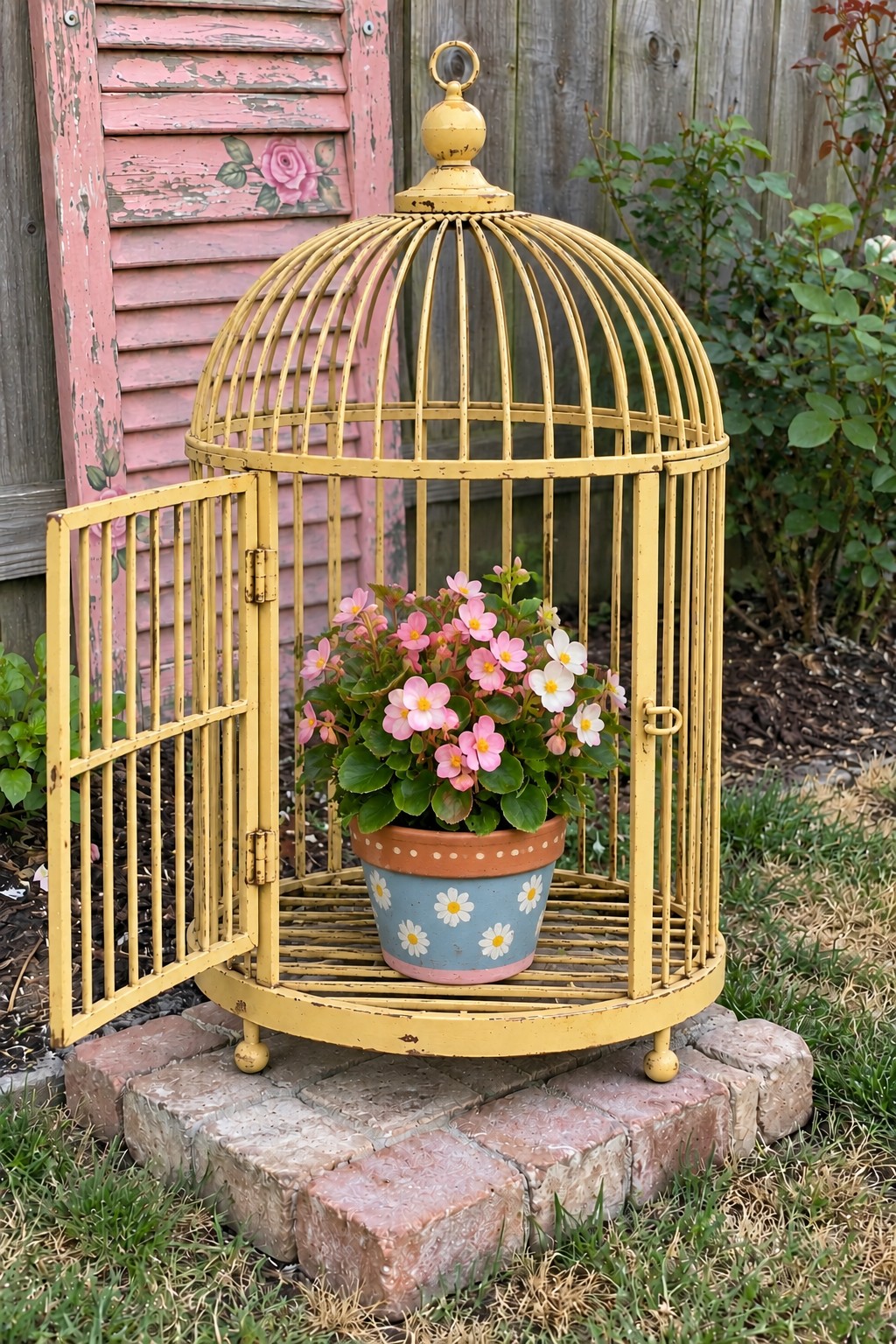
A blue painted flowerpot of pink and white begonias stands inside an open yellow birdcage set on brick paving. The painted daisies echo the yellow cage without obscuring its curved bars, and empty space preserves the domed outline. Measure the pot against the cage doorway before planting, so the pot can pass through without bending stems. Fasten the cage door open so it cannot swing across the paving or catch the begonia stems. Favor a smaller birdcage and a compact begonia for a narrow corner, leaving the yellow bars visible around the blue pot.
16. Coral Tea Cart and Floral Teapot
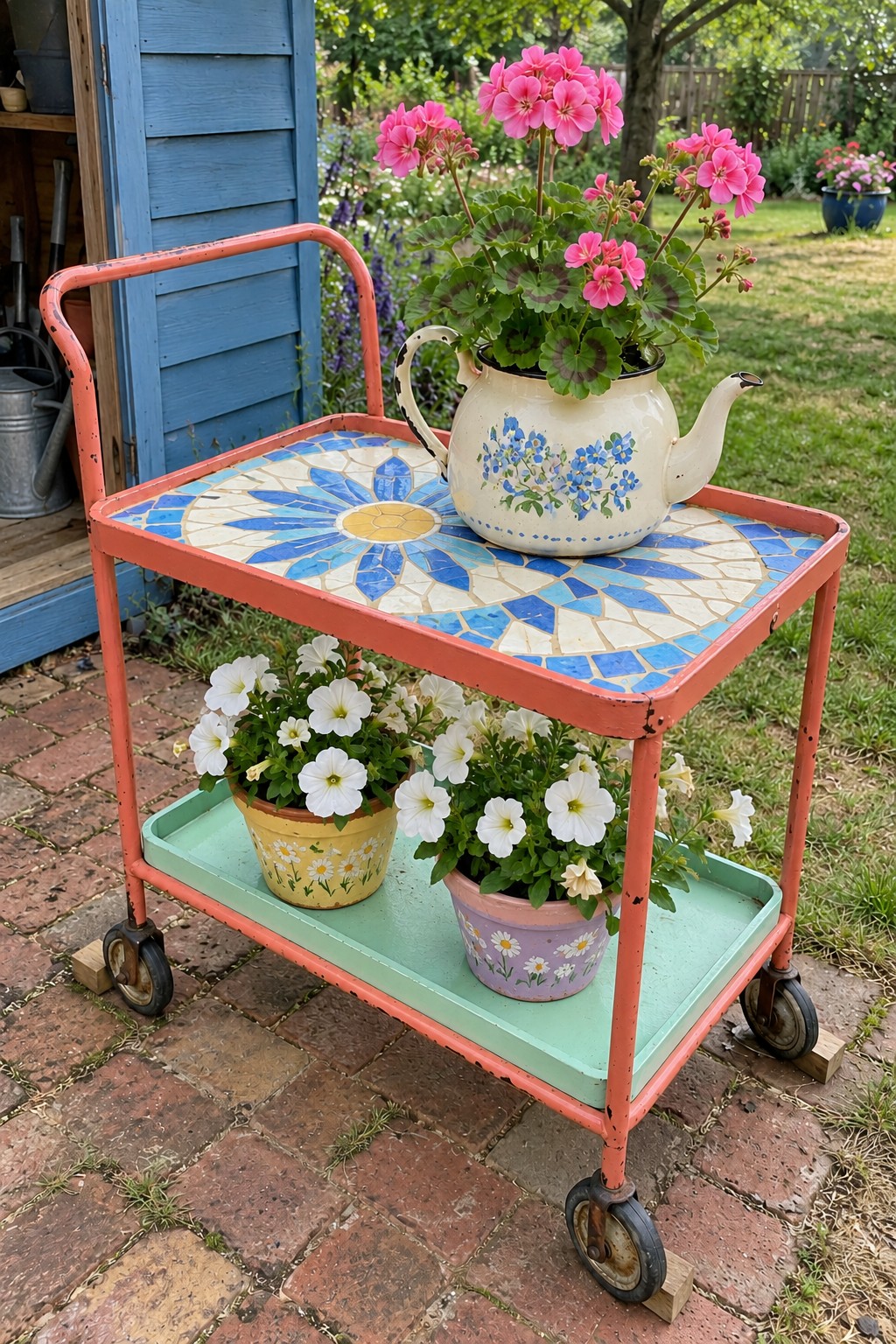
A floral teapot holds pink geraniums on a coral tea cart with a blue mosaic top and a mint lower tray carrying white petunias. Blue flowers painted on the teapot repeat the mosaic color, connecting the different containers without making them identical. Arrange a wide teapot and flowerpots on the cart trays, with each base resting flat. Immobilize the wheels with wooden blocks and confirm the trays do not flex under the watered containers. Simplify the cart for a small patio by leaving the mint tray empty and letting the floral teapot become the single planting accent.
17. Mint Balance Scale and Daisy Pots
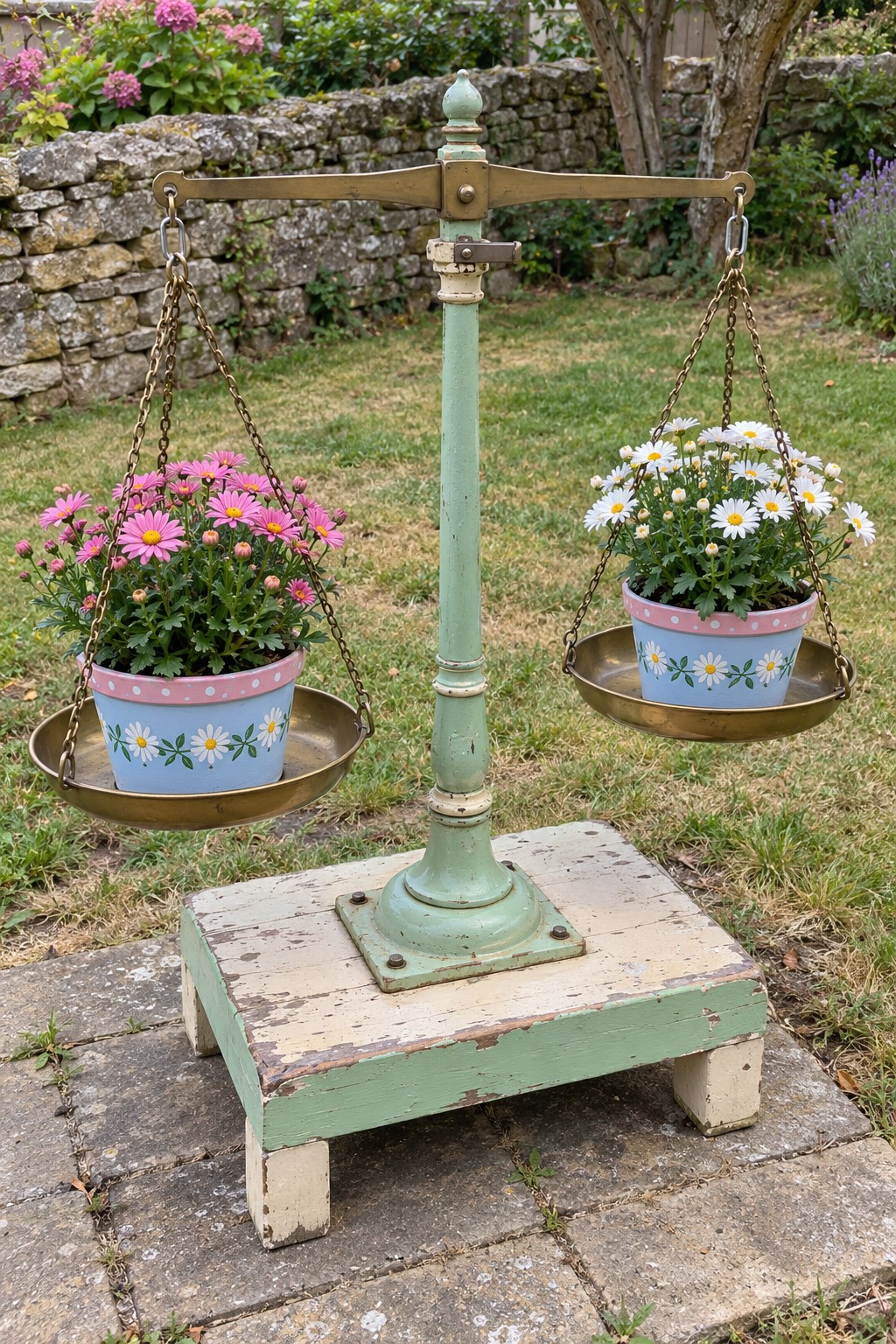
Blue daisy pots holding pink and white blooms rest in the metal pans of a mint balance scale on a low wooden base. Matching painted daisies connect the pots, while the contrasting live flowers distinguish the suspended sides. Bolt a scale to a wooden base with no soft or rotten areas, then place pots fully inside the pans. The scale's beam needs restraint against sudden movement before watered pots are placed in the pans. Retain the scale empty and place the daisy pots on the wooden base if the old beam or chains cannot support planting.
18. Coral Screen and Tulip Containers
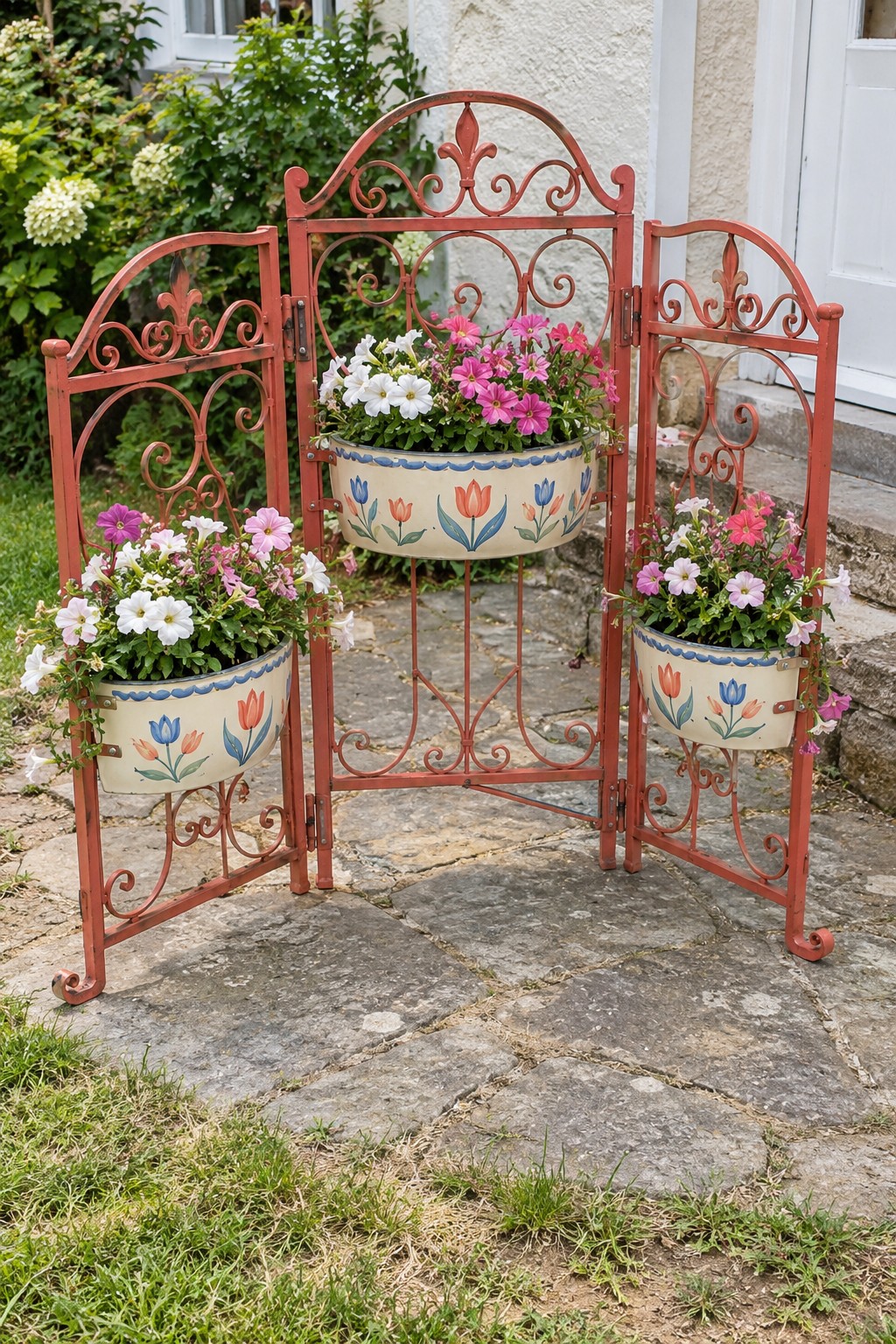
Cream containers painted with tulips hold pink and white flowers across a coral folding metal screen. The screen's curved tops and repeated tulip decoration establish a rhythm, while varied container heights reveal more of the scrollwork. Attach containers to the screen's straight uprights after confirming the hinges move without pulling apart. Assess the attachments and anchor the screen against tipping before adding watered plants. Fold the coral screen closer for a narrow patio only while its feet remain firmly supported and its flower containers stay clear of one another.
19. Enamel Troughs on an Upright Wooden Sled
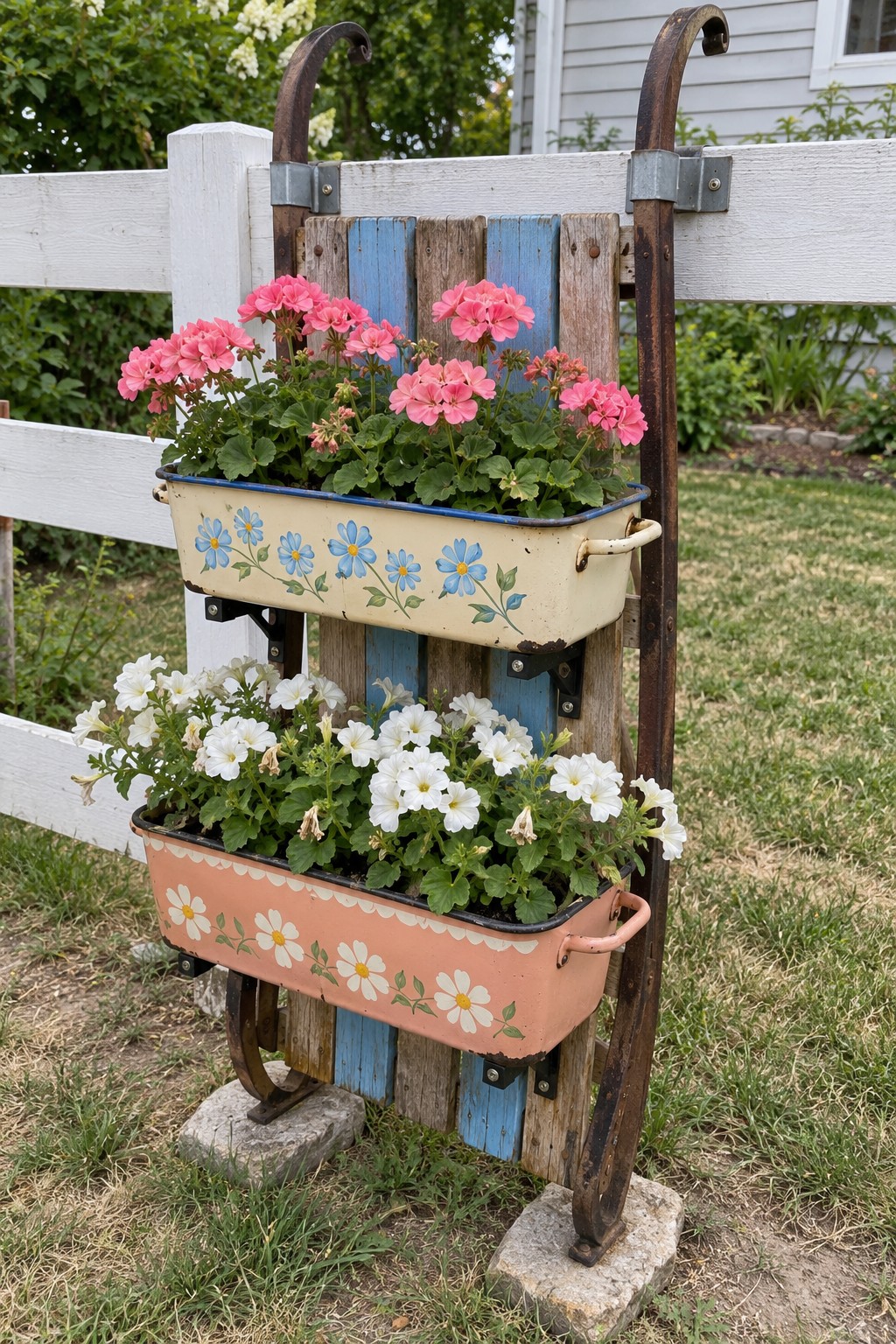
Painted enamel troughs hold pink geraniums and white petunias across an upright wooden sled with faded blue slats. The long runners add height, while the cream and coral troughs break the narrow outline into horizontal planting areas. Screw the brackets through slats without splits, then hang the troughs. The sled must be secured to the fence and its trough connections assessed before loading them with wet planting. Display a shorter sled with a single enamel trough when a small garden needs a vertical accent without a large collection of flowers.
20. Blue Carriage with Begonias and Lobelia
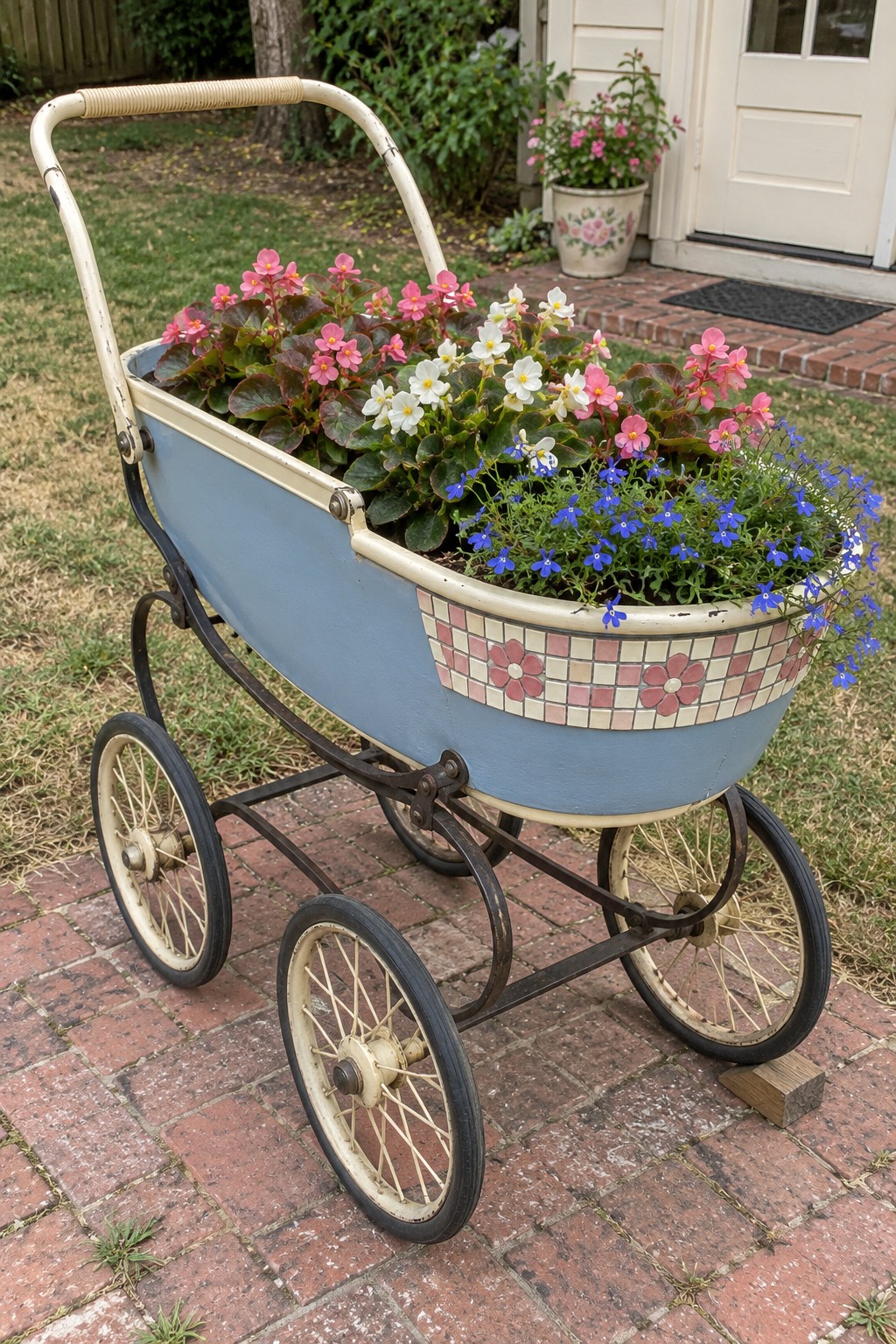
Pink and white begonias rise from a blue carriage decorated with a pink and cream mosaic band, while blue lobelia trails over the curved front. Exposed spoked wheels preserve the carriage's identity, making the planting feel connected to the original object. Convert a retired carriage whose body has no rust holes and whose wheel connections do not loosen when moved. Secure the carriage against rolling with wooden blocks, and resolve drainage before filling its body. Position the blue carriage along the edge of a small patio, allowing its long side to face the open space.
21. Fan Blade Daisy and Marigolds
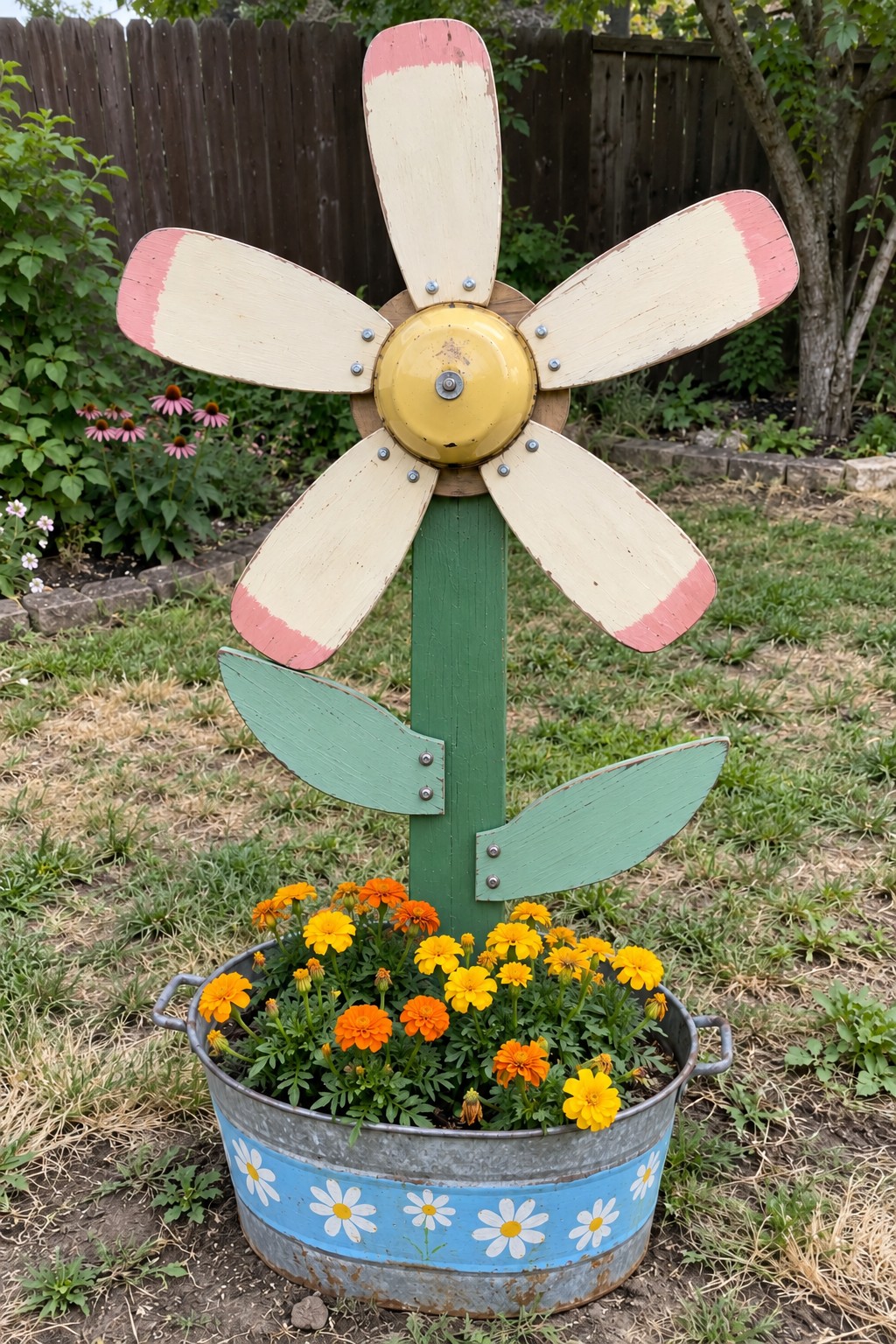
A fan blade daisy has cream wooden blades with pink tips, a yellow center, and mint leaves on a green post rising from a tub of marigolds. Orange and yellow marigolds connect the oversized ornament to the living flowers without repeating its pale petals. Bolt retired wooden fan blades to the circular wooden backing for a stationary daisy, then paint the post and leaves. Secure the post and prevent the blades from rotating or loosening in wind. Trim the blades before painting to create a smaller daisy for a compact border, keeping every blade similar in length.
22. A Flower Basket Framed by Ornate Molding
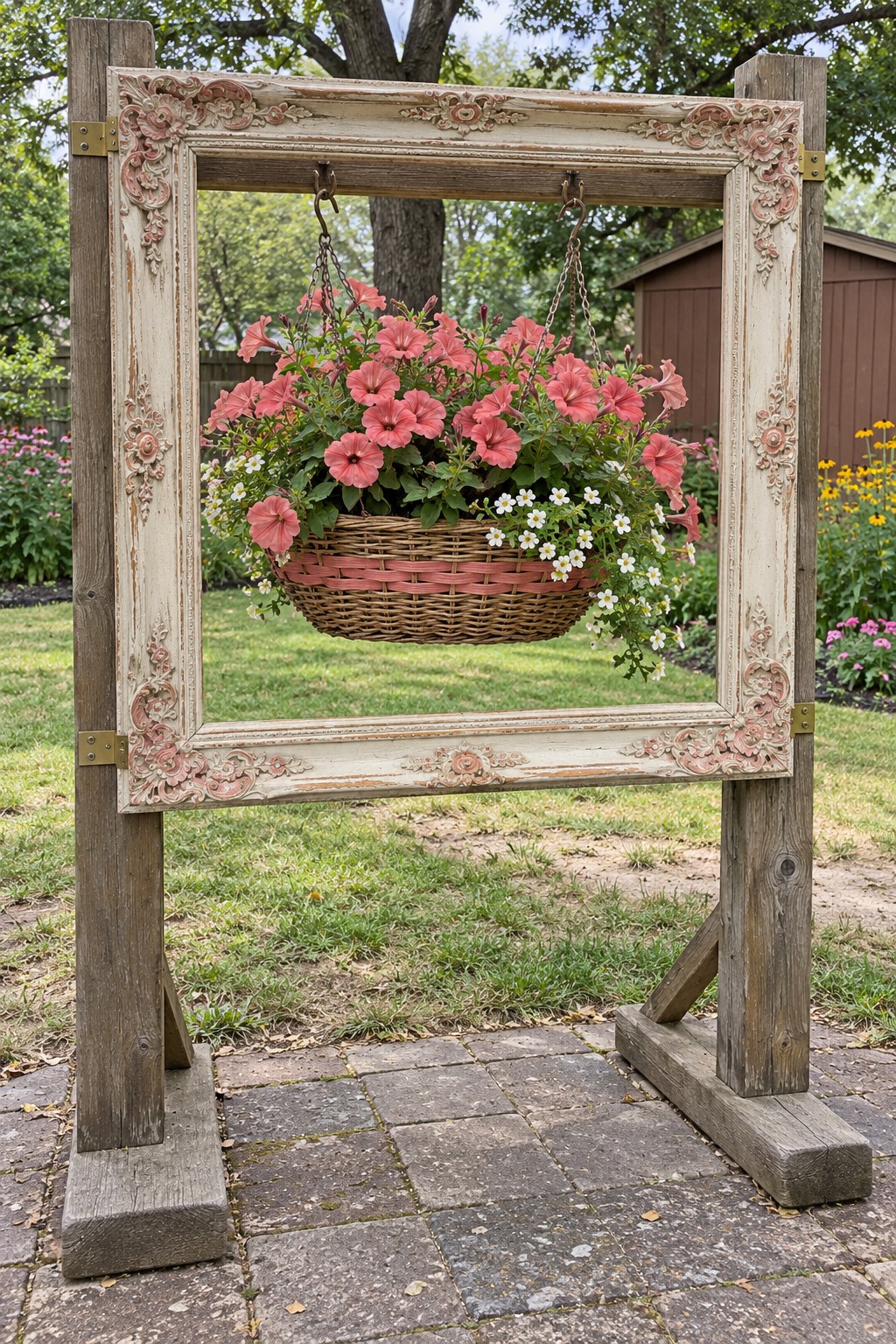
A cream and pink ornate frame surrounds a woven flower basket of coral petunias and trailing white blooms, supported by a wooden structure. The empty space around the basket isolates the flowers while leaving the lawn visible through the frame. Build a wooden support for the frame, check that its decorative corners are secure, then hang the basket from the support’s crossbar. Have the crossbar, hooks, chains, and braced wooden feet assessed for the watered basket weight rather than loading the ornamental molding. Center a smaller flower basket within a smaller frame when a narrow patio cannot accommodate the wide wooden structure.
23. Yellow Coat Stand and Woven Baskets
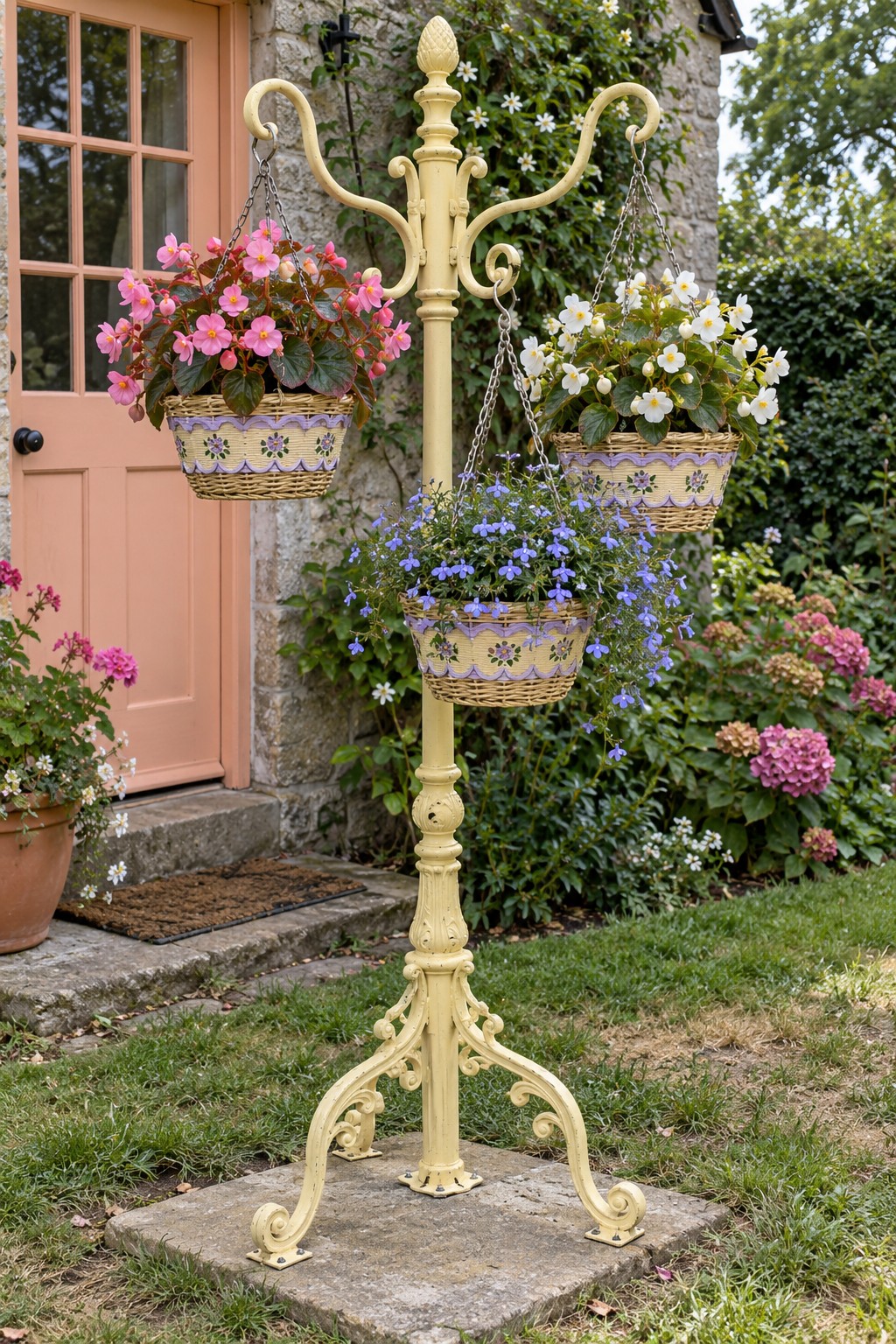
Woven baskets of pink and white begonias and blue lobelia hang from a pale yellow coat stand on a paving slab. Lavender decoration repeats across the baskets, linking their different hanging heights without hiding the yellow central post. Repurpose a metal coat stand whose hooks do not bend under pressure, spacing baskets clear of the post. Have the hooks and base fixings assessed for watered basket loads, then anchor the feet so the stand cannot tip. Hang fewer woven baskets for a smaller porch, arranging them so the remaining planting does not pull the stand toward one side.
24. Mint Plant Stand and Colanders
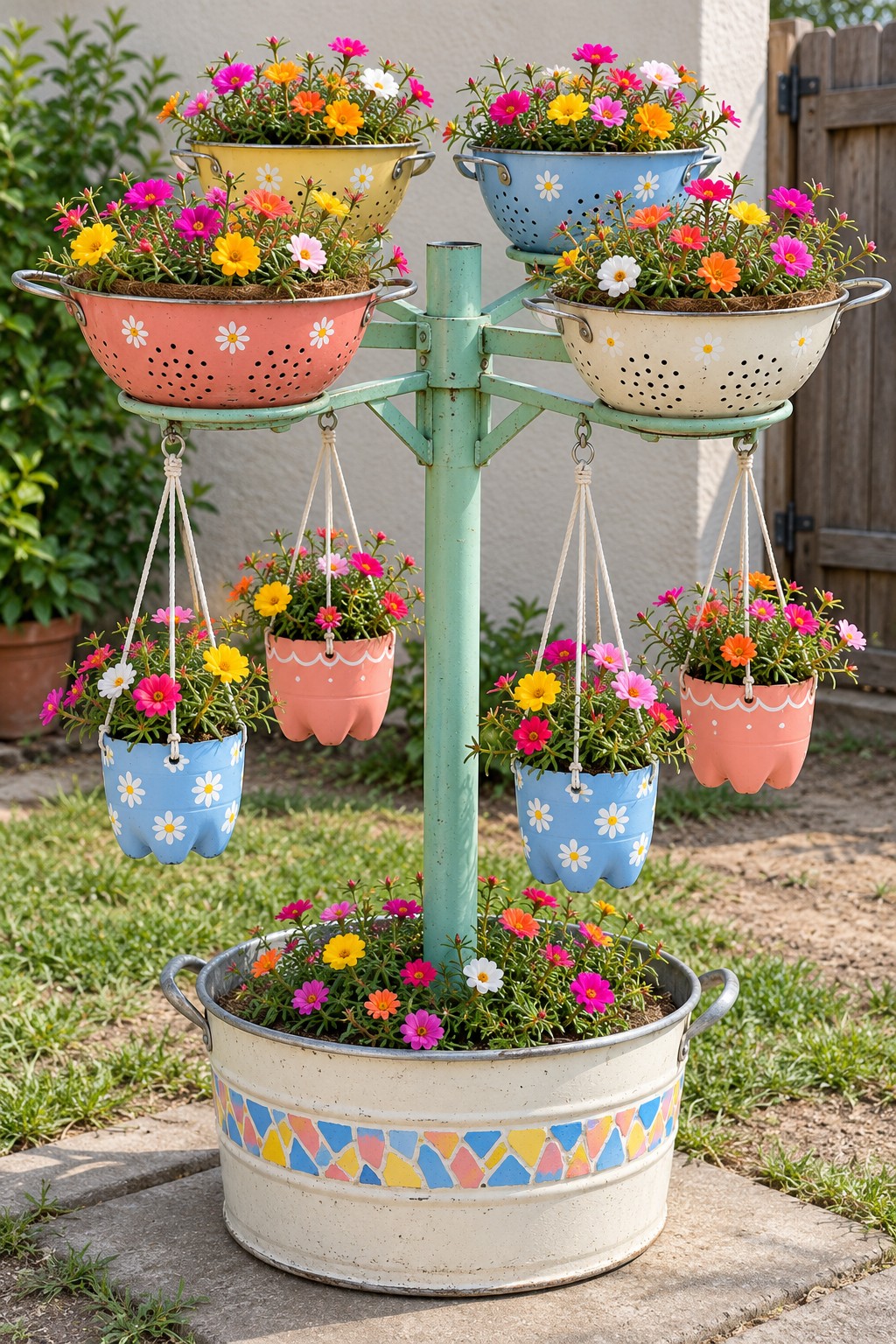
Pastel colanders and painted bottle pots carry moss rose flowers around a mint plant stand rising from a cream tub with mosaic trim. Repeating pink, yellow, and white blooms across the containers unifies their different shapes and heights. Set colanders within the metal rings of a stand whose arms remain rigid, then hang bottle pots by cords that do not fray. Follow NC State's moss rose advice on sun and draining soil, and assess the stand's stability before watering. Omit the hanging bottle pots in a small yard, retaining the colanders and cream tub as a simpler planting group.
25. Tennis Racket Sweet Pea Trellis
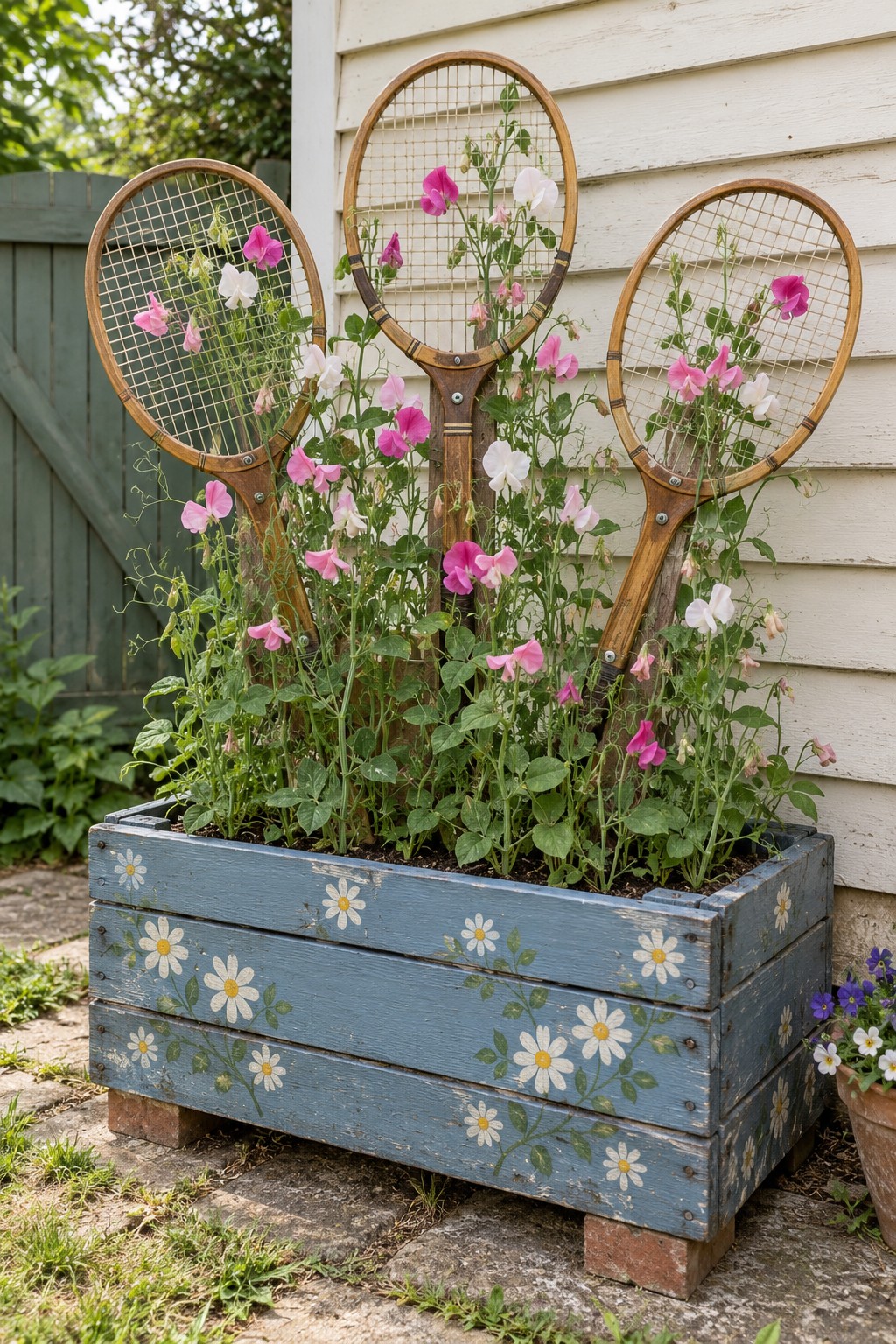
Wooden tennis rackets form a sweet pea trellis for pink and white flowers growing from a blue crate painted with daisies. A trellis is an open support that gives climbing stems places to attach as they grow. Drill pilot holes and screw the racket handles to the inside back of the crate, keeping the strings taut. Follow RHS advice on sweet peas when selecting compact plants and maintaining their growing conditions. Plant fewer compact sweet peas around a single tennis racket when the blue crate must fit into a narrow sunny corner.
26. Mushroom Ornaments Made from Colanders
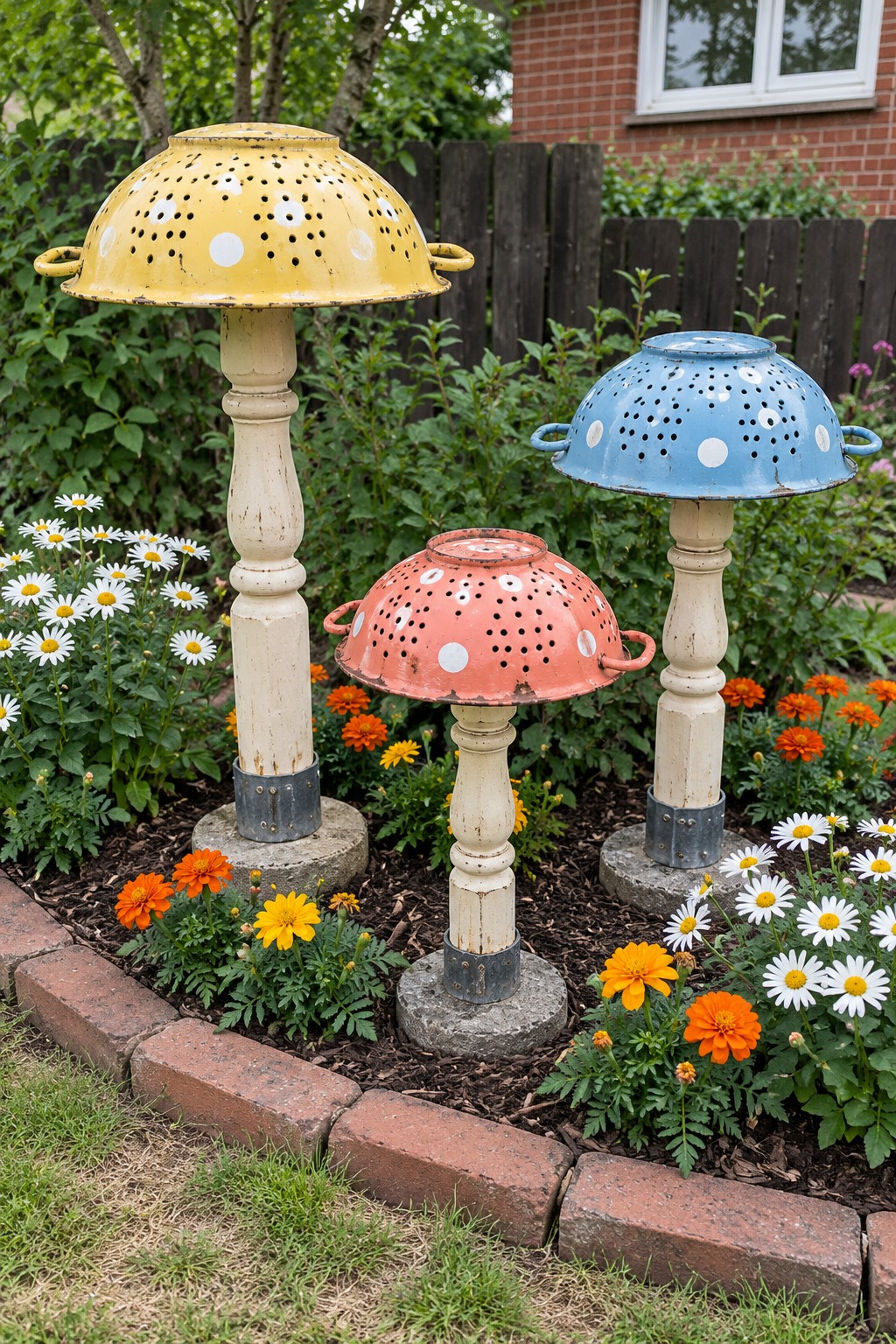
Yellow, blue, and coral colander caps rest on cream turned wooden stems among white daisies and orange marigolds. The inverted colanders resemble mushroom caps, while white painted spots connect the different colors. Assemble the ornaments from retired colanders and wooden furniture legs that have no splits near their ends, fastening the colanders directly to the stems. The caps and stems need mechanical connections that resist wind, with metal collars holding the stems to their circular bases. Cluster shorter wooden stems and smaller colander caps in a compact bed, leaving the surrounding flowers visible between the ornaments.
27. A Flower Wagon Beneath a Gingham Canopy
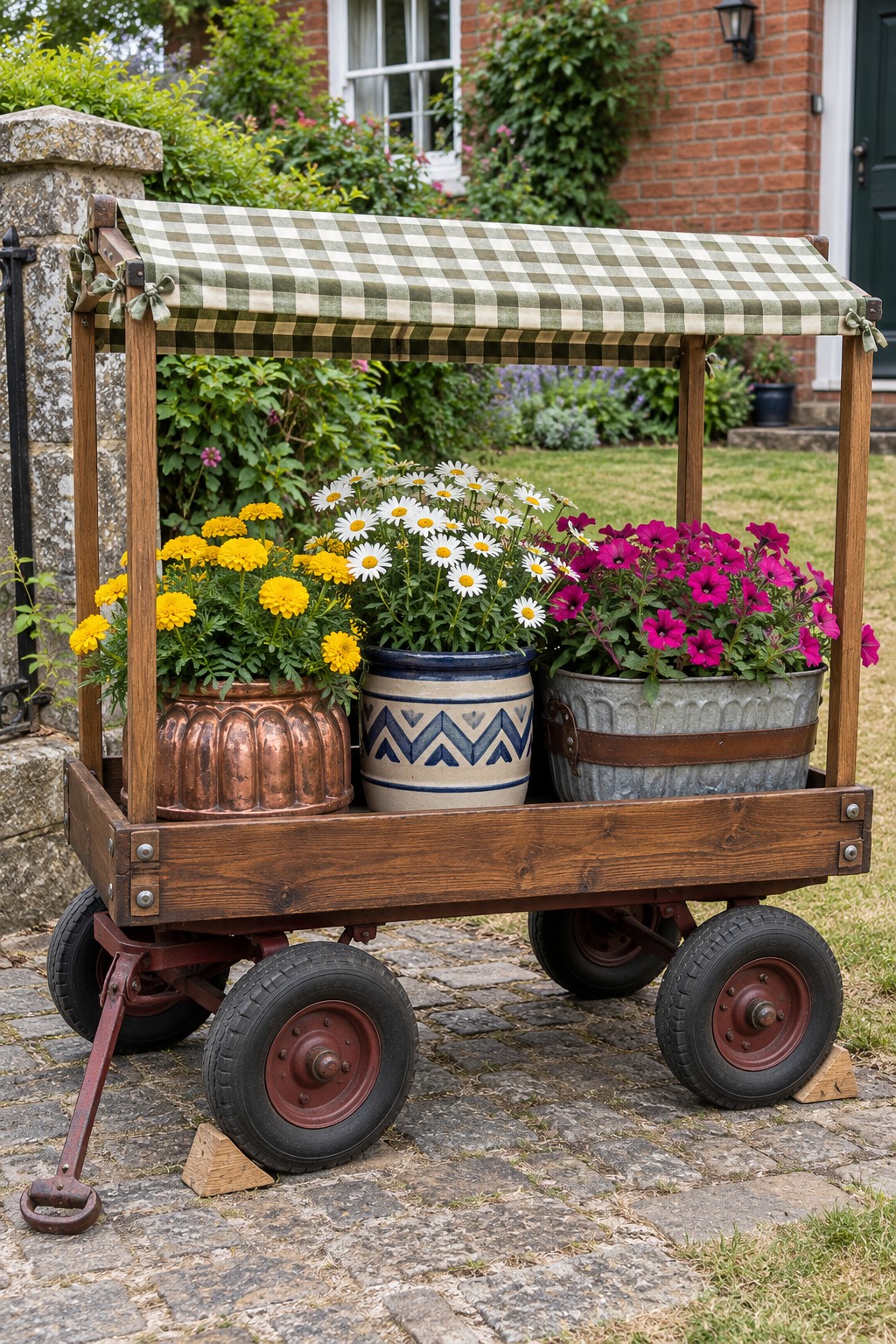
A wooden flower wagon holds yellow marigolds, white daisies, and magenta petunias beneath a green gingham canopy. The canopy's repeated checks visually gather the mismatched metal and ceramic containers into a small market stall arrangement. Attach the canopy's wooden uprights to the corners of a wagon whose bed does not flex. Block the wheels and take down the fabric before strong winds, allowing enough sunlight to reach the flowers during ordinary use. Remove the canopy for a smaller patio display, letting the wooden wagon and contrasting flower containers supply the structure.
28. Grandfather Clock Plant Cabinet
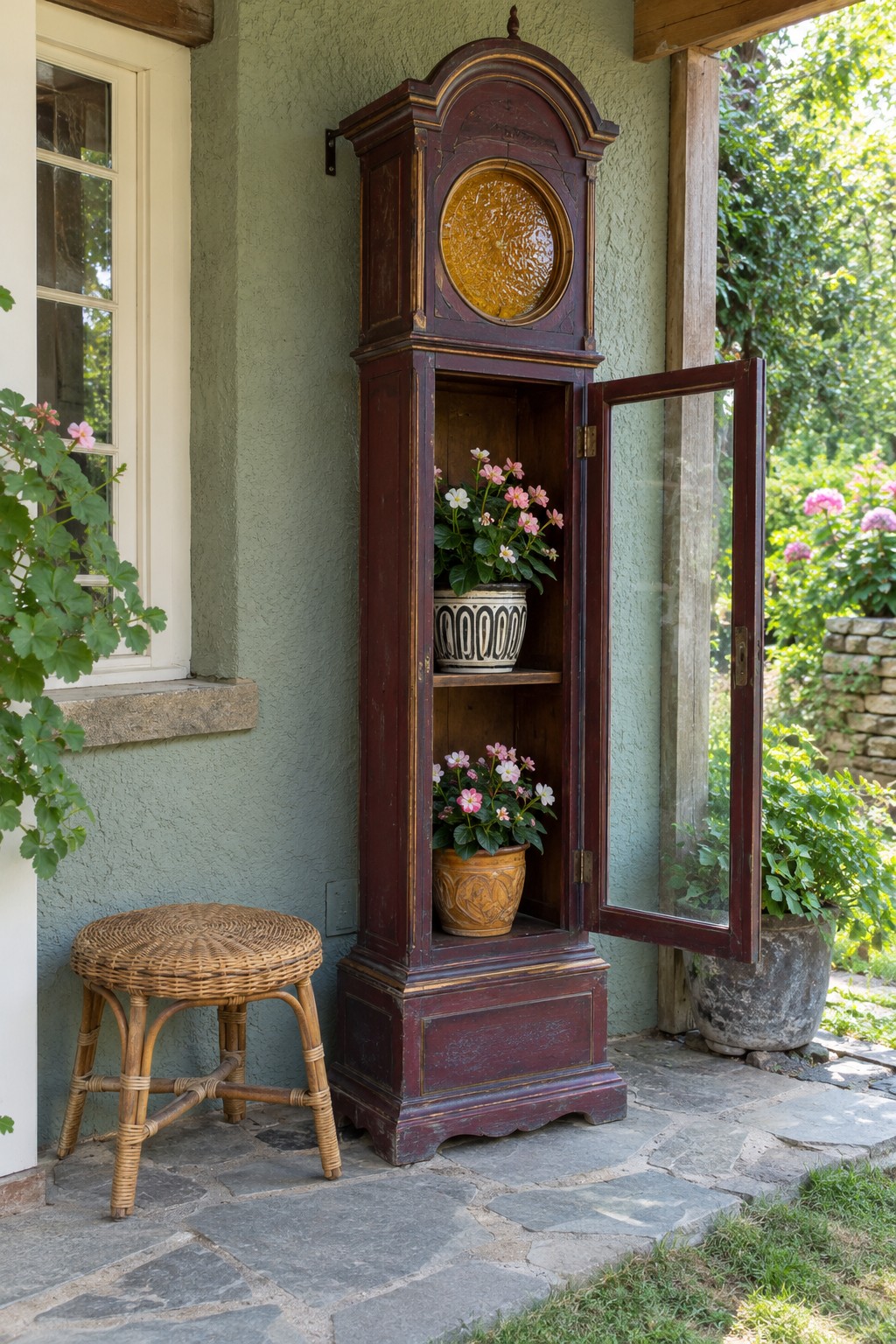
A burgundy grandfather clock case becomes a plant cabinet, with flowering pots on wooden shelves and an amber circular insert at the top. The tall clock outline concentrates color vertically, while the covered porch protects the wooden case from direct rain. Convert an empty clock case whose shelves do not flex and whose door hinges hold without sagging. Secure the case to the wall, restrain the glass door open, and remove the pots for watering. Borrow the cabinet's narrow footprint for a smaller porch by selecting a shallower grandfather clock case with room for compact flowering plants.
Where to Start
I would begin with the blue enamel box, the yellow birdcage, or a small auricula theater. The enamel box teaches restraint through a simple grouping, the birdcage makes access part of the design, and the theater rewards attention to spacing and plant care. The chandelier and loaded screen deserve more planning because their appeal depends on connections that must carry watered containers. Let a recognizable old object establish the structure, then give the flowers room to grow. For the setting around the chosen project, explore Decovive's corner garden seating and planting layouts or its garden arrangements made with broken terracotta.
Leave a Reply