20 Floral Styling Concepts That Make Rooms Feel More Curated

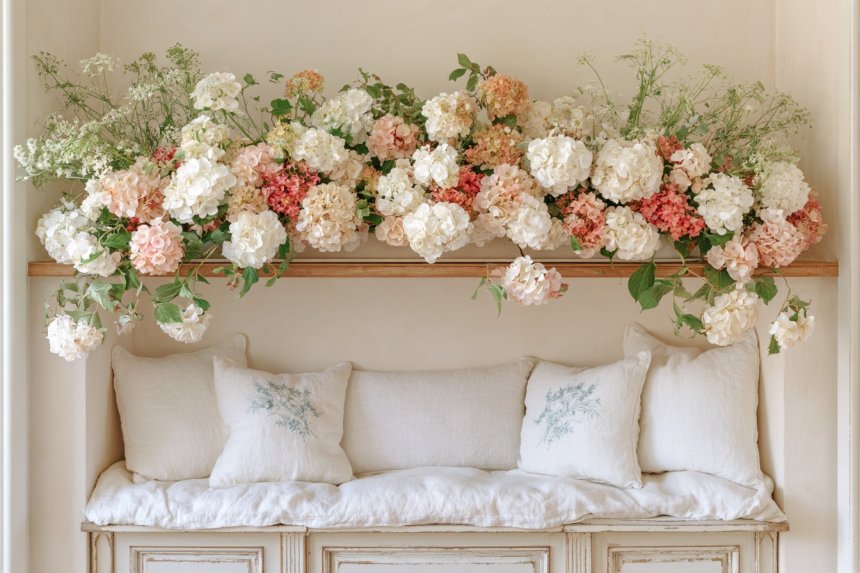
Floral arrangements can do much more than add color to a table. Used thoughtfully, flowers can create height, soften hard architecture, echo the shape of furniture, or turn an overlooked corner into a deliberate focal point. The most interesting arrangements often avoid the traditional mixed bouquet completely. One oversized branch, a cluster of low ceramic vessels, a suspended botanical composition, or several flowers arranged by color gradient can feel much more memorable than a standard centerpiece. These floral styling concepts focus on proportion, placement, texture, and container choice as much as the flowers themselves, giving each arrangement a distinct role within the room rather than treating every vase as interchangeable decoration.
1. Build a Sculptural Branch Arrangement for a Bare Corner
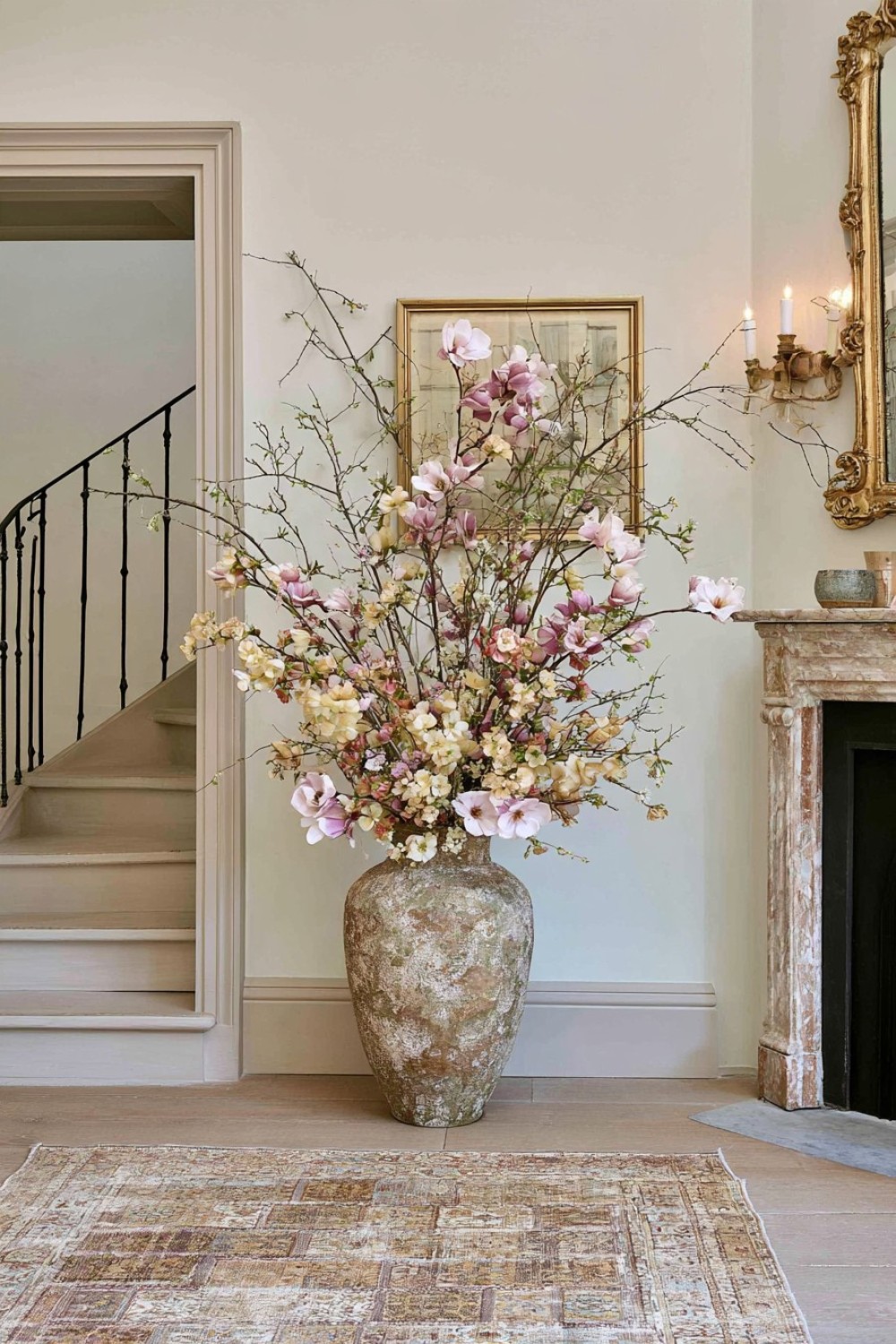
A tall branch arrangement can fill vertical space without making a room feel cluttered.
Choose one or two architectural branches such as magnolia, quince, cherry, olive, or curly willow and place them in a heavy floor vessel with a relatively narrow opening.
The key is scale. Let the branches extend well beyond the rim instead of trimming them to conventional bouquet height.
Rotate the stems until their natural bends interact with the wall and ceiling rather than fighting against them.
This works particularly well beside a console, stair landing, fireplace, or empty corner where a small arrangement would disappear visually.
Use a stone, ceramic, or textured plaster vessel to give the base enough visual weight.
If using fresh branches, choose a container that can hold substantial water and position it away from delicate artwork or surfaces that may be damaged by moisture.
2. Arrange One Flower Variety Across Several Tiny Vessels
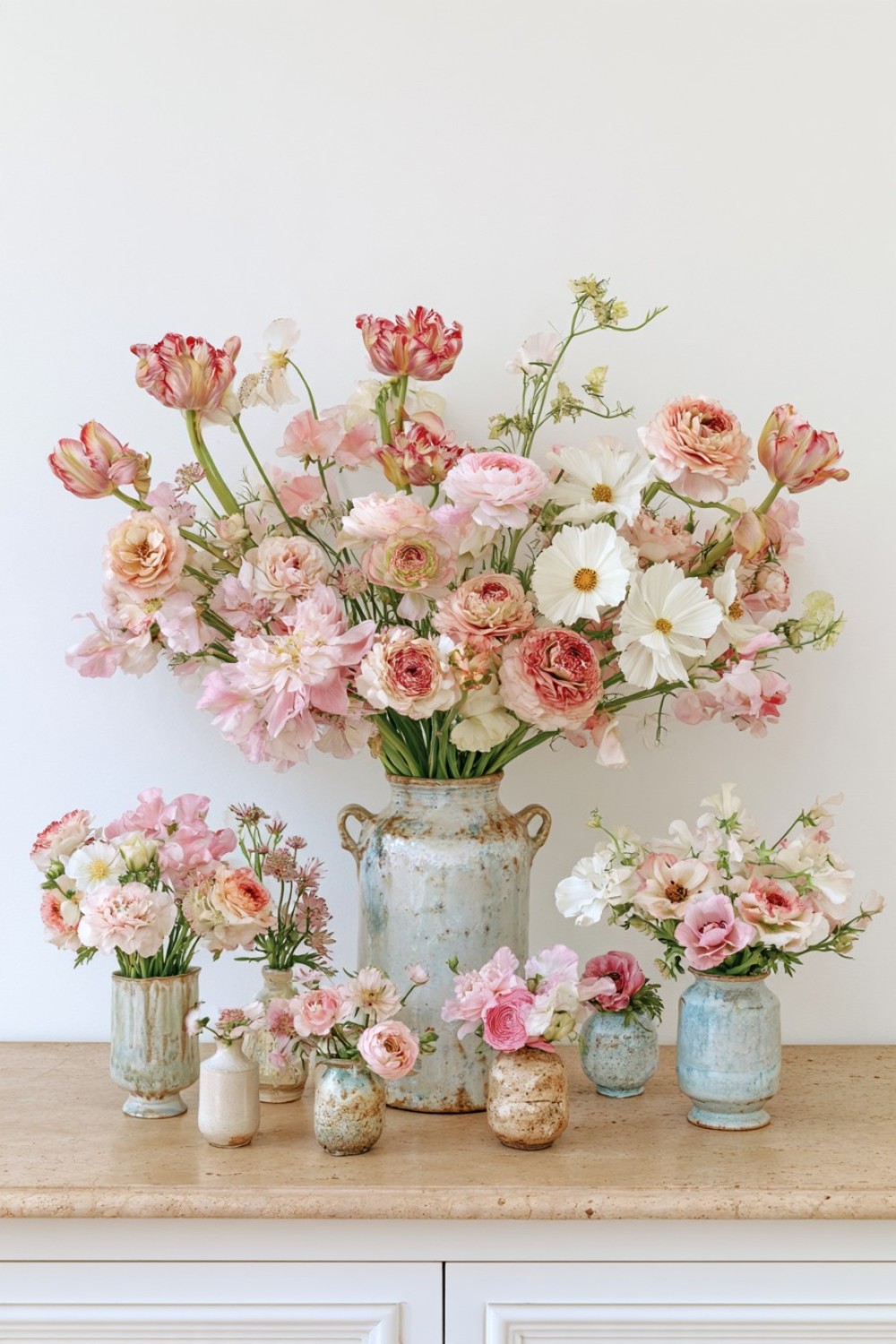
Instead of building one large bouquet, split a single flower variety across five or seven small containers.
Tulips, ranunculus, cosmos, sweet peas, anemones, or garden roses work especially well because each stem has an individual shape worth seeing.
Use mismatched ceramic cups, bud vases, miniature bottles, or tiny stone vessels, but keep their colors closely related.
Arrange them loosely down a dining table, windowsill, or console rather than lining them up perfectly.
The repetition creates cohesion while the separate containers keep the composition light.
This approach is also practical because shorter stems or slightly damaged flowers that would disappear inside a large arrangement can still be used beautifully.
The result feels more like a collection than a centerpiece and is easy to move when the table is needed.
3. Create a Floral Gradient From Pale to Deep Color
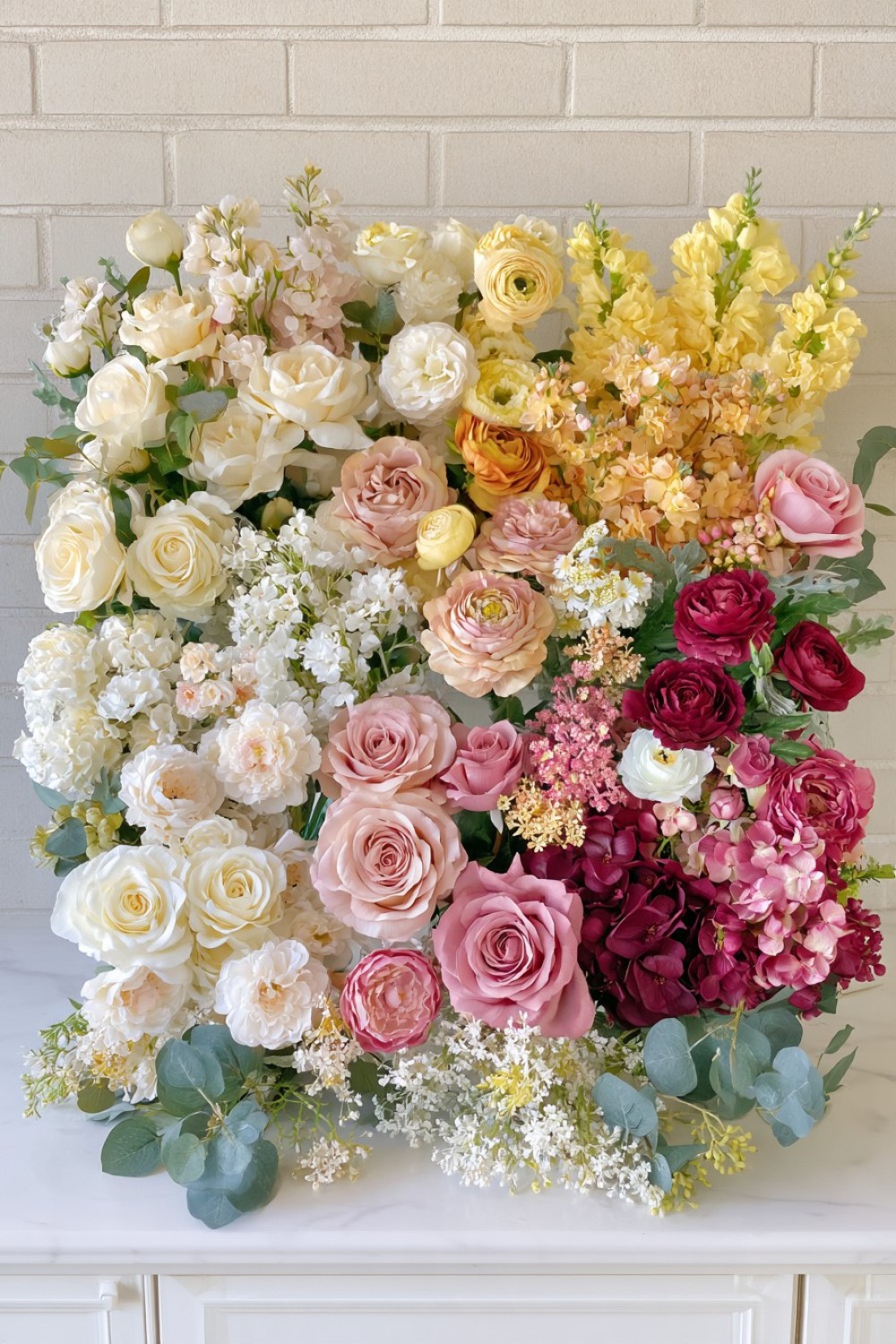
Color can become the organizing principle instead of flower type.
Choose several flowers within one tonal family and arrange them from the palest shade at one side to the deepest at the other.
For example, start with cream, move through blush and dusty rose, then finish with wine or burgundy. Another version could move from pale yellow into ochre and burnt orange.
Use low vessels so the gradient reads clearly across the table or sideboard.
The flowers do not need to match exactly in shape. In fact, mixing different silhouettes can make the color transition more interesting.
Avoid introducing contrasting greenery everywhere; too much green can interrupt the progression.
This technique works particularly well on long dining tables and mantels because the eye naturally travels across the arrangement.
4. Make a Floating Flower Bowl With Almost No Visible Stems
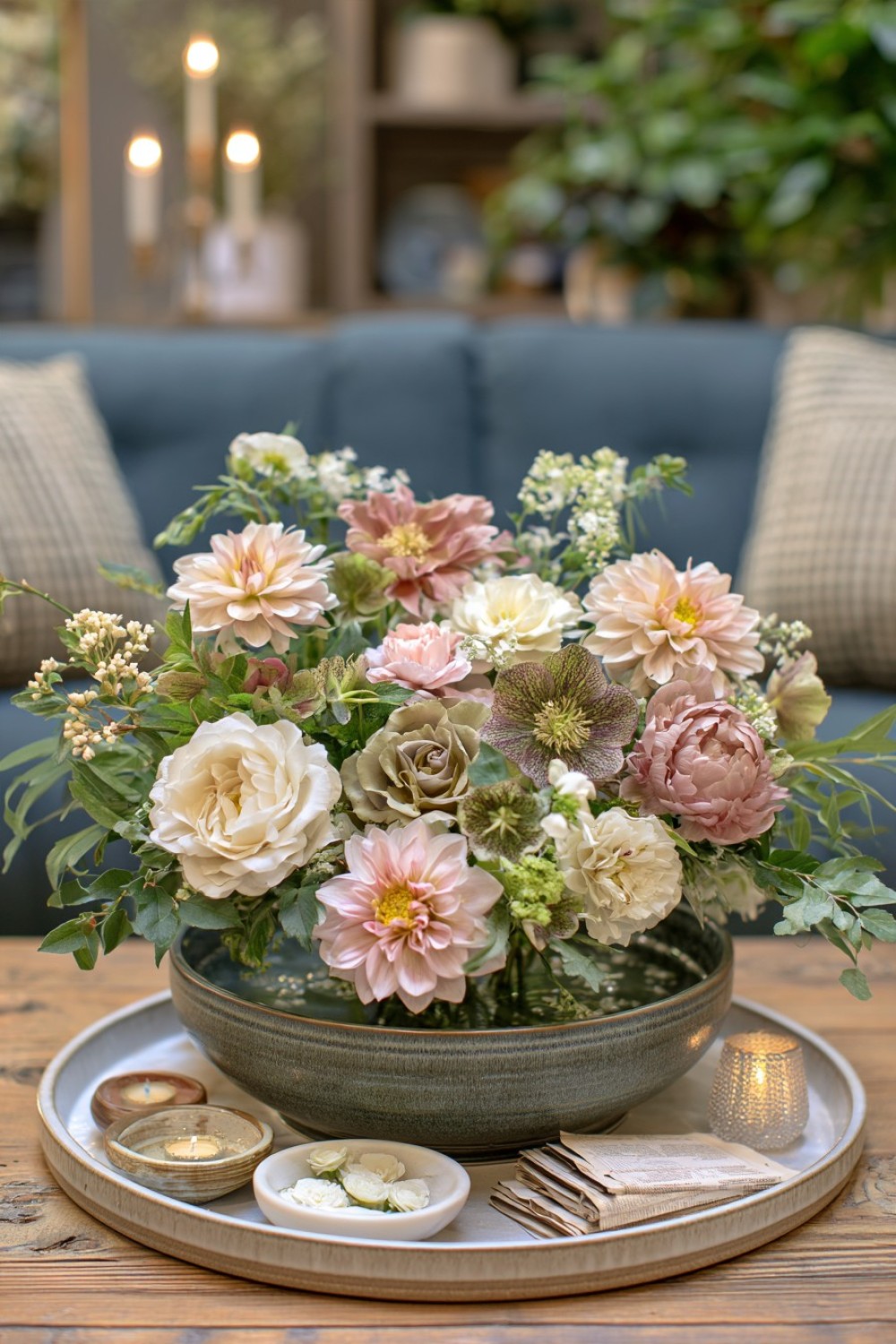
A shallow bowl can create a floral arrangement that feels more like a surface composition than a bouquet.
Use a wide ceramic or stone vessel, floral pin holders or a reusable flower frog, and short-cut blooms with strong shapes.
Peonies, dahlias, hellebores, garden roses, or anthuriums work well because they have enough visual presence at low height.
Arrange the flowers so some hover just above the rim while others sit closer to the water.
Leave visible water or empty space between blooms instead of filling the entire bowl.
This works beautifully on coffee tables because it keeps sightlines open.
For a more contemporary effect, use only three to five oversized flowers rather than many smaller ones.
The arrangement appears simple, but the spacing between stems is what gives it a sculptural quality.
5. Turn a Fireplace Mantel Into a Botanical Landscape
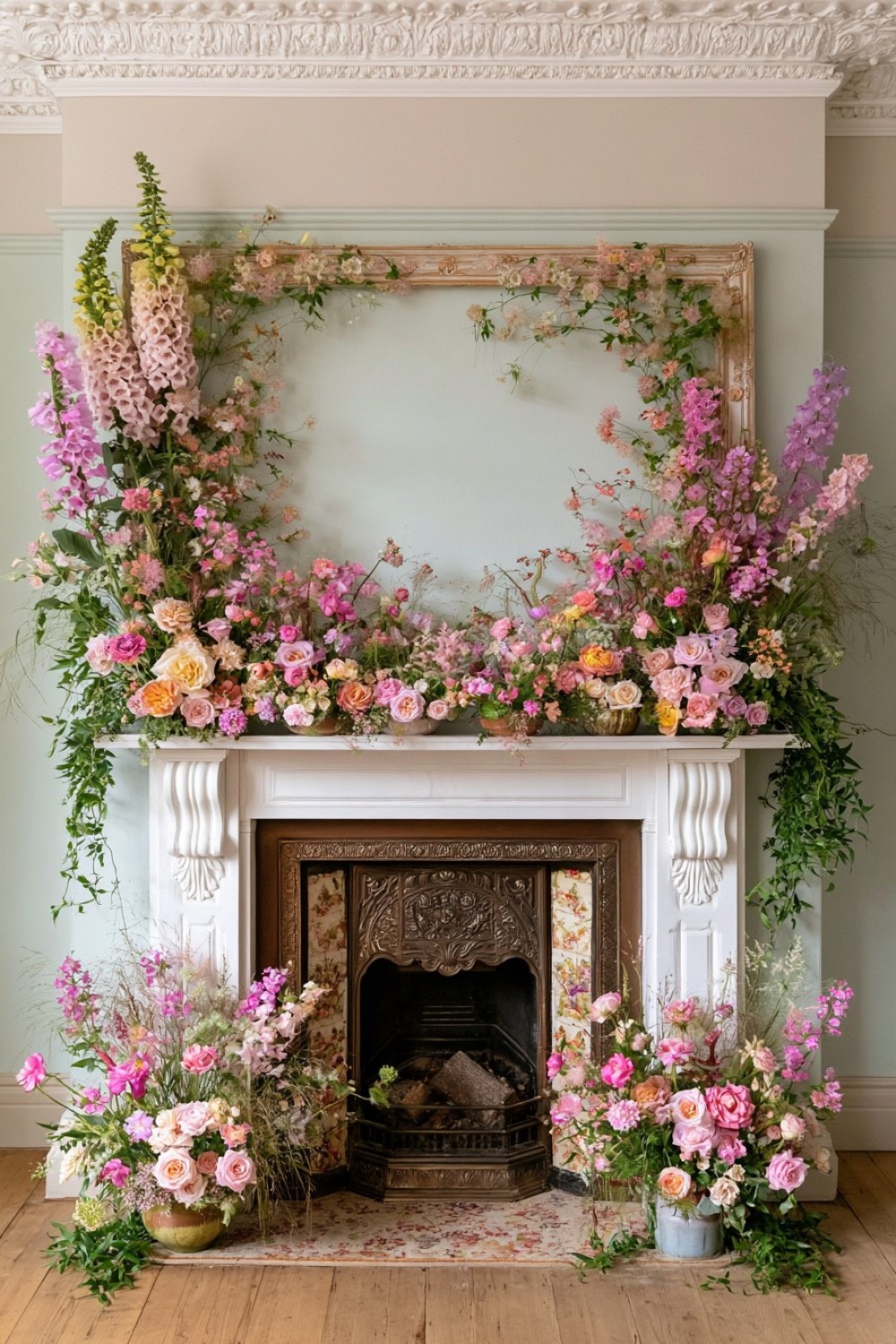
Instead of centering one vase on the mantel, create a composition that moves across the entire surface.
Use several low vessels in different shapes, then connect them visually with flowers and foliage that overlap slightly from one container to the next.
Keep one side fuller than the other so the arrangement feels intentional rather than perfectly symmetrical.
For example, tall foxgloves or delphiniums can anchor one end while lower roses, grasses, and trailing greenery taper toward the opposite side.
Leave parts of the mantel visible between clusters.
This creates the impression that the flowers are spreading naturally across the architecture.
If the fireplace is operational, all floral materials should remain well away from heat and flames. For active fireplaces, use the mantel display only when safe clearances can be maintained.
6. Use Transparent Vessels to Make the Stems Part of the Design
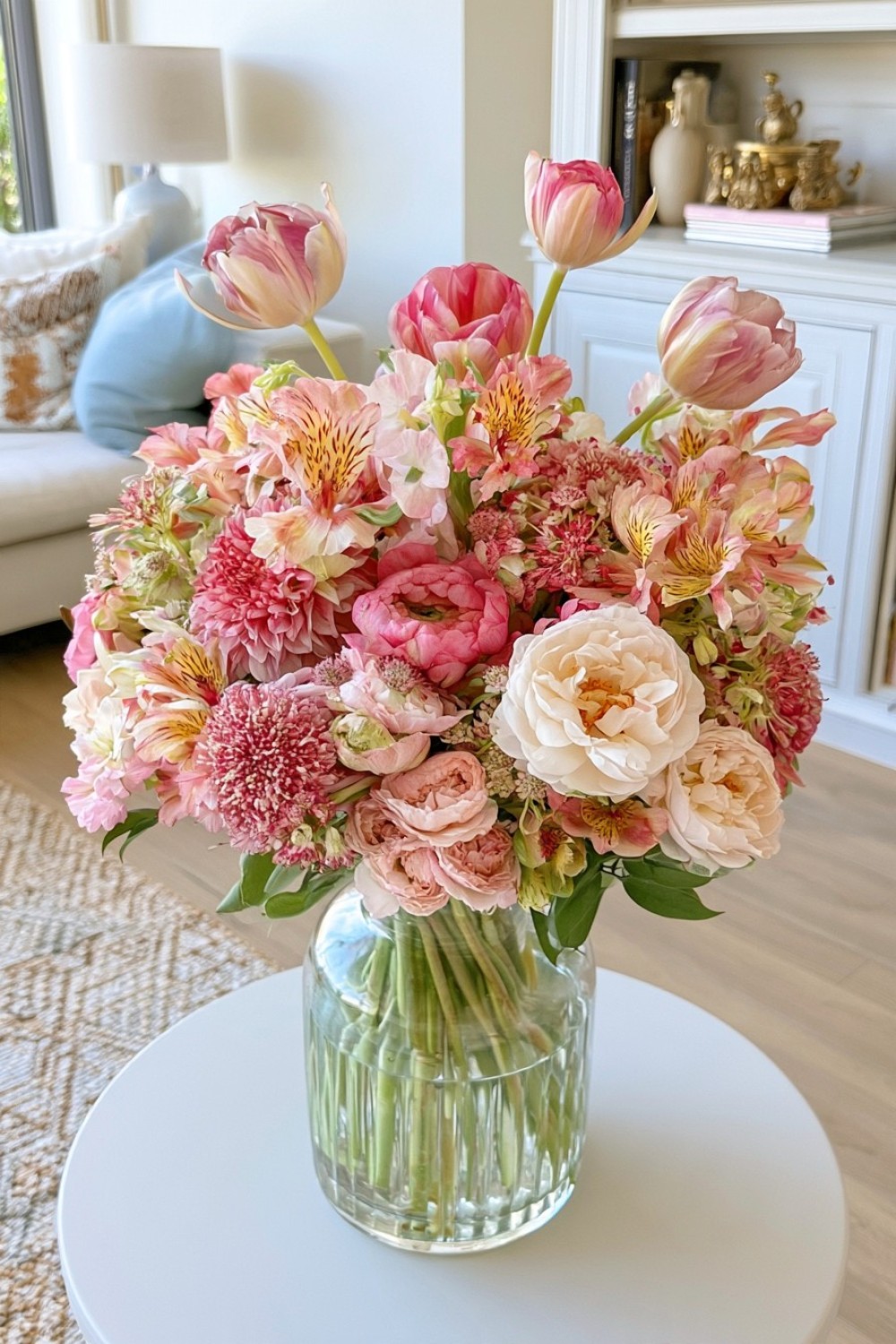
Clear glass can turn the hidden structure of an arrangement into part of the visual interest.
Instead of covering the stems, choose a tall cylindrical or rectangular vessel and arrange them deliberately so they form a clean pattern underwater.
Use flowers with attractive long stems such as tulips, calla lilies, alliums, or delphiniums.
Remove foliage below the waterline and keep the water exceptionally clean because every detail remains visible.
For a more graphic effect, angle the stems in one direction rather than letting them cross randomly.
A few large flowers can look stronger than a dense bouquet in this format.
This approach works particularly well in minimalist rooms where the vase needs to feel light and unobtrusive.
The transparency makes the arrangement appear larger without adding visual heaviness.
7. Create a Table Arrangement That Looks Like a Mini Meadow
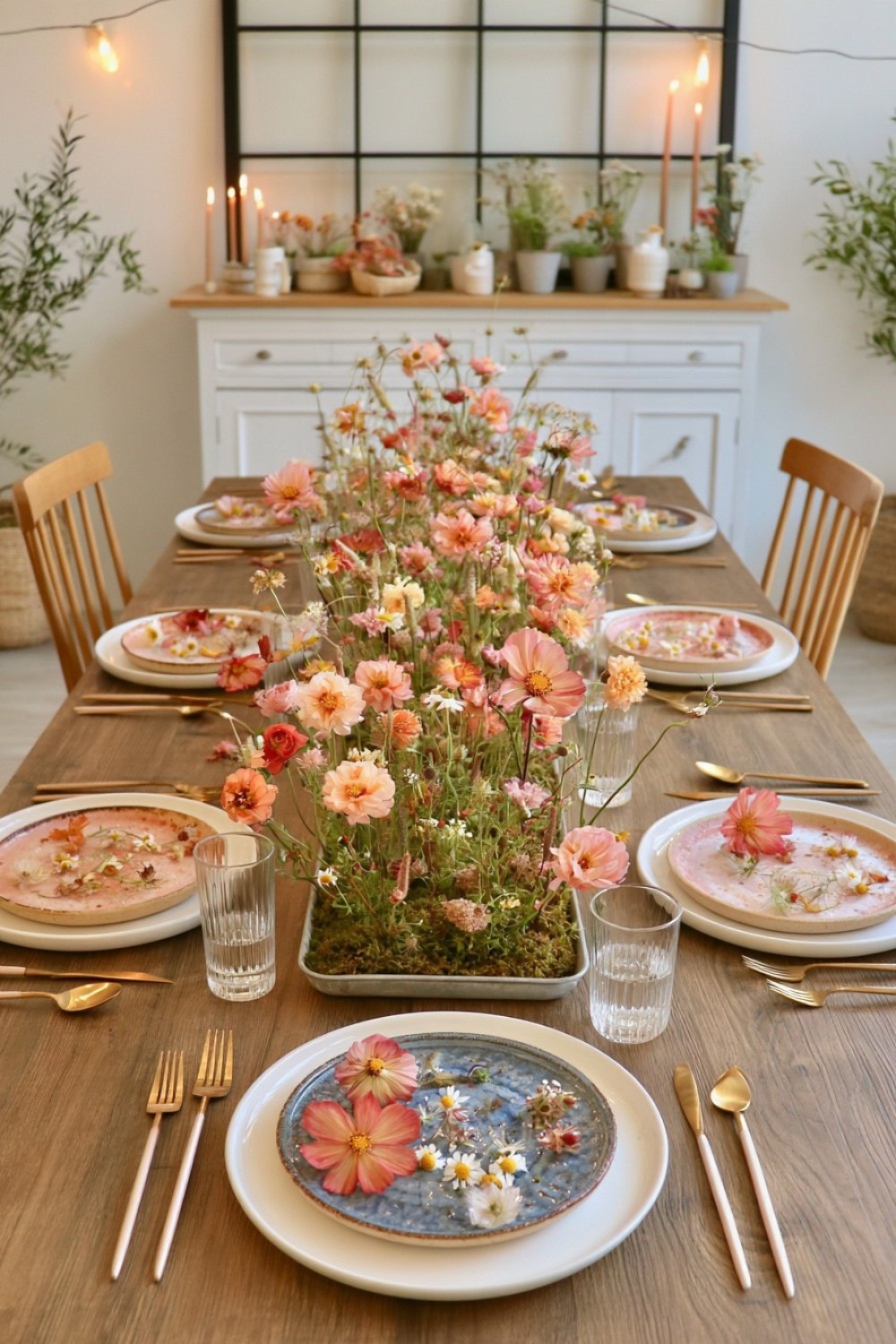
Instead of building one central mound of flowers, create a low landscape that appears to grow across the table.
Use several pin holders or small hidden vessels beneath moss, pebbles, or a narrow tray.
Insert fine-stemmed flowers at different heights: cosmos, chamomile, scabiosa, grasses, nigella, or small daisies all work well.
The arrangement should include visible gaps and uneven heights rather than forming a continuous wall of flowers.
Keep the center of the table lower so guests can see across it comfortably.
This works especially well on a long dining table where the arrangement can run between place settings without overwhelming them.
The effect is more natural when the flowers lean slightly in different directions, as they would outdoors.
8. Let One Oversized Flower Become the Entire Arrangement
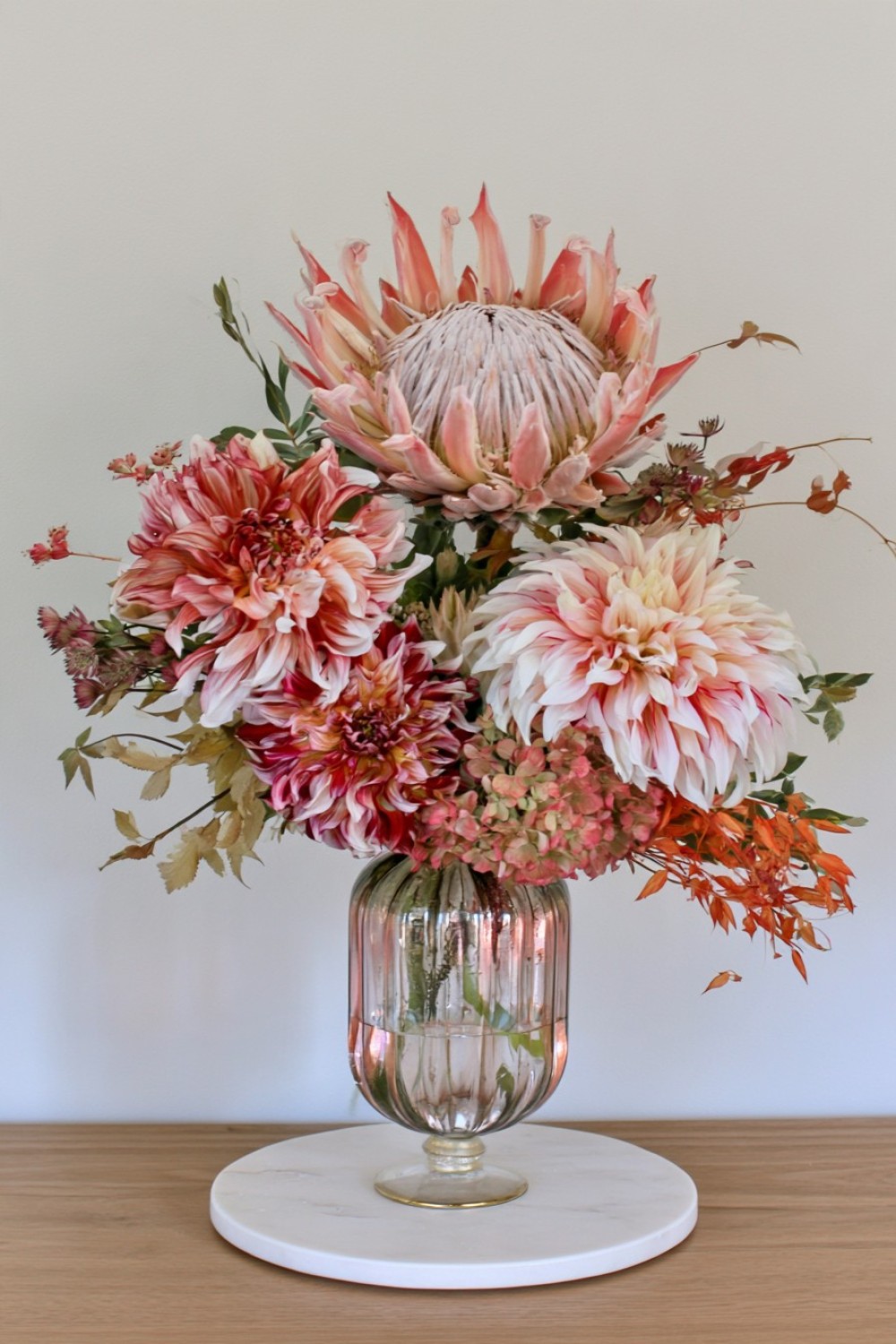
A dramatic arrangement does not always require many stems.
One large protea, sunflower, hydrangea head, king protea, or oversized dahlia can become enough when the vessel and placement support it.
Choose a compact vase with strong material presence—stone, ceramic, metal, or colored glass.
Cut the stem relatively short so the flower feels visually connected to the vessel instead of hovering awkwardly above it.
Place the arrangement somewhere with negative space around it, such as a bedside table, narrow shelf, or small console.
This approach is particularly effective in minimalist interiors because the flower reads almost like an object rather than part of a bouquet.
The simplicity also makes the natural structure of the bloom easier to appreciate.
9. Build a Floral Arrangement Around a Piece of Driftwood
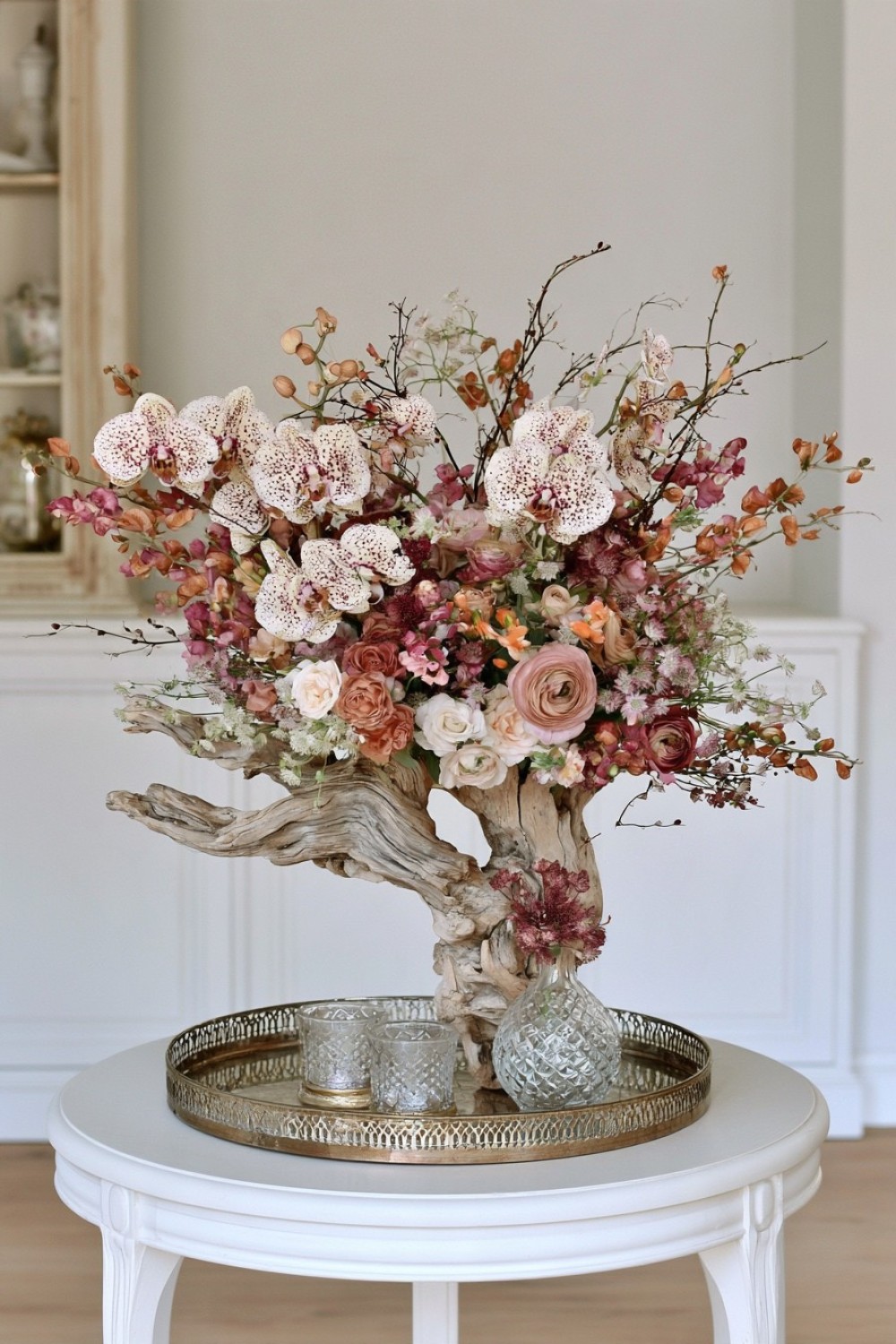
A sculptural piece of wood can provide the structure for a more unusual floral composition.
Place a piece of clean, dry driftwood or weathered branch across a shallow waterproof tray.
Hide several small water tubes or bud vases around it and insert flowers so they appear to emerge naturally from gaps in the wood.
Orchids, small roses, ranunculus, or grasses can work especially well.
Keep the flowers restrained so the wood remains visible.
This approach works beautifully on low tables, sideboards, or entry consoles where the arrangement can be viewed from several angles.
If using found natural material, clean and dry it thoroughly before bringing it indoors and avoid pieces showing signs of mold or insect activity.
10. Make a Botanical Composition From Flowers and Fruit
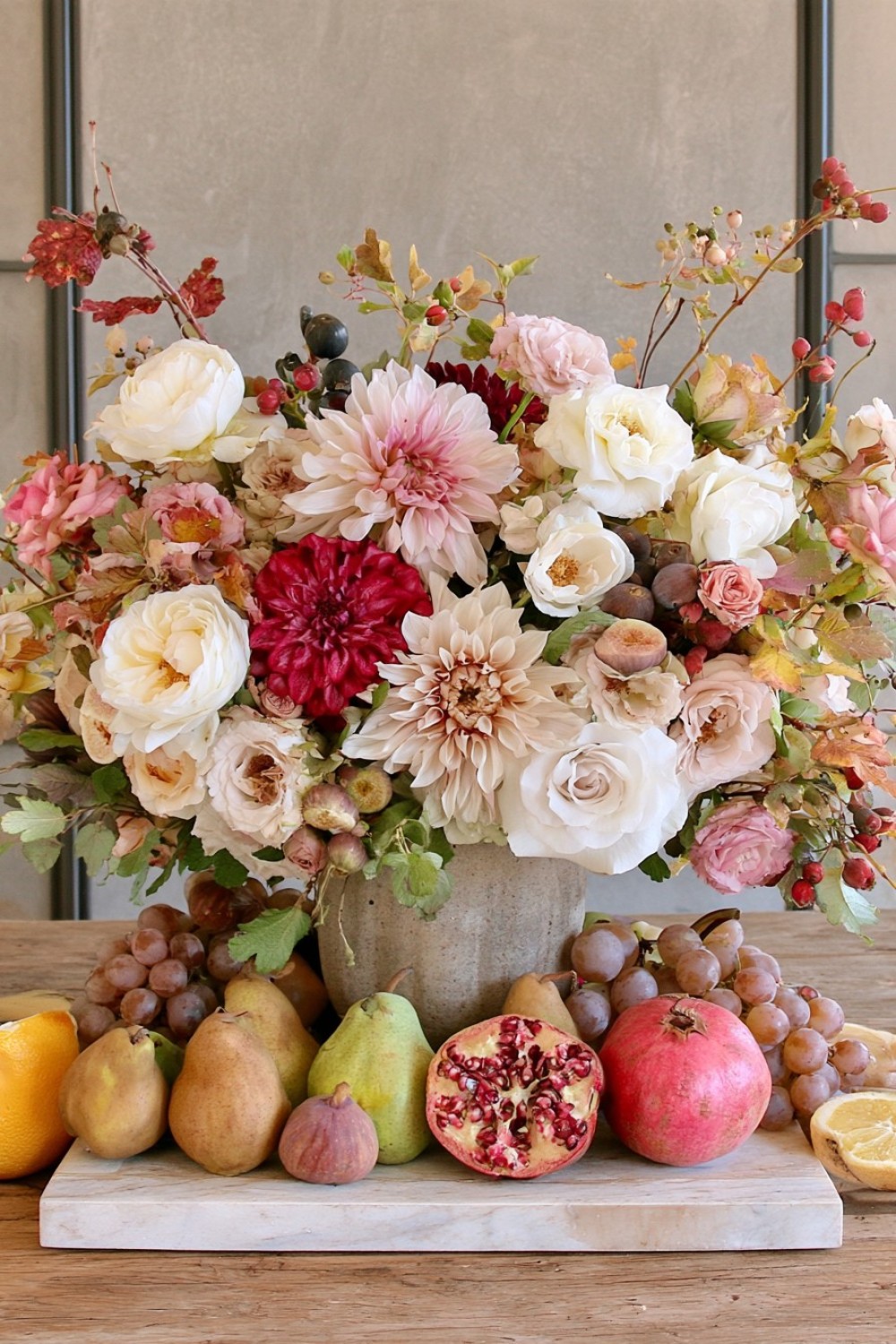
Flowers can interact beautifully with fruit when the colors and scale are chosen carefully.
Instead of filling a bowl with fruit and adding flowers beside it, combine the two within one composition.
Use figs, pears, citrus, pomegranates, or grapes around a low floral arrangement, allowing a few pieces to rest directly on the table.
Match the tones rather than the species. Deep red dahlias with figs and grapes can feel rich and moody, while white flowers with pale pears create a much quieter look.
This style works particularly well on dining tables and kitchen islands because it connects decoration with the room’s function.
Keep food that will be eaten separate from floral foam, flower preservatives, or non-food-safe surfaces.
11. Create a Tall Asymmetrical Arrangement With One Empty Side
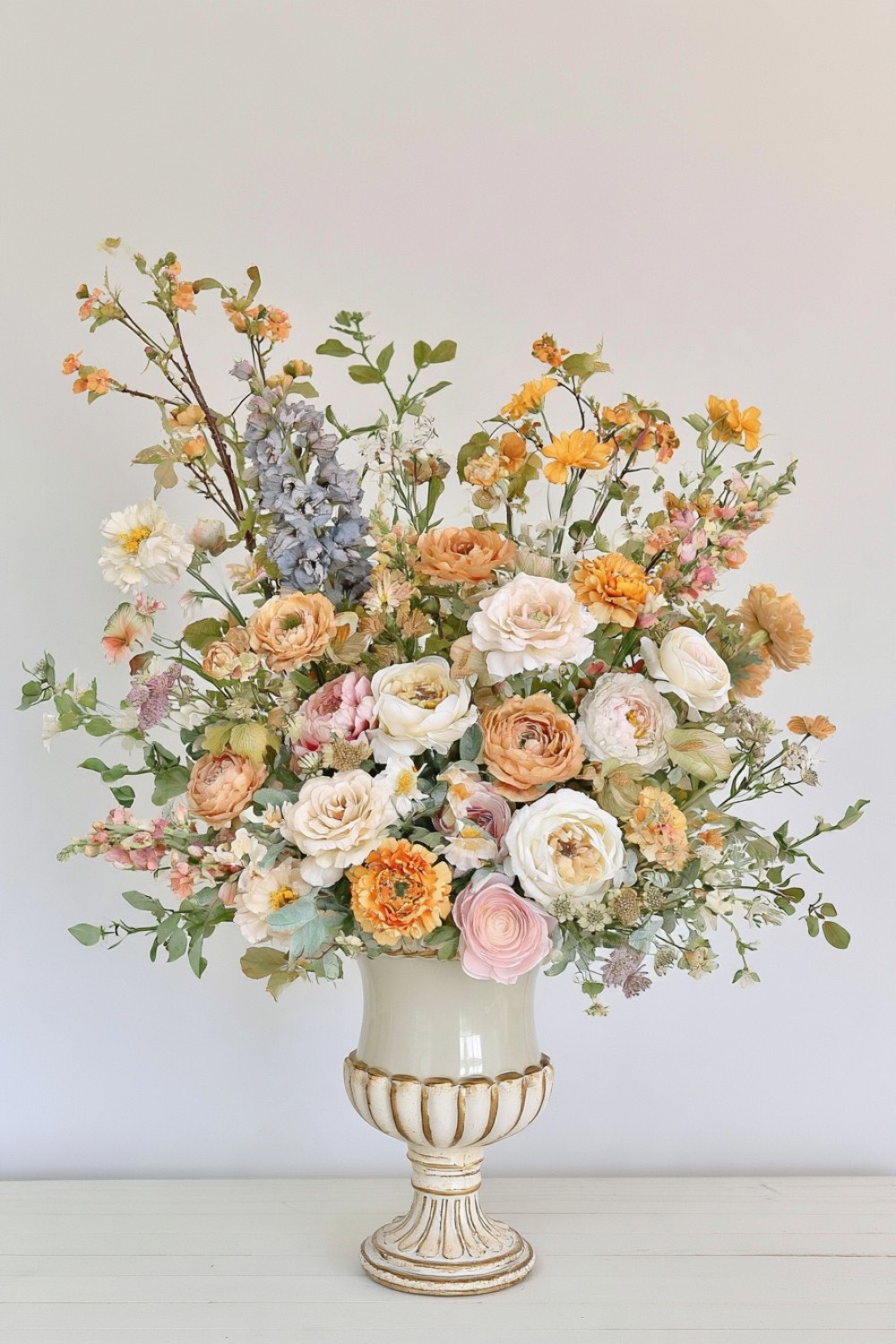
Most tall arrangements are built evenly around the vase. Leaving one side deliberately open can make the composition feel much more modern.
Start with one strong branch or tall flower leaning to one side. Then build a smaller cluster of supporting flowers near the base.
The empty side becomes part of the arrangement.
Use flowers with strong line and movement such as delphinium, snapdragon, anthurium, gladiolus, or flowering branches.
A narrow-necked vessel helps control the angle.
This technique works especially well on consoles and sideboards where the arrangement can lean visually toward artwork or a mirror.
Avoid placing it where the extending branch will interfere with walking paths.
12. Build a Monochrome White Arrangement Using Texture Instead of Color
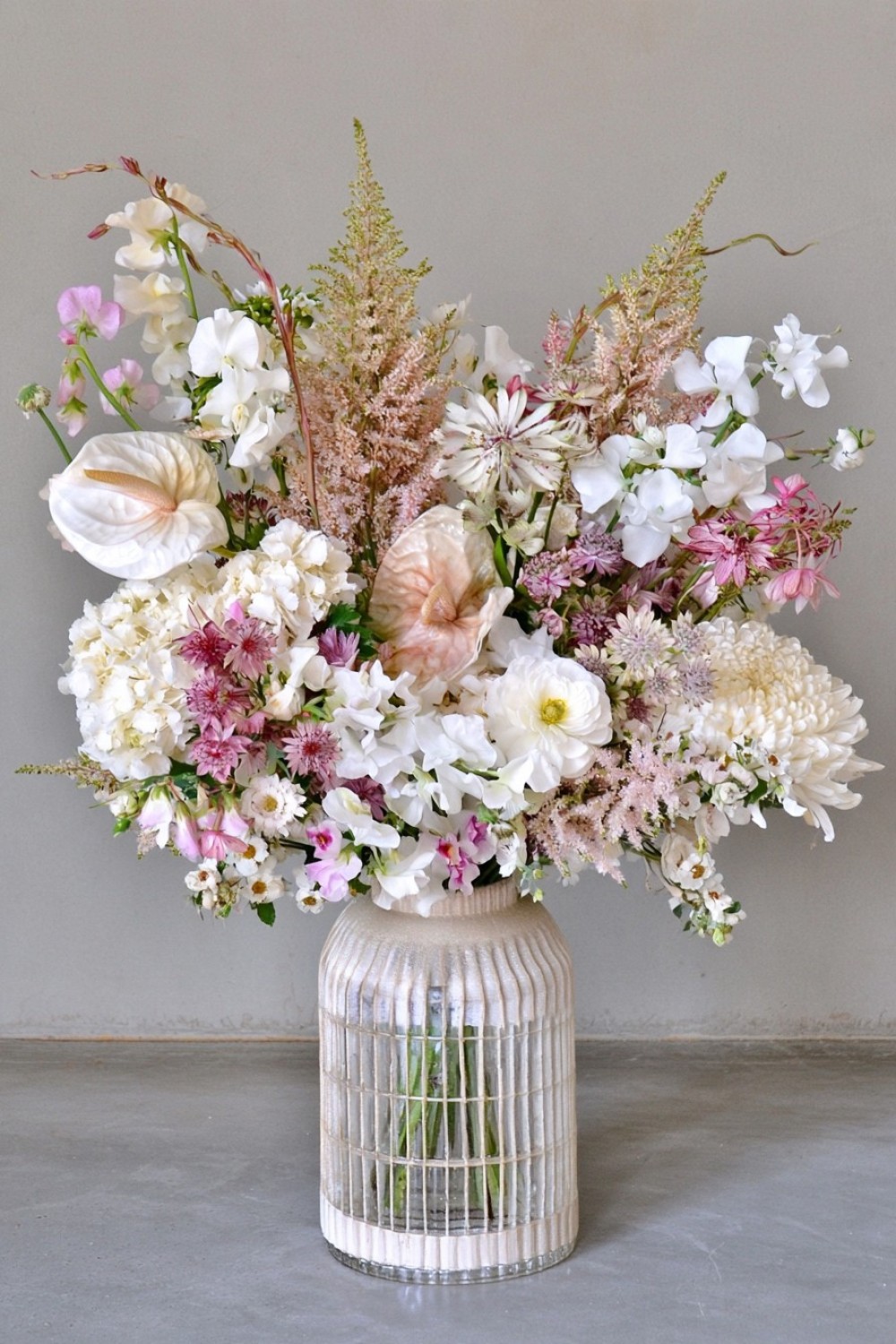
An all-white arrangement becomes interesting when the flowers differ dramatically in texture.
Combine soft hydrangeas, spiky alliums, delicate sweet peas, sculptural anthuriums, fluffy astilbe, or textured chrysanthemums.
Use only a small amount of greenery so the tonal effect remains strong.
A matte white, pale stone, or transparent glass vessel helps keep the focus on shape.
This works particularly well in rooms already filled with color because the flowers provide relief rather than introducing another competing palette.
For more depth, include off-white, cream, and very pale beige instead of forcing every bloom to be pure white.
The subtle tonal variation makes the arrangement feel richer.
13. Use a Vintage Soup Tureen as a Low Floral Vessel
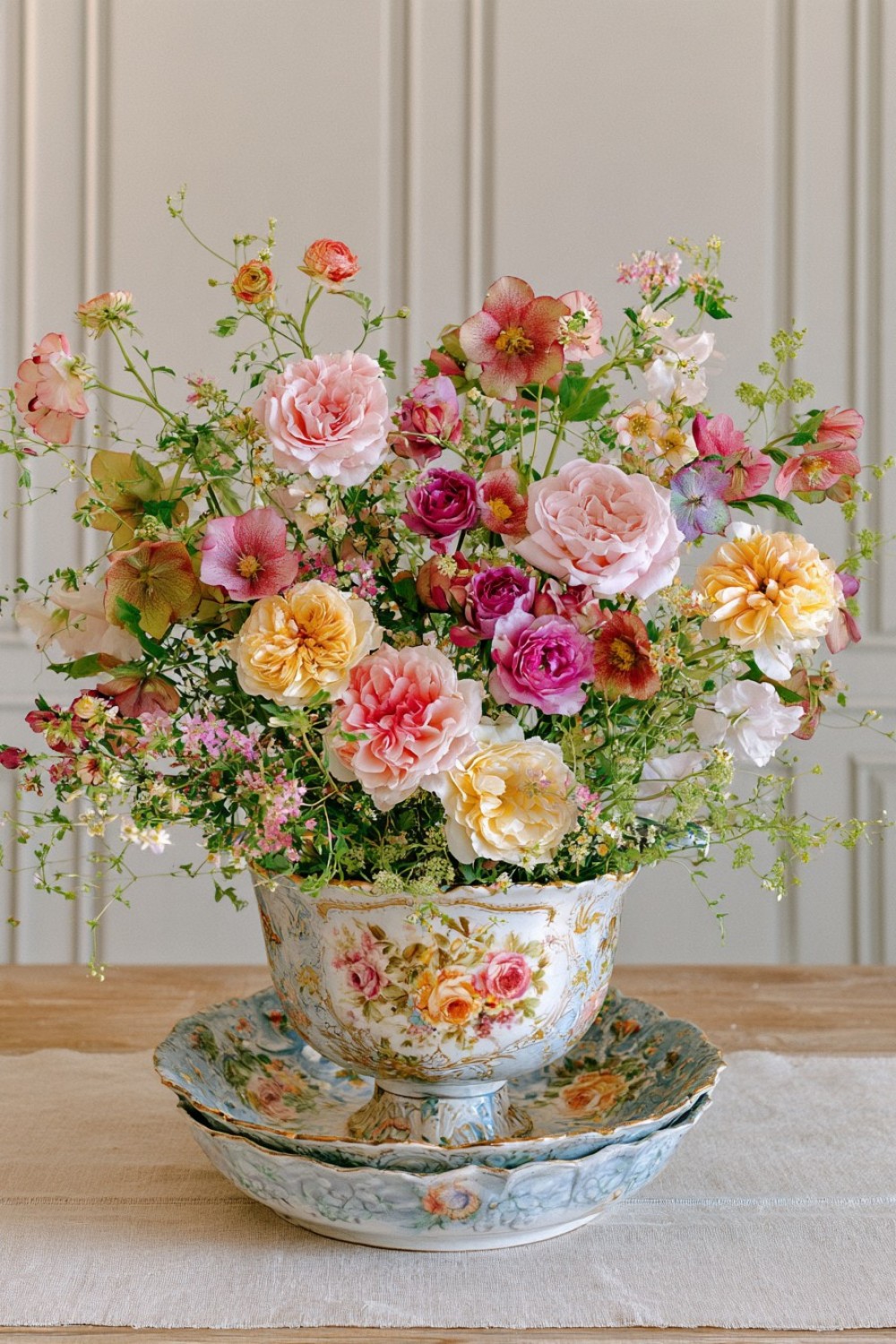
A wide lidded tureen, ceramic serving bowl, or antique-style dish can make a beautiful low arrangement.
Remove the lid and use a flower frog or small waterproof insert inside so the flowers remain stable.
Because the vessel is broad, keep the arrangement relatively low and allow stems to move outward rather than upward.
Garden roses, hellebores, peonies, herbs, and trailing greenery can suit this format especially well.
This is an effective way to reuse decorative tableware that might otherwise remain hidden in a cabinet.
The contrast between formal ceramic and loose flowers gives the arrangement character.
If the vessel is antique or has an unknown glaze, use a separate waterproof insert rather than allowing flower water to sit directly inside it for long periods.
14. Create a Botanical Wall Moment With Hanging Test Tubes
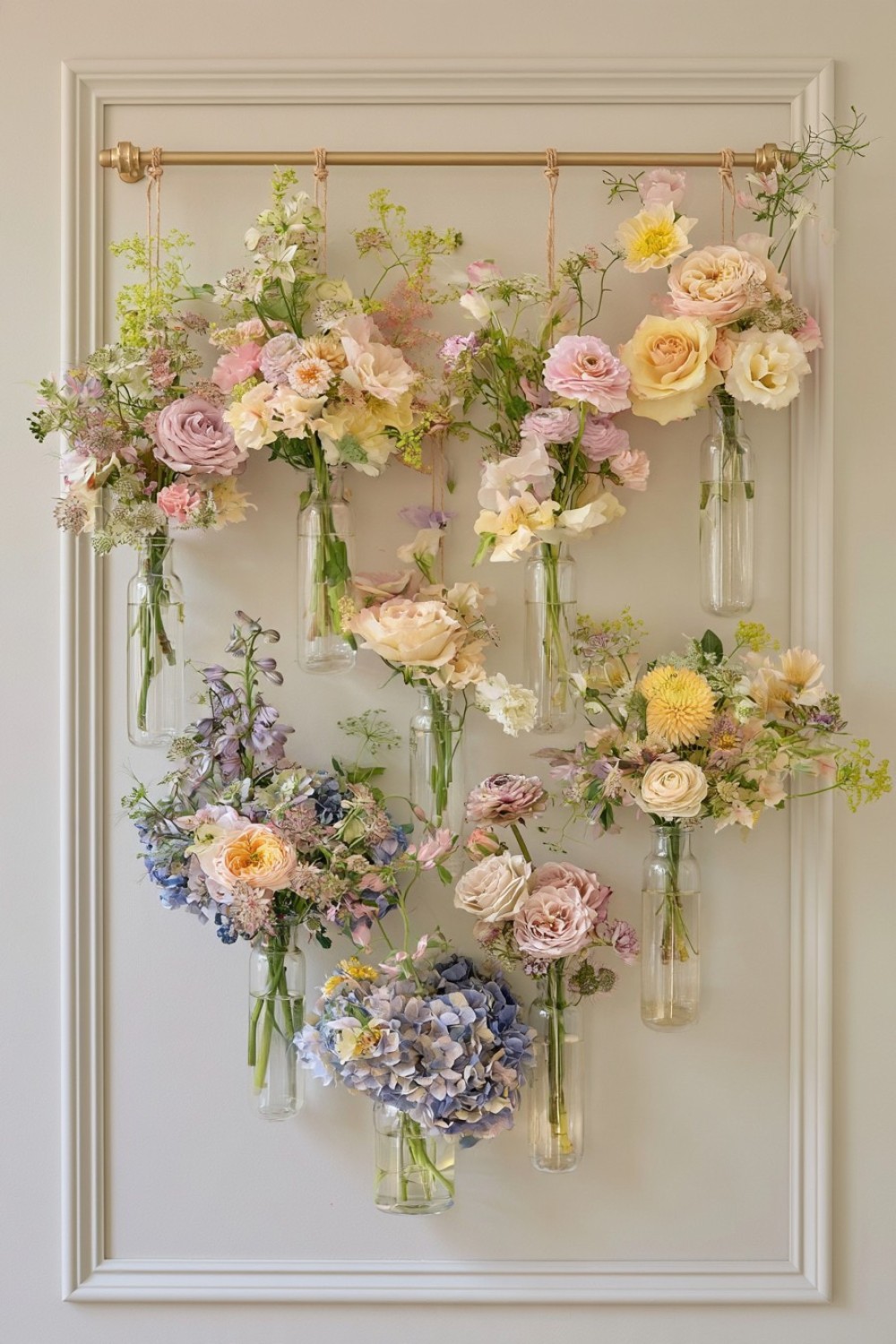
Instead of placing flowers on a surface, arrange them vertically.
Mount a narrow timber strip or metal rail to the wall and suspend several small glass tubes from it at different heights.
Place one or two stems in each tube.
You will need a secure rail, small vessels with hanging loops, strong cord or wire, and appropriate wall fixings.
Keep the overall arrangement sparse so each flower remains visible.
This works well in hallways, kitchens, craft rooms, or narrow spaces where a traditional vase would take up valuable surface area.
The tubes should be easy to remove for cleaning and refilling.
Avoid placing them where they can be knocked by doors or people passing closely.
15. Build a Floral Arrangement That Mirrors a Painting
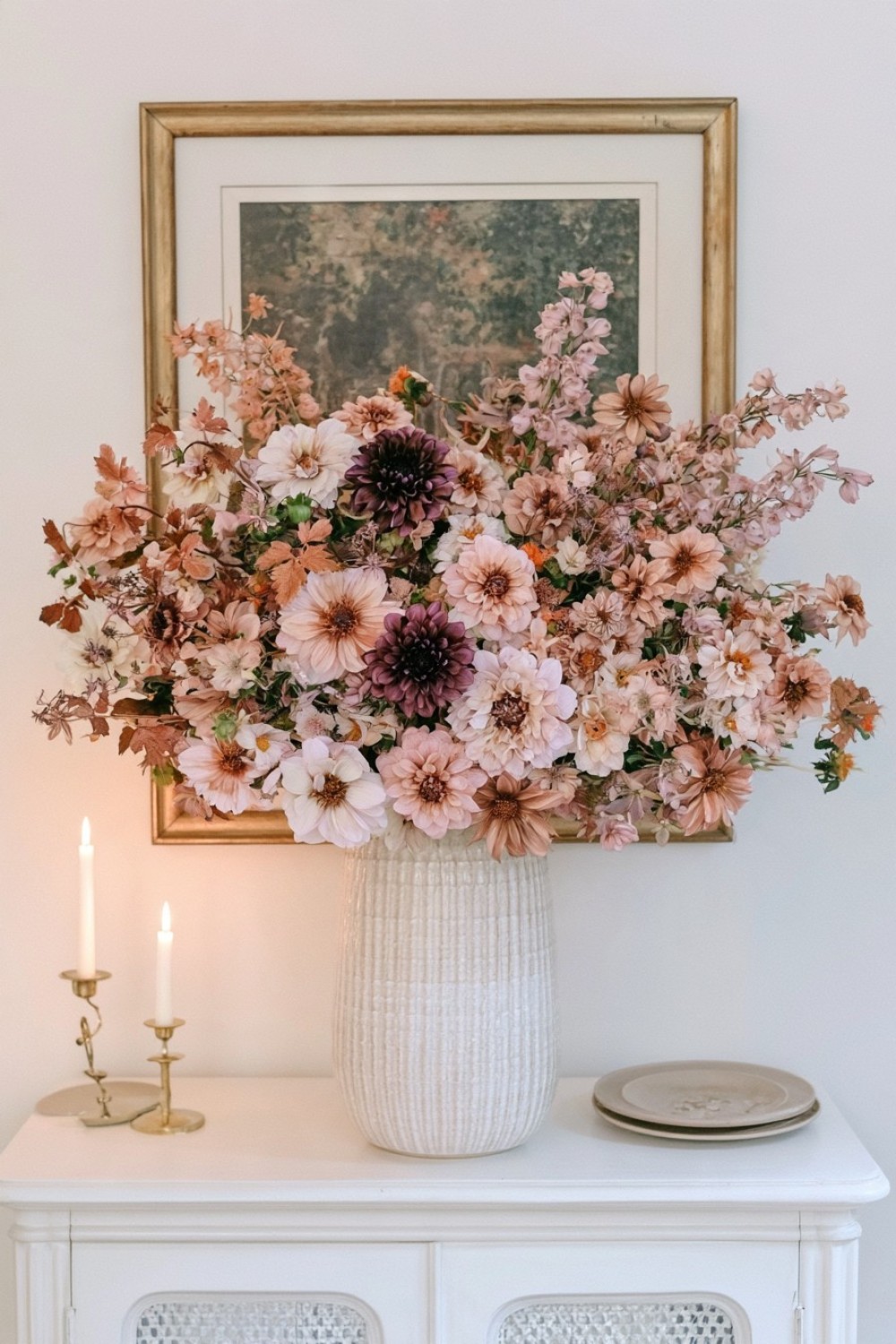
A floral display can interact with nearby artwork instead of existing independently.
Choose two or three colors from a painting, print, or textile and repeat them in the flowers below.
The arrangement does not need to match literally. A burgundy shape in the artwork might become a deep red dahlia, while a pale blue area could be echoed through delphinium.
Also consider the direction of movement in the artwork. If the composition leans upward on one side, let the flowers do the same.
This creates a stronger relationship between wall and surface.
The arrangement works best when the vessel remains visually quiet so the connection between flowers and artwork is easy to read.
16. Create a Floral Arrangement From Mostly Leaves
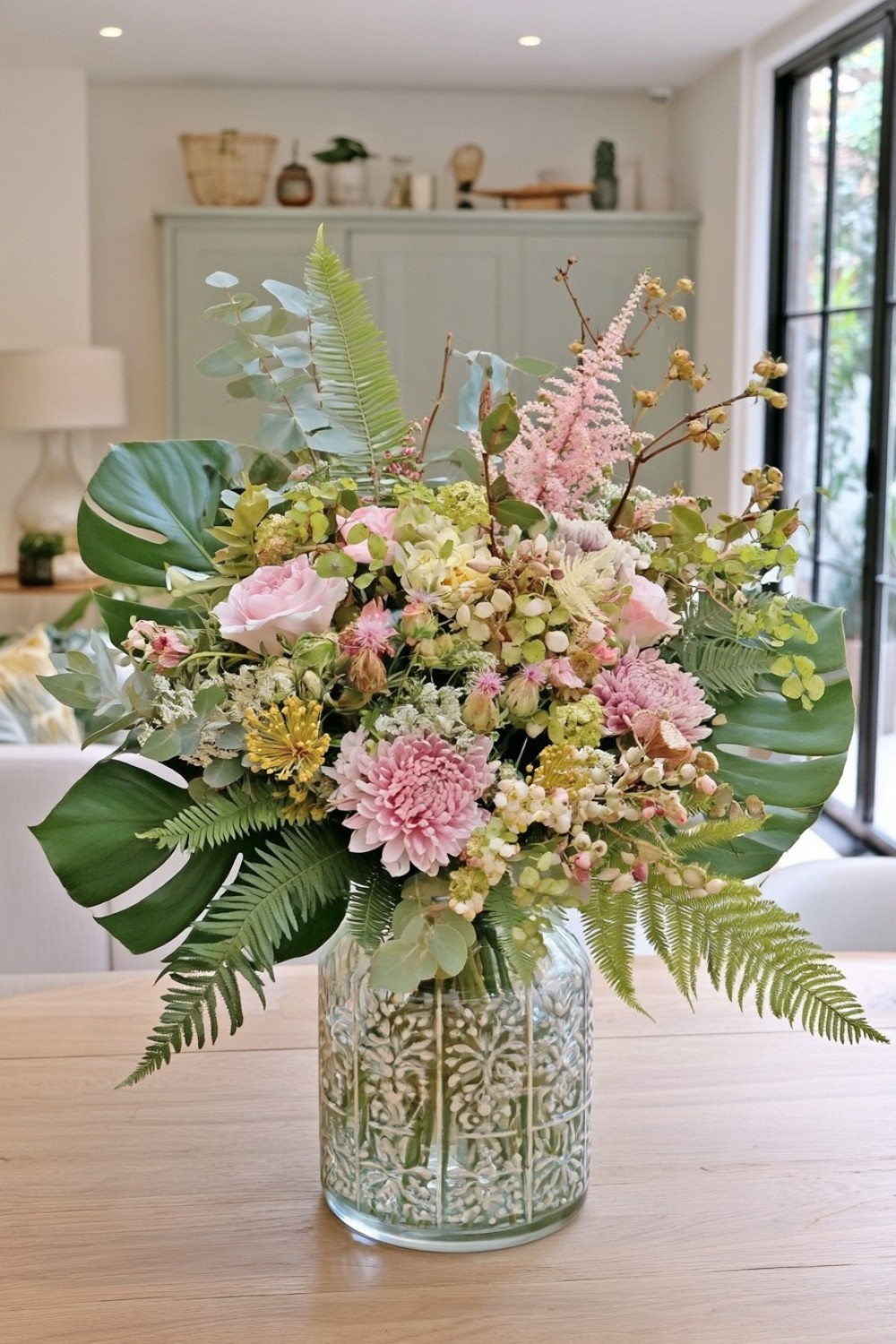
Flowers do not need to dominate every arrangement.
Use foliage with strong shapes and contrasting surfaces: eucalyptus, monstera, fern, ruscus, olive, magnolia leaves, or branches with small seed pods.
Add only one or two flowers for color.
The result can feel much more architectural and often lasts longer than a flower-heavy bouquet.
Use a wide vessel that allows foliage to spread rather than forcing it into a tight bunch.
This approach works especially well in modern or natural interiors where large green shapes can interact with furniture and wall colors.
Keep leaves below the waterline removed to reduce decay and keep the water cleaner.
17. Use Several Identical Vases With Completely Different Flowers
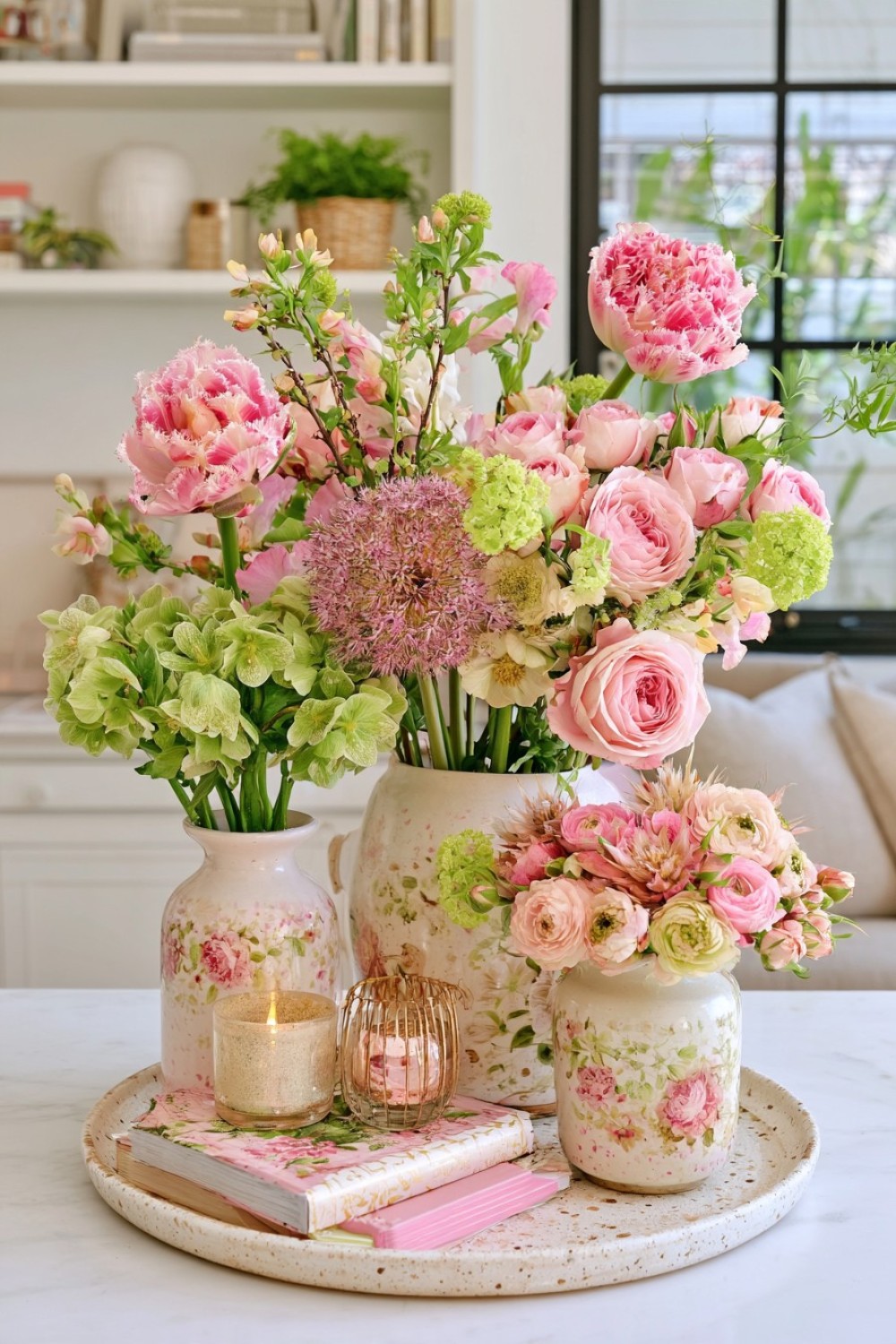
Repetition can make mismatched flowers feel surprisingly cohesive.
Choose four or five identical small vases, then place a completely different flower in each one.
One vase might hold a tulip, another an allium, another a rose, and another a small branch.
Because the vessels repeat, the flowers can vary dramatically without looking chaotic.
Arrange them in a straight line for a graphic effect or stagger them slightly for a more relaxed composition.
This works especially well on mantels, long shelves, and window ledges.
The arrangement is also practical because individual flowers can be replaced as they fade without rebuilding the whole display.
18. Make a Coffee Table Arrangement With Flowers Below Eye Level
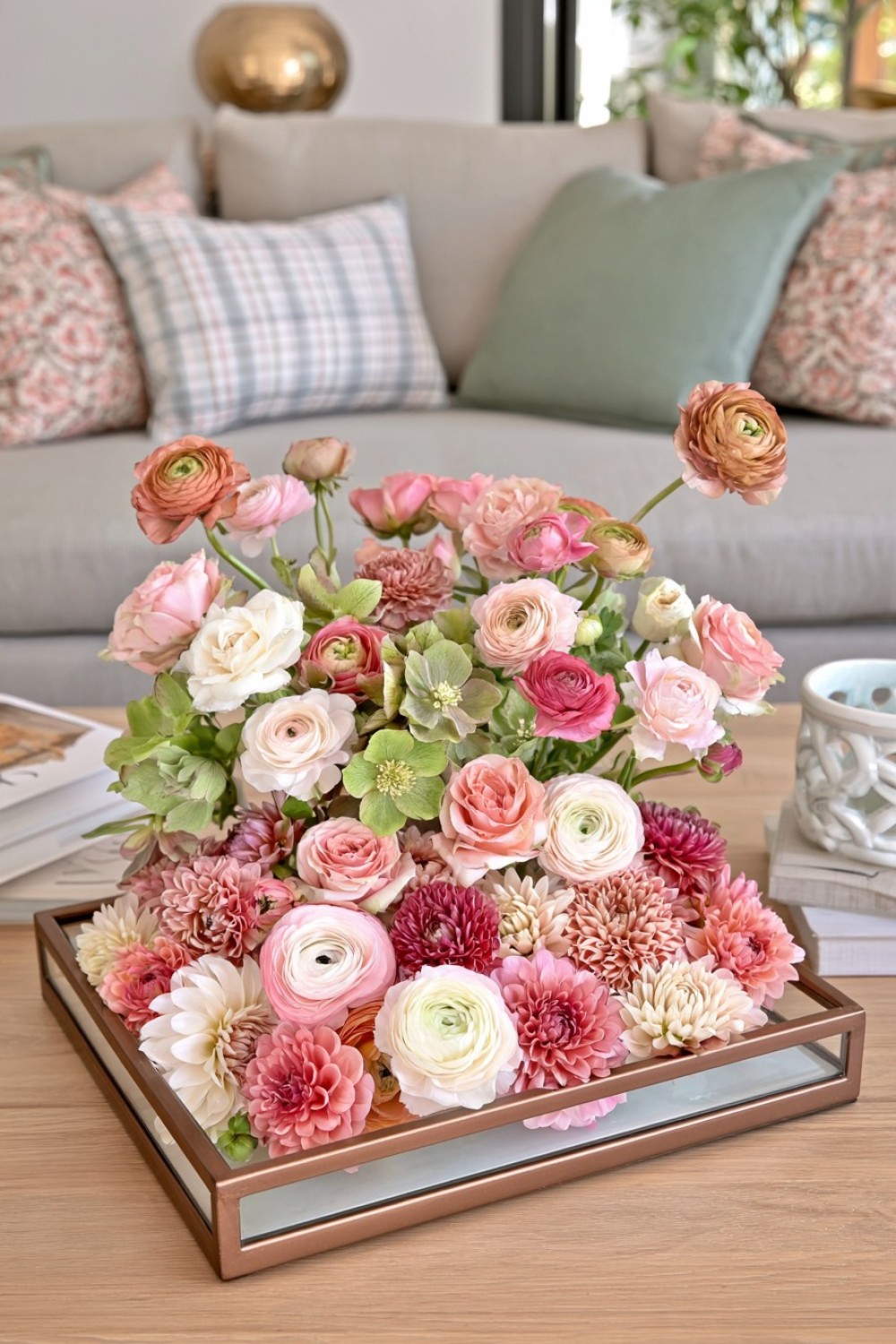
Coffee-table flowers often become frustrating because they block views across the room.
Instead, use a very shallow bowl or low rectangular vessel and keep the flowers almost flush with the rim.
Cut flowers short and arrange them densely enough to create a visible surface but not so tightly that they lose shape.
Ranunculus, roses, hellebores, chrysanthemums, or small dahlias work well.
Add one slightly taller stem off-center to keep the composition from looking flat.
This arrangement works especially well on large low tables where a conventional tall vase would feel disconnected from the furniture.
It also allows books, trays, and decorative objects to coexist around the flowers.
19. Suspend a Floral Installation Above a Table
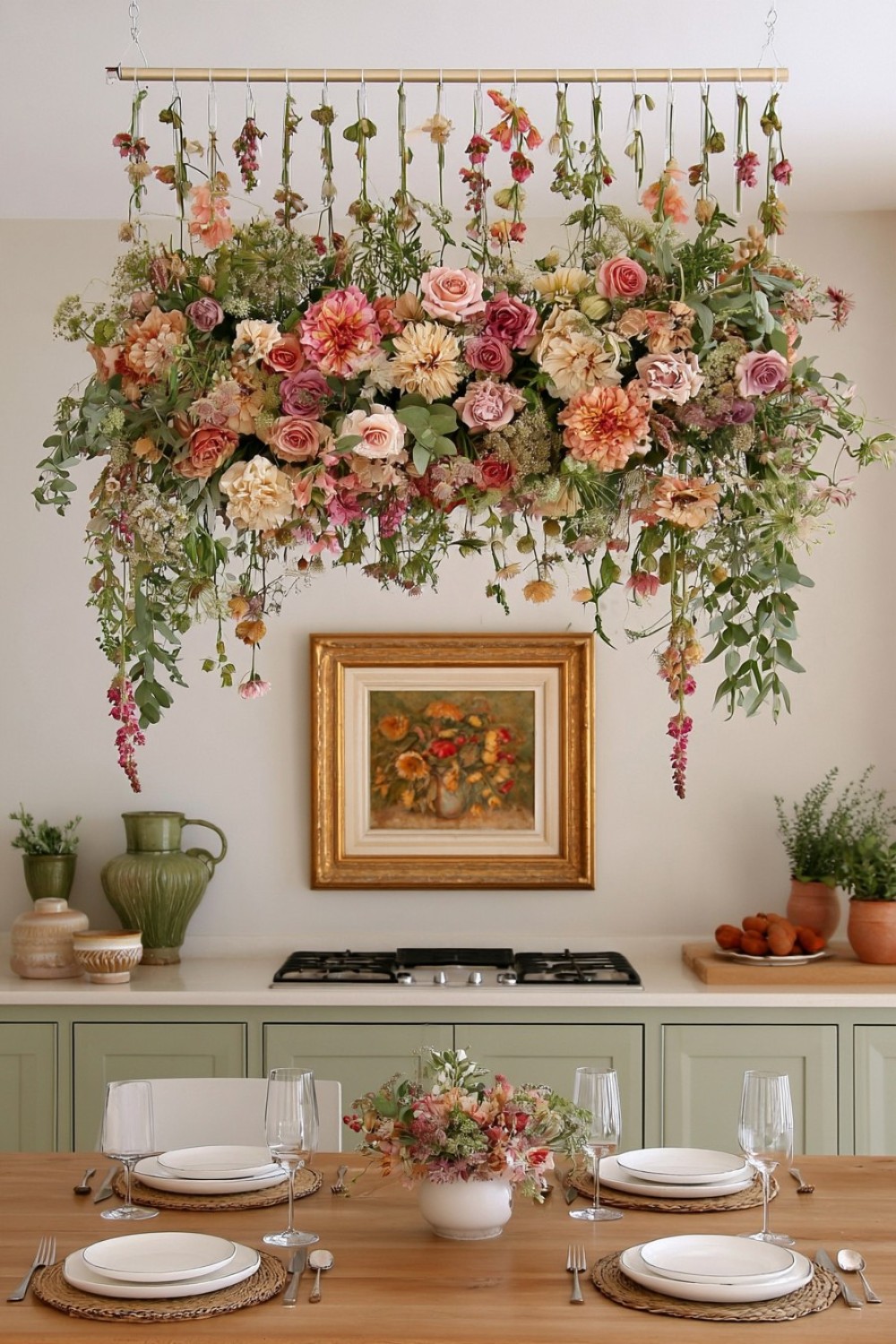
For a dramatic room, move the flowers off the table entirely.
Create a lightweight overhead frame and attach small water tubes, dried botanical elements, or professionally prepared floral mechanics along it.
Let selected stems descend slightly while leaving the table below almost empty.
This works particularly well over a dining table or kitchen island where floor and surface space is limited.
Fresh suspended installations require careful planning because water, weight, and plant longevity all matter.
For home use, a smaller composition made primarily from dried or long-lasting materials may be easier to maintain.
Any overhead structure should be securely attached to appropriate structural support and kept clear of lighting, sprinklers, and walking areas.
20. Create a Rotating Seasonal Flower Station
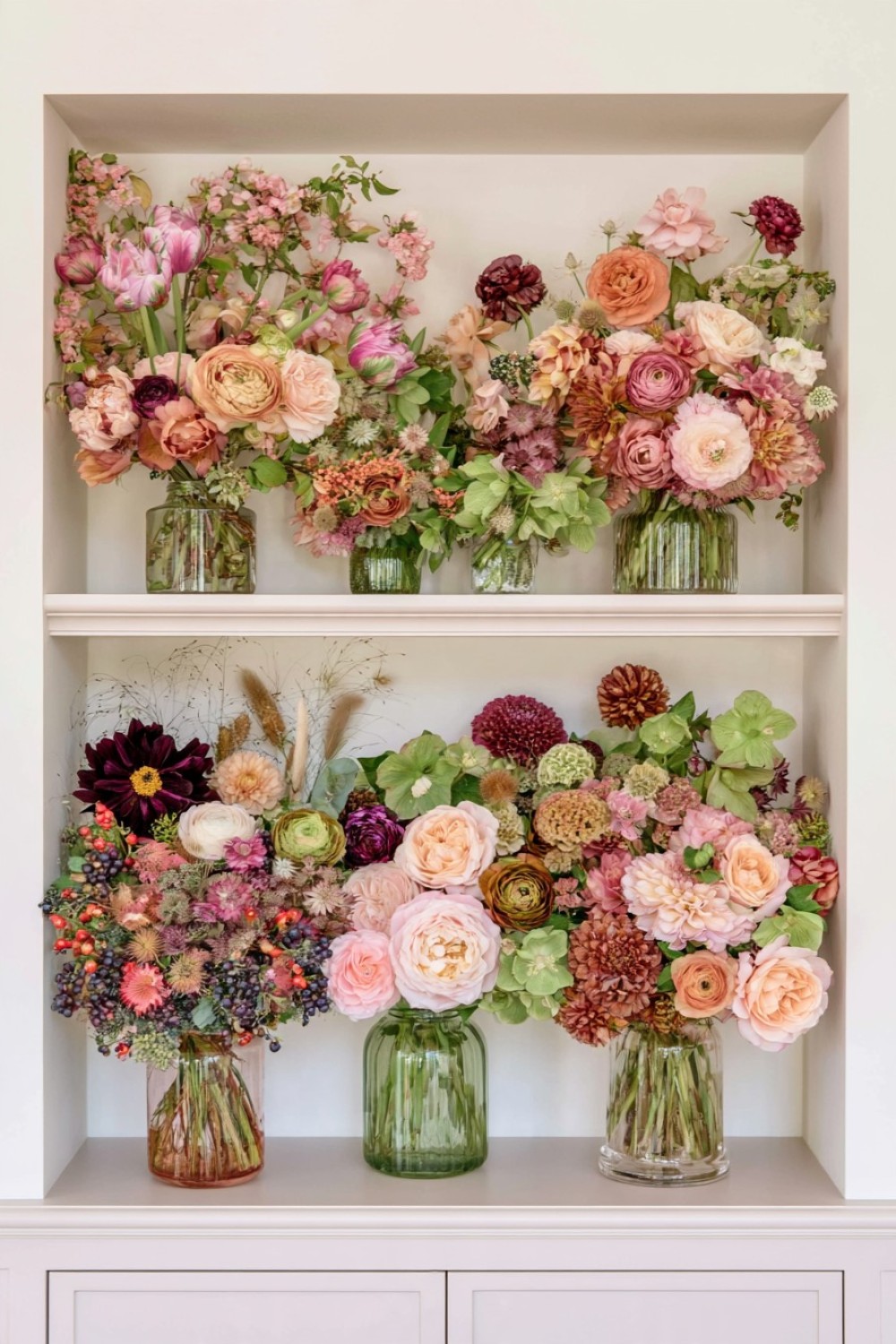
Instead of treating every arrangement as temporary decoration, create one permanent location in the house specifically for changing seasonal flowers.
Choose a console, niche, or shelf and keep one primary vessel there year-round.
Only the flowers change.
In spring, use flowering branches and tulips. Summer might bring cosmos and dahlias. Autumn could introduce berries, grasses, and seed heads, while winter might rely on evergreen branches, hellebores, or sculptural bare stems.
Keeping the vessel constant gives the display continuity while the botanical material reflects the season.
This approach also makes flower buying more intentional because you are filling one designed location rather than scattering small bouquets randomly throughout the house.
Over time, the arrangement becomes part of the rhythm of the room.
Making Floral Arrangements Feel More Designed
The strongest floral displays usually have a clear reason for looking the way they do. A tall branch composition responds to ceiling height, a low meadow keeps dining sightlines open, and a row of bud vases works because repetition creates rhythm. The flowers are only part of the design.
Before arranging anything, consider the room, the surface, and the viewing angle. A coffee table needs a different shape from a mantel, and a narrow console benefits from a different scale than a dining table.
It also helps to use fewer flower varieties with more intention. One strong branch, one dominant color, or one repeated vessel can create more visual impact than a complicated mixed bouquet.
When placement, proportion, texture, and container choice work together, flowers become part of the room’s composition rather than temporary decoration sitting on
MORE IDEAS


Share
What's Your Reaction?
 Like
0
Like
0
 Dislike
0
Dislike
0
 Love
0
Love
0
 Funny
0
Funny
0
 Angry
0
Angry
0
 Sad
0
Sad
0
 Wow
0
Wow
0