

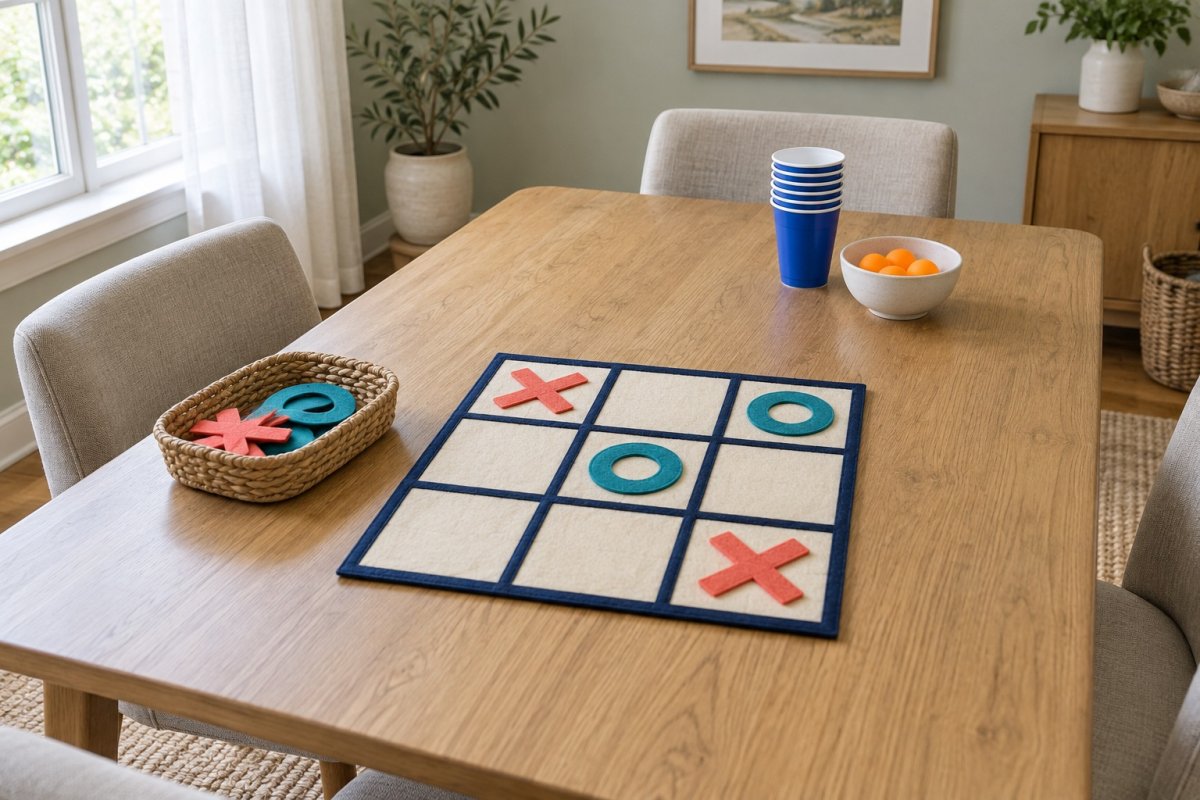
A family game earns its place at home when everyone can reach the pieces, understand the first turn, and help put it away. A dining table, an open stretch of floor, or a kitchen island can provide the setting without buying another piece of furniture. The most useful games start with the room you already share and materials you can bring out again.
These 27 setups are for families working around everyday furniture, smaller rooms, and modest supply budgets. The sequence moves between quick cup challenges, floor games, quieter tabletop activities, and paper projects, so you can pick an activity that matches the energy in the room. Each idea includes a way to arrange the space, a simple way to play, and an adjustment for different players. Unless a manufacturer's instructions are linked, the scoring and turn limits are suggested house rules rather than competition rules.
Table of Contents
- Plan the Playing Space Before Buying Supplies
- Match the Game to the Surface
- Treat Tape Color as Decoration, Not a Product Label
- Share the Reach and the Reset
- 1. Paper Roll Cup Race
- 2. Party Blower Ball Knockdown
- 3. Red Cup Paper Pull Tower
- 4. Tabletop Shuffle Counters
- 5. Bounce Ball Cup Triangles
- 6. Bottle Bowling on a Taped Lane
- 7. Fabric Tic Tac Toe on a Tape Grid
- 8. Rope Ring Toss with Wooden Pegs
- 9. Indoor Cornhole with Wooden Boards
- 10. Felt Ball Spoon Sorting Race
- 11. Indoor Bocce on a Taped Lane
- 12. Beanbag Shuffleboard in an Attic Lane
- 13. Living Room Putting Challenge
- 14. Balloon Volleyball over a Low Net
- 15. Block Tower Stacking Game
- 16. Cooperative Domino Run
- 17. Shadow Puppet Guessing Game
- 18. Family Jigsaw Puzzle with Sorting Trays
- 19. Whiteboard Drawing and Guessing Game
- 20. Paper Airplane Target Toss
- 21. Paper Bridge Coin Challenge
- 22. Tabletop Curling with Cardboard Discs
- 23. Origami Frog Races
- 24. Timed Paper Chain Race
- 25. Living Room Charades
- 26. Picture Book Memory Game
- 27. Egg Carton Color Pattern Game
- Compare Supplies Before Spending
- Where to Start
Plan the Playing Space Before Buying Supplies
Match the Game to the Surface
Cup bouncing needs a firm tabletop, while paper folding benefits from a clear surface where creases can be pressed flat. Rolling games work best on a continuous floor without a rug edge interrupting the lane. Walk through the motions before arranging chairs: a seated player needs room to reach, and a standing player needs space to release a bag without hitting furniture. Place the waiting seats beside the play area so collecting pieces does not interrupt another turn.
Treat Tape Color as Decoration, Not a Product Label
Blue lines can connect a game to existing cushions or storage baskets, but tape color alone does not tell you what adhesive touches the floor. Follow the surface instructions for the exact roll; 3M's delicate surface tape information includes wood floors among its listed uses. Test an inconspicuous spot first, and stop if the finish lifts. For a floor you cannot tape, arrange the game on a removable board instead.
Share the Reach and the Reset
Set the target distance from the least confident player's comfortable reach, then let experienced players move farther back. A basket for each team reduces searching, while a shared tray makes loose craft pieces easier to count before packing away. Small balls, coins, felt balls, and loose counters must stay away from children younger than three, following CPSC toy safety guidance. Build short rounds around taking turns, with everyone pausing while pieces are collected.
1. Paper Roll Cup Race
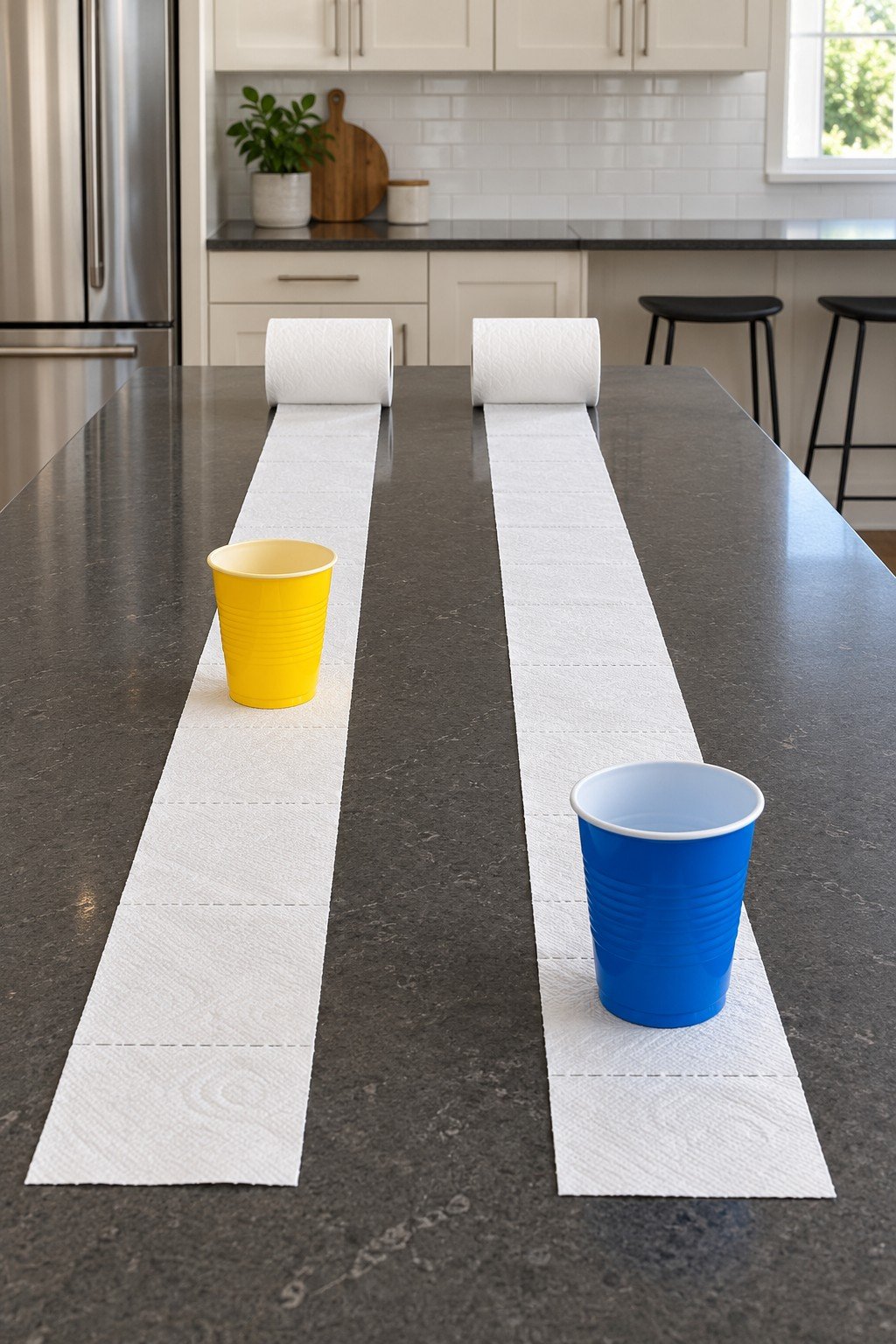
White paper strips run from paper rolls toward yellow and blue cups on a dark kitchen island. The parallel lanes make the cup races easy to follow, and the contrast helps players spot a strip starting to wrinkle. Unroll equal lengths of paper, set an empty cup on each free end, and wind the paper back around its roll to draw the cup closer. A torn strip or tipped cup means pausing to reset that lane. Shorten the paper for younger players so control matters more than speed.
2. Party Blower Ball Knockdown
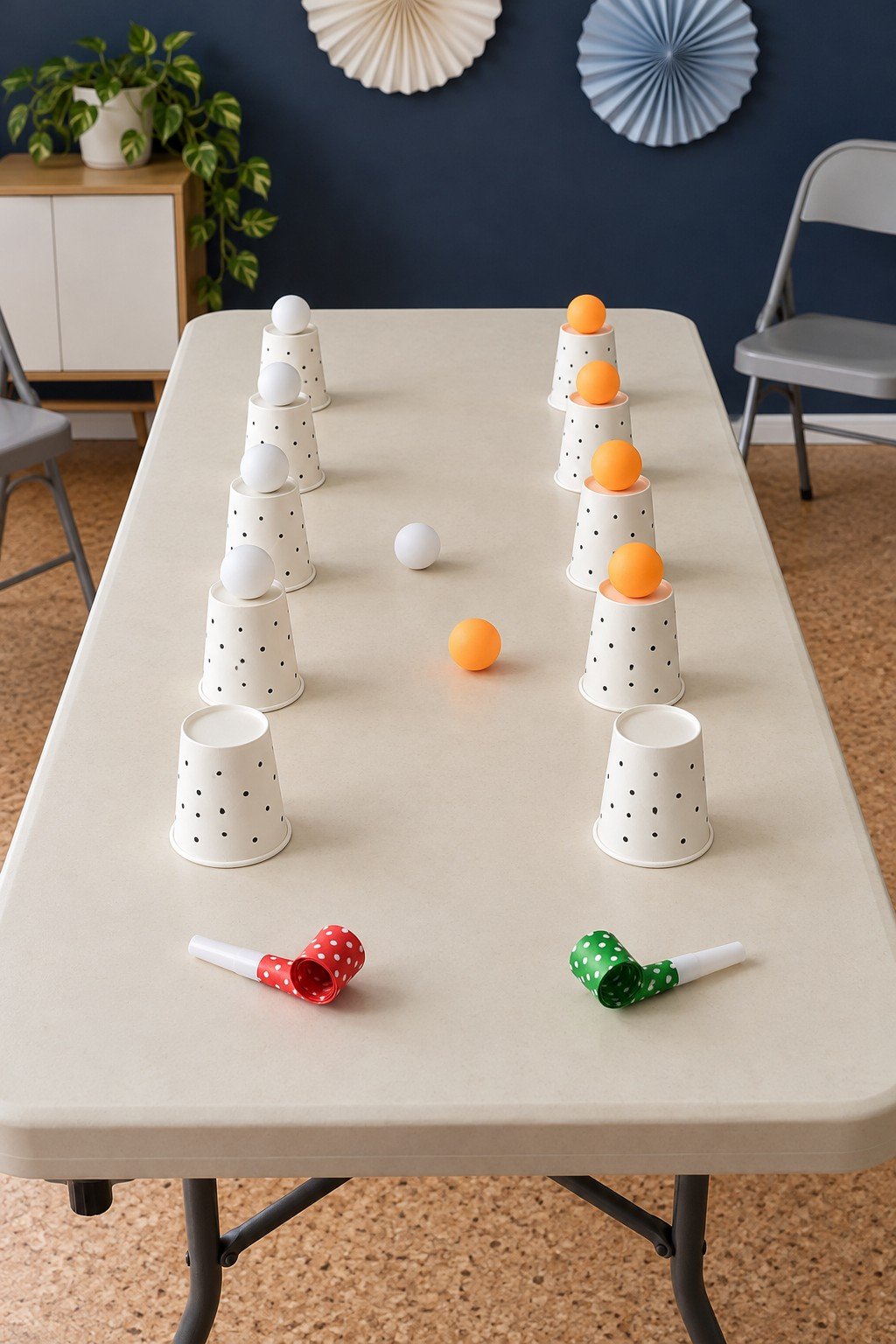
White and orange balls rest on inverted dotted cups, with red and green party blowers at the starting end of the table. The repeated cup spacing gives the ball targets a clear rhythm against the navy wall. A party blower is a rolled paper tube that unfurls when someone blows into its mouthpiece. Arrange matching rows and take turns extending a blower to nudge a ball from its cup, giving each player a separate mouthpiece. Replace the blowers with fingertip nudges for a quieter version that also works from a chair.
3. Red Cup Paper Pull Tower
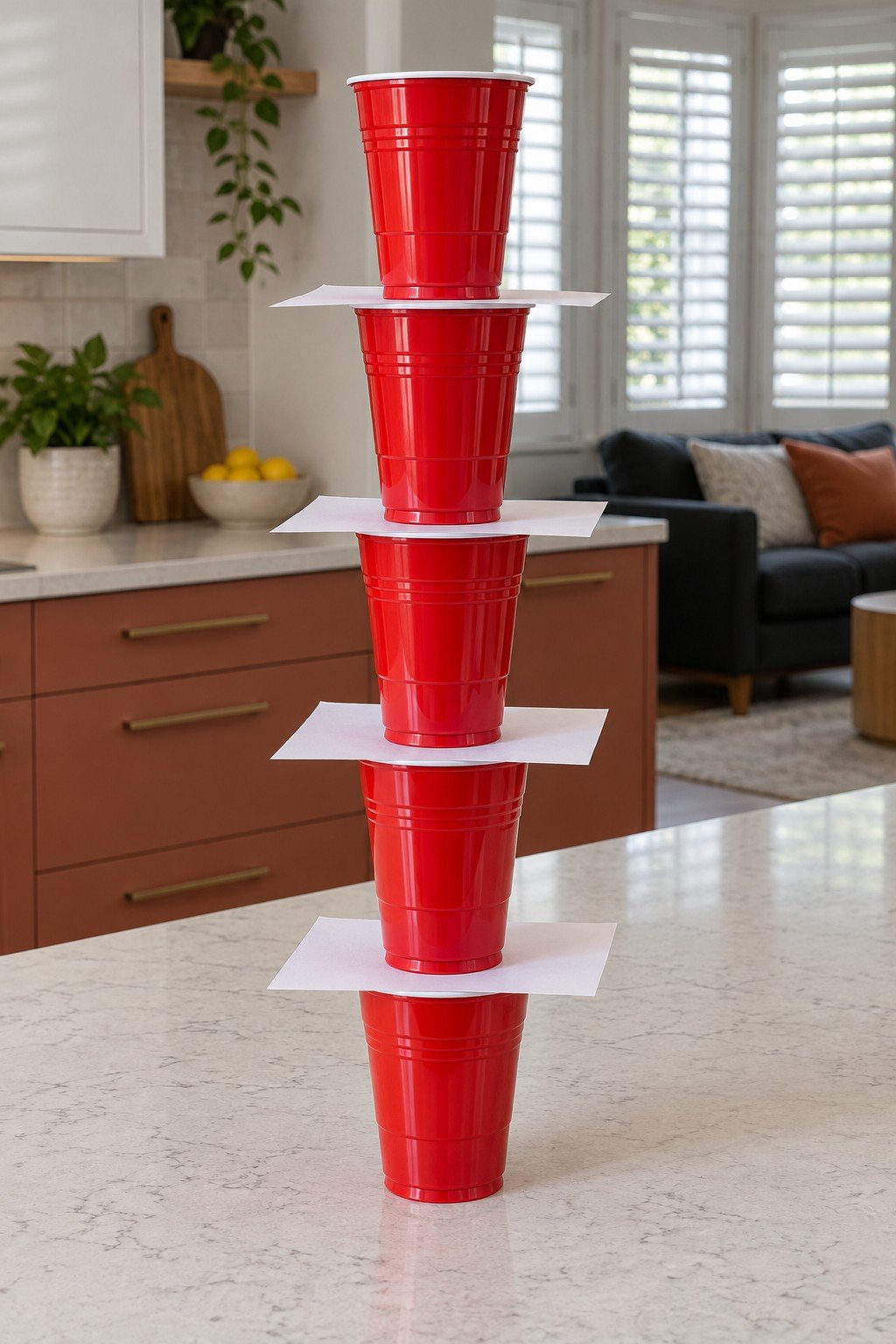
Red cups form a tower with white paper sheets separating the levels on a pale counter. The small footprint leaves room around the challenge, while the red and white layers make every shift noticeable. Build the tower from empty matching cups and paper, then pull the lowest remaining sheet sideways so the upper cups drop into the cup beneath. A leaning stack is the cue to rebuild before another pull rather than trying to catch it midair. Start with fewer cups when steady hands are still developing.
4. Tabletop Shuffle Counters
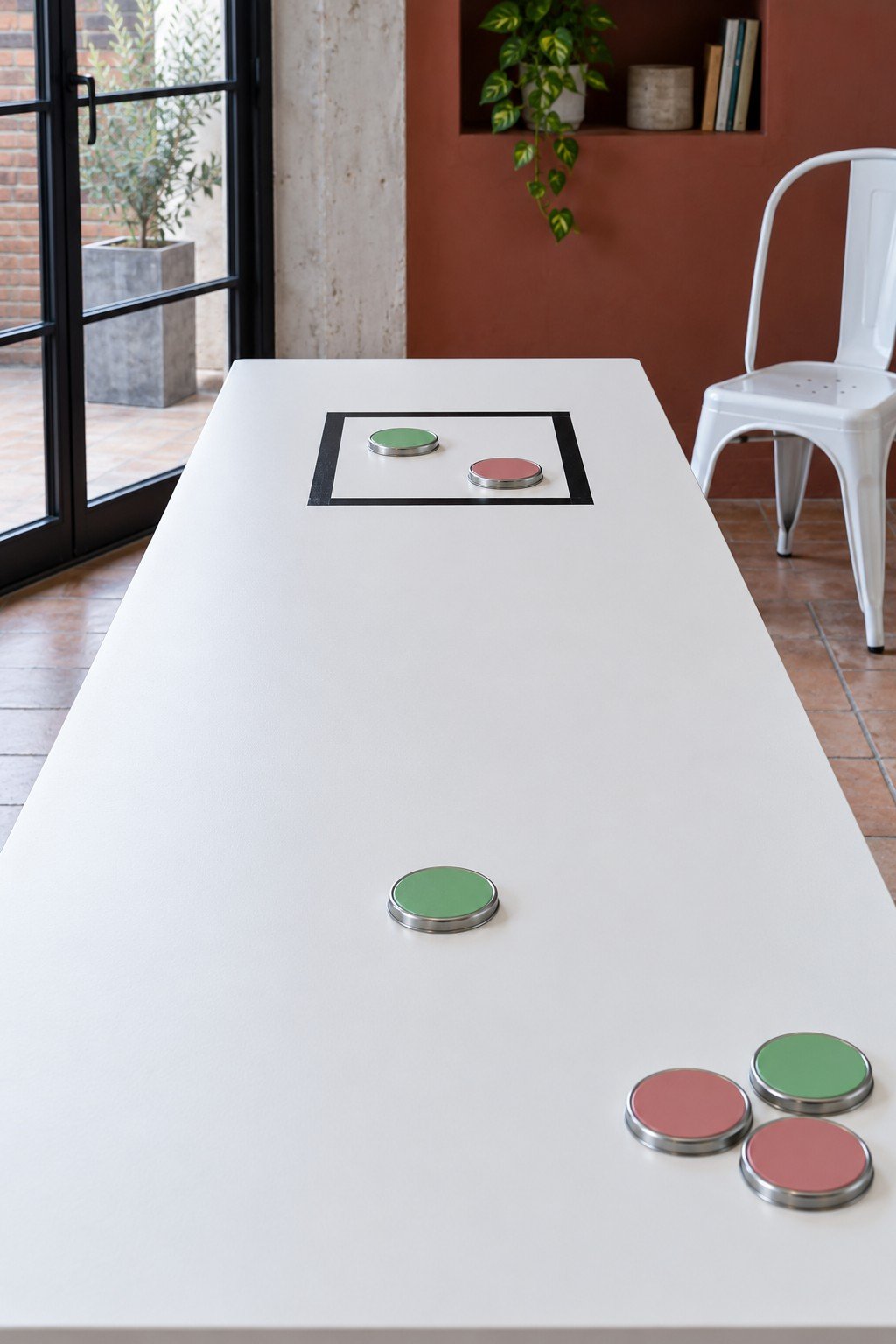
Red and green counters with silver colored rims sit on a white tabletop marked with a black square. The uncluttered surface makes the square readable, and the broad play area leaves room for counters that stop short. For a homemade version, cut smooth cardboard discs, color each team's set, and slide them toward a taped square without lifting them from the table. Count only counters resting entirely inside the square after everyone has taken the same number of turns. Shrink the sliding distance when the table also needs to serve dinner.
5. Bounce Ball Cup Triangles
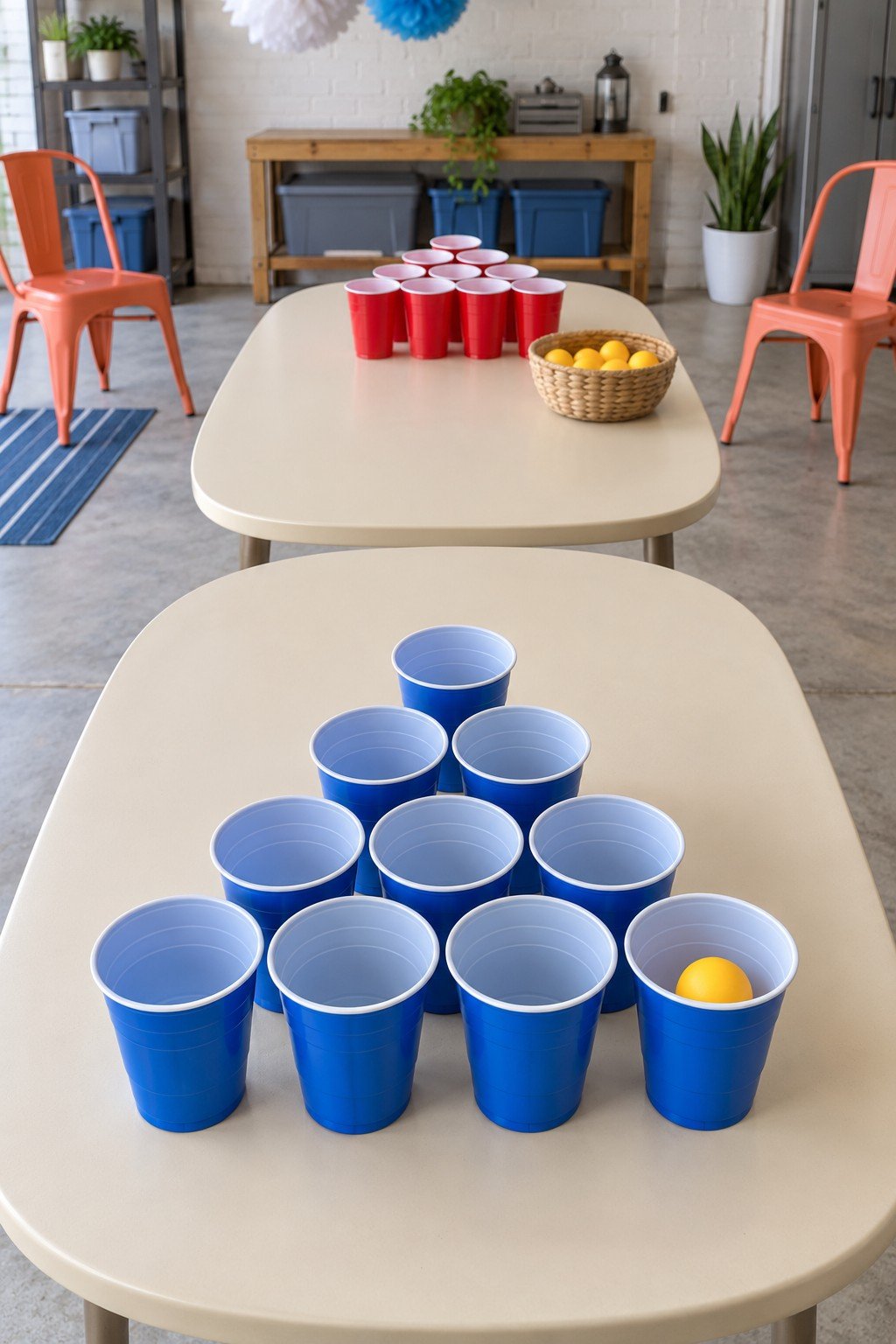
Blue and red cup triangles occupy separate tables, and yellow balls wait in a woven basket. Matching triangular arrangements give each team the same target pattern without covering the whole tabletop. Set empty cups in compact rows and bounce a ball on the table before it lands in a cup, removing each successful target until a team clears its set. These ball bounces work as a dry skill game, so drinks can stay elsewhere. Bring the tables closer for beginners, leaving the gap clear rather than leaning across it.
6. Bottle Bowling on a Taped Lane
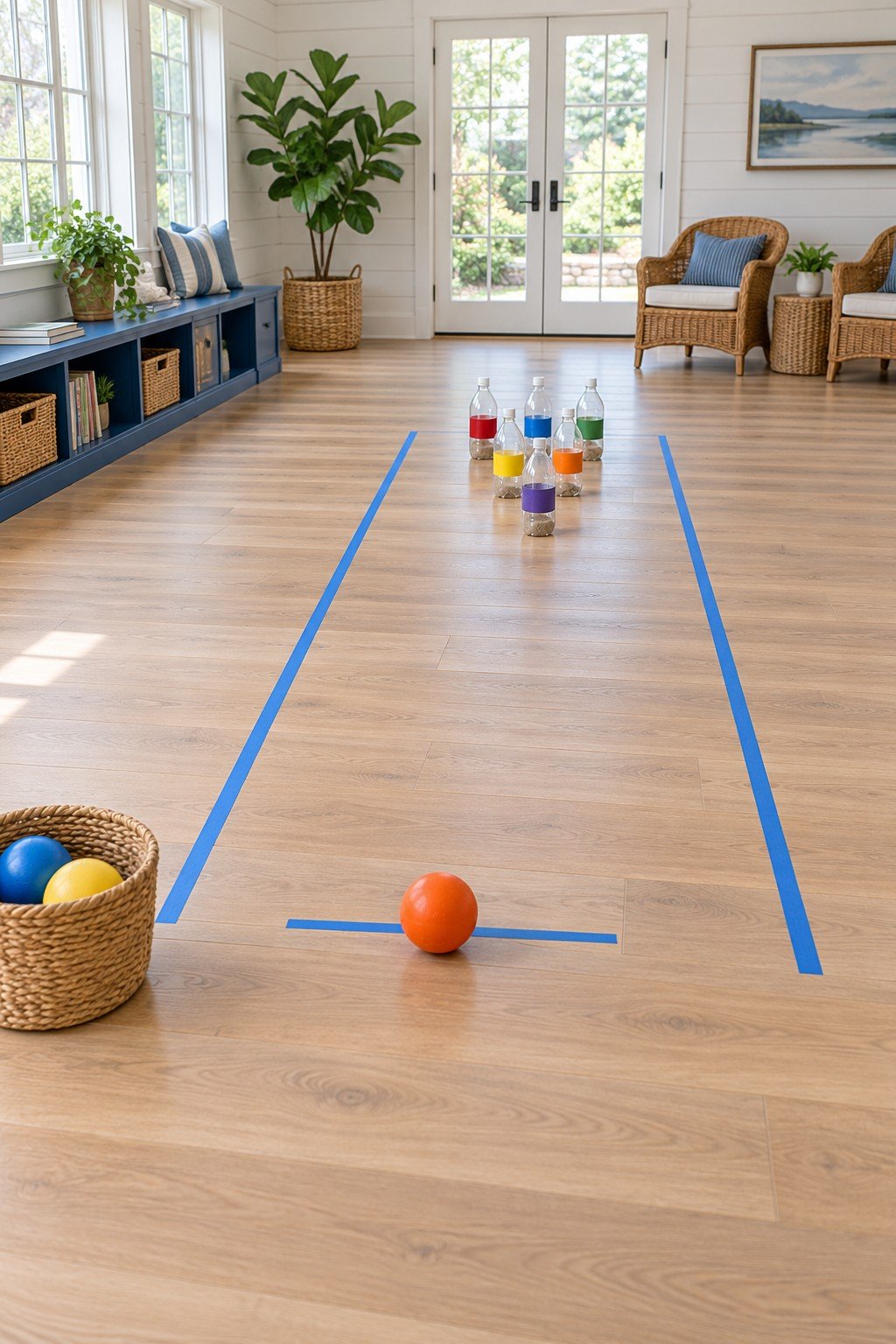
Clear bottle pins with colored bands stand at the end of a blue lane, with an orange ball near the starting line. The bands distinguish the targets while the narrow tape outline leaves the surrounding room visually open. Rinse and dry matching plastic bottles, secure their caps, and arrange a triangular group that a gently rolled soft ball can knock down. Give players equal rolls and total the fallen bottles before standing the pins up again. Move the starting line closer when younger children need a more achievable first round.
7. Fabric Tic Tac Toe on a Tape Grid
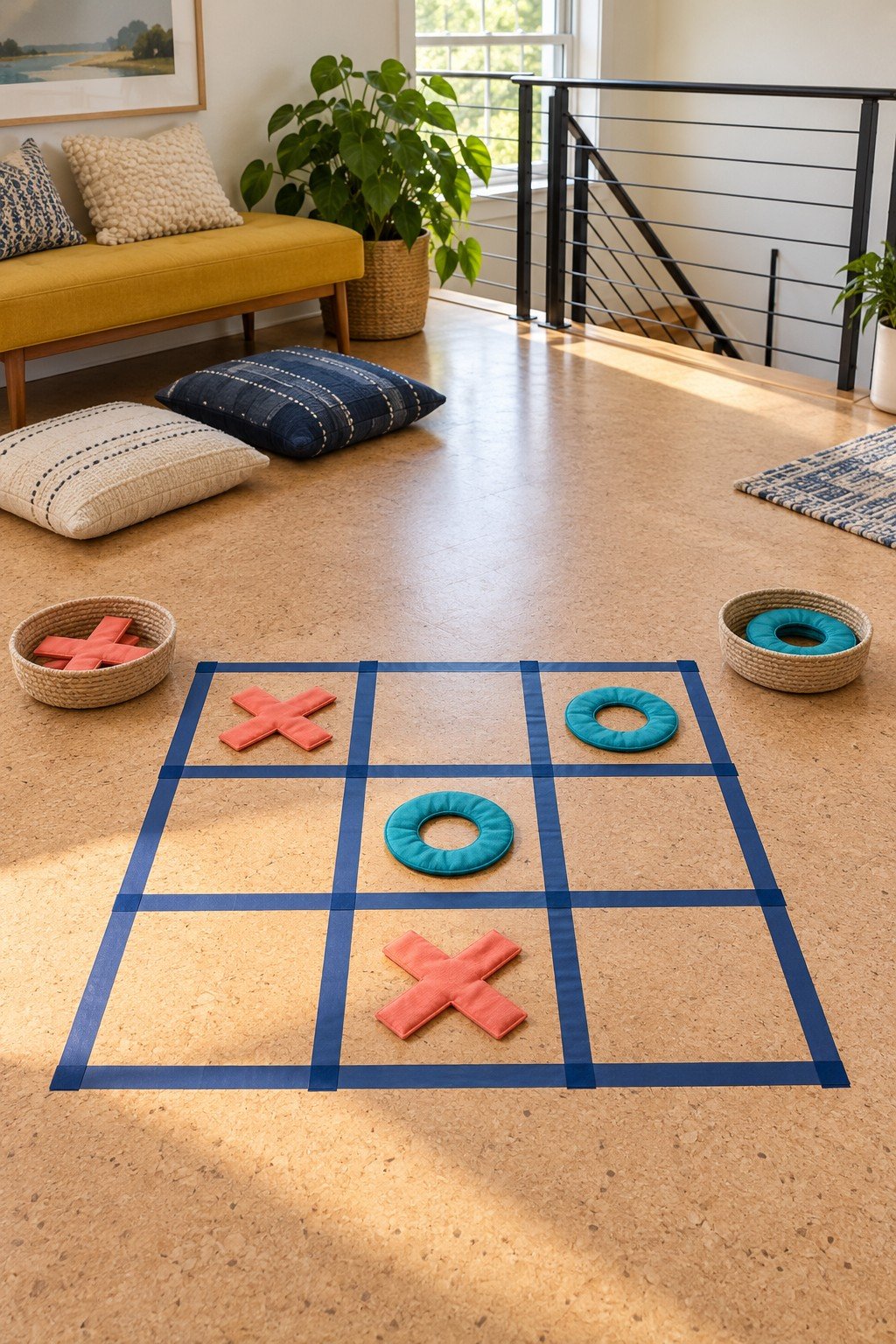
Coral fabric crosses and teal rings sit within a blue tape grid, with woven baskets holding extra pieces. The shapes distinguish teams without depending on color alone, and the fabric adds a softer texture than the floor. Sew paired fabric shapes together, turn the seams inward, and topstitch the edges, or cut flat shapes from thick felt. Take turns placing a piece in an empty cell, aiming for three matching shapes in a straight line, keeping a clear buffer between the grid and the stair opening. Stitch larger shapes for players who find small counters difficult to grasp.
8. Rope Ring Toss with Wooden Pegs
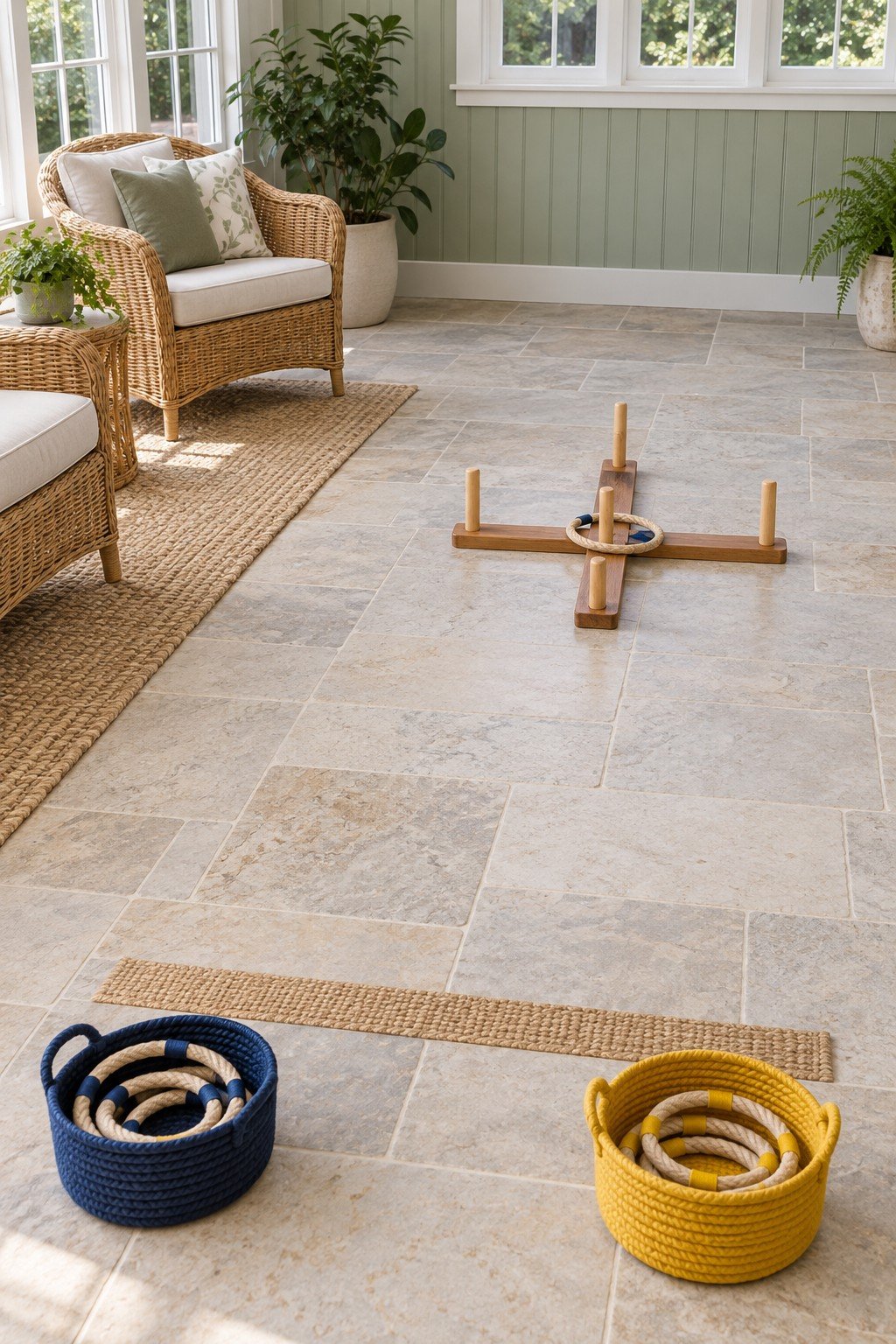
Rope rings wait in navy and yellow baskets facing wooden pegs on a low cross shaped base. The natural rope and wood repeat the woven seating textures, so the game does not compete with the room's furniture. A ready made peg set avoids cutting wood; for homemade rings, stitch the rope ends together and cover each join with tightly wrapped cloth tape. Toss from a shared position and count rings that settle around a peg, pausing before anyone retrieves them. Offer a closer seated throwing position to make the same target accessible to more players.
9. Indoor Cornhole with Wooden Boards
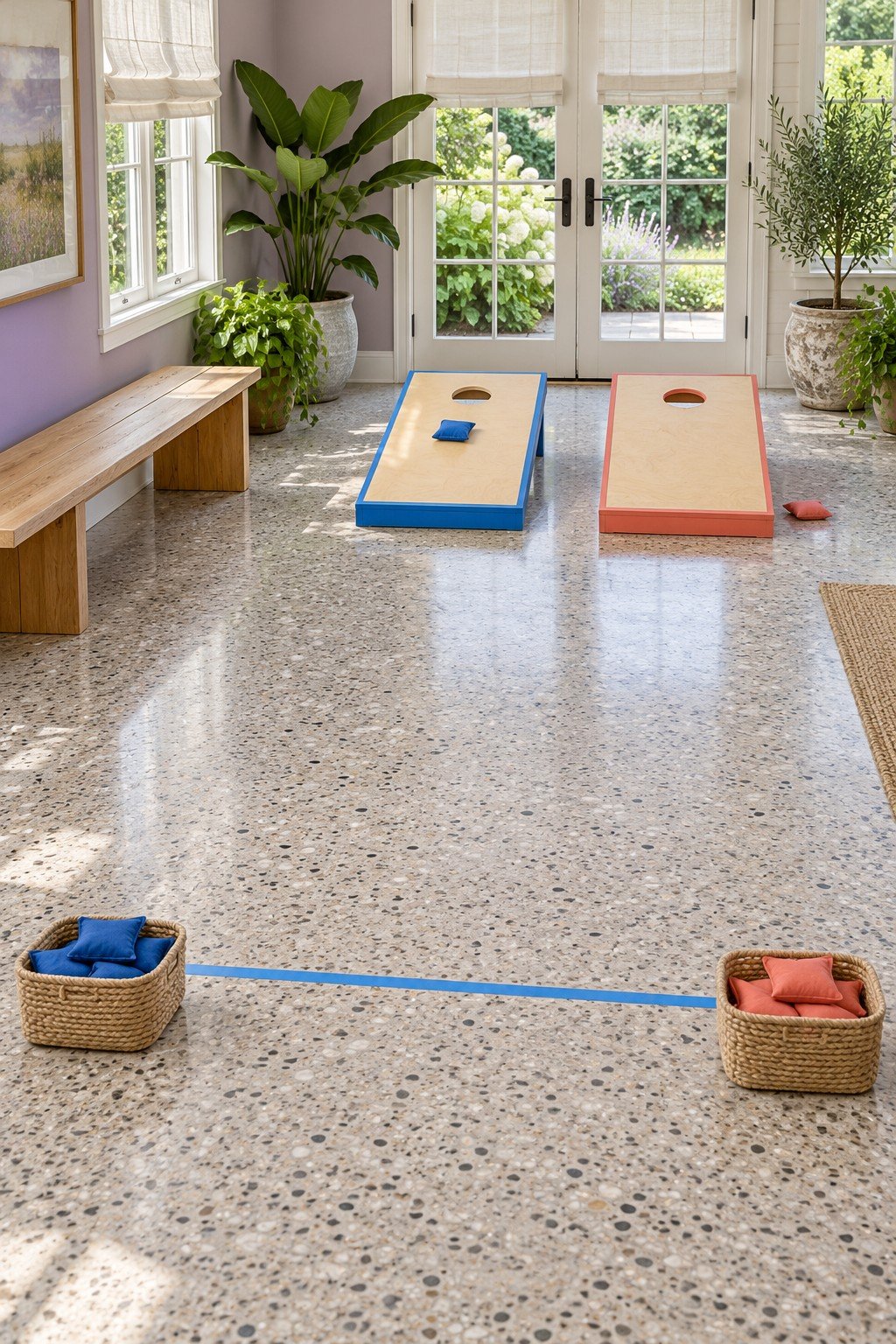
Blue and coral beanbags coordinate with the trim on wooden targets, while woven baskets mark the throwing end. Repeating each team color on both storage and equipment makes resetting the game straightforward. Arrange the boards for short indoor target practice and take turns landing bags on a board or sending them through its hole, with a hole counting more than a landing. Sew small fabric bags with enclosed seams and soft scrap filling if you already have boards to play on. Substitute a close tabletop target when the room cannot leave a clear throwing lane.
10. Felt Ball Spoon Sorting Race
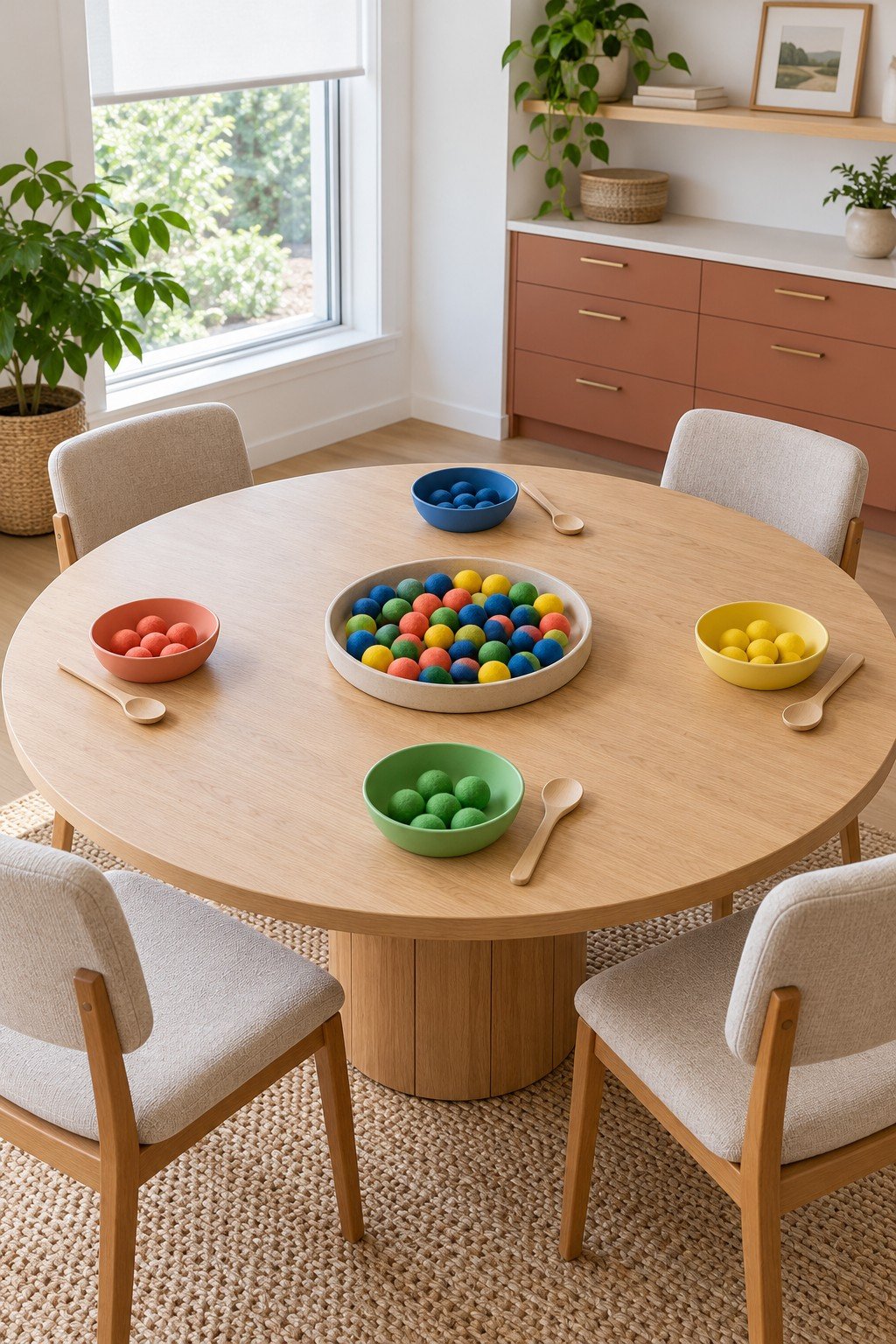
Colored felt balls fill a shared shallow tray, with matching bowls and wooden spoons arranged around a round table. The circular layout gives players a similar reach, and the bowls make sorting progress visible. Place mixed felt balls in the tray and transfer a player's color to its bowl using only a spoon, returning dropped pieces to the center. Equal starting quantities matter more than racing against a fast timer, especially when different ages share the table. Enlarge the spoon and bowl for players who need a wider landing area.
11. Indoor Bocce on a Taped Lane
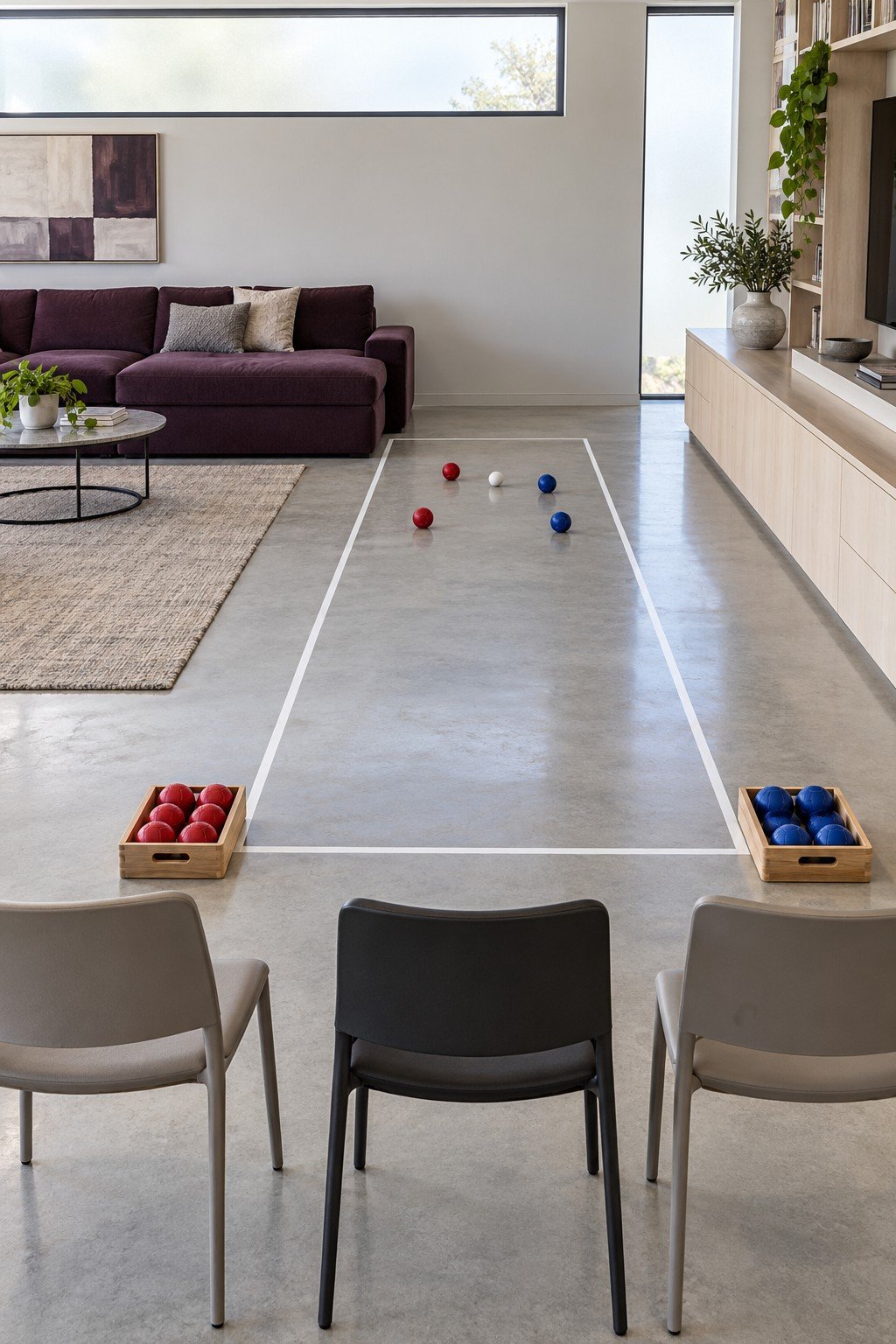
Red and blue bocce balls gather around a small white target inside a white taped floor lane. The lane separates play from the sofa, while shallow trays keep each team's remaining balls together. Bocce centers on rolling closer to a target ball, as explained by Special Olympics' bocce introduction; a home round can simply award the win to the closest ball after equal turns. Replace heavy outdoor equipment with soft indoor balls before playing near furniture or glass. Swap the full lane for a shorter seated rolling game when floor space is limited.
12. Beanbag Shuffleboard in an Attic Lane
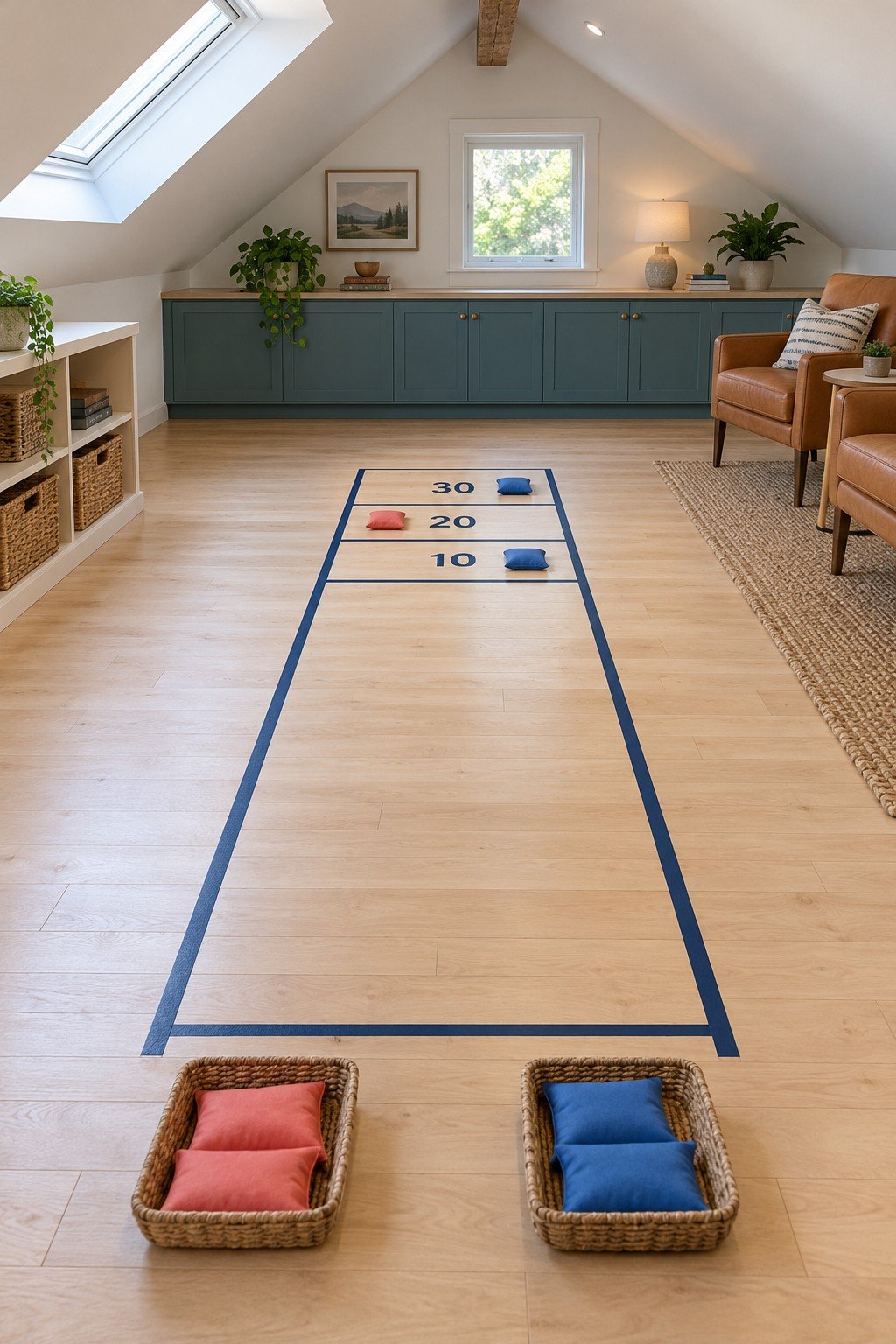
Red and blue beanbags sit in an attic lane divided into zones labeled 10, 20, and 30. The long rectangle follows the room's open center, leaving the lower ceiling edges for cabinets and seating. Mark equal scoring zones with removable tape and slide fabric bags toward them, awarding the value of the zone where each bag stops entirely inside the lines. A bag crossing a boundary can count for the lower neighboring score as an agreed house rule. Reduce the lane length while preserving the scoring order when adapting the game to a small room.
13. Living Room Putting Challenge
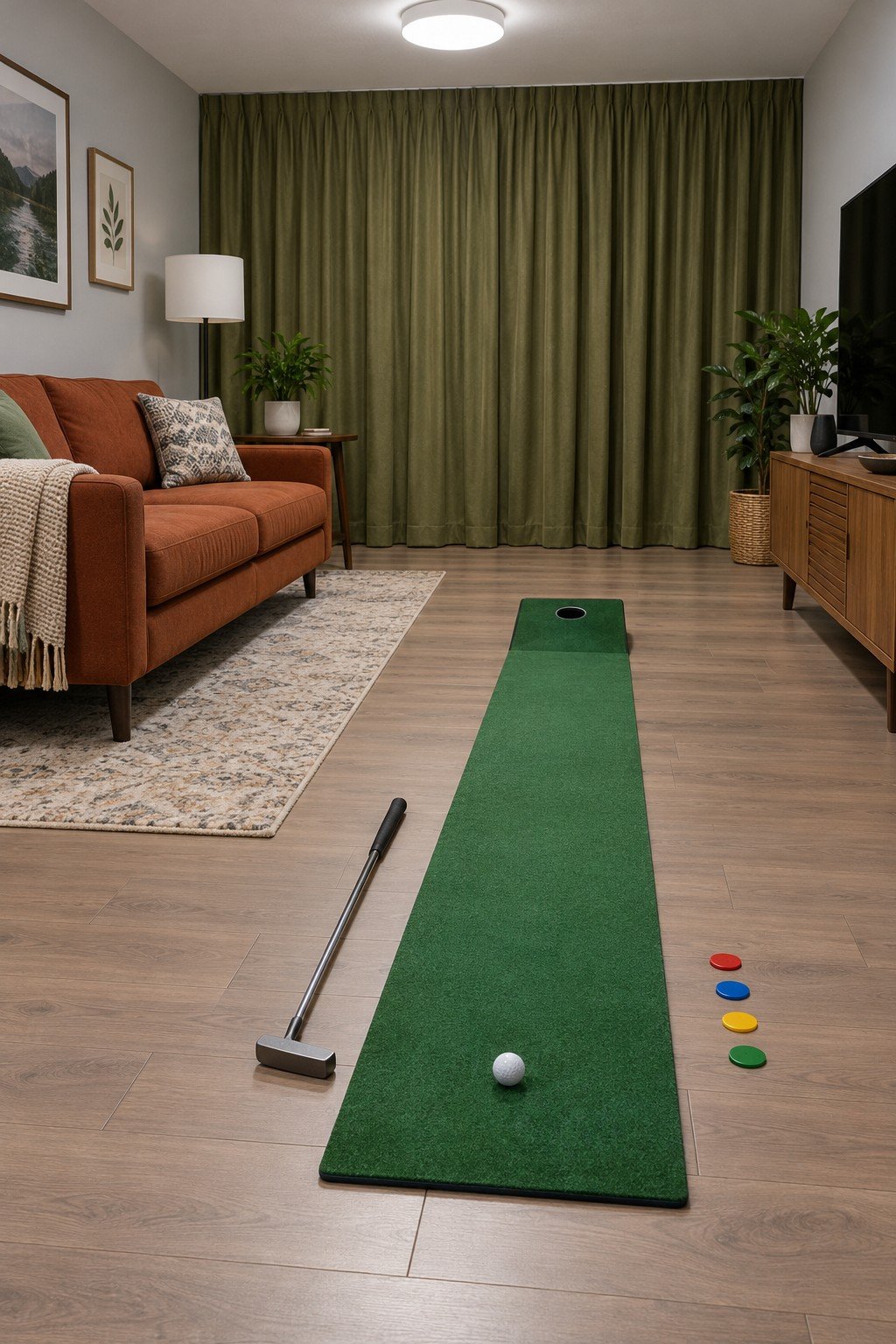
A green putting mat leads toward a hole in a raised end, with a putter, white ball, and colored markers nearby. The narrow mat leaves most of the living room open, and the markers can record different starting positions without adding furniture. Set the mat flat and take turns putting from a shared marker, counting the strokes required to reach the hole. A homemade flat felt strip can instead end at a colored target, avoiding a hole that has no space beneath it to catch the ball. Finish with a shorter starting distance for a player learning to control the putter.
14. Balloon Volleyball over a Low Net
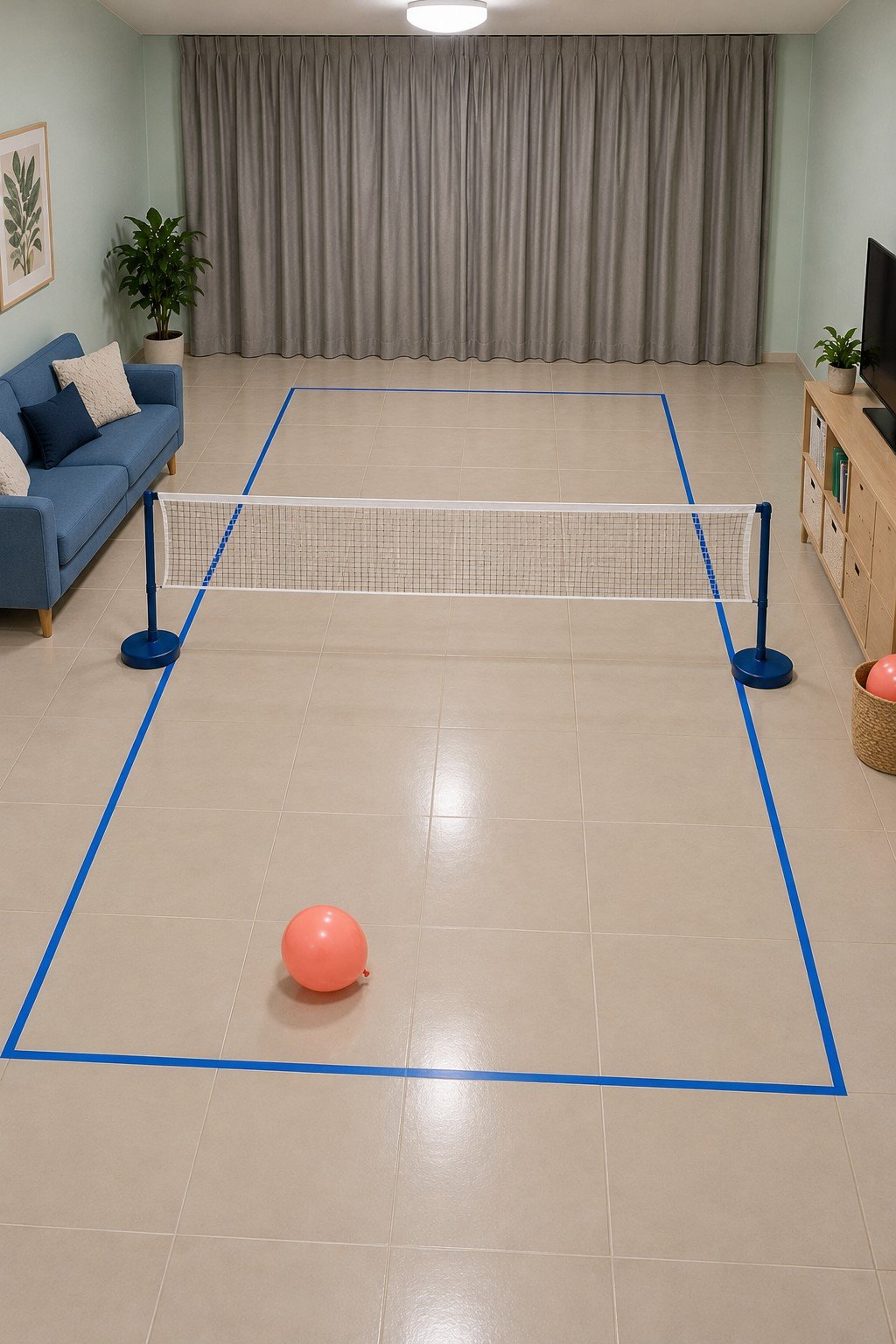
A coral balloon rests inside a blue taped court divided by a low net with freestanding bases. The thin net preserves the view across the room, while the court outline identifies where players should stop. For balloon volleyball, gently tap the balloon across the net and count cooperative returns before it touches the floor, with walking feet and no diving. An adult should inflate the balloon, supervise play, keep uninflated balloons away from children younger than eight, and discard broken pieces immediately. Lower the net for seated players so the game rewards controlled taps rather than jumping.
15. Block Tower Stacking Game
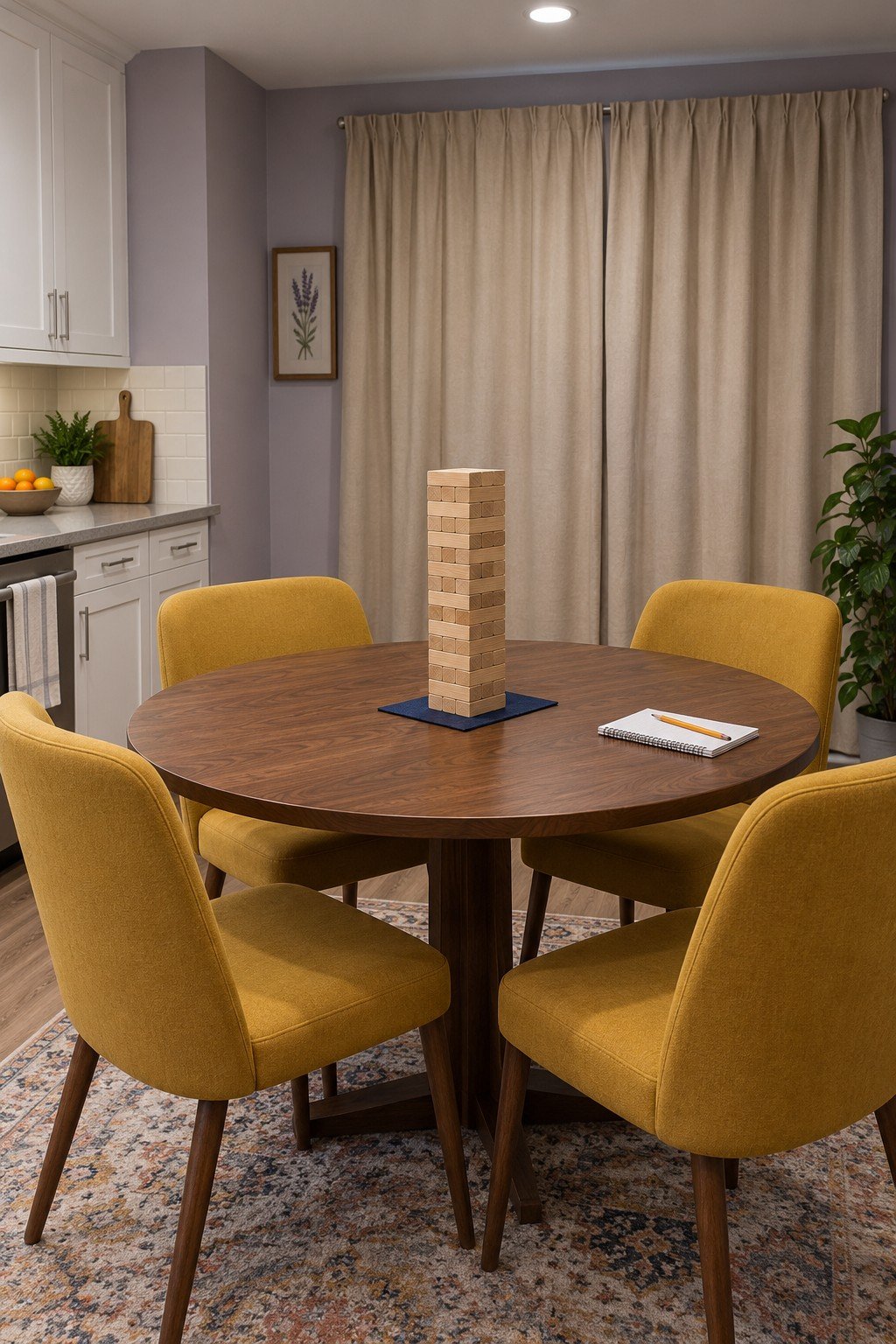
Wooden blocks form a tall tower on a navy mat at a round table surrounded by mustard chairs. The central position offers a shared view, and the navy mat makes the pale blocks easier to distinguish from the brown tabletop. A commercial stacking set supplies evenly sized pieces; Hasbro's Classic Jenga instructions explain the remove and restack format. Keep the mat flat and thin so its edges do not tilt the base, and leave a clear landing area around the tower. Introduce a cooperative round where everyone works toward the tallest standing tower rather than eliminating a player.
16. Cooperative Domino Run
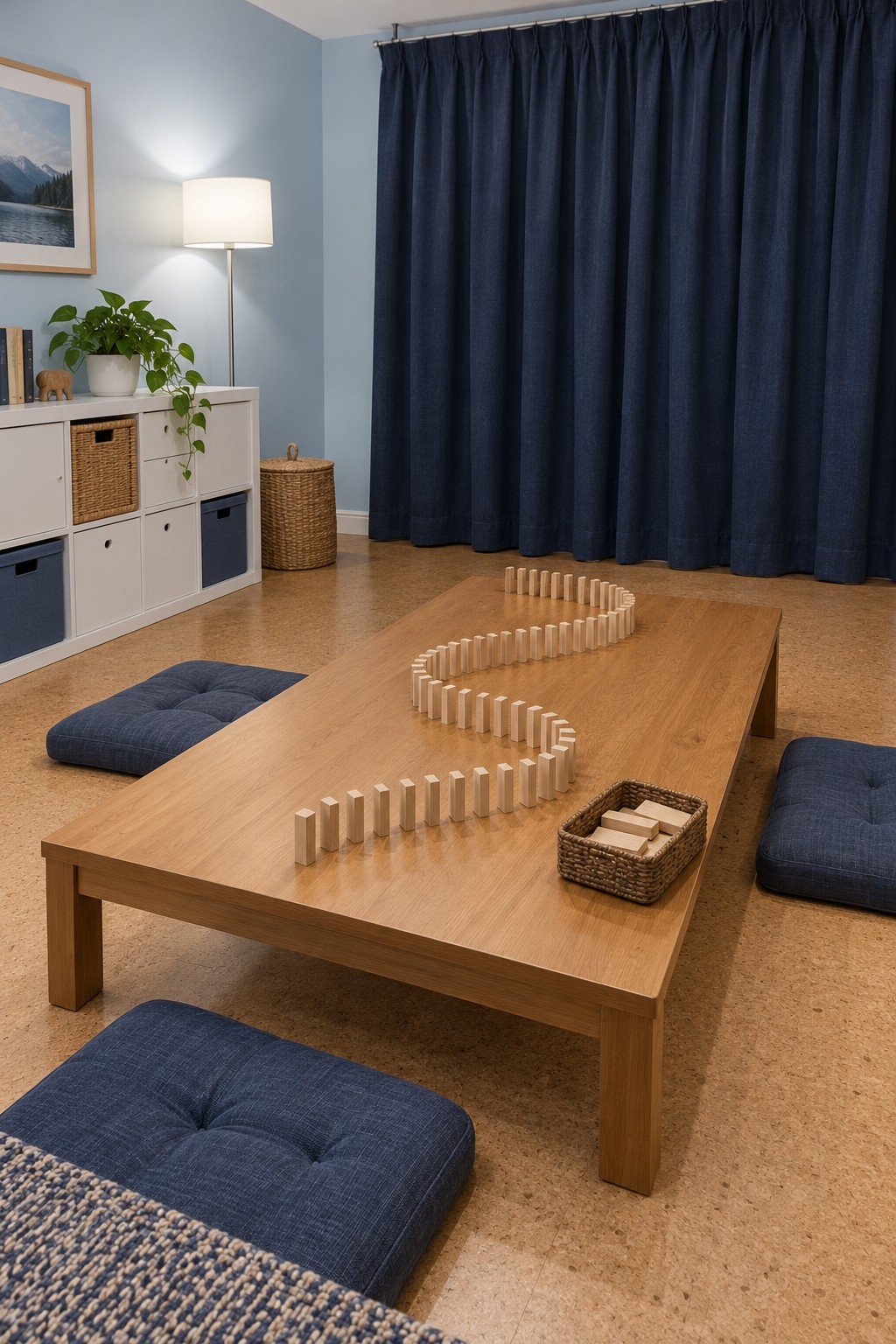
A winding domino run crosses a low wooden table, with navy floor cushions and a small basket of spare tiles. A domino run is a line of upright pieces arranged so each falling piece knocks down the next. The low surface makes the route visible from several sides, while the basket keeps unused tiles out of the path. Stand equal wooden tiles on their narrow ends with gaps shorter than their height, working in separate sections before connecting the route. Divide the building into small teams for a cooperative challenge, letting everyone help set the chain reaction in motion.
17. Shadow Puppet Guessing Game
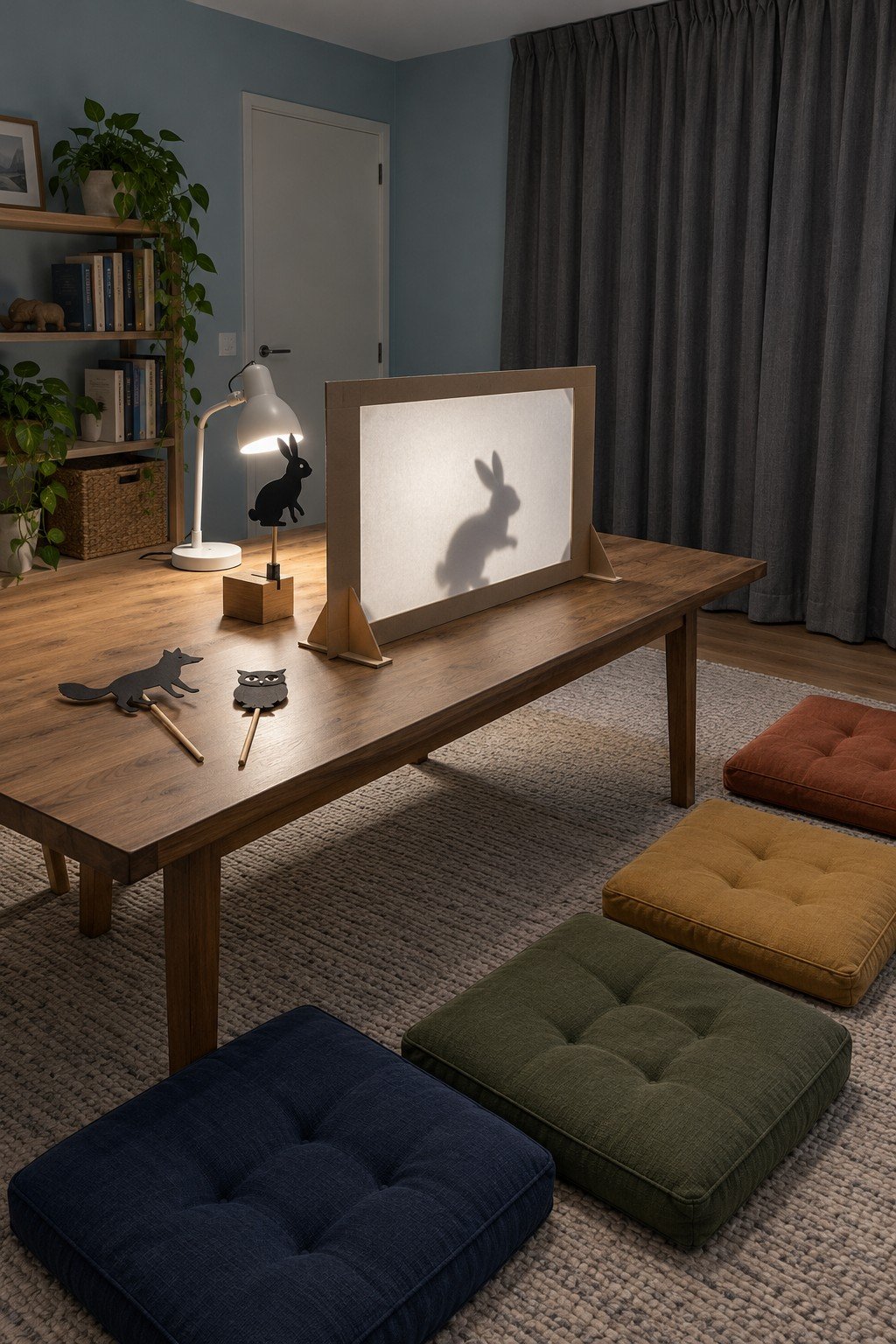
Animal shadow puppets on sticks accompany a tabletop screen, and a lamp casts a rabbit silhouette onto the translucent surface. Floor cushions create an audience area without blocking the puppeteer, while the plain screen gives the silhouette a clear outline. Make a cardboard frame with broad triangular feet, attach translucent paper, and position a puppet between the lamp and screen so its shape becomes readable. A cool LED lamp should remain clear of paper, fabric, and the puppet handles. Pair a storyteller with a puppet operator for a short animal guessing game that includes reluctant performers.
18. Family Jigsaw Puzzle with Sorting Trays
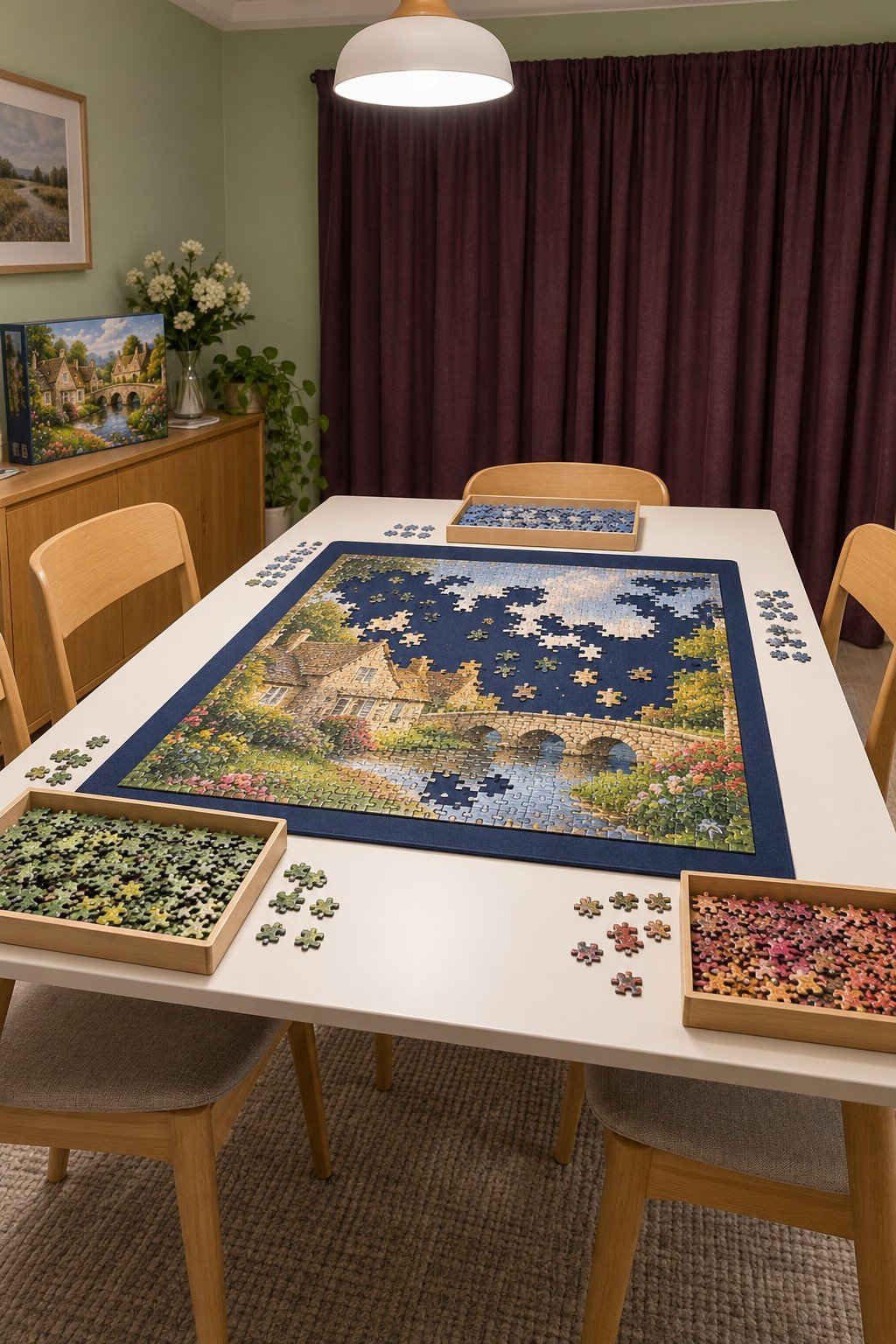
A cottage jigsaw puzzle spreads across a navy mat, with sorting trays separating loose green, blue, and pink pieces. The dark border makes stray pieces easier to notice, while the shallow trays let several players search without reaching across the puzzle. Begin with edge pieces and sort the remaining pieces by a distinctive feature such as roof tiles, flowers, or sky, then build small groups before joining them. Repurpose shallow trays already at home instead of buying a dedicated sorting system. Assign a smaller, clearly defined puzzle area to a beginner so everyone can contribute at a comfortable pace.
19. Whiteboard Drawing and Guessing Game
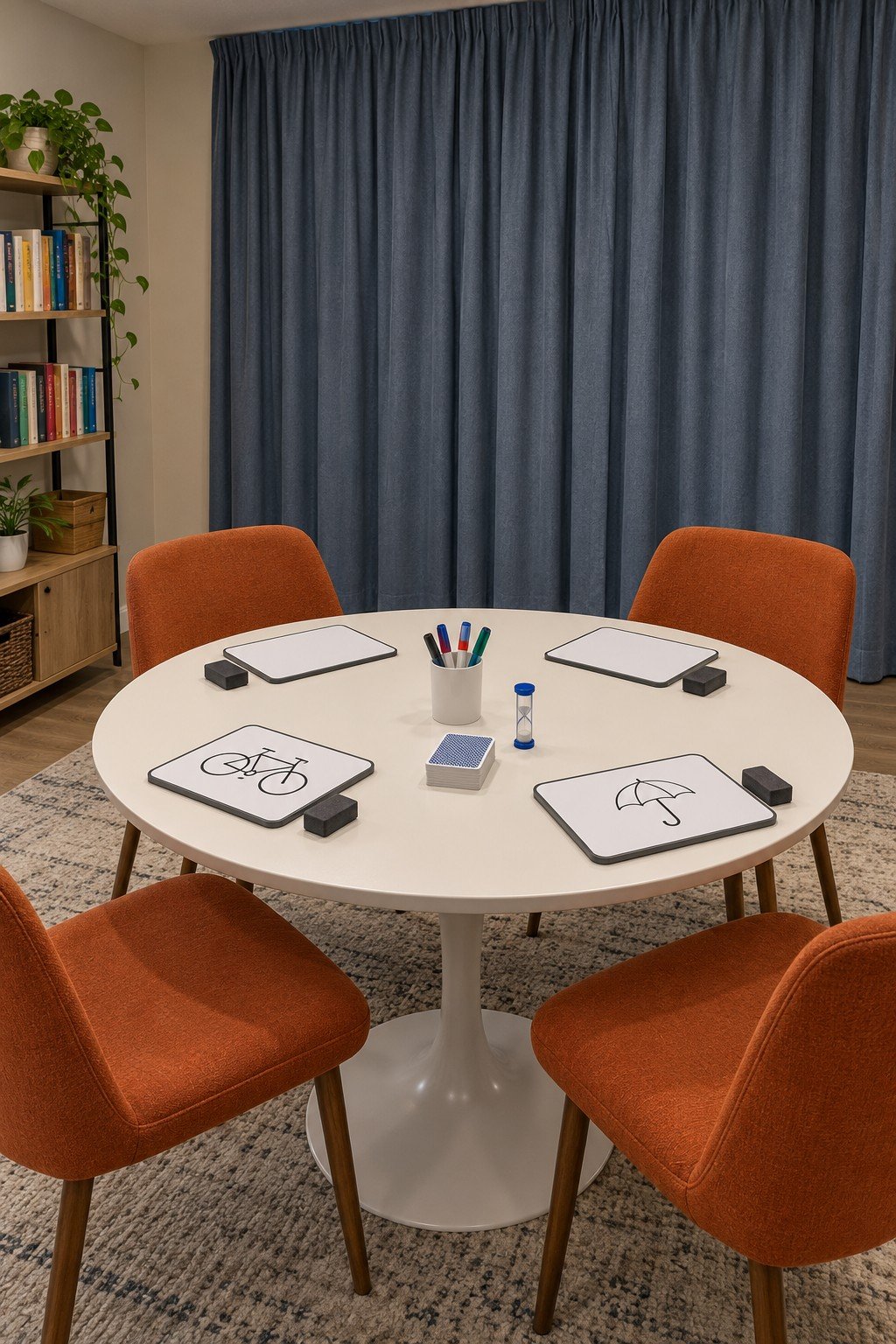
Small whiteboards, markers, erasers, a card stack, and a sand timer share a round table with orange chairs. Individual whiteboards give everyone a drawing surface, while the central supplies remain within reach of the seated group. Write familiar objects on homemade cards, let a player draw without letters or spoken clues, and invite the others to guess before the timer runs out. Blank boards can double as scoreboards between rounds, reducing the number of loose paper sheets. Trade timed competition for a shared drawing story when younger players want more thinking time.
20. Paper Airplane Target Toss
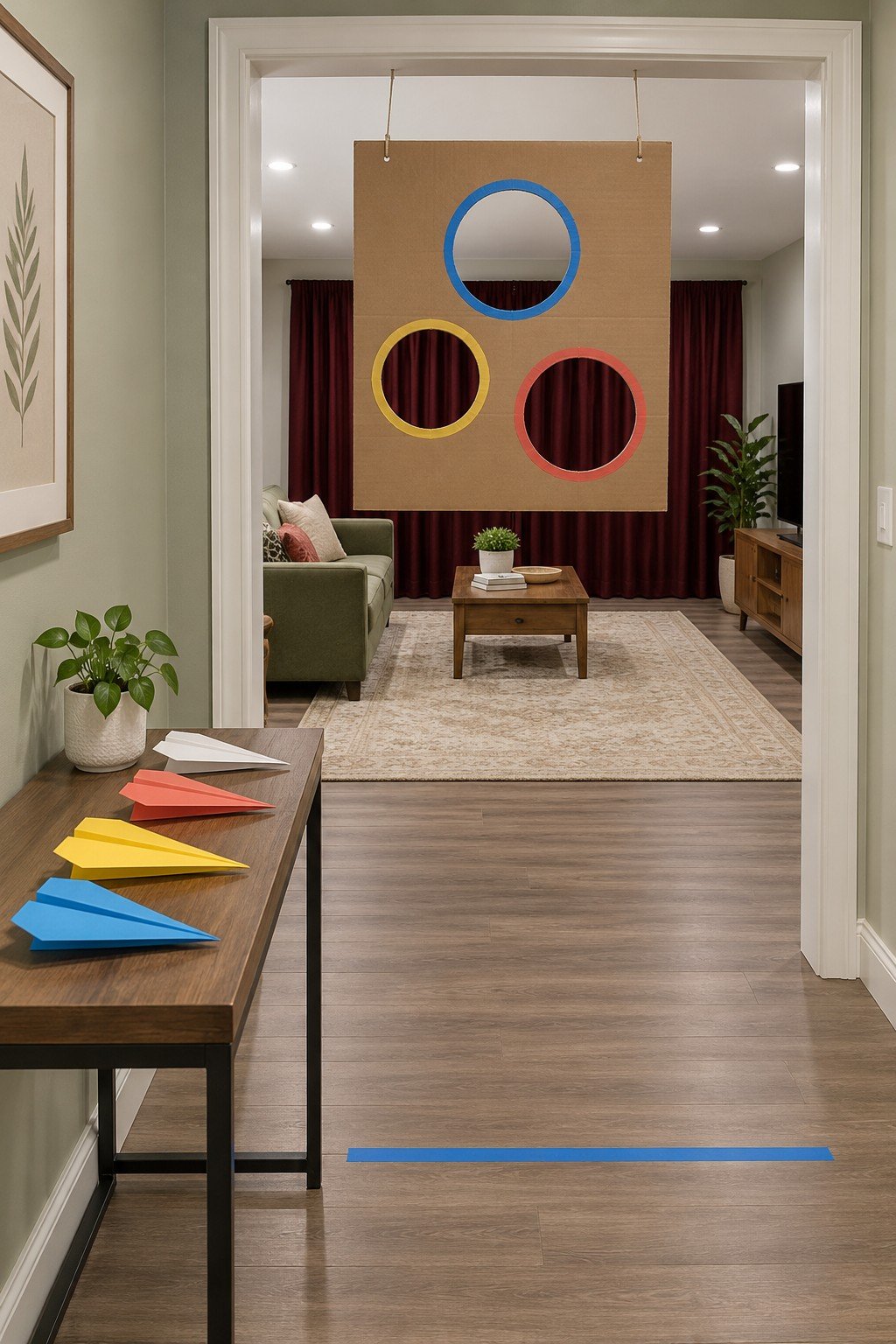
Paper airplanes wait beside a doorway holding cardboard targets outlined in blue, yellow, and coral. Three colored rings make the targets easy to see without written scores, and the flat cardboard packs away easily. An adult can cut smooth openings in a flat carton side and hang it from secure existing attachment points, with the doorway closed to foot traffic during play. Fold matching planes and aim through any ring, then call a color before each throw for a harder round, retrieving planes only after the throwing round ends. Widen the openings or move the launching position closer when planes repeatedly strike the cardboard.
21. Paper Bridge Coin Challenge
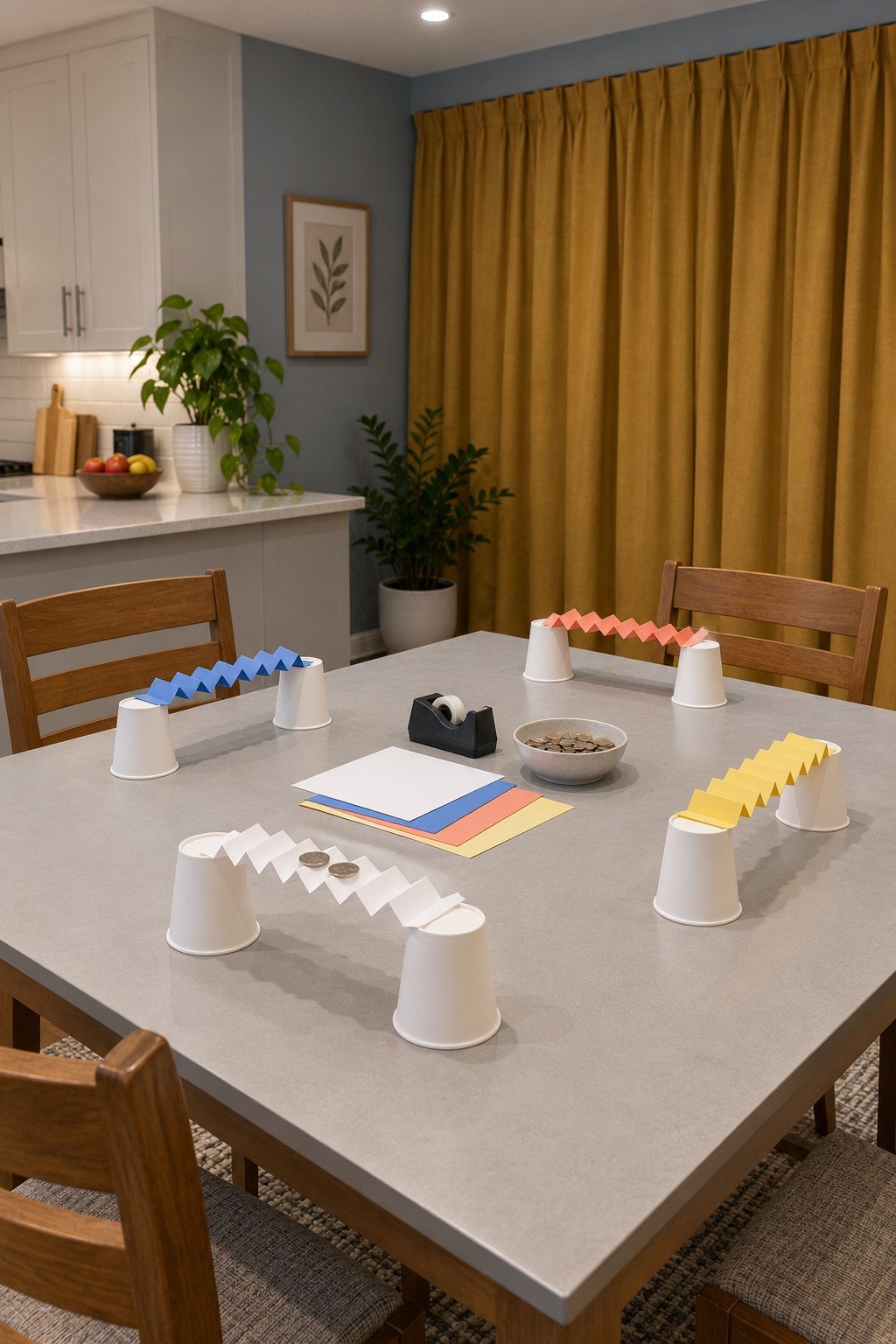
Accordion folded paper bridges span inverted cups, with colored sheets, tape, and coins on the table. Accordion folding means alternating folds back and forth, creating ridges that change how the paper bends under a load. Give each builder matching paper and the same gap between cup supports, then add identical coins gently near the middle until the bridge bends or slips. Change only the folding pattern between attempts so the result compares structure rather than different materials or spans. Repeat the challenge together when children would rather improve a shared design than compete.
22. Tabletop Curling with Cardboard Discs
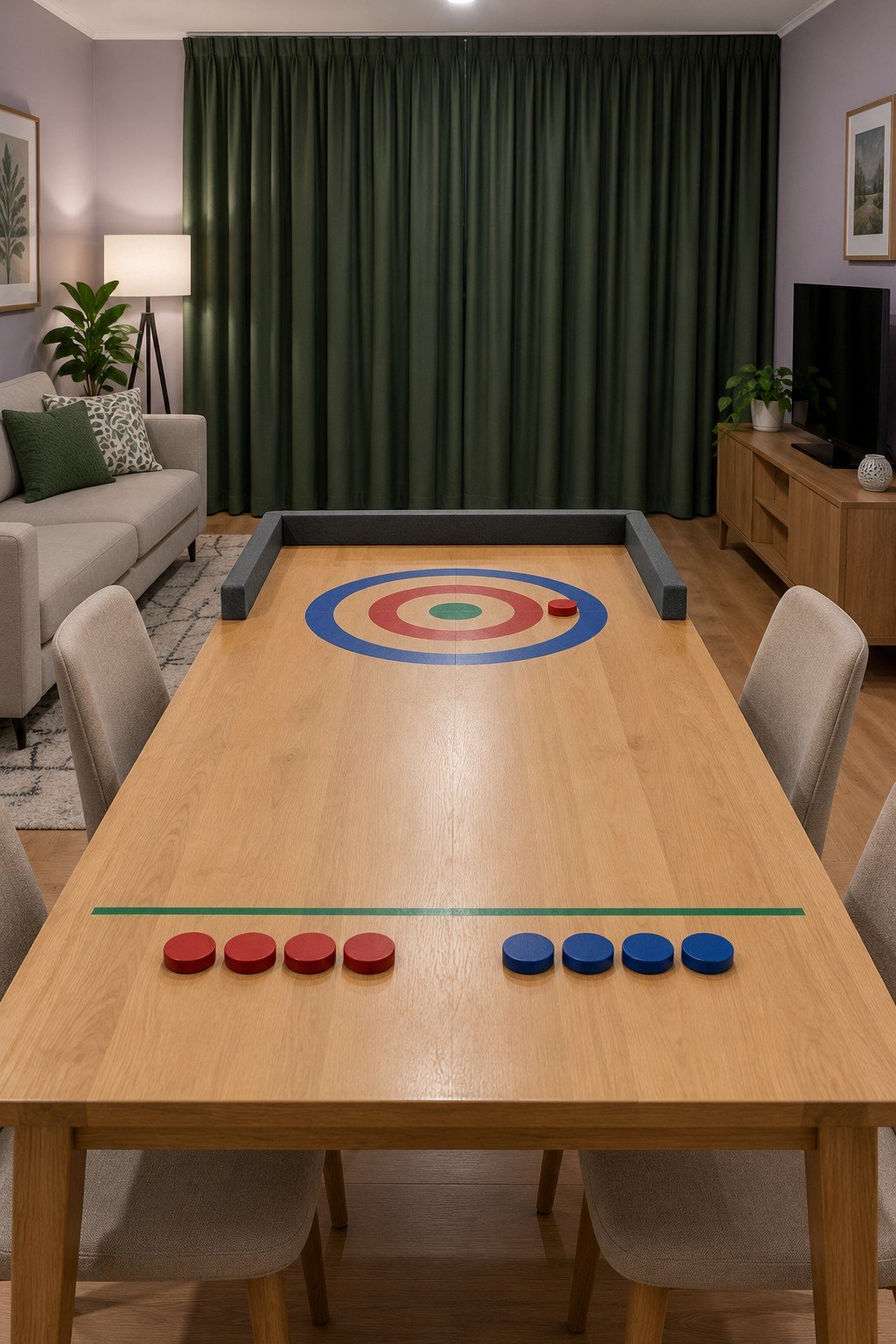
Red and blue curling discs face colored target rings at the far end of a wooden table, with dark bumpers along the target edges. The rings create a strong focal point, and the open starting end gives players room for a gentle sliding release. Make flat cardboard discs and draw concentric circles on a separate smooth board, then alternate slides and compare which disc stops closest to the center. The board protects the dining surface from repeated play; the edge bumpers stop most discs, but keep the far end clear in case one slides past. Limit each round to equal turns so the target stays readable rather than crowded.
23. Origami Frog Races
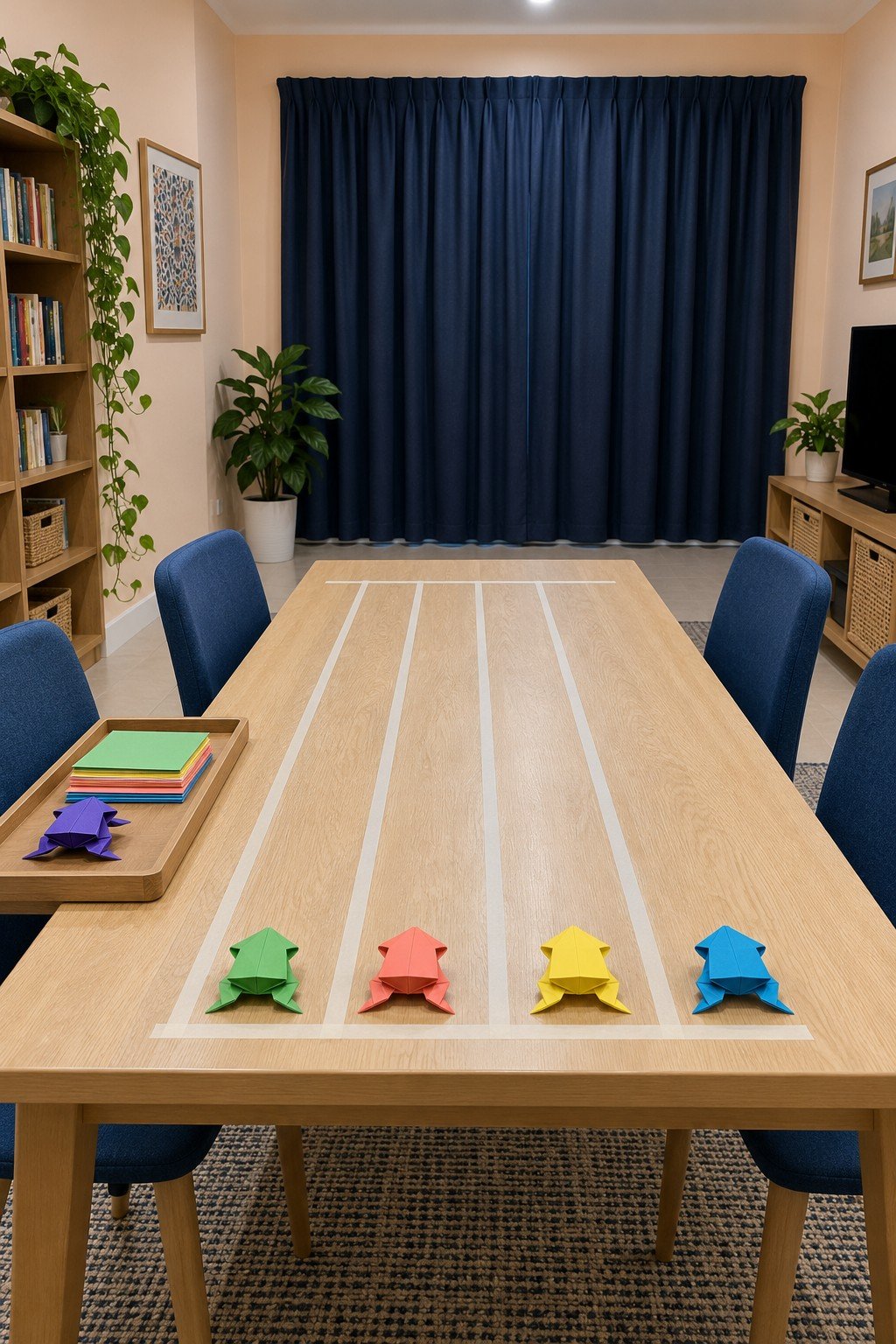
Green, coral, yellow, and blue paper frogs line up at the start of white taped racing lanes. Separate lanes make progress easy to compare, and matching paper sizes give the folding a fair starting point. Follow Origami.me's jumping frog folding instructions, then press and release each frog's folded back to make it hop toward the finish. Players can alternate hops rather than reaching over one another, resetting only a frog that leaves its lane. Fold the frogs together before racing so beginners can adjust a weak crease without feeling rushed.
24. Timed Paper Chain Race
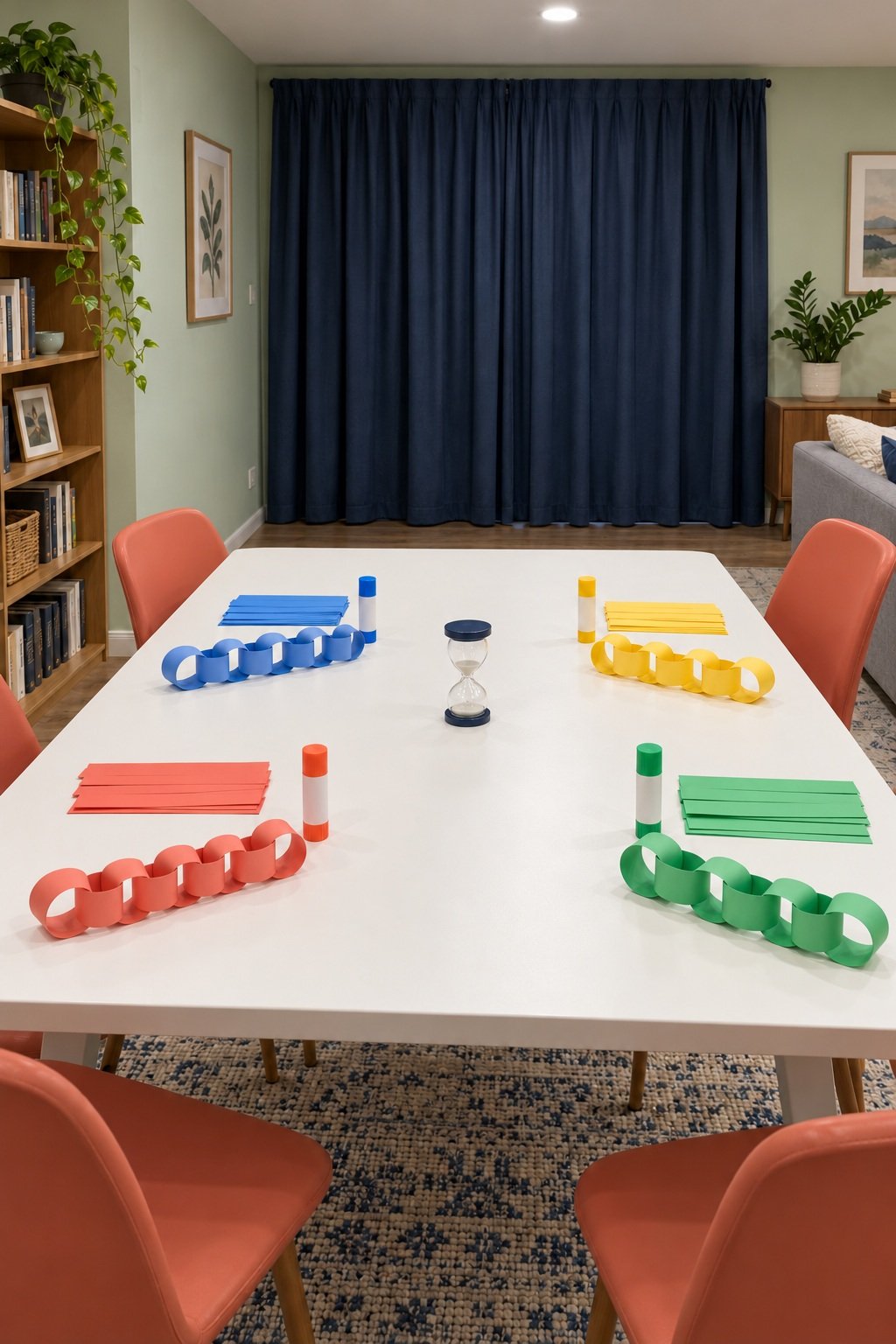
Blue, yellow, coral, and green paper chains sit beside matching strips and glue sticks, with a sand timer in the center. Each color gives a player an identifiable station, and the shared timer avoids extra equipment around the table. Prepare equal paper strips, glue the ends of a strip into a loop, and thread each new strip through the previous loop before closing it. Compare only closed links after the same timed round, allowing glue joins to set before lifting the paper chains. Join the finished chains into a shared party decoration so the game produces something worth keeping.
25. Living Room Charades
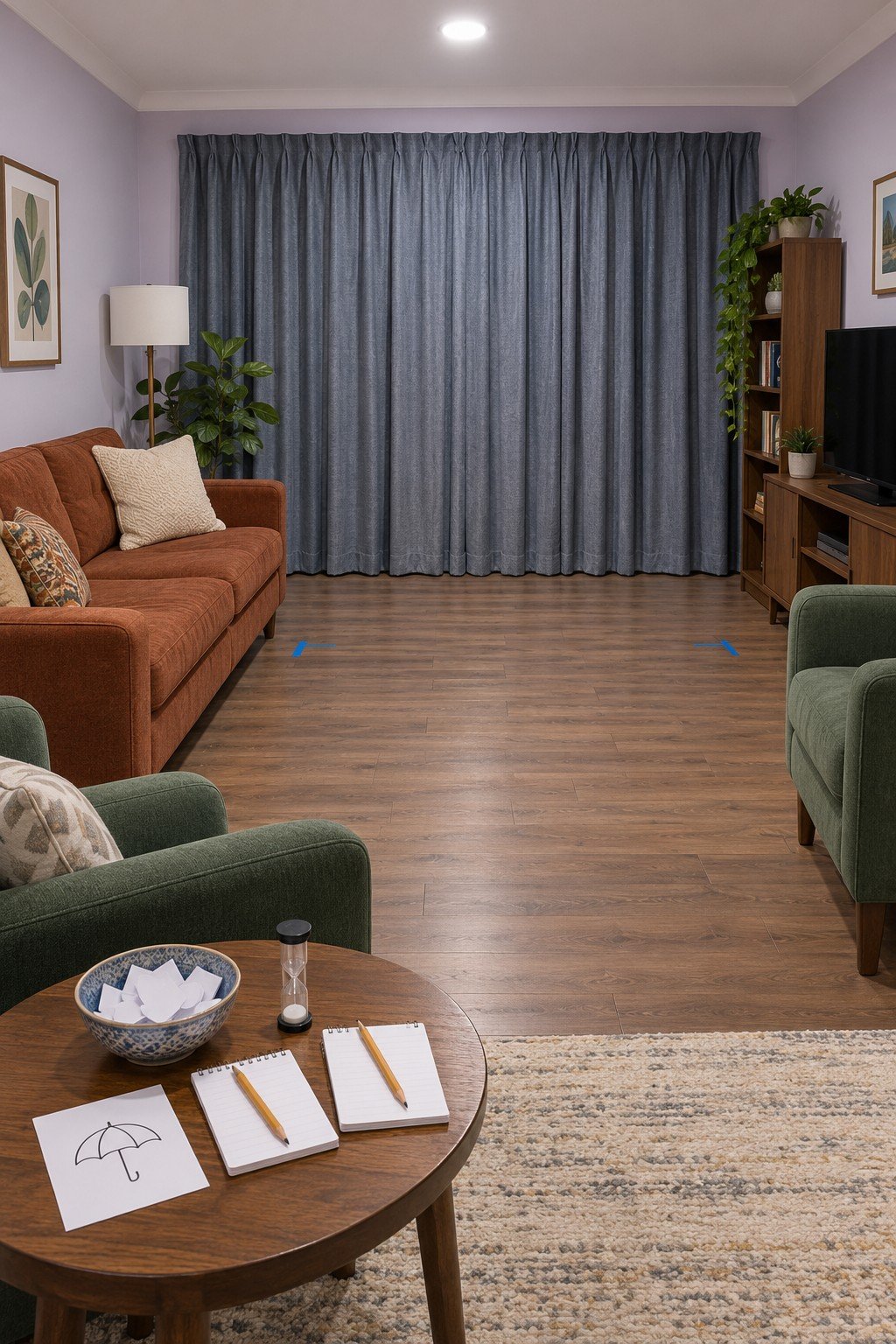
Folded charades slips, pencils, notepads, and a sand timer sit beside an open living room stage marked with small blue tape corners. The existing sofa and armchairs provide audience seating, so the center can stay clear of extra furniture. Write familiar actions or animals on the slips, draw a prompt, and act it out without speaking while the group guesses. For a simple house rule, a correct guess earns the group another turn rather than sending a player out. Allow seated gestures and untimed rounds so participation does not depend on standing or reading quickly.
26. Picture Book Memory Game
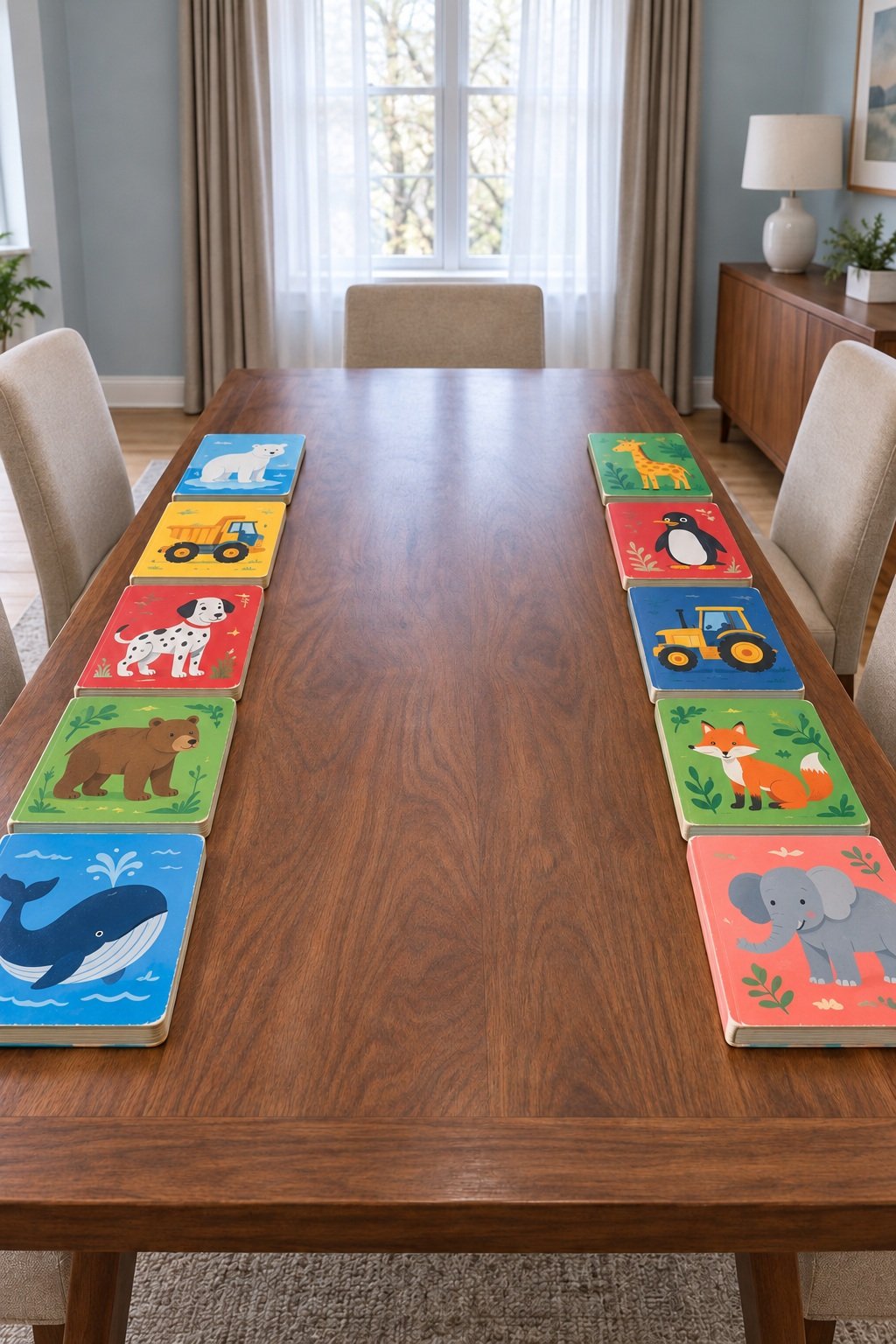
Animal and vehicle picture books form two rows along a wooden table. The recognizable covers give a recall game clear subjects without requiring players to read, while the long rows make changes easy to spot. Invite everyone to study the covers, then have a player close their eyes while someone removes a book. The player names the missing animal or vehicle before the cover returns. Select fewer books for a younger group, then add another when remembering becomes easy.
27. Egg Carton Color Pattern Game
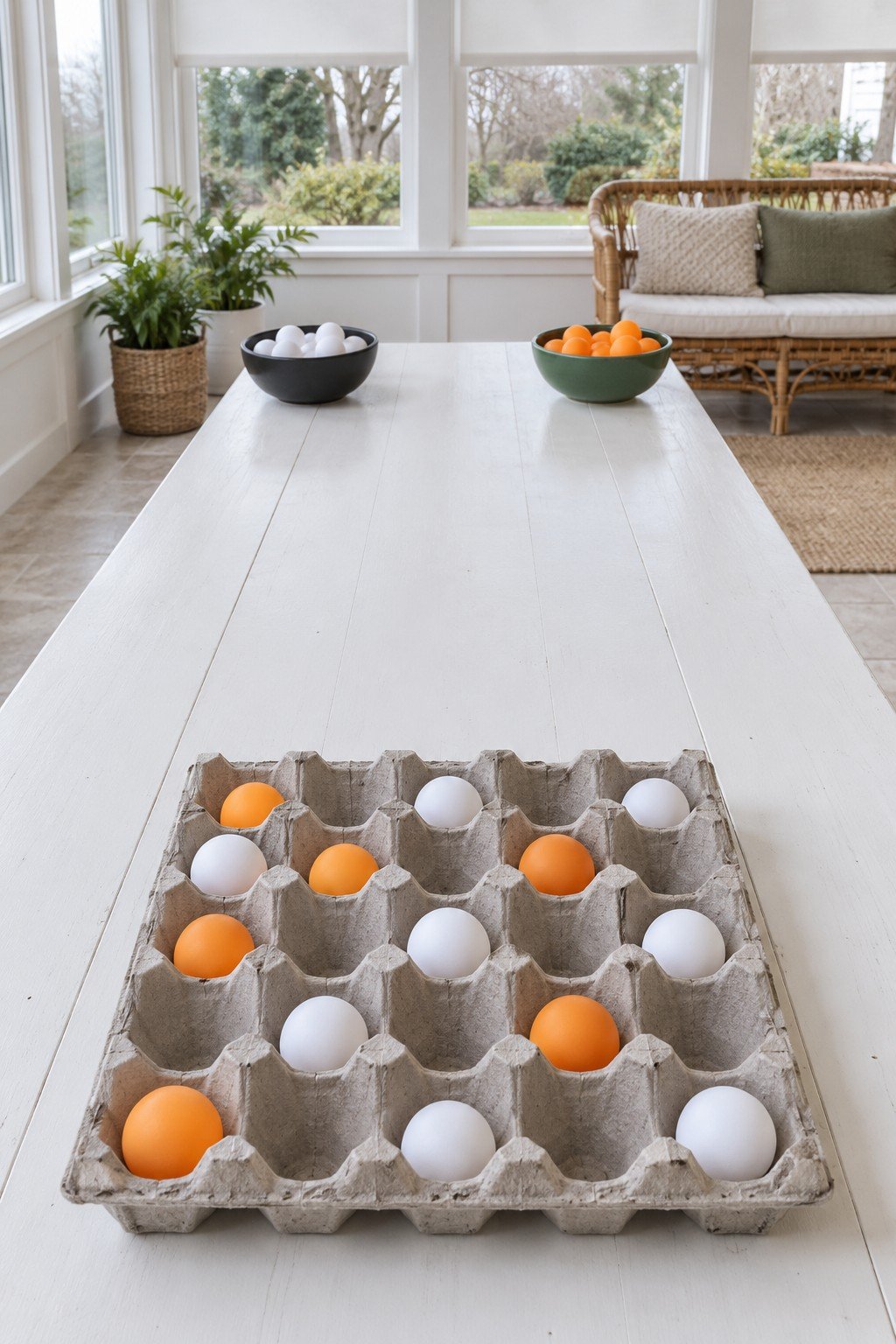
White and orange balls occupy the pockets of a gray molded carton tray, with bowls of spare balls at the far end of a white table. The repeating pockets give ball patterns a clear structure, and the neutral tabletop makes both colors easy to distinguish. Set a clean unused carton tray within reach and let a player arrange a short color sequence, then ask another player to copy the pattern in empty pockets. A clean craft tray avoids repurposing packaging that has held raw eggs. Narrow the pattern to a single row before introducing more pockets or a memory challenge.
Compare Supplies Before Spending
For a U.S. shopping reference checked October 28, 2026, the examples below compare supply purchases, making effort, and storage. Prices exclude tax and shipping and may change; existing household supplies can reduce the purchase list. The clear cups are a lower cost alternative to buying separate team colors.
| Material or method | Price reference | Making effort | Cleanup and storage |
|---|---|---|---|
| Plastic cups | 28 clear cups listed at $2.89 | Arrange targets or a paper tower; no cutting for cup games | Nest dry cups together; discard cracked or crushed pieces |
| Table tennis balls | 12 Franklin Sports balls listed at $2.99 | Ready for cup bouncing or carton patterns | Wipe clean and count back into a closed container |
| Colored construction paper | 200 Mondo Llama sheets listed at $4.25; glue costs extra | Fold bridges and loops; thinner paper can be easier for layered frogs | Store flat and dry; discard torn or wet game pieces |
| Fabric scraps and existing trays | No additional purchase for pieces already at home; bought fabric and tools add cost | Cut flat felt shapes or sew bags with enclosed seams | Follow the fabric care label; nested trays gather pieces between sessions |
A rough estimate for buying the cups and balls is about $6 before tax and shipping, based on a combined listed price of $5.88. Adding the paper brings that supply subtotal to $10.13, or about $10; tape, glue, and equipment such as nets or wooden boards are separate. Spend on those larger pieces only after trying a simpler game in the available space.
Where to Start
Begin with the paper roll cup race, the fabric tic tac toe grid, and the picture book memory game. They offer different kinds of play while borrowing surfaces and objects already used at home. The cup race suits a quick shared challenge, the grid supports a slower exchange of turns, and the memory game leaves room for younger players to succeed without reading. Try the activity the family wants to repeat before adding more equipment.
For the next making session, explore cardboard toys for tabletop games; for a dedicated play area, compare basement layouts organized around different games.
Leave a Reply