
These 26 wooden crate decorating ideas cover entryway storage, reading corners, kitchen stations, plant displays and sculptural shelving. The making guide explains how to choose crates, plan their layout, prepare surfaces and organize connections before decorating. Illustrated assembly stages provide a practical starting point, followed by room specific choices for access, moisture and mounting. Some arrangements use crates as simple storage; seating, beds and larger installations need additional structural planning for the job they will perform.
Table of Contents
- Decide What the Crates Need to Hold
- Choose Sound Crates, Materials and Tools
- Prepare the Layout and Connect the Parts
- Match Mounting and Finish to the New Use
- Use These Making Decisions for the 26 Ideas
- 1. Modular Crate Reading Nook with Book Storage
- 2. Wooden Crate Entryway Shoe Bench
- 3. Two Row Crate Shoe and Accessory Storage
- 4. Wooden Crate Bedside Table
- 5. Rolling Wooden Crate Coffee Table
- 6. Bathroom Wall Storage with Wooden Crates
- 7. Tiered Wooden Crate Plant Stand
- 8. Wooden Crate Home Office Shelving
- 9. Kids Room Crate Storage and Reading Bench
- 10. Wooden Crate Media Console
- 11. Wooden Crate Coffee Bar
- 12. Open Wooden Crate Room Divider
- 13. Wooden Crate Laundry Sorting Station
- 14. Flexible Wooden Crate Pantry Wall
- 15. Children's Art Station with Crate Storage
- 16. Architectural Wooden Crate Arch Display
- 17. Geometric Crate Divider with Open Cutouts
- 18. Indoor Garden Crate Bench
- 19. Wooden Crate Daybed with Stair Step Shelves
- 20. Crate Sunburst Display Around a Mirror
- 21. Spiral Wooden Crate Display Tower
- 22. Wooden Crate Bar Cabinet
- 23. Staircase Pattern Crate Wall Shelf
- 24. Tree Form Crate Shelf Composition
- 25. Tree Shaped Wooden Crate Bookcase
- 26. Circular Wooden Crate Display Wall
- Keep the Arrangement Useful After Decorating
Decide What the Crates Need to Hold
Compare ideas 2 and 3 for shoes, 7 and 18 for plants, and 13 and 14 for utility storage. Measure the actual books, baskets or pots along with the space needed to lift them out. Include door swings, walking routes and access for cleaning. An arrangement that looks compact from the front can project substantially into a room when crates face different directions.
Choose Sound Crates, Materials and Tools
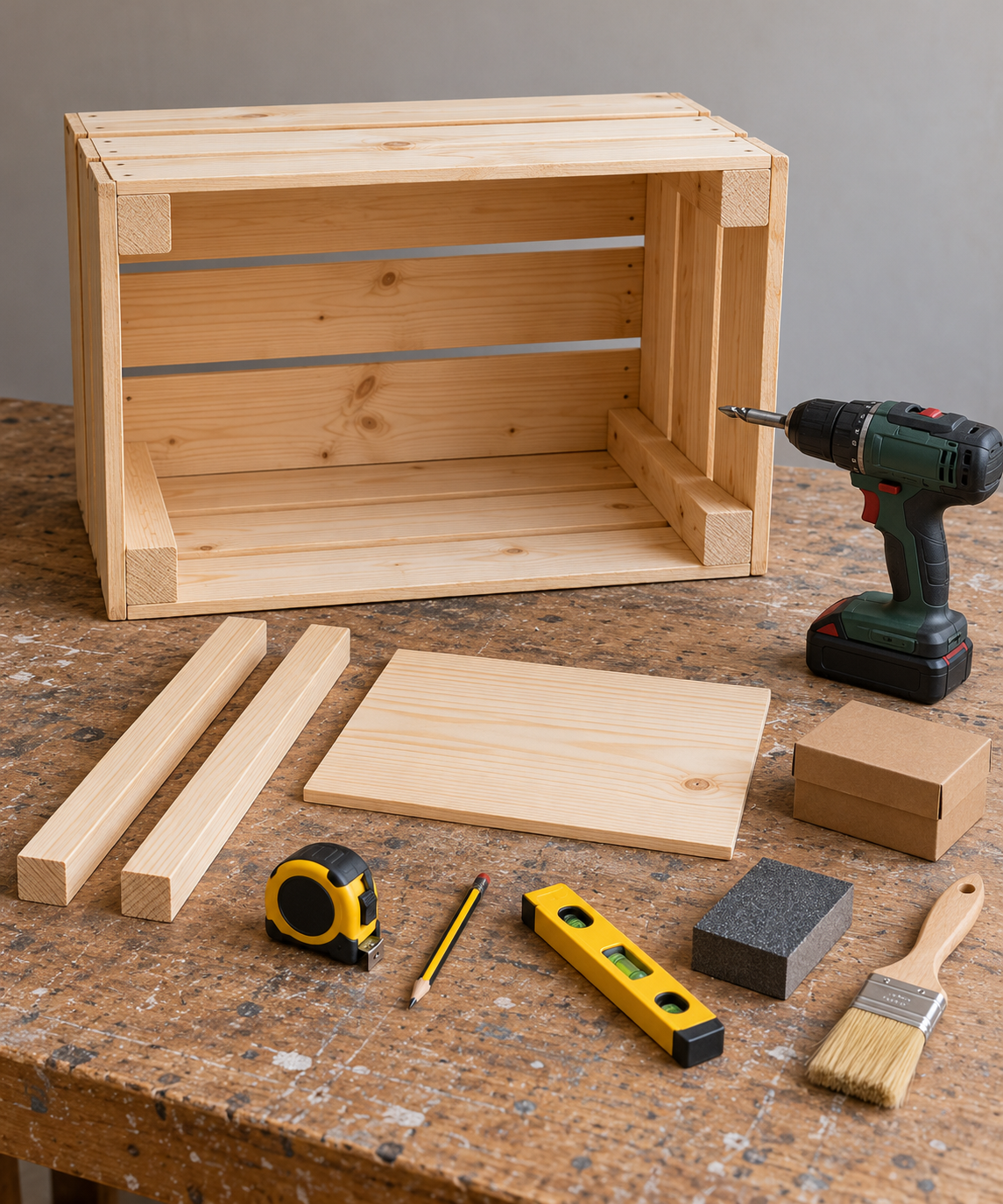
Check corner joints, slats and fasteners, rejecting rot, splits and protruding metal. Know the previous use of reclaimed crates; avoid materials with unknown chemical contamination. Assess unknown old coatings before sanding or scraping them. For a new layout, additional timber rails, a solid base or top, screws, brackets and suitable wall fixings may be needed. Their sizes and connections depend on the planned loads and support conditions.
Useful tools include a tape measure, pencil, square, spirit level, drill with appropriate bits, driver and sanding tools. A suitable saw is needed if preparing new panels or rails; supplier prepared cuts may simplify that work. Brushes handle paint or protective finishes. Use eye protection, dust control and a supported work setup as the tools require. Furniture that carries people needs a measured structural plan, not dimensions estimated from a photograph.
Prepare the Layout and Connect the Parts
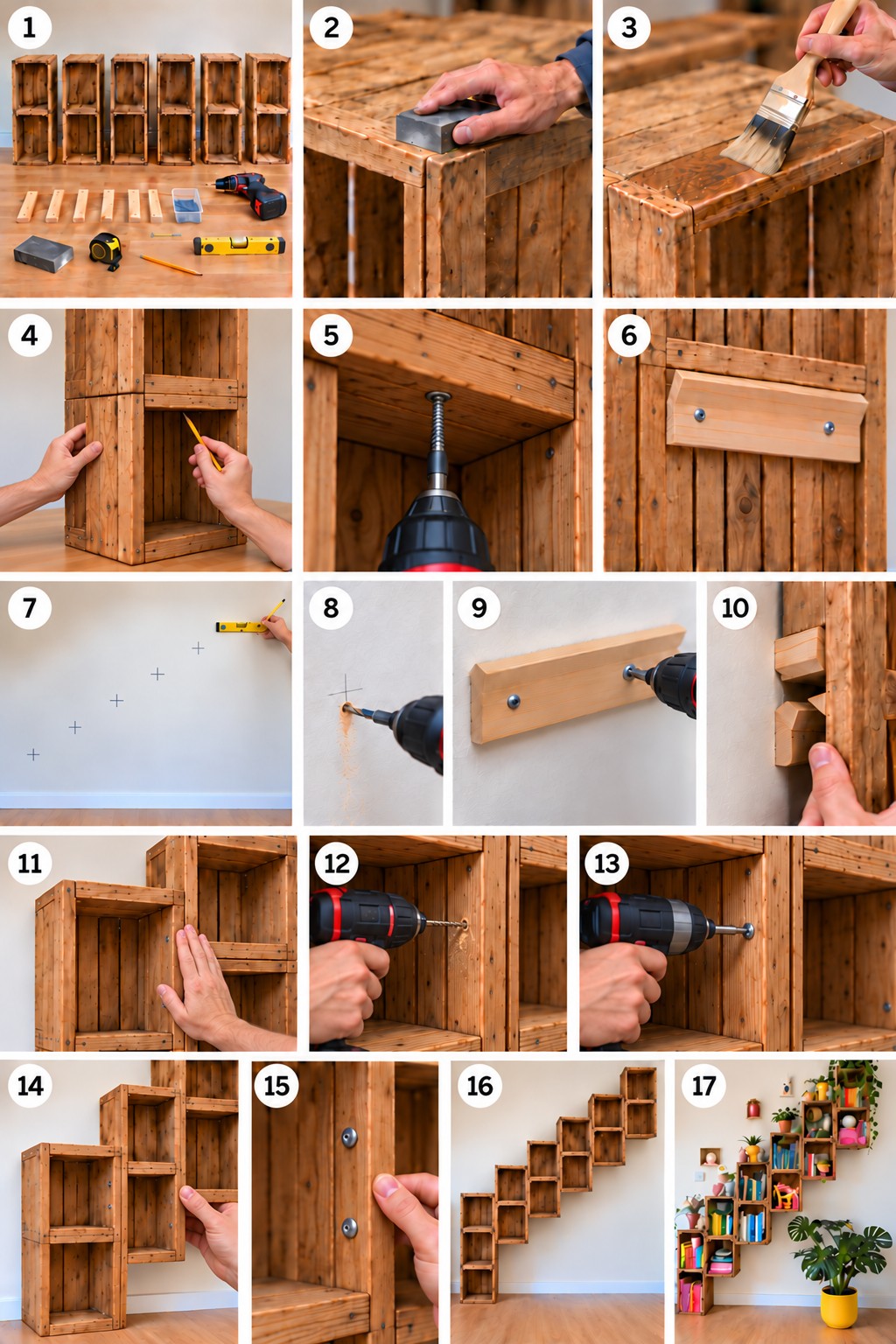
The making stages begin with crates and timber strips, then show surface smoothing and a brushed finish. Later views show fixing points marked, timber mounting rails attached, matching wall fittings positioned and neighboring crates joined. The completed stepped layout illustrates a working order: prepare individual parts, establish their supports, then assemble the arrangement. It does not supply a universal fastener size, wall specification or load rating.
Try the layout before fastening, checking crate openings and accessible connection points. Plan connections through suitable structural members rather than relying on a thin slat wherever it happens to meet the next crate. Pilot holes and screw lengths must suit the wood and joined thicknesses. If your construction plan uses adhesive, follow its surface preparation, holding and full cure instructions; a dry looking bond is not necessarily ready to load.
Match Mounting and Finish to the New Use
Joining crates into a unit and mounting that unit are separate tasks. Identify the wall and choose fixings for the complete loaded arrangement, checking for concealed services before drilling. Floor standing tall pieces may need restraints against tipping; suspended crates need mounts that carry their weight. Keep those connections accessible for inspection.
Choose a finish for the location and expected cleaning, following its preparation and readiness instructions. Bathroom humidity and plant watering call for moisture protection, removable trays and access to dry the wood. A decorative coating cannot turn weak crate construction into a seat or an unsuitable top into a television support.
Use These Making Decisions for the 26 Ideas
With the preparation sequence in mind, choose an arrangement below and adapt it to your room. Reorient compartments for taller books, reserve a clear seat where people will sit, or keep planting in removable containers. Retain the useful layout principles while designing the support for that particular job. Start with the smallest arrangement that solves your storage need, then coordinate its finish and accessories.
1. Modular Crate Reading Nook with Book Storage
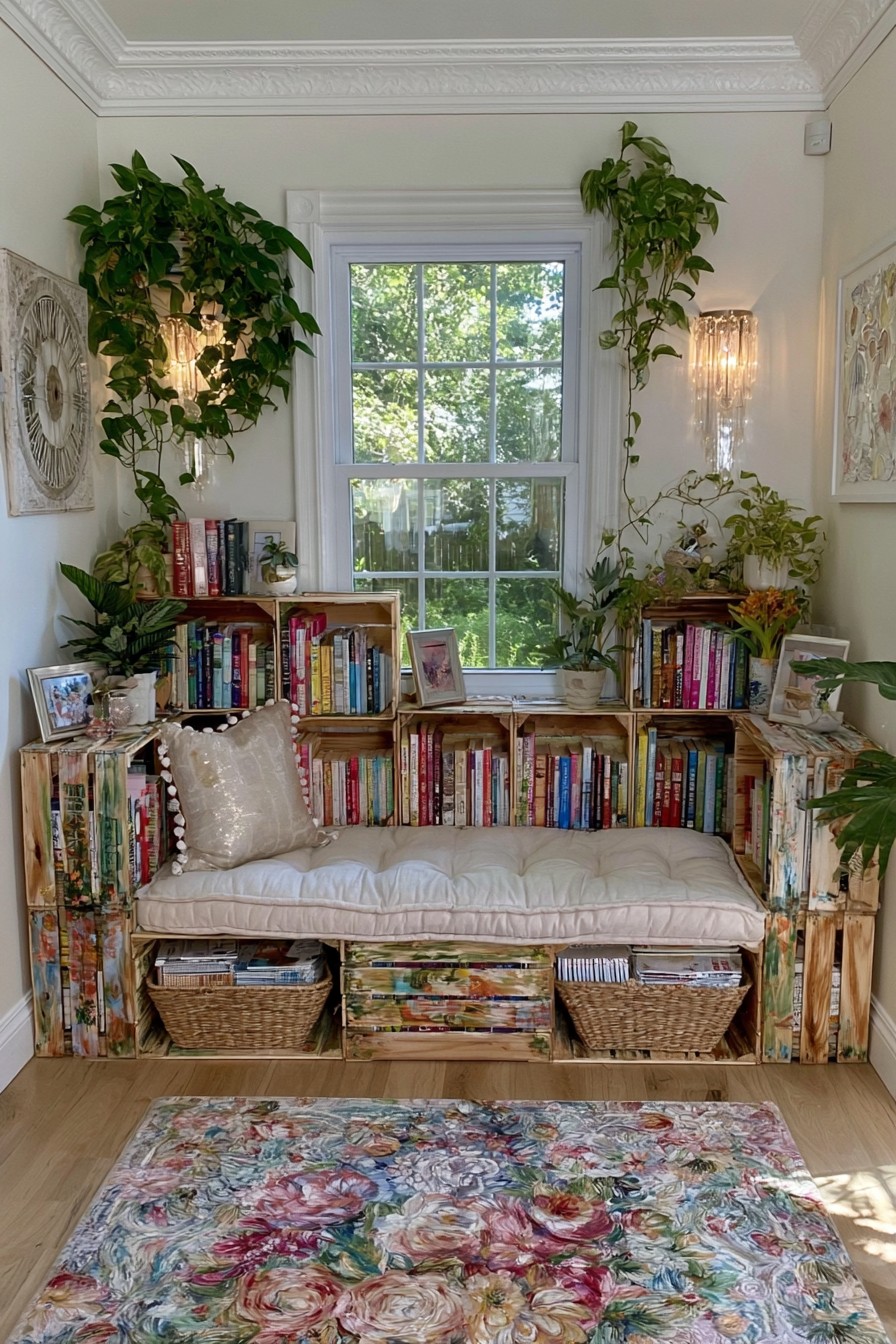
A reading nook can combine a cushioned seat with crates used as open book cubbies. Place frequently read titles within easy reach and use baskets in lower compartments for magazines or small accessories. The repeated wooden openings give the corner a clear structure without requiring closed cabinetry.
If the surface is intended for sitting, build or select a seat base designed to support people and use the crates as its storage component. Anchor any tall shelving around the nook separately. A cushion and focused reading light complete the space while keeping the books easy to browse. Check seated reach before choosing the upper shelf positions, and leave enough clear edge to stand up without gripping a crate.
2. Wooden Crate Entryway Shoe Bench
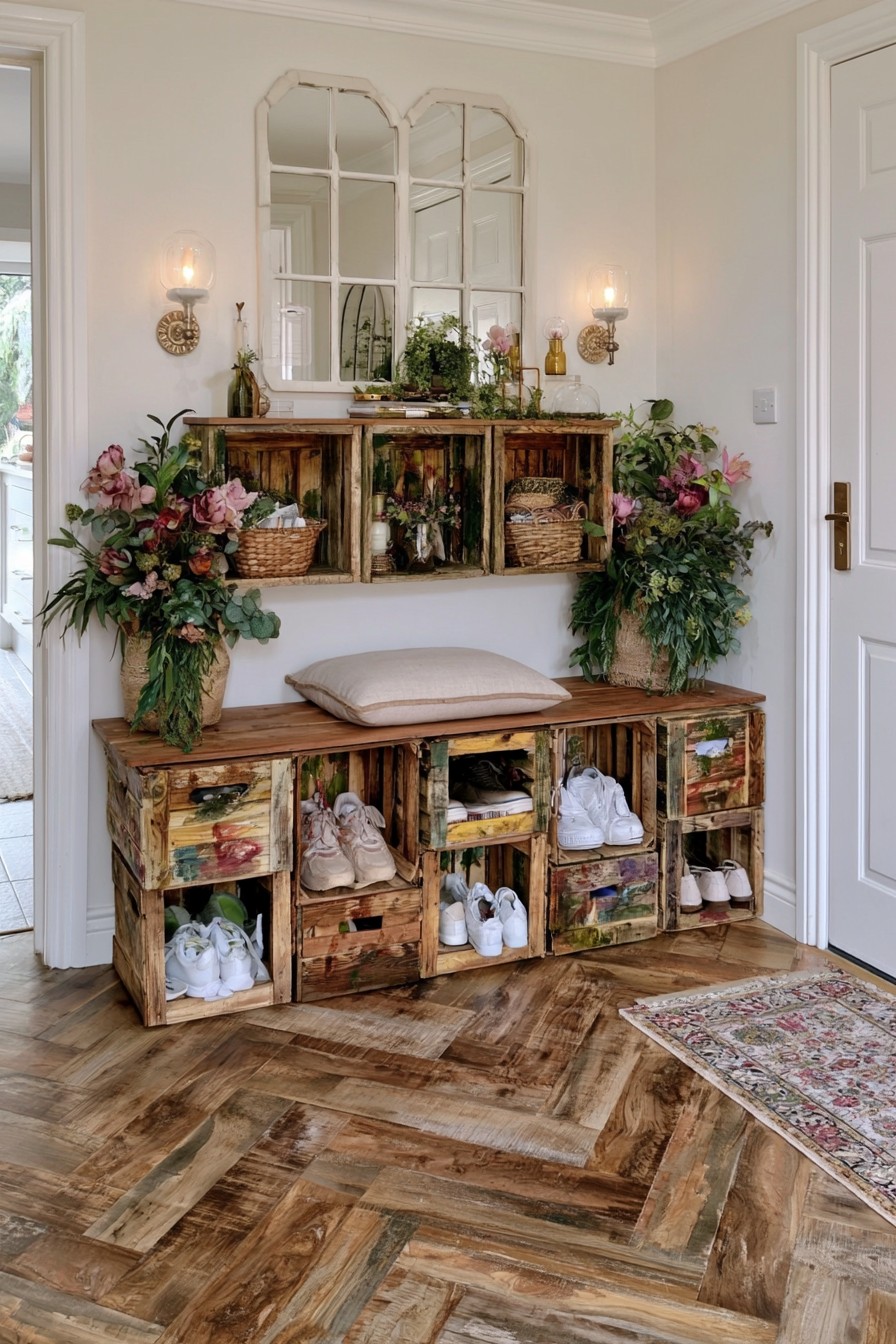
Open crate compartments can give shoes, bags, and seasonal accessories clear places near the door. A solid top visually unifies the lower row, while baskets in selected openings hide smaller items such as gloves. Keep the most used shoes at floor level so the station remains convenient during busy mornings.
A seat must have a load bearing structure suited to its intended use; do not depend on loosely stacked crates beneath a board. Allow room for cabinet doors or drawers to open, and leave an unobstructed route through the entryway. Wall mounted storage above the bench needs its own secure anchors. Measure the largest footwear in the household and keep the seat clear of baskets that would block its use.
3. Two Row Crate Shoe and Accessory Storage
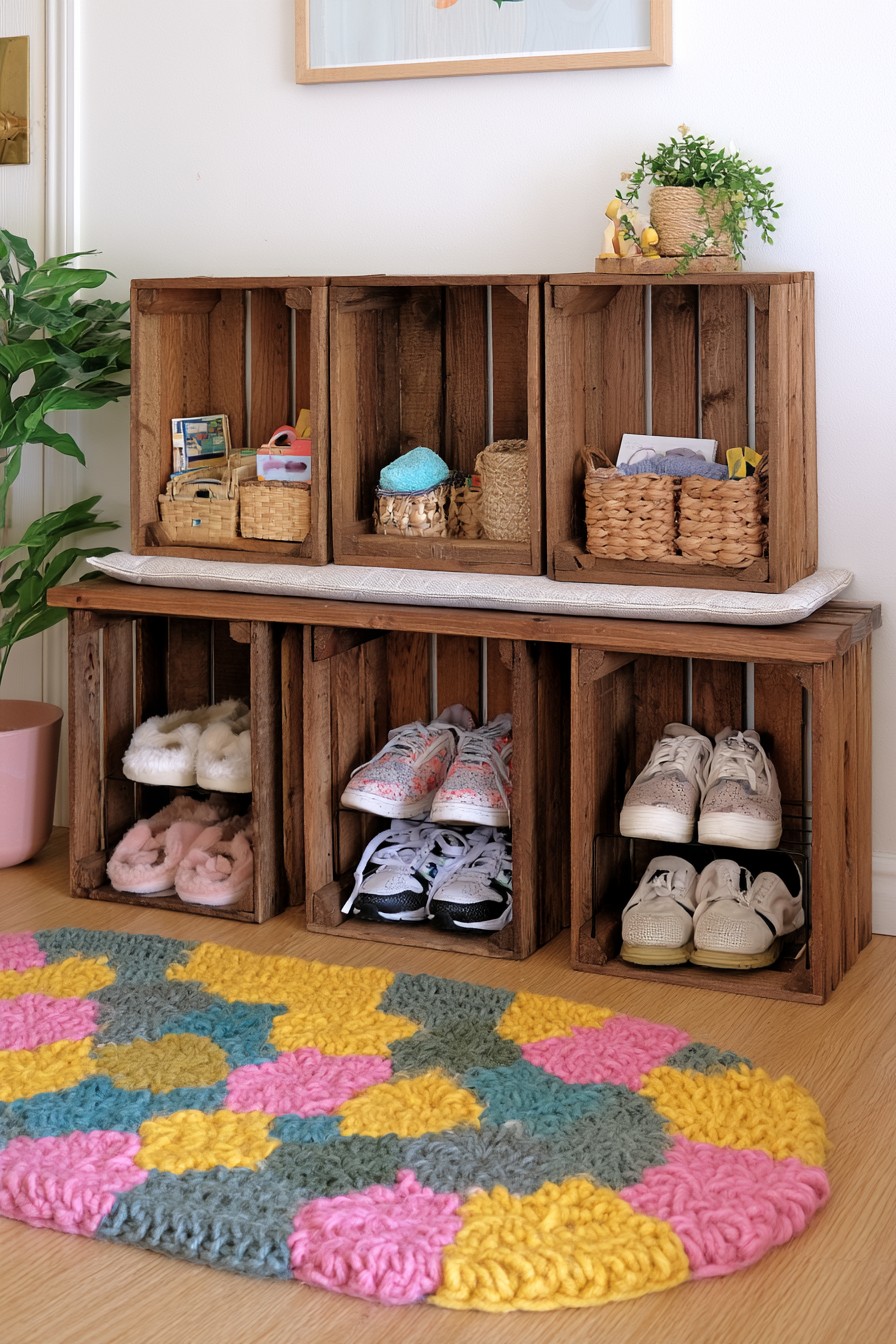
The lower row organizes shoes, while baskets in the upper row separate smaller accessories. Choose crate sizes around the objects you plan to store, and mock up their positions before fixing them together. Their different contents explain the layout more clearly than a size comparison. Use this two row arrangement when visible shoes and grouped gloves, scarves or other daily items need their own places near an entry or wardrobe.
The upper crates sit above the cushion and occupy the space that would otherwise be used for sitting. This distinguishes the example from the usable bench in idea 2. For an adaptation, plan firm support and connections between rows; a soft cushion is not a structural shelf. Keep heavier contents low, check that baskets lift out without catching adjacent compartments, and leave enough floor space to retrieve shoes comfortably.
4. Wooden Crate Bedside Table
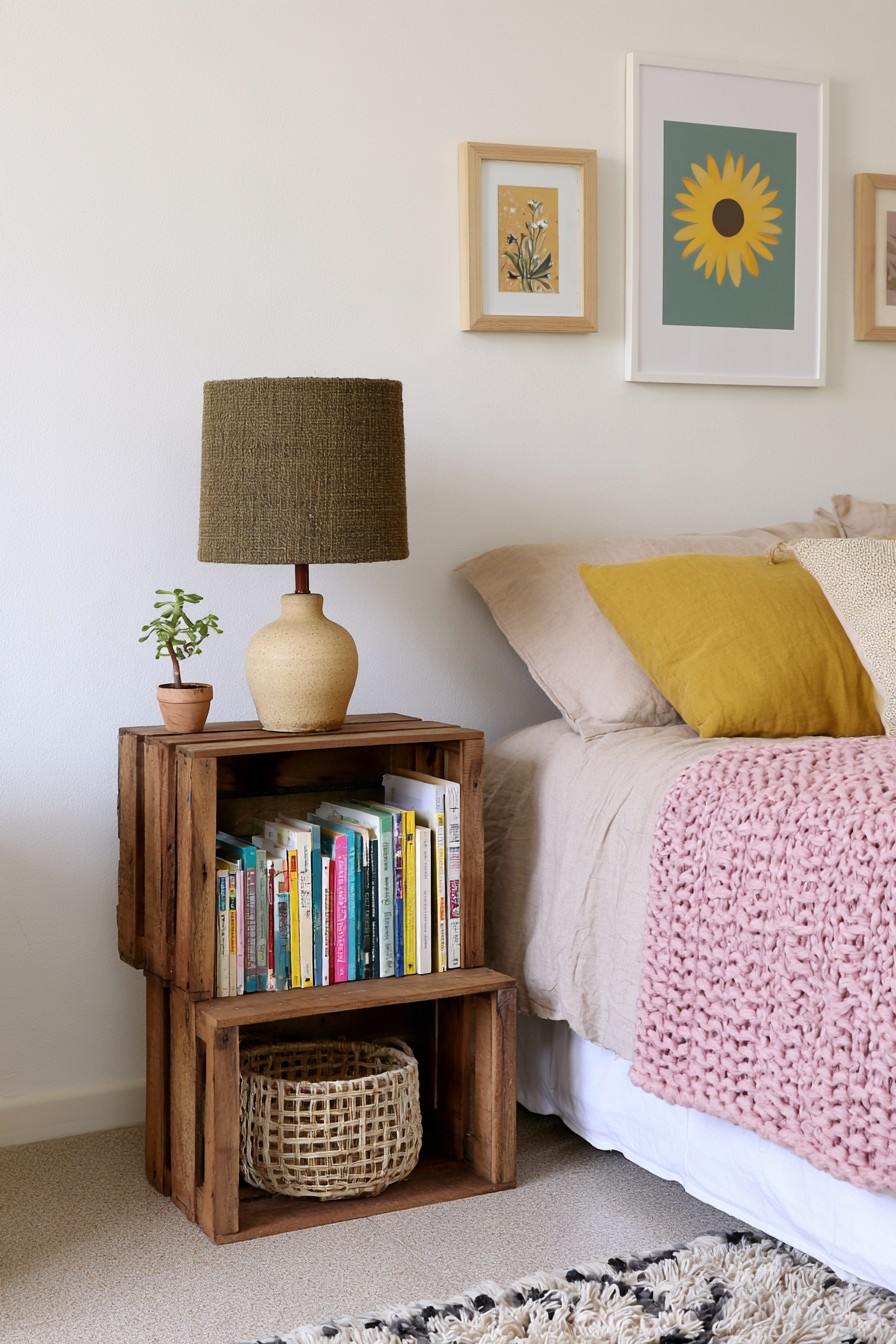
Two vertically arranged crates can provide a narrow bedside storage unit for books, a small basket, and nighttime essentials. Open shelves make a current read easy to reach, while the upper surface can hold a lamp and a few regularly used items. Natural wood adds warmth beside soft bedding.
Join the crates securely and add a flat top if the slats leave an uneven surface for a lamp or glass of water. Keep charging cords from hanging through the openings or across a walking path. A basket in the bottom cubby contains small items without losing the open look. Set the top height relative to the mattress, including bedding, and check that a book can be removed without knocking the lamp.
5. Rolling Wooden Crate Coffee Table
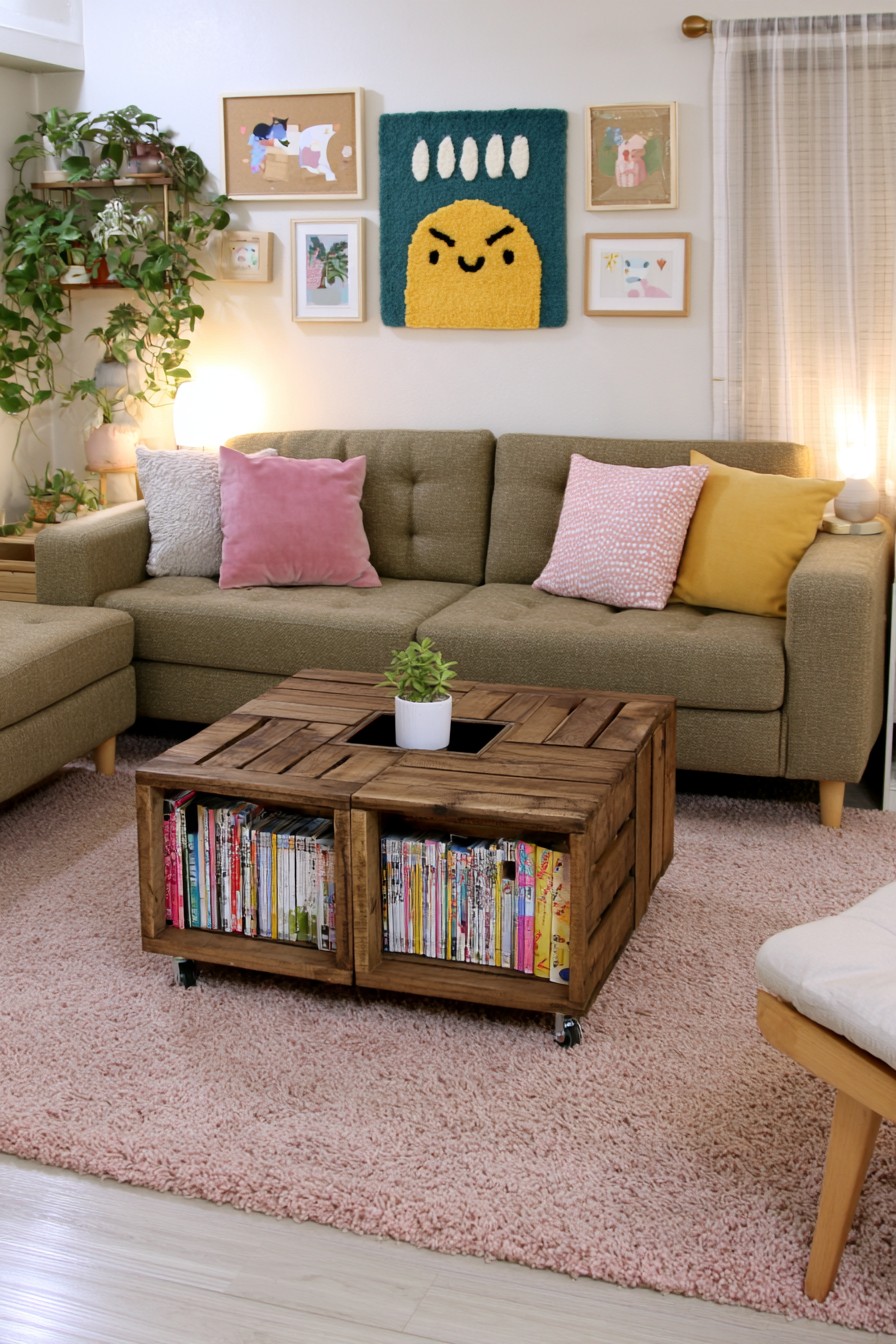
Outward facing crate openings give books and magazines a place beneath this low coffee table. A central recess holds a small plant, while the surrounding top remains available for everyday use. Choose this arrangement when storage needs to be reached from the seating area, checking which openings face the sofa and which face a walking route before planning the base.
Connect the crates through a suitable stable base and choose casters for the table plus its intended contents. Locking wheels help retain the working position; check that their controls remain reachable after assembly. A smooth continuous top can be added where crate slats do not provide a suitable surface. Keep a plant in a removable protected container, and leave room to clean the center recess and the floor underneath.
6. Bathroom Wall Storage with Wooden Crates
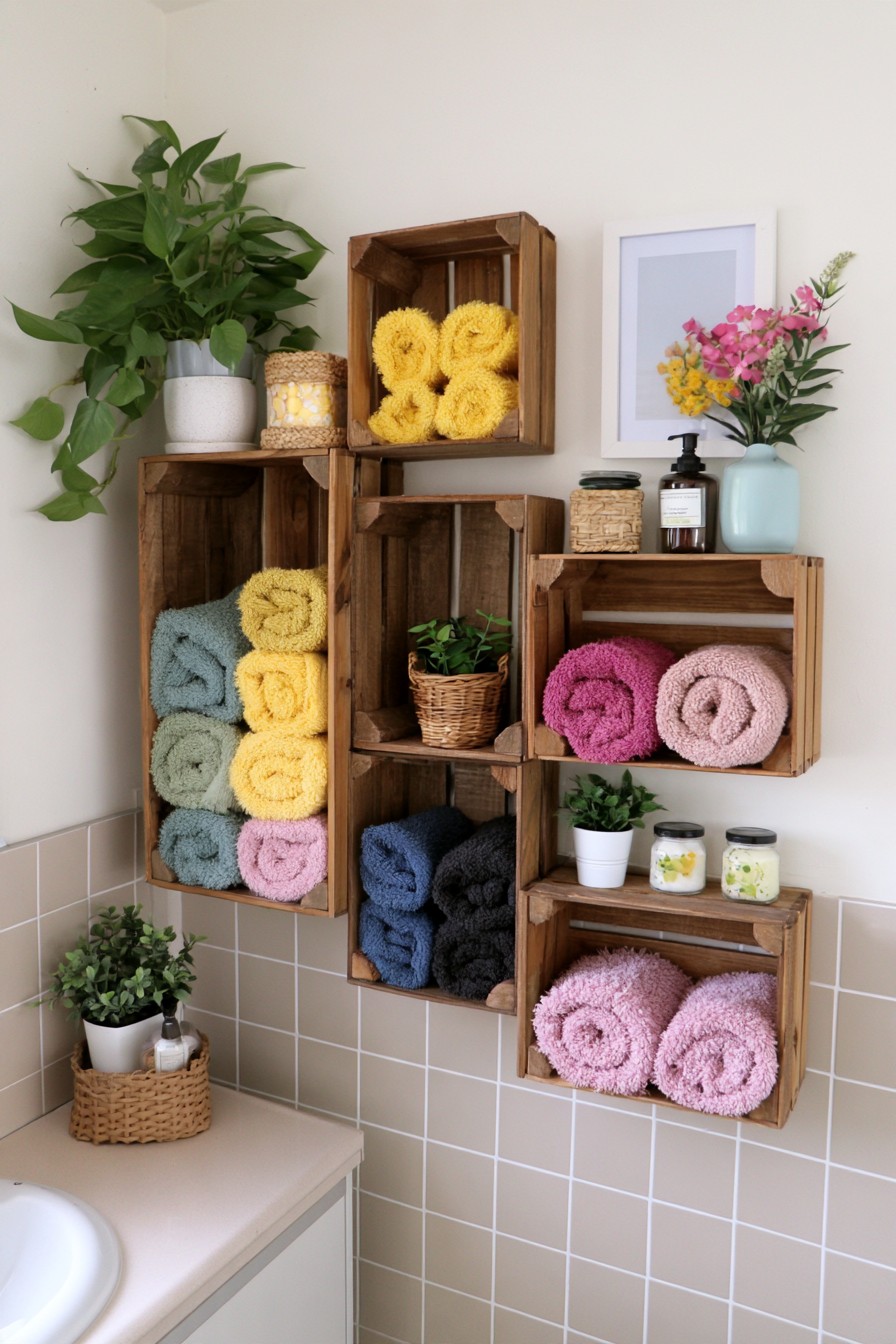
Crates mounted at different heights can free counter space while keeping rolled towels and everyday toiletries visible. Deeper compartments fit folded linens; smaller ones suit baskets or jars. Wood also introduces a warmer material against tile and other hard bathroom surfaces.
Choose a finish appropriate for a humid room and avoid locations exposed to direct shower spray. Anchor each crate for the weight of its contents, especially when storing multiple towels or bottles. Keep frequently used supplies within comfortable reach rather than filling the highest shelves first. Allow clearance above pump bottles so dispensing a product does not push against the compartment above it. Keep wet items on removable trays.
7. Tiered Wooden Crate Plant Stand
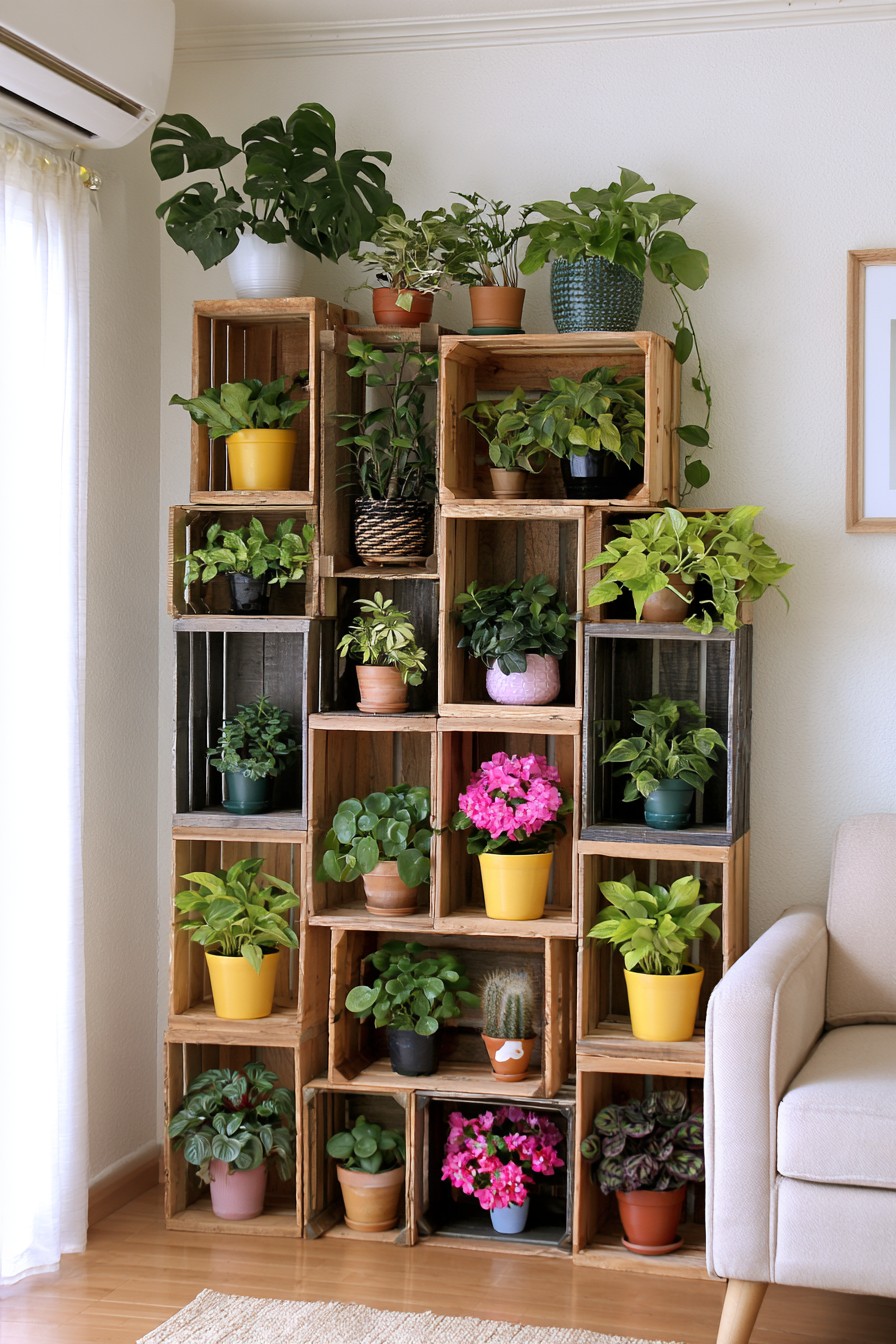
Horizontal and vertical crate openings give this plant collection a range of display spaces. Tall foliage occupies broader areas while smaller pots remain visible within the grid. Choose plant positions for their light needs and mature shape, rather than using pot color alone to decide the layout. Leave enough room to remove each container without catching leaves on the wooden edges.
Plan crate connections and any restraint for the loaded arrangement, including wet growing medium and pots. Use saucers or removable trays, drying water that reaches the wood. Compare these wooden plant stand ideas when a separate stand with fewer compartments would provide easier access. Keep heavier containers low and recheck spacing as plants grow; a collection may need rearranging before all its pots need replacing.
8. Wooden Crate Home Office Shelving
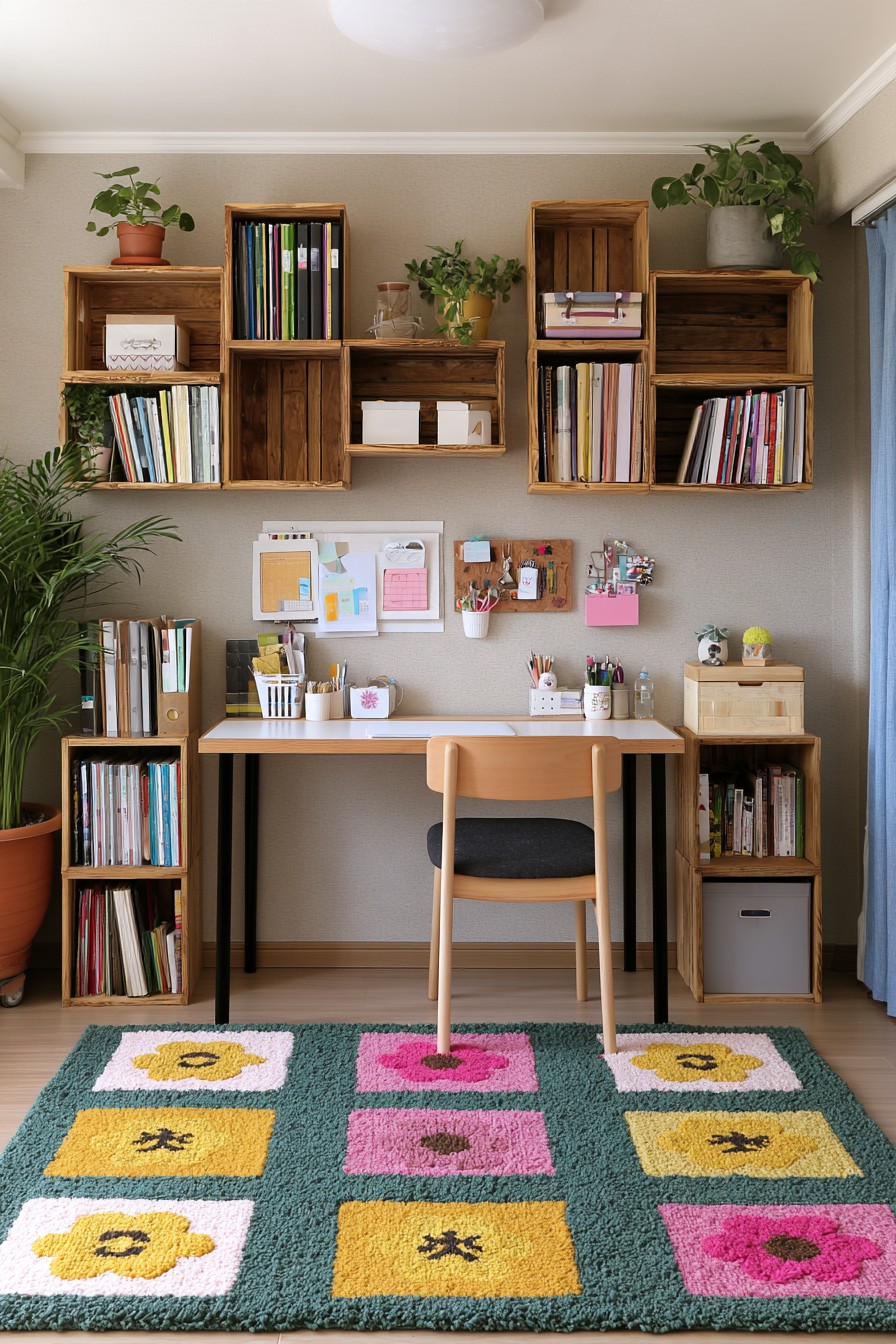
Wall mounted crates can organize books, folders, and supply boxes above a desk. Turning some crates vertically accommodates taller files, while horizontal ones provide wider shelves. Floor level crates can hold less frequently used materials and leave the desktop available for work.
Map the contents before mounting: books and full binders weigh much more than decorative objects. Use suitable wall fixings and place daily supplies where they can be reached without leaning over the desk. Consistent wood tones help an intentionally varied layout feel organized. Use full size folder or binder samples to plan the openings, and keep space behind the screen free for daily desk work.
9. Kids Room Crate Storage and Reading Bench
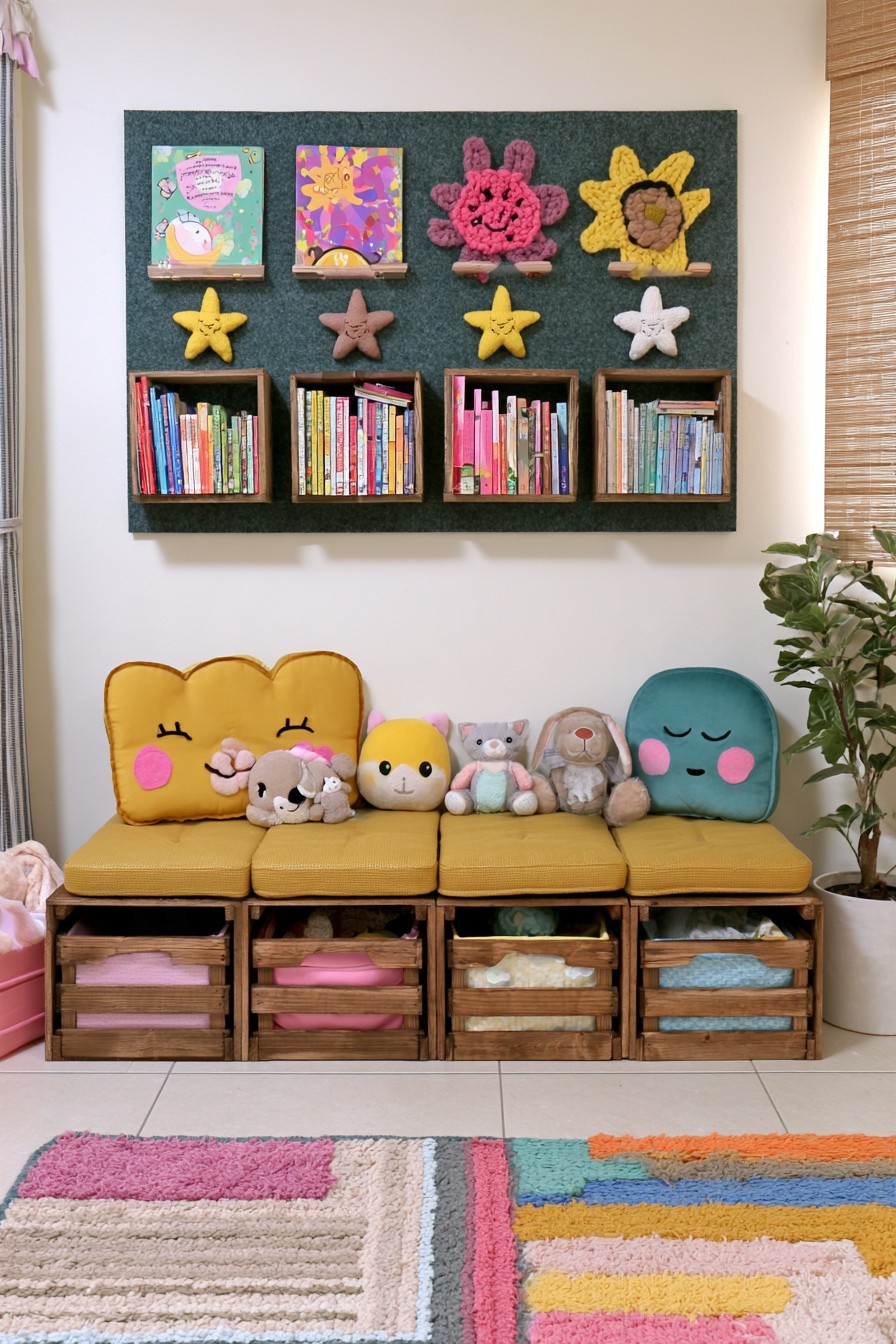
Low open cubbies make books, blankets, and toys easier for children to find and put away. A cushion can turn a properly supported base into a reading seat, while shallow displays above keep favorite book covers visible. Bright textiles soften the wood and give the corner a welcoming feel.
Smooth rough edges, fasten the storage together, and anchor any wall mounted sections. Store heavier items low and avoid making tall crate stacks that children might climb. If the unit is used for sitting, its structure must be built for that load rather than relying on decorative crates alone. Choose removable cushions and baskets that children can handle comfortably, keeping cleaning access to the seat structure and its connections.
10. Wooden Crate Media Console
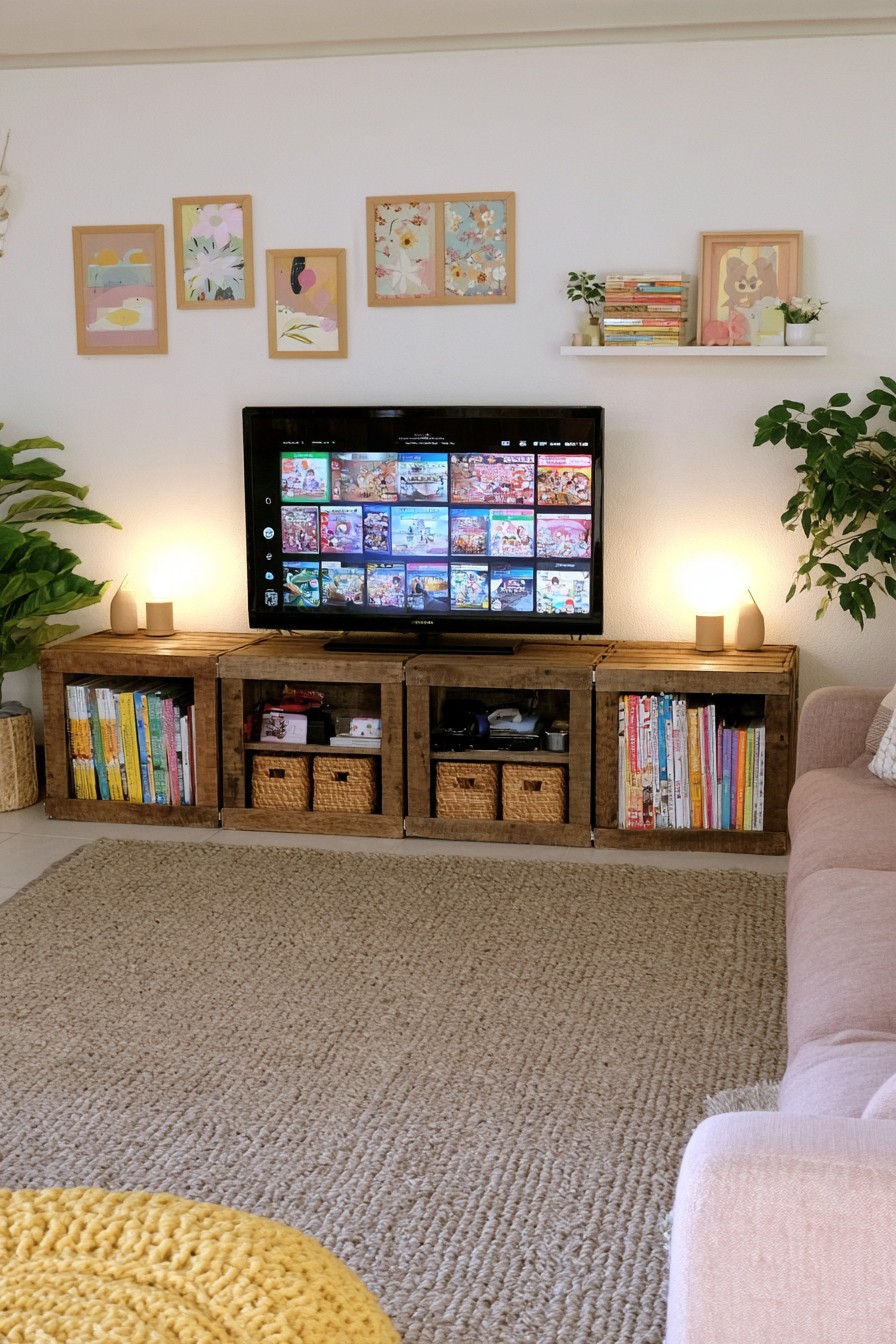
A low row of open compartments holds books, devices and baskets beneath a television resting on the top. This arrangement gives media accessories defined places without closed cabinet fronts. Plan the surface around the television stand footprint and the equipment below, leaving access to plugs and controls. Design the supporting frame and wall connections for the television and the other intended loads.
Secure the console assembly so its components cannot shift, and provide device ventilation as their manufacturers require. The television needs its own appropriate restraint or wall mounting, following its installation instructions. Fastening crates to one another does not secure the screen. Choose furniture intended for television support, or integrate the decorative crates into a properly designed media structure. Keep cables accessible without placing them across a walking route.
11. Wooden Crate Coffee Bar
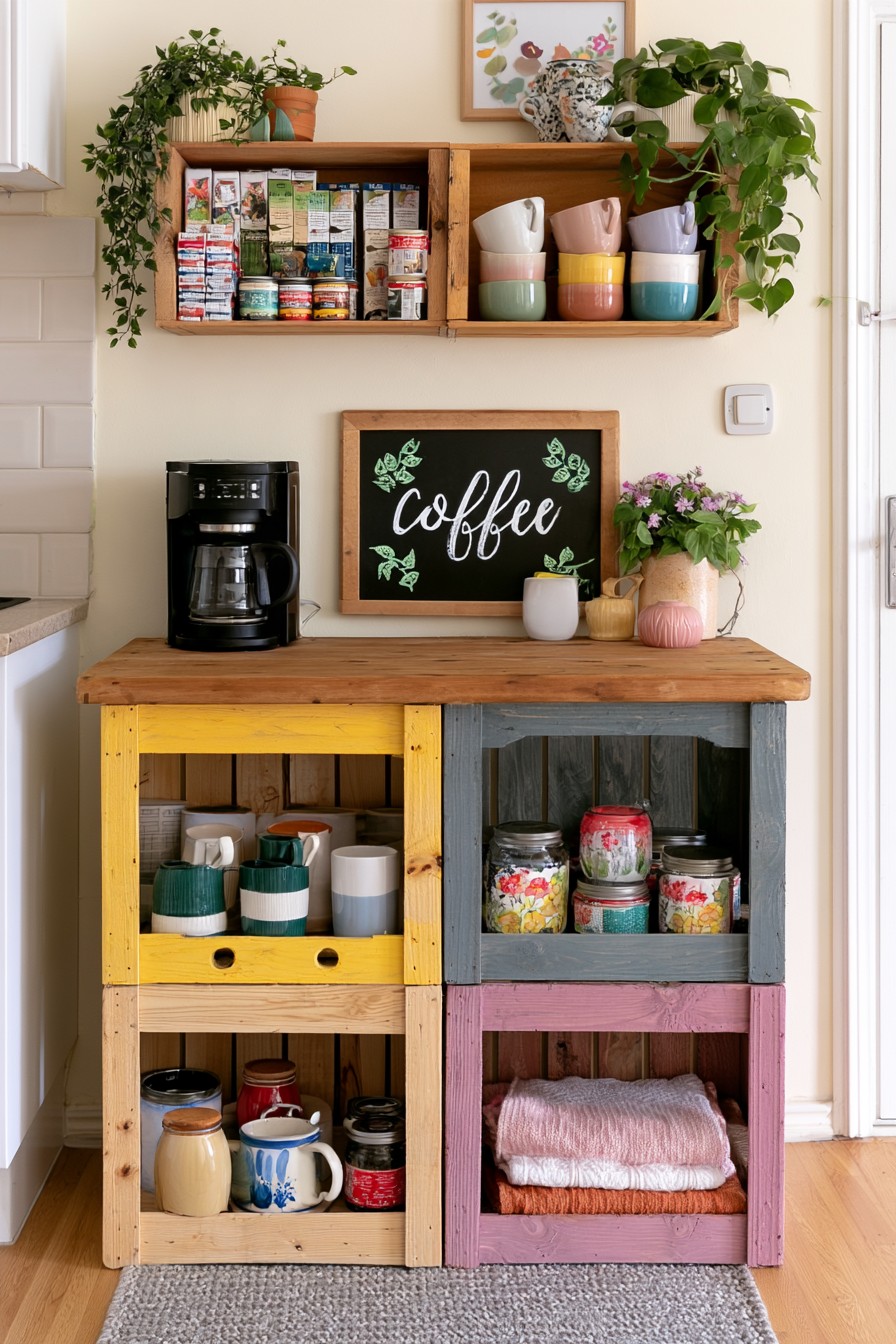
Yellow, gray and pink front sections bring color to this coffee station, while the wood top and wall compartments connect it to the room. Select one or two painted areas to repeat elsewhere rather than covering every crate surface. These painted wooden crate ideas offer related surface styling. Mugs, sealed supplies and folded linens can each occupy a different compartment.
Keep a clear preparation area beside the appliance and select a counter surface suited to spills and cleaning. Follow the coffee maker instructions for clearances and ventilation, keeping electrical connections away from water. Wall cupboards need mounting for their loaded ceramics, and cups should lift out without touching the shelf above. A removable tray for daily ingredients makes wiping the counter simpler after drinks are prepared.
12. Open Wooden Crate Room Divider
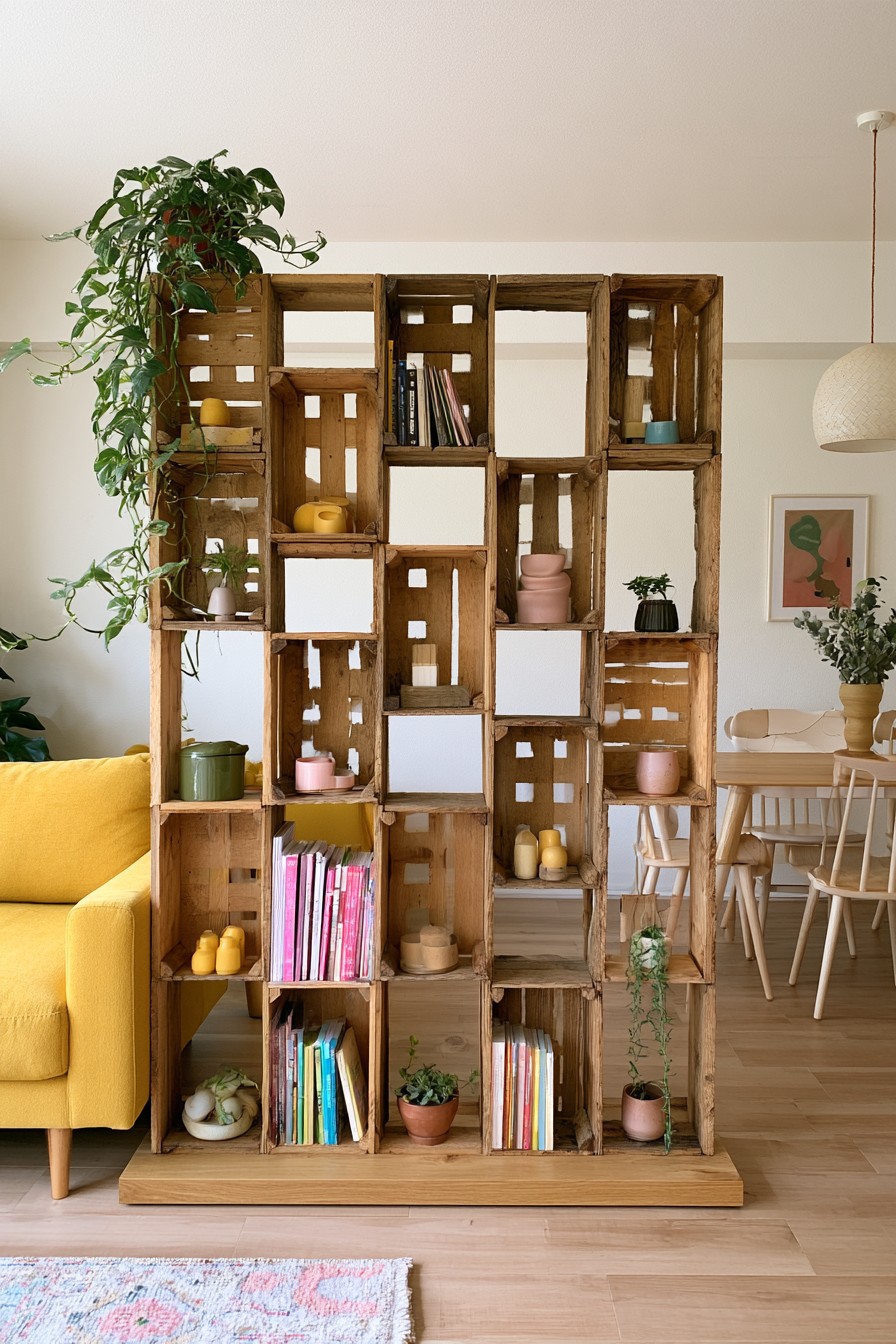
An open grid of crates can suggest a boundary between living and dining areas while preserving sightlines. Alternating crate directions creates compartments of different sizes for books, baskets, and small objects. Leaving some spaces empty prevents the divider from reading as a solid wall.
A tall divider needs secure connections and appropriate anchoring; stacking crates freely is not sufficient. Keep heavier books near the bottom and maintain a clear route around both ends. Plan which side of each crate should face each room before fastening the structure. Trial a basket removal from each side to confirm that its handle and contents do not snag on the divider structure.
13. Wooden Crate Laundry Sorting Station
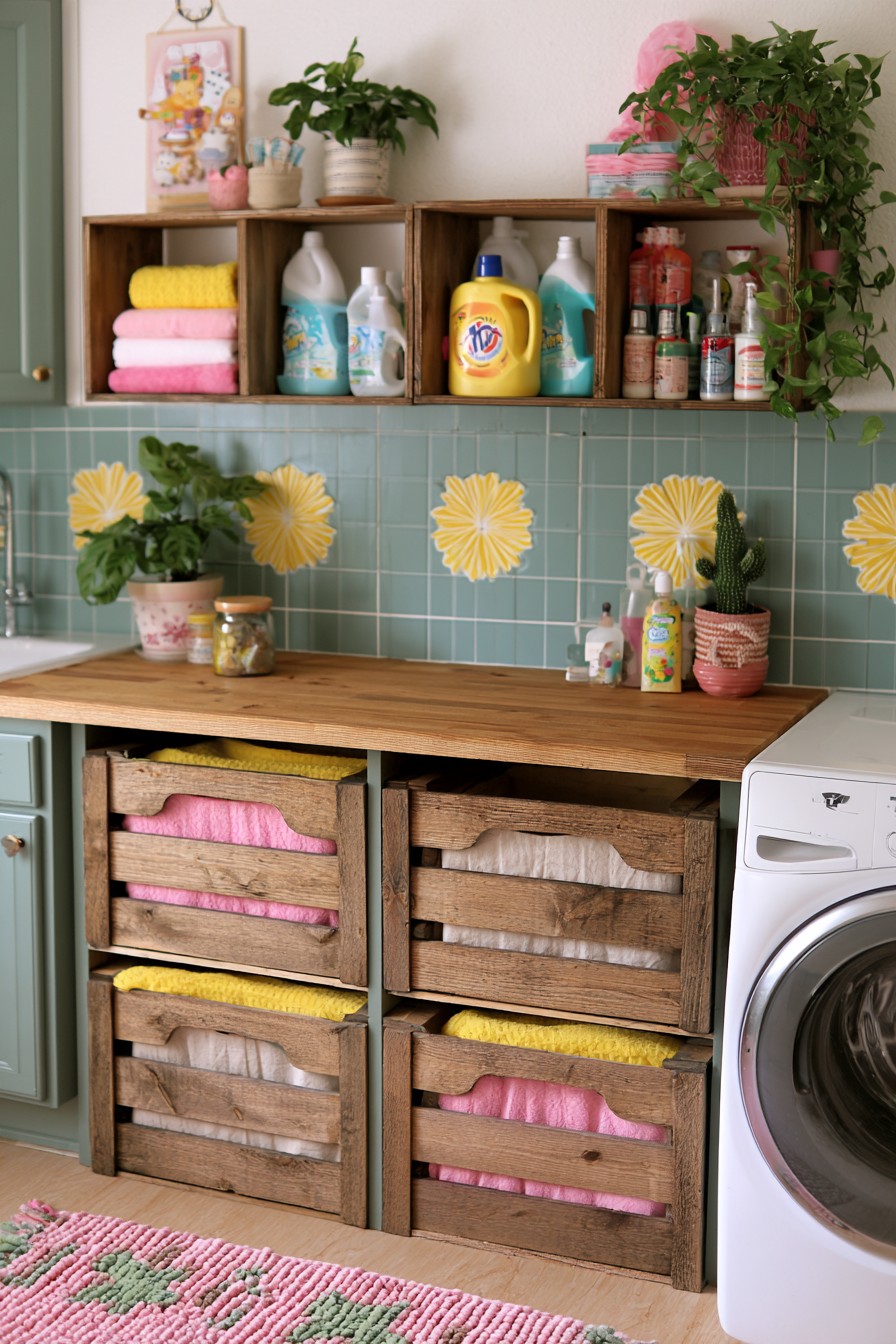
Folded towels and linens fill the lower crate drawers, with washing supplies arranged in the upper wall compartments. The countertop between them provides a clear folding surface. This is useful when clean laundry needs sorting before it returns to bedrooms or bathrooms. Decide on categories first, then check drawer depth and the space needed to pull a loaded crate out fully.
A washable removable bin is a different option for collecting damp or soiled laundry; keep that material from resting directly on wood. Store cleaning products in their original containers and follow their storage instructions, restricting access where required. Plan the counter support independently of the moving drawers, and leave ventilation in a humid utility area. Make drawer stops, runners and their access part of the construction plan rather than assuming the visible crate fronts reveal the mechanism.
14. Flexible Wooden Crate Pantry Wall
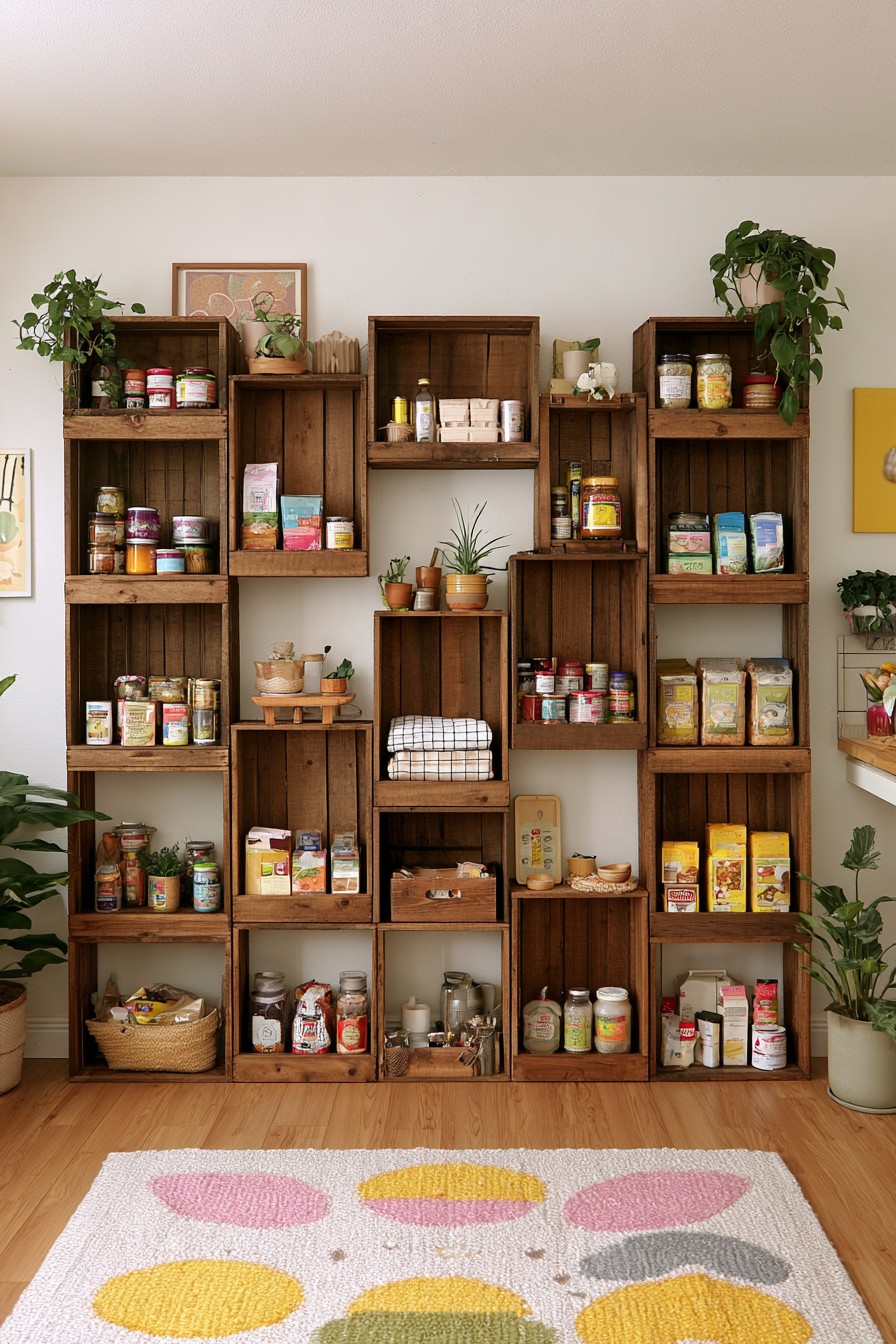
Crates in several orientations can accommodate jars, boxed staples, and baskets of smaller packets. Grouping ingredients by use makes an open pantry easier to navigate: baking supplies, breakfast items, and frequently used seasonings can each have a defined area.
Keep food sealed and follow its storage instructions rather than treating the crates as food containers. Place heavy jars low and mount every wall crate for the weight it will carry. Leave enough space between shelves to read labels and remove containers without shifting neighboring items. Measure jars with their lids included and provide finger space above the containers most often taken out during cooking.
15. Children's Art Station with Crate Storage
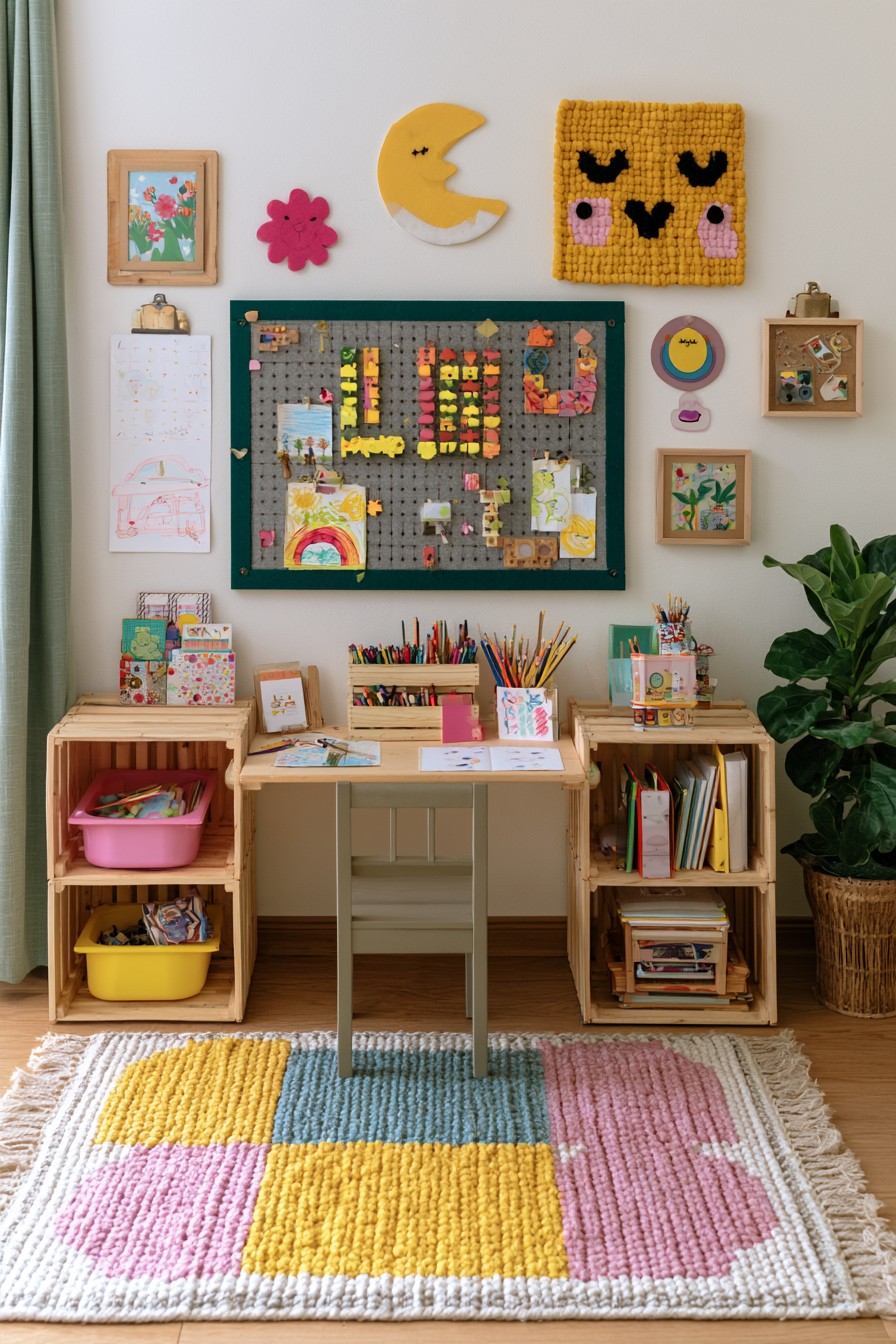
Crates beside a worktable can separate paper, sketchbooks, coloring tools, and unfinished projects. Clear bins or simple labels help children recognize where supplies belong. Placing the most used materials at their height supports independent setup and cleanup.
Fasten the crates, smooth splintered surfaces, and keep heavier materials on the lowest level. Store tools that require adult supervision separately. Leave the tabletop mostly open so the storage system supports making art rather than occupying the space needed to do it. Try the setup with the chair pulled out, preserving room for movement between the worktable and the lower supply compartments. Reserve one bin for unfinished work so the tabletop can be cleared between sessions.
16. Architectural Wooden Crate Arch Display
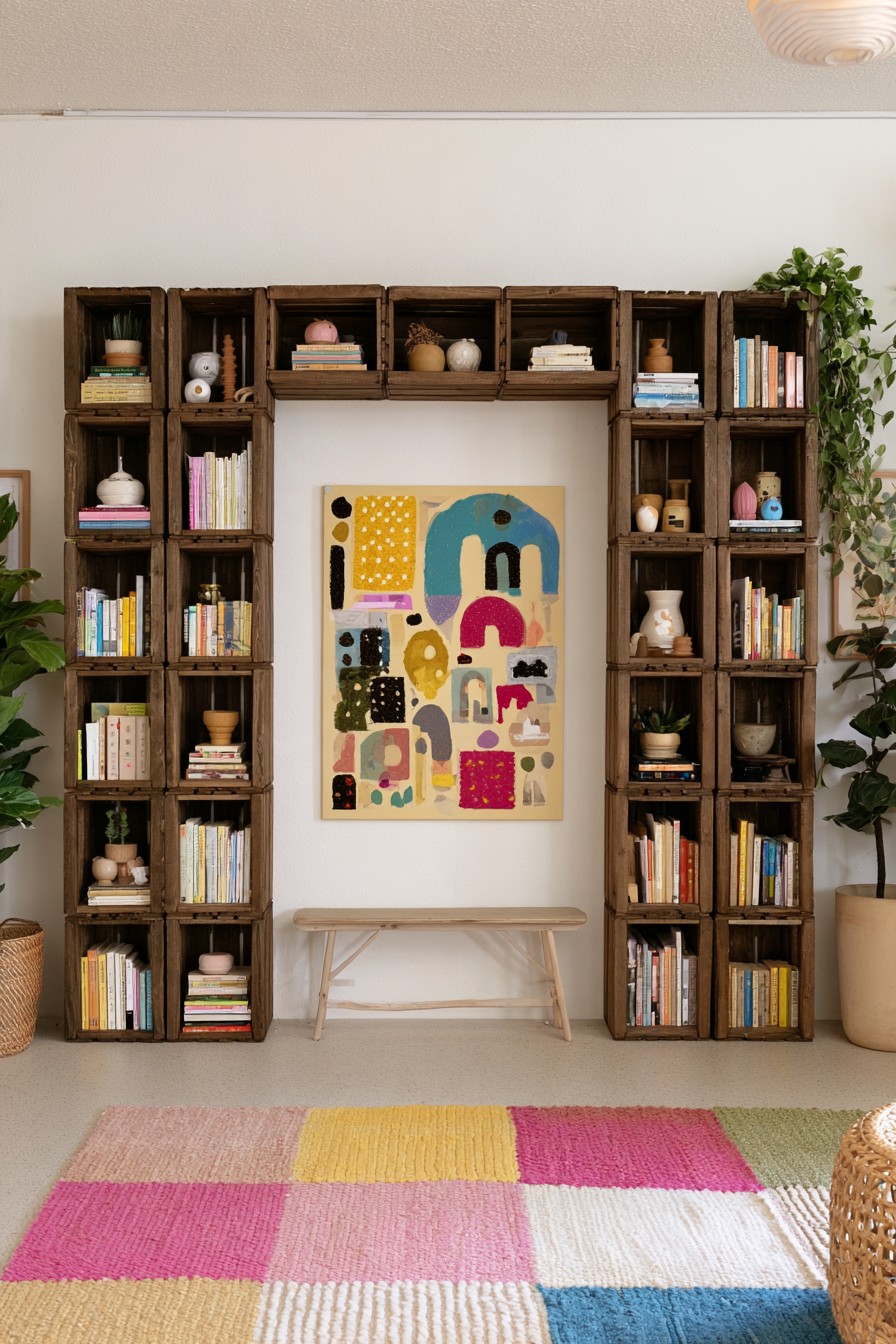
Crates arranged along two sides and across the top can frame a bench or open wall area. Repeating one wood finish makes the separate compartments read as a single architectural feature. Books fit lower down, while lighter objects give the upper shelves breathing room.
The span above the opening needs a properly designed support and wall attachment; crates should not be bridged overhead by simple stacking. Keep the center passage clear and account for headroom. This is a substantial installation that calls for more planning than a small freestanding shelf. Prepare the upper connection layout before placing the side units, so every part of the installation has a defined route for its weight.
17. Geometric Crate Divider with Open Cutouts
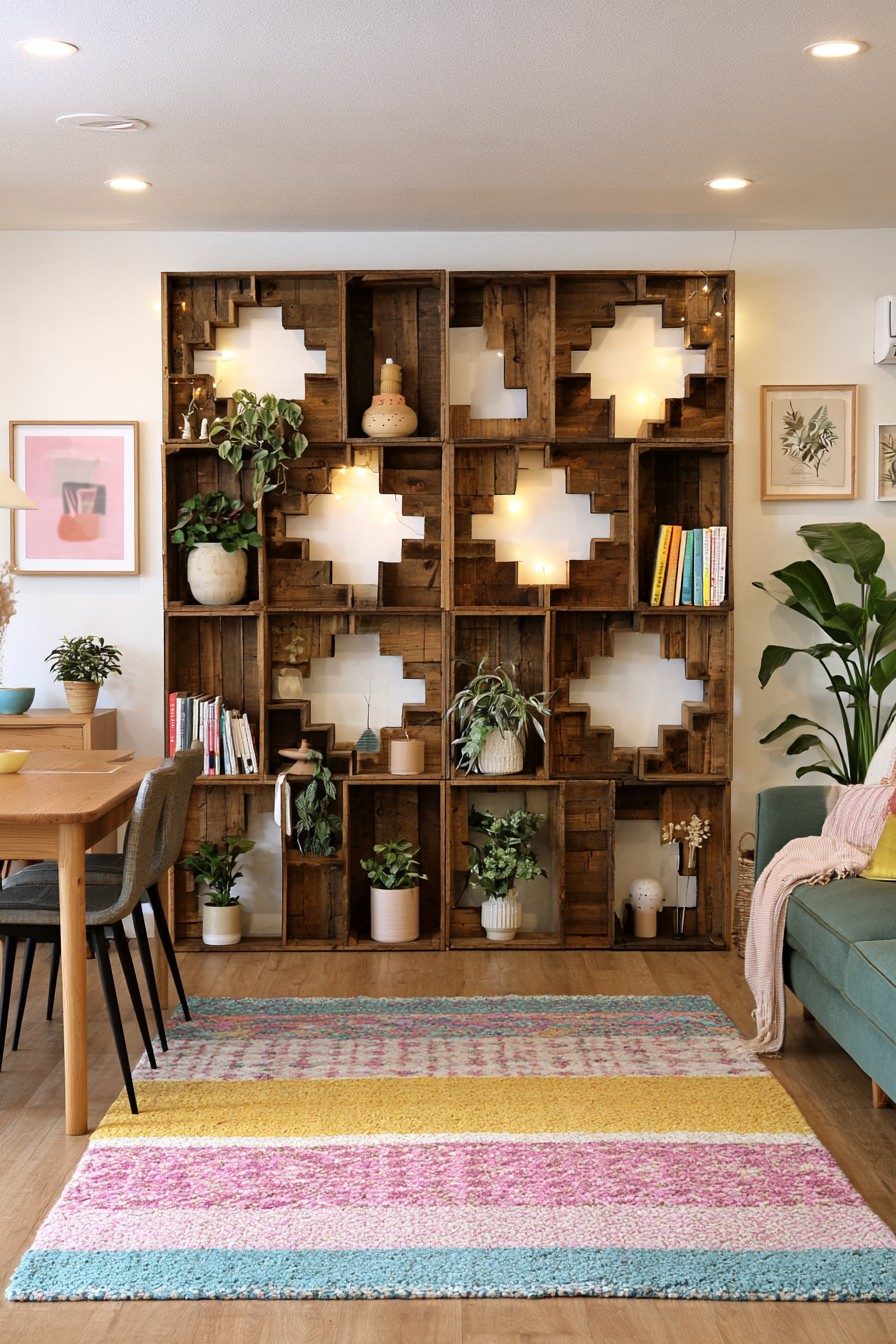
Stepped edges shape the large open cutouts within this geometric divider, creating a pattern beyond a standard rectangular crate grid. Books and plants occupy the smaller surrounding compartments while the cutouts preserve views between rooms. Choose this design for its architectural outline, recognizing that reproducing those openings requires custom shaping and more planning than arranging unaltered crates side by side.
Plan the cutout shapes and the load carrying structure together so removed material does not weaken the unit. Use joints and supports suited to the shelves' projection and the combined weight of their contents. Use a measured design for the frame, connections and anchoring, with heavier contents low and projecting areas lightly styled. For a simpler modular arrangement, the regular grid in idea 12 offers a related room divider purpose without the same stepped openings.
18. Indoor Garden Crate Bench
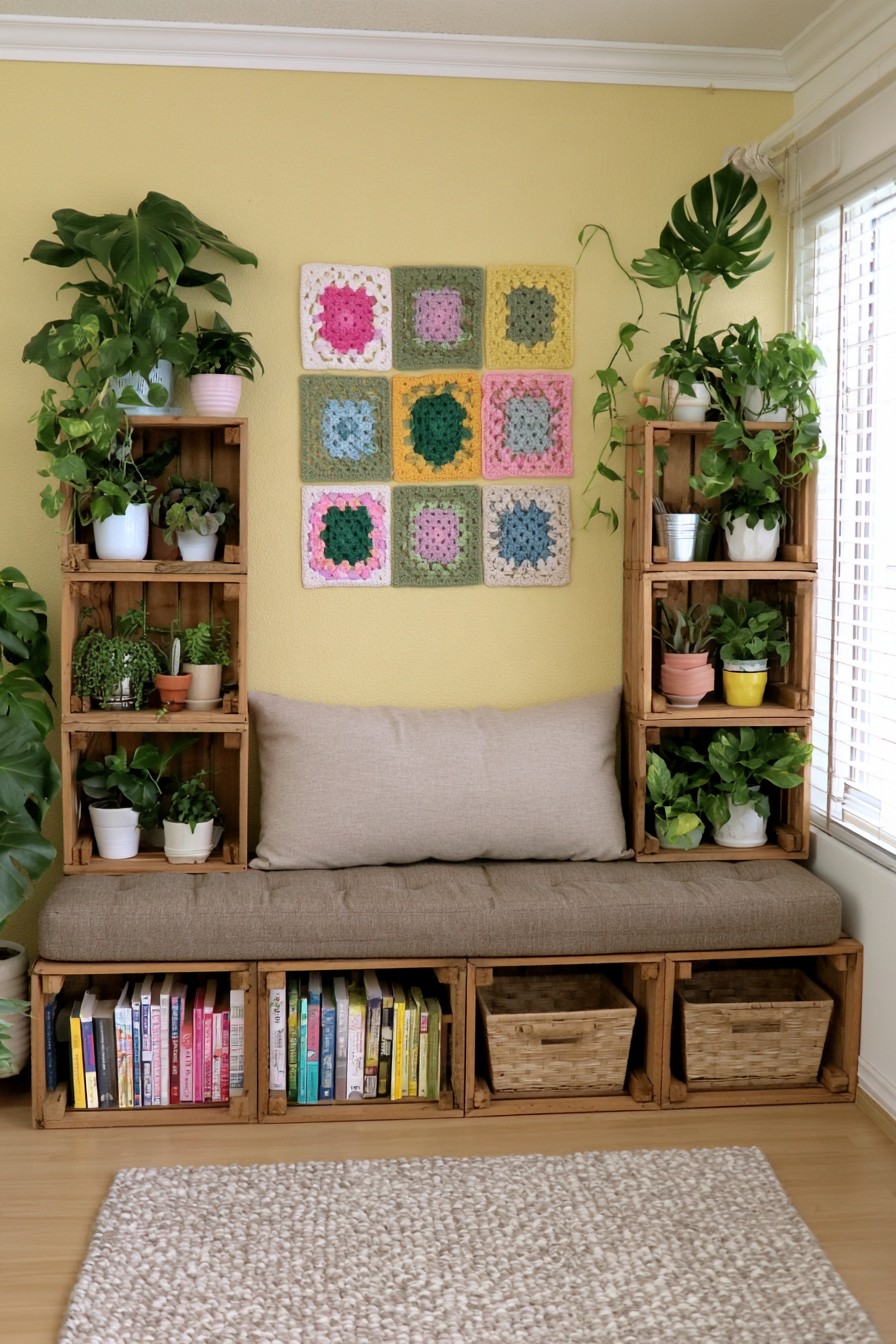
Books and baskets below a cushioned seat can make an indoor garden corner useful beyond plant display. Crates at the ends create varied levels for pots, allowing greenery to surround the reading spot without covering the seating area. Natural wood pairs easily with neutral cushions and colorful textiles.
Use a seat base constructed for body weight, with crates serving as storage or securely integrated components. Place plant saucers under every pot and keep watering access clear. Taller side units need anchoring so leaning against the bench cannot shift the display. Separate plant care from the seating textiles: lift pots out where practical and let wet trays dry before replacing them.
19. Wooden Crate Daybed with Stair Step Shelves
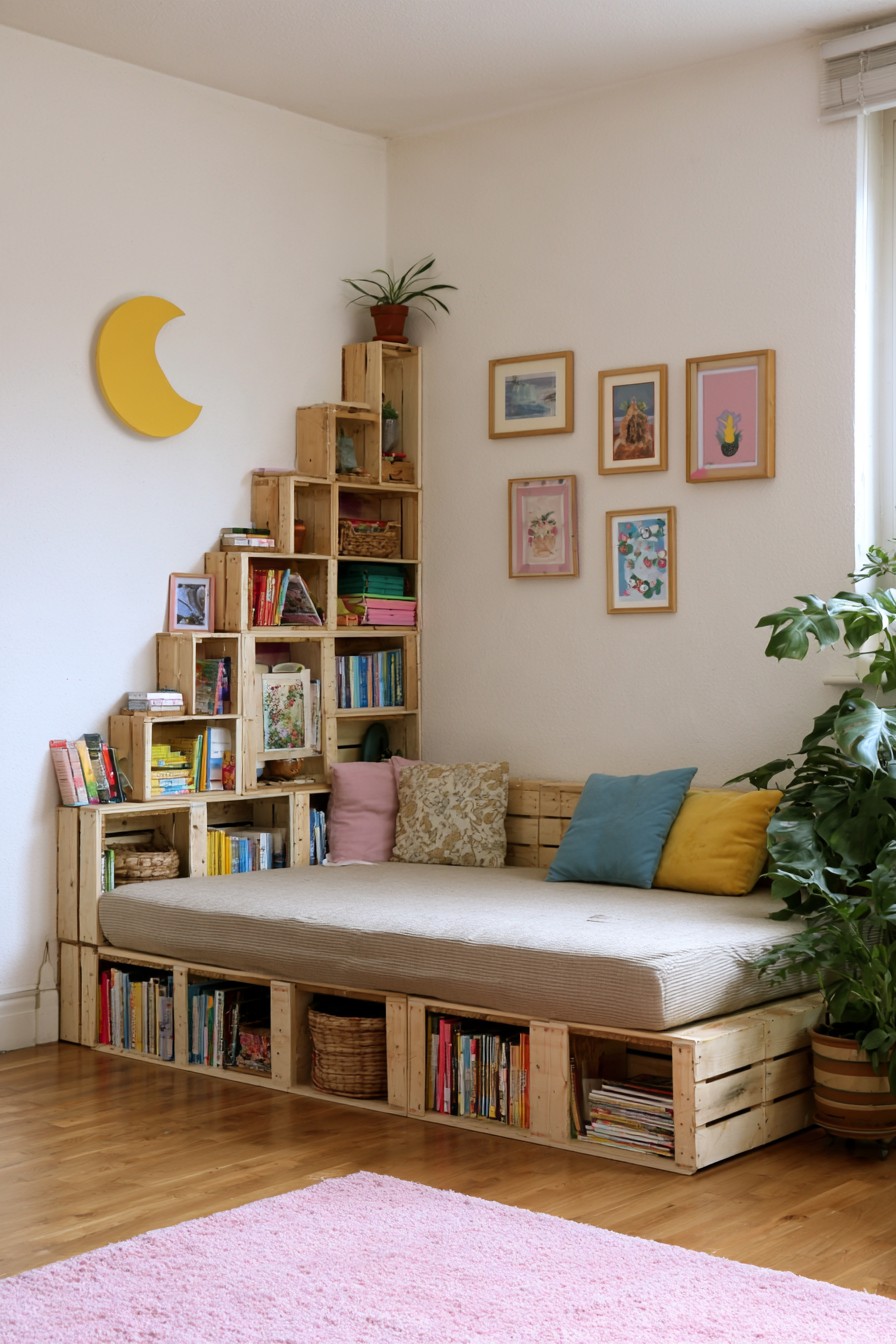
Open crate cubbies beneath a daybed can keep books and baskets close to a lounging area. A graduated shelf at one side adds room for a small collection and gives the larger piece a stepped silhouette. Light wood helps the combined storage and seating feel less visually heavy.
Use a proper bed or daybed frame and treat the crates as attached storage rather than assuming they can support a mattress and person on their own. Anchor the tall side shelves, keep heavier books low, and make sure the mattress remains supported across its full area. Check that the graduated shelves are display storage rather than usable steps, and keep the route for changing bed linen open.
20. Crate Sunburst Display Around a Mirror
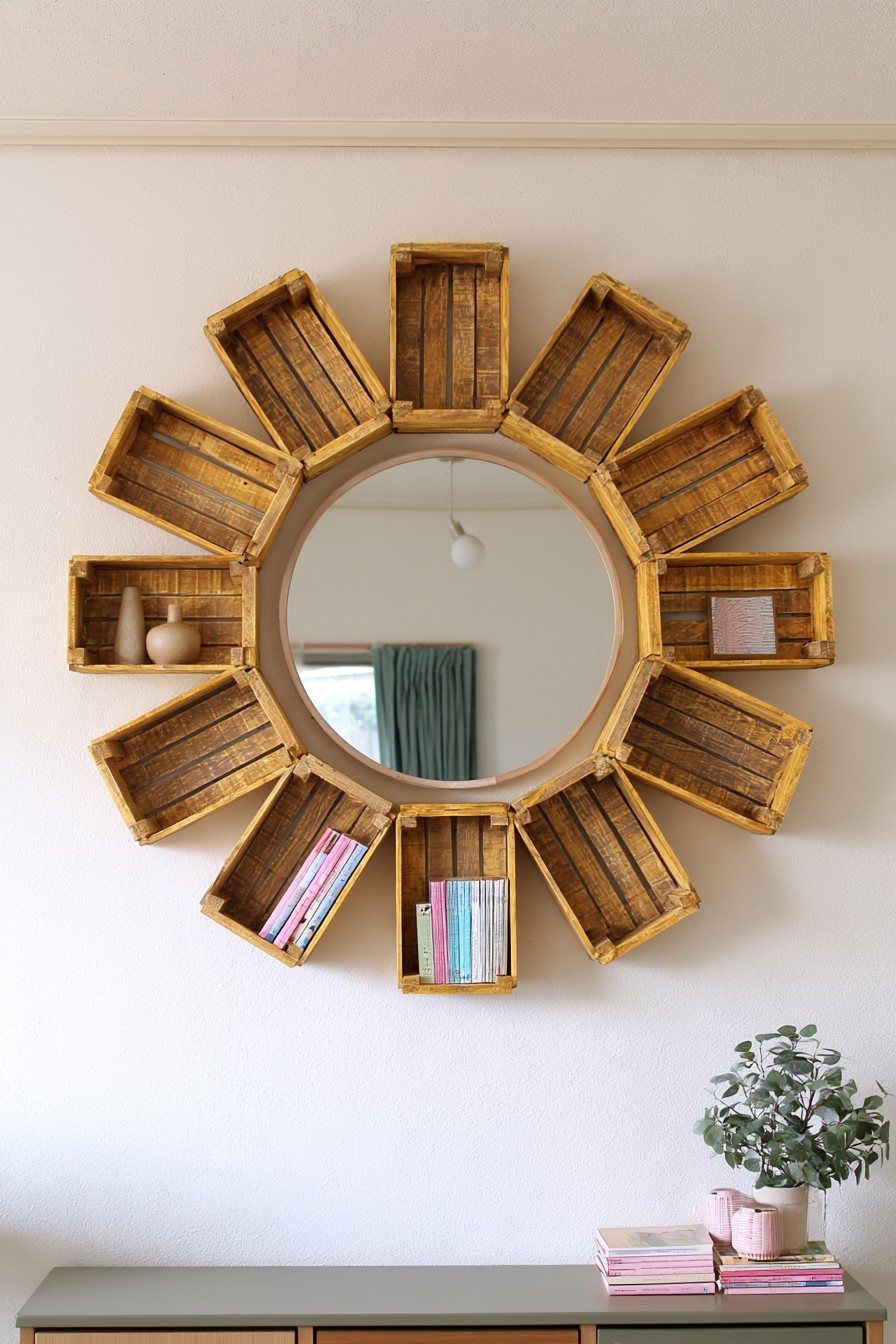
Angled narrow crates can form a sunburst around a round mirror. Their openings provide small display spaces, while the mirror interrupts the repeated rectangular shapes. Leaving some compartments empty makes the outline easier to appreciate.
Mount the mirror and each crate independently using fixings suited to the wall. Check the full arrangement on the floor before drilling so the angles and gaps are consistent. Keep objects in the angled shelves lightweight and secure enough that they cannot slide out. Plan retaining surfaces for angled contents instead of relying on friction alone; a shelf that tilts cannot store objects like a level one.
21. Spiral Wooden Crate Display Tower
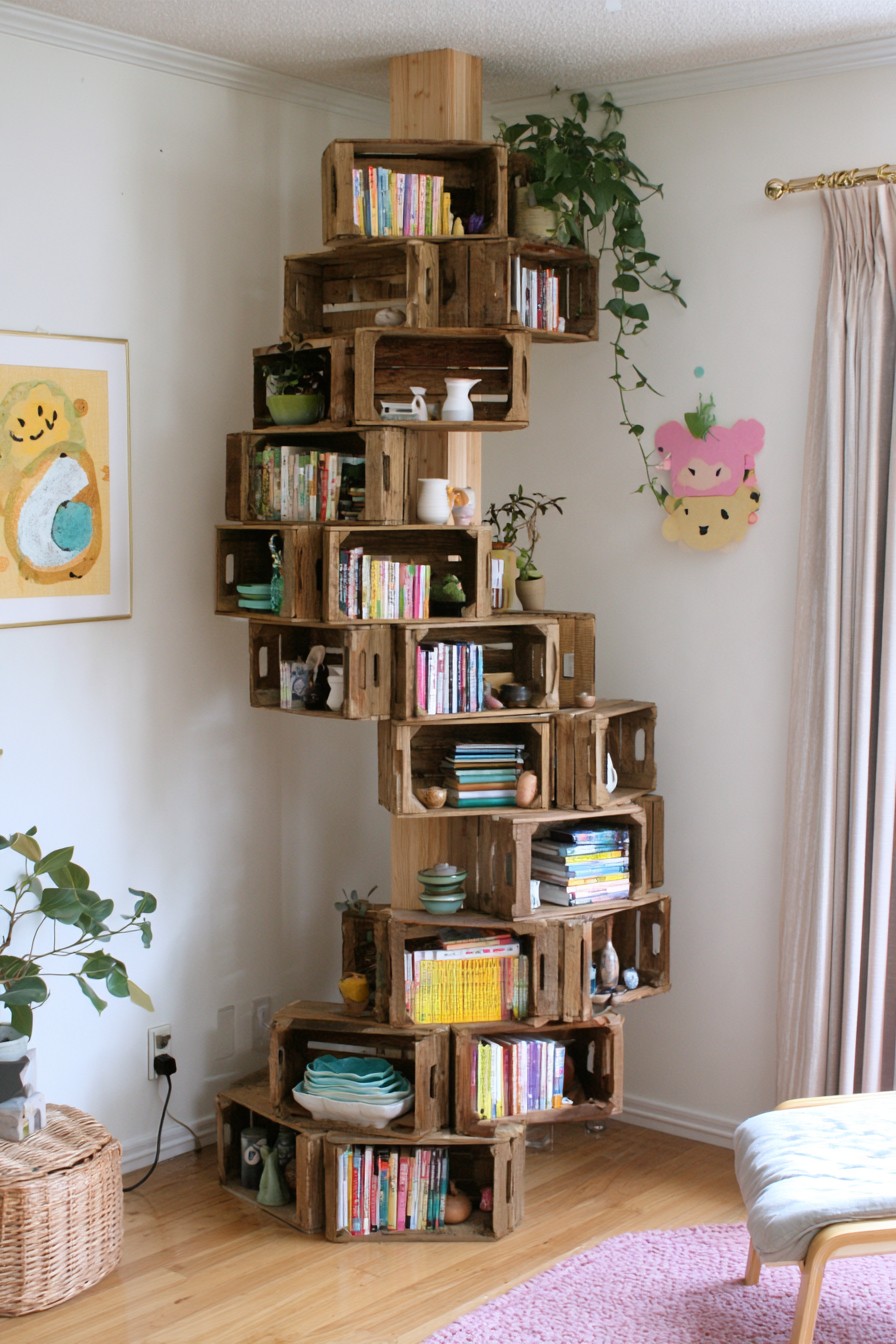
Rotating crates slightly at each level creates a sculptural tower with shelves projecting in different directions. The staggered openings can hold a small collection of books, pottery, and plants while taking up relatively little floor area. Partially empty sections preserve the spiral shape.
Because this arrangement is tall and uneven, it needs a stable base, firm connections, and secure anchoring. Keep heavy contents at the bottom and avoid using projecting shelves as handholds. A corner location can help the tower feel integrated without blocking movement through the room. Consider the footprint of all projecting corners, not just the base, and reserve a clear path for retrieving objects without pulling the tower.
22. Wooden Crate Bar Cabinet
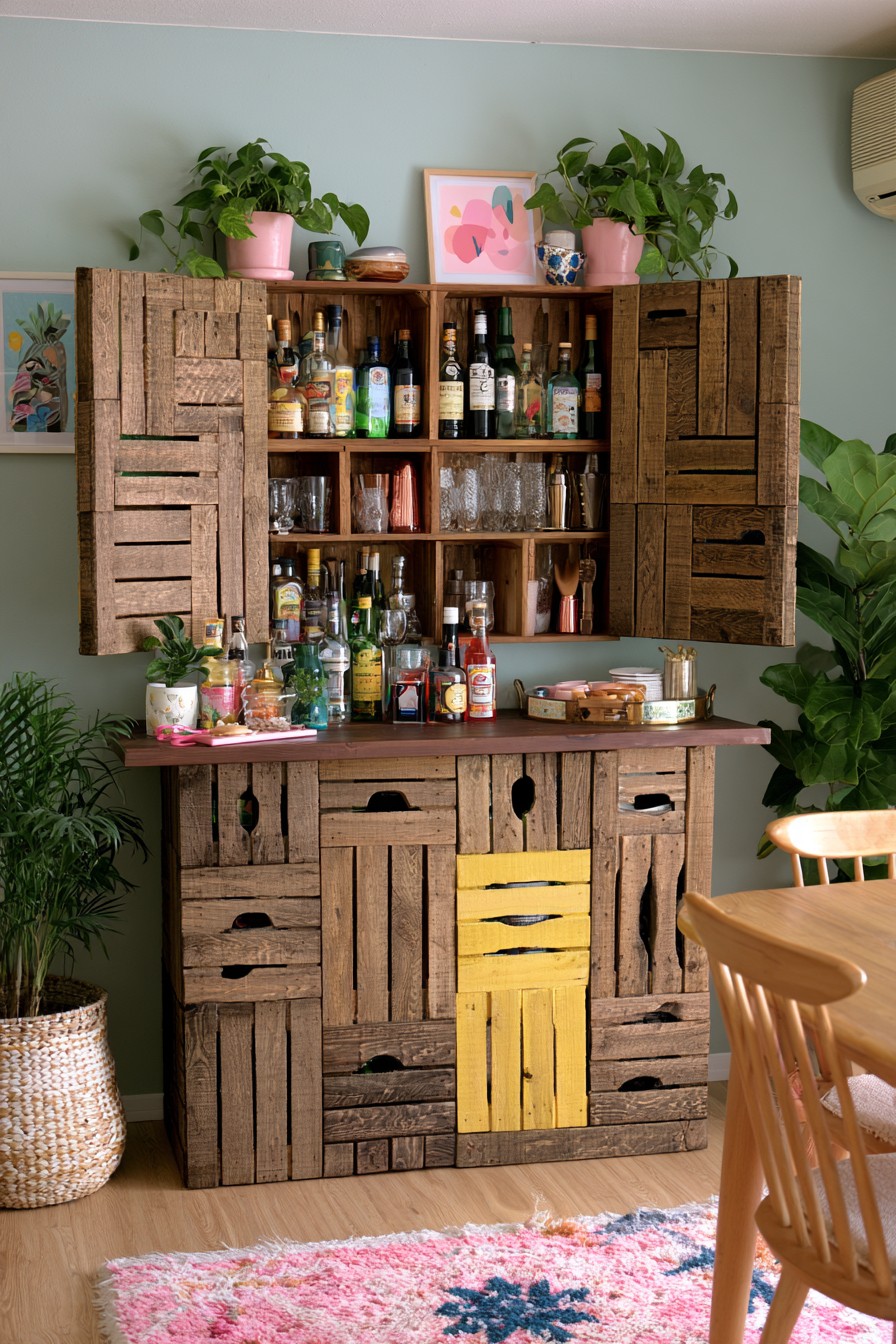
Open bottle and glass compartments sit above a serving surface, with lower storage behind crate styled doors. This arrangement separates display from the supplies used when preparing drinks. Choose shelf spacing from the bottles and glasses actually owned, including the clearance needed to lift them out. Group bottles by height and reserve a separate compartment for fragile stemware so glasses can be lifted out without reaching across the bottle storage.
Keep heavy bottles on properly supported lower levels and use suitable dividers where glassware might contact neighboring pieces. Protect the serving surface from spills, and leave clearance for the doors to open fully. Wall mounted parts need their own loaded mounting plan. If children can access the room, alcoholic drinks belong in locked storage; ordinary closed crate doors are not equivalent. Open sections can instead hold appropriate serving accessories.
23. Staircase Pattern Crate Wall Shelf
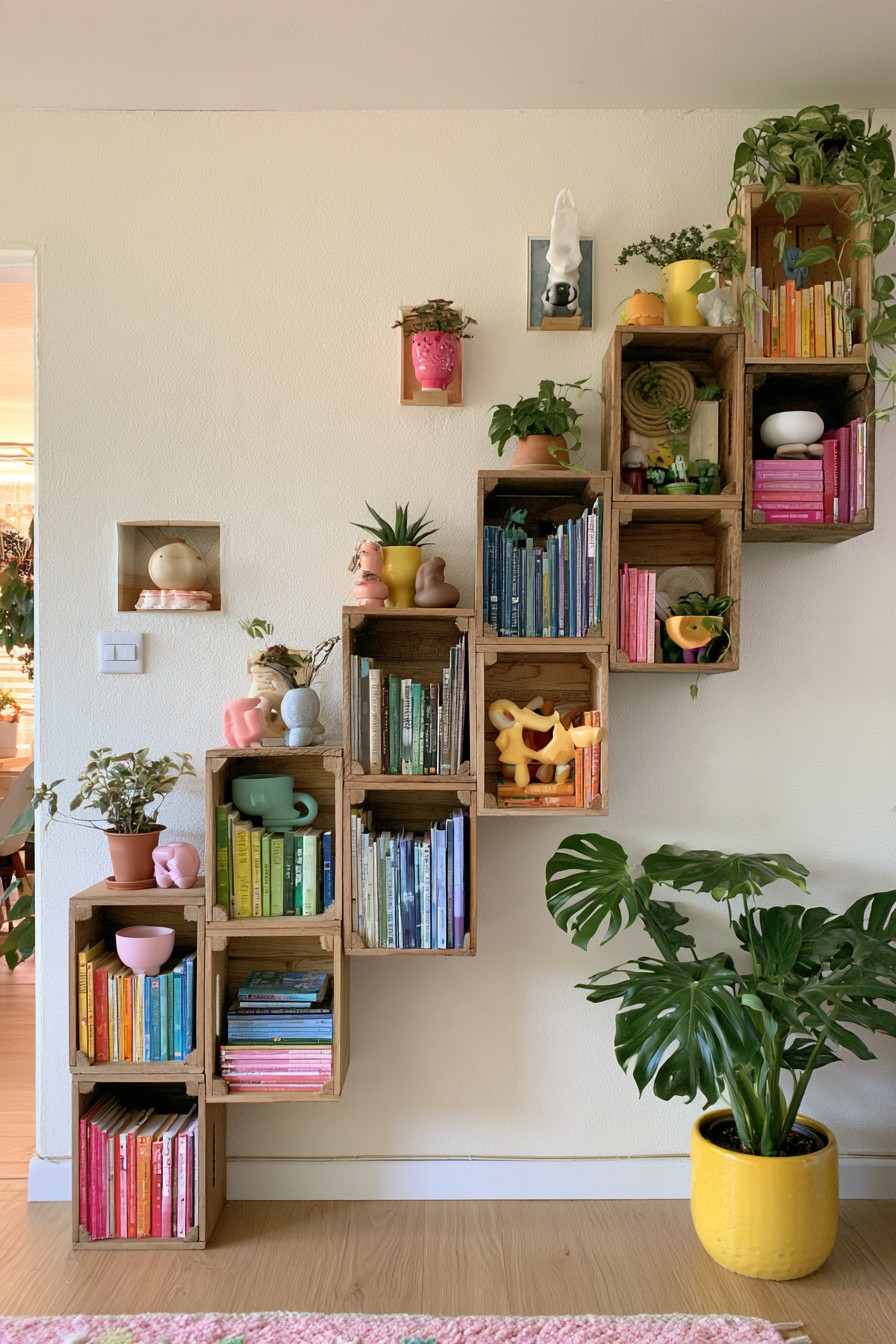
Crates mounted at gradually increasing heights create a lively wall pattern for books and small display pieces. Color grouped book spines can give the repeated compartments visual order, while a few open spaces keep the installation from becoming a solid block of wood.
This is a decorative shelf pattern, not a structure for climbing. Support and anchor each projecting crate for its expected contents, and keep heavier books near the lower end. Check that the lowest sections do not obstruct furniture or the room's main route. Arrange the books within reach from the floor, leaving high compartments for suitably supported display items rather than encouraging climbing.
24. Tree Form Crate Shelf Composition
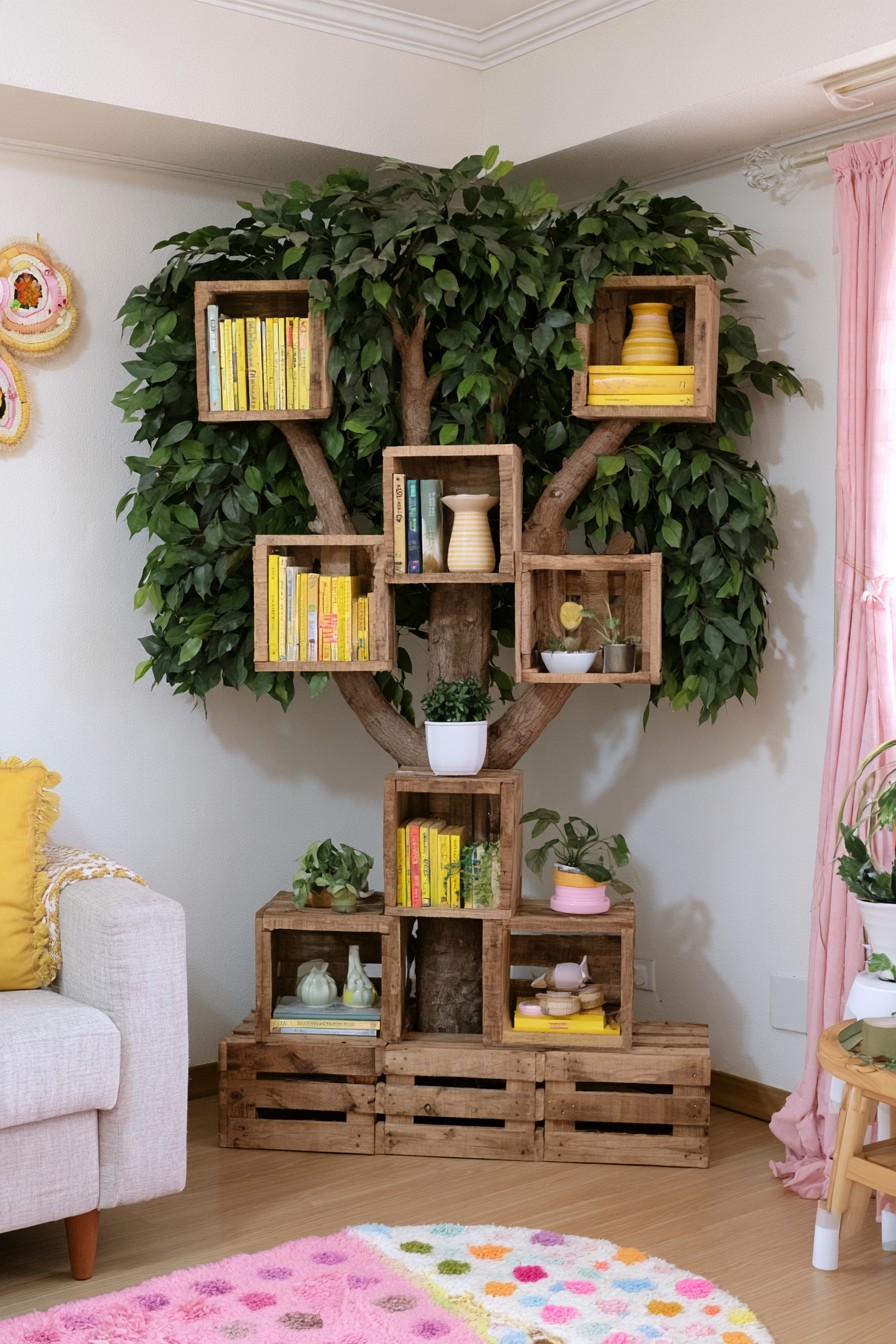
Crate compartments are composed around a trunk and branching form, with dense foliage behind the upper shelves. Books, ceramics and small plants bring the tree shaped arrangement into a reading corner. Build the shelves on an independent supporting frame, and choose living or artificial foliage according to the light and maintenance available. Reserve the useful openings for books and everyday storage, leaving selected upper compartments lightly decorated.
A similar structure needs designed supports for the branches and loaded compartments, whether the foliage is decorative or living. If adapting the idea around a live tree, give the shelving an independent support system and keep its load off the trunk and branches. Leave access to the planter, room for growth and a route for watering without wetting books or wood. For the live plant adaptation, add separate supported containers and a watering route that keeps the books and timber dry.
25. Tree Shaped Wooden Crate Bookcase
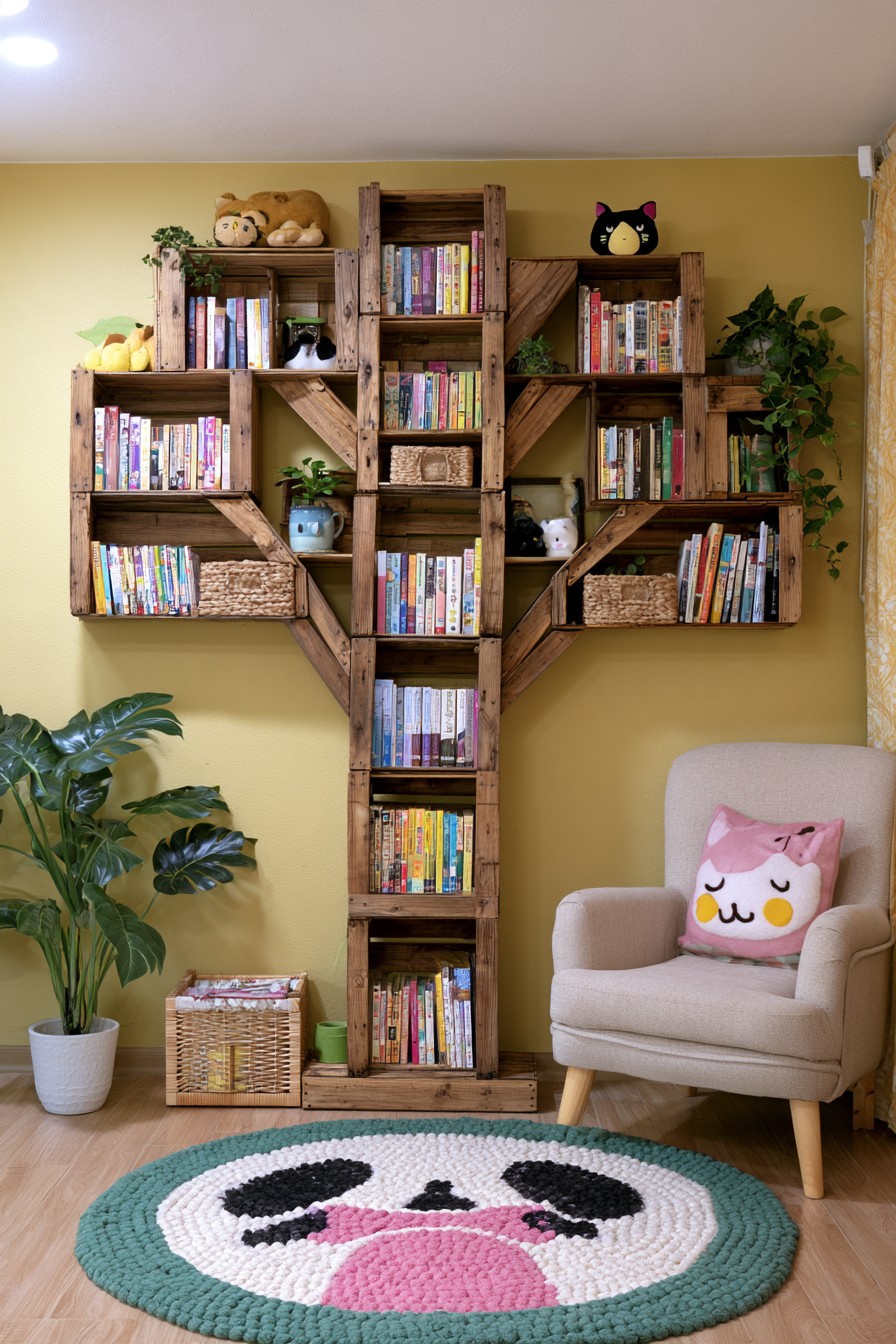
A central column of crates can suggest a tree trunk, with outward sections forming branch like shelves. Different orientations provide room for books of varied sizes and a few baskets. The recognizable outline makes the bookcase a focal point for a reading corner.
Plan the branch positions before assembly so upper crates do not project farther than the supports allow. Join the structure properly and anchor it to suitable wall framing, particularly in a children's space. Concentrating heavy books low improves both access and stability. Check the longest book or basket against the branch compartments, and leave space to remove it without catching on neighboring projections.
26. Circular Wooden Crate Display Wall
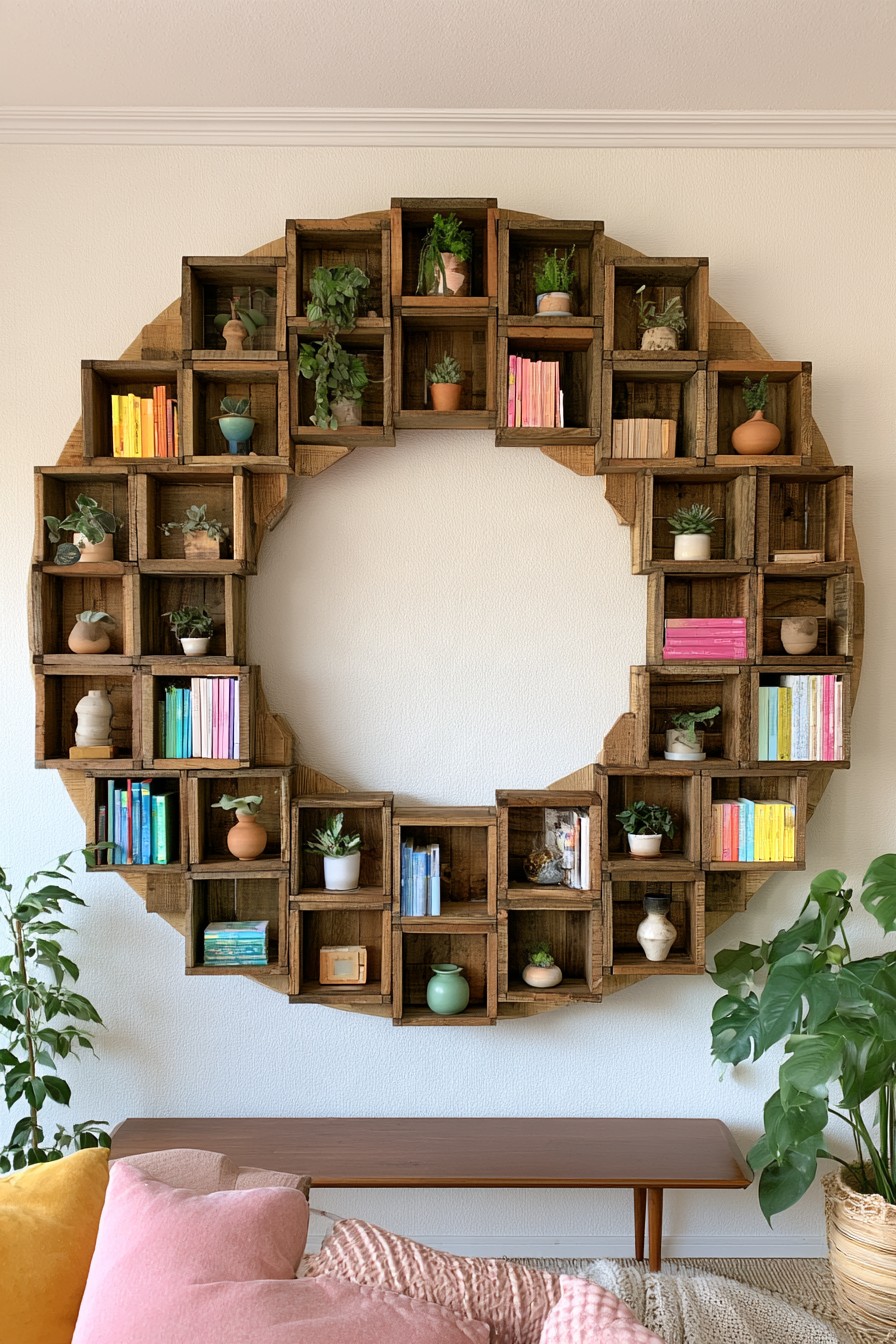
Crates arranged around an open center create a broad circular feature. Alternating books, greenery, and empty compartments makes the shape visible instead of turning it into another crowded storage wall. The center can remain blank or frame a separate piece of furniture below.
Lay out the full circle and mark its supports before mounting anything. Every crate needs secure attachment to an appropriate backing or wall structure; upper sections should hold only items suited to their support. Leave plants removable for watering so moisture does not accumulate against the wood or wall. The center is part of the design, so resist filling it with extra compartments. Set the circle height around the furniture below it.
Keep the Arrangement Useful After Decorating
Check connections, restraints and shelf access when the contents change. Dry spills promptly, remove plant containers for care and keep the lifting points of baskets visible. Finish with a limited palette or repeated textile detail so the crates relate to the room. A layout that holds the right belongings and remains easy to clean will be more useful than additional compartments that are awkward to reach.

Leave a Reply