
Goth garden decor combines dark ironwork, rich planting, and strong shapes with places people can comfortably use. Pink roses, pale stone, and fine green foliage can be as important to the contrast as near-black leaves. These 29 ideas range from a small patio coffee corner to formal beds, woodland seats, and water features for a larger garden. Three short videos offer visual assembly inspiration alongside the related ideas; the collection focuses on design choices and practical use, with site-specific construction resolved separately.
Table of Contents
- Plan a Gothic Garden With Practical Planting
- Choose a Starting Point for Your Space
- Match the Style to the Garden’s Conditions
- 1. Rose Courtyard with Black Ironwork
- 2. Black Gravel Garden Path with Gothic Sculptural Planters
- 3. Gothic Pergola Lounge with Pink Curtains and Plum Cushions
- 4. Mossy Stone Fountain Garden with Romantic Gothic Planting
- 5. Gothic Container Garden with Black Bistro Furniture
- 6. Moon Garden Border with Dark Foliage and Stone Accents
- 7. Reclaimed Brick Gothic Garden with Black Picket Gate
- 8. Gothic Dining Garden with Antique Ironwork and Dark Gravel
- 9. Raised Gothic Seating Terrace with Jewel-Tone Cushions
- 10. Gothic Garden with a Victorian Plant Theatre
- 11. Formal Gothic Flower Garden with Symmetrical Beds
- 12. Repurposed Metal Washstand with Dark Gothic Planting
- 13. Gothic Garden Seating Beneath a Woven Canopy
- 14. Circular Stone Mosaic with Gothic Garden Chairs
- 15. Woodland Gothic Reading Corner with Black Stepping Stones
- 16. Gothic Garden with a Carved Stone Water Channel
- 17. Ornate Iron Garden Seating for a Quiet Resting Corner
- 18. Black and White Pebble Spiral as a Garden Focal Point
- Video Inspiration: Arranging a Black and White Pebble Pattern
- 19. Gothic Garden with a Weathered Metal Obelisk and Climbing Roses
- 20. Black Lattice Screen with Pink Garden Seating
- 21. Gothic Garden with an Ornate Wrought Iron Swing Seat
- 22. Gothic Garden with a Checkerboard Lawn Patio and Cathedral-Style Bench
- 23. Gothic Garden with a Dark Dry Creek Bed and Woodland Planting
- 24. Victorian-Style Wire Plant Cages
- 25. Gothic Garden with Corrugated Metal Planters and Black Privacy Screening
- 26. Black Timber Steps with Layered Flower Beds
- 27. Vertical Stone Cascade with a Pebble Basin
- Video Inspiration: Composing a Vertical Water Feature
- 28. Circular Black Garden Arch with Rose Accents
- Video Inspiration: Framing a Path with a Rose-Accented Arch
- 29. Gothic Garden Entrance with Antique Urns and Spired Iron Details
- Make the First Change Useful, Then Keep It in Shape
Plan a Gothic Garden With Practical Planting
Choose a Starting Point for Your Space
For a compact patio, begin with the coffee corner, the plant theatre, or the washstand planter. For a shaded reading destination, consider the woodland bench, checking its soil and root competition first. Seating-focused gardens can compare a curtained lounge, a raised terrace, and a swing seat. For a larger organized layout, look at symmetrical flower beds or a checkerboard foreground. Water becomes a low focal point in 4, a border feature in 16, and a tall accent in 27.
Match the Style to the Garden’s Conditions
Map the light, existing levels, soil drainage, and regular routes before choosing the dark palette. Gothic color does not imply shade-loving planting. Check named plants for local winter suitability, mature spread, and the care their position will allow. Reserve the furniture footprint and its movement space before filling the borders; one strong frame or focal feature can carry the theme in a small yard.
For water features accessible to young children, plan effective access control and continuous close adult supervision. A small basin or decorative edging is not an access barrier. Pump electrical provision must be arranged by a qualified electrician for the location. Use appropriate structural designs and installation methods for walking bridges, retaining elements, pergolas, and swings.
1. Rose Courtyard with Black Ironwork
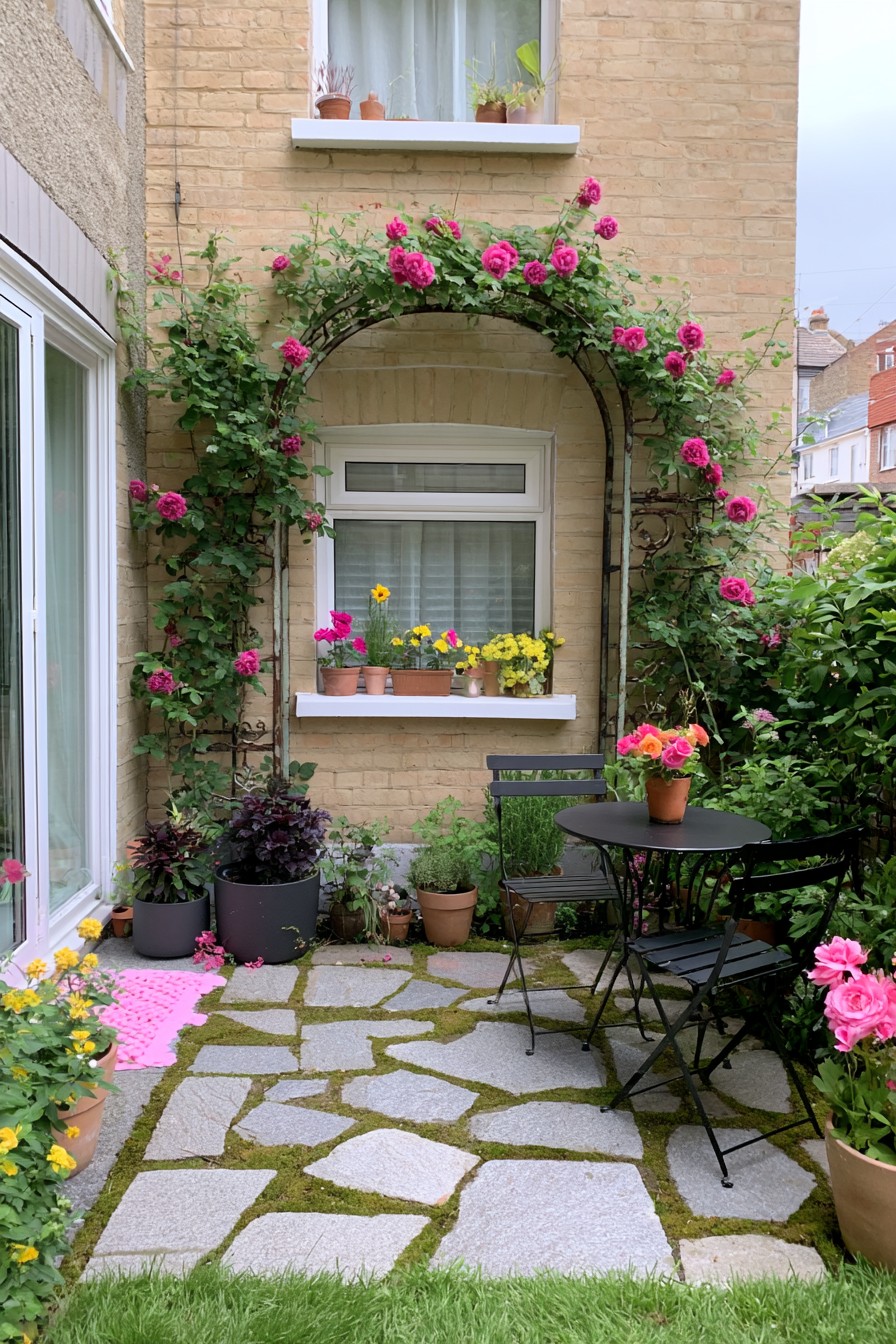
Pink roses around a black arch give this courtyard its romantic Gothic outline. Pale paving and smaller pots keep the space lively, while a compact iron table and chairs make it useful for a short break. Burgundy flowers could be an alternative color choice, but the contrast here comes from pink blooms against dark metal.
Choose a climbing rose whose mature size fits the arch, checking its sunlight needs before buying for color. Most roses prefer sun, though some tolerate light shade. Keep growth away from the door opening and allow chairs to pull back without catching thorny stems. Maintain an even walking surface between the paving joints; the aged appearance should not depend on slippery growth where people step.
2. Black Gravel Garden Path with Gothic Sculptural Planters
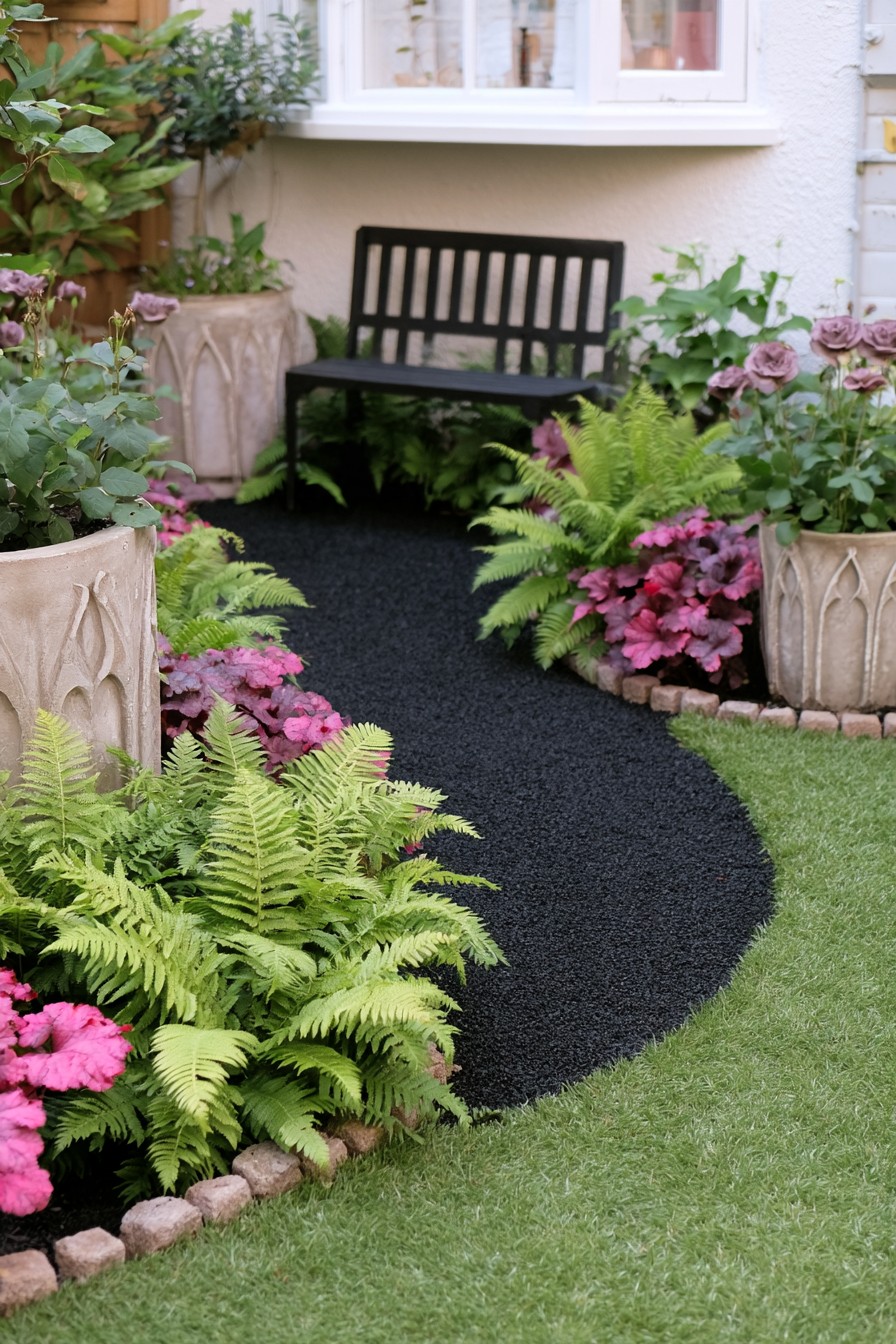
The black gravel curve gives the garden a strong direction before the sculptural planters and bench are noticed. Fine green foliage and pink-toned leaves soften its edges, making the dark route part of the planting. This suits a secondary garden walk or a decorative view toward a resting place.
For a main route, consider pushchairs, wheelbarrows, wheelchairs, and walking aids: loose gravel can shift beneath feet and make small wheels harder to move. A continuous, firm surface with dependable wet-weather grip may be more useful, while dark edging retains the same outline. Contain the gravel along the beds, and place the bench on its own level base so sitting down does not displace stones beneath its legs.
3. Gothic Pergola Lounge with Pink Curtains and Plum Cushions
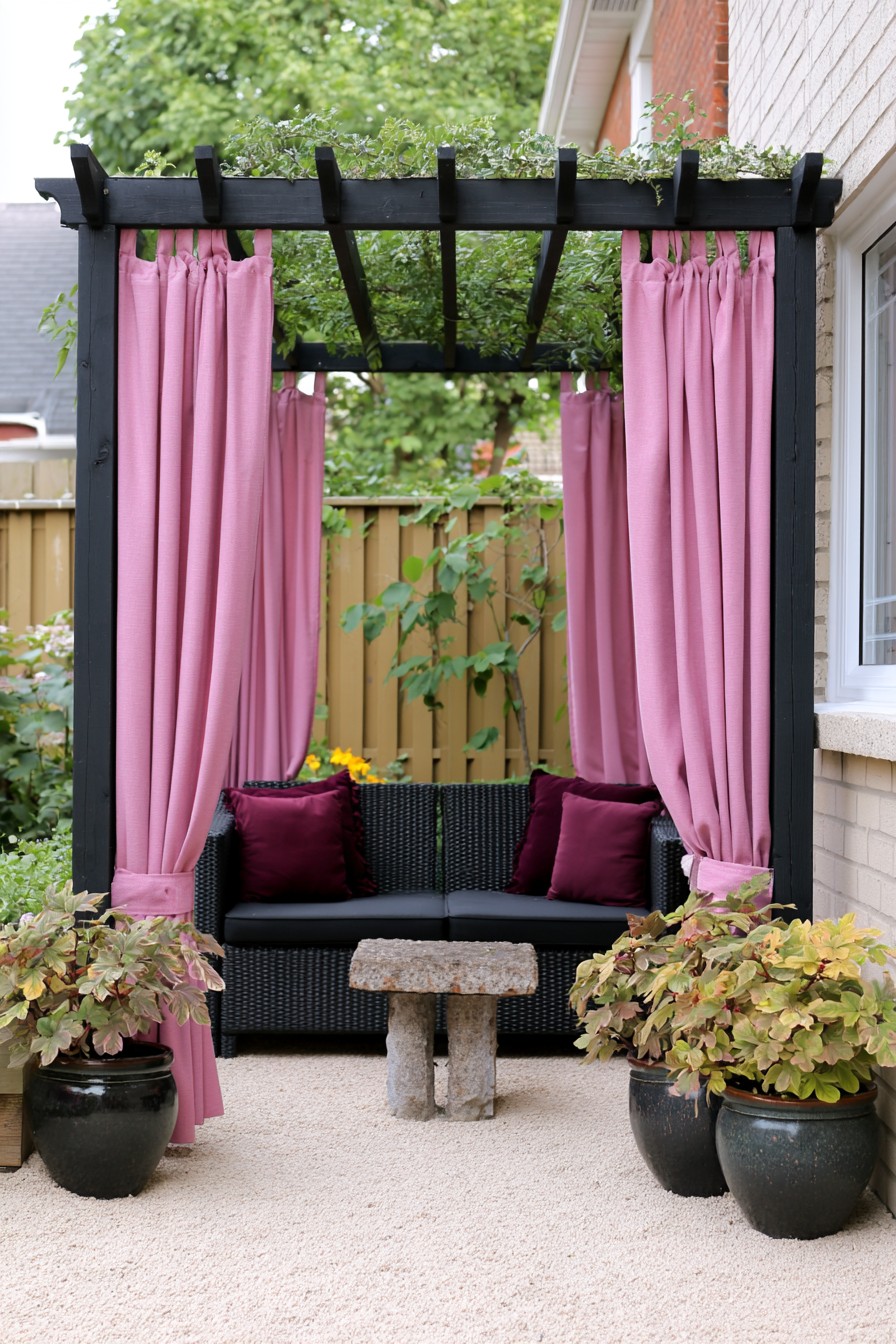
Pink curtains soften a black pergola, while plum cushions give the lounge a deeper color accent. The drapery creates adjustable enclosure at the sides without needing a solid screen around the whole seating area. It can work beside a house or boundary where a defined place to relax matters more than a large planted border.
Check the sun at the hours the lounge will be used; side curtains cannot guarantee shade from overhead sunlight. Choose exterior textiles, follow their wind guidance, and keep them tied back or removed when conditions require it. Test the sofa and table spacing with the curtains both open and closed. Compare layered outdoor seating arrangements for ways to combine textiles with clear approaches and usable furniture positions.
4. Mossy Stone Fountain Garden with Romantic Gothic Planting
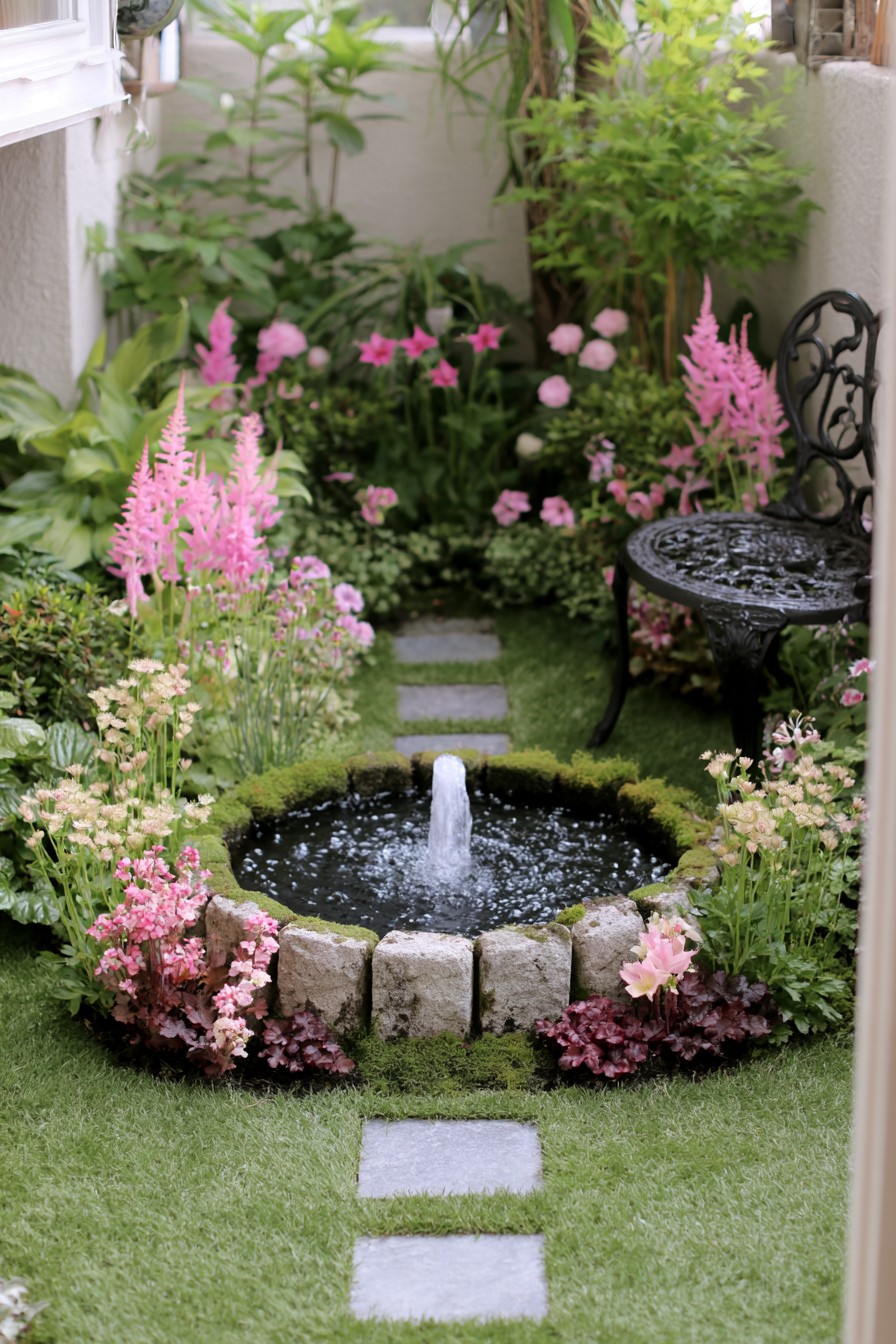
A low stone-edged fountain creates a quiet pause in a narrow garden. Its rounded basin sits within soft planting, and an iron chair nearby makes the water something to enjoy from a seat. The worn-looking stone and delicate flowers add age and texture without needing a large architectural feature.
Place the chair beyond the splash zone and retain an approach to the basin for clearing fallen leaves. Confirm where the pump can be reached before planting closes around the feature, and check water levels according to the chosen system. The neighboring route needs reliable footing when damp. Avoid treating an aged surface as proof of a particular stone or finish: choose a fountain product and base appropriate to the site, then use planting to soften the installation.
5. Gothic Container Garden with Black Bistro Furniture
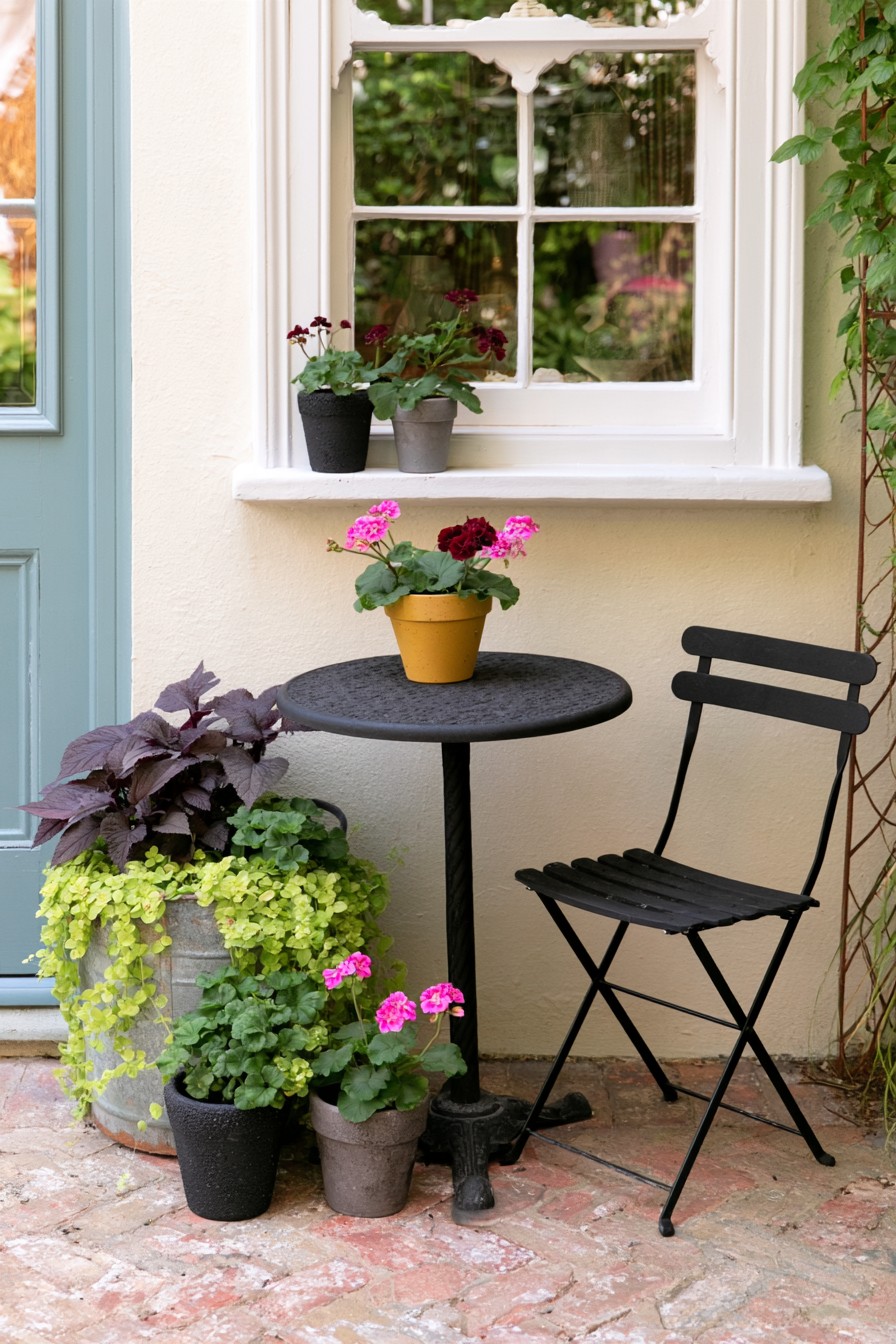
One black bistro chair, a small table, and a group of pots turn a modest patio into a daily coffee corner. The dark furniture links the purple foliage to the larger container, while pink flowers keep the setting from feeling heavy. This is a practical starting point when there is space for a personal seat but little room for a full dining arrangement.
Place the furniture first, checking that the chair can move and the cup surface stays within reach. Cluster containers beside the seat instead of filling the approach. Group pots with compatible care needs, but inspect their moisture individually because size and exposure affect drying. Keep drainage runoff away from the chair’s feet, and leave the smaller pots removable as the display grows or seasonal planting changes.
6. Moon Garden Border with Dark Foliage and Stone Accents
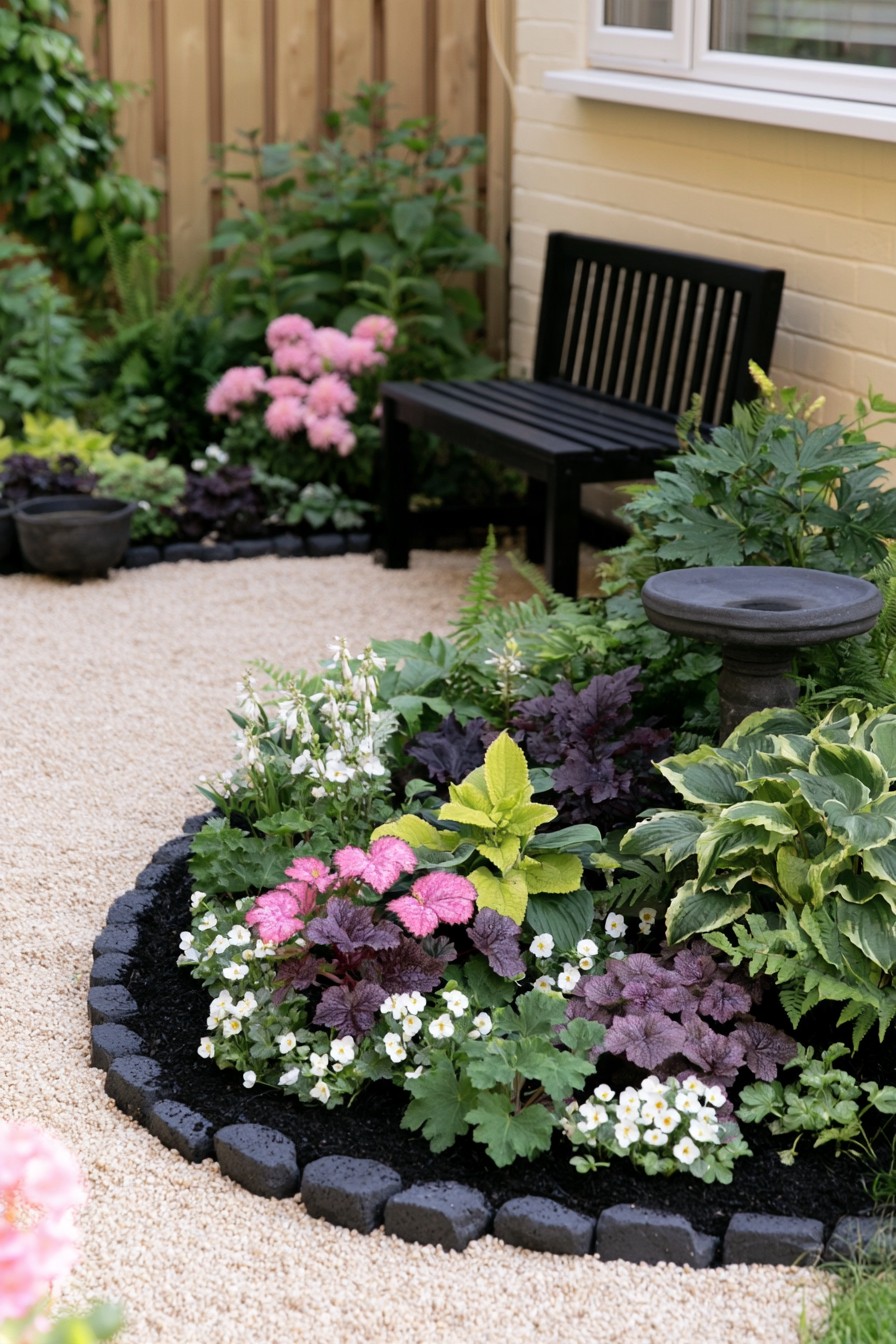
A border of broad purple leaves, pale flowers, and black edging gives a moon-garden effect through contrast. The lighter flowers remain easier to distinguish as daylight fades, while the darker foliage grounds the composition. This idea works along the edge of a small sitting area where planting can be enjoyed close up.
Heuchera ‘Obsidian’ is one possible dark-leaved choice for fertile soil that holds moisture but drains well, in sun or partial shade. Ophiopogon planiscapus ‘Nigrescens’ offers narrow, nearly black foliage; some afternoon shade benefits it in warm climates. These are options for recreating the contrast, not identifications of every plant shown. Pair rounded and fine leaf shapes according to the bed’s actual light, and leave access to remove old leaves without disturbing the whole edge.
7. Reclaimed Brick Gothic Garden with Black Picket Gate
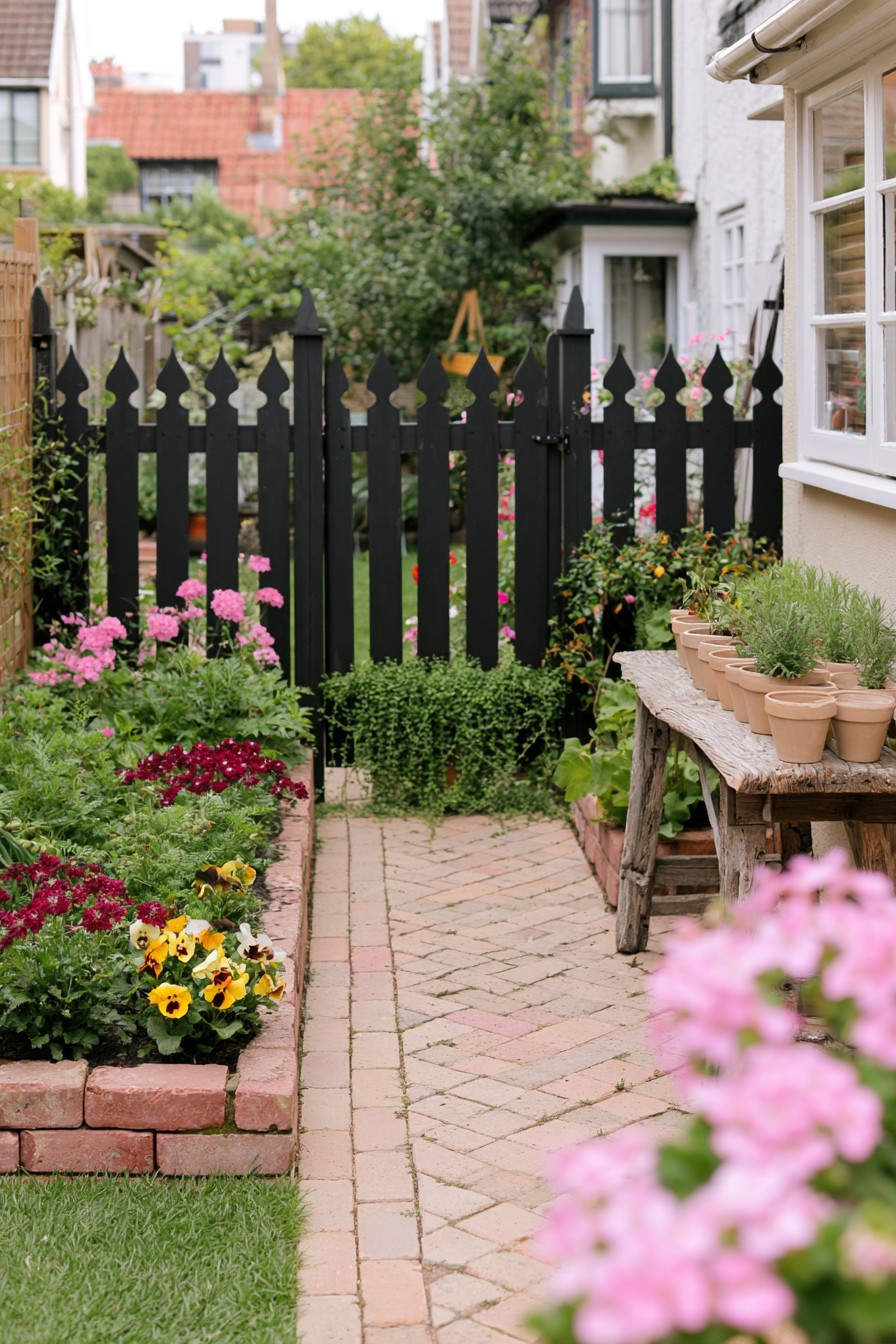
A pointed black gate gives a small brick courtyard a clear threshold. Raised flower beds and a potting surface make the space feel like a working garden rather than an entrance decorated only for viewing. Pink planting draws attention along the brick route, while the gate supplies the strongest Gothic shape.
Check the gate’s complete swing before arranging pots or tools beside it. The potting bench should remain reachable without narrowing the passage, including when trays and watering cans are in use. Lay reclaimed bricks on a suitable prepared base, checking their condition and keeping the finished walking surface even. Keep soil and expanding plants within the bed edges, and inspect the route for movement after wet weather or repeated use.
8. Gothic Dining Garden with Antique Ironwork and Dark Gravel
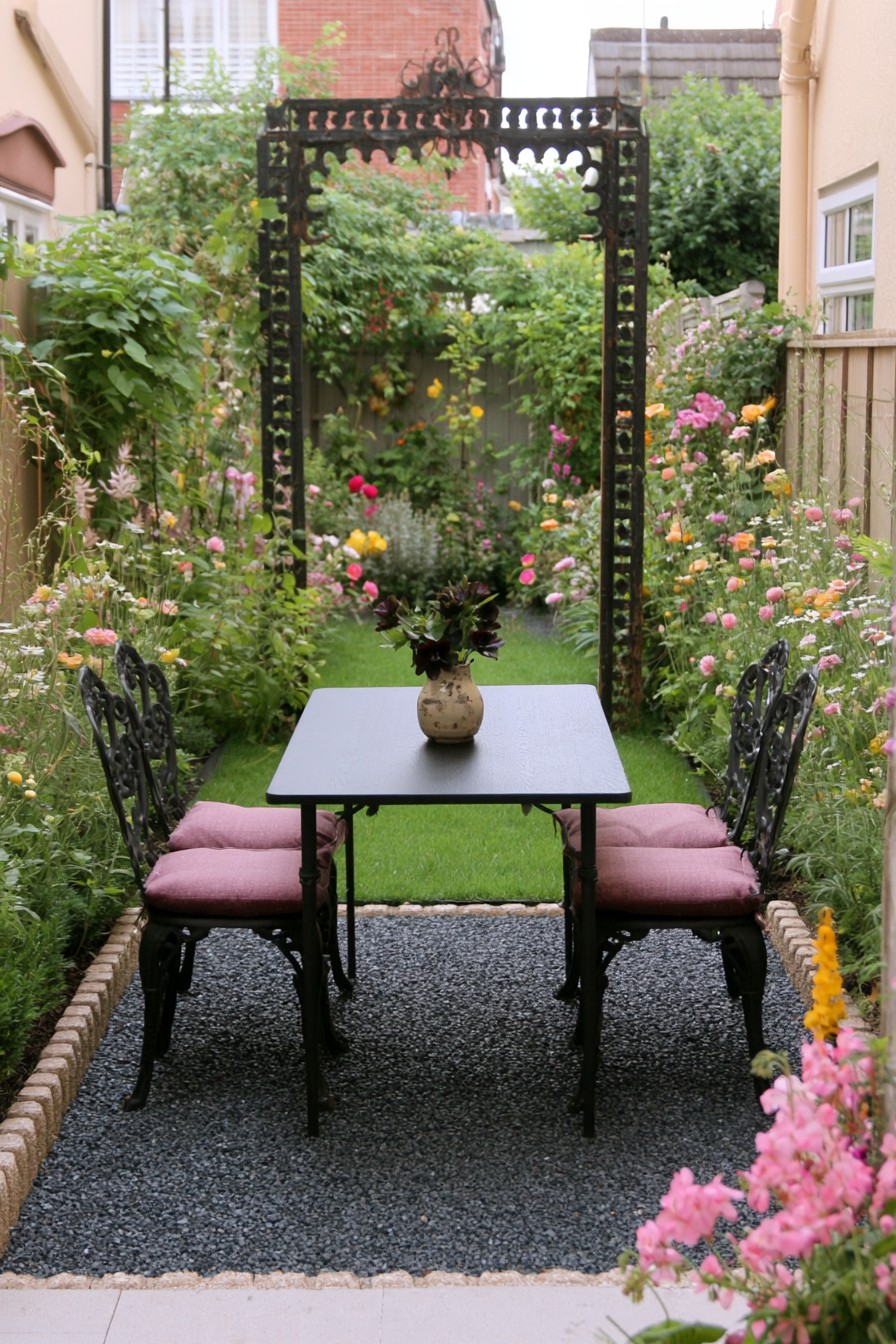
A dark dining table beneath ornate ironwork gives this garden a different purpose from the single-chair coffee nook. The paired seats and larger tabletop support meals, while the rose borders enclose the setting. Pink cushions soften the metal without changing the clear arrangement of table, chairs, and central approach.
Leave enough space to pull chairs out, carry dishes around the table, and reach a seat without brushing against thorns. Select roses by mature habit and size, not flower color alone, and keep pruning access to the arch. Gravel may need replacing with a more continuous surface beneath dining furniture if chair legs sink or movement becomes awkward. Removable exterior cushions should be stored or dried as their care instructions require; a welcoming dining area still needs a workable serving route.
9. Raised Gothic Seating Terrace with Jewel-Tone Cushions
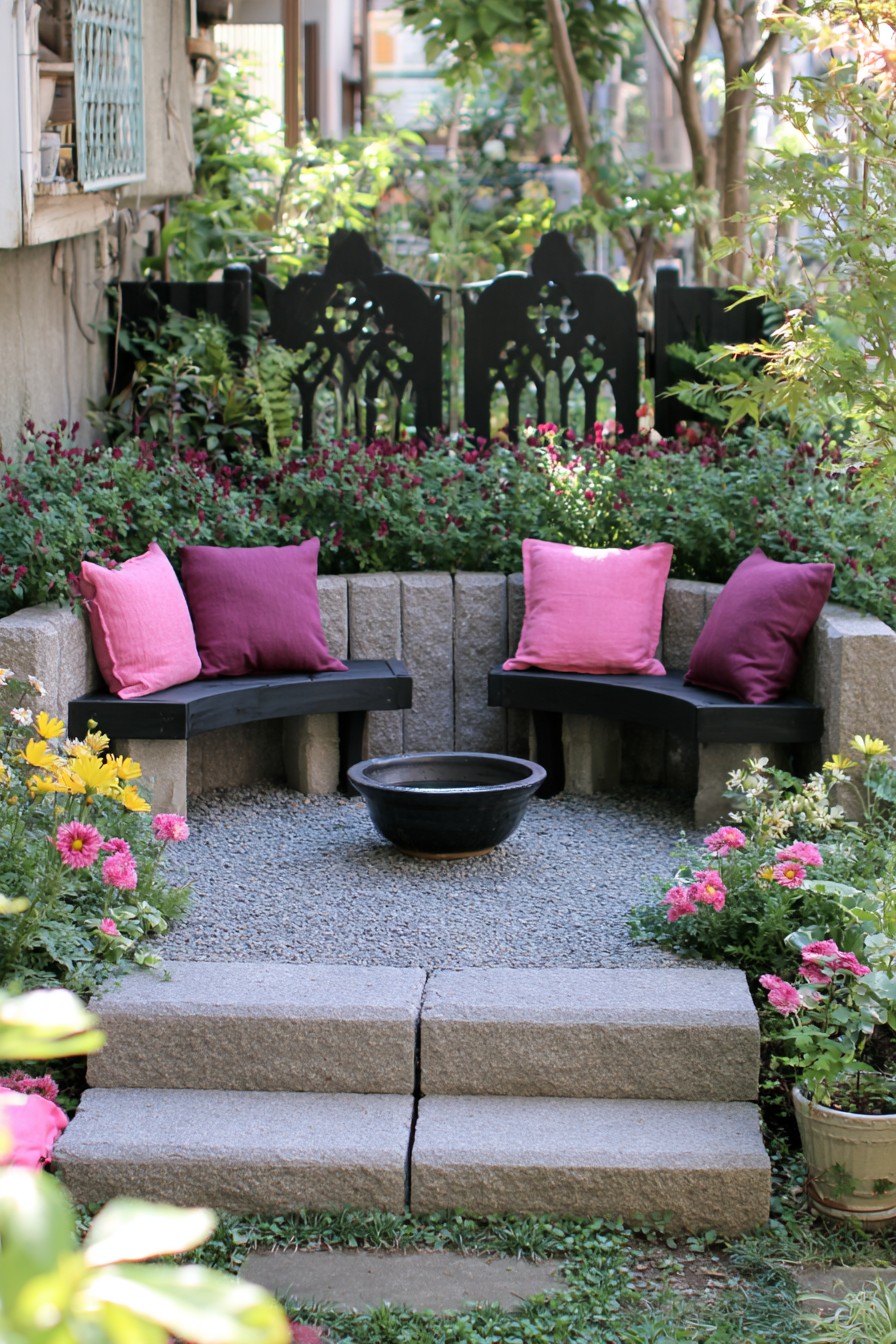
Broad steps lead up to a stone-lined seating terrace. Black seat tops and pink-to-plum cushions create a richly colored destination above the foreground planting. The level change separates the lounge from the lower garden, giving the seated view a distinct foreground. This can help define a destination where the site already has a slope or terrace.
Assess how people will enter, turn, and sit down at the upper level, keeping furniture and plants away from step edges. Resolve drainage for the terrace surface and any retaining construction so runoff does not spill onto the approach or collect beneath cushions. Step proportions, edge protection, and access requirements need their own design decisions. Adapt the colors and enclosed layout to a raised terrace whose dimensions, structure, and edge protection are designed for your site.
10. Gothic Garden with a Victorian Plant Theatre
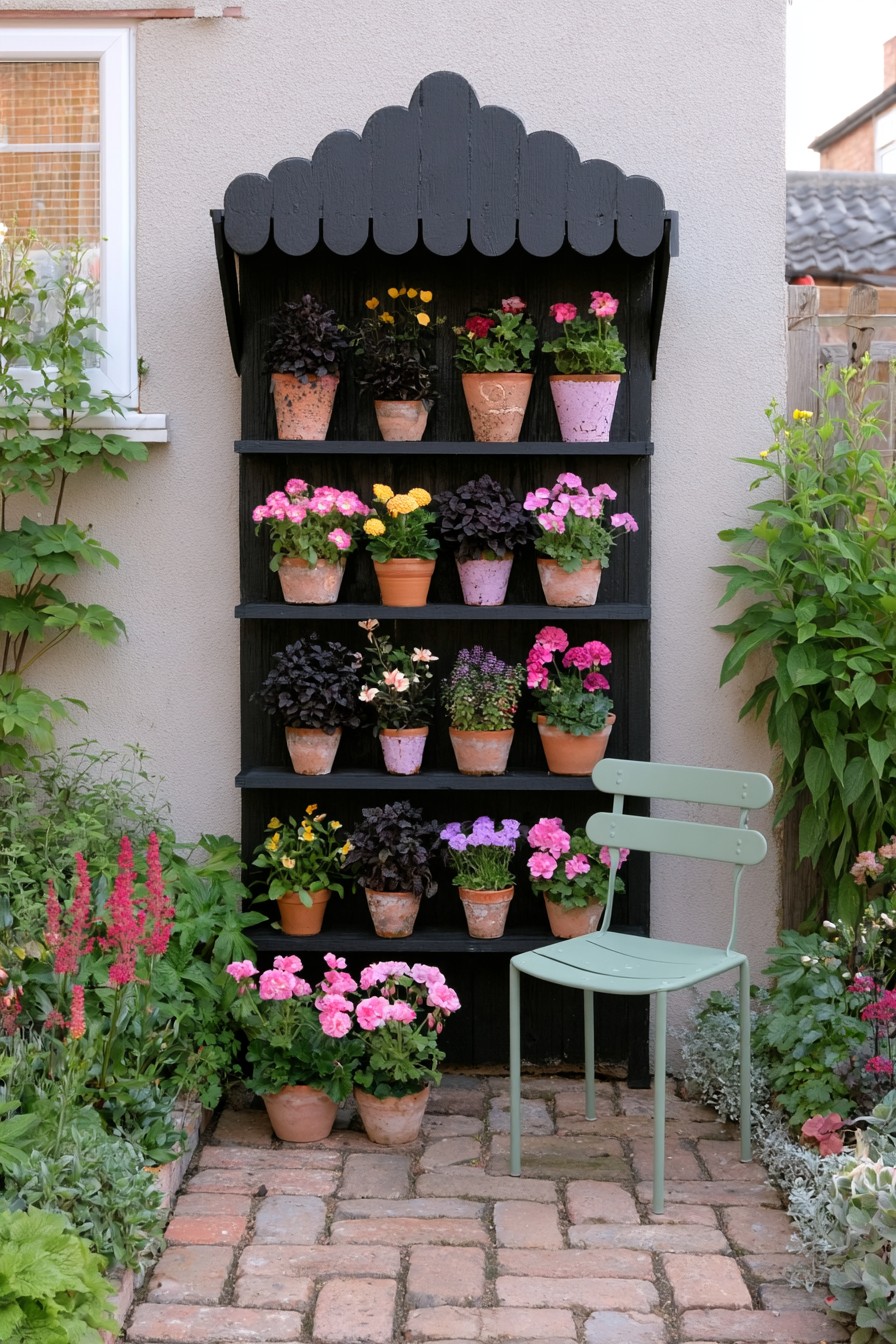
A black plant theatre displays a changing collection of small pots against a plain wall. Its shaped top provides the Victorian character, while terracotta and flowers supply variation within one narrow footprint. This suits a courtyard where a wide planted bed would take space away from seating or circulation.
Before choosing a tall unit, test whether upper pots can be lifted out comfortably, not merely reached with a watering-can spout. Shelves and their supports need to accommodate the combined weight of wet pots. Keep heavier containers lower and leave room above each plant for growth. Removable drip trays can help manage runoff, but empty them as needed; water from an upper shelf should not repeatedly soak lower plants or the wall behind the display.
11. Formal Gothic Flower Garden with Symmetrical Beds
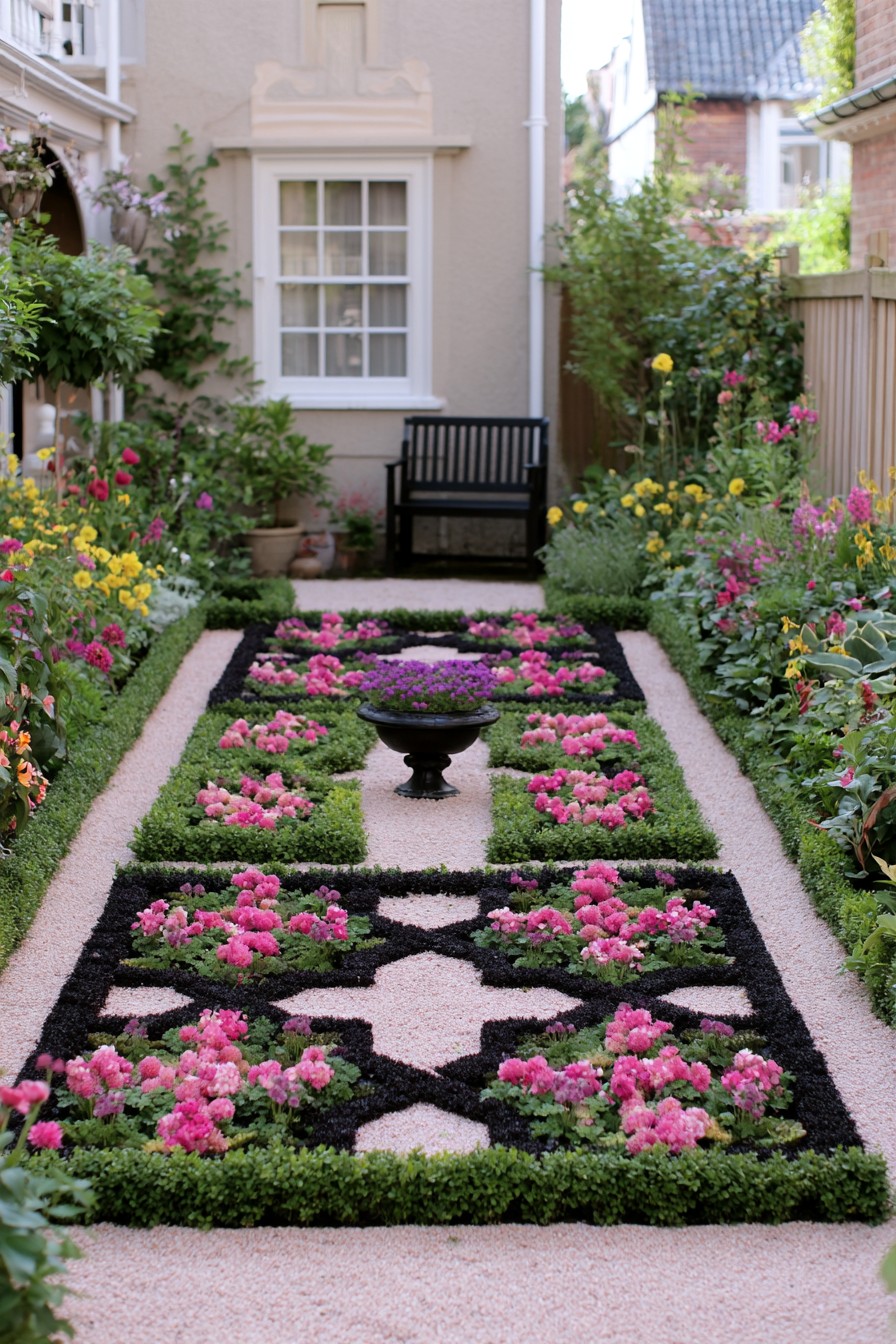
Symmetrical beds, dark internal divisions, and a central pedestal give this flower garden a formal Gothic rhythm. Each compartment holds a distinct planting group, allowing pink flowers to repeat across the layout without losing the pattern. Pale paths make the dark geometry visible from the house, while the central object gives the eye a place to settle.
Low-growing Heuchera ‘Obsidian’ could provide a rounded dark-leaf layer; Ophiopogon planiscapus ‘Nigrescens’ offers a finer texture where conditions fit. Choose by leaf form, local climate, and soil moisture, not symmetry alone. Keep the routes wide enough to tend every compartment and allow eventual plant spread within each shape. Regular edging and seasonal replacement are part of maintaining the pattern, so use fewer, larger compartments if time for detailed upkeep is limited.
12. Repurposed Metal Washstand with Dark Gothic Planting
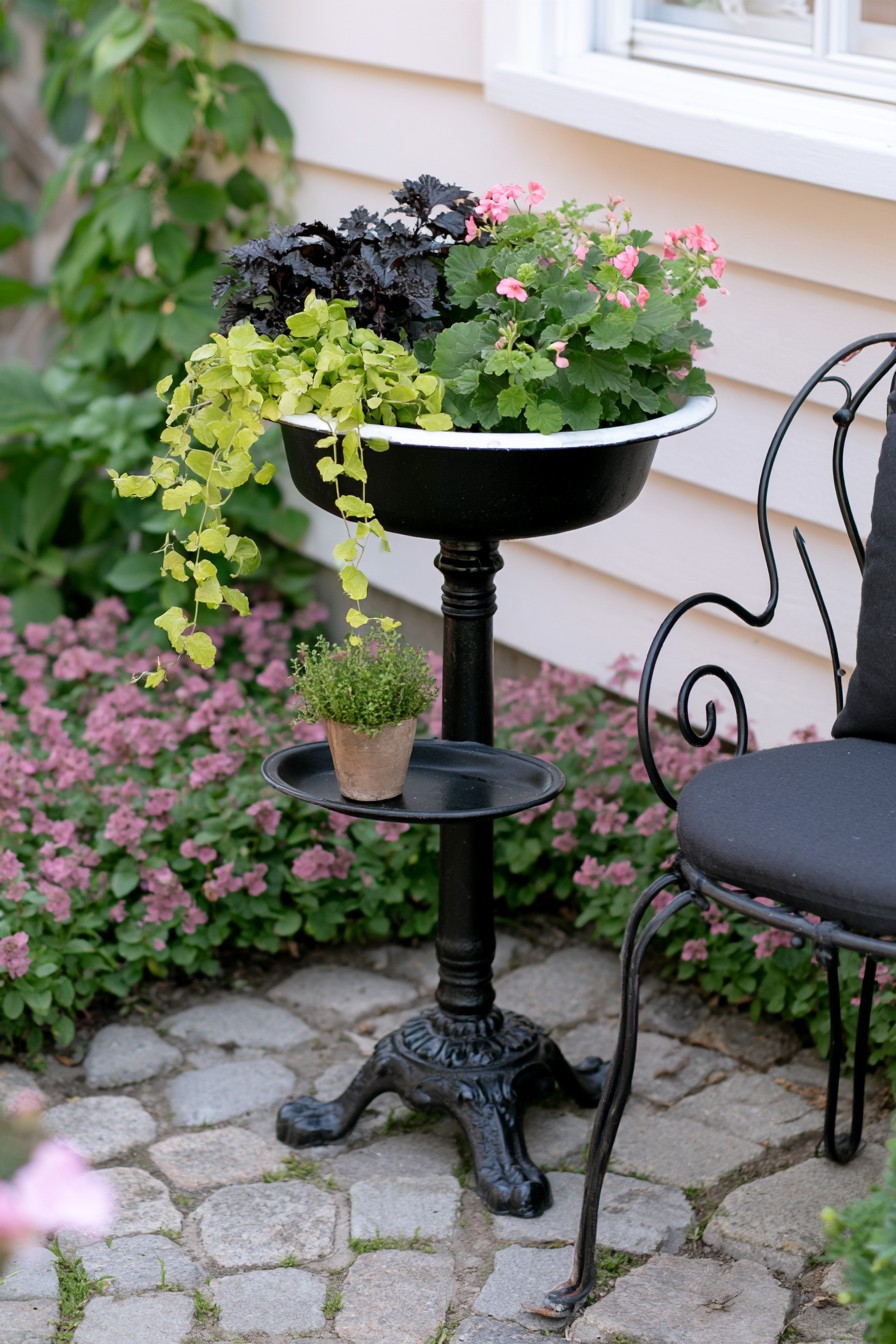
A metal washstand raises a small foliage arrangement to viewing height, turning a useful old form into a distinctive planter display. Dark leaves give the white-rimmed basin contrast, and trailing growth softens its outline. It can sit beside a patio chair without requiring a new planted bed.
If the outer basin is to stay intact, use removable growing pots with drainage holes and check for water collecting beneath them. Lift the pots out for watering or maintenance when that is the easiest way to manage runoff. The stand must remain stable with the full wet load, with its feet on a level support surface. Keep trailing stems clear of the access side so checking the basin and changing the planting remain simple.
13. Gothic Garden Seating Beneath a Woven Canopy
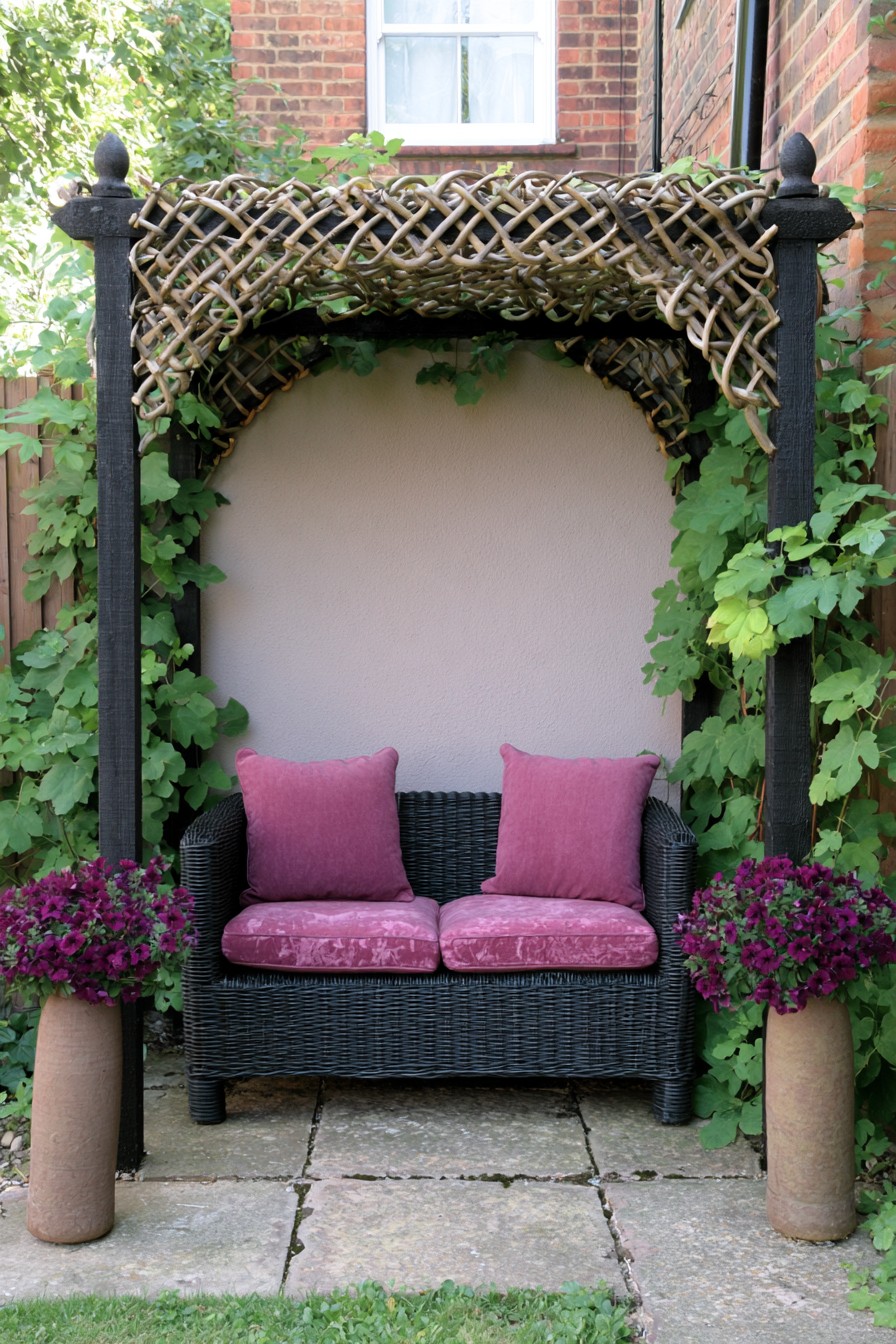
A woven canopy bends over a compact loveseat, making a sheltered-looking nook without the heavy outline of a solid roof. Dark posts provide structure, while the pale weave and climbing foliage soften the enclosure. This is a useful direction for a garden seat that needs a defined overhead frame.
Observe how the weave shades the cushions at the intended sitting time; filtered light changes as the sun moves. An open woven surface is not a rainproof roof. Use a structure with appropriate anchoring for its location, and retain access to inspect the weave and prune any climbers. Keep damp branches away from upholstery, and choose removable exterior textiles. A supported canopy can create atmosphere, but its weather performance and maintenance depend on its materials and construction.
14. Circular Stone Mosaic with Gothic Garden Chairs
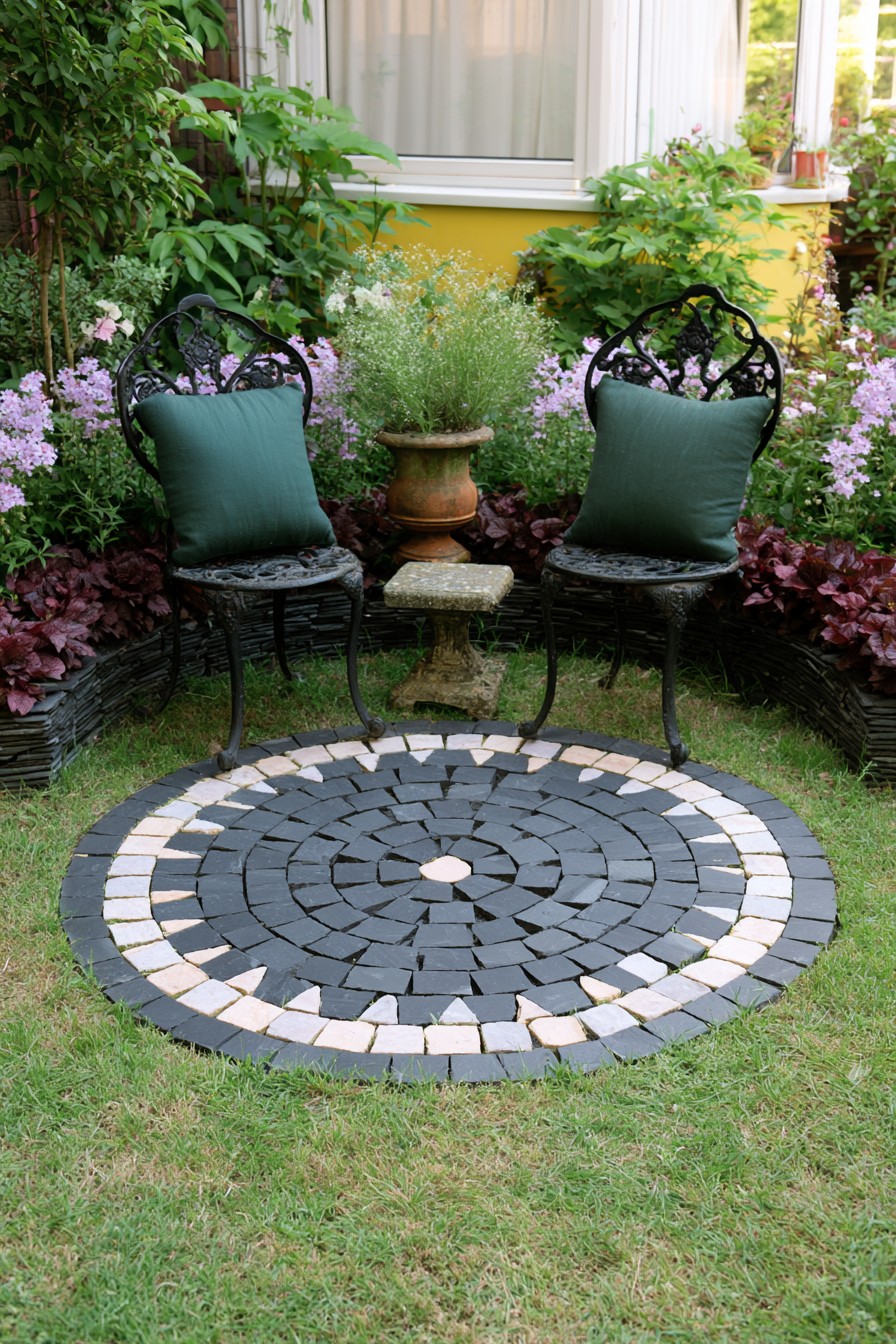
A circular mosaic of dark and pale stone forms a decorative floor medallion between two iron chairs. Its pattern gives the garden a center without covering a large area. The chairs stand beyond much of the circle, so the small mosaic should first be understood as a viewing feature rather than a complete seating patio.
To make the pattern part of a usable terrace, enlarge the support surface to match the chairs’ footprint and movement space. Test where each leg rests and where feet land when standing up. Specify a level installation with a finish appropriate to wet conditions. The stone type is not established by its color alone; select actual paving materials for performance, then repeat the circular contrast through their layout.
15. Woodland Gothic Reading Corner with Black Stepping Stones
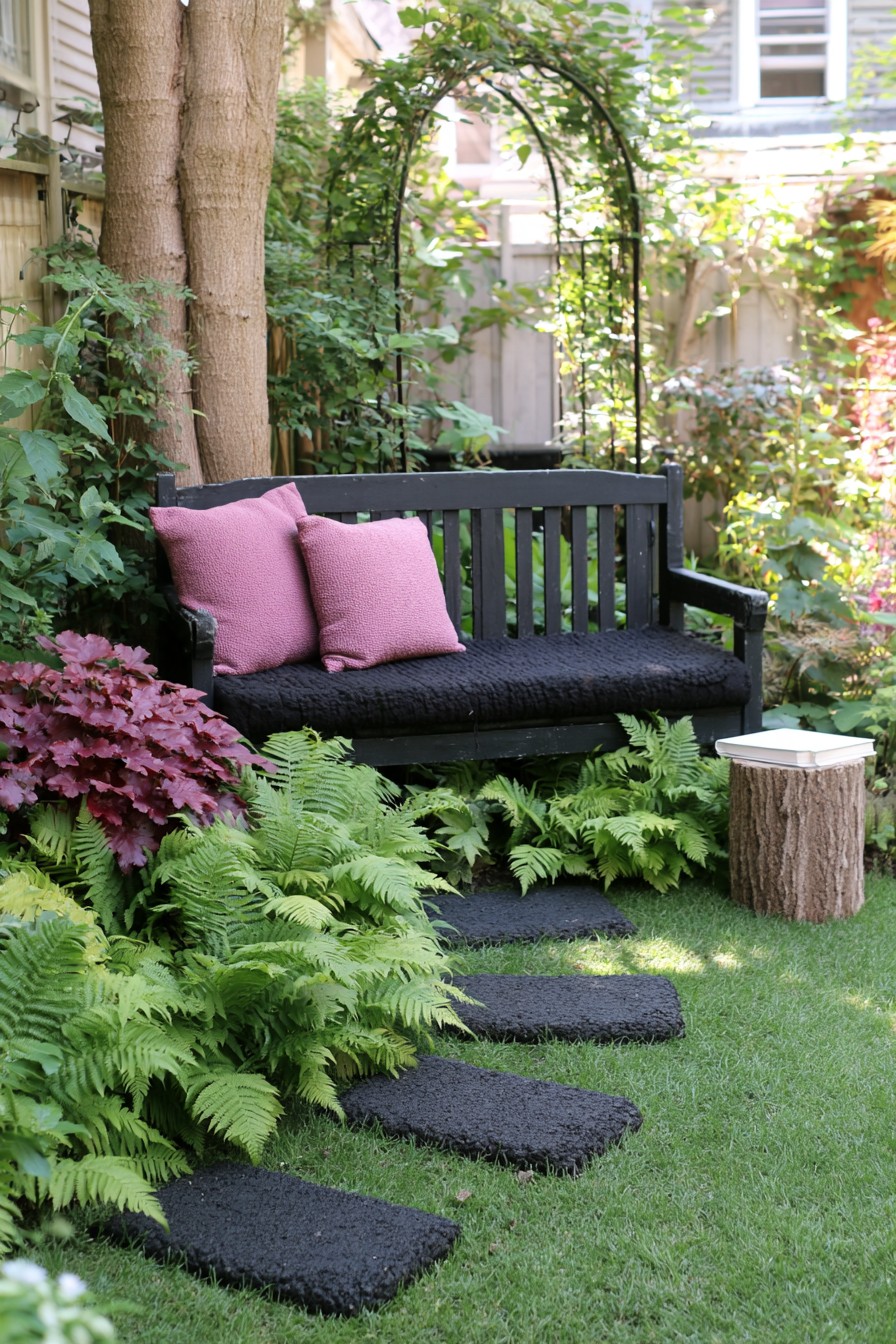
A black bench beneath the trees creates a reading destination, with separate dark stepping stones marking a short approach. Pink cushions and varied leaf textures soften the woodland setting. This works when the seat can be reached comfortably and the planting respects the existing trees rather than requiring substantial disturbance around their roots.
Check shade and root competition before choosing the underplanting. Where soil retains adequate moisture, Heuchera ‘Obsidian’ or Ophiopogon planiscapus ‘Nigrescens’ may supply dark foliage; neither should be chosen simply because the space looks shaded. Protect established roots during surface work. If the route needs to serve walking aids or wheeled equipment, replace the separated stones with an appropriate continuous surface. Position the small side table within reach while leaving room to stand up from the bench.
16. Gothic Garden with a Carved Stone Water Channel
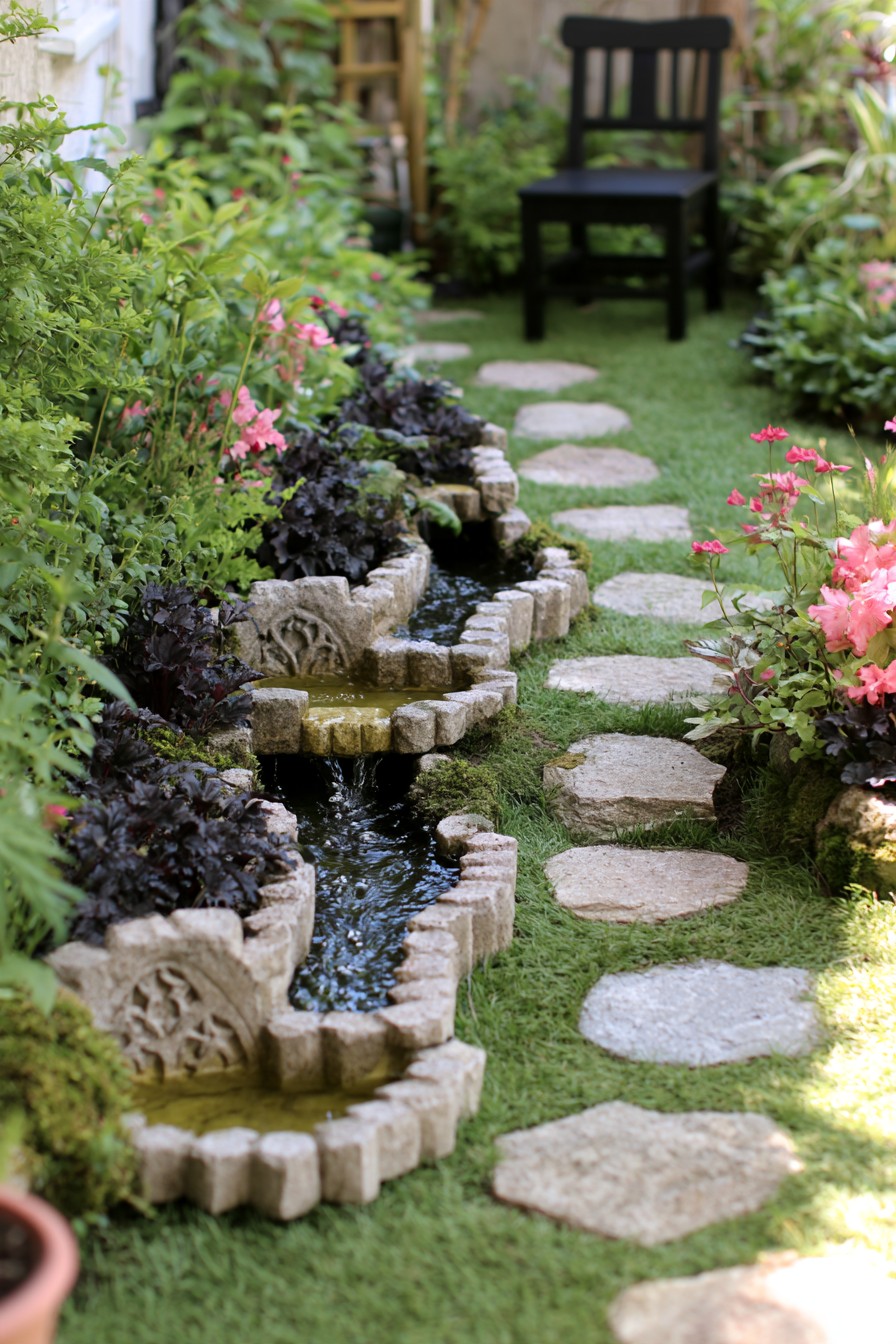
An ornamental stone water channel stretches movement along a border instead of concentrating it into a single round fountain. Small changes in level give the water a sequence, and planting softens the outside edge. It suits a narrow planted strip where the feature can be enjoyed from the neighboring route.
Keep the channel reachable for clearing leaves and sediment, and establish where the circulation equipment can be serviced. Check water levels so the chosen pump system runs as intended. Assess splash at the points where water changes height; it should not repeatedly wet the adjacent walking line. Decide whether the visible stones beside the channel are decorative accents or part of a usable route, then provide a surface and clearance appropriate to that decision.
17. Ornate Iron Garden Seating for a Quiet Resting Corner
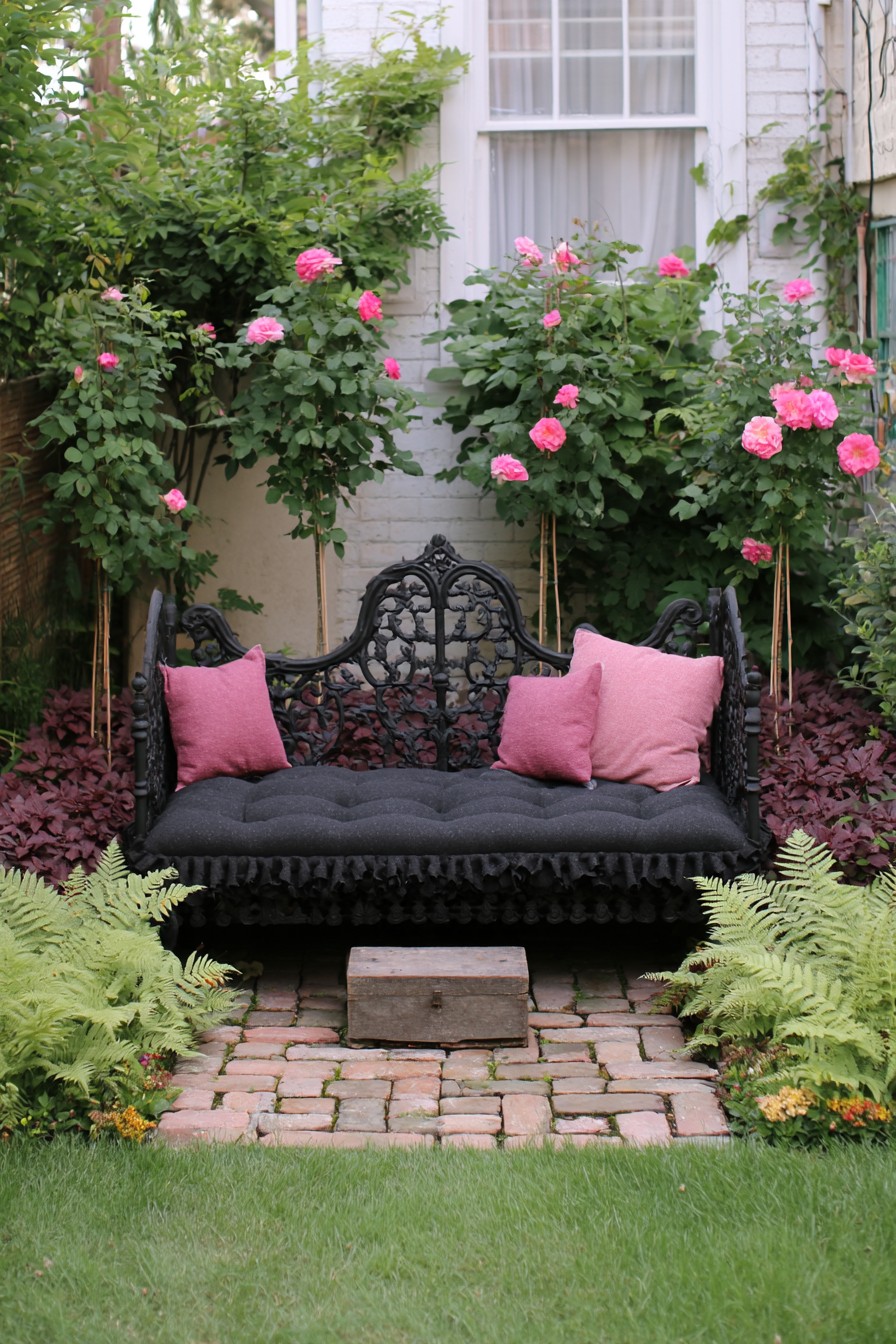
An ornate iron seat becomes the garden’s main resting point, framed by roses, ferns, and dark lower foliage. The black frame creates a strong silhouette, while pink cushions add softness. This can inspire either a lounging corner or a generous bench arrangement where brick paving provides a clearly defined furniture area.
Choose a daybed deep and long enough for the way you want to rest, and try the cushions for both sitting and reclining. Support every foot on stable ground. Leave an approach along the usable side and keep thorny or damp foliage clear of the upholstery so cushions can be removed and dried.
18. Black and White Pebble Spiral as a Garden Focal Point
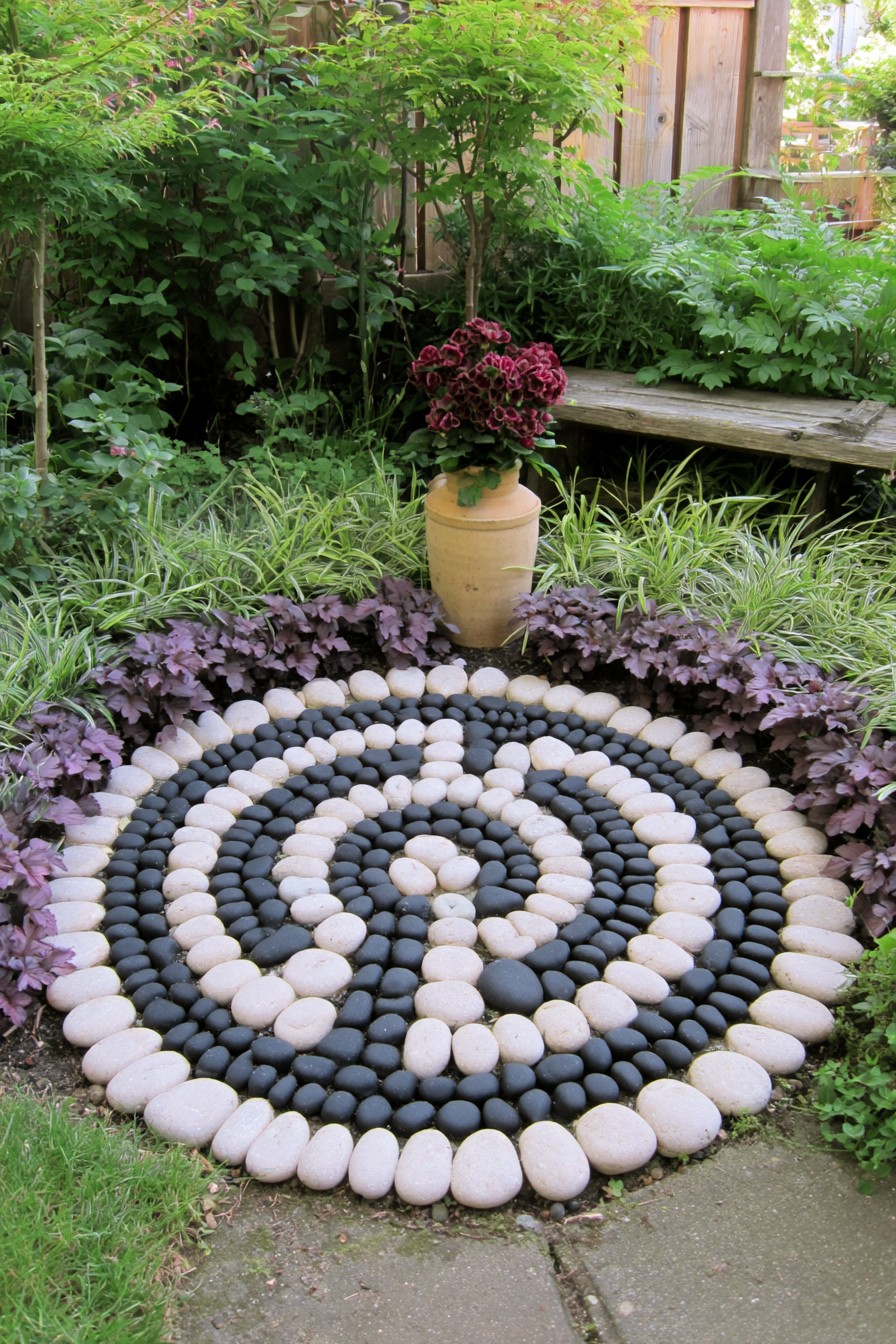
Alternating black and white pebbles form a compact spiral-like motif, turning an open patch into a graphic focal point. The nearby urn and purple foliage reinforce the contrast. Keep this miniature patterned feature as a display viewed from the surrounding garden, leaving walking routes around it.
Mark the circle and compare it with the view from the nearest path before choosing its size. A decorative version can sit beside circulation, with an edge that keeps loose stones in place. A surface intended for walking needs a different assessment of base, drainage, stone stability, and traction. Maintain the contrast by removing leaf litter and resetting displaced pebbles, without allowing the planted border to swallow the outer line.
Video Inspiration: Arranging a Black and White Pebble Pattern
The clip moves from a marked circular area to a dark sheet and pale bedding layer, then to traced curves and rows of light stones. Dark pebbles fill the spaces between those rows, producing the final contrasting pattern. The useful visual lesson is to establish the outline and the pale lines before filling the surrounding field.
Treat this as inspiration for the order of the decorative arrangement. Prepare a paving specification that covers the base, drainage, finished levels, and intended traffic before laying the pattern. A viewing display and a surface intended to carry foot traffic need different preparation.
19. Gothic Garden with a Weathered Metal Obelisk and Climbing Roses
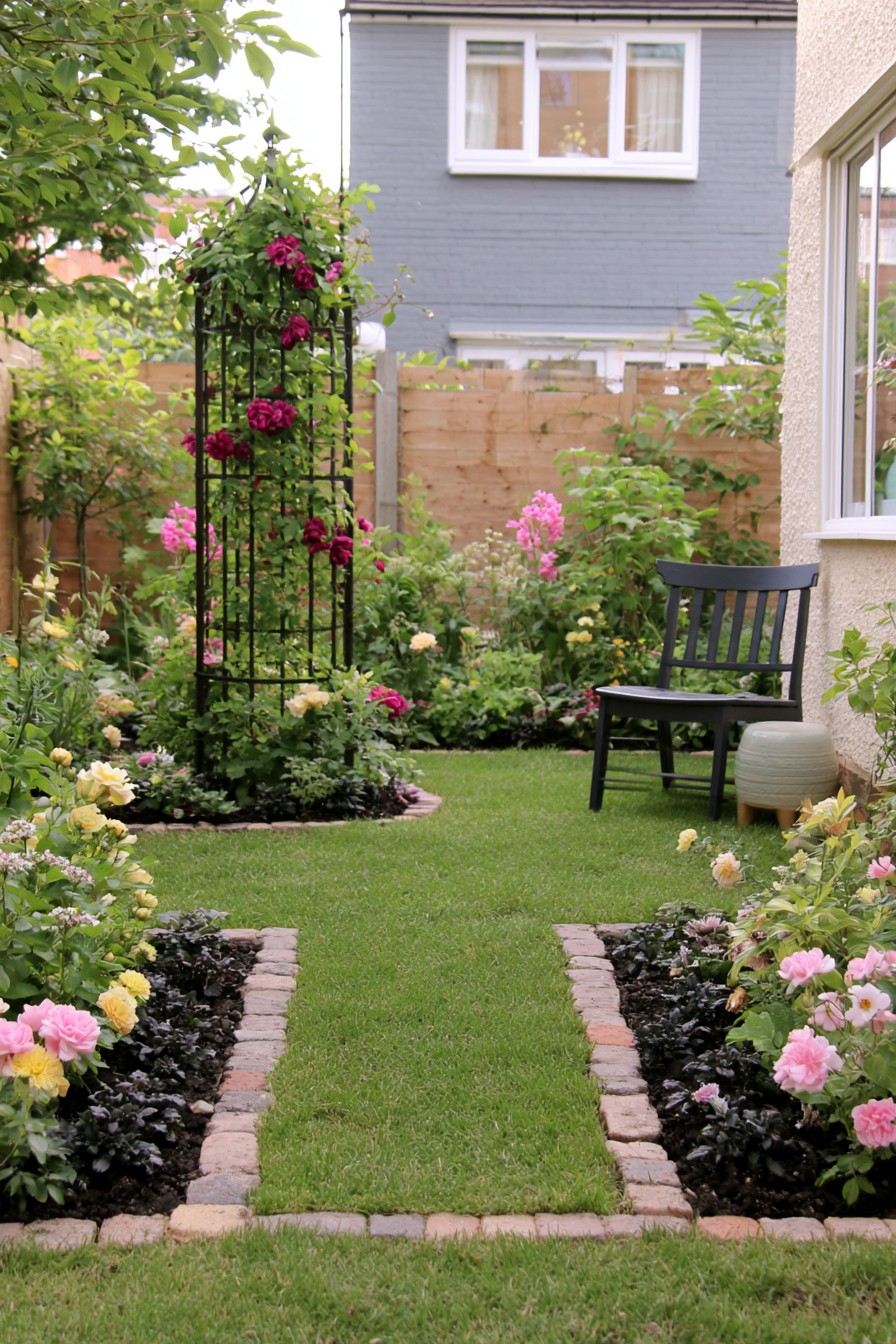
A tall, weathered-looking metal obelisk lifts rich pink rose flowers above the lower border. Its narrow vertical shape suits a bed that needs height without an overhead arch across the route. The nearby bench can enjoy the flowering view while leaving the plant support entirely within the planting area.
Match the rose’s growth habit and eventual size to the obelisk; a vigorous rambler can overwhelm a small support. Choose a position with the light the variety needs and enough room to reach the stems for training and pruning. The support and anchoring must suit the mature plant, including when wet. Keep thorny growth away from the seated person’s shoulder and standing space, and retain access around the base as the lower planting fills out.
20. Black Lattice Screen with Pink Garden Seating
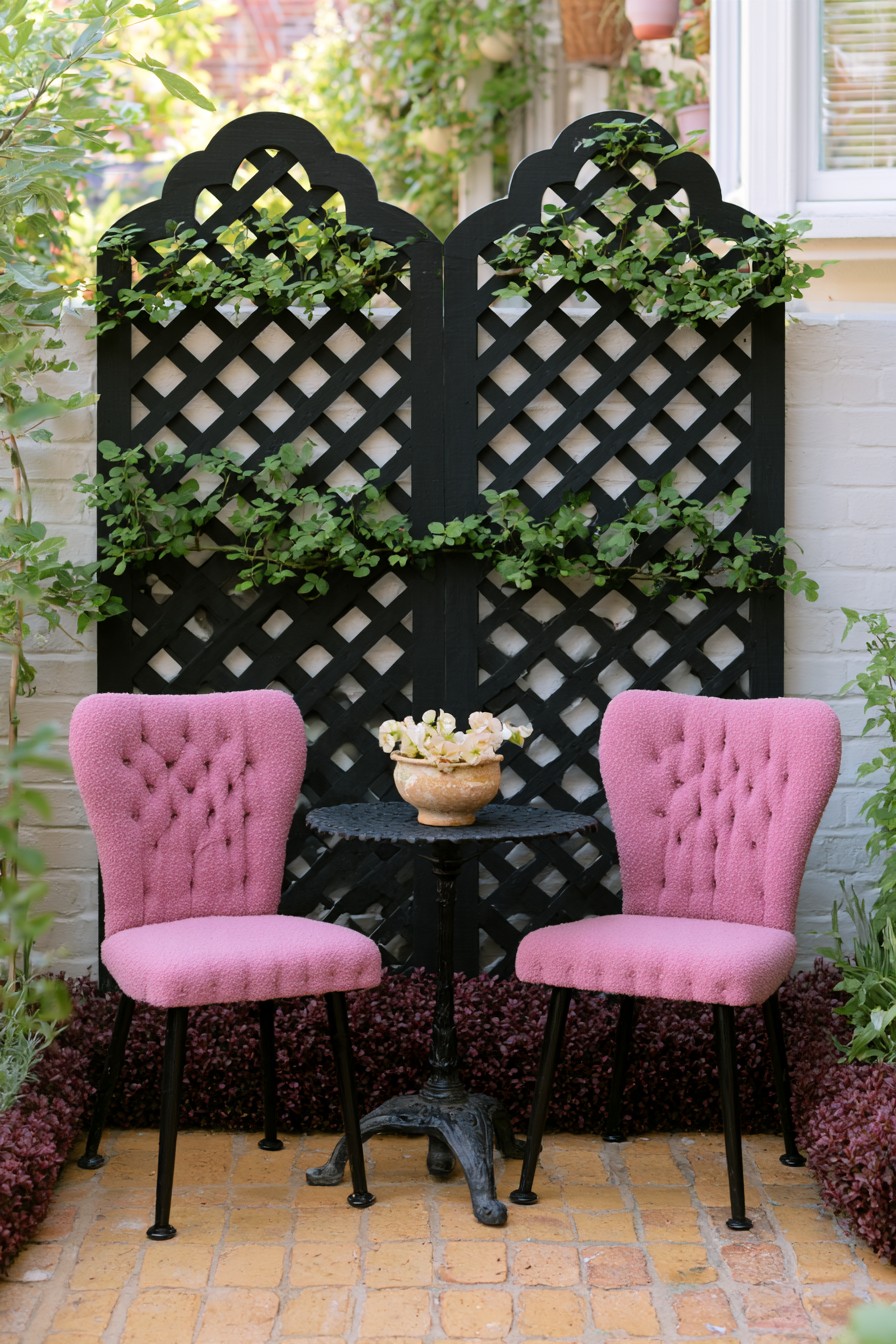
A black lattice screen creates a backdrop for two pink chairs without forming a completely solid wall. The repeating openings and arched tops supply the Gothic character, while foliage adds depth through the grid. This can define a seating pocket beside the house while keeping some visual connection to the planting behind it.
Decide how much privacy is needed before relying on the open panel. Any climber will need appropriate support and reachable pruning space, and plant coverage changes through the seasons. For an exposed garden, select outdoor seating and check the upholstery's weather resistance and drying requirements. Alternatively, bring the chairs out for short use and store them under cover afterward. Set the little table within reach of both seats and preserve their approach.
21. Gothic Garden with an Ornate Wrought Iron Swing Seat
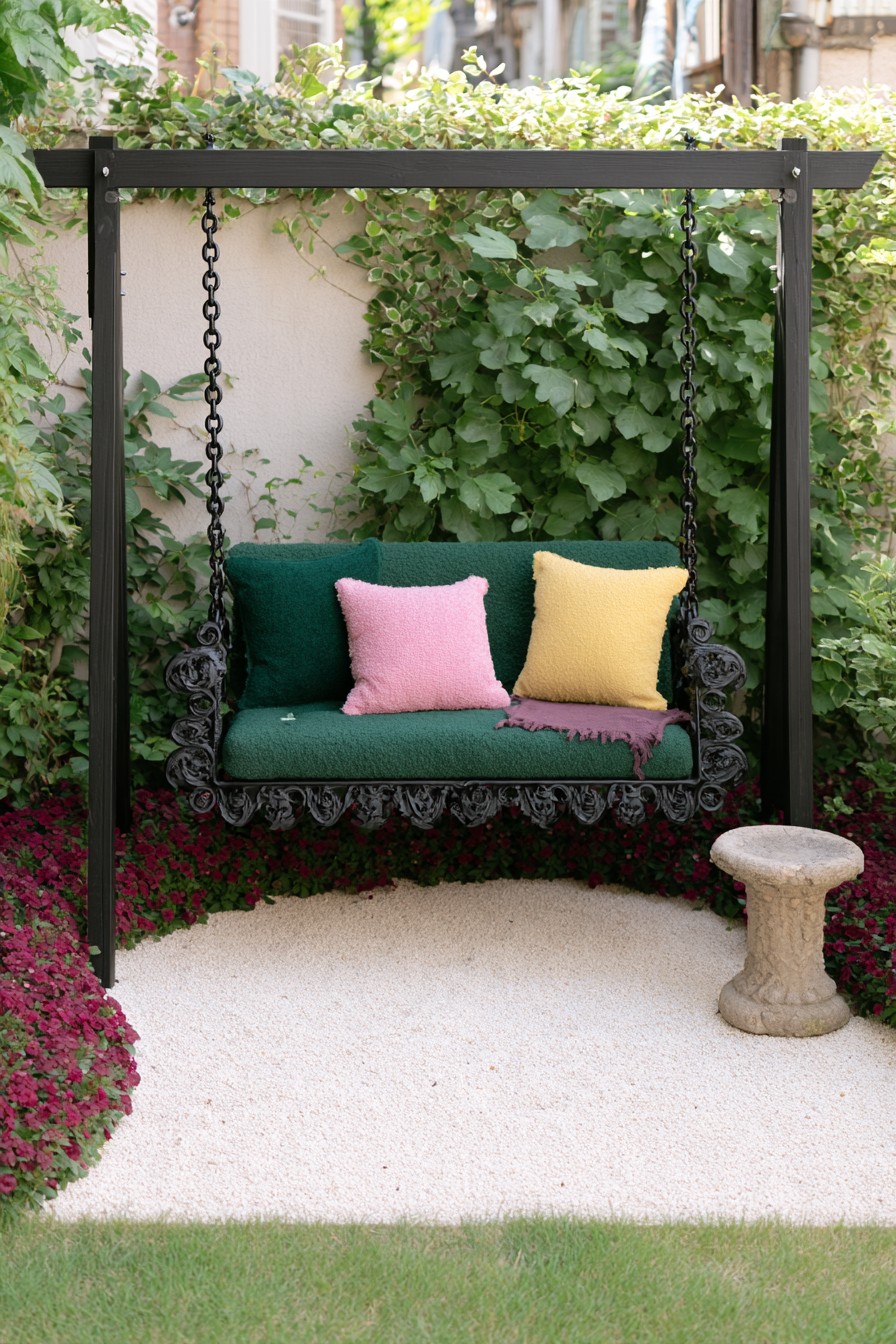
An iron swing seat brings gentle movement into an otherwise still planted corner. The scrolling frame and suspended bench carry the Gothic style, while green upholstery connects the seat with the foliage. This needs more open space than a fixed bench because the furniture’s movement becomes part of the layout.
Evaluate the carrying frame, suspension points, and connections as one system, following the product’s use and inspection instructions. Choose a version rated for the intended contents and secure it according to its installation instructions. Check the full movement envelope in front, behind, and beside the seat before adding a pedestal table or containers. Keep the approach usable when someone is sitting on the swing, and choose a stable surrounding surface. Inspect the system as directed, especially after exposure or changes in placement.
22. Gothic Garden with a Checkerboard Lawn Patio and Cathedral-Style Bench
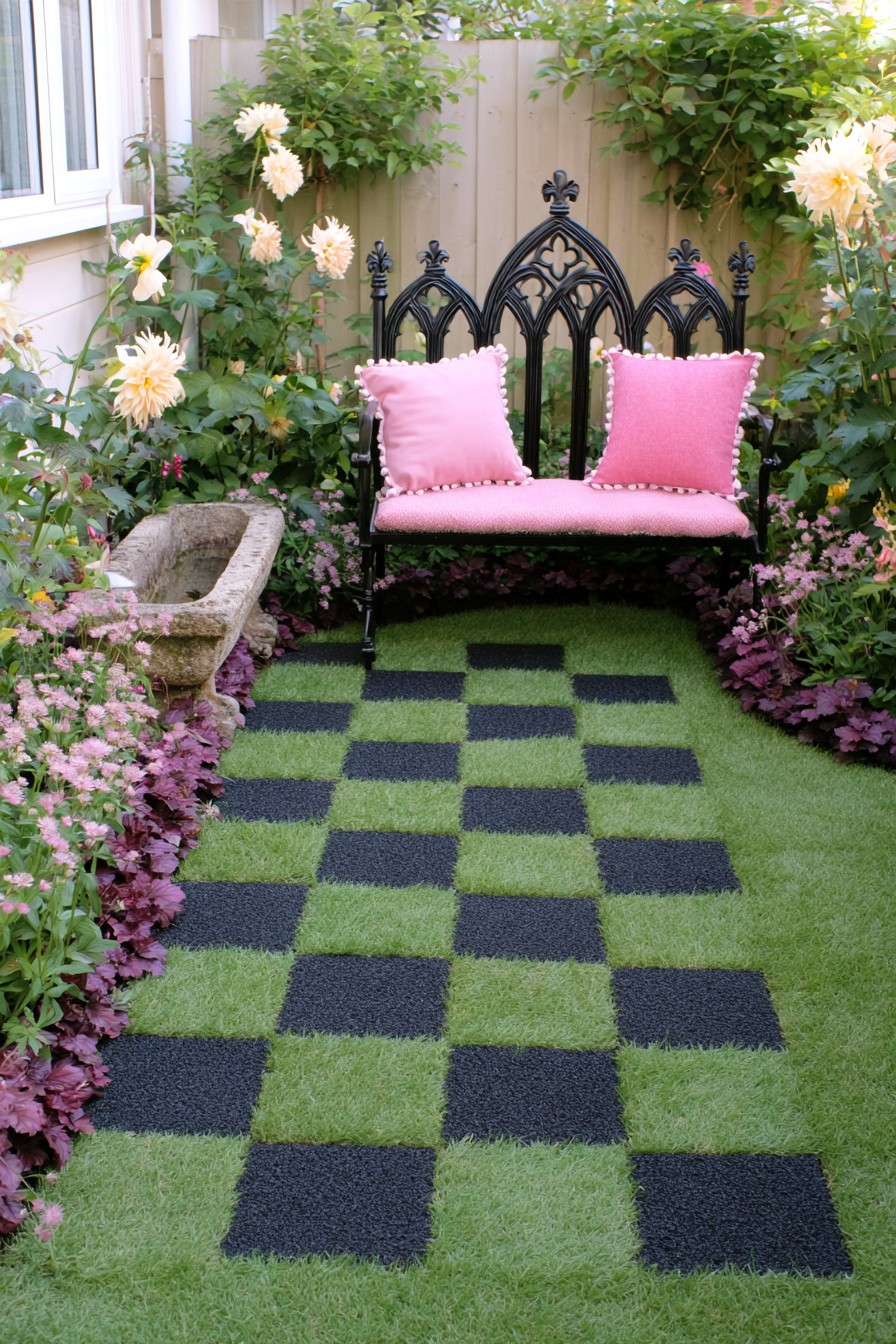
Dark and green squares turn the foreground into a checkerboard leading toward a cathedral-style bench. The pattern gives a compact garden a formal identity, while pink cushions and flowers soften the geometry. Choose living turf where light, rooting depth, and maintenance allow it, or use an outdoor artificial surface with suitable drainage for the grass effect.
If using natural grass with paving, plan mower access, edge trimming, and how the two surfaces will remain level over time. Settling can turn a graphic pattern into an awkward route. If using another green surface, check its drainage and outdoor care requirements alongside those of the dark squares. Make the main approach dependable for its users, then place the bench beyond the pattern with enough room to sit and stand comfortably.
23. Gothic Garden with a Dark Dry Creek Bed and Woodland Planting
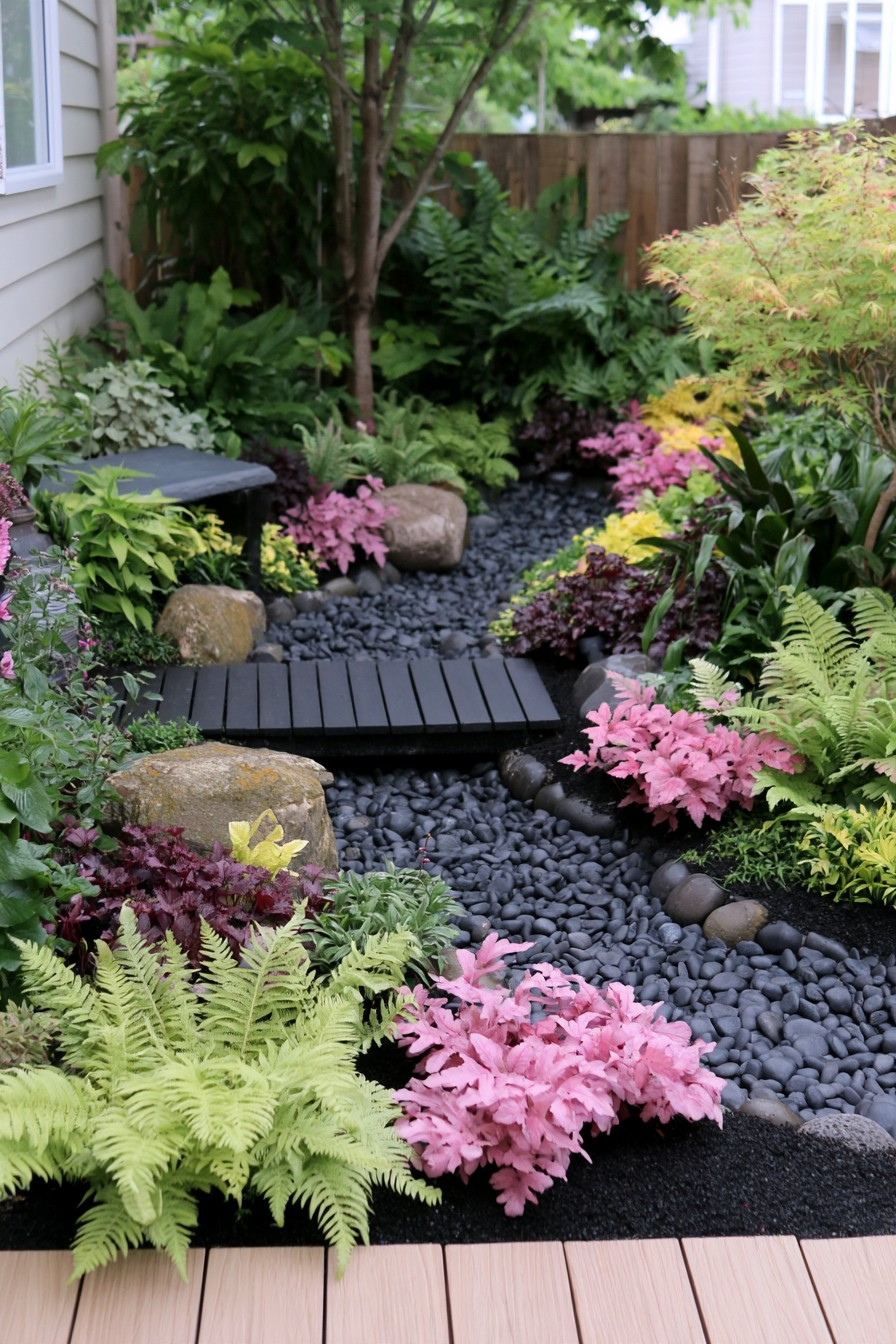
A dark dry creek gives woodland planting a winding central line, with small timber crossings connecting the sides. Pink foliage and ferns break up the black stones, while larger rocks keep the channel visually varied. It is an option for organizing a planted scene without introducing a circulating water system.
Decide whether the creek is decorative or intended to carry rainwater. A drainage function needs an appropriate slope, base, outlet, and consideration of where runoff ends up; stones alone do not create that system. A crossing used by people needs its own span, support, load, and wet-surface design. These ideas for planning a garden bridge help separate scenic crossings from daily routes. For a display-only bridge, keep everyday circulation on a separate path.
24. Victorian-Style Wire Plant Cages
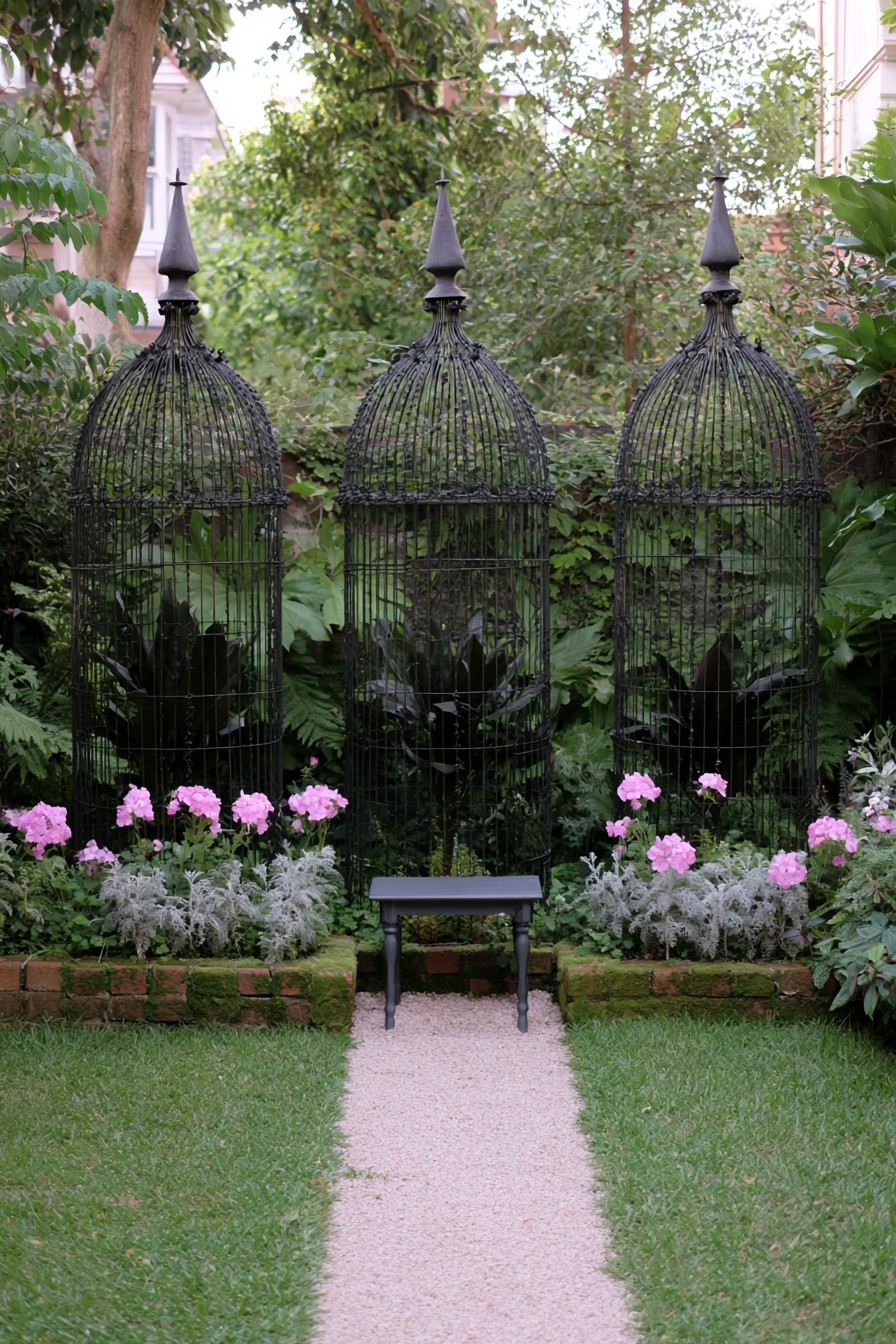
Tall pointed wire cages repeat a Victorian-style outline above the planting. Their open construction adds vertical detail while leaves remain visible through the metal. This suits the back of a border where repeated silhouettes can define the view without turning the whole boundary into a solid wall.
Treat the cages as decorative frames or plant supports appropriate to their design. Open wire does not provide the enclosed weather protection associated with a covered cloche; any protective function depends on a separate cover and its specification. Anchor the frames for the exposure and leave enough room inside for the plant’s growth. Check for stems rubbing against wire, retain a way to reach the plants, and keep projecting points outside the approach to the nearby seat.
25. Gothic Garden with Corrugated Metal Planters and Black Privacy Screening
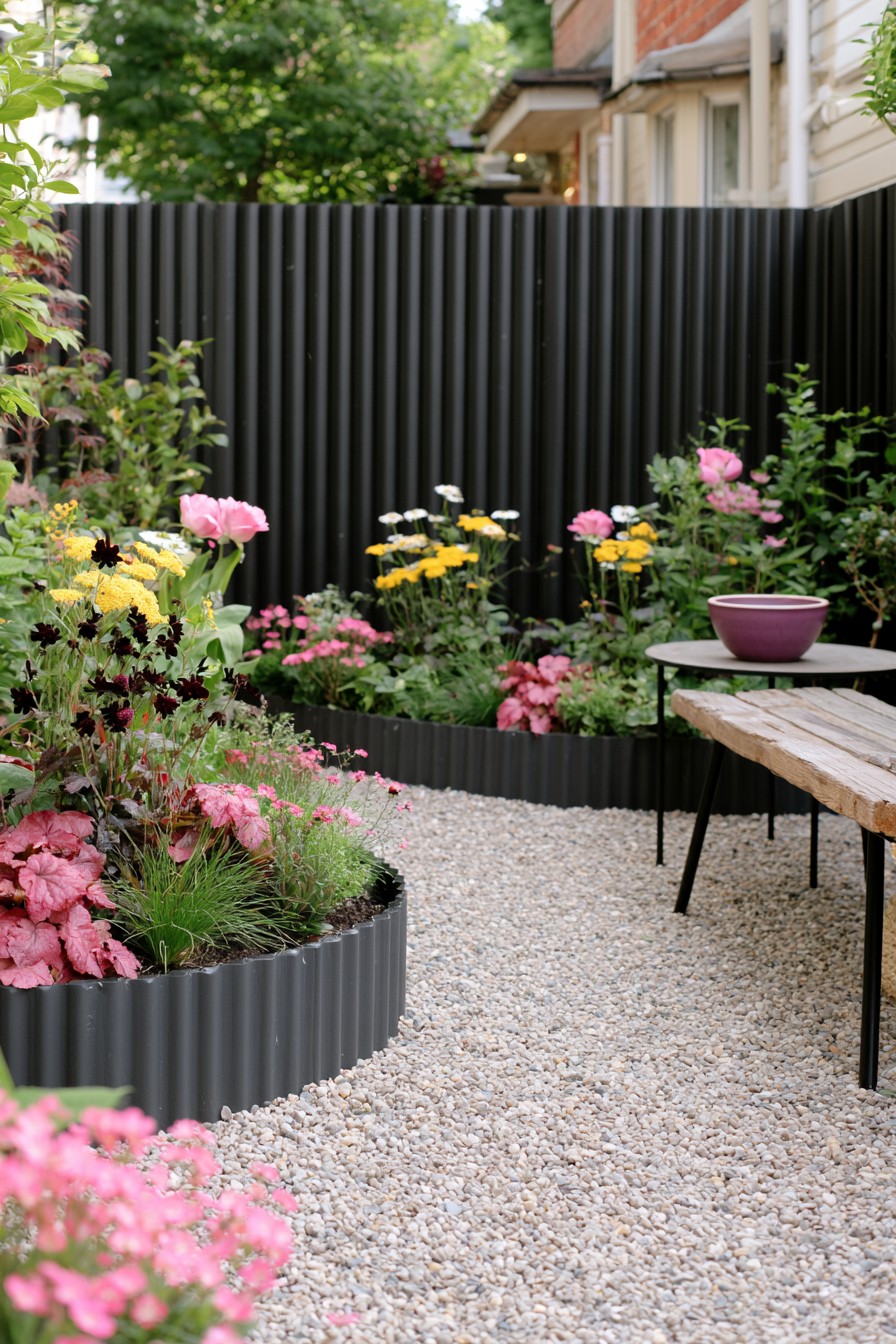
Corrugated metal planters and a dark privacy screen give this garden a strong contemporary outline. Pink and yellow flowers interrupt the black surfaces, while the rounded front planter softens the furniture area. This suits a boundary that needs definition and a planted display with a clear edge.
Check sun exposure before choosing the planter position: metal can become hot, and shallow root space may dry quickly. Use adequate planting depth and a growing medium appropriate to the selected plants, with accessible drainage. Heuchera ‘Obsidian’ can add broad dark leaves; Ophiopogon planiscapus ‘Nigrescens’ offers finer contrast where its moisture and light needs can be met. Assess moisture below the surface instead of watering by a fixed calendar, and leave room to reach the back containers.
26. Black Timber Steps with Layered Flower Beds
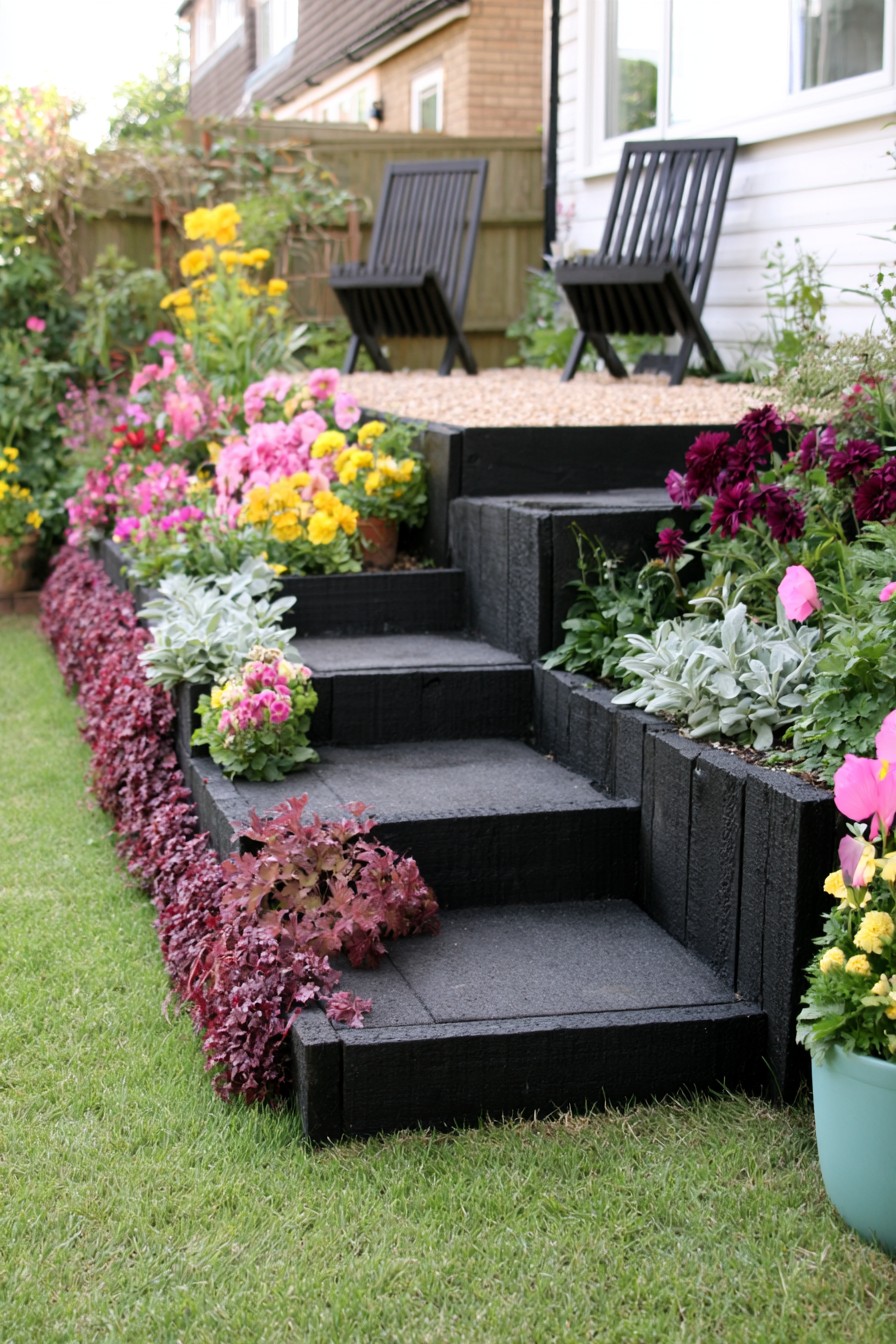
Black timber steps and terraced flower beds make a change in level part of the garden’s color scheme. Bright flowers mark the edges, while dark foliage links the steps with the beds. The upper chairs create a destination, so the arrangement combines planting display with an actual approach to seating.
For a black finish, choose a documented exterior coating or a specified treated timber product suited to the intended use. Select a timber specification for its job and exposure. Steps and soil-retaining elements need designs for their loads, supports, drainage, and ground conditions; exterior-rated boards alone do not resolve those requirements. Keep treads visible as plants expand, assess edge protection where needed, and allow movement around the upper chairs. The visual arrangement is inspiration for handling levels, not a structural construction detail.
27. Vertical Stone Cascade with a Pebble Basin
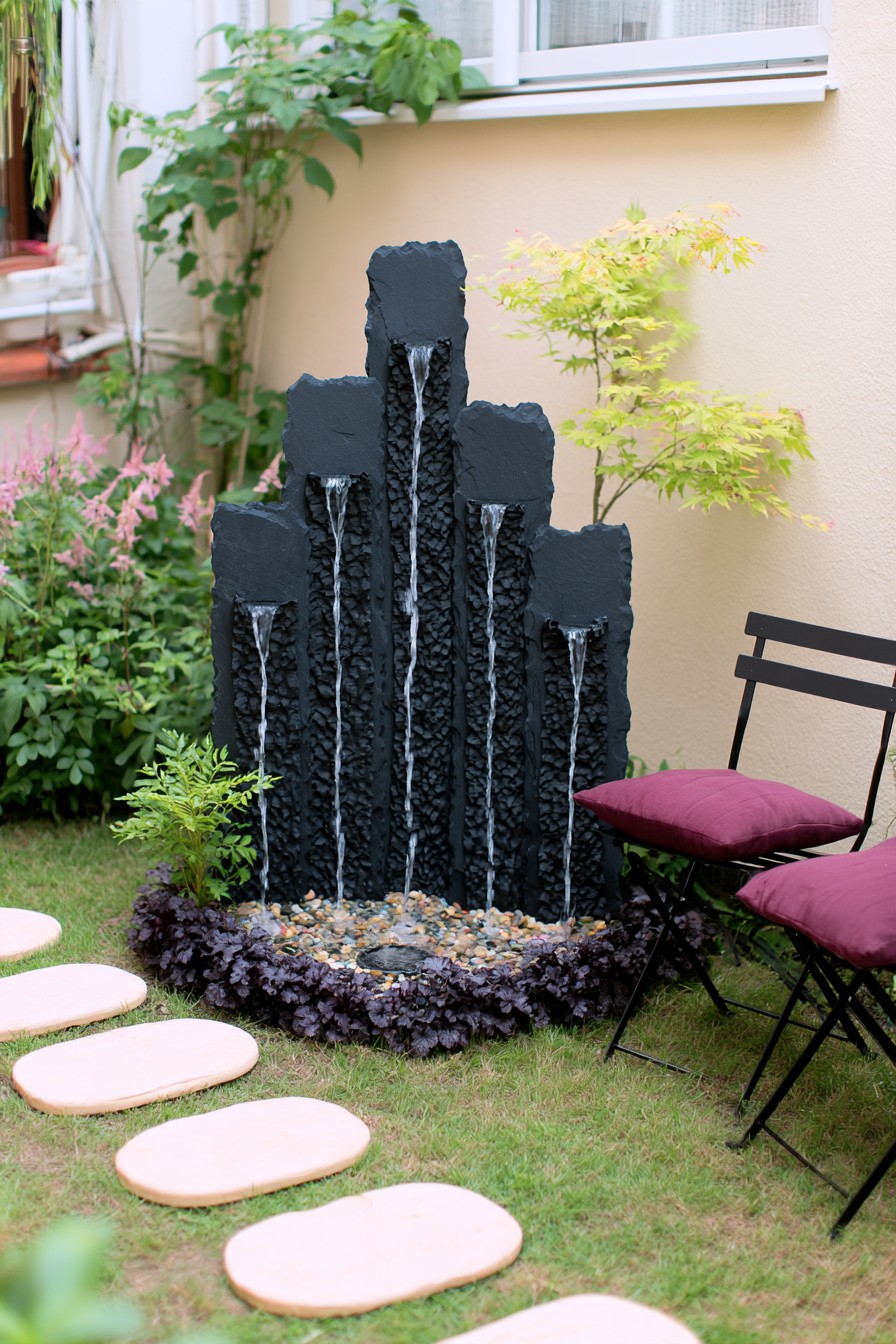
Upright stone surfaces at different heights create a dramatic cascade beside the sitting area. Thin streams of water emphasize the vertical outline, with a pebble basin softening the base. This offers a taller focal point than the low fountain or the long water channel, making it useful against a relatively plain wall.
Select a complete water-feature system with appropriate support for its upright elements and access to the reservoir and pump. Leave an accessible service point within the pebble finish rather than covering everything permanently. Monitor water levels and clear collected leaves as the system requires. Check the splash pattern before placing the chair close to it. Choose the dark facing material by supplier description, then check that it suits the water feature's supporting structure and exposure.
Video Inspiration: Composing a Vertical Water Feature
A marked footprint is followed by reservoir components, upright dark faces at different heights, water outlets, and a pebble finish around the base. The completed scene shows how a tall cascade can occupy a compact corner while the nearby chair remains the resting point. The varying heights give the feature its architectural outline.
Use a specified cascade system sized for the site. Plan its support, anchoring, accessible reservoir and electrical supply before arranging pebbles and plants around the base. Leave the pump and connections reachable for cleaning and servicing.
28. Circular Black Garden Arch with Rose Accents
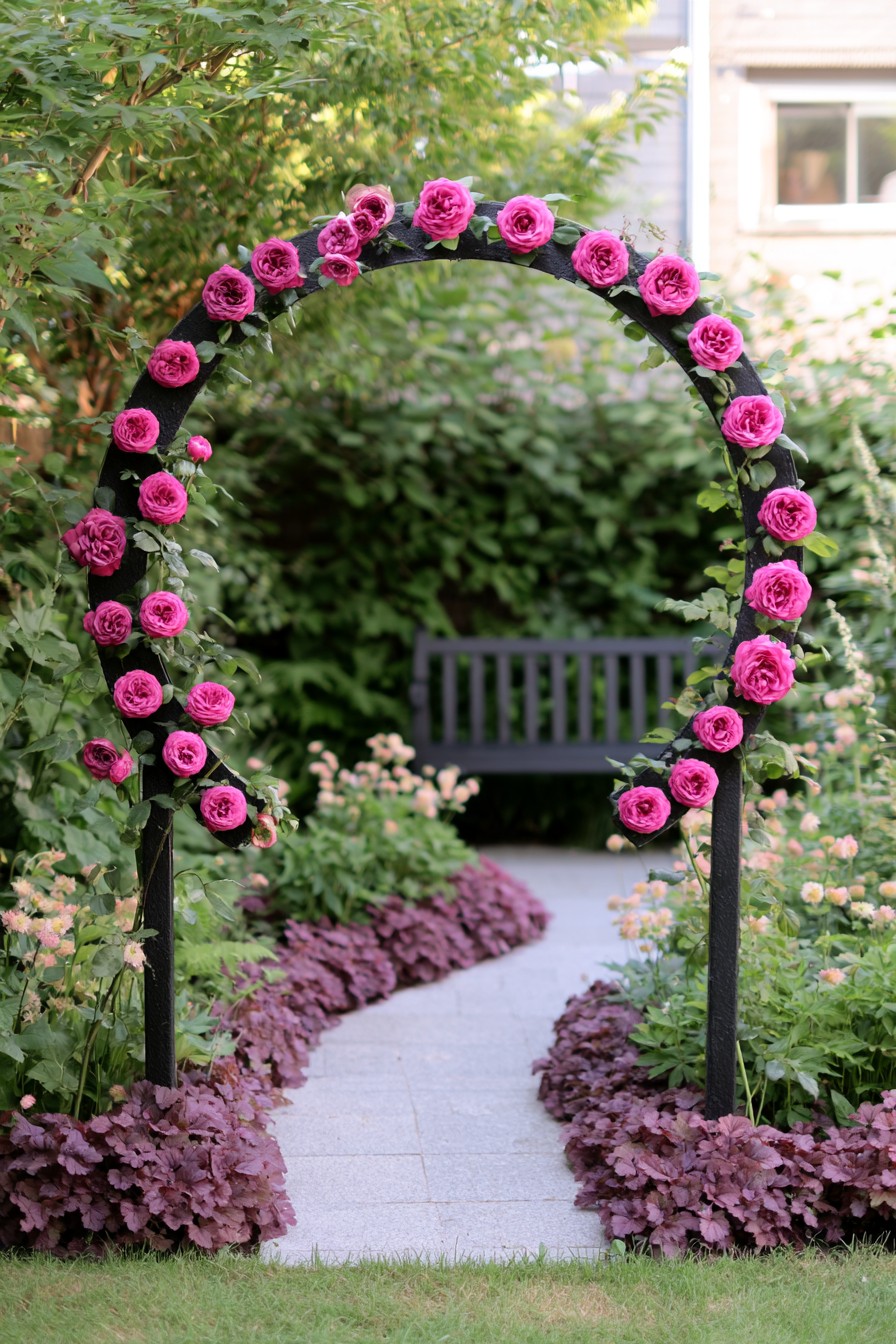
A circular black arch frames the view toward a garden bench, with pink rose accents highlighting its curve. The round opening makes the planted route feel like a destination rather than an ordinary gap in the border. This is useful where one focal frame can organize the view through a small garden.
Choose between seasonal floral decoration and a living rose covering. Decorative accents can provide the outline immediately; a climbing rose needs appropriate light, a growth habit that fits the frame, and room for training and pruning. Keep its mature stems clear of the usable opening. The frame and its fixing need to suit the chosen load and exposure. Place it around an existing route only after checking that the opening remains comfortable for the people using it.
Video Inspiration: Framing a Path with a Rose-Accented Arch
The sequence positions two uprights beside an existing path, adds the circular frame, and places rose accents around the curve. It demonstrates how a single outline can frame the bench beyond and connect the planting on both sides of the route. The floral detail is added as part of the display sequence; it is not evidence of instant living-rose coverage.
Use the view to compare placement and proportion. The brief assembly does not specify foundations, wind resistance, or capacity for mature climbing growth. A seasonal floral display and a living planted arch should be planned for their different loads and maintenance.
29. Gothic Garden Entrance with Antique Urns and Spired Iron Details
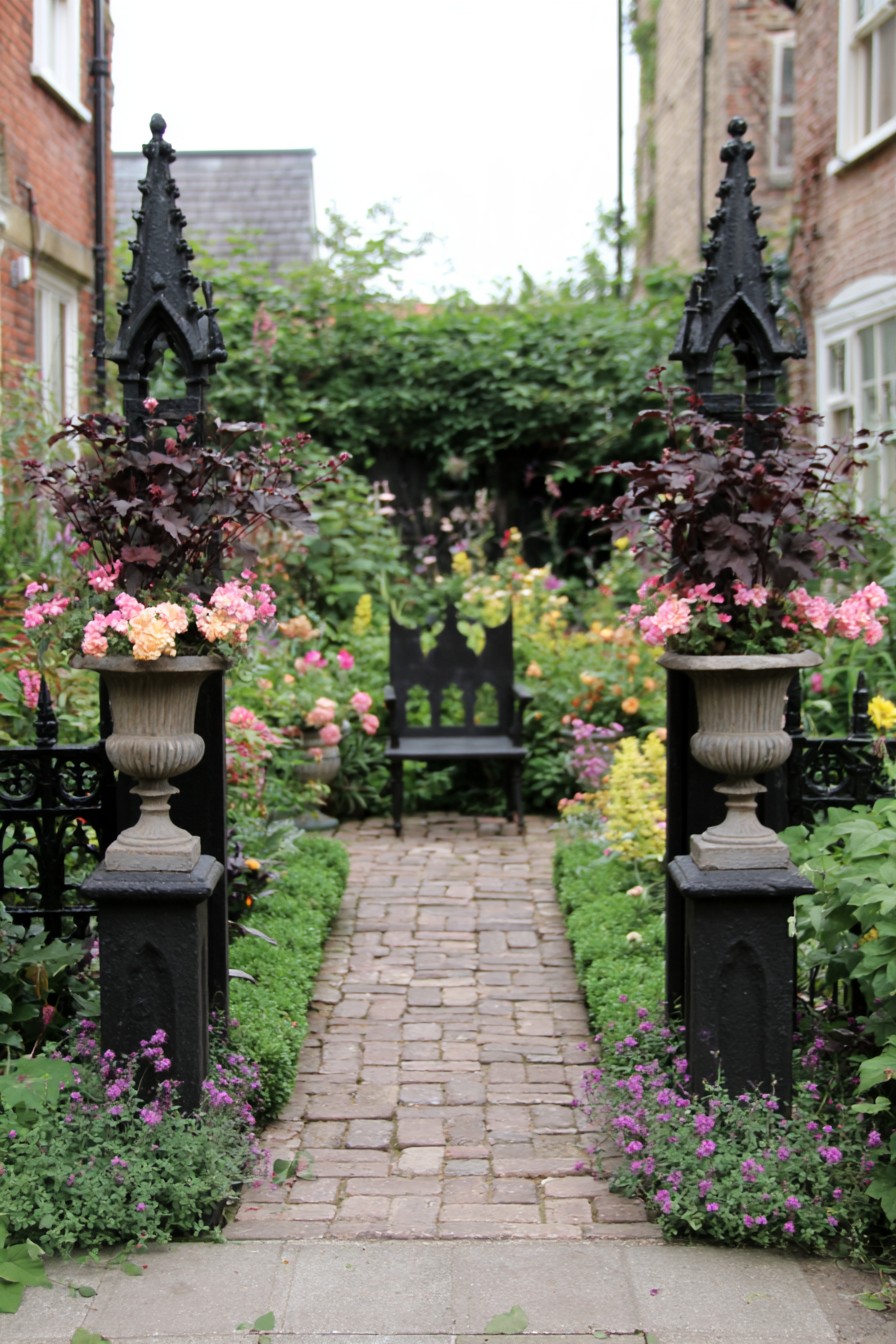
Paired urns and spired iron details create a formal entrance, with the brick path providing a clear line through the planting. The raised containers place foliage and flowers near eye level, while the surrounding borders keep the display connected to the garden. This works where the entrance can accommodate substantial objects outside its usable width.
Choose stable support surfaces for heavy urns and consider their filled weight before positioning them on plinths. Leave access for watering and seasonal plant changes, including a way to lift out an inner pot if used. Check that water can leave the growing container freely and that runoff will not make the entrance slippery. Maintain the clear route between the urns as foliage expands, keeping the formal pairing useful as well as visually balanced.
Make the First Change Useful, Then Keep It in Shape
Start with the need that will make the garden easier to enjoy: a comfortable seat, a workable route, a planted boundary, or a focal view from the house. Mark its footprint, check the growing conditions, and choose the main material or plant before adding smaller decorative pieces. Repeat a limited set of dark outlines and flower colors so the arrangement feels connected.
During care rounds, check containers below the surface for moisture and inspect drainage holes if water stops leaving freely. Clear leaves from water features as their systems require, keep chairs and service points reachable, and review climber ties as stems grow. Dry and store textiles according to their instructions. The style stays convincing when its dark structure supports a garden that remains pleasant to use through changing seasons.


Leave a Reply