
A rescued chandelier offers more than a change of paint: its arms can organize a collection, support a planting display, or become the outline of a garden ornament. This guide includes three short video project examples followed by 22 photographed inspiration ideas, covering storage, growing, decorative displays, and painted makeovers. Choose a direction that suits both your space and the condition of the fixture you have.
- DIY project examples: three videos with materials, an adaptation sequence, and finishing notes.
- 22 inspiration ideas: different uses and finishes, with advice on where they work and what each adaptation needs.
Table of Contents
- DIY Project Examples: Three Chandelier Transformations
- Prepare the Fixture for Its New Role
- Project 1: A Garden Chandelier with Candle Shapes
- Project 2: A Tabletop Chandelier Propagation Stand
- Project 3: A Folk Art Painted Chandelier
- 22 Chandelier Inspiration Ideas for Your Home and Garden
- 1. Striped Green Chandelier With Bold Swirl Arms
- 2. Bronze Chandelier Planter With Moss Toned Clay Pots
- 3. Olive Green Candle Chandelier in a Garden Tree
- 4. Windowsill Chandelier Stand With Glass Plant Vases
- 5. Chandelier Frame for a Garden Feeding Station
- 6. Wrought Iron Chandelier Pot Rack Above a Kitchen Island
- 7. Gilded Chandelier Fruit Basket for the Kitchen
- 8. Gold Chandelier Bird Bath Under a Pergola
- 9. Antique Brass Chandelier Spice Rack
- 10. Shabby Chic Chandelier Wall Sconce With Dried Flowers
- 11. Bronze Chandelier With Succulent Pots in a Sunroom
- 12. Teacup Chandelier Planter on a Shepherd's Hook
- 13. Porch Chandelier With Hurricane Glass Candle Holders
- 14. Chandelier Mug Holder for a Breakfast Nook
- 15. Family Photo Chandelier
- 16. Freestanding Chandelier Strawberry Planter
- 17. Chandelier Wind Chime With Brass Bells
- 18. Green and Orange Painted Porch Chandelier
- 19. Folk Art Floral Chandelier for a Dining Room
- 20. Navy Floral Chandelier Under a Garden Pergola
- 21. Gothic Rose Chandelier in Orange, Green and Black
- 22. Pastel Pink and Lilac Chandelier
- Keep the Conversion Useful After the First Display
DIY Project Examples: Three Chandelier Transformations
The videos show the main transformations at a glance. The notes below expand the preparation and practical decisions around them; support design, electrical work, and product curing must be resolved for the actual fixture. Start with a detached chandelier, and decide whether its new role is entirely decorative or whether it will remain a working light.
Prepare the Fixture for Its New Role
- Electrical condition: have a qualified electrician disconnect a fixed light and verify isolation before removal or work. For a nonworking conversion, have unwanted electrical parts removed. Retained electrical use needs inspection and any necessary repair before installation.
- Frame condition: inspect arms, threads, joints, and the central body. Deep corrosion, cracks, and loose castings need assessment; paint is a finish, not a structural repair. Reuse individual sound parts if the complete fixture cannot be safely adapted.
- Painting preparation: identify the metal and existing finish, clean it with a compatible product, and let it dry. Older unknown coatings need assessment before abrasive stripping or sanding. Choose primer, color, and any clear finish as a compatible system, following their application and curing instructions.
- Support and capacity: account for the chandelier plus filled pots, water, cookware, or other contents. Have connections and the supporting surface assessed for that use. A former light mounting point does not automatically suit the converted load.
- Candle displays: the home adaptations here use flameless candles. Former electrical cups and added decoration are not automatically candle holders rated for an open flame, and glass surrounds do not establish that an improvised assembly is safe.
Project 1: A Garden Chandelier with Candle Shapes
This video follows the cleaning and removal of old electrical parts, placement of white tapers, and suspension of the frame beneath a tree branch. For the home adaptation, use flameless tapers while keeping the original metal silhouette. Assess the proposed support separately before hanging the completed display.
Materials and Tools
- One detached, decommissioned chandelier with sound arms and usable cups.
- A soft brush, cloth, and cleaner compatible with its finish; tools matched to its existing fasteners.
- One flameless taper for each cup being used, with bases or fitted holders that match those cups.
- A hanging assembly and support selected for the complete display by a competent installer.
Steps
- Set up the working surface. Support the detached frame on a protected surface so its arms are not carrying its weight. Photograph the existing assembly before any parts are removed.
- Prepare the decommissioned frame. After electrical isolation and removal of unwanted electrical parts, clean the accessible metal and check the cups and joints. Stop if a cup, arm, or fixing is loose.
- Fit the candle shapes. Try the flameless tapers in their matched holders. Each should remain upright without relying on improvised wax packing or a loose friction fit.
- Check the arrangement before hanging. Keep the arm positions as designed and make sure the candle shapes are retained during gentle handling. Remove them for installation if the product or installer requires it.
- Install and finish the display. Use the assessed hanging assembly and keep the ornament level and outside passing routes. A tree location needs a branch condition and load assessment; use another evaluated support if that is impractical. Choose a location where moving foliage cannot strike the frame.
A green finish can connect the metalwork to surrounding leaves, while repeated white candle shapes make the outline easy to read. Store indoor only candle products after a short dry weather display instead of leaving them outdoors.
Project 2: A Tabletop Chandelier Propagation Stand
The second video uses a freestanding frame with a decorative foot and five glass vessels. The vessels sit at different heights, giving plant cuttings separate growing spaces while keeping the metal structure visible. Begin with a frame that already stands securely; adding a new base is a separate fabrication task.
Materials and Tools
- One stable freestanding, decommissioned frame with five sound vessel holders, as in the example.
- Five purpose made removable glass propagation vases with bases that fit the holders.
- Five healthy stem cuttings chosen from plants that can root in water, plus clean cutting tools.
- Clean water, a small pouring jug, a cloth, and tools matched to the frame fasteners.
Steps
- Check the standing frame. After decommissioning, check that the foot sits level and the arms and central joints are secure. Choose a surface wide enough for the complete arrangement.
- Match the vessels to the holders. Seat each empty vase in its intended position. It should be retained without tilting, while remaining removable for cleaning and refilling.
- Check the filled arrangement. Add water with the stand on its display surface, keeping the level below each opening. Account for the increased weight and stop if the stand rocks or any arm moves.
- Prepare and add the cuttings. For stem cuttings such as pothos or heartleaf philodendron, include a node and remove leaves that would sit underwater. Give each cutting space instead of crowding several stems into a small vessel.
- Choose the growing position. Use bright indirect light matched to the selected plants. Keep the stand away from a ledge edge and leave room to remove a vase without reaching across another arm.
- Maintain the display. Check water levels and replace water when it becomes cloudy; clean vessels regularly and refill with fresh water. Pot up established rooted cuttings when they need more growing space. A propagation vase is a starting container, not automatically a permanent home.
Repeating the same glass shape keeps the stand coherent while different leaf forms supply the variation. Lift out individual vessels for maintenance and clear spills from the surface beneath them.
Project 3: A Folk Art Painted Chandelier
The painting video combines green arms, a dark column, terracotta bands, and small flowers, then shows the fixture hanging indoors. It illustrates color placement and brushwork. Preparation, drying, curing, and assessment of any retained electrical function still need to follow the actual products and fixture.
Materials and Tools
- One detached chandelier, electrically isolated and assessed before work.
- A compatible cleaner, any primer required for its surface, and paint suited to the metal and intended location.
- Green, navy, and terracotta base colors, with small amounts of coral, cream, yellow, and turquoise for motifs.
- A broad brush, fine detail brushes, masking materials, a protected working area, and an assessed working support.
- A compatible clear finish only if recommended for the chosen paint system; protective equipment specified by the products.
Steps
- Prepare and protect the fixture. After isolation, remove bulbs and protect sockets, threads, and areas needed for servicing. Clean the surface and complete the coating assessment described above before painting.
- Establish the base colors. Apply any required primer, then paint the arms green and the column navy, using terracotta bands to mark its divisions. Follow the stated recoat times instead of painting over a tacky surface.
- Practice and repeat the motifs. Try a small flower, leaf, and dot pattern on a sample first. Place larger flowers on the broad column and smaller motifs along the narrower arms.
- Complete the details. Use the cups and bands to repeat selected accent colors. Keep decorative coating away from electrical contacts and areas that must remain accessible for service.
- Cure and arrange installation. Let the finish cure as specified, applying a clear coat only when compatible and required. A qualified electrician should inspect and install a version that remains a light. A nonworking decorative version still needs a support assessed for its finished weight.
The same flower vocabulary can suit a small room if used only on the column and a few cups. Keep surrounding textiles simpler so the painted metalwork remains the main decorative feature.
22 Chandelier Inspiration Ideas for Your Home and Garden
The following ideas show how different frames, containers, collections, and finishes change a chandelier's role. They are inspiration concepts with adaptation notes, rather than complete construction plans. Choose the use first, then decide which parts of your fixture are sound enough to carry it.
- Planting: Compare suspended pots, standing glass vases, succulent containers, teacups, and a strawberry stand according to light, growing space, and access for watering.
- Useful kitchen storage: Ideas 6, 7, 9, and 14 focus on pans, fruit, spices, and mugs, with different requirements for reach and retention.
- A decorative refresh: Start with painted stripes or ideas 18, 19, 20, 21, 22 for botanical, Gothic, and pastel finishes.
1. Striped Green Chandelier With Bold Swirl Arms
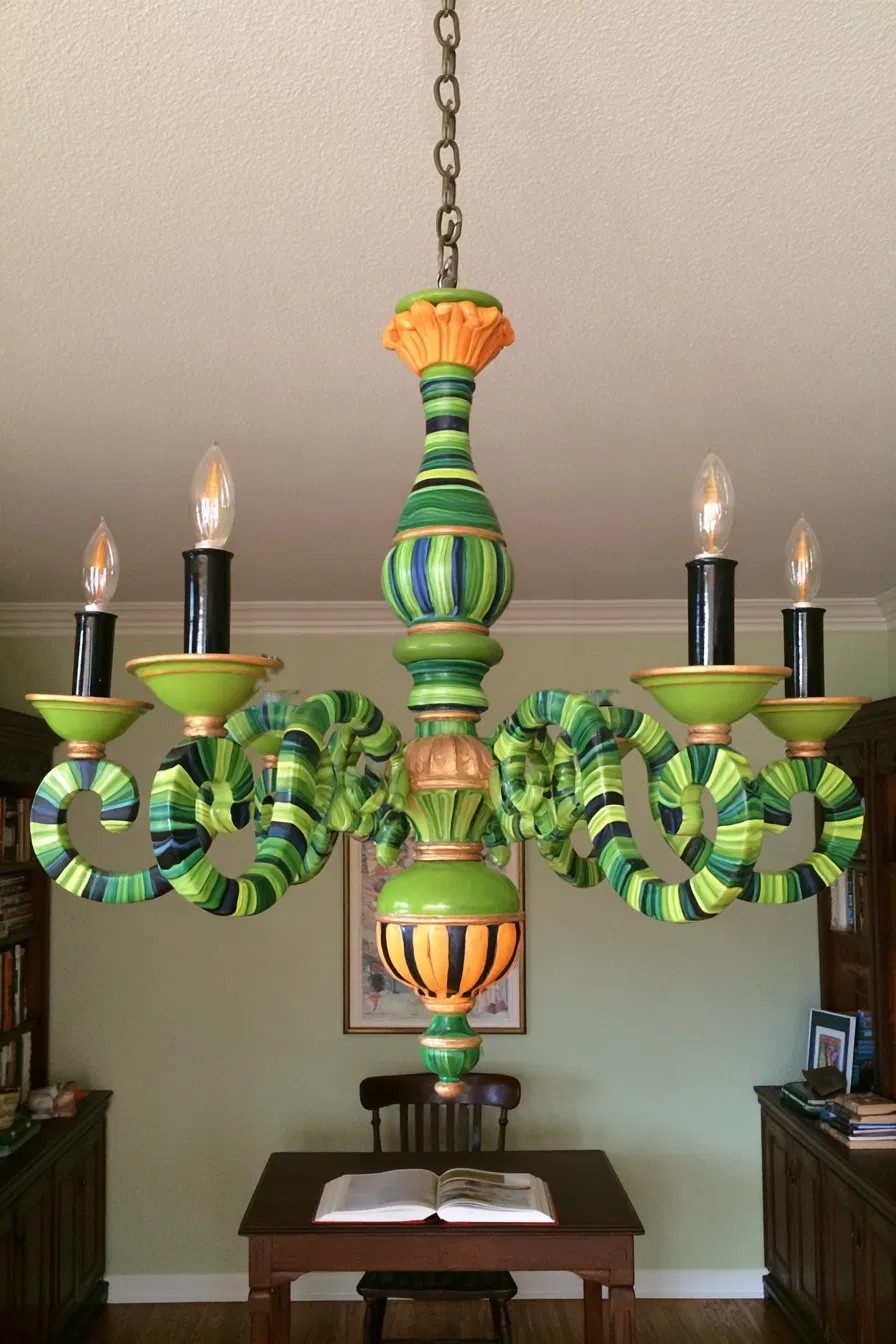
Stripes following the curved arms make this green chandelier feel like a painted sculpture. Navy lines sharpen the scrolls, while orange details on the central body stop the palette from becoming uniform. This approach reuses the fixture through a finish change, so it suits someone who likes the original shape but wants a more expressive focal point above a reading table.
Sketch the stripe direction on paper first, then test the colors on a sample with the same paint system. Broad stripes are easier to read from below than tiny marks on every curve. Use brushes suited to the rounded surfaces and allow each color to dry before adding the next. A nonworking decorative version can preserve the silhouette; retaining electrical use requires the assessment described in the preparation section.
2. Bronze Chandelier Planter With Moss Toned Clay Pots
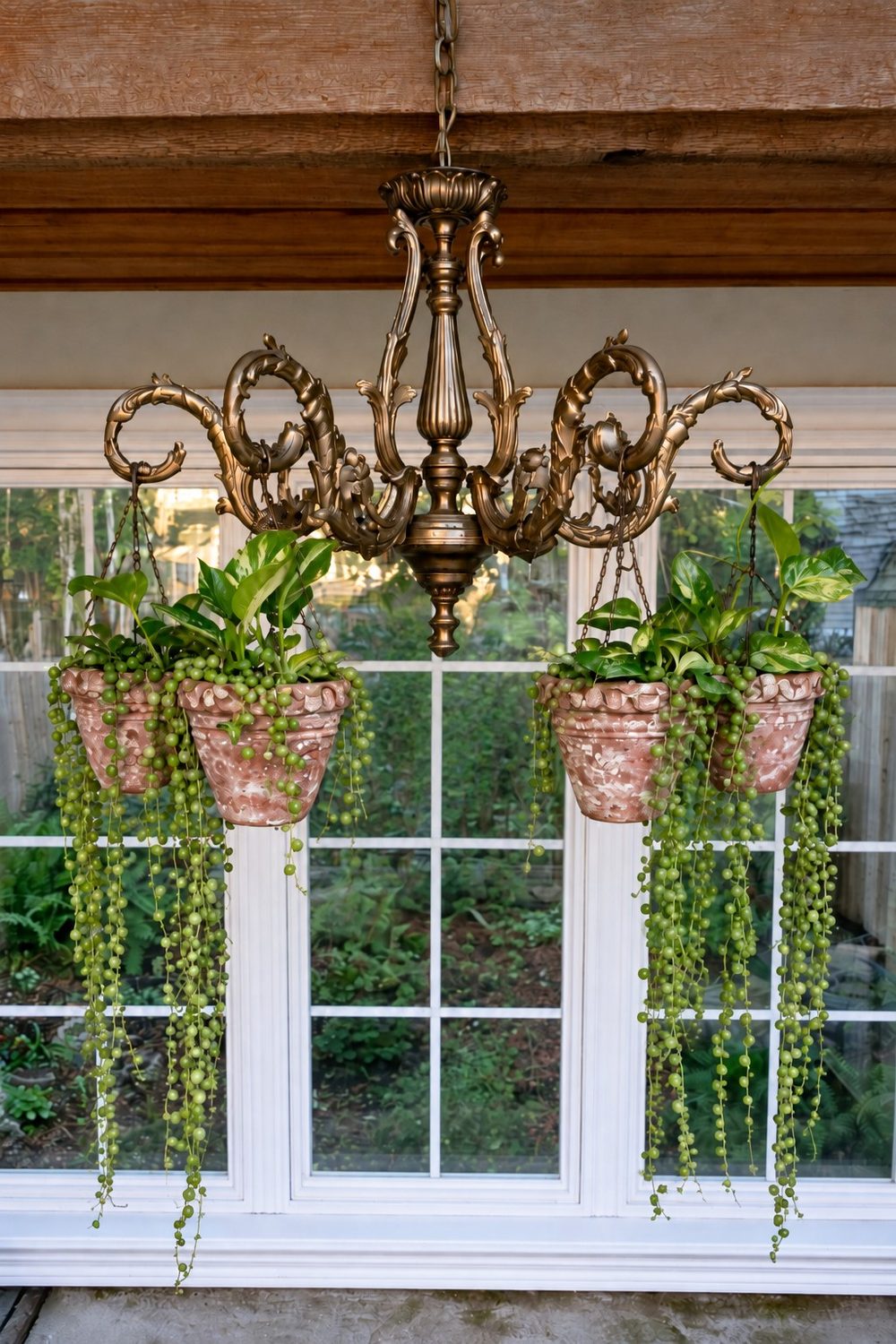
Small chains suspend the clay pots from the bronze arms, leaving the original chandelier's curls visible above the planting. The aged pink containers and long trailing stems contrast with the formal metalwork. This is a hanging container arrangement, with a different maintenance routine from the pots seated directly in cups in idea 11.
Choose removable pots and matching carriers that hold their filled weight securely, then select plants for the actual window or porch conditions. A leafy pothos arrangement and a string of pearls arrangement have different watering needs, so use separate containers if you want both effects. Provide drainage, water the pots where runoff can be managed, and return them after excess water drains. Set the hanging height so plants remain reachable as they grow. Compare frame and container arrangements with these indoor hanging planter ideas.
3. Olive Green Candle Chandelier in a Garden Tree
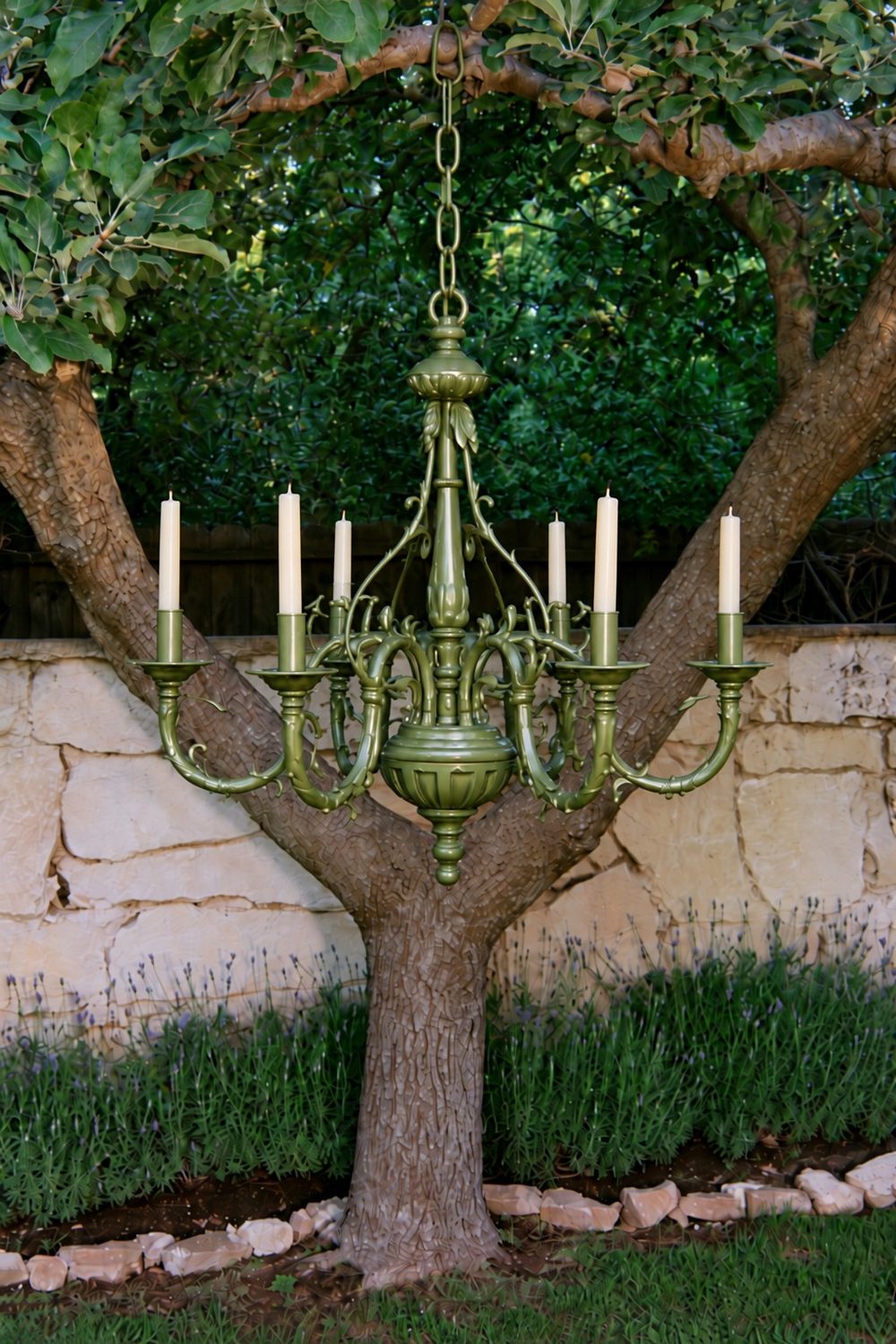
Olive green makes the chandelier recede into the tree canopy, while the white tapers create a clear outline along its arms. The result feels closer to a garden ornament than an indoor light moved outdoors. It can mark a sheltered seating corner without adding another planter or tabletop object to a small garden.
Borrow the green finish and repeated candle shape using flameless tapers chosen for the conditions in which they will be displayed. Have the tree's condition and proposed suspension point assessed for the fully loaded display before adding hanging hardware. Where that cannot be assessed, use a separately evaluated garden support. Position the ornament outside the route beneath it and where branches cannot strike it in wind.
4. Windowsill Chandelier Stand With Glass Plant Vases
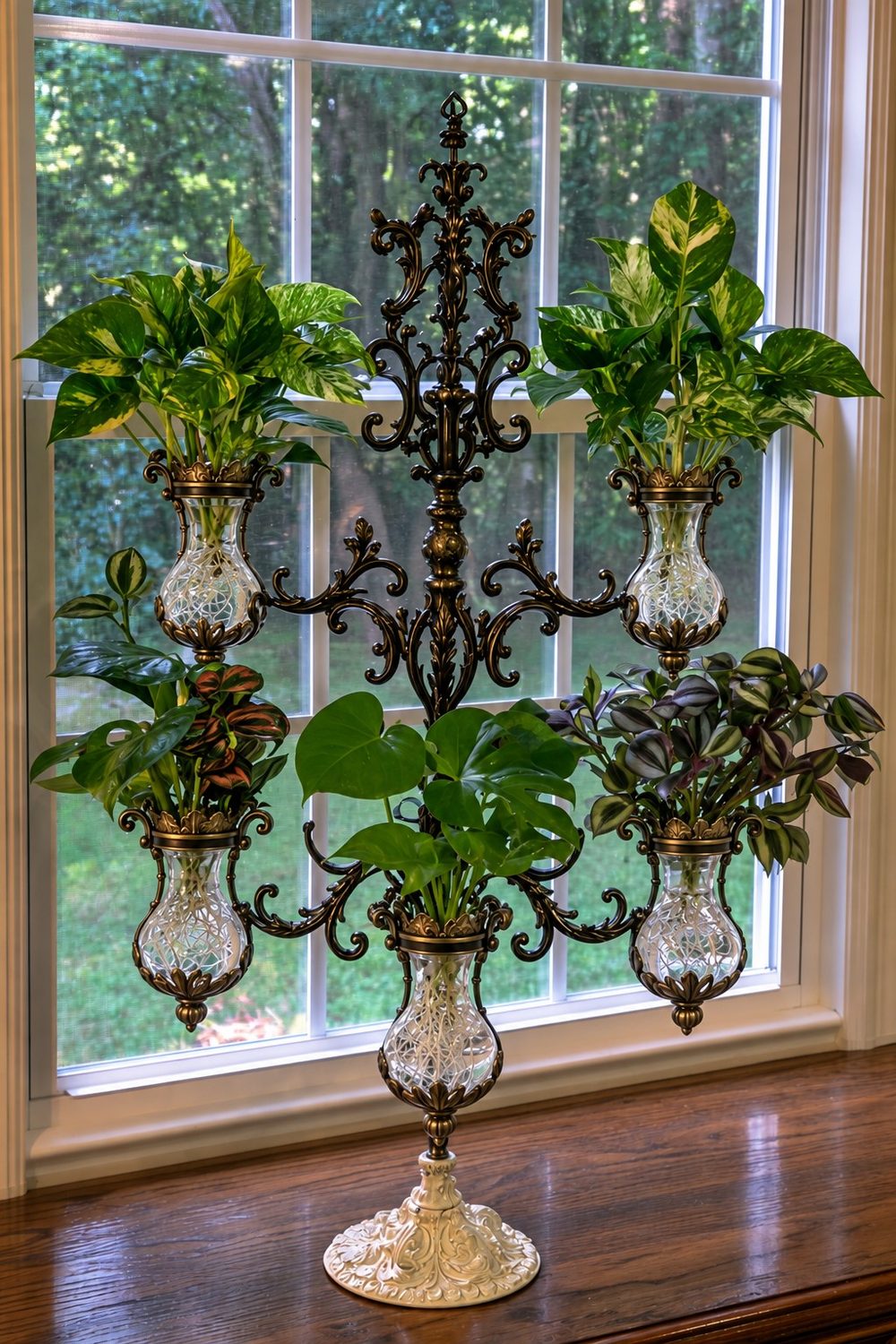
A decorative foot turns the chandelier frame into a standing display for cut glass vases. The tiered arms lift some foliage above the rest, giving a windowsill or console collection more structure than a straight row of jars. The glass remains part of the design even when the stems are small and the metalwork is most visible.
Begin with a stable freestanding frame, then choose removable vases whose bases match its holders. Test the arrangement on a level surface with the vessels filled before adding cuttings. Pothos and heartleaf philodendron are possible choices for a bright position out of harsh direct sun; these are suggestions, not identifications of every plant. Keep submerged leaves out of the water and transfer rooted cuttings to pots when established. A deep console may provide more secure space than a narrow sill.
5. Chandelier Frame for a Garden Feeding Station
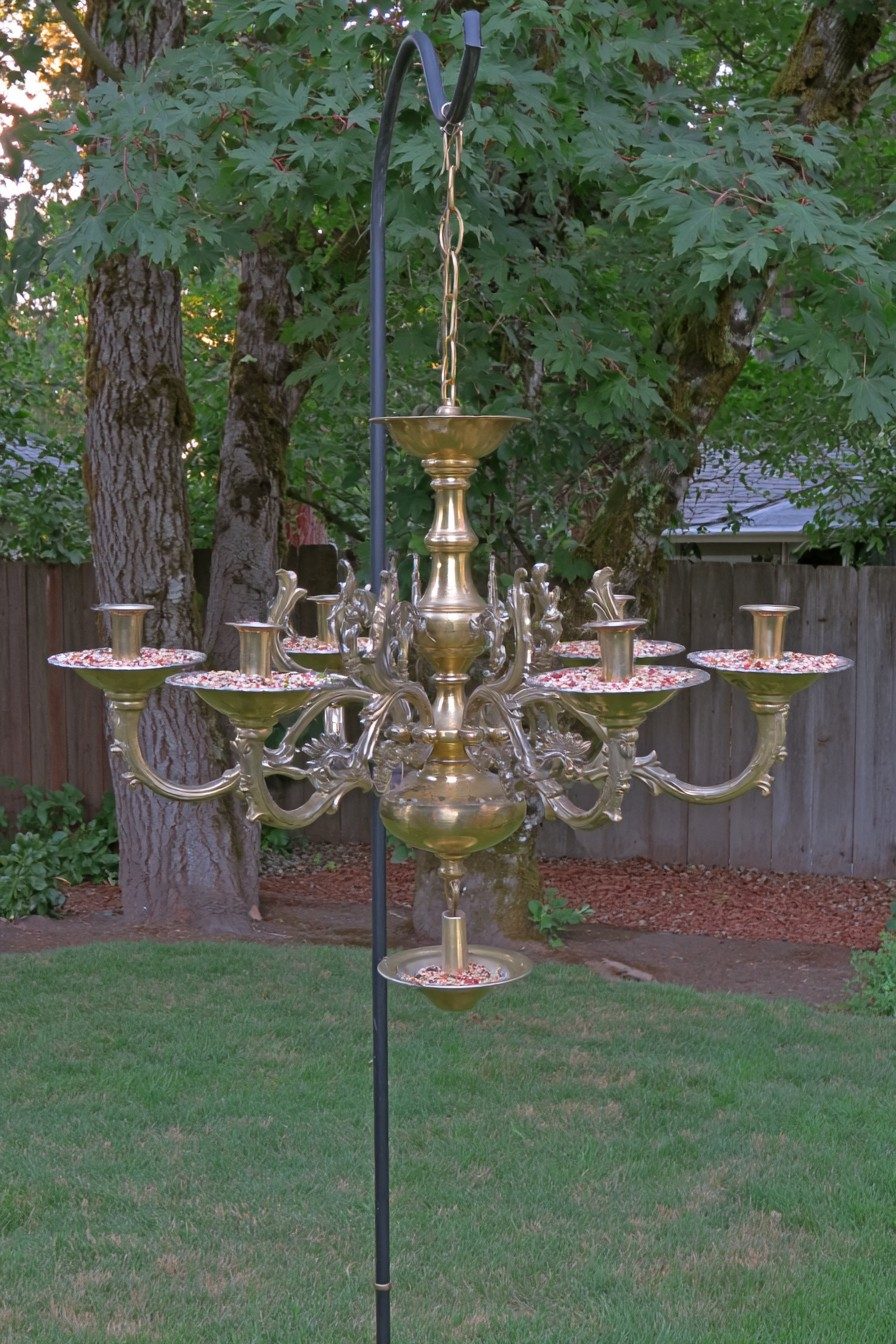
Broad dishes around a brass chandelier create a garden feeding station with a strong radial silhouette. The shepherd's hook keeps the central chain and ornate body easy to see. However, open seed surfaces can retain contaminated food and droppings, so the dish arrangement needs reconsideration before being used to feed wild birds.
For a working adaptation, use removable feeders designed to keep seed off flat feeding surfaces, following current wildlife guidance for your area on food and season. Have the chandelier and support assessed for those feeders and their filled weight; ornamental arms are not automatically load bearing attachment points. Make each feeder accessible for cleaning and let it dry before refilling. If that arrangement is impractical, retain the brass frame as an unfilled garden ornament and place a purpose made feeder nearby.
6. Wrought Iron Chandelier Pot Rack Above a Kitchen Island
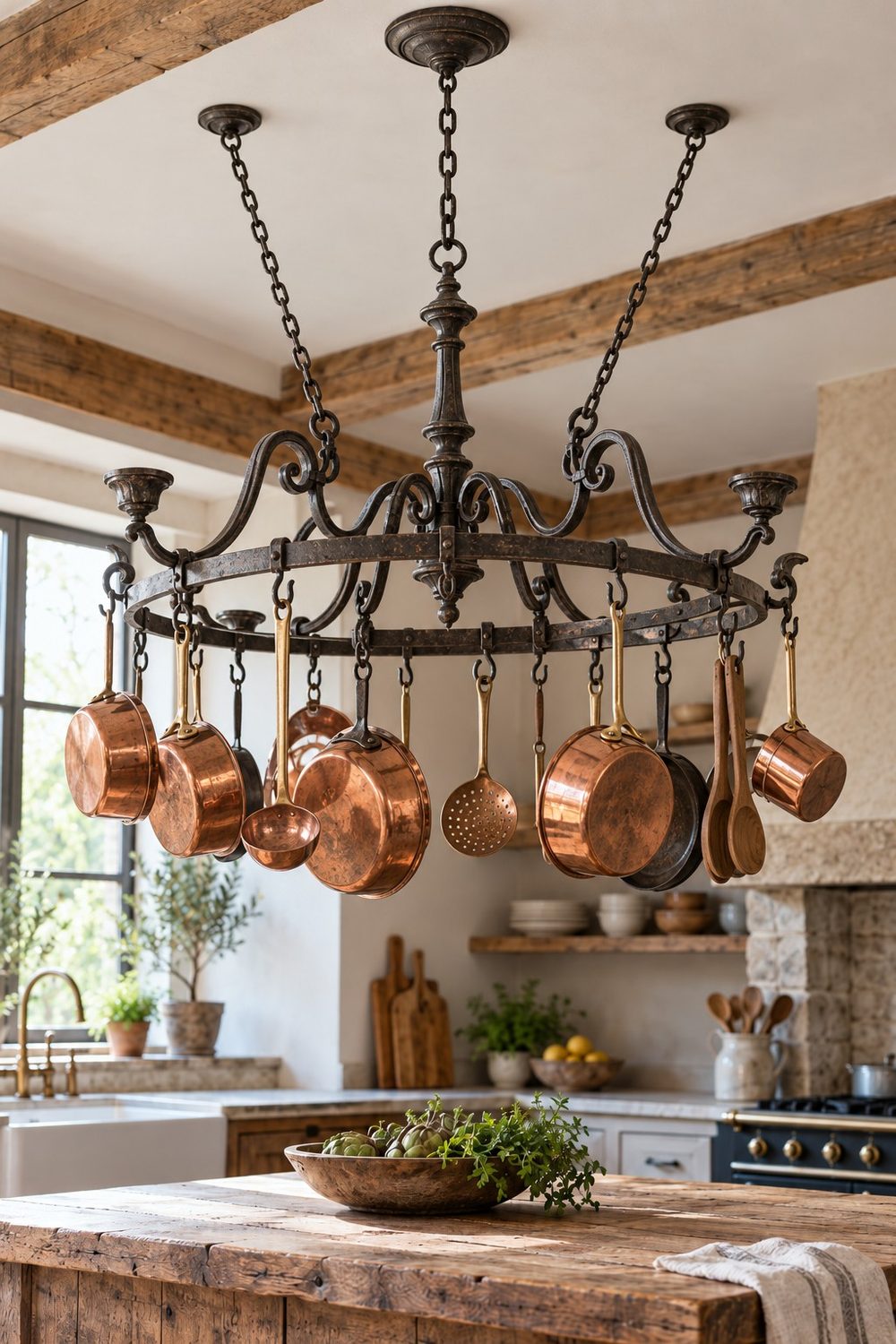
The dark metal ring provides a continuous storage line for copper pans and utensils, while the curved upper arms retain the chandelier's identity. Three suspension chains give this version a different structure from the single chain display pieces. It offers inspiration for a kitchen with cookware worth displaying and limited convenient storage close to the preparation area.
For a cookware conversion, assess the frame, connections, and ceiling structure for the full load before hanging utensils. Ask an installer or fabricator to plan it around the heaviest intended combination. Hooks should retain handles during everyday removal without catching neighboring pans. Set the position around reach, head clearance, and cooking movement before choosing its decorative height. A few lightweight utensils are a smaller adaptation only if the supporting assembly has been assessed for them.
7. Gilded Chandelier Fruit Basket for the Kitchen
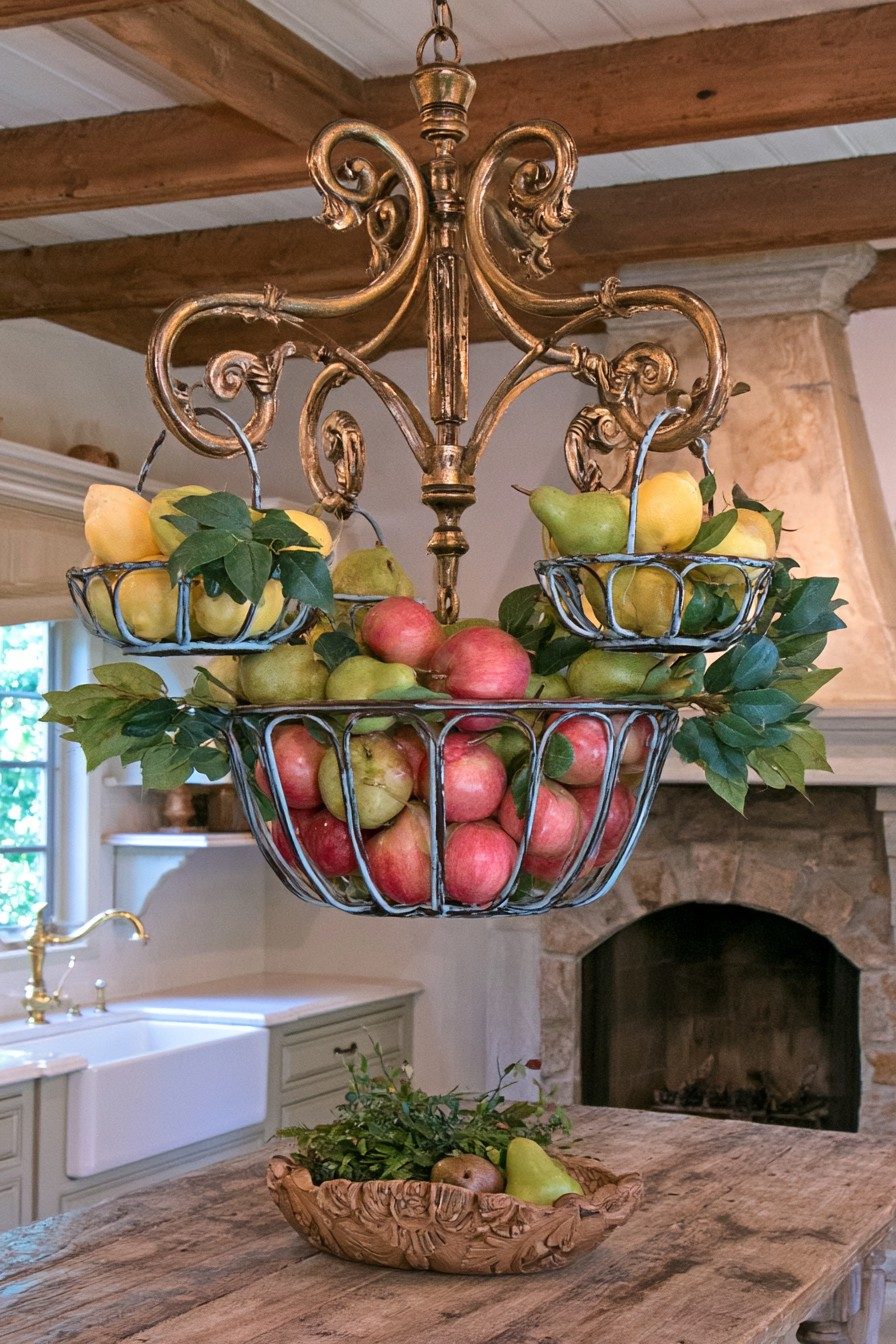
One large central basket and smaller side baskets make a chandelier into a tiered fruit display. Their open construction allows the fruit to remain visible, while the gold curls rise above the baskets instead of disappearing behind them. The idea works visually in a breakfast area where an overhead feature can replace a collection of countertop bowls.
Choose removable baskets intended for food storage and accessible enough to empty and wash. Keep food away from unknown old coatings on the chandelier. Allow for every filled basket and check the assembly's permitted loading and balance before choosing their positions. Check fruit for soft spots and remove decorative foliage that obscures inspection. If reaching over the island is awkward, position the display above an accessible side surface.
8. Gold Chandelier Bird Bath Under a Pergola
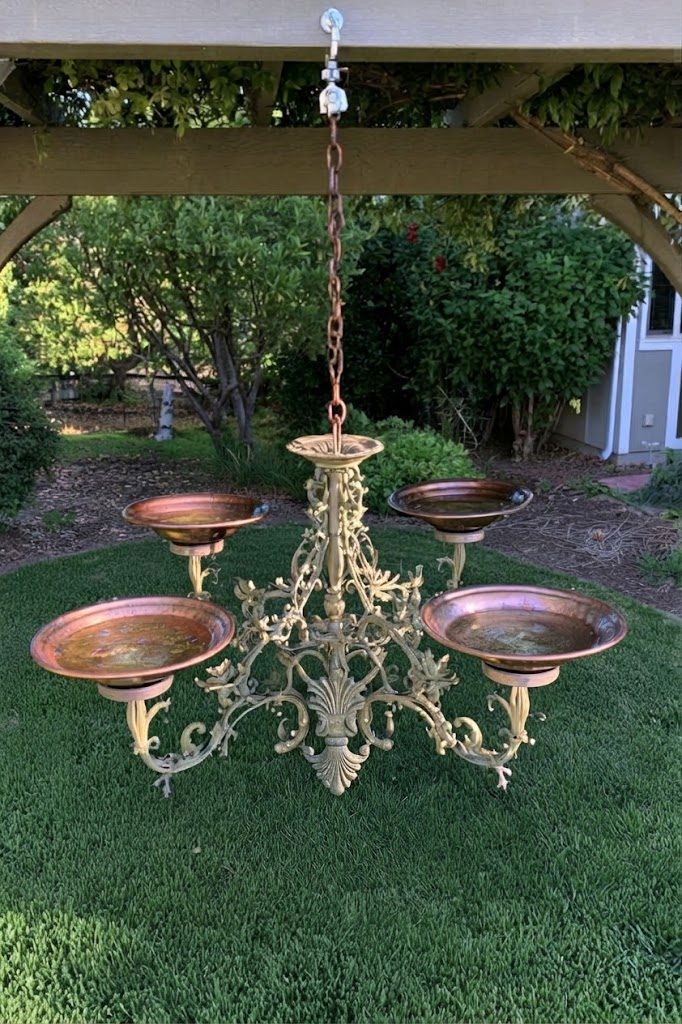
Wide copper toned bowls replace the upright candle shape on this gold frame, creating a low, open profile beneath the pergola. The repeated water surfaces make it an attractive garden feature. A successful bird bath needs more than that outline, though: the bowls must offer usable edges, secure footing, and a dependable place for a bird to land.
For a bathing adaptation, choose removable shallow bowls intended for the purpose, with gently sloping edges and a surface birds can grip. Keep unknown metal coatings out of contact with the water. Replace water daily and clean the bowls weekly, with more frequent attention when dirty. If the suspended frame swings or makes cleaning difficult, use it decoratively and provide a separate stable bird bath at ground level. Its appearance does not guarantee that birds will use it.
9. Antique Brass Chandelier Spice Rack
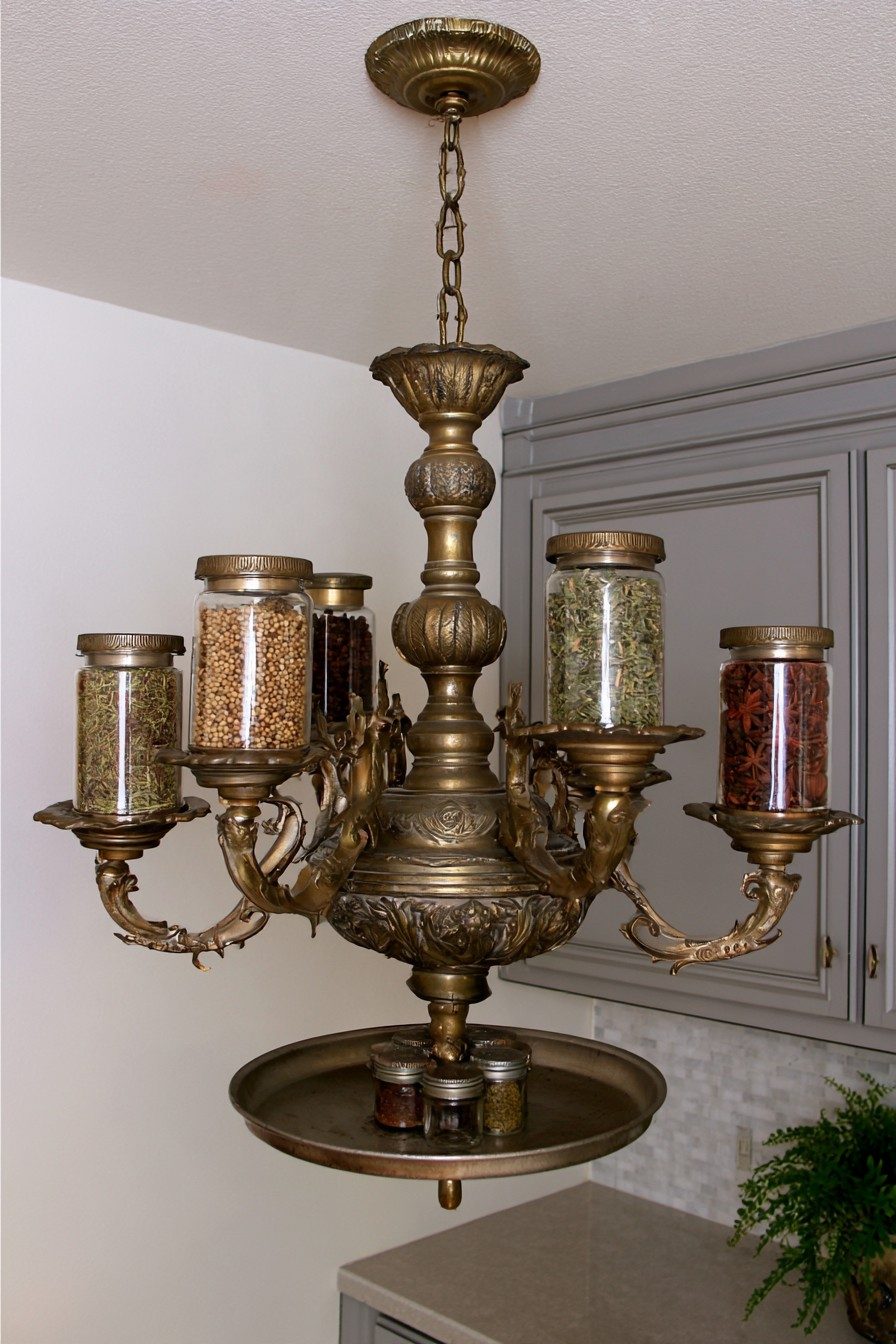
Glass spice jars turn the individual arms into a circular display, with a lower tray holding smaller jars. The arrangement keeps the contents visible while making the brass frame part of the kitchen's character. It is most useful for someone who wants a compact, reachable collection, not an overhead store for every spice in the cupboard.
Use closed jars and individually retaining holders so jars cannot slide off when a neighboring one is lifted. A tray connection needs to be designed for its contents; the finial is not automatically a storage mounting point. Keep the display away from stove heat, steam, and direct sun, and label jars where you can read them from the working position. Test whether lifting one jar makes the whole fixture swing before putting fragile containers into everyday use.
10. Shabby Chic Chandelier Wall Sconce With Dried Flowers
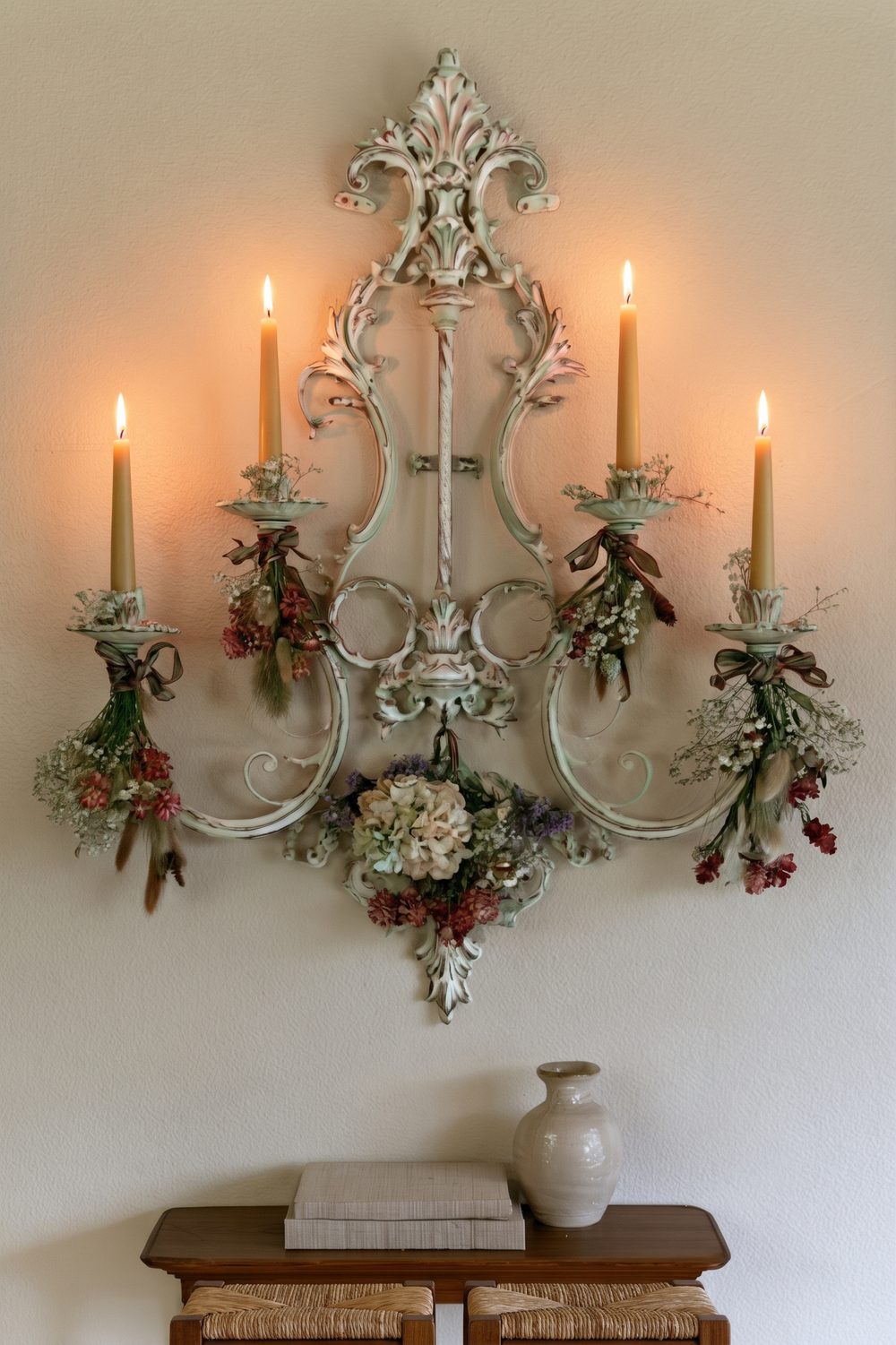
A pale mint and cream frame spreads across the wall like an ornamental relief, with small dried flower bundles adding softness beneath the cups. Its worn color and romantic botanical detail make it recognizably shabby chic. The flat composition suits a console wall where a hanging fixture would occupy more space than the room allows.
Use flameless candles with dried flowers and ribbon, keeping this a decorative wall arrangement. Select a frame suited to wall placement and have its attachment planned for the wall material and total weight. A small matching flower bundle under two cups can suggest the style without filling every curl. Create the worn finish with a controlled painted effect after checking the old coating, and make the flower ties removable so dusty or faded bundles are easy to replace.
11. Bronze Chandelier With Succulent Pots in a Sunroom
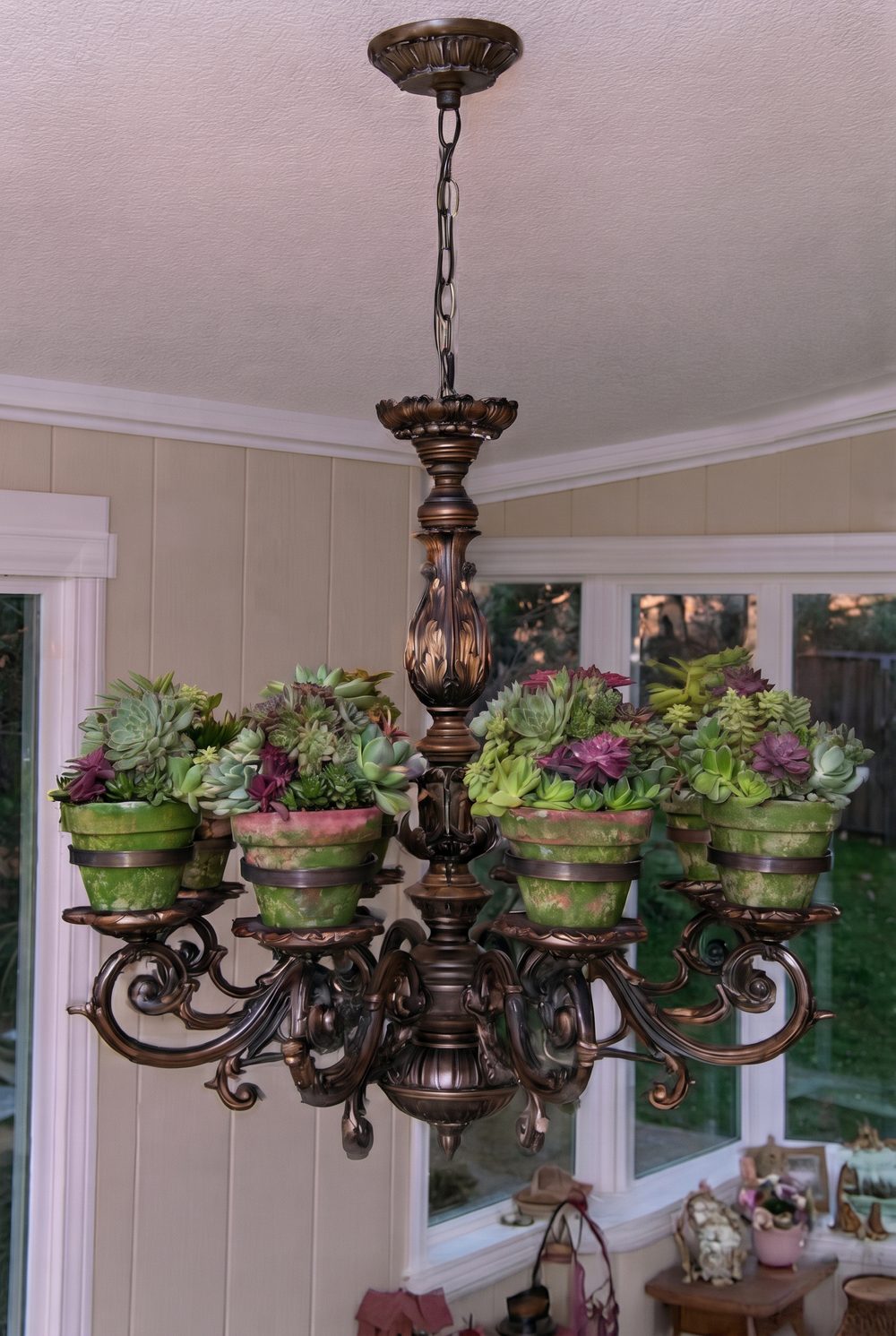
Succulent rosettes sit close to the bronze arms, making this planter denser and more compact than the long trailing arrangement in idea 2. Green and pink pot finishes echo the plant colors, while the chandelier's central column remains visible. It is a sunroom idea whose success depends on the available light, not simply on the room being called a sunroom.
Choose containers with drainage and a growing mix matched to the selected succulents. Echeveria and many sedums need stronger light than a typical dim indoor corner; check the requirements of the particular plants before combining them. Remove the pots for watering, drain them thoroughly, and inspect the mix before watering again. Several plants can share the display while keeping separate care routines. Leave enough space to lift each pot without scraping neighboring leaves or pressing on the metal scrolls.
12. Teacup Chandelier Planter on a Shepherd's Hook
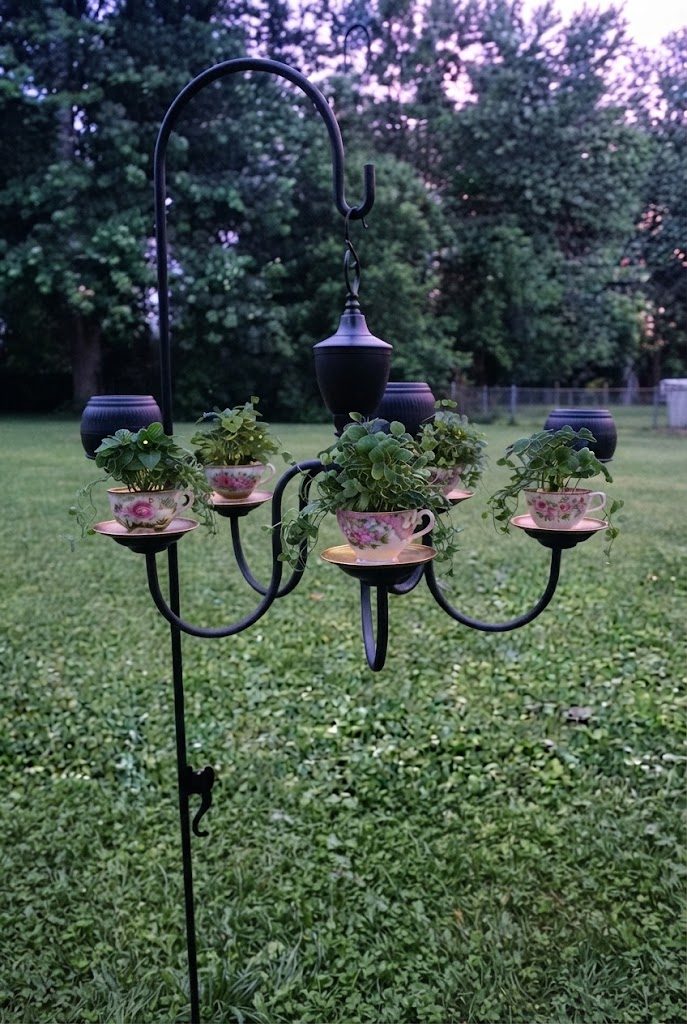
Floral teacups against a dark chandelier frame turn mismatched china into a small garden display. The saucers make the cups look intentionally grouped, while the dark metal keeps their patterns distinct. This is a decorative container concept for a sheltered corner, with less growing volume than the clay pots in the other planter ideas.
Use the teacups as outer containers for small removable nursery pots with drainage holes, wherever their dimensions allow. Empty water left in the cups after watering. A plant that soon outgrows the available space will need moving to a larger container, so select slow, compact growth and check the fit first. Have the china carriers and frame assessed together; glue alone is not a dependable plan for suspended breakable pots. Keep the arrangement accessible for lifting and cleaning each cup. For other found object container approaches, explore these unusual hanging planter ideas.
13. Porch Chandelier With Hurricane Glass Candle Holders
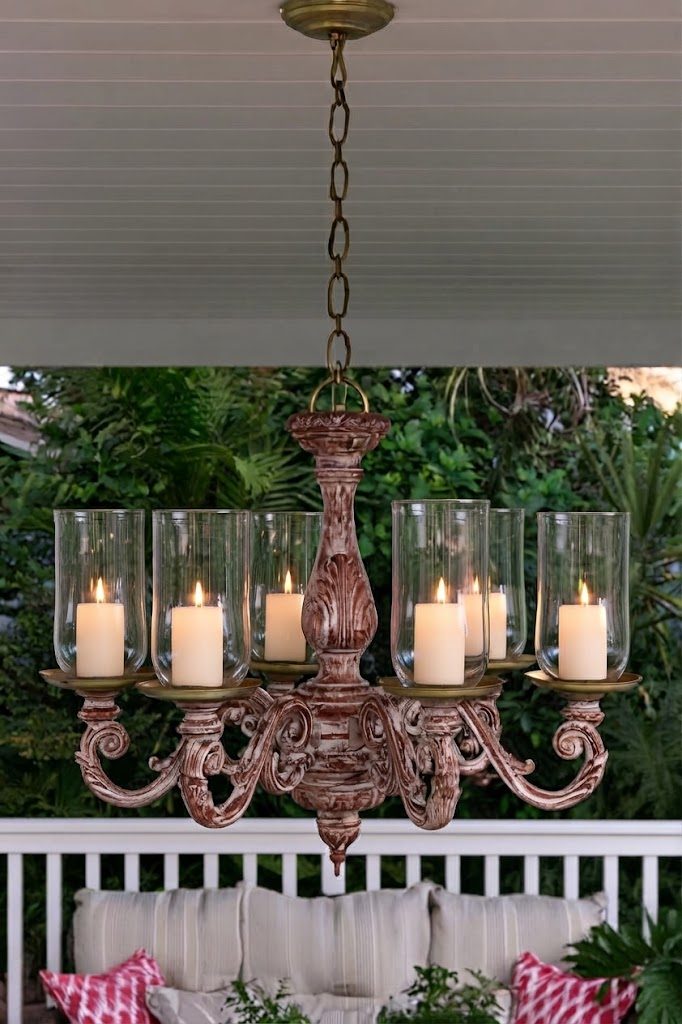
Clear glass cylinders repeat around the whitewashed red frame, making the candle shapes visible without hiding the carved body. Their vertical outline gives this porch display a different character from the slender garden tapers. The finish can relate to weathered furniture and pale cushions, while the darker red showing through adds definition to the details.
For a decorative adaptation, use flameless pillars and securely retained glass holders whose bases fit the supports. Glass surrounding a candle does not by itself make an improvised fixture safe for a flame. Keep the cylinders removable for cleaning and allow a level, stable seat for each one. A dry brushed paint effect can reproduce the worn appearance without aggressive distressing. Check the exposure under the porch roof before selecting the finish and candle products.
14. Chandelier Mug Holder for a Breakfast Nook
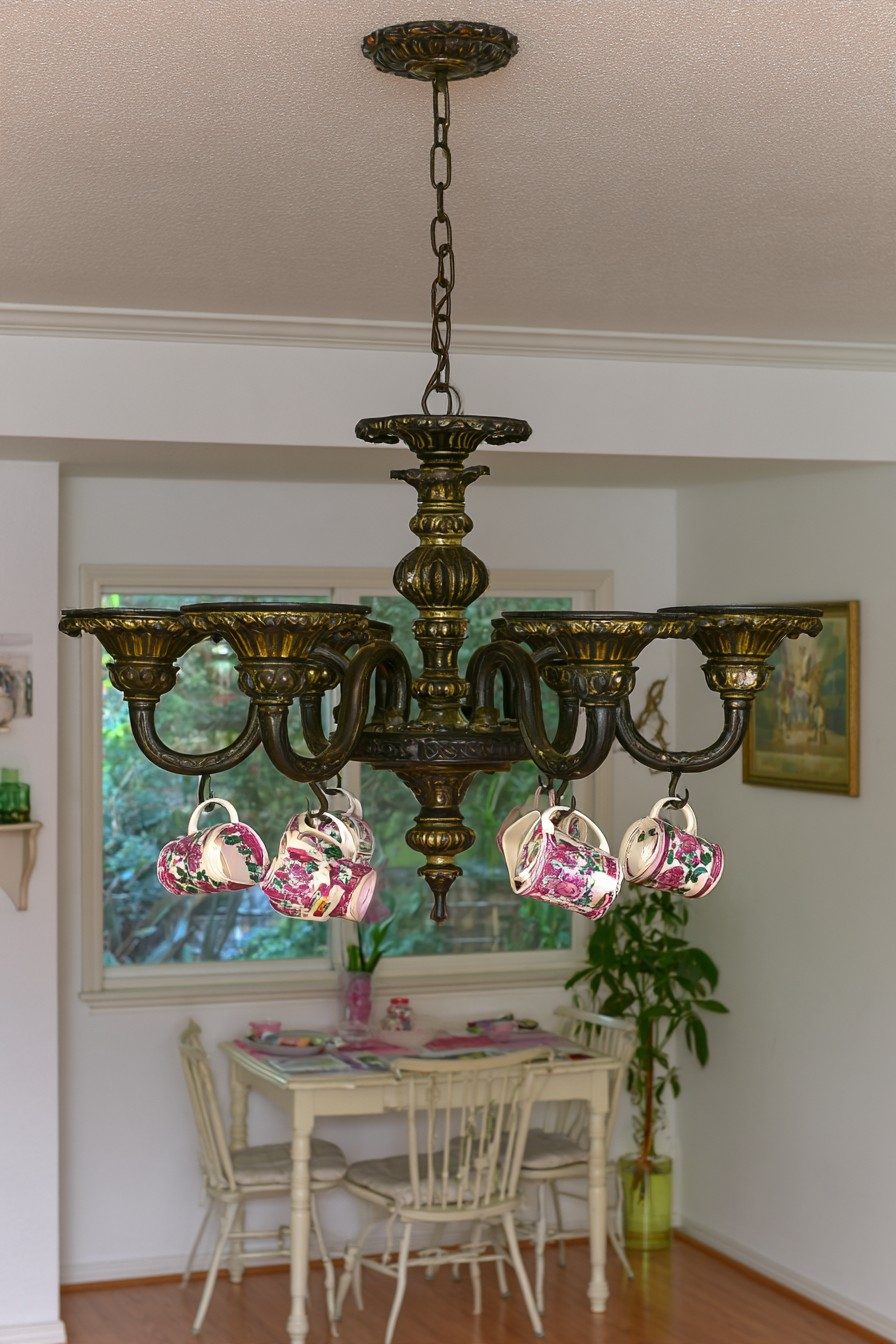
Floral mugs hang beneath the bronze arms, leaving the upper cups empty and showing the original chandelier shape. The display belongs naturally near a breakfast table or coffee station, where a coordinated mug collection can become part of the room. Unlike the fruit baskets, it provides individually selected pieces rather than one shared storage container.
Choose retaining hooks with smooth contact surfaces that suit the mug handles, then have their connections to the frame assessed. Test the removal path so one mug can be taken down without striking the next. Keep the selection small enough to remain reachable and account for the heaviest mug you intend to use. Chipped handles or cups that swing into the frame belong elsewhere. A reduced version with a few light mugs can keep the display readable.
15. Family Photo Chandelier
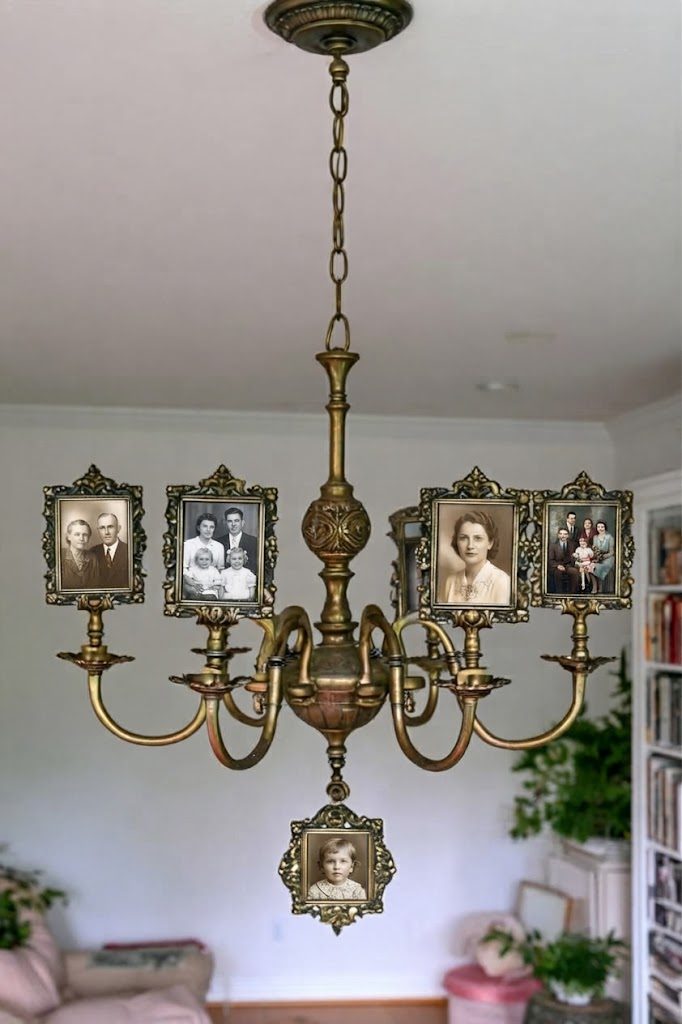
Small framed portraits occupy the chandelier's arms, with a further portrait suspended below the central body. Repeated brass tones turn separate photographs into a circular family display. It gives a library or living room a personal focal point without taking over an entire picture wall, particularly when viewers can approach it at a comfortable height.
Print copies of family photographs and keep irreplaceable originals in appropriate storage. Lightweight frames with acrylic glazing reduce the burden and the risk associated with overhead glass. Plan holders that retain each frame and allow it to be removed for dusting; decorative candle cups are not automatically suitable frame mounts. Aim the portraits toward the main viewing directions and keep the lower frame clear of passing shoulders. Leave electrical components unused in this display conversion.
16. Freestanding Chandelier Strawberry Planter
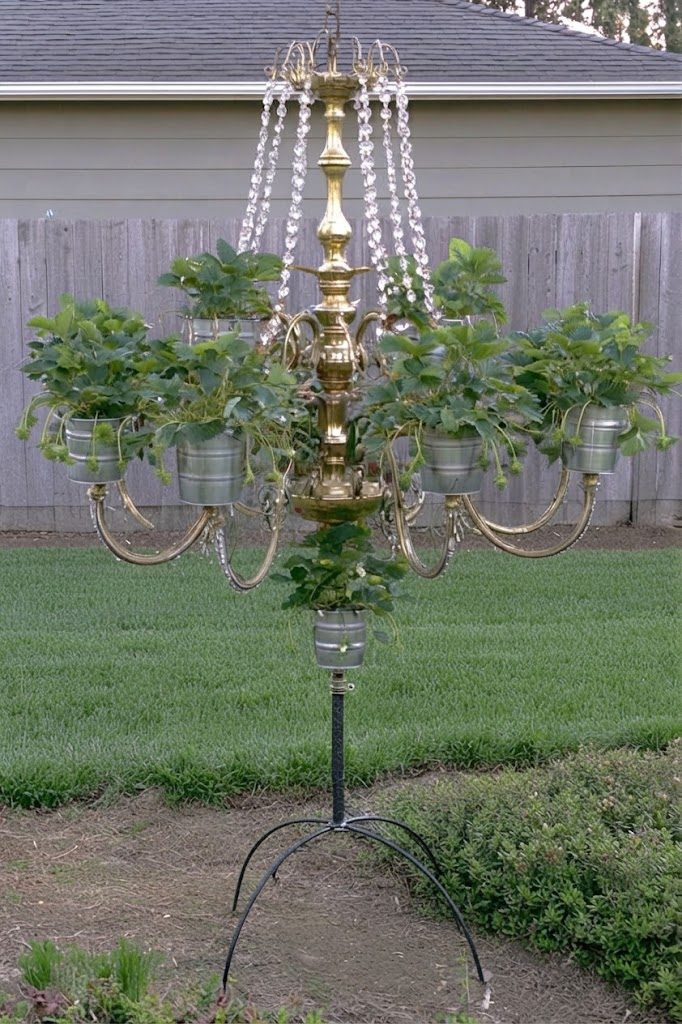
A freestanding support raises the brass arms and galvanized containers into a strawberry display, with retained crystal strands adding a decorative layer above the foliage. This makes the chandelier part of a productive garden instead of only a flower arrangement. The stand avoids a ceiling location, but its stability matters as containers fill with water and plants grow outward.
Use drained containers deep enough for the selected strawberry plants, leaving the crown at the compost surface. Position them for good sun and access to watering and picking. Check container moisture frequently during warm weather and water according to the compost, not a fixed daily rule. Have the loaded frame and stand assessed together, including the uneven load when a container is removed. Keep crystal strands clear of leaves and containers so maintenance does not snag them.
17. Chandelier Wind Chime With Brass Bells
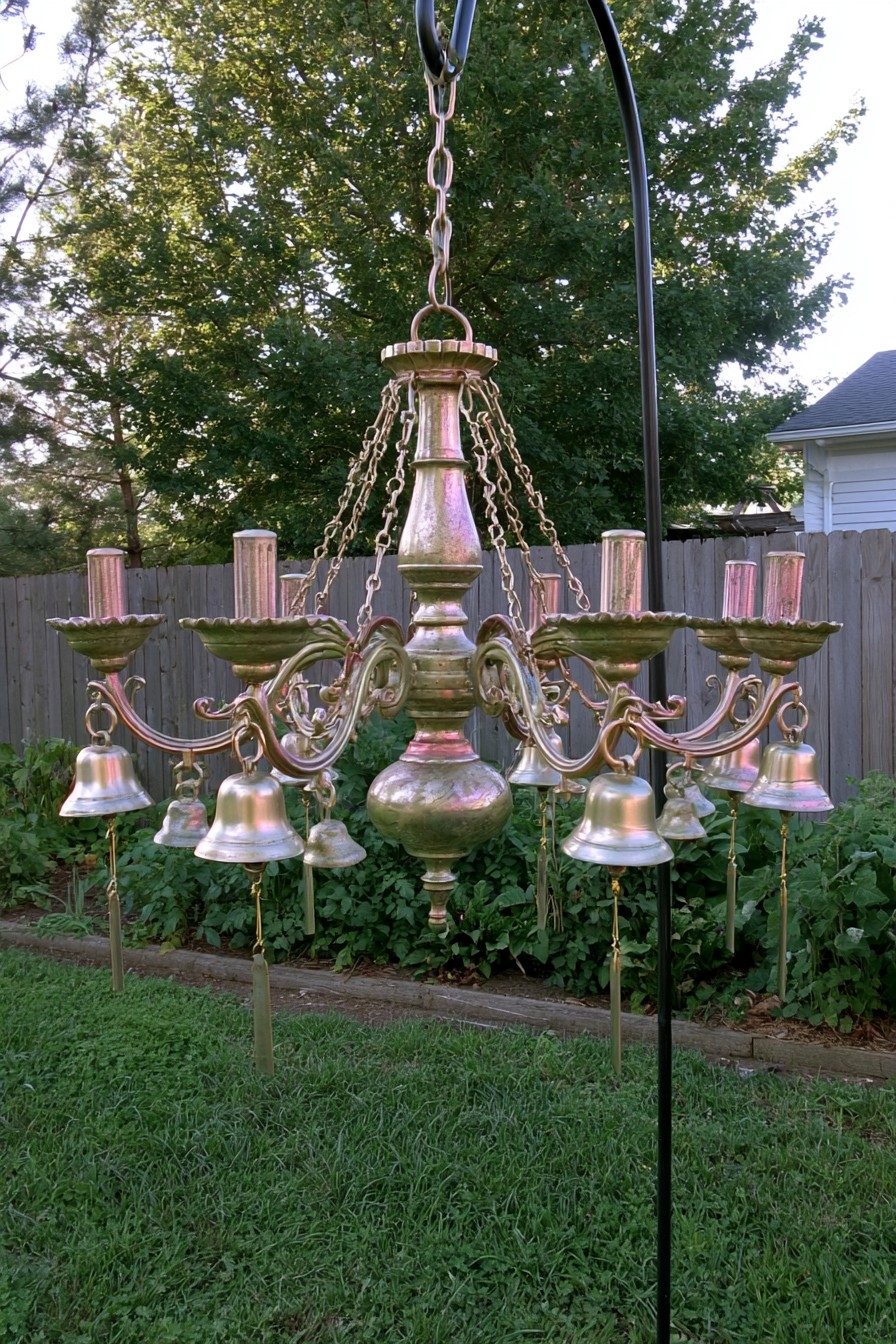
Bells suspended below the arms give this chandelier a second life as a garden sound feature. Their varying sizes create a lively lower outline, while chains descending from the upper body preserve the fixture's layered shape. It suits an open garden position where a little movement is welcome and the sound will not intrude on a bedroom or a neighbor's seating area.
Choose bells with working clappers and enough freedom to move; merely hanging metal shapes does not guarantee a chime. Set their lengths so bells avoid striking brittle ornaments or the main body. A smaller selection can produce a clearer arrangement than filling every available arm. Assess the frame and support for outdoor movement, and include a way to take the chime down in strong wind. Test its sound before committing to the final location.
18. Green and Orange Painted Porch Chandelier
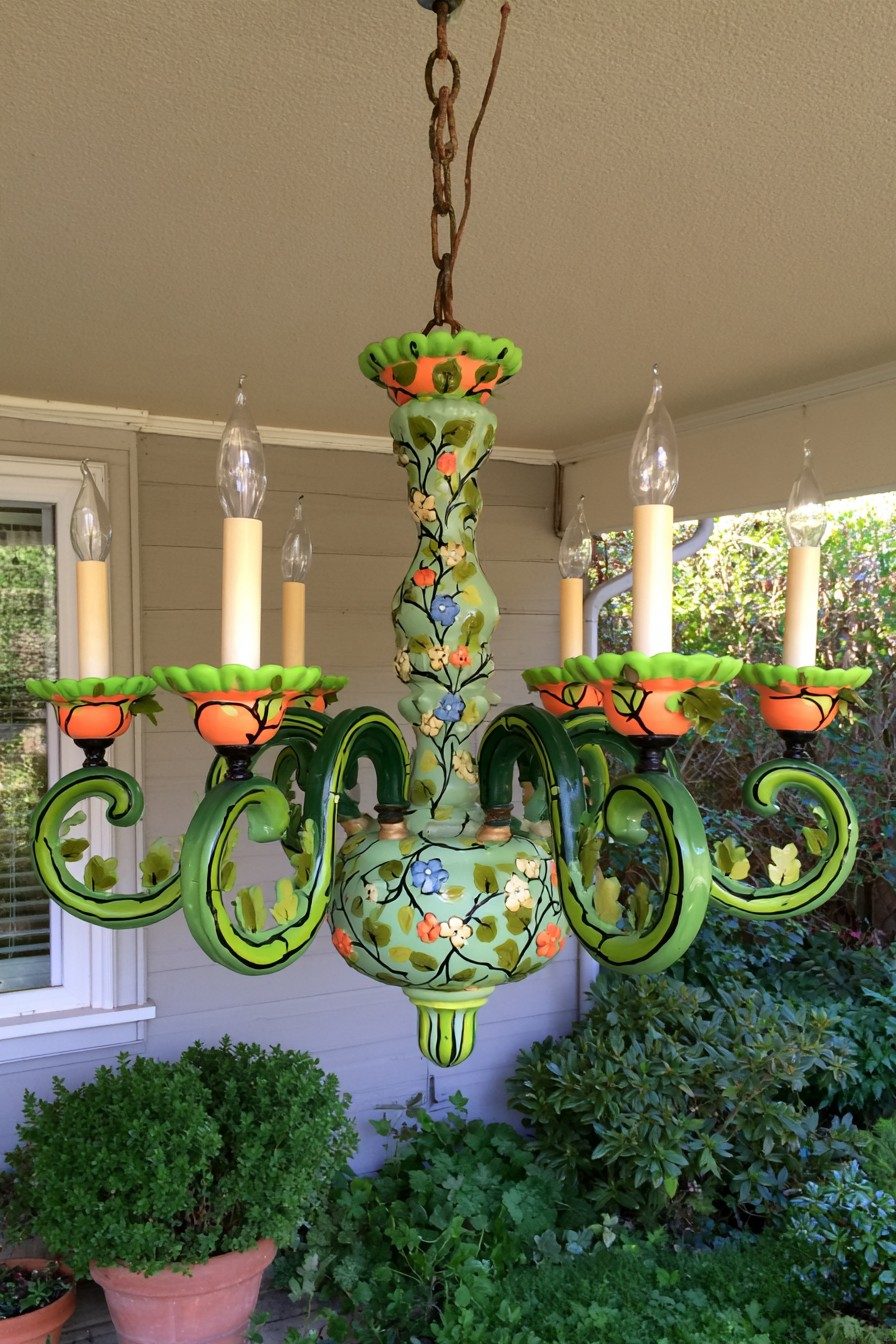
Green scrolls and orange cups make this painted chandelier relate to a porch garden without using live planting. Small floral marks on the pale central column provide a quieter detail between the stronger color blocks. It is a useful makeover when you want a botanical atmosphere but prefer a display that needs no watering or soil handling.
Assign the main green to the arms, orange to the cups, and a pale ground to the column before adding the fine vines. Keeping those roles separate makes the pattern easier to follow. Choose a compatible coating system for the fixture's material and actual porch exposure; a clear coat alone cannot make an indoor object weatherproof. If it stays electrically functional, the finished installation also needs assessment for that location, including moisture exposure.
19. Folk Art Floral Chandelier for a Dining Room
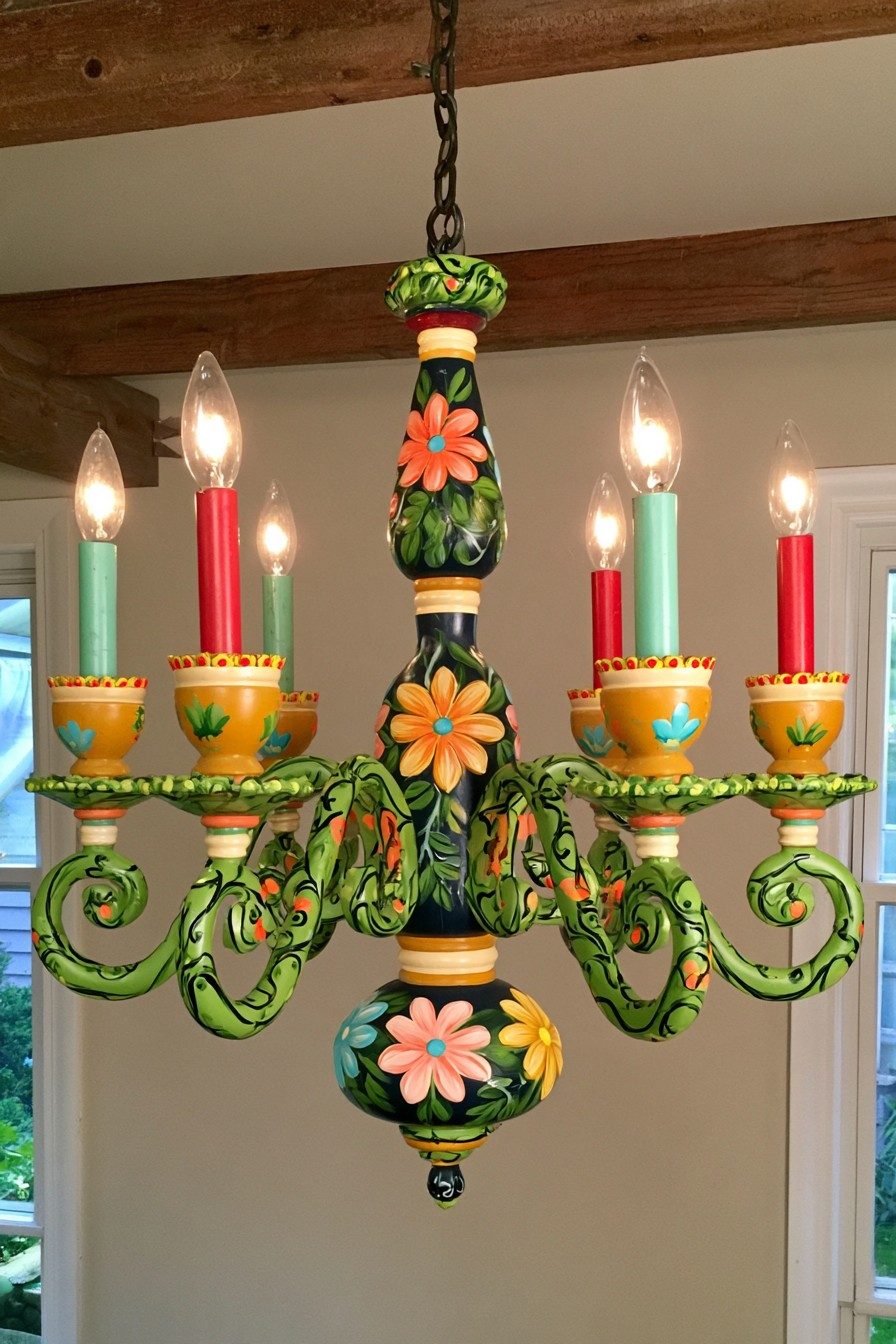
Large flowers on the dark column give this dining room version a recognizable folk art character. Smaller motifs continue onto the green scrolls and yellow cups, while alternating red and mint sleeves add another rhythm. The decoration follows the fixture's original divisions, so the color feels organized despite the number of painted details.
Practice a simple petal, leaf, and dot combination on a curved sample before repeating it across the body. Use larger motifs on broad surfaces and smaller marks on narrow arms, leaving enough dark background to separate them. Existing cast details can guide the pattern without adding new ornaments. Repeat a few of the colors in table linens or ceramics for a connection to the room. Follow the painting example above for surface preparation and any retained electrical function.
20. Navy Floral Chandelier Under a Garden Pergola
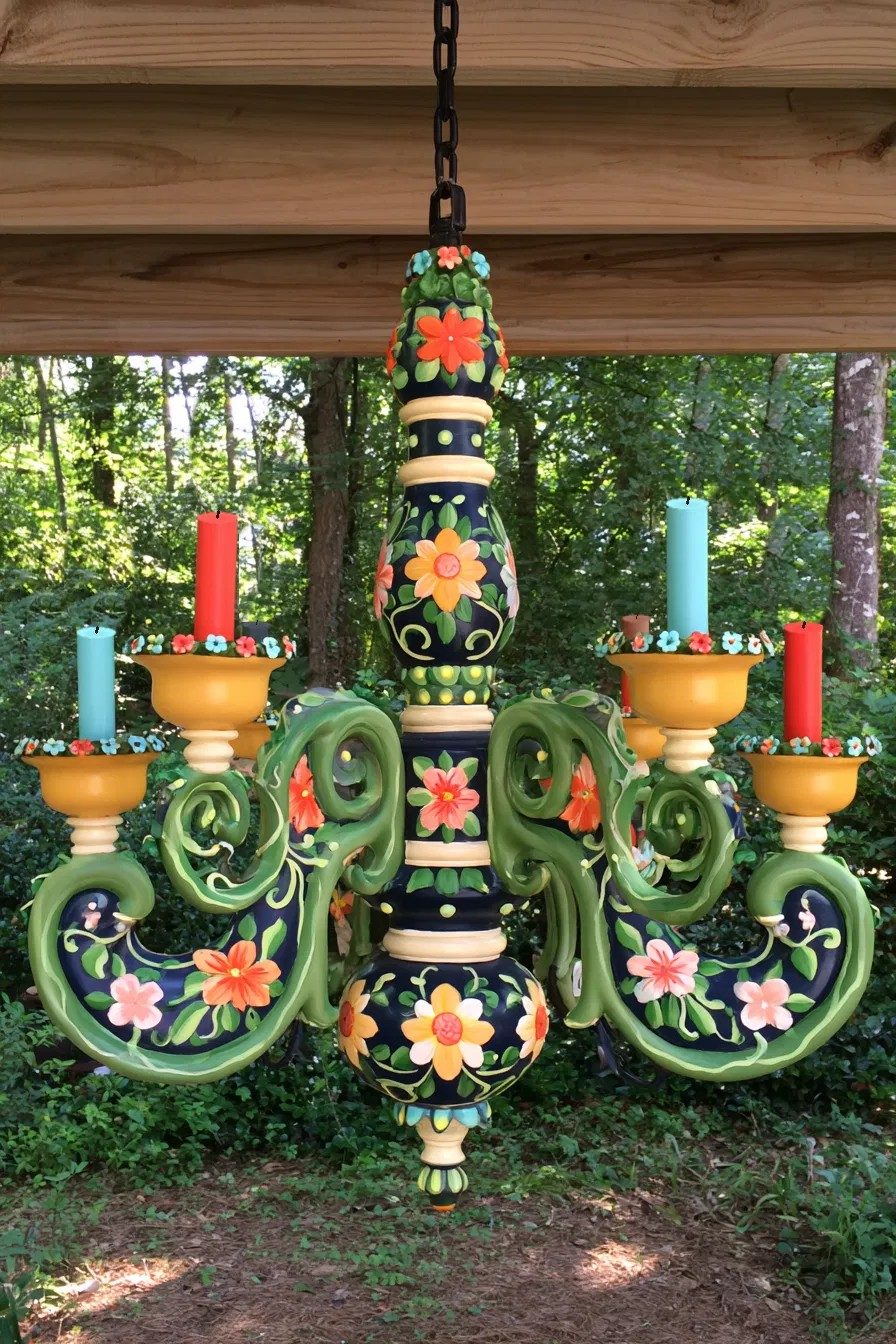
Raised floral details make this navy and green chandelier more sculptural than the flatter folk art painting in idea 19. Pale bands divide the central column, while small flowers edge the yellow cups. Beneath a pergola, it creates a decorative focal point whose depth remains visible even when viewed from the side of the table.
Begin with a fixture that already has molded detail, or use lightweight decorative additions compatible with the metal and chosen display conditions. Generic air dry clay is not automatically appropriate for damp outdoor exposure. Test any added material and its attachment before repeating it, accounting for the extra weight. Choose flameless candle shapes for the adapted display. A painted flower border around the cups offers a smaller version when raised decoration would be difficult to maintain.
21. Gothic Rose Chandelier in Orange, Green and Black
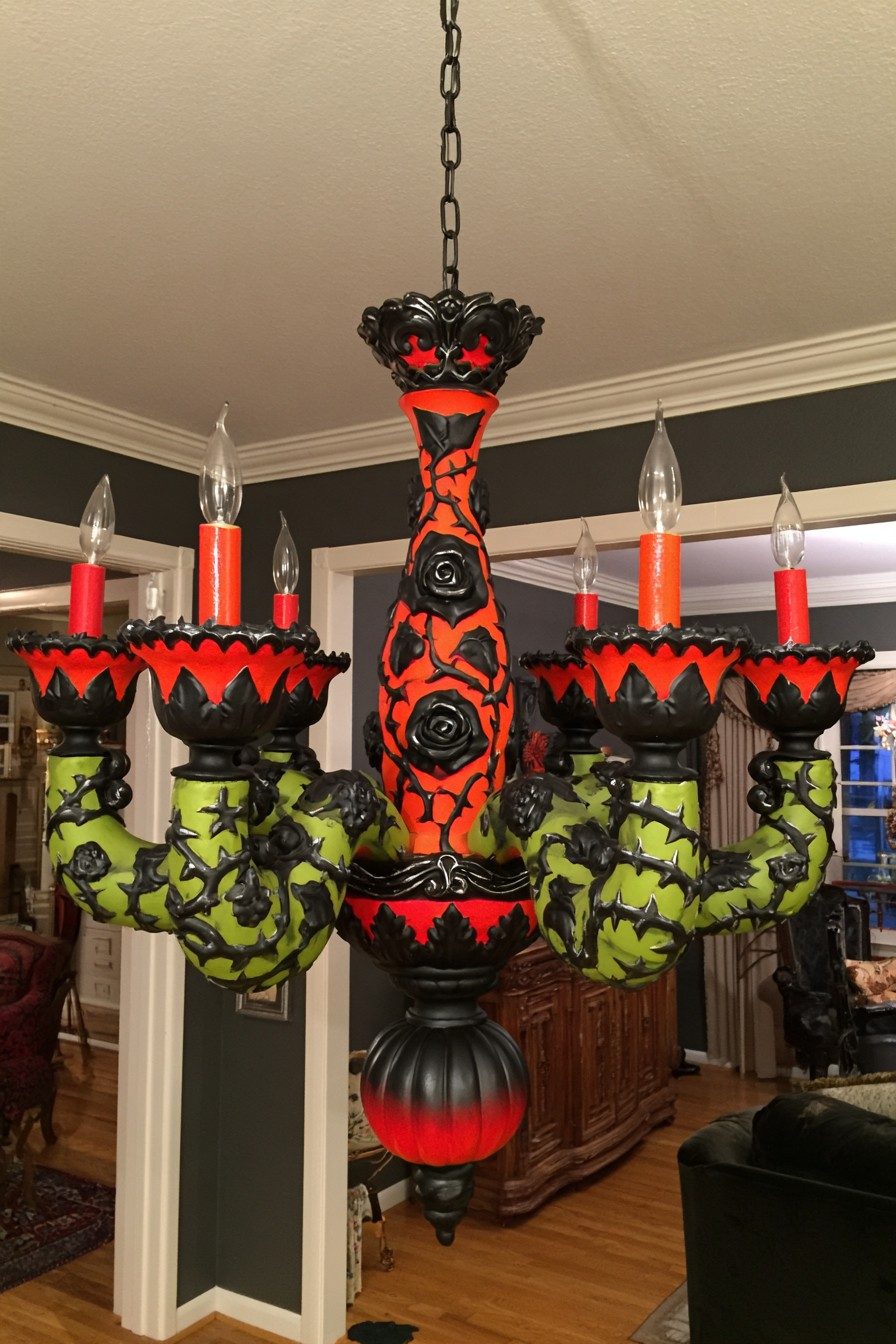
Black roses and thorn like vines turn the bright orange and lime green surfaces into a Gothic statement. The dark detail interrupts the color blocks, while red sleeves and the shaded lower bowl give the chandelier a more theatrical finish. This interpretation can anchor a Halloween room, but it also suits a year round interior that uses bold color and ornamental shapes.
Let the roses define a few focal areas instead of covering every curl. Painting existing relief gives less added weight than attaching a full collection of new sculpted pieces. If you add ornaments, select a material and fixing method compatible with the frame, keeping servicing areas accessible. Echo the dark floral motif in one nearby textile or decorative object, while giving the chandelier room to remain the main feature. These Gothic decoration ideas offer ways to connect a dark floral focal point with the rest of a room.
22. Pastel Pink and Lilac Chandelier
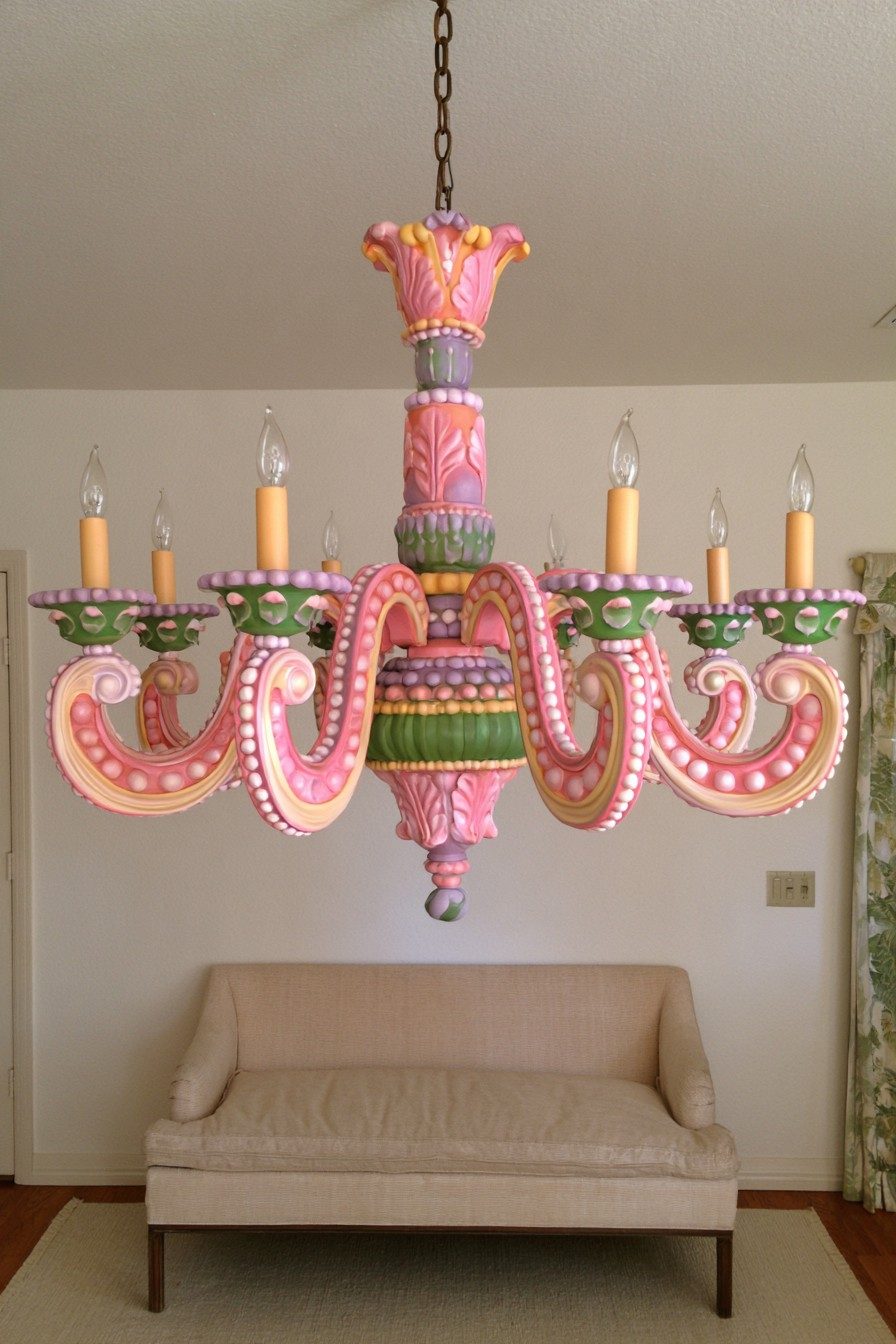
Pink scrolls, lilac bands, green cups, and raised dot trim make this chandelier feel like a confectionery inspired decorative object. The repeating dots outline the arms, distinguishing it from the floral painted finishes. A plain background allows the sweet palette to carry the composition, so the room does not need matching patterns on every surrounding surface.
Map one color to each part of the fixture, then apply the dot detail consistently around the visible edges. Painted dots can suggest the effect where additional raised trim would complicate cleaning or attachment. Test the spacing on a sample before working around the curved arms. This can be a decorative hanging sculpture or a professionally assessed light, depending on the fixture's condition. A restrained version could use the pink scrolls and lilac bands without reproducing every ornament.
Keep the Conversion Useful After the First Display
Choose one role for the fixture and keep maintenance part of the design. Empty containers and removable accessories before lifting a heavy assembly. Check growing space as plants develop, remove food storage pieces for washing, and replace worn or loose decorative ties and fittings. Inspect outdoor finishes and connections after wet or windy weather, following the products' care guidance. Store seasonal pieces dry and labeled so their positions can be restored without rebuilding the arrangement from memory.
For a first makeover, use the sound frame you already have to guide the choice. A painted finish changes its character with relatively little added weight; a standing vase display needs a stable foot; hanging storage and planted containers call for a different support plan. Choose the simplest version that meets your purpose, then confirm the measurements, contents, and installation before adding the final decorative detail.


Leave a Reply