
A painted staircase can begin with a single colored riser and grow into a complete entrance scheme. The most convincing designs connect the steps, handrail, and surrounding walls while giving each surface a clear role. A patterned riser brings detail close to eye level as you climb, a contrasting rail emphasizes the staircase shape, and a mural turns an otherwise awkward wall into the main feature.
These 23 painted staircase ideas explore pastel spirals, geometric borders, expressive murals, portrait galleries, and Gothic details. Alongside the decorating ideas, you will find guidance on choosing suitable finishes, planning the pattern, and adapting each look to your own staircase. Some schemes combine painted woodwork with a textile runner, so you can introduce color without painting every walking surface.
Table of Contents
- Plan the Painted Surfaces Before Choosing the Pattern
- Make the Pattern Work With Everyday Use
- 1. Pastel Spiral Steps With a Raspberry Handrail
- 2. Kilim Inspired Geometry Between Cream Stair Borders
- 3. Charcoal Stairs Beneath a Sweeping Copper Colored Ribbon
- 4. Interlaced Riser Ribbons in Rose and Terracotta
- 5. Plum Treads With an Expressive Portrait Mural
- 6. Teal Treads and Ochre Spindles With Printed Shapes
- 7. Framed Cream Risers With Green and Oxblood Woodwork
- 8. Apricot Risers Under a Painted Mobile Composition
- 9. Olive and Dusty Pink Risers With Graphic Dot Textures
- 10. Burnt Orange Risers With a Retro Wall Stripe
- 11. Burgundy Rails Against a Monochrome City Mural
- 12. Cobalt Steps With a Carnival Mask Wall
- 13. Gothic Tracery on Pale Walls and Cream Risers
- 14. Bright Abstract Risers With Turquoise Step Edges
- 15. Deep Blue Woodwork With a Portrait Gallery and Burgundy Runner
- 16. Plum Rails and a Teal Door in an Apricot Gallery Hall
- 17. Wine Colored Borders Around a Dark Gothic Stairwell
- 18. Cream Risers With Small Black Diamonds
- 19. Lavender Rails With a Celestial Wall Collection
- 20. Primary Color Risers in a Pop Art Music Gallery
- 21. Teal and Brick Risers for a Jazz Record Stairway
- 22. Rose Painted Woodwork With Harlequin Walls
- 23. Plum Risers Beneath a Fan Pattern and Puppet Collection
- Choose One Detail to Carry Through the Hall
Plan the Painted Surfaces Before Choosing the Pattern
Start by separating the treads, which you walk on, from the vertical risers and the surrounding woodwork. For painted treads, choose a floor coating specifically suitable for your stair material and indoor foot traffic. A durable trim enamel can suit compatible wooden risers, spindles, and handrails, while the walls need an appropriate interior wall paint. A metal railing requires a coating system intended for that metal. Matching colors does not mean using one product everywhere.
For a typical wood staircase refresh, gather the specified cleaner, suitable abrasive paper, a vacuum, clean cloths, painter’s tape, an angled brush, and a small roller. Depending on the surface and chosen coating, you may also need wood filler, a compatible primer, or a knot treatment. Patterned designs add a measuring tape, pencil, paper templates, and stencil brushes to the list.
Clean the surfaces and let them dry, then prepare the existing finish as the paint manufacturer directs. Remove sanding dust before priming where required. Paint the rail and other upper details before the treads, working toward an accessible exit. Apply the specified coats and respect the separate drying, recoating, and curing times. A surface that feels dry is not necessarily ready for normal stair traffic.
Test the complete finish on a small suitable area before committing. Products differ in surface compatibility, coat count, and preparation requirements, so do not transfer instructions from one paint system to another. If an existing coating is old or unidentified, have it assessed before sanding or stripping. Repair loose steps or an unstable railing before decorating.
Make the Pattern Work With Everyday Use
Look at the staircase from the entrance, the bottom step, and the upper landing. A design spread across several risers changes as you move, while a repeated motif remains easier to read from different angles. Keep tread edges visually distinct and confirm the chosen finish is suitable for stair traction; a matte appearance alone does not establish slip resistance. Avoid raised decorative attachments on walking surfaces.
Plan any wall display around the usable handrail and clear passage. Frames need suitable fixings, and consoles or cabinets belong outside the walking route. A textile runner needs proper stair installation rather than loose placement. For a painted border that continues onto a landing, explore these floor painting ideas and carry over a color or simple shape instead of repeating every detail.
The ideas below offer different levels of commitment. Choose a palette that works with your existing floor, then decide whether the main attraction should be the risers, the railing, or the surrounding walls. You can borrow the color relationship from a detailed scheme and simplify the decorative work to suit your space.
1. Pastel Spiral Steps With a Raspberry Handrail
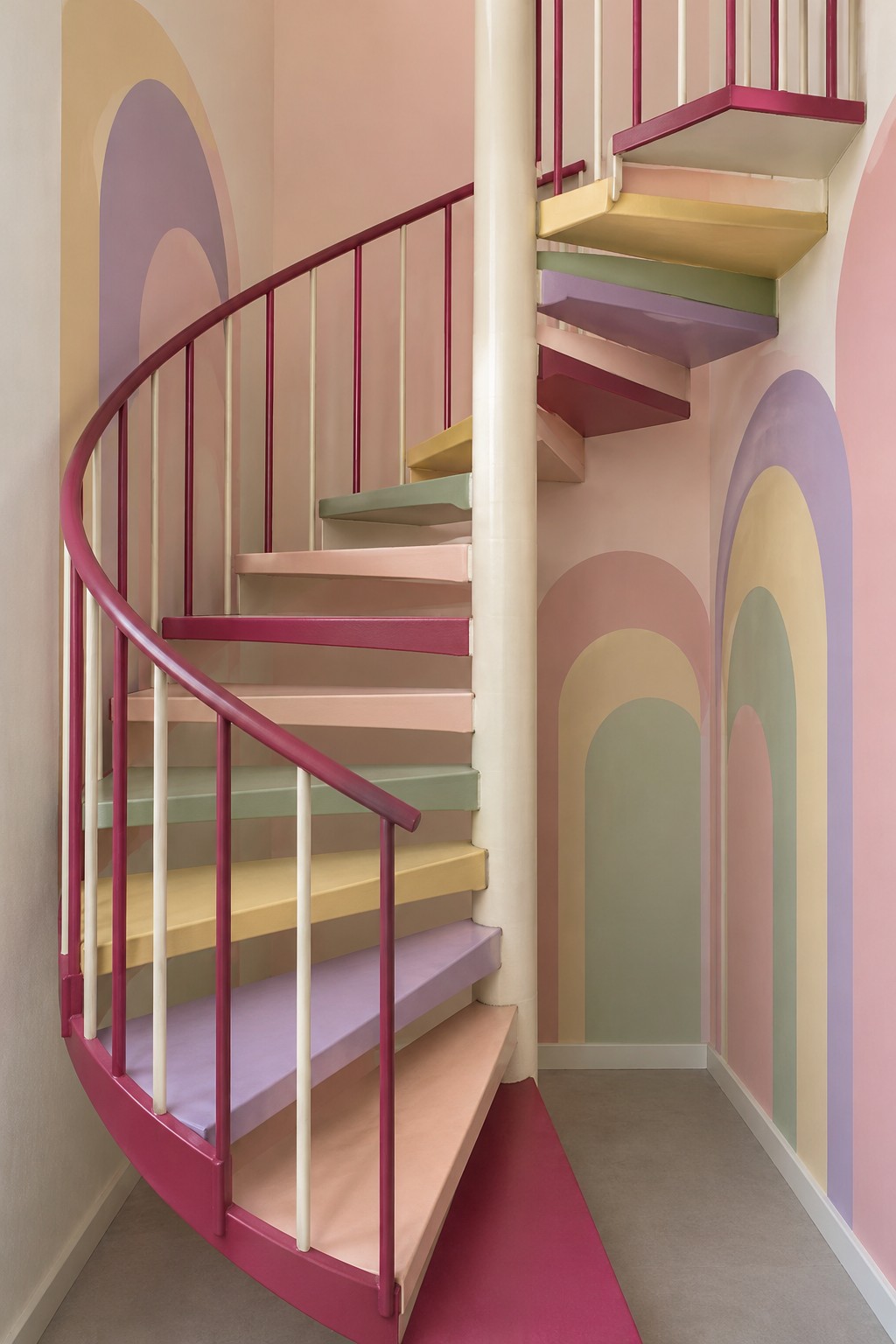
A raspberry handrail gives this compact spiral a continuous outline, while peach, pale yellow, sage, and lilac divide the individual steps. Cream uprights keep the railing visually light. Oversized arches on the surrounding walls repeat the pastel colors at a much larger scale, turning the narrow stairwell into a coordinated composition.
Plan the color sequence on a drawing before painting so neighboring steps remain distinguishable. Use floor paint on the walking surfaces and a compatible finish for the railing material. For the wall arches, make paper templates or mark broad curves before filling them with wall paint. Keep the existing tread shapes and safety clearances intact; this idea changes the finish of a sound staircase rather than its construction.
2. Kilim Inspired Geometry Between Cream Stair Borders
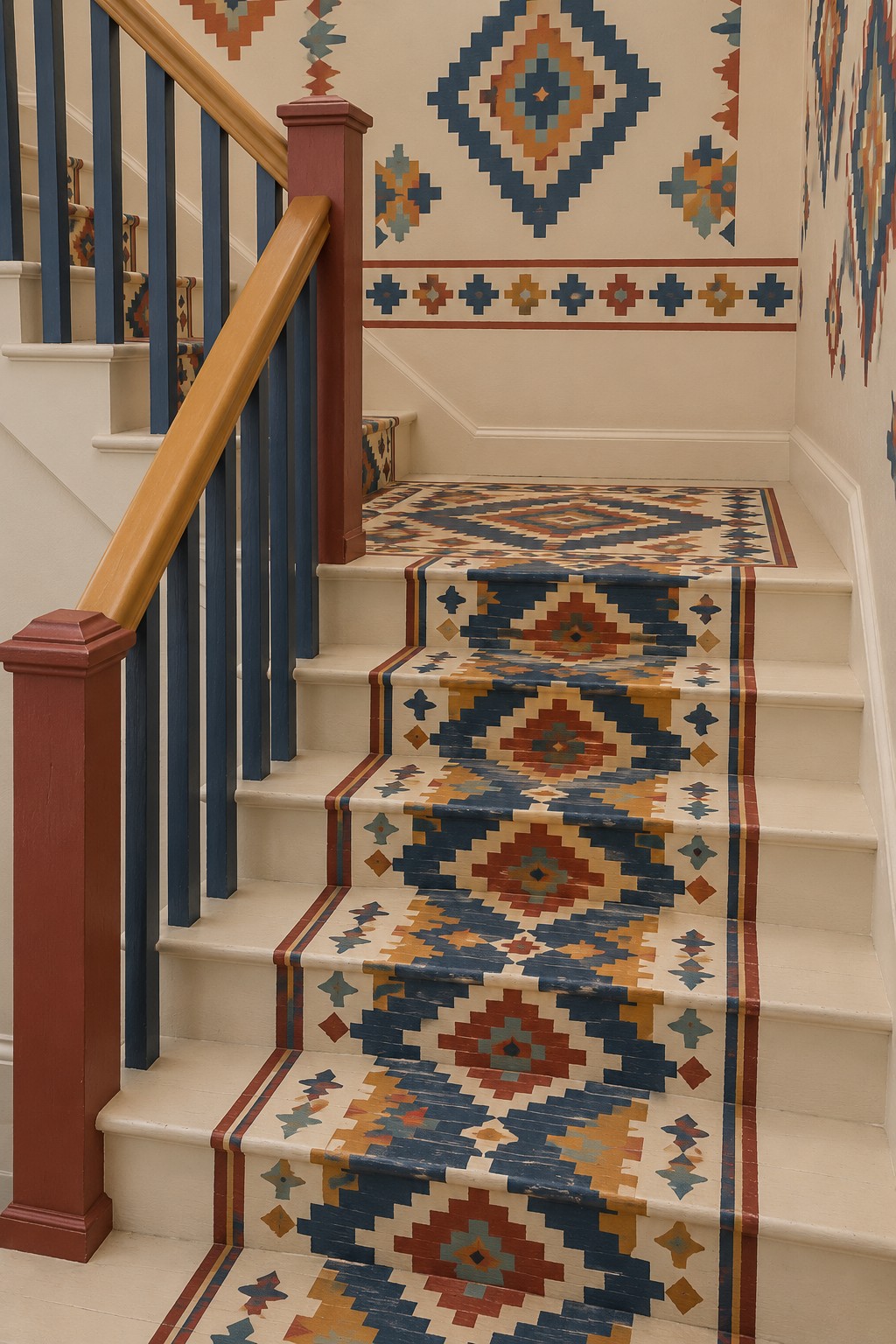
Stepped diamonds in navy, rust, ochre, and muted green create a richly patterned center framed by cream stair edges. Blue spindles and rust colored posts draw individual colors out of the pattern, while the warm timber handrail adds a quieter surface. The wall repeats the geometric vocabulary without making every element identical.
For a painted interpretation of this kilim effect, establish the centerline and side margins first, then divide the design into manageable repeats. Use a reusable template for the diamonds and smaller border marks, with suitable floor coatings wherever the pattern crosses a tread. Adjust the repeat at the landing rather than stretching one motif to fill it. A simpler version can keep the geometry on the risers and leave the treads plain.
3. Charcoal Stairs Beneath a Sweeping Copper Colored Ribbon
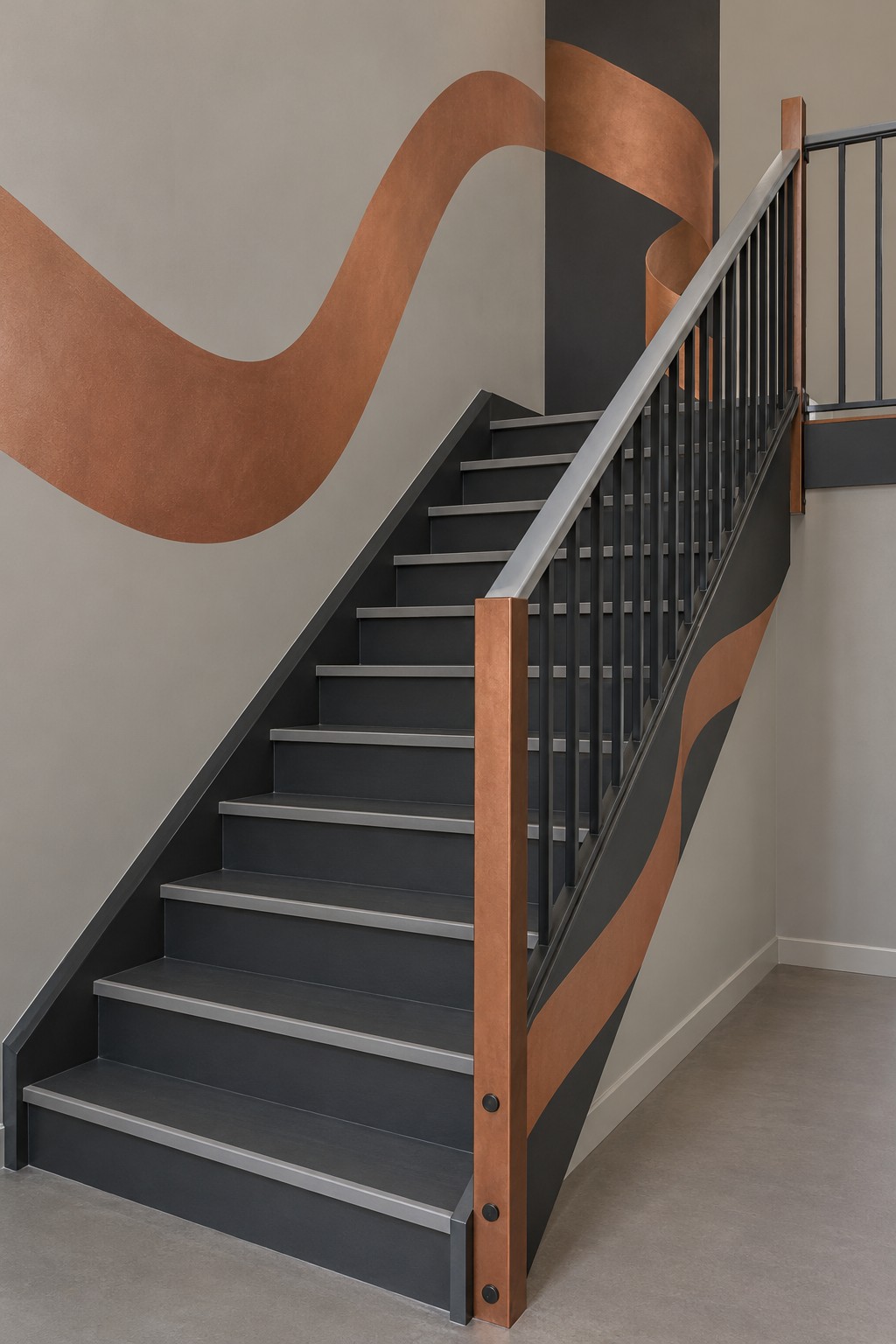
A broad copper colored ribbon travels across the pale wall and wraps onto the dark upper section. Beneath it, charcoal treads and risers form an uninterrupted base, with lighter tread edges helping each step read clearly. The timber post introduces warmth that relates to the ribbon without matching it exactly.
Start by drawing the complete wall curve, including its turn around the corner, before applying color. A sample board will help you compare a flat terracotta finish with a metallic effect if you want more reflected light. Keep the staircase coating separate from the wall treatment and use an appropriate metal finish on metal balusters. The strongest adaptation preserves the generous curve and limits extra decoration around it.
4. Interlaced Riser Ribbons in Rose and Terracotta
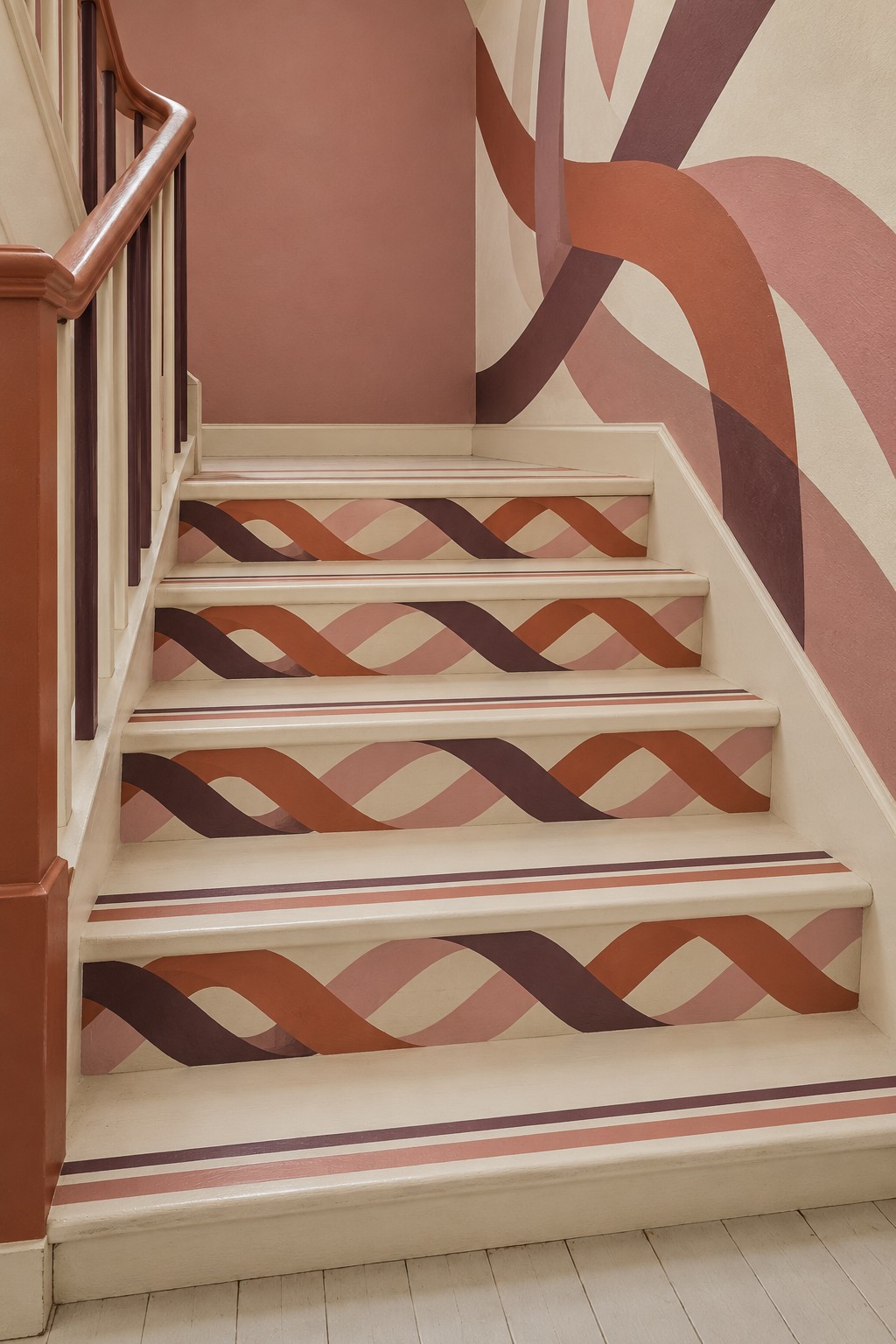
Interwoven ribbons give the cream risers a rhythmic pattern in dusty rose, terracotta, and deep plum. Narrow stripes across the treads echo those colors without filling the whole walking surface. Broad wall bands enlarge the same movement, while the warm handrail and cream spindles keep the underlying staircase recognizable.
Draw one complete riser repeat at actual size and use it to plan the crossing points. Paint the broad ribbon shapes first, letting each layer reach the required stage before masking an overlap. Keep the painted bands flat, with no applied trim on the treads. In a short flight, two ribbon colors can carry the idea; the larger wall curves can then provide the third accent.
5. Plum Treads With an Expressive Portrait Mural
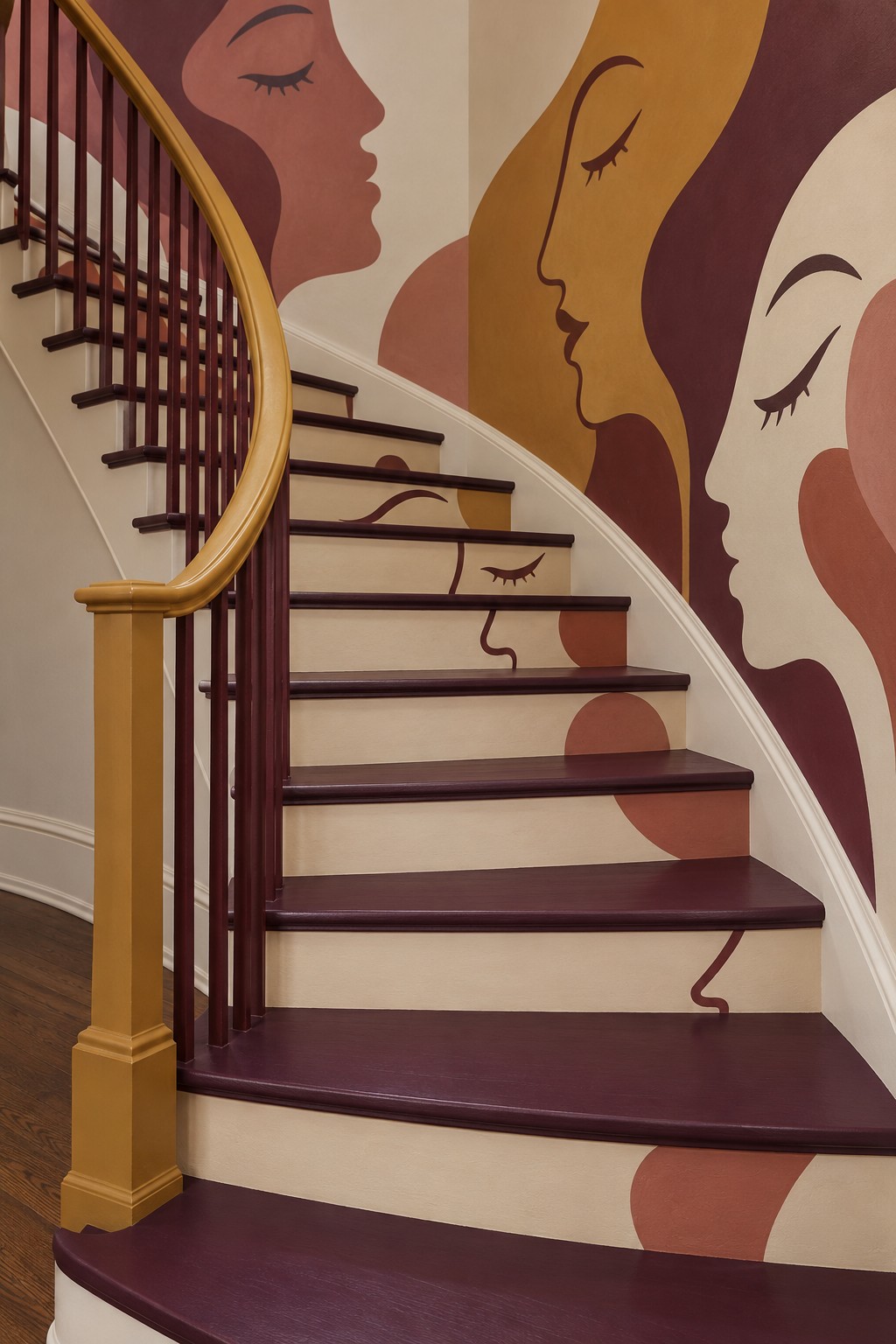
Large stylized faces follow the curved wall in cream, mustard, terracotta, and plum. The deep plum treads anchor the composition, while a mustard handrail traces the staircase’s sweep. Smaller facial outlines and colored shapes continue onto selected risers, creating a relationship between the wall art and the steps without repeating a complete face on each one.
Sketch the mural as a full composition before transferring its main outlines. Keep the largest profiles on the wall and use restrained fragments on the risers, where tread edges interrupt the drawing. Wall paint, suitable woodwork enamel, and floor paint each have a separate role here. If detailed drawing feels ambitious, retain one profile and a few broad color fields instead of filling the entire stairwell.
6. Teal Treads and Ochre Spindles With Printed Shapes
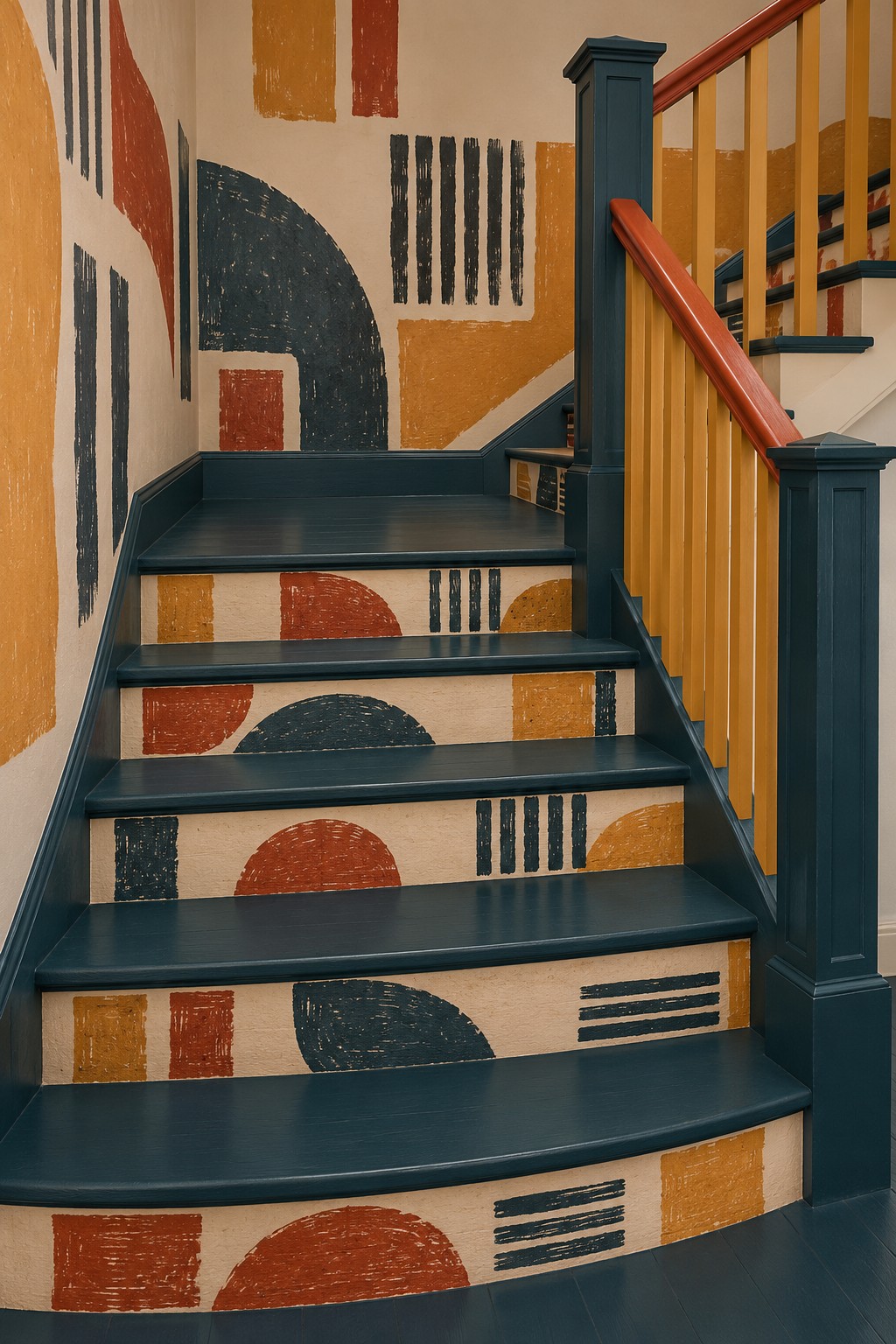
Dark teal treads and posts provide a strong frame for ochre spindles and a rust colored handrail. Semicircles, rectangles, and short striped groups appear across the cream risers and neighboring walls. Their uneven painted texture gives the geometry a printmaking character rather than the precision of a tiled grid.
Use separate templates for the basic shapes and decide which element repeats on each riser. A lightly loaded stencil brush can create broken color on the decorative vertical surfaces; keep the functional tread coating continuous and properly applied. Vary the placement while repeating the same small palette. This is a useful approach when you want visible handmade detail without painting an elaborate picture across the whole flight.
7. Framed Cream Risers With Green and Oxblood Woodwork
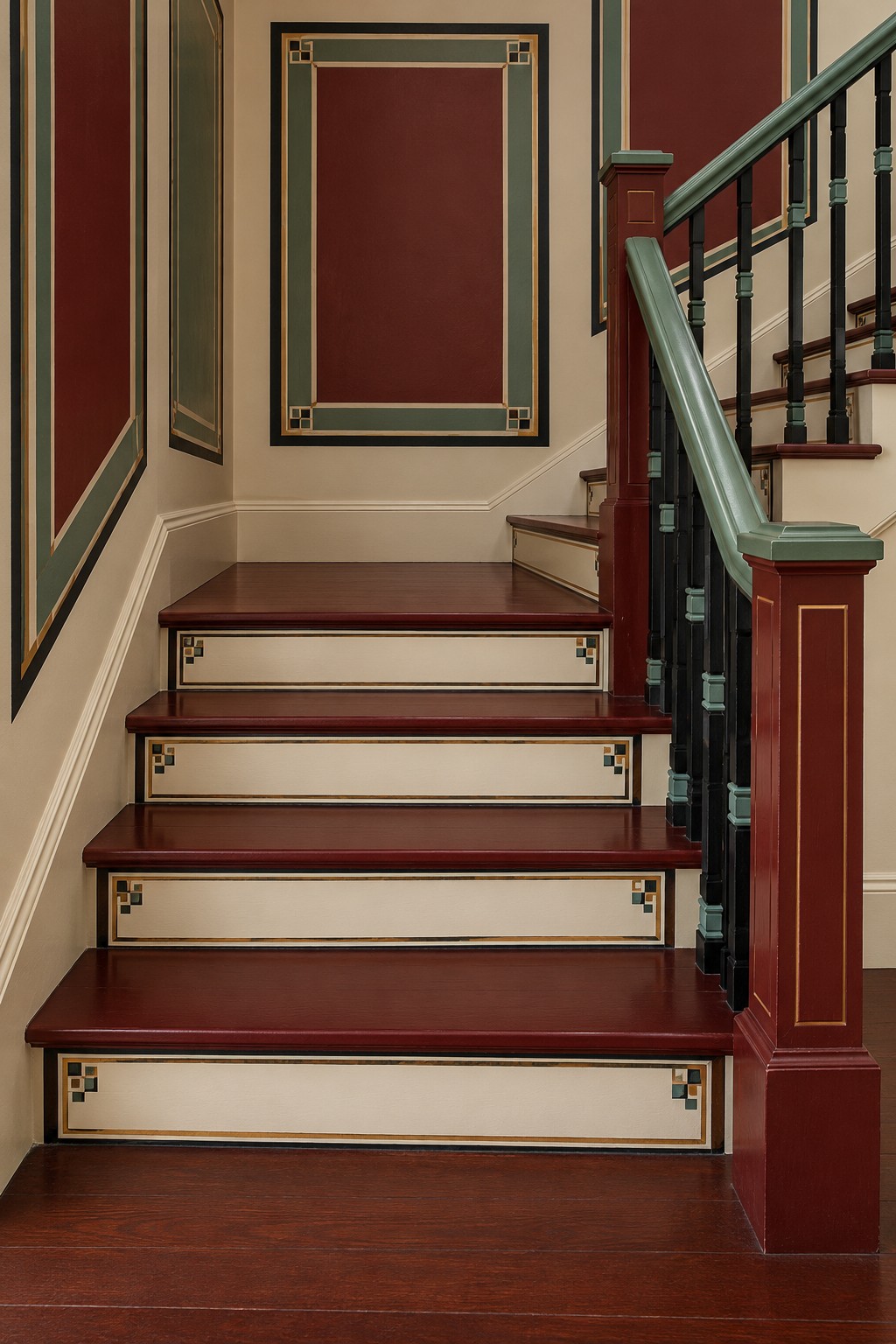
Fine rectangular borders turn the cream risers into a series of small decorative panels. Green rails and dark spindles sit beside oxblood posts, while the wall uses larger rectangles in the same colors. The warm wood appearance of the treads provides a visual pause between the outlined surfaces.
Measure a consistent inset from each riser edge and use narrow tape to establish the main rectangles. Small corner templates make the stepped details easier to repeat. Keep the warm treads exposed if their existing finish is sound, and concentrate the new paint on the risers and woodwork. The slim gold colored accents are decorative painted lines, so the effect does not require attaching metal strips along the stairs.
8. Apricot Risers Under a Painted Mobile Composition
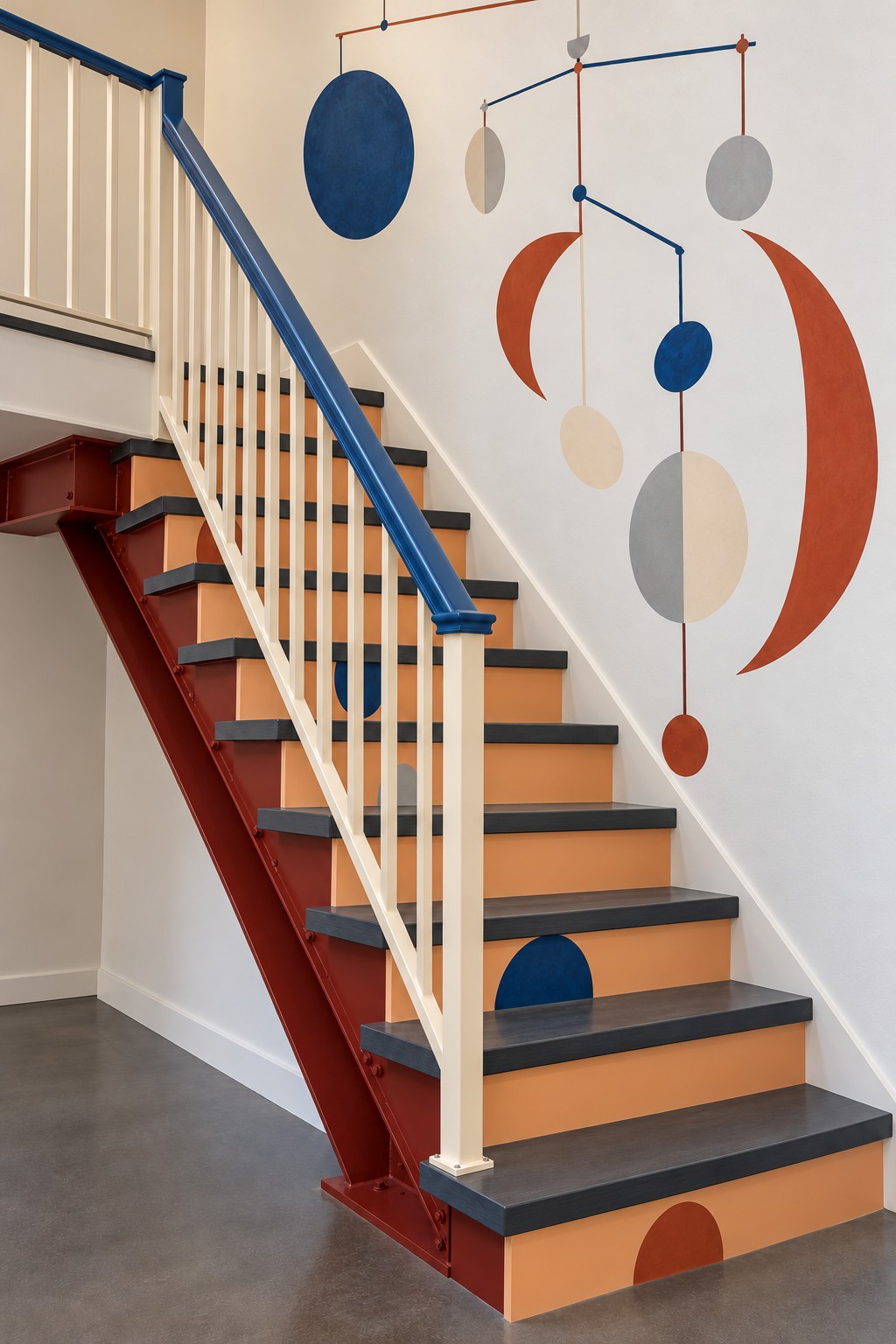
Circles, crescents, and fine connecting lines turn the wall into a flat interpretation of a hanging mobile. Apricot risers warm the lower half of the scene, and the blue handrail picks up the strongest mural color. White spindles allow the wall composition to remain visible through the railing.
Lay out the thin lines and the largest shapes together so the painted mobile looks balanced before adding smaller circles. Paper circle templates and a straightedge can simplify the drawing. Repeat only a few small shapes on the risers, leaving the dark treads plain. Because the mobile is painted, there are no dangling pieces to interfere with headroom or the handrail, making the motif particularly useful in a compact stairwell.
9. Olive and Dusty Pink Risers With Graphic Dot Textures
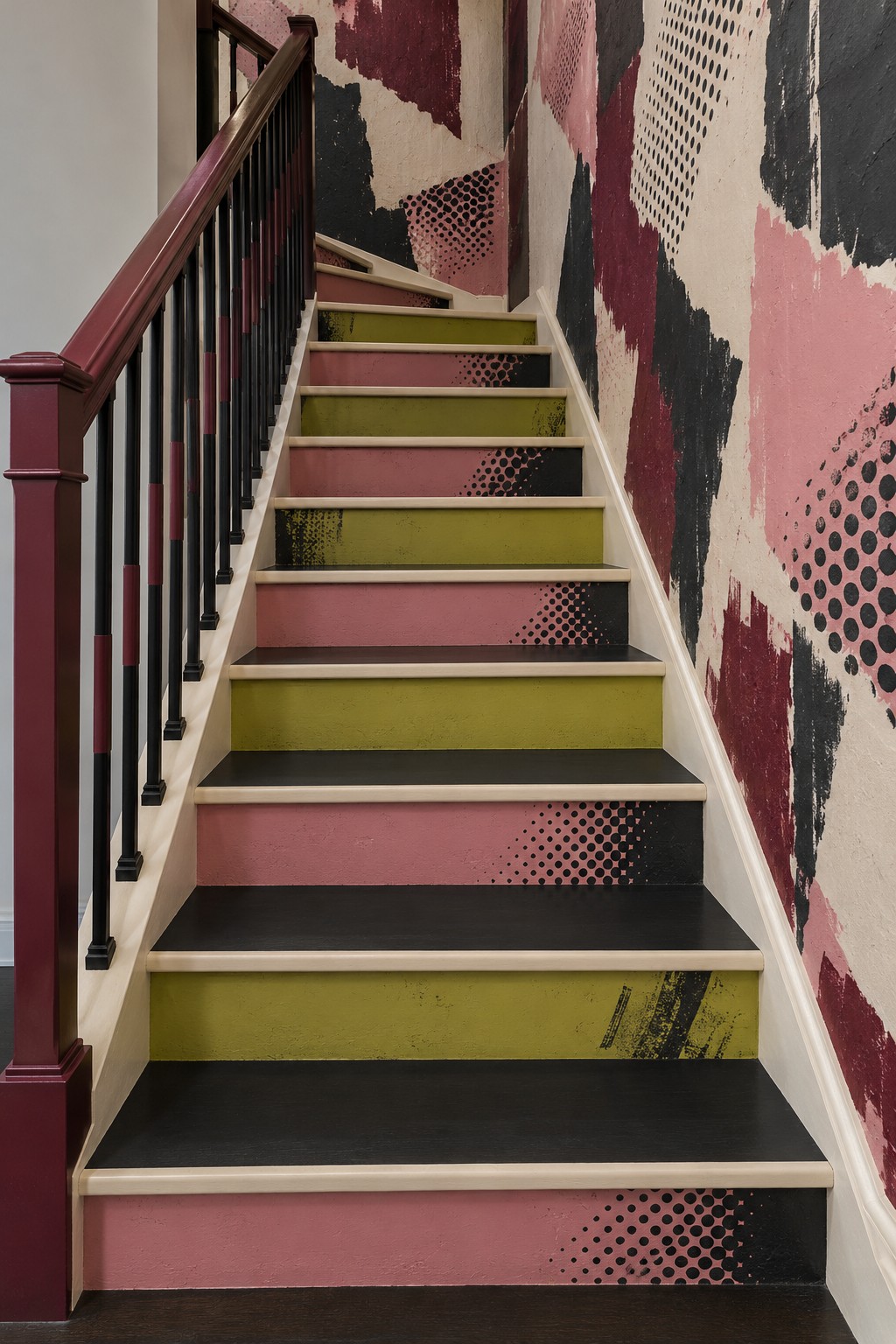
Olive and dusty pink alternate along the risers, with dark treads separating the colors. Dot clusters and rough black marks interrupt the smooth bands at selected ends. Larger patches in pink, burgundy, cream, and charcoal cover the wall, giving the passage a layered graphic character.
Paint the riser backgrounds first, then use a dot stencil and a sparingly loaded brush for the surface marks. Keep the densest textures near one side of each riser so the alternating colors remain clear. The effect should come from paint rather than physically roughened walking surfaces. For a more restrained version, preserve the two riser colors and limit the wall treatment to a single large abstract panel.
10. Burnt Orange Risers With a Retro Wall Stripe
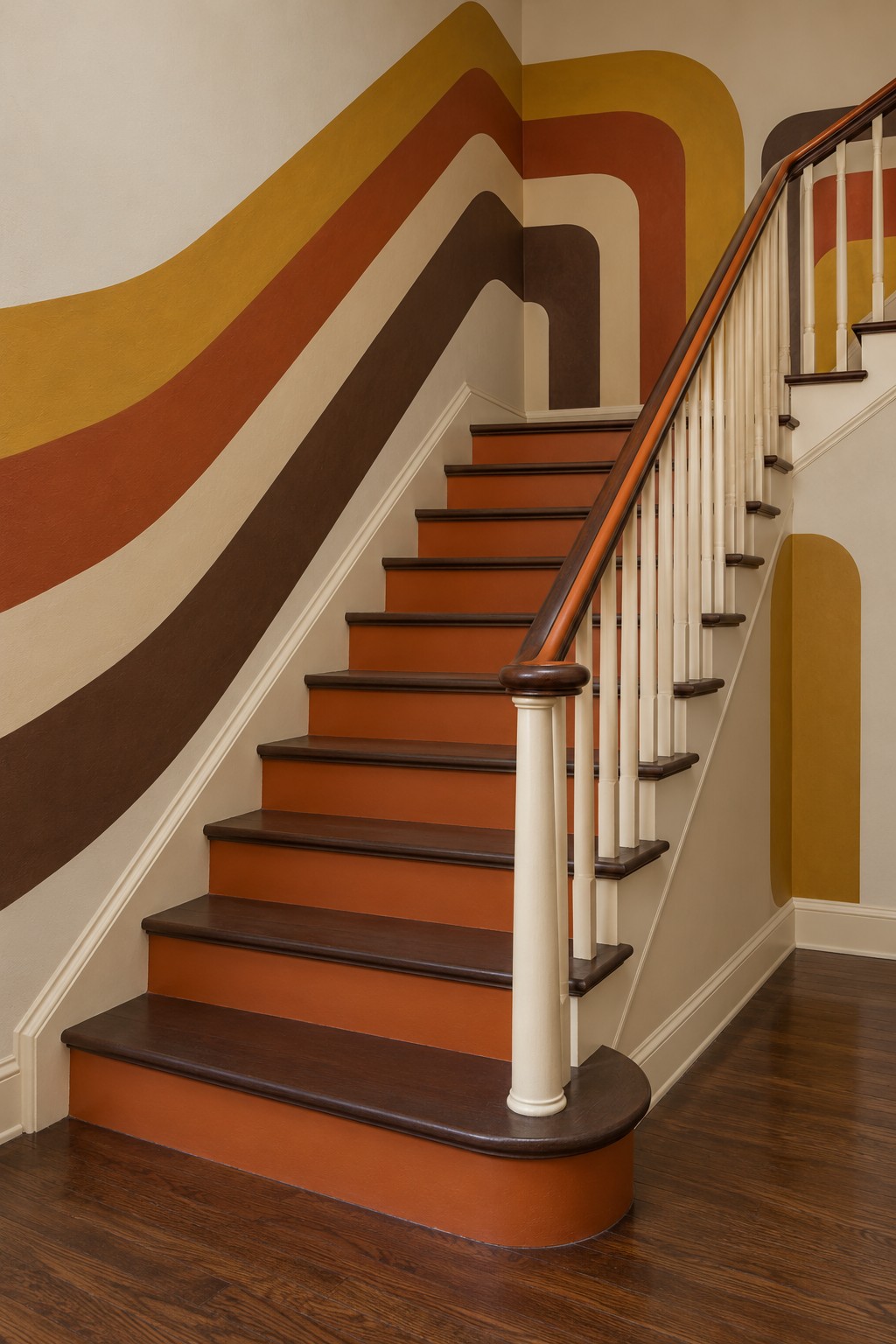
Burnt orange risers introduce a warm rhythm beneath dark wood toned treads. Wide mustard, rust, cream, and brown bands climb the wall, turn at the corner, and follow the upper flight. Cream spindles separate the staircase from the mural, while the warm rail repeats the orange family in a narrower line.
Mark the wall stripe from several fixed reference points rather than assuming the stair slope or wall corner is perfectly regular. Draw the rounded turn before masking the straight sections. A small palette of warm colors keeps this bold treatment coherent. If the hallway is narrow, use the orange risers and one broad wall band first, allowing the existing timber to provide the darker contrast.
11. Burgundy Rails Against a Monochrome City Mural
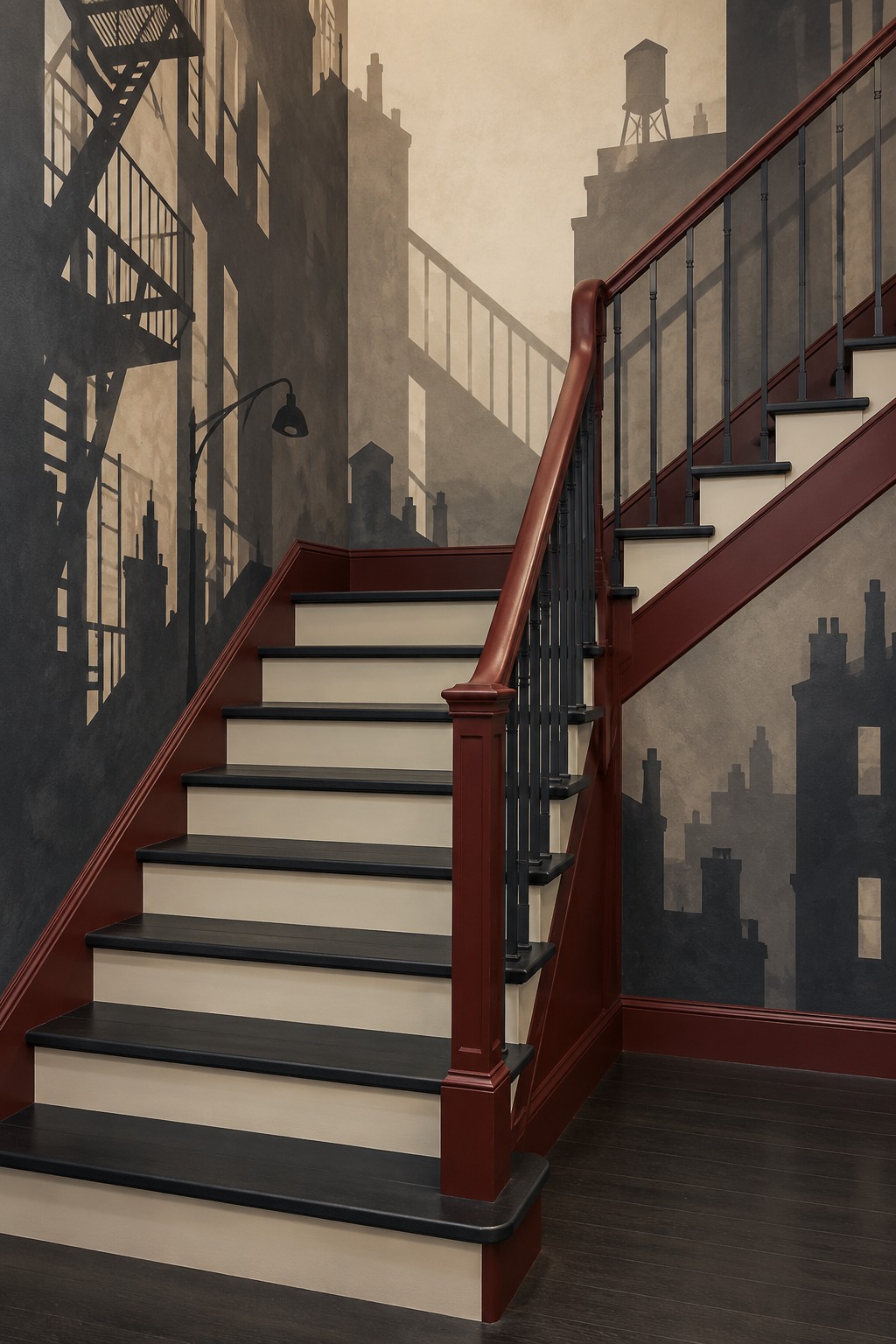
A monochrome city scene fills the tall stairwell with fire escapes, rooflines, a water tower, and distant buildings. Cream risers and black treads echo its tonal range, while burgundy rails, posts, and trim introduce one concentrated color. The contrast keeps the staircase distinct from the architectural silhouettes behind it.
Choose the viewpoint of the mural from the main approach and build the skyline in broad layers before adding windows or fire escape details. The risers can remain plain because the wall already carries the narrative. A mural artist can help adapt the drawing to corners and tall areas; use suitable access equipment for work above stairs. A smaller skyline panel at the landing can deliver a similar effect with less painted wall area.
12. Cobalt Steps With a Carnival Mask Wall
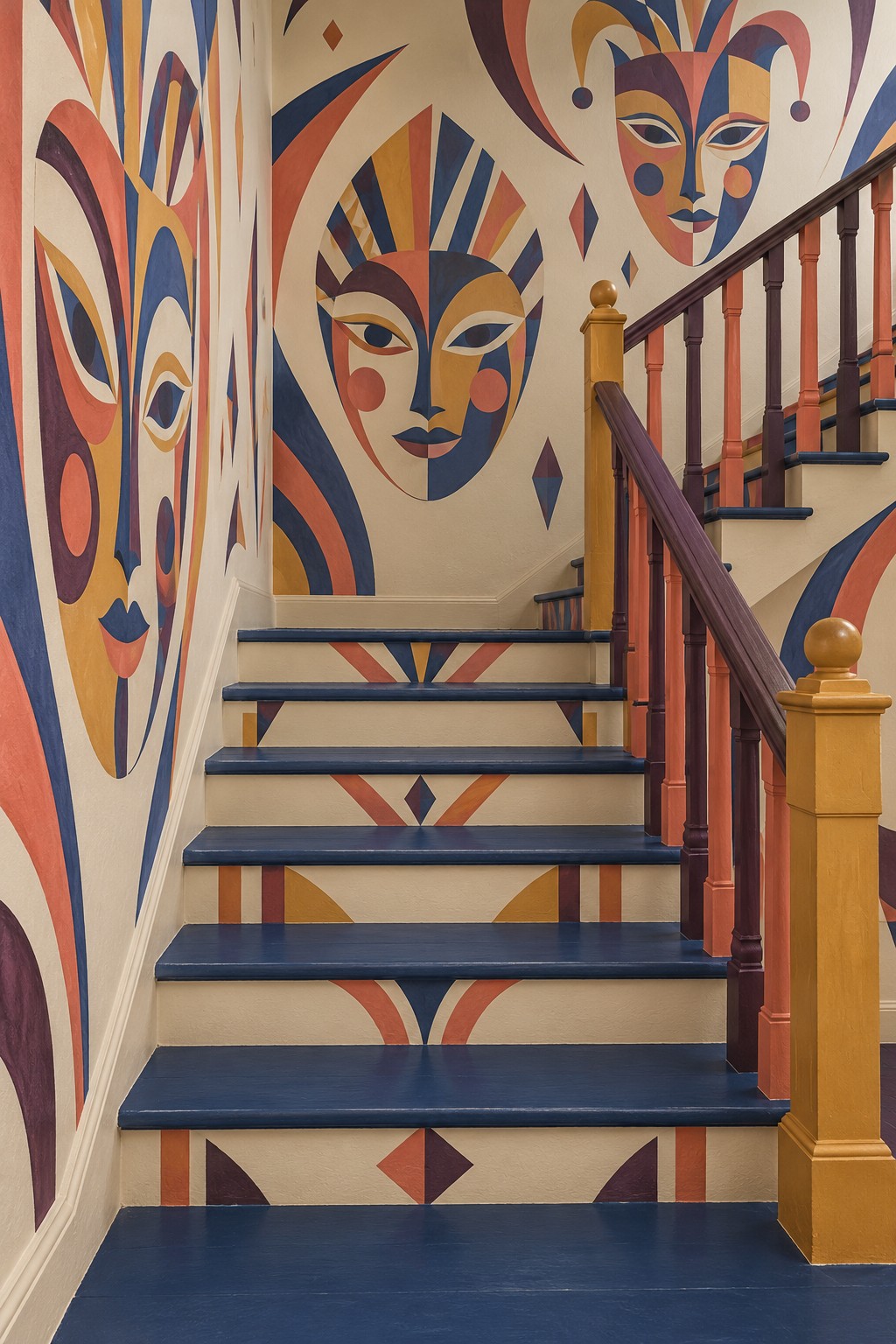
Large carnival masks bring theatrical expression to the cream walls. Cobalt treads repeat the blue in the faces, while rust, plum, and mustard connect the geometric riser designs to the railing. The cream spaces between the masks are essential to the composition, allowing individual faces and shapes to remain readable.
Plan each mask as a separate wall element rather than forcing one face across a corner. Use paper patterns for the facial outlines and keep the smaller stair motifs to diamonds, fans, and angled bands. A cobalt floor finish suits the painted treads when approved for the substrate, while the mural uses wall coatings. You can simplify the scheme to one large mask at the landing and a repeating two color riser pattern.
13. Gothic Tracery on Pale Walls and Cream Risers
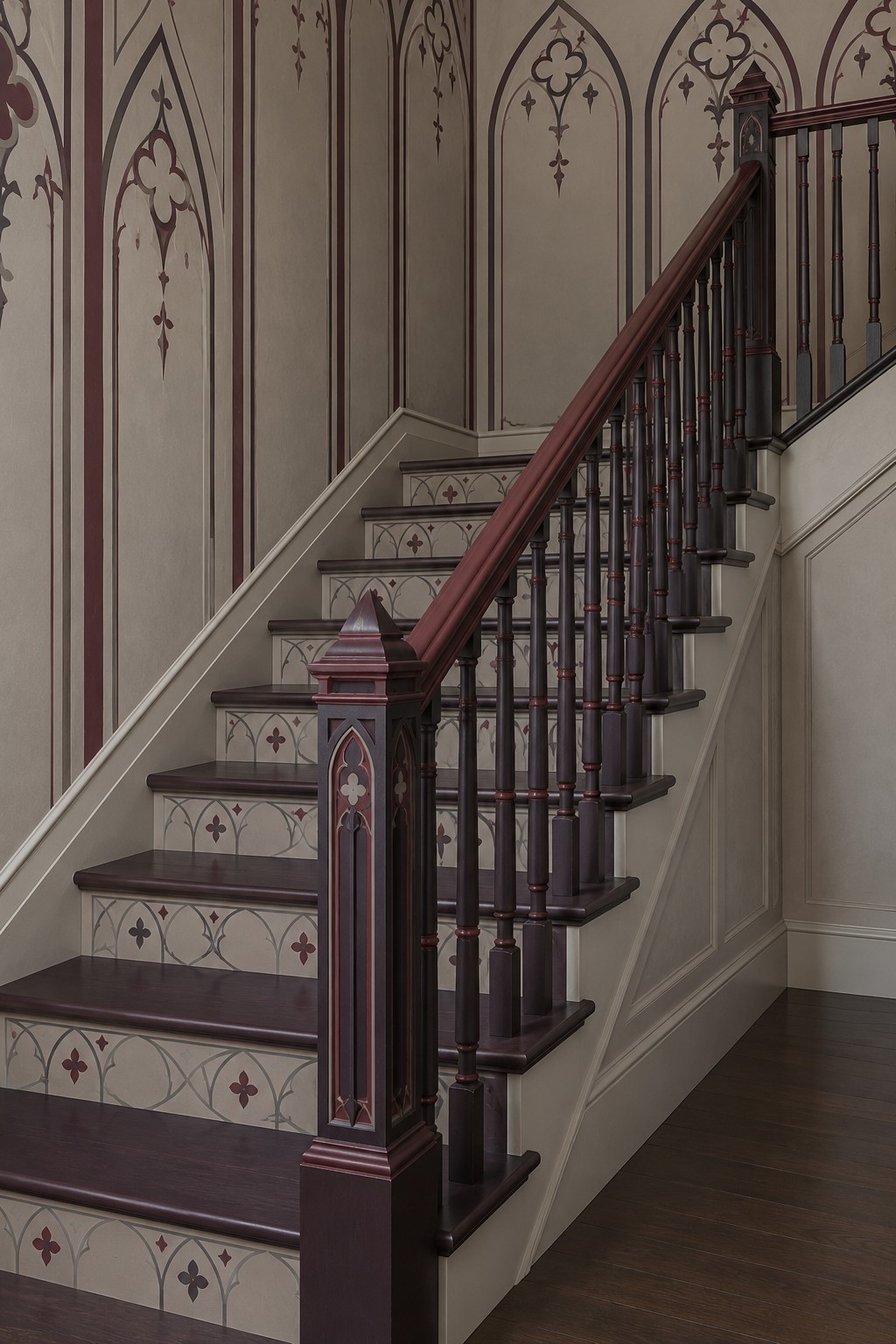
Fine pointed arches and small ornamental shapes give this stairwell its Gothic identity. The pale walls and cream risers carry the drawing, while dark plum treads and woodwork create the frame. Decorative details on the substantial newel post repeat the architectural motif at a smaller scale.
Build the tracery from a reusable arch template, checking its proportions against both the wall height and the riser height. Use fine brushes for the smaller flourishes and keep the most intricate work on vertical surfaces. The wall version can be tall and narrow, while the riser repeat needs a shorter, wider adaptation. For related mirrors and accessories, these Gothic decor ideas offer ways to extend the theme beyond the staircase.
14. Bright Abstract Risers With Turquoise Step Edges
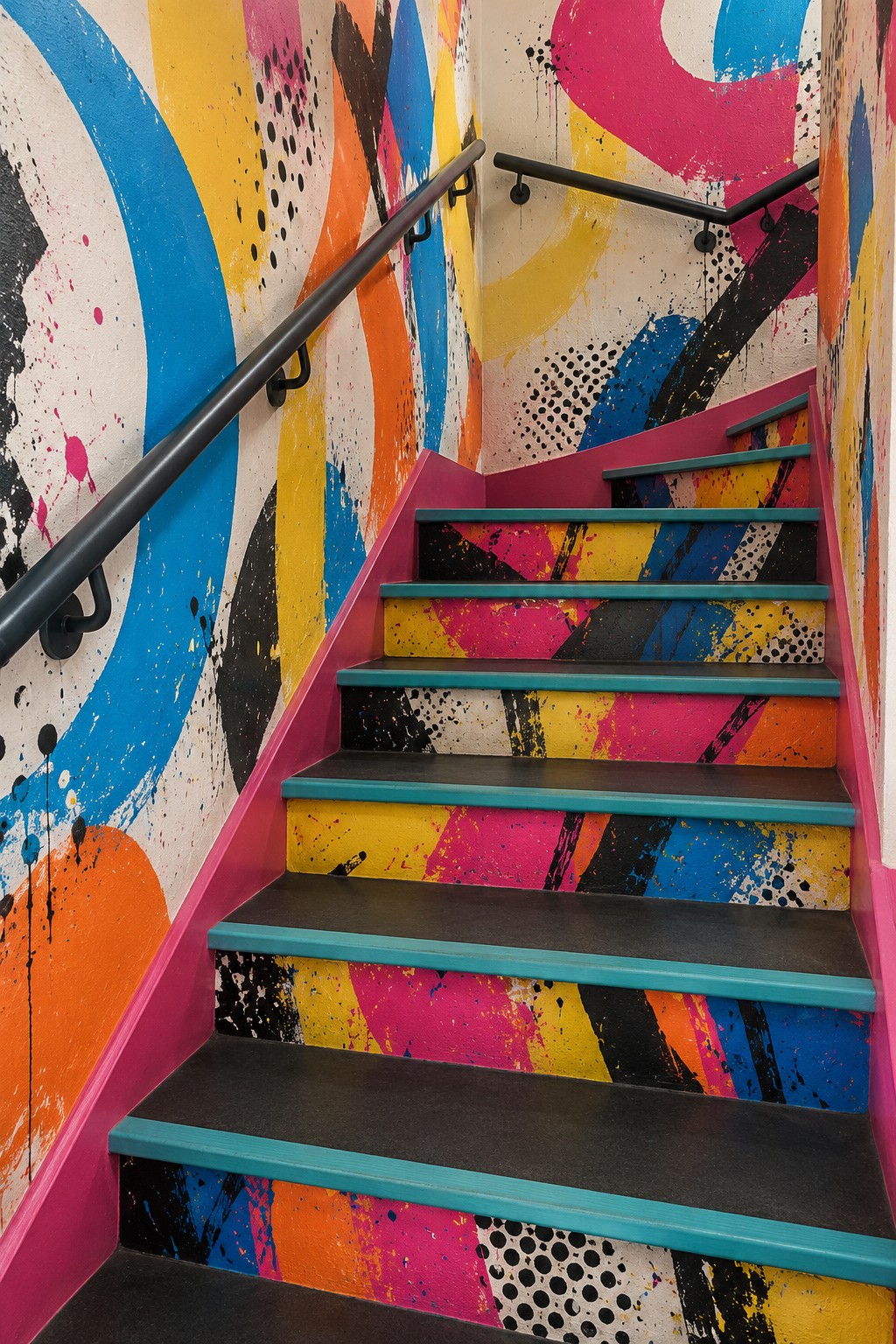
Hot pink, yellow, orange, blue, and black spread across the risers and walls in broad gestures. The turquoise tread edges give the busy composition a recurring horizontal marker, while the main tread surfaces stay dark. Black wall mounted handrails provide a clear line through the surrounding color.
Establish the large color shapes before adding smaller dots or splashes. Protect the handrails and the finished tread surfaces while decorating the walls, then apply any edge color using the appropriate floor coating. Controlled marks with brushes and stencils are easier to contain than throwing paint in a narrow stairwell. Leave enough of each dark tread visible to distinguish the steps, and avoid placing black patches where they would visually conceal the handrail brackets.
15. Deep Blue Woodwork With a Portrait Gallery and Burgundy Runner
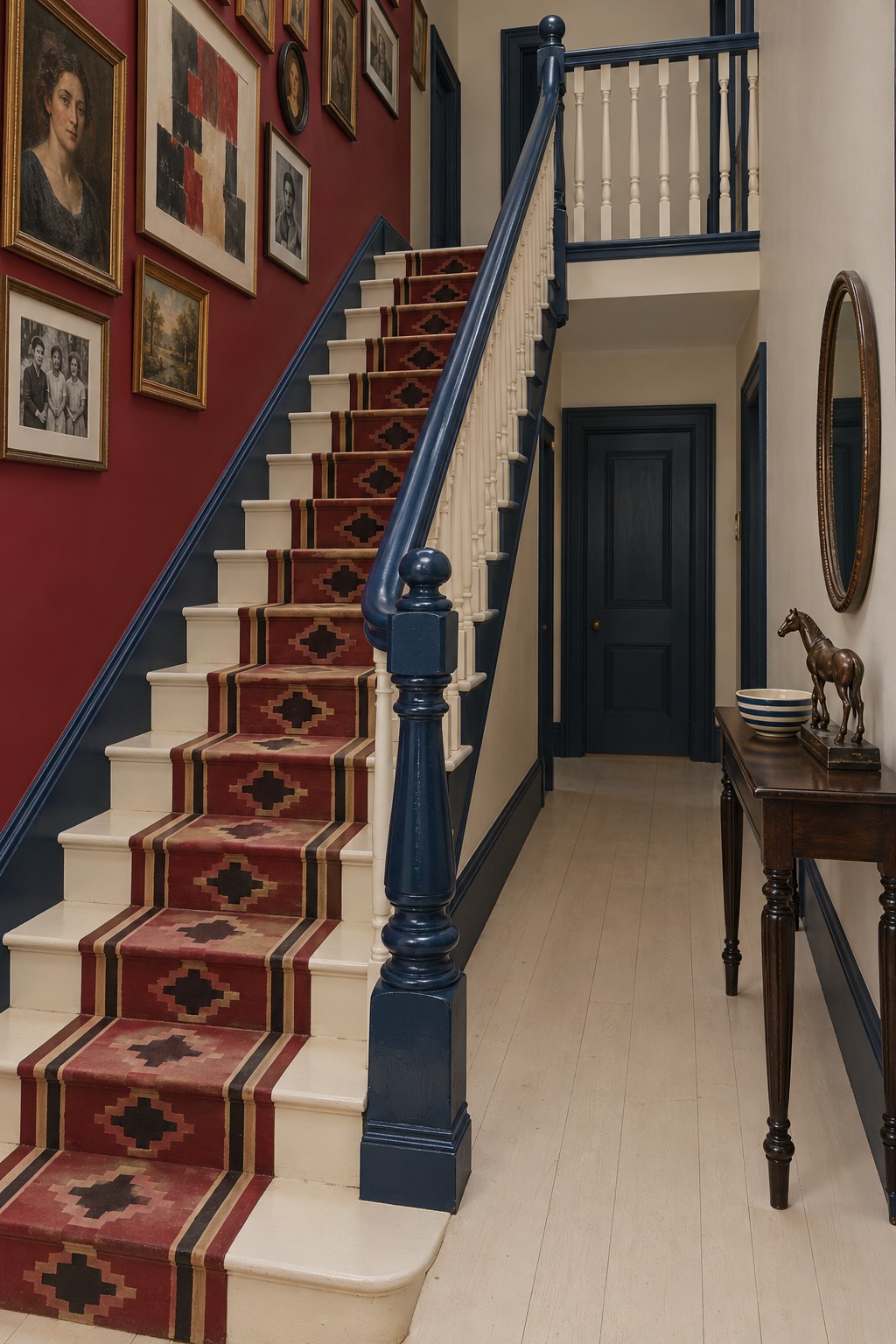
Deep blue rails, posts, and door trim connect this entrance from floor level to the upper landing. Cream spindles and stair edges brighten the center, while a burgundy patterned runner relates to the red gallery wall. Mixed portraits, photographs, and abstract art create the collected mood, with a narrow console and oval mirror on the opposite side.
Let the runner establish the accent palette, then test a blue woodwork sample beside it. Treat the runner as a separate textile installation rather than assuming its pattern is paint. Arrange paper frame templates above the rail before hanging the gallery, leaving comfortable hand clearance. Keep the console shallow enough for the passage and select a few small objects so the staircase remains the entrance’s main feature.
16. Plum Rails and a Teal Door in an Apricot Gallery Hall
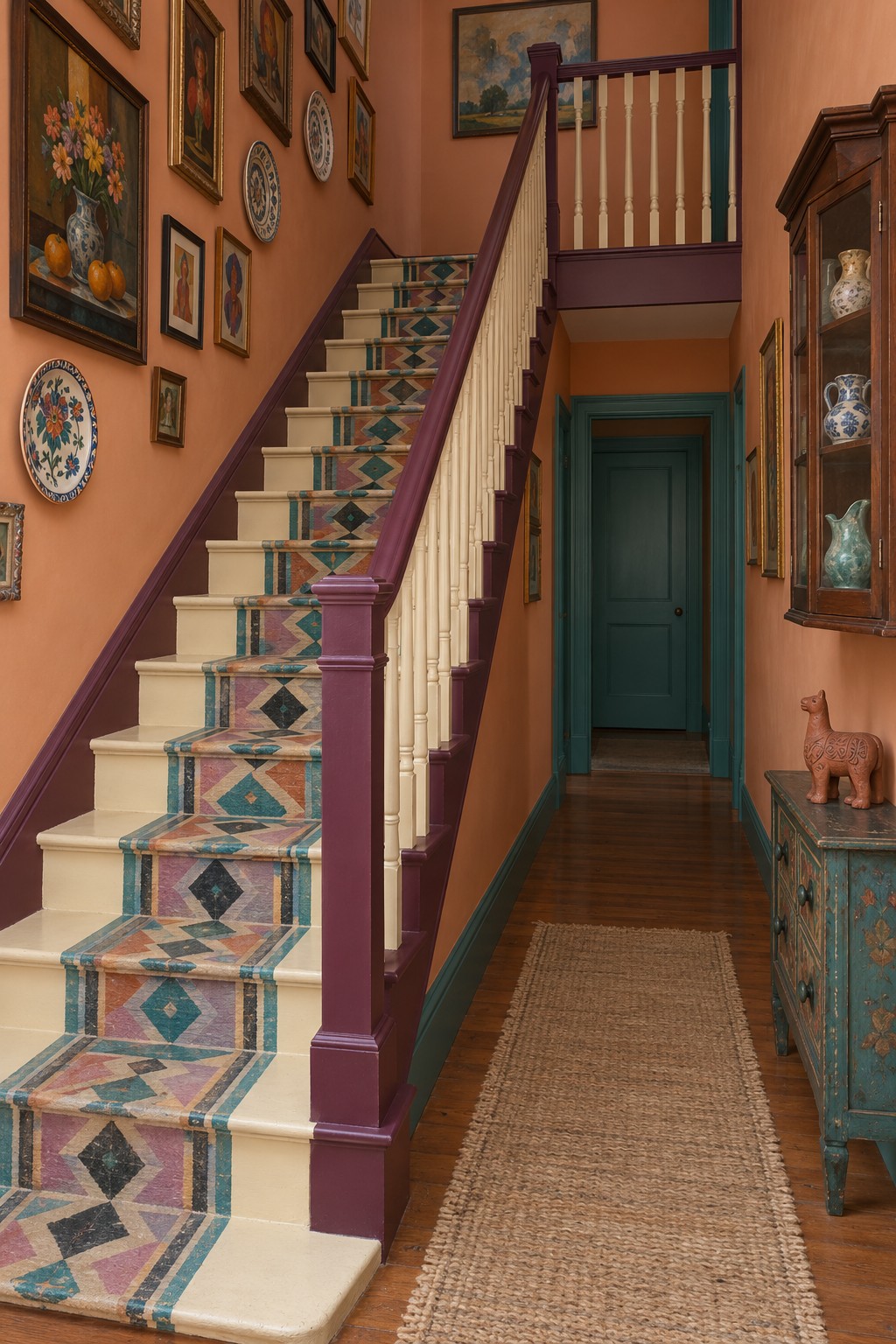
Apricot walls bring warmth to a long hallway filled with framed art and decorative plates. Plum rails and posts outline the cream staircase, while teal appears in the patterned runner, door, trim, and small cabinet. The cabinet of ceramics adds another display surface without requiring more pattern on the steps.
Start with the relationship between the apricot wall, plum woodwork, and teal door, then select a runner that connects those tones. Keep cream on the spindles and exposed stair edges to separate the darker accents. If you want to adapt an existing console to the scheme, these furniture painting ideas can help you choose a complementary treatment. Wall plates need purpose made hangers, and furniture should stay outside the clear route through the hall.
17. Wine Colored Borders Around a Dark Gothic Stairwell
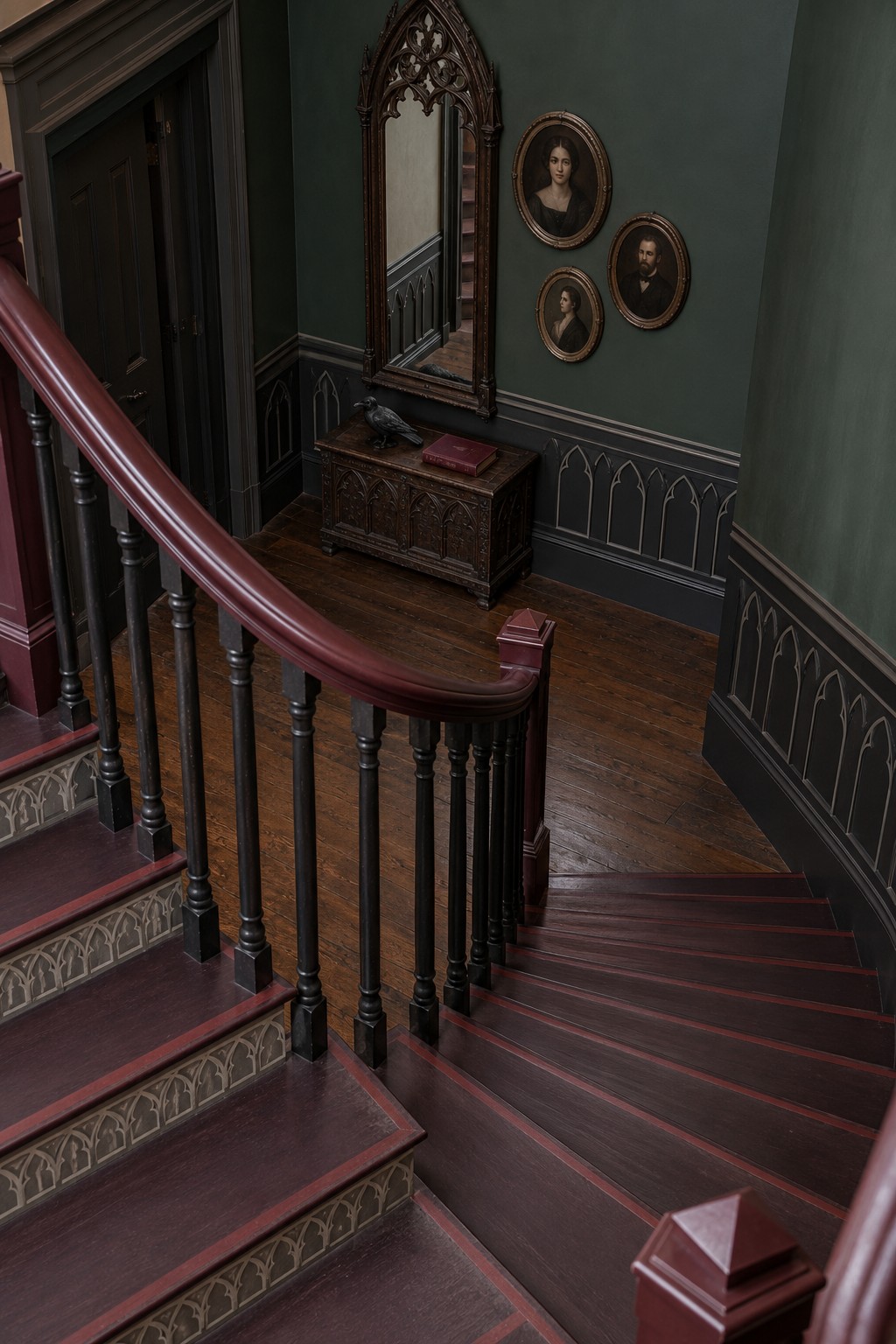
Wine colored lines follow the edges of dark wood toned steps, with the same shade continuing along the curved handrail. Black spindles and charcoal lower walls make the pale tracery stand out. Above them, deep green walls, oval portraits, and a pointed mirror create a concentrated Gothic landing scene.
Use the existing dark stair finish as part of the palette where it remains suitable, adding narrow borders only with a compatible coating system. Repeat the arch motif on the lower wall and visible risers instead of introducing another pattern. Dark finishes need practical stair lighting so every tread edge remains easy to identify. Place a chest or display piece only where the landing allows unobstructed movement, and support a heavy mirror with fixings suited to its weight and wall.
18. Cream Risers With Small Black Diamonds
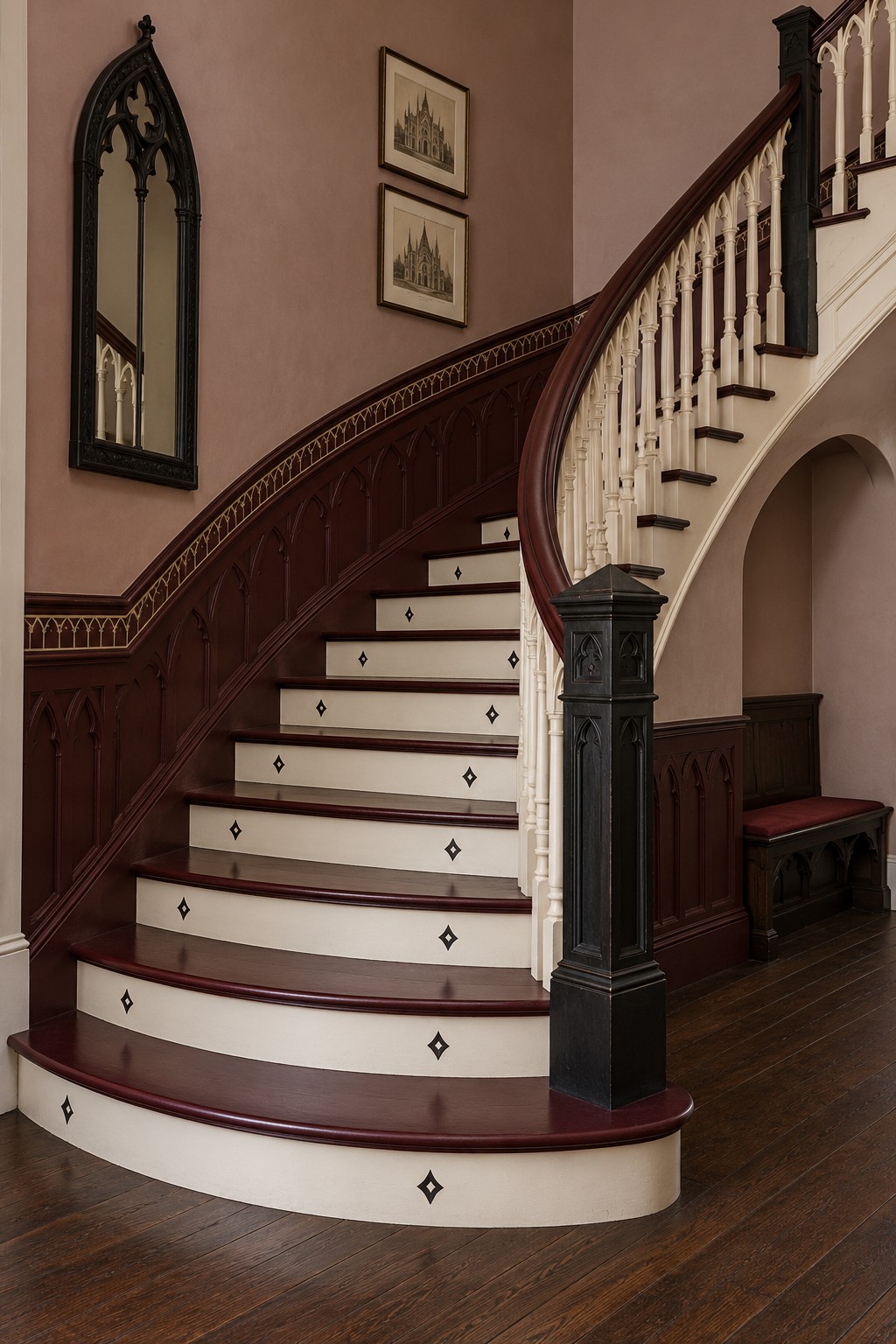
A small black diamond on each cream riser gives this curved staircase a measured rhythm. Dark wood toned treads and handrail preserve its warm character, while the black newel post and pointed mirror add depth. Burgundy wall paneling and dusty rose walls make the simple stair pattern feel part of a richer room.
Measure the visual center of each riser separately, especially around the curved lower steps, rather than placing every diamond along one vertical line. A small stencil keeps the shape consistent, with a fine brush for the pale center. This is an approachable decorative treatment because the motif stays on the risers. Keep the treads plain and allow the curved rail and wall paneling to supply the more elaborate detail.
19. Lavender Rails With a Celestial Wall Collection
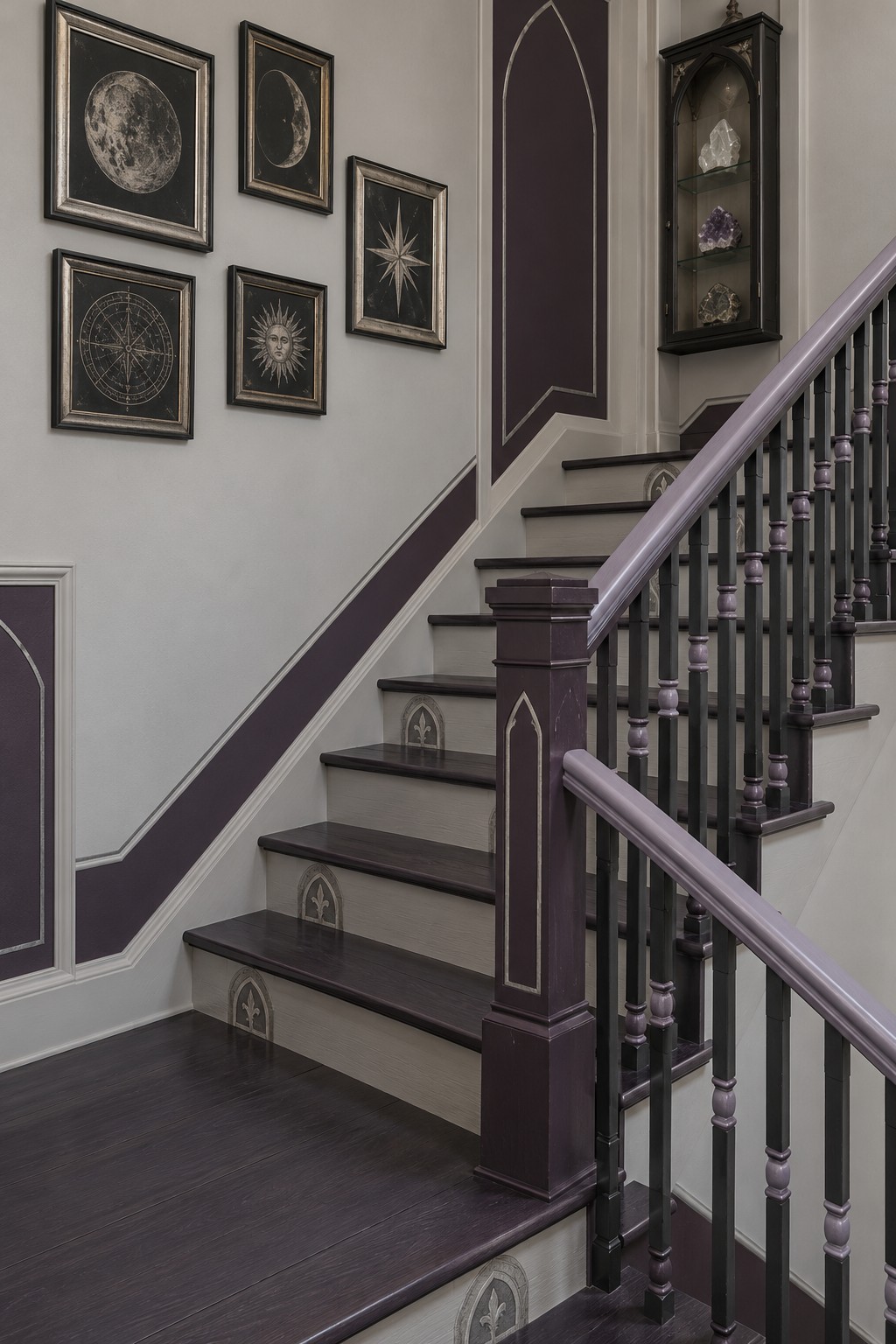
Lavender rails soften the deeper plum posts and wall panels, while pale risers sit beneath dark treads. Small pointed arch details appear on selected risers and repeat in the tall wall decoration. Framed moons, stars, and circular diagrams introduce a celestial theme without requiring a full illustrated mural.
Choose the lavender and plum together, checking that their contrast remains visible in the stairwell’s light. Use a simple arch template for the risers and keep the larger wall outlines slim. The framed collection can vary in size while sharing dark backgrounds and related frame finishes. A narrow display cabinet belongs on a wall with adequate clearance, with its contents secured and its projection kept away from shoulders and the handrail.
20. Primary Color Risers in a Pop Art Music Gallery
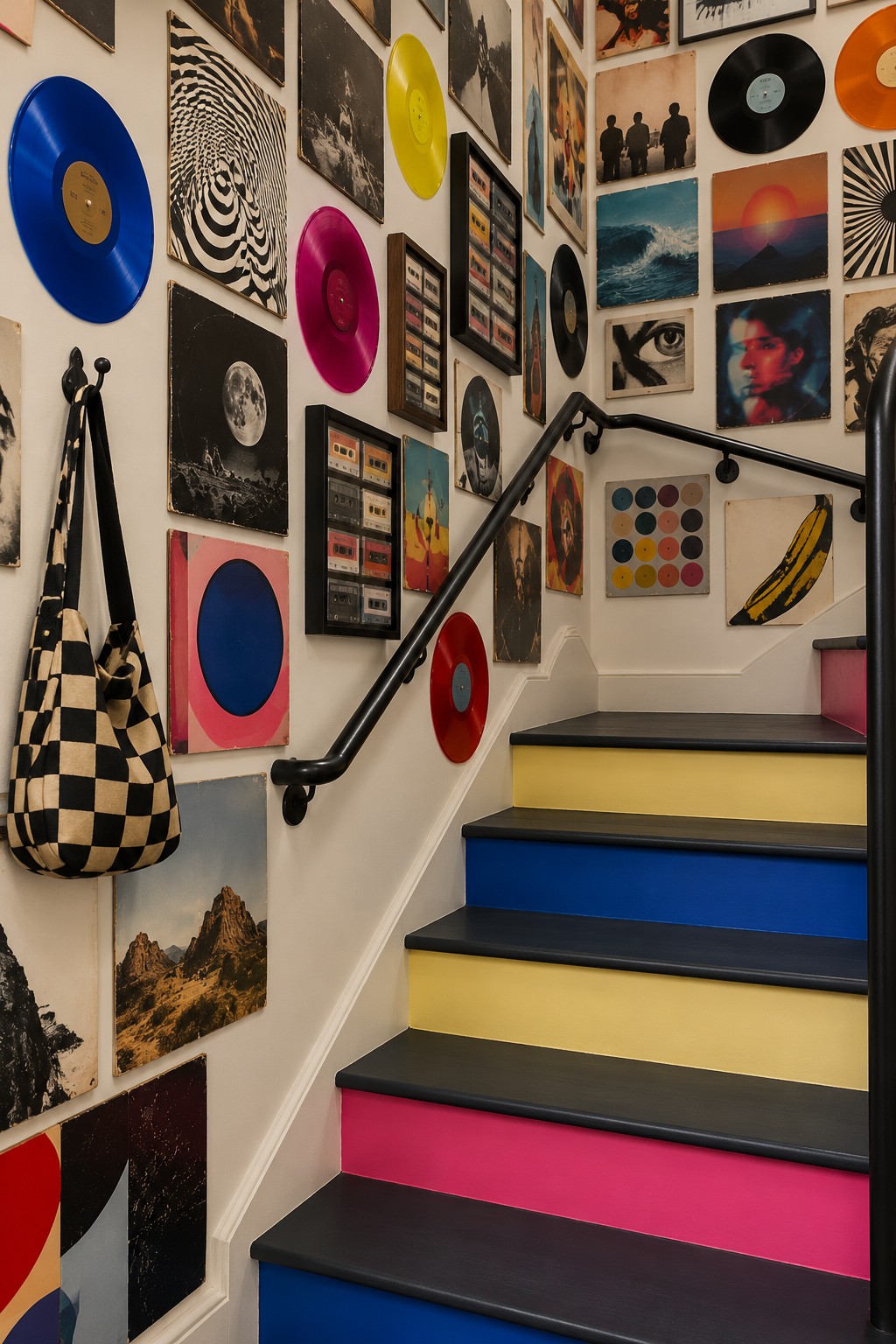
Pink, cobalt, and yellow risers punctuate a stairwell filled with graphic art, portraits, and brightly colored records. The dark treads create pauses between the saturated colors, while pale walls keep the many separate images visible. A black handrail reads as a continuous functional line through the gallery.
Sample the riser colors beside the intended artwork before deciding on their order. Paint each riser as a complete block, leaving the tread coating separate, and repeat the palette selectively through record sleeves or prints. Arrange the largest wall pieces first, then fill the smaller spaces without crowding the rail. Use secure record display mounts and move everyday bags away from the stair route if their straps could catch someone passing.
21. Teal and Brick Risers for a Jazz Record Stairway
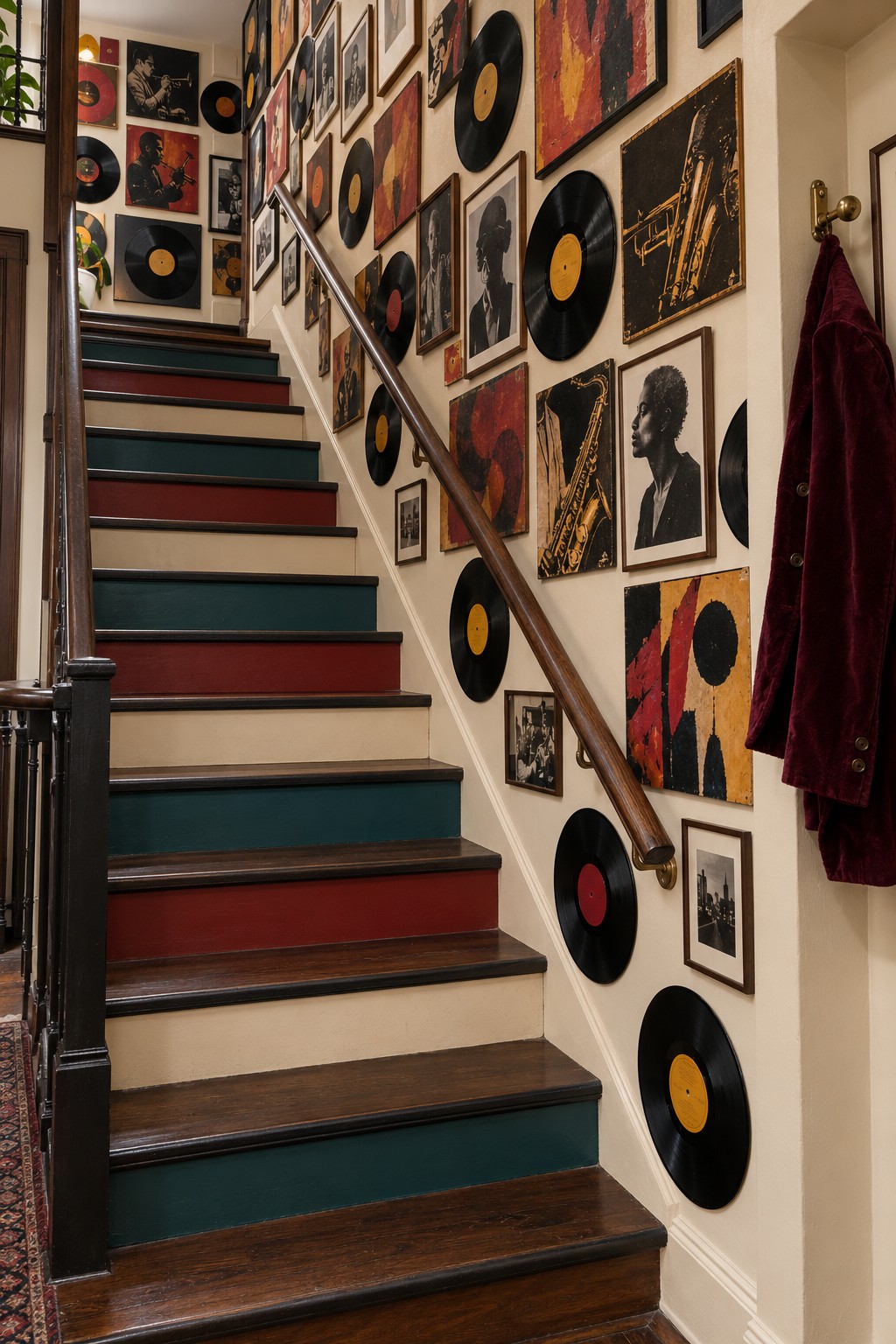
Deep teal, brick red, and cream alternate beneath warm wood toned treads. Black records, musician portraits, and brass instrument imagery build a jazz inspired gallery around the flight. The restrained palette makes the dense wall collection feel connected, with the wooden handrail echoing the treads.
Begin with a repeating three color sequence and check how it ends at the landing. Keep the wood visible where the existing finish is in good condition, concentrating paint on the risers. For the gallery, group related portraits and record displays before filling the spaces with smaller art. Compared with the brighter pop art scheme, this approach suits warmer wood and muted prints, while still giving the staircase a strong individual identity.
22. Rose Painted Woodwork With Harlequin Walls
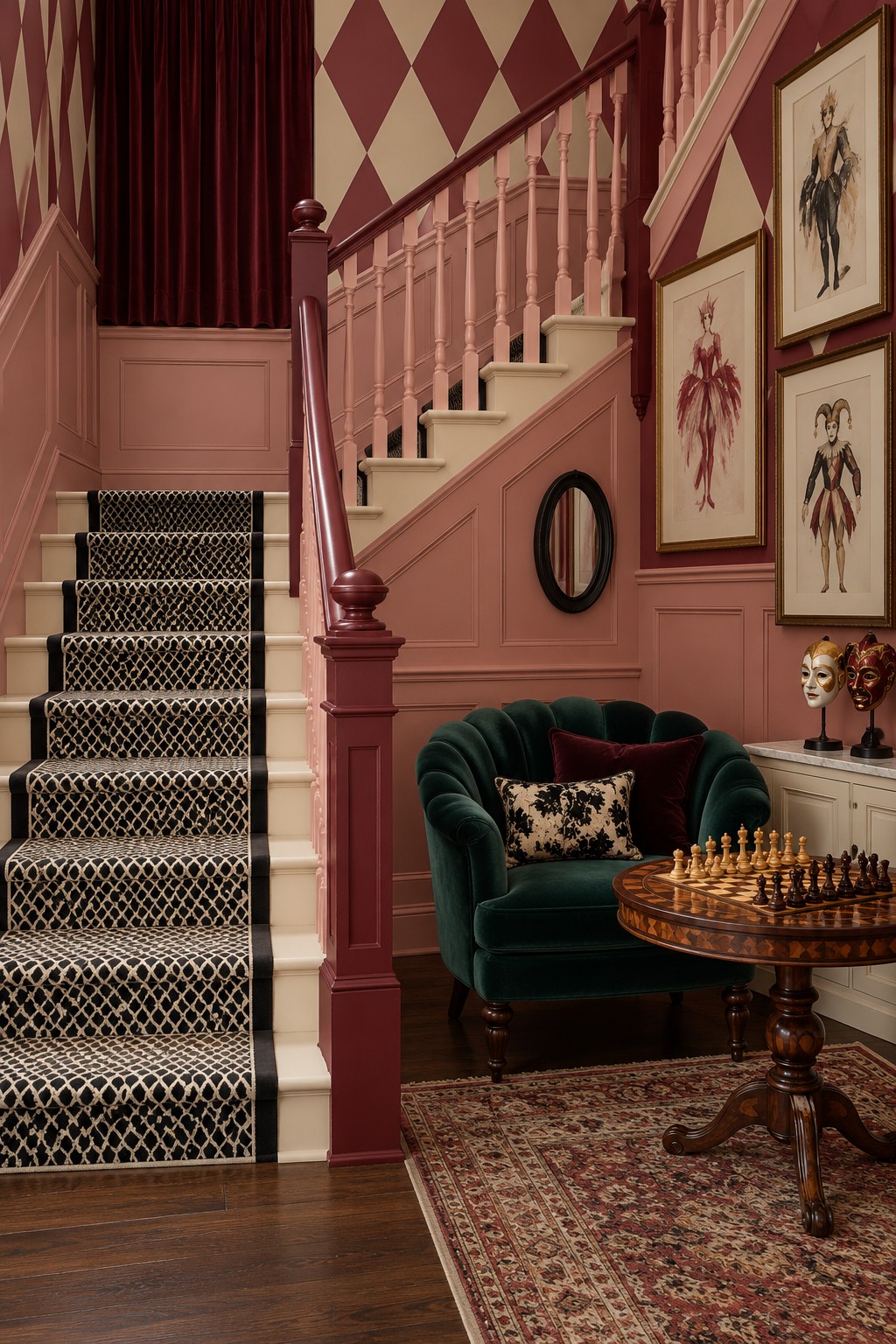
Dusty rose paneling and spindles connect the staircase to a small sitting area, while burgundy rails repeat the darker diamonds on the upper walls. A dark patterned textile runner adds fine detail between cream stair edges. The green chair, chess table, theatrical portraits, and masks bring a distinctly theatrical character to the entrance.
Lay out the wall diamonds as a measured grid, checking their placement around corners and frames before painting. Keep the lower paneling a solid rose so the large pattern has a clear boundary. The runner should be fitted as a stair textile, with the paint scheme designed around it. Add seating only where the hall has enough space for both the furniture and a clear approach to the first step.
23. Plum Risers Beneath a Fan Pattern and Puppet Collection
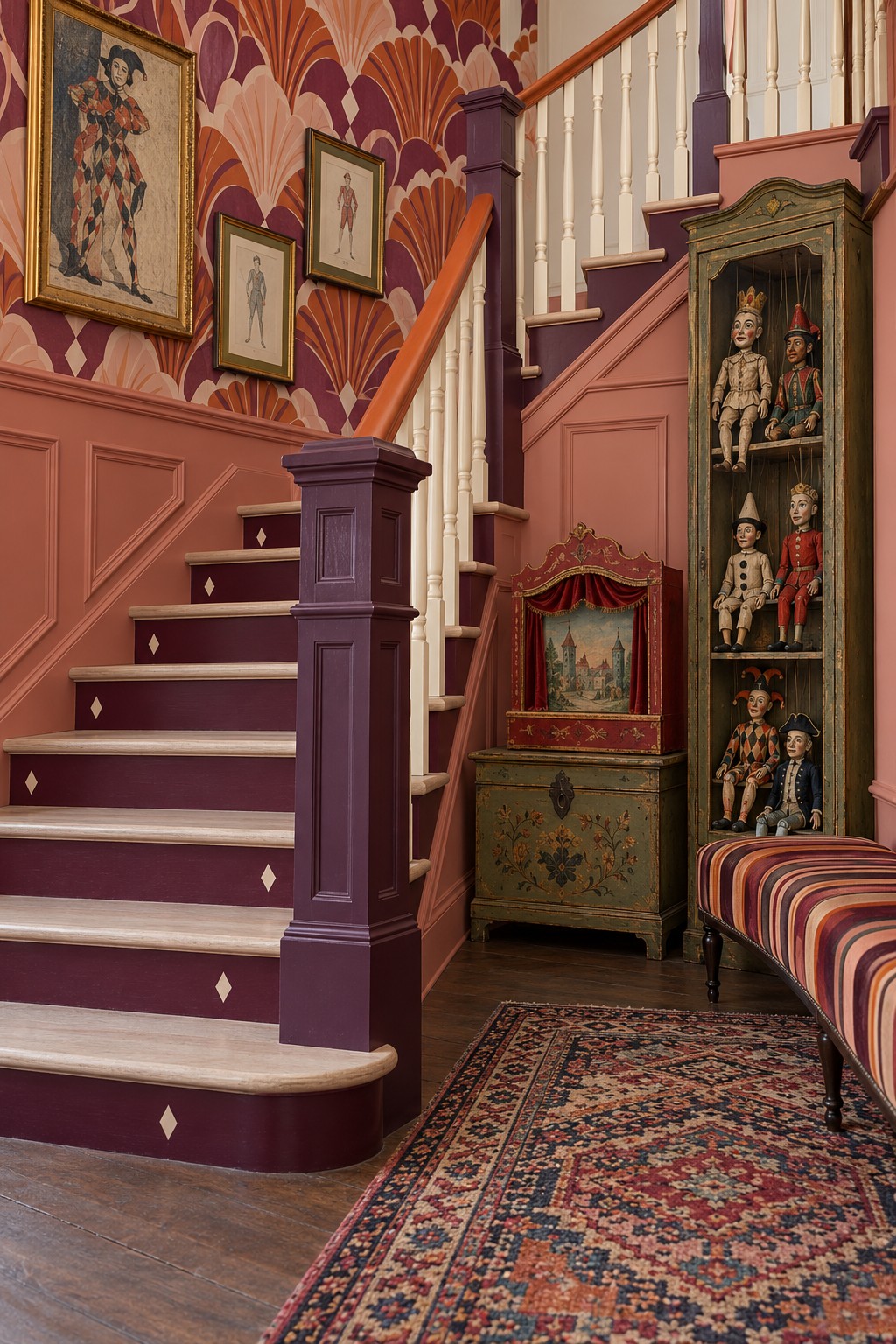
Cream treads and small cream diamonds break up the plum risers, while purple posts and an orange handrail draw colors from the large fan pattern above. Coral paneling provides a quieter middle layer. Framed theatrical figures, a miniature stage, and a tall puppet cabinet give the surrounding hall a specific collector’s story.
Paint the risers and their simple diamonds first as the staircase’s repeatable motif, then plan the wall fans at a scale large enough to remain readable behind the frames. Use separate templates for the fan outline and internal rays. Keep the cabinet and upholstered bench outside the walking route and secure tall furniture as instructed. You can preserve the character with one theatrical display and a small section of fan pattern if the entrance cannot accommodate the full collection.
Choose One Detail to Carry Through the Hall
A successful painted staircase does not need every surface to compete for attention. If you choose a detailed mural, let the treads provide a quieter foundation. If the risers carry the pattern, repeat just one of their colors in the handrail or door trim. Where a runner or a personal collection is the main attraction, painted woodwork can give those pieces a coherent setting.
Keep a record of the paint products, colors, and preparation used so future touch ups remain compatible. Once the finish has cured, follow its cleaning instructions and address wear before a small damaged patch spreads. The most useful idea is the one you can enjoy from the doorway, navigate comfortably, and maintain as part of everyday life.

Leave a Reply