
Leaf cushions, fitted vase covers, pocket organizers, and small catchall bowls give green crochet different jobs around the home. These 14 ideas explain how to choose a useful shape, plan its construction, and adapt the botanical colors to your room. Start with the vase cover fitting guide, then explore the designs for material choices, attachments, and everyday care.
Table of Contents
- What the Green Botanical Theme Brings to a Room
- Choose the Construction Before the Yarn
- Collage Example: Wrap and Close an Open Vase Cover
- 14 Green Crochet Ideas for Different Uses
- 1. Textured Leaf Crochet Cushion in Layered Green Tones
- 2. Chunky Crochet Storage Tote for Soft Household Organization
- 3. Botanical Crochet Table Runner Made from Leaf Motifs
- 4. Wall Organizer with Crochet Pockets for Small Essentials
- 5. Botanical Bedside Organizer for Books and Daily Accessories
- 6. Geometric Crochet Lampshade with Retro Green Color Blocking
- 7. Floral Pendant Shade with Layered Crochet Foliage
- 8. Small Crochet Floral Display for Shelves and Consoles
- 9. Layered Crochet Wreath with Leaves and Dimensional Flowers
- 10. Hanging Crochet Mobile with Flowers, Leaves, and Tassels
- 11. Crochet Covered Hanging Shelf for a Small Plant Display
- 12. Crochet Covered Vase with Dimensional Green Texture
- 13. Floral Crochet Ottoman Cover with Green Tassel Details
- 14. Scalloped Crochet Catchall Bowl in Mixed Green Shades
- Keep Covers Easy to Use and Care For
What the Green Botanical Theme Brings to a Room
Sage works as a soft background beside pale upholstery, olive connects naturally with timber, and forest green gives lighter leaves a clear outline. Choose the green beside the furniture or fabric it will accompany, then use pink or yellow in a few flower centers or petals. Repeating one shade in separate pieces can connect a cushion, basket, and wreath without giving them identical patterns.
Choose one main textured piece and repeat a selected green elsewhere. A raised leaf cushion can sit beside plain upholstery, while a wreath can introduce the theme without altering furniture. For smaller practical projects, compare the catchall bowl and wall pockets. For covers, see the vase and ottoman. Their fitting requirements are different.
Choose the Construction Before the Yarn
A surface design uses separate leaves or flowers attached to a backing. A pocket organizer needs a supporting panel and usable compartments. A wreath needs a firm ring. A cover fits an existing object, while a tote or bowl forms its own body. The wrapping method in the collage helps with fitted covers; it cannot replace the structure of a basket, hanging shelf, or organizer.
Prepare yarn, a hook suited to the yarn and selected pattern, a measuring tape, scissors, and a blunt yarn needle. Measure the object at its widest point as well as its height, including changes in shape. Make a sample in the intended stitch, finish it as the yarn and pattern require, and use its measured stitch and row density to plan the panel. Keep a note of the hook size and sample measurements for matching pieces.
Collage Example: Wrap and Close an Open Vase Cover
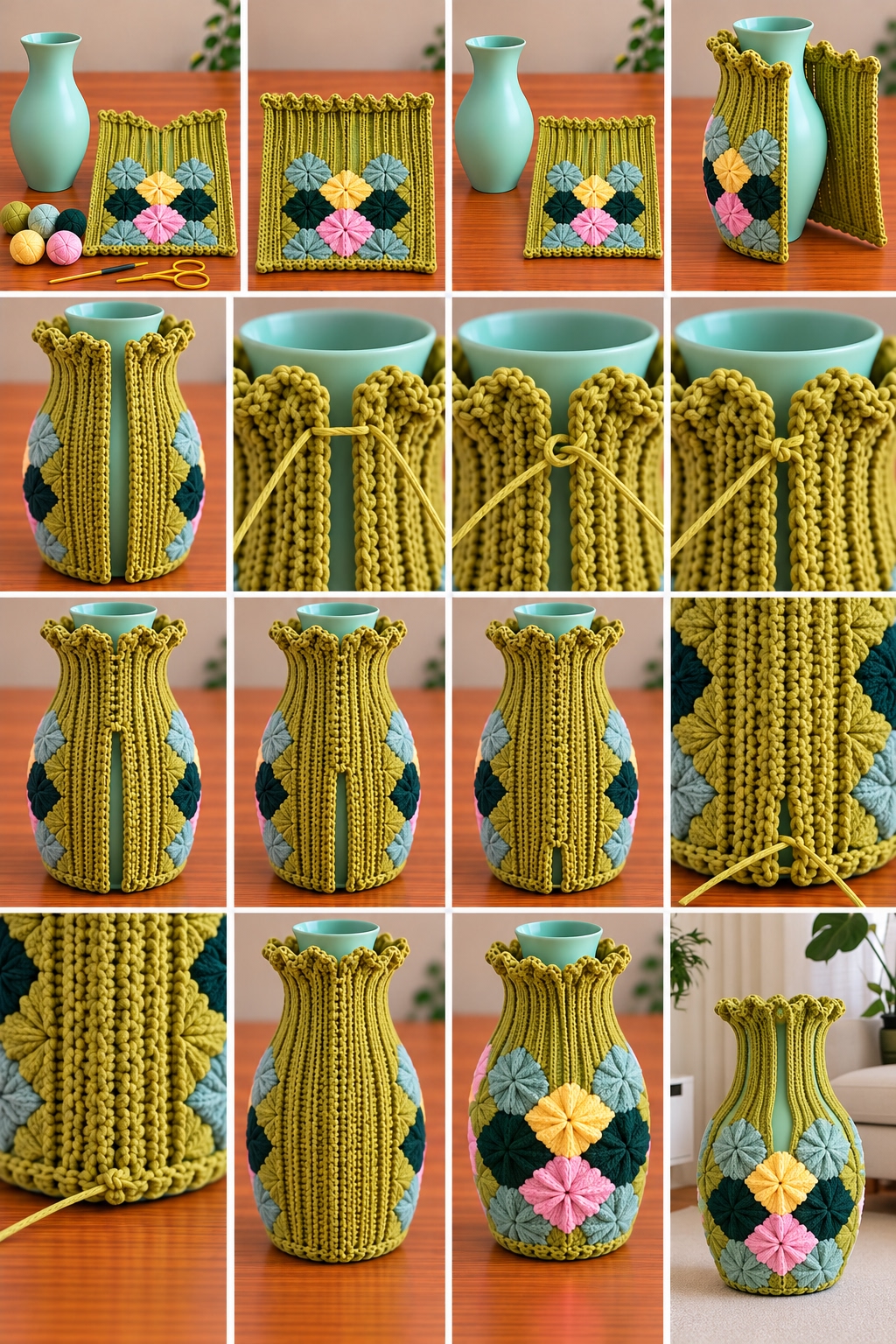
For a vase with a broad body and narrow neck, make a cover that opens along one side. The ribbed panel needs to fit around the body with its floral motifs arranged clear of the closing edges. Use the collage to follow the wrapping and tying stages, and use a crochet pattern and finished sample to establish the stitches for your own vase.
Try the panel around the empty vase before attaching the motifs permanently. Bring the edges together gently, then join them with closely spaced removable ties or lacing. Work along the opening without pulling hard against the glass. Finish yarn ends within the textile and test the full opening so the cover can be removed without stretching it over the neck.
A sewn seam can suit a straight vessel when the finished cover slides off easily. Whipstitch joins corresponding edges with a yarn needle; removable ties are more useful when the silhouette prevents that sliding movement. Keep knots away from the vase base so it stands evenly, and lift the vase by its own body rather than by the crochet.
14 Green Crochet Ideas for Different Uses
Use these ideas to choose a first project: a cushion or runner adds texture, pockets organize light essentials, and a fitted cover changes an object you already own. Plan the base, joins, and opening for that particular use before adding the leaves and flowers.
1. Textured Leaf Crochet Cushion in Layered Green Tones
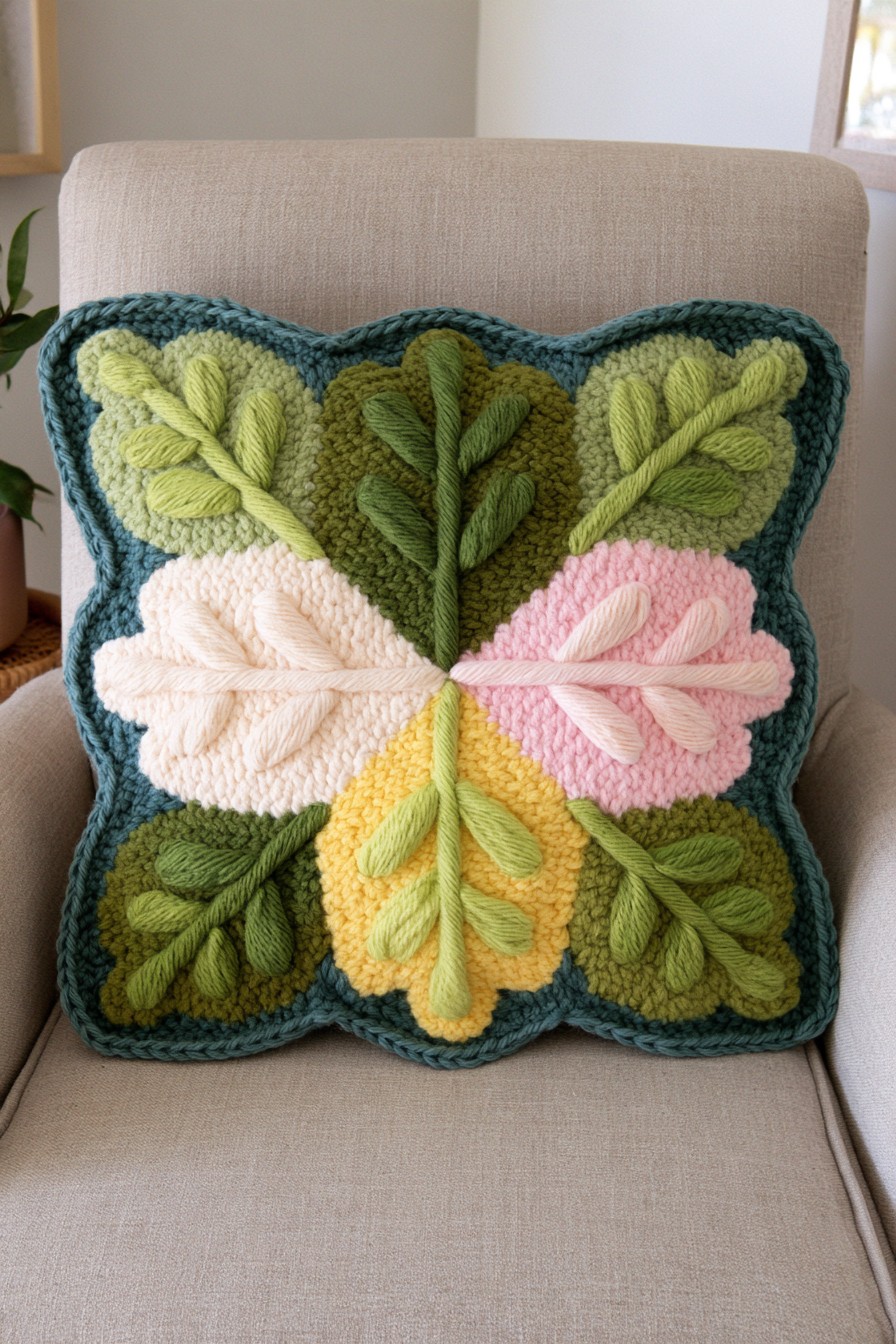
Large raised leaves form a cushion face in forest green, olive, cream, pink, and yellow. A darker scalloped outline separates the cushion from the pale sofa. The botanical effect comes from the clearly defined leaf shapes as well as the green palette.
Prepare the motifs on a cover supported by an insert that fills it without straining the seams. Place the opening on the back or another accessible edge. This highly textured face may work best as a display side; use a flatter reverse for frequent leaning if the raised stems feel uncomfortable. Pair it with plain seating or explore textured handmade pillow ideas to compare how different surfaces suit decorative and everyday use.
2. Chunky Crochet Storage Tote for Soft Household Organization
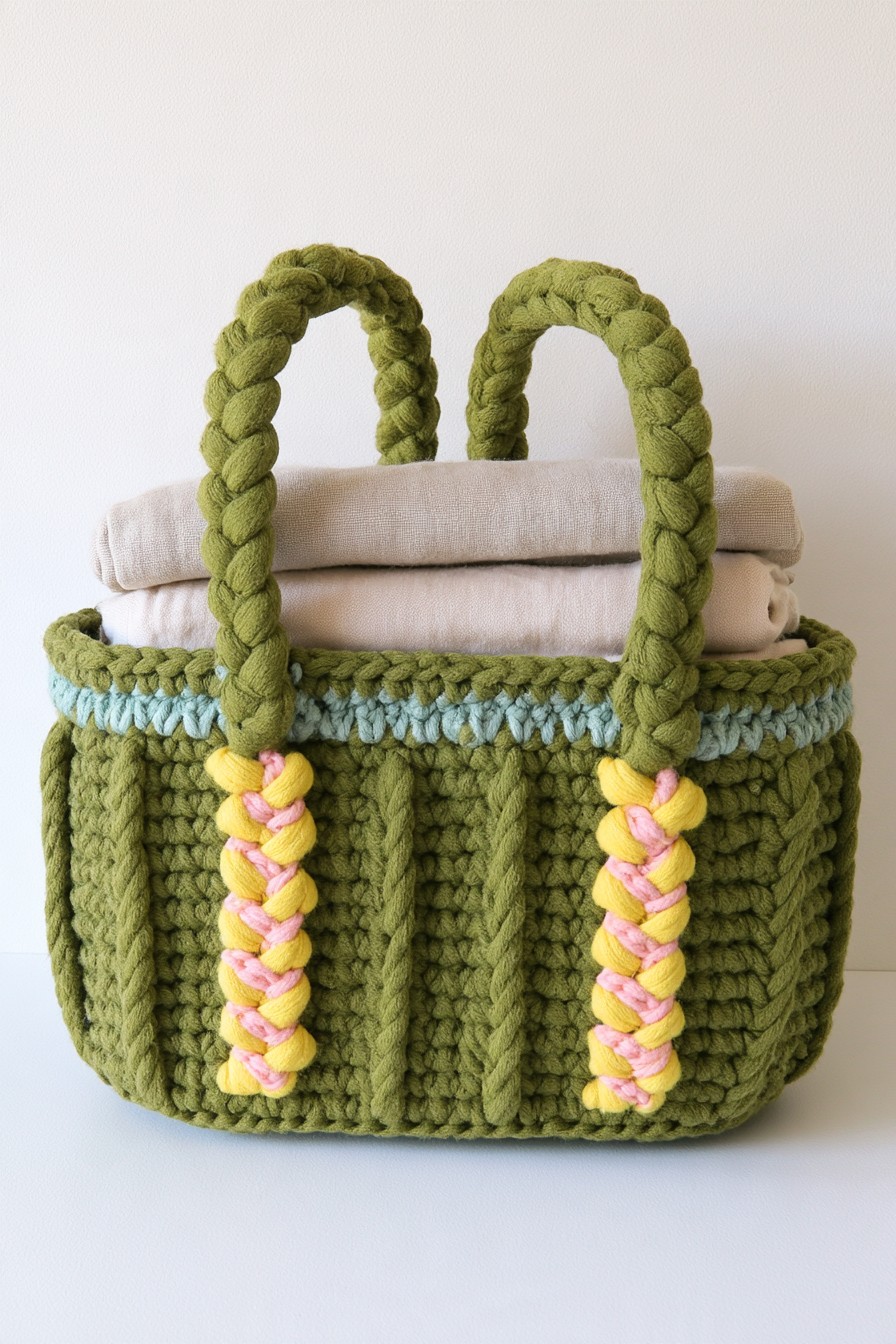
Thick olive stitches form a storage tote with substantial handles and pale trim around the opening. Smaller pink and yellow details brighten the handle area without covering the whole body. The broad opening makes folded textiles visible and easy to reach.
This is a complete container, not simply a fitted cover over another object. Yarn thickness, stitch choice, tension, and base construction all influence whether it stands. Make a small base and side sample before committing to the full tote, then test shape with light intended contents. Follow a suitable basket pattern for handle attachment and check stretching when it is lifted. Match the tote's contents and handling to its base, handles, and joins, and check them before carrying it.
3. Botanical Crochet Table Runner Made from Leaf Motifs
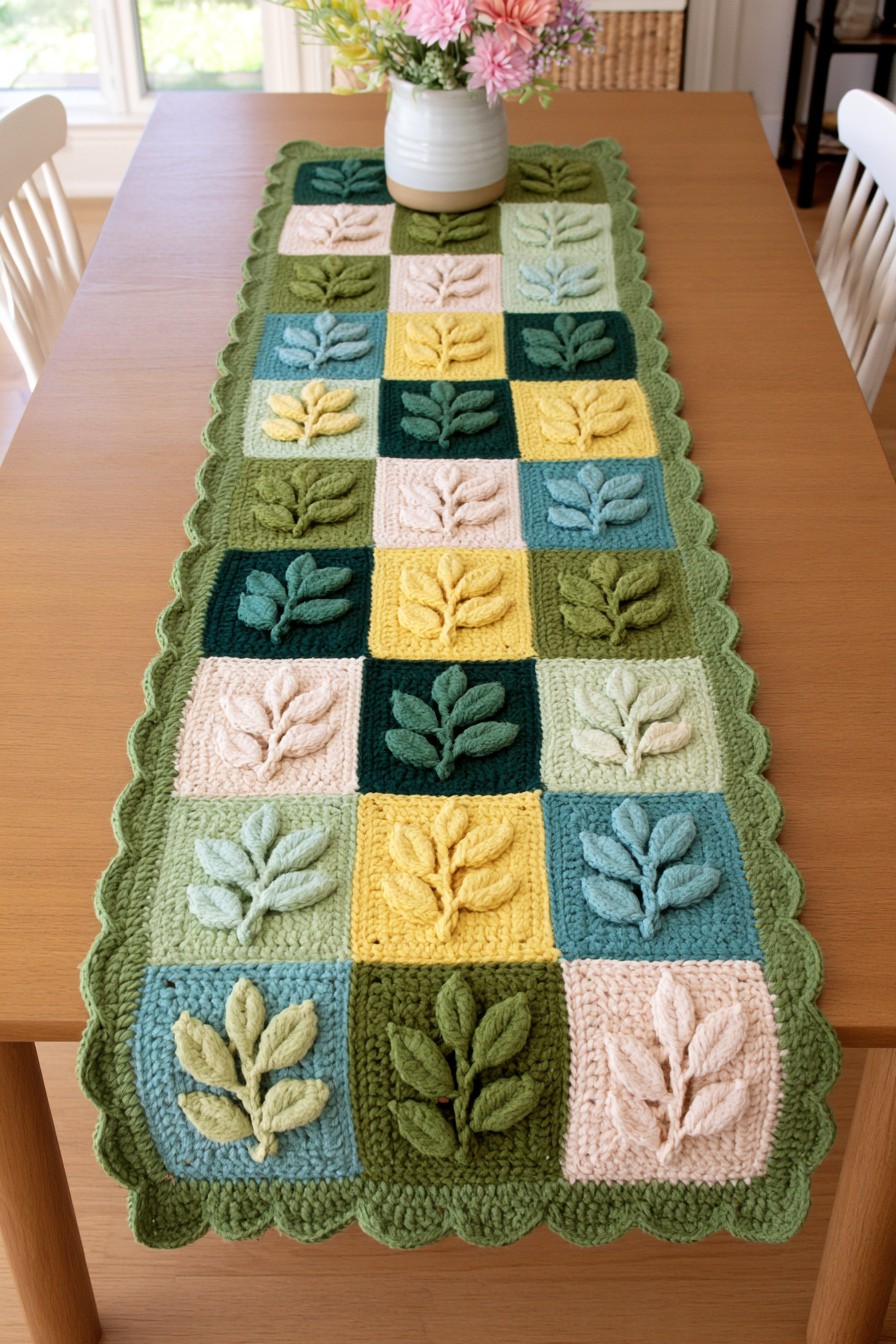
A long runner joins colored squares with raised leaf motifs and a green scalloped border. Pale pink, yellow, blue, and several greens break up the repeated geometry. The design distributes botanical texture along the table instead of concentrating it in one centerpiece.
Lay out the squares against the actual tabletop before joining them, leaving useful exposed surface at the sides. Reserve flat positions for glasses, vases, and serving dishes; raised leaves should not become an unstable base beneath them. A shorter runner can occupy only the decorative center if the table is used frequently for meals. Join the motifs on a separate backing or with an appropriate crochet join, then check that the finished arrangement lies evenly.
4. Wall Organizer with Crochet Pockets for Small Essentials
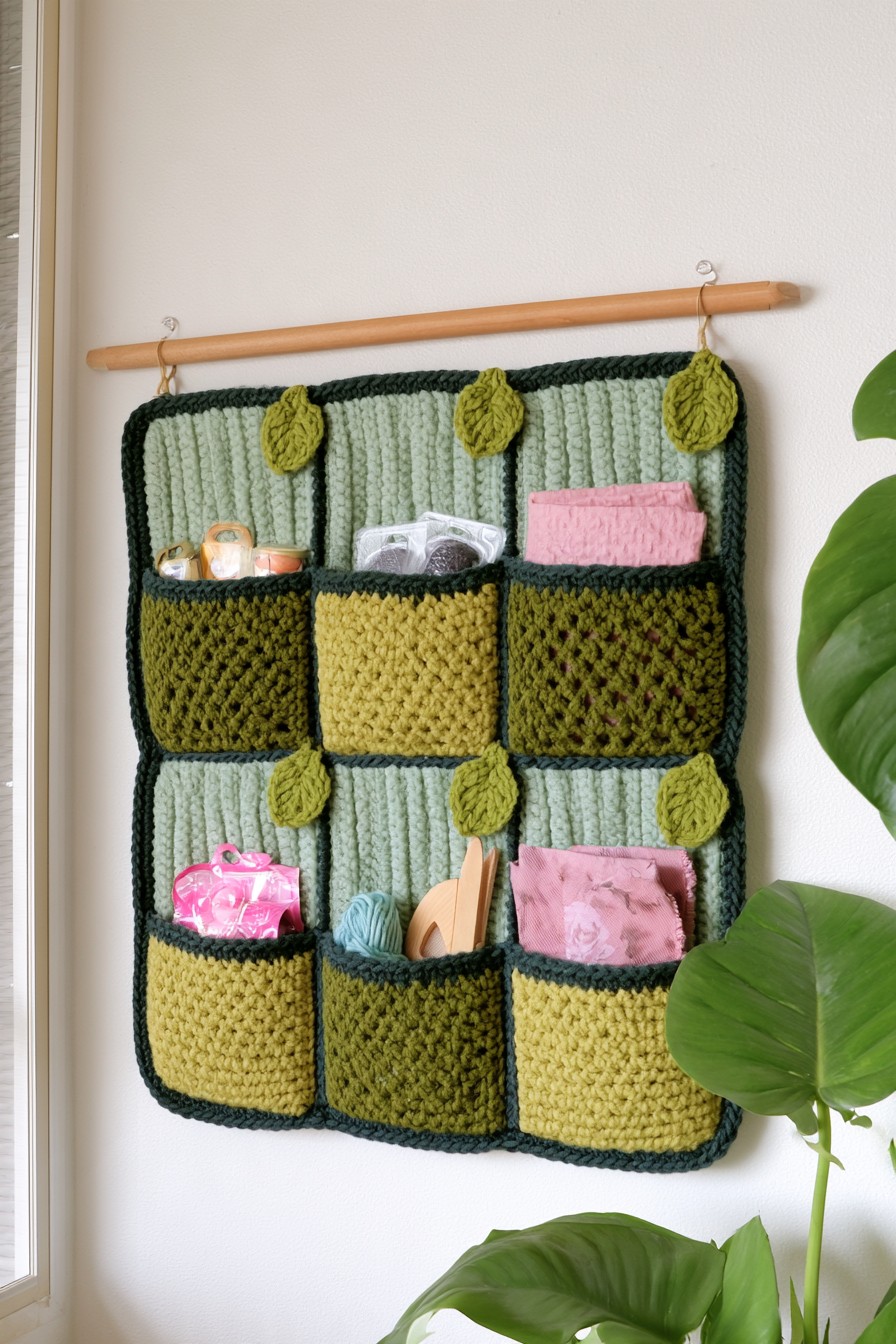
Six pockets sit on a striped green panel suspended below a wooden rod. Different green shades distinguish the compartments, while small leaves along the upper edge carry the botanical theme. The arrangement keeps light essentials visible without adding storage across a desk.
Size the pockets around the intended objects and keep their openings easy to grip. The rod and wall attachment need to support the panel and its contents together. Fill it with light items during a trial, checking whether the panel pulls away from the wall or the mount moves when an object is removed. Dense edging can help limit distortion, but it cannot replace an appropriate mount. Keep raised motifs outside the places your hand repeatedly reaches.
5. Botanical Bedside Organizer for Books and Daily Accessories
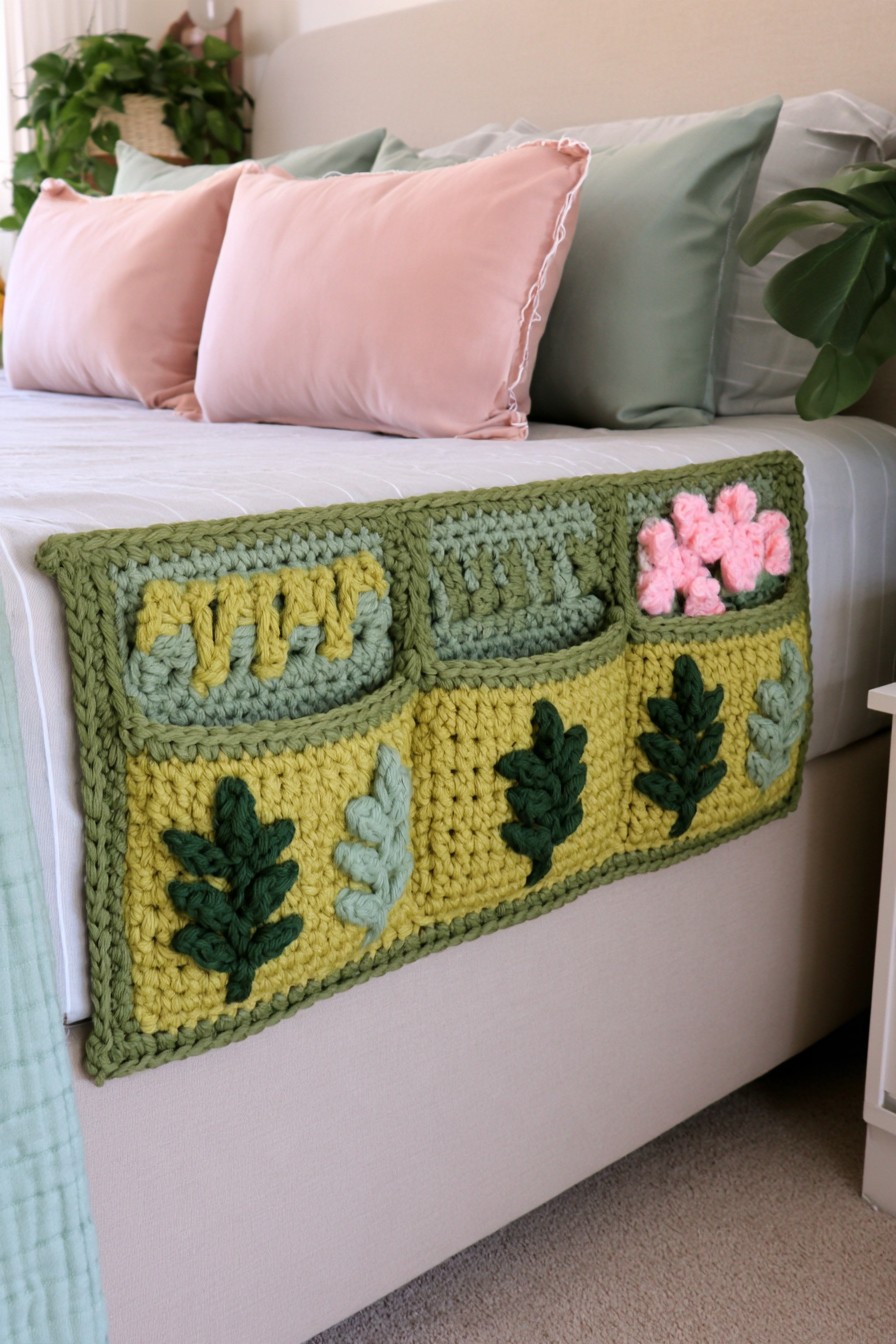
A green pocket panel hangs beside the bed, with botanical motifs on the lower compartments and contrasting edges around the openings. Its position puts everyday accessories within reach while leaving the floor clear. The color groups give individual pockets a readable order.
Select a secure attachment permitted for the actual bed construction and position the pocket openings within comfortable reach. Check that the panel stays in place when bedding is changed and a paperback is removed. Start with light items, keeping knots behind the backing and clear of the sleeper and moving bed parts. Firm pocket stitching and a reliable attachment are both needed for daily use.
6. Geometric Crochet Lampshade with Retro Green Color Blocking
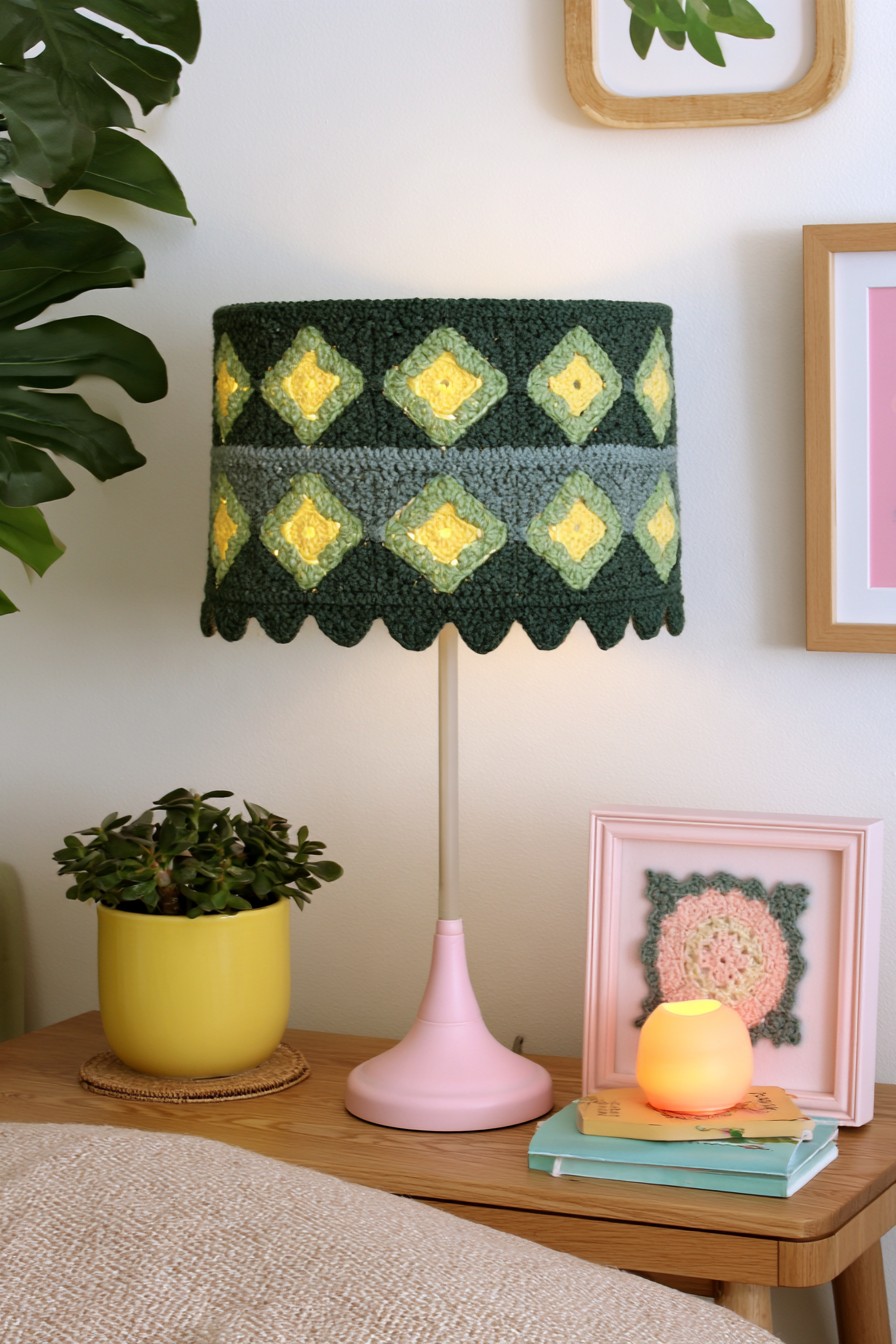
Yellow diamonds repeat within sage shapes on a dark green shade, finished by a scalloped lower edge. The pattern adds a retro note while keeping the room’s botanical palette. The simple geometric repetition differs from the raised foliage used elsewhere in the selection.
Before making a textile cover for a working lamp, confirm that the light fitting and shade system permit that material and arrangement. Follow their specified clearances and keep the crochet from sagging toward the bulb, socket, or ventilation openings. Plan an opening that allows removal and inspection without disturbing the electrical parts. If you cannot establish compatibility, make the patterned form as an unpowered decoration instead.
7. Floral Pendant Shade with Layered Crochet Foliage
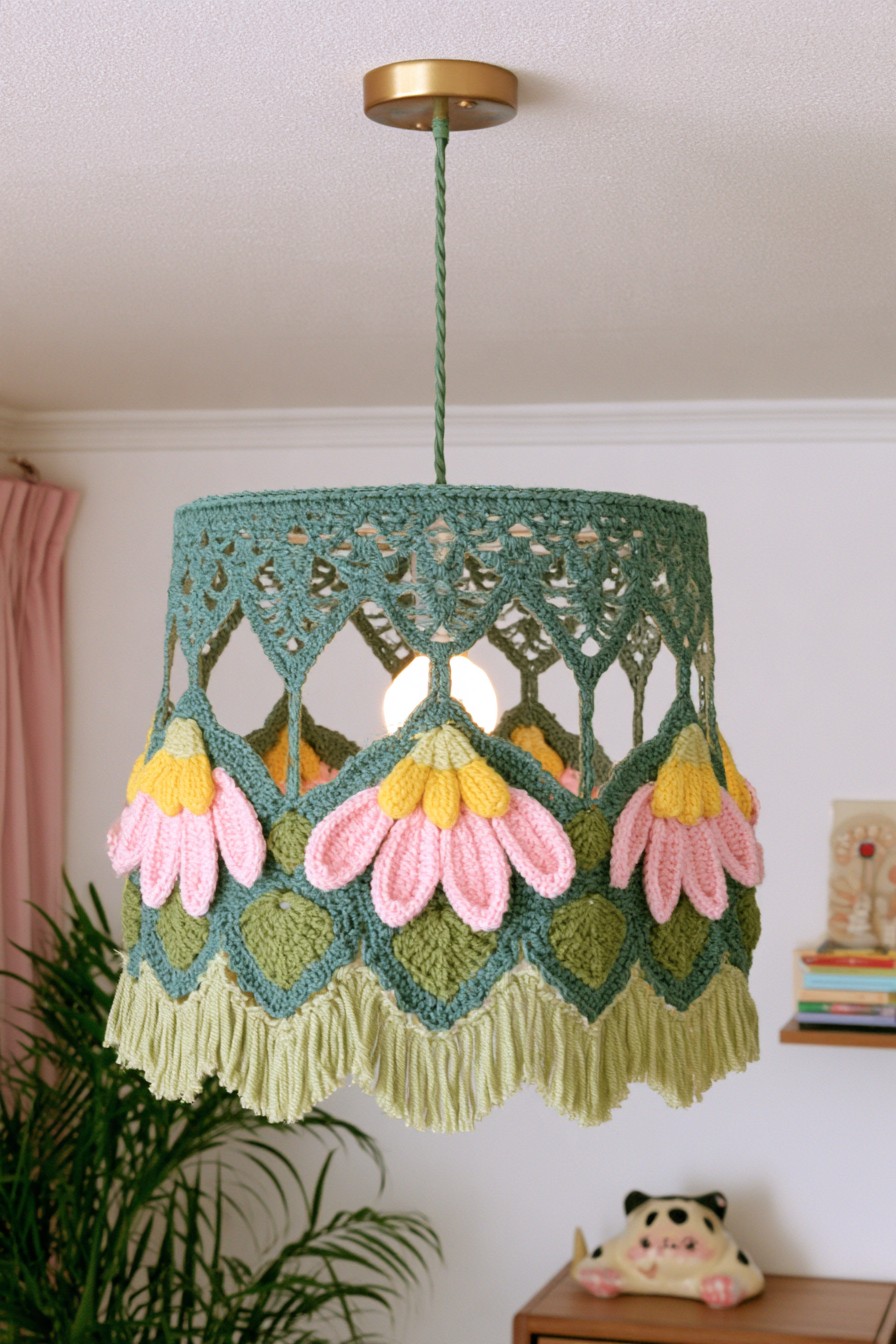
Open crochet surrounds a pendant form, with pink and yellow petal shapes, green leaves, and pale fringe along the bottom. The upper openwork gives the arrangement a lighter appearance than a dense cover. Repeated flower groups make the botanical outline visible from several sides.
Plan the flower groups on a separate band before fixing them to the supporting form. Distribute their weight evenly and keep fringe from falling inward. A working pendant needs a shade and fitting system suitable for the added textile, with the required ventilation, clearances, and electrical access preserved. For an unpowered hanging decoration, secure the form independently and position its strands away from doors and walking routes.
8. Small Crochet Floral Display for Shelves and Consoles
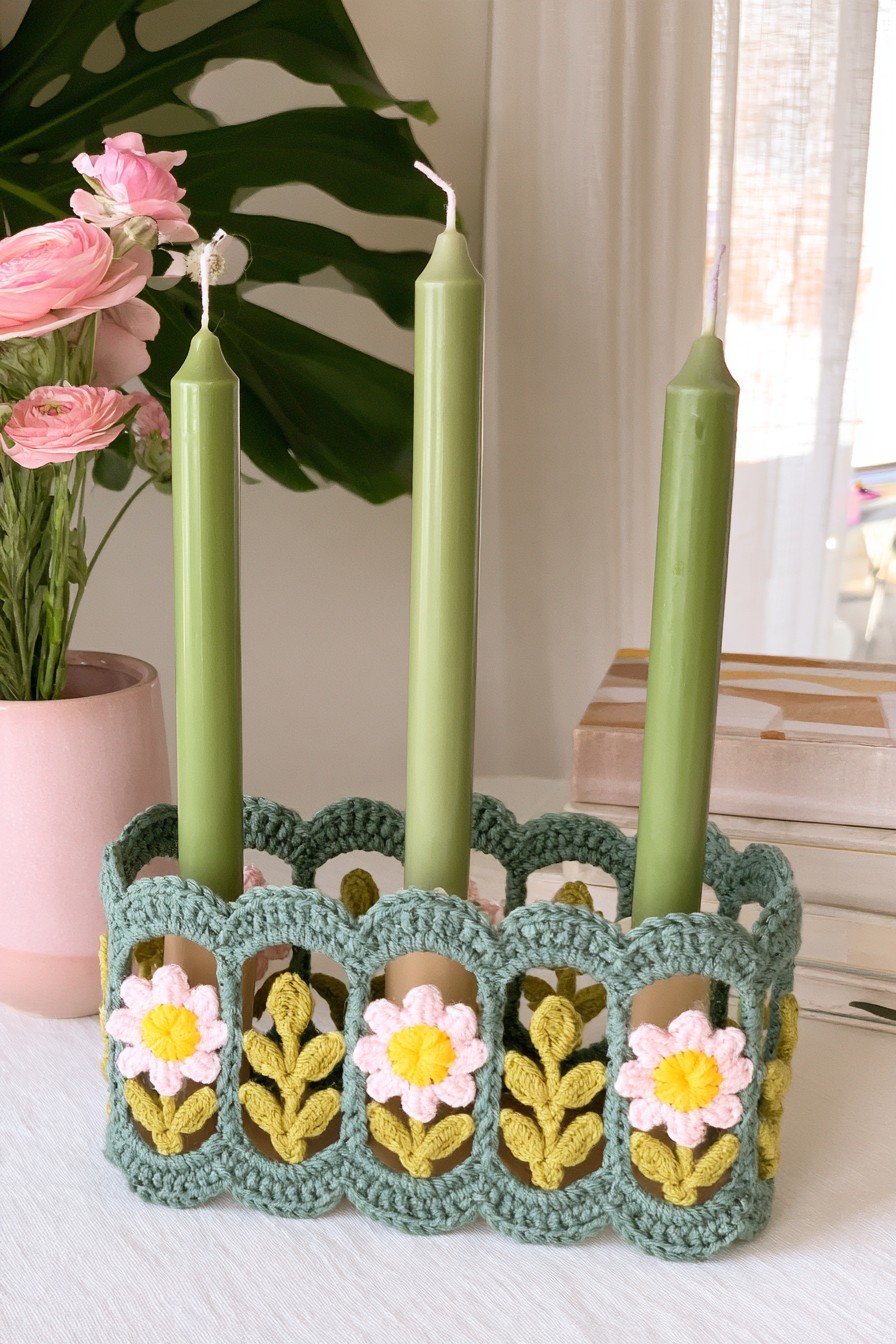
Three tall green candle shapes rise above a small crochet garden of arched sections, leaves, and pale flowers. Repeat two greens through the lower motifs and use the blossoms as smaller accents. A shelf or console with a plain background lets the curved silhouette remain visible.
Keep wax candles unlit in this yarn arrangement, or choose suitable battery powered flameless candles for an illuminated version. When making your own, stitch the flowers and leaves to a separate crochet base, leaving clear, flat positions for the lights. Check that nothing rocks when the arrangement is moved. Keep switches, battery compartments, and any required ventilation accessible without pulling on the motifs, and follow the lights’ placement instructions.
9. Layered Crochet Wreath with Leaves and Dimensional Flowers
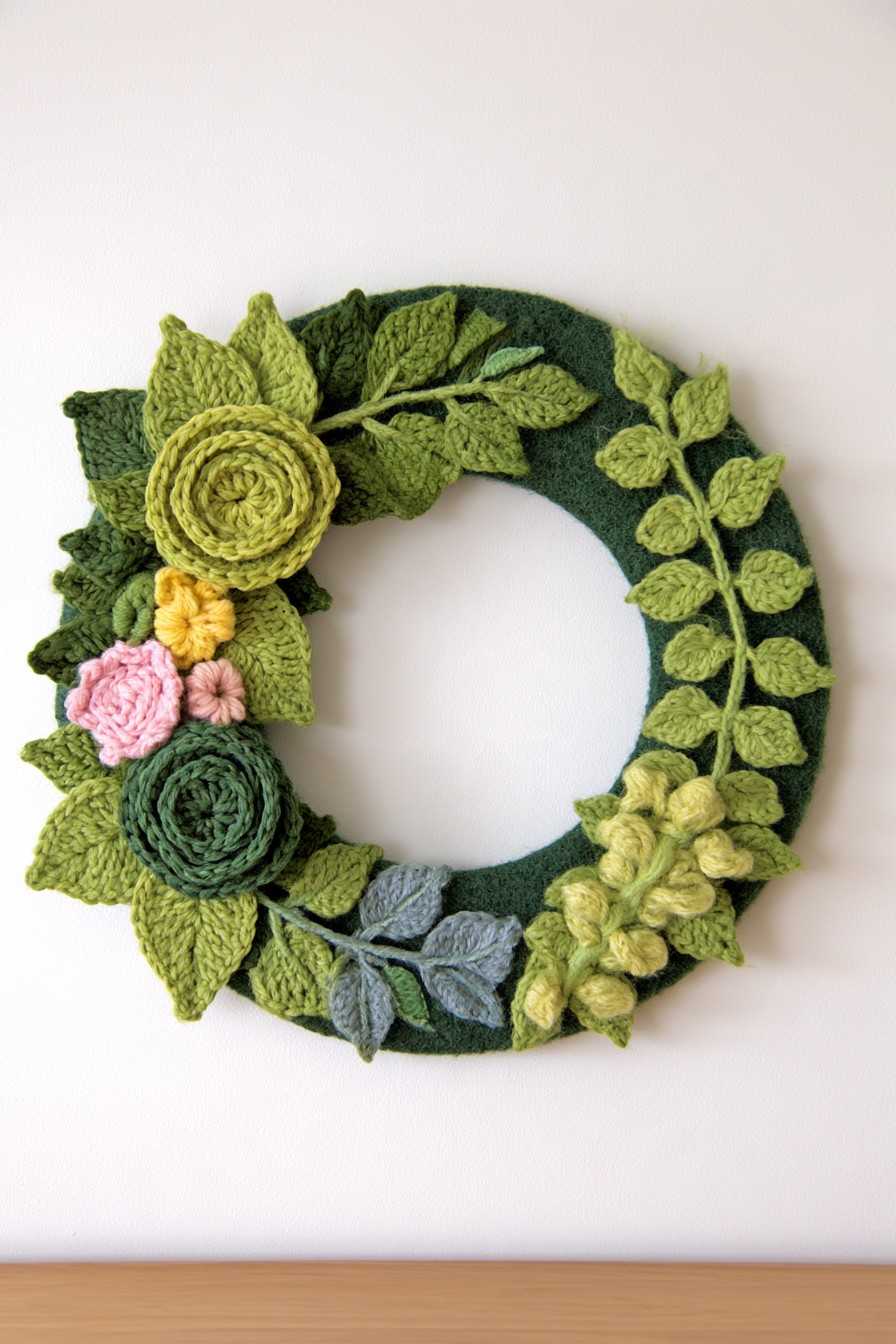
Layered green leaves follow a circular wreath with larger roses and smaller flower accents grouped around it. Different greens separate overlapping shapes, while the open center keeps the arrangement recognizably botanical. The flowers supply focal points without requiring equal ornament all around the ring.
Choose a firm base and distribute motifs before attaching them. Stitch or tie each motif through its back to a compatible ring covering so pieces can be repaired individually. The hanging point should connect to the structural base and suit the completed weight. Keep the back reasonably even so the wreath sits as intended. A smaller wreath with fewer layers can preserve the leaf theme when a doorway or wall has limited space.
10. Hanging Crochet Mobile with Flowers, Leaves, and Tassels
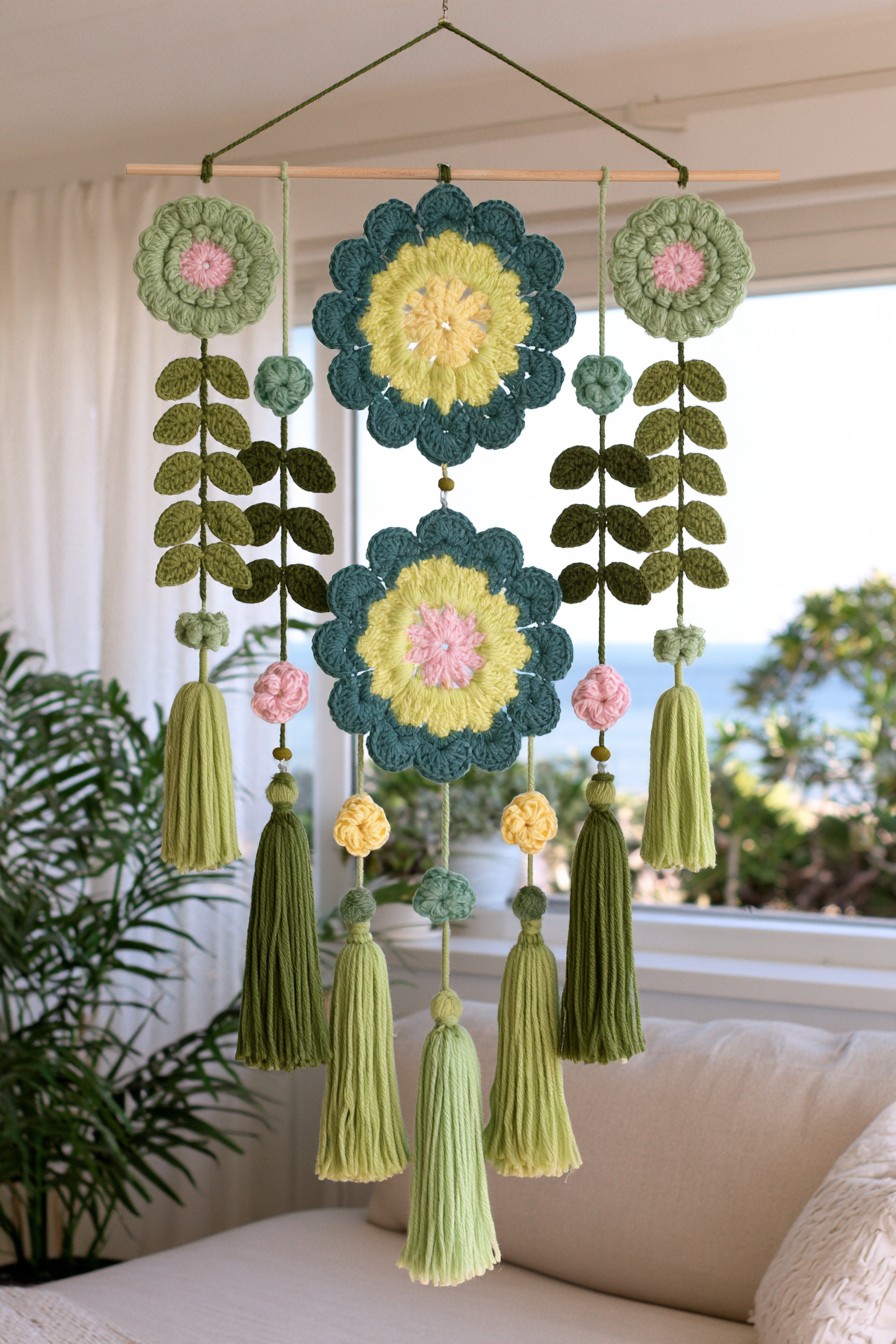
A horizontal dowel supports strands of leaves, large flower discs, and long green tassels. Different lengths create an irregular botanical outline, with darker edging defining the pale flower centers. The hanging provides detail without occupying a tabletop.
Prepare each strand separately, then attach it to a support appropriate to the whole piece. Space the largest flowers before adding smaller accents so they remain visible. Hang it clear of doors, seats, and areas where strands can be caught or pulled; it is decorative room art, not a toy or cot mobile. Use accessible strand connections if seasonal changes or cleaning matter. Finish the tails within the motifs so the design does not rely on loose joining ends.
11. Crochet Covered Hanging Shelf for a Small Plant Display
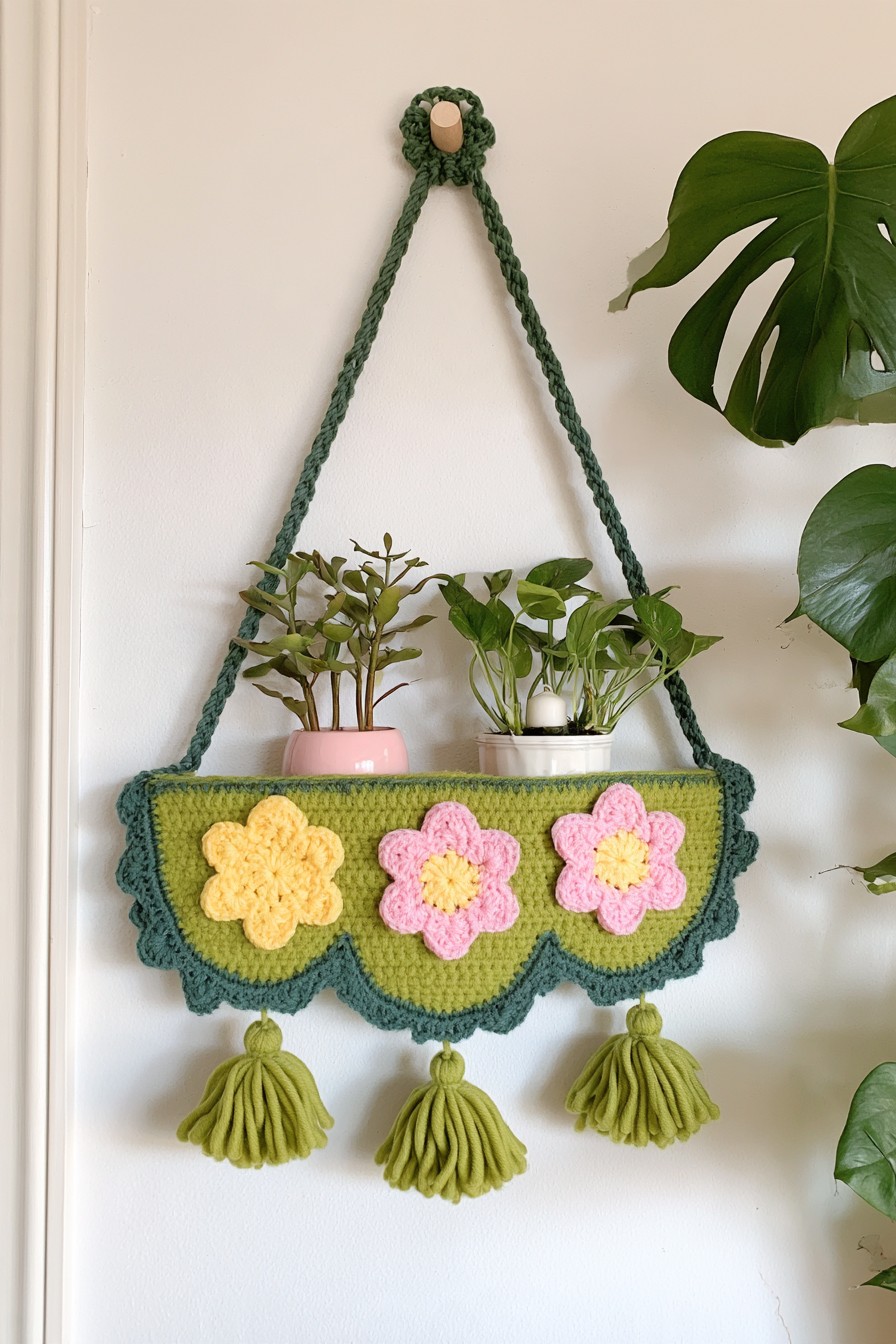
A small hanging plant shelf has a floral textile front, green edge detail, and three tassels below. Two pots sit above the decorative surface. The yarn softens the appearance, while the usable shelf needs its own firm platform and mounting arrangement.
Assess the complete loaded weight, including the platform, pots, soil, plants, and water. Keep the textile edging separate from the load carrying support so decoration is not expected to hold the pots. Use appropriate saucers and remove the textile panel if watering could wet it. Place its closure underneath or behind where it remains reachable, and check that removal will not disturb the suspension. Plant maintenance access matters more than filling every available section with motifs.
12. Crochet Covered Vase with Dimensional Green Texture
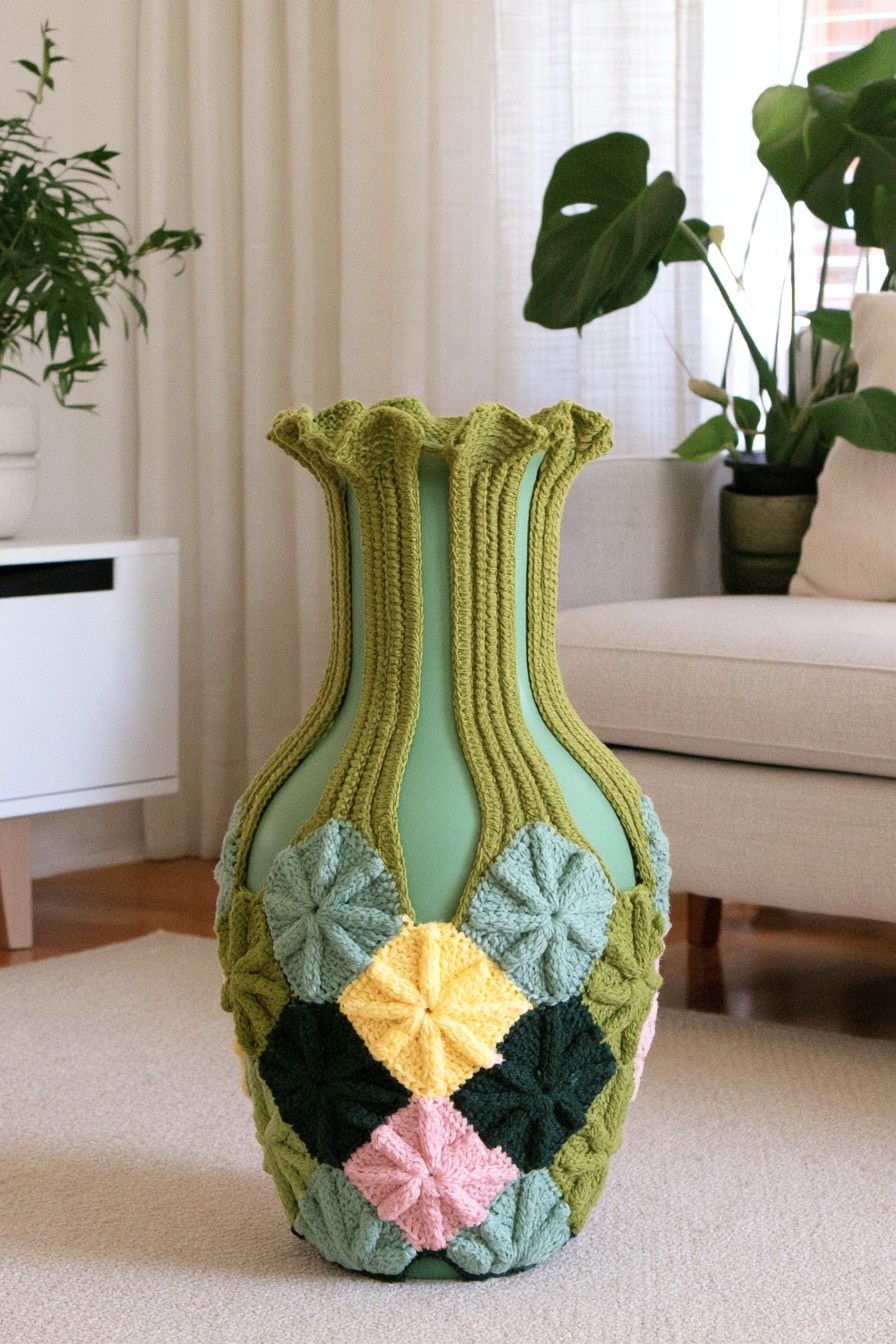
Ribbed olive sections follow a tall vase’s neck, while raised colored motifs surround the wider body. The flared top and changing silhouette remain visible beneath the crochet. This makes the vase itself part of the design rather than hiding it inside a straight tube.
Plan an opening along the side, as in the fitting guide, or make separate neck and body sections; a broad fitted cover may not slide over a narrow neck. Keep the opening accessible when the vase is in place. These removable yarn covers and closure methods offer related fitting approaches. With fresh flowers, remove the cover before cleaning the vase and changing its water. Use these floral styling ideas for vases to plan a bouquet that leaves the opening easy to reach.
13. Floral Crochet Ottoman Cover with Green Tassel Details
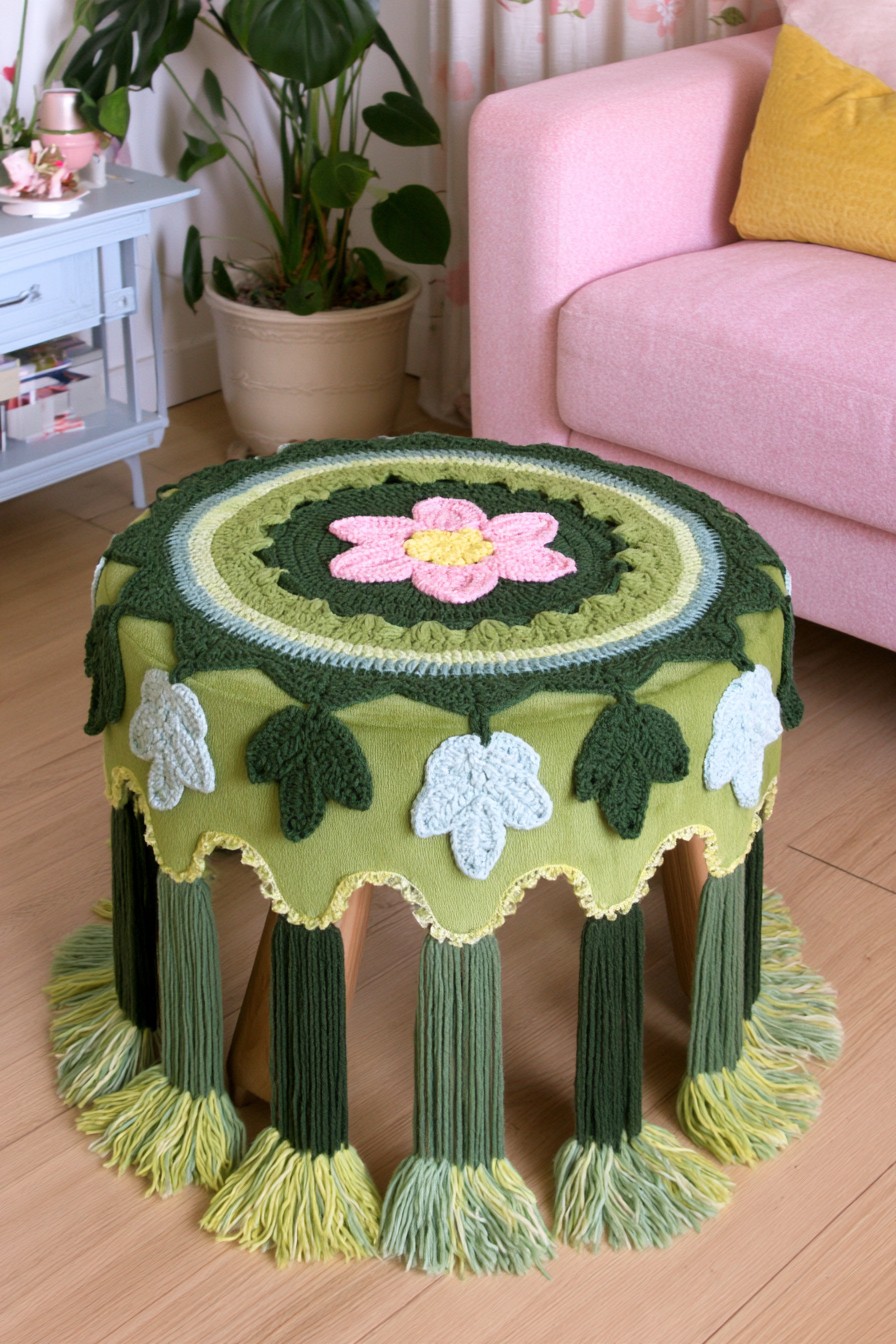
Concentric green bands and a pink flower define the ottoman top, with leaf motifs around the sides and long tassels below. Use contrasting greens to make the separate crochet areas distinct. The fringe adds movement around the lower edge, so decide its length around the way the ottoman will be used rather than treating it as a fixed part of the design.
Measure the top diameter, side height, and intended closure position, then use a stitch sample to plan the cover’s size. Place an opening underneath or at an accessible lower side so removal does not require stretching the whole top. For daily seating or footrest use, shorten fringe or keep it away from feet and floor movement. A flatter central flower can also improve contact comfort. Check the underlying ottoman’s intended use; the cover adds appearance, not strength.
14. Scalloped Crochet Catchall Bowl in Mixed Green Shades
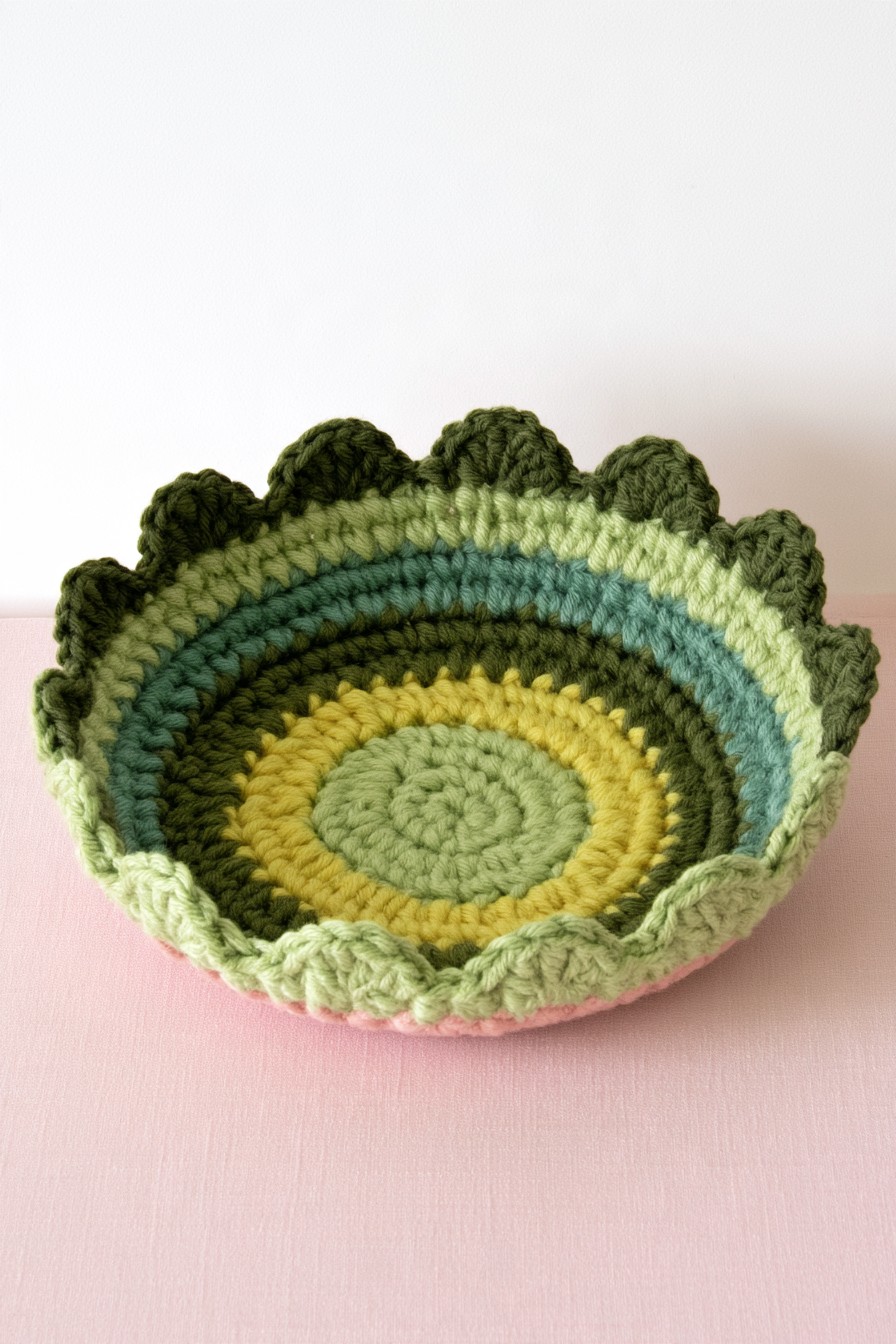
Concentric rows of sage, olive, teal, and deep green form a shallow bowl with a scalloped rim. The changing colors emphasize the rounded shape without needing separate floral embellishments. Its modest scale suits a console, dresser, or craft surface.
Test a small base and upright edge with your intended yarn and stitch before making the full bowl. Adjust tension and shaping until the sample holds the outline you want. Use light accessories and check whether small pieces fall through the openings; a removable lining can help contain them. If you need rigid sides, plan a suitable inner bowl and crochet a removable outer cover around its dimensions.
Keep Covers Easy to Use and Care For
Retain yarn labels and follow their washing and drying directions. A cover that can be removed is not necessarily machine washable. Check care compatibility before combining different yarns, trims, or backing materials. After cleaning, confirm the piece’s shape and fit, and allow it and the underlying object to dry before refitting.
Begin with the object’s purpose: a soft display surface, useful storage, or a removable decorative layer. Choose the green palette next, then the texture and closure. A piece that can be opened, cleaned, and returned without affecting normal use will be easier to enjoy than a closely fitted cover with no practical removal route.

Leave a Reply