
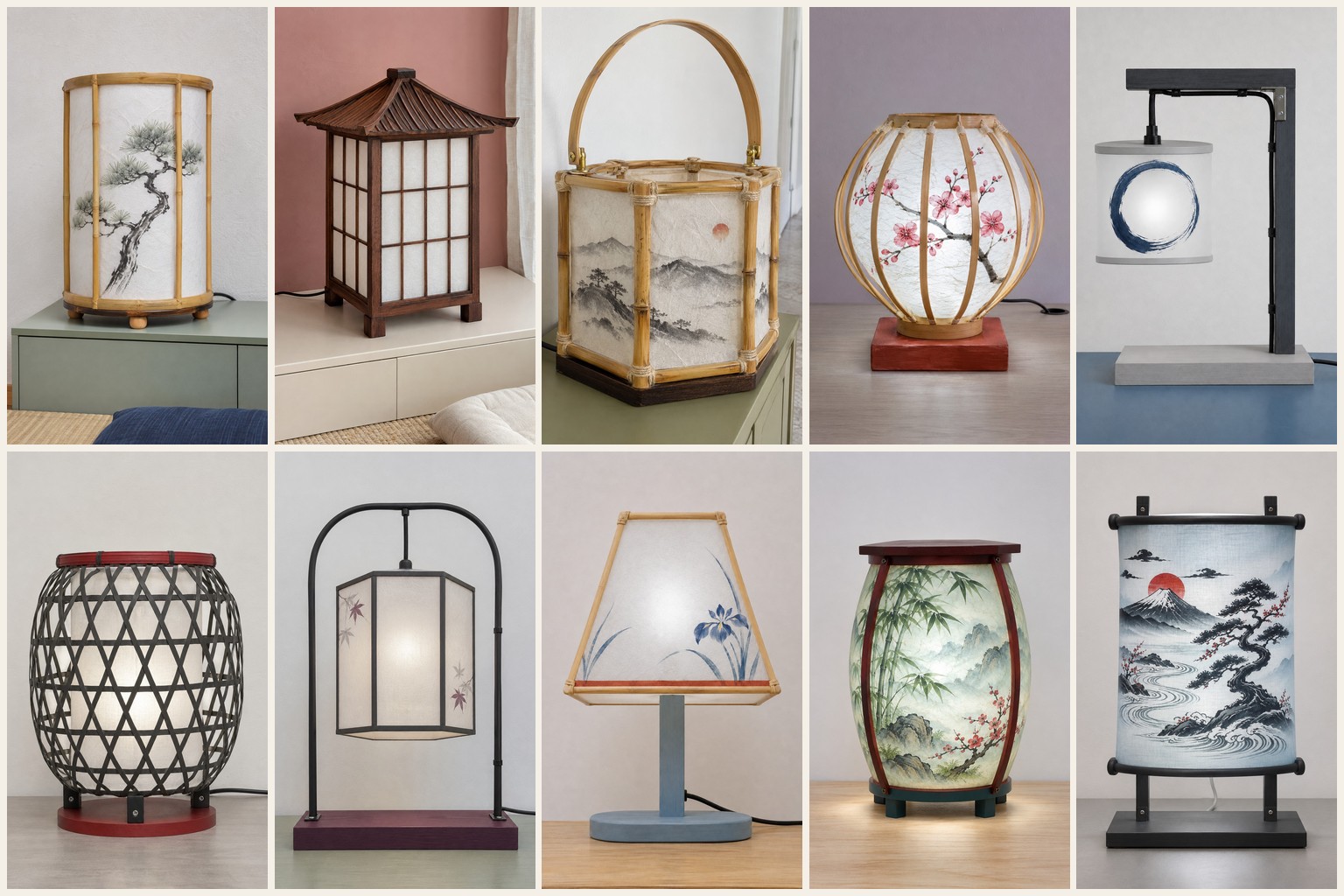
A lamp is often the first thing that tells you whether a room feels calm. Japandi rooms lean on that idea. They borrow the paper lanterns, bamboo and quiet ink painting of Japanese homes, then pair them with the clean lines and pale woods of Scandinavian design. The result is light that feels soft and close, the kind you switch on in the evening and leave on.
The 52 lamps below are all things you can build at home with a saw, a brush and some patience. Some are as restrained as a single pine branch on white washi, others carry wisteria, koi and cherry blossom in full color. The calm ones blend into a neutral room, while the painted ones work best as the one bright piece in an otherwise simple space. They are grouped by how they are built, so you can go straight to wooden frames, bamboo, round lanterns, flat panels, cloth or arms. For more table lamps in other styles, browse our creative DIY lamp projects.
Table of Contents
- What to Know Before You Build a Japandi Lamp
- Paper and cloth that let the light through
- Which glue goes where
- Wiring and bulbs
- Painting on washi and linen
- Waiting times worth planning for
- Shoji and Wooden Lantern Frames
- 1. Pagoda Roof Shoji Lantern
- 2. Mountain Silhouette Hexagon Lantern
- 3. Mount Fuji Hexagon Lantern With a Painted Lid
- 4. Teal Scroll Hexagon Lantern
- 5. Wisteria Lantern With a Raised Roof
- 6. Tall Andon With Koi and Maple Panels
- 7. Navy Slatted Lantern With Wave Accents
- 8. Barrel Lantern With Curved Wooden Ribs
- 9. Torii Gate Lantern
- 10. Zigzag Folding Screen Lantern
- Bamboo, Rattan and Woven Frames
- 11. Ink Pine Bamboo Cylinder
- 12. Hexagonal Bamboo Lantern With a Bent Handle
- 13. Bamboo Cage Over a Round Paper Lantern
- 14. Rattan Frame Shade With Iris Panels
- 15. Pressed Maple Leaf Dome
- 16. Kagome Basket Lamp
- 17. Wave Hat Shade on a Folding Arm
- 18. Spiral Ribbon Lantern
- 19. Cord Wrapped Teal Shade
- Round Paper Lanterns Painted by Hand
- 20. Stacked Chrysanthemum Lanterns
- 21. Hydrangea Oval Lantern on Bamboo Legs
- 22. Lobed Lantern With an Autumn Stream
- 23. Pear Shaped Lantern With Plum Blossom
- 24. Floating Pine Lantern on an L Stand
- Fans, Screens and Flat Panel Lamps
- 25. Half Open Fan on an Oak Base
- 26. Wisteria Paper Medallion
- 27. Two Panel Byobu Screen Lamp
- 28. Pleated Fan With Pine and Red Sun
- 29. Plum Blossom Cloud on a Twisted Trunk
- 30. Koi Drum Lantern in a Crescent Cradle
- 31. Seigaiha Moon Disc
- 32. Shippo Oval Ring
- 33. Wisteria Ribbon Helix
- 34. Cherry Blossom Cube on Its Point
- Linen, Stitching and Cloth Shades
- 35. Stitched Linen Cone on a Stone Base
- 36. Sashiko Pillow Lamp
- 37. Asanoha Bow Shade on a Clay Bottle
- 38. Hourglass Linen Lantern
- 39. Noren Banner Lamp
- 40. Iris Gauze Bench Lamp
- 41. Sumi Painted Linen Scroll Lamp
- 42. Furoshiki Wrapped Cube
- Arms, Branches and Hanging Shades
- 43. Wisteria Shade on a Sculpted Vine
- 44. Twin Iris Bells on a Forked Stem
- 45. Maple Star Shade on a Real Branch
- 46. Hexagon Lantern Under a Black Steel Arch
- 47. Plum Panel Under a Bamboo Arch
- 48. Ensō Drum on an L Shaped Stand
- 49. Maple Cone on a Gooseneck Arm
- Bases Borrowed From Jars, Pots and Plants
- 50. Frosted Globe on a Plum Blossom Jar
- 51. Seigaiha Shade on a Flowerpot
- 52. Lotus Bud on a Bamboo Stem
- Safety Notes for Handmade Lamps
What to Know Before You Build a Japandi Lamp
Paper and cloth that let the light through
Most of these lamps rely on Japanese washi, a paper made from long plant fibers such as kozo, a kind of mulberry. It is often sold as rice paper, though it is not made from rice. Plain kozo or shoji paper gives an even glow, while unryu paper has visible fibers that look like drifting clouds when lit. Linen and loose weave cotton work in the same way. Thin paper and cloth cannot hold a shape on their own, so for drum, cone and curved shades they are pressed onto adhesive lampshade styrene, a thin plastic sheet with a peel away backing that turns soft material into a stiff, smooth panel.
Which glue goes where
Wood to wood joints, such as frames, feet and lids, take an ordinary PVA wood glue. Clamp them for 30 minutes to an hour and leave them a full 24 hours before you put any load on the joint; a cold room stretches both times. Paper onto a wooden or bamboo frame is traditionally fixed with rice starch paste, sold as shoji nori, which dries clear and lets you peel the paper off later with a damp cloth. White PVA glue watered down to a thin cream also works and sets faster, but it is harder to undo. If paper sags after the paste has dried, a very light mist of water on the front pulls it tight as it dries again. Skip the misting on laminated or plastic coated shoji papers.
Bamboo and rattan have a hard, waxy outer skin that resists glue and paint, so sand the contact spots lightly first and back up glued joints with lashing. When wood meets acrylic, glass or metal, a two part epoxy is the safer choice. Keep hot glue for trim that sits well away from the light, since it softens again when it gets warm.
Wiring and bulbs
The decorative shell is the part to make by hand. The electrical part is best bought as a ready made lamp kit or cord set with a socket, a switch and a polarized plug. If you do have to connect a socket, the ribbed wire of the cord goes to the silver screw and the smooth wire goes to the brass screw. Use LED bulbs only in paper, cloth and wooden lamps. They run far cooler than incandescent or halogen bulbs, and that is what makes thin washi a sensible material in the first place. Leave space between the bulb and the shade, and after the lamp has been on for a while, touch the top of the shade to check that it only feels slightly warm.
Painting on washi and linen
Watercolor and sumi ink soak into the fibers and stay translucent, so a painted branch glows rather than turning into a dark shadow. Acrylic sits on top of the paper and blocks more light, which is useful for bold borders but heavy for large areas. Thin it with water and build color in layers. Always test on an offcut of the same paper and hold it up to a lamp, because a color that looks right on the table can look muddy when lit from behind. Flat panels are easiest to paint before assembly; for a round lantern, put one hand inside to support the paper as you work.
Waiting times worth planning for
A few of these projects run on patience more than skill. Pressed leaves need around two to three weeks in a heavy book before they are dry enough to seal into paper. Papier mâché shades and bases need roughly a day per layer, longer in damp weather, and should be completely dry before painting. Concrete bases usually need about a day before they come out of the mold, though the time on the bag is the one to follow. Wood glue and most epoxies are at full strength after 24 hours.
Shoji and Wooden Lantern Frames
1. Pagoda Roof Shoji Lantern
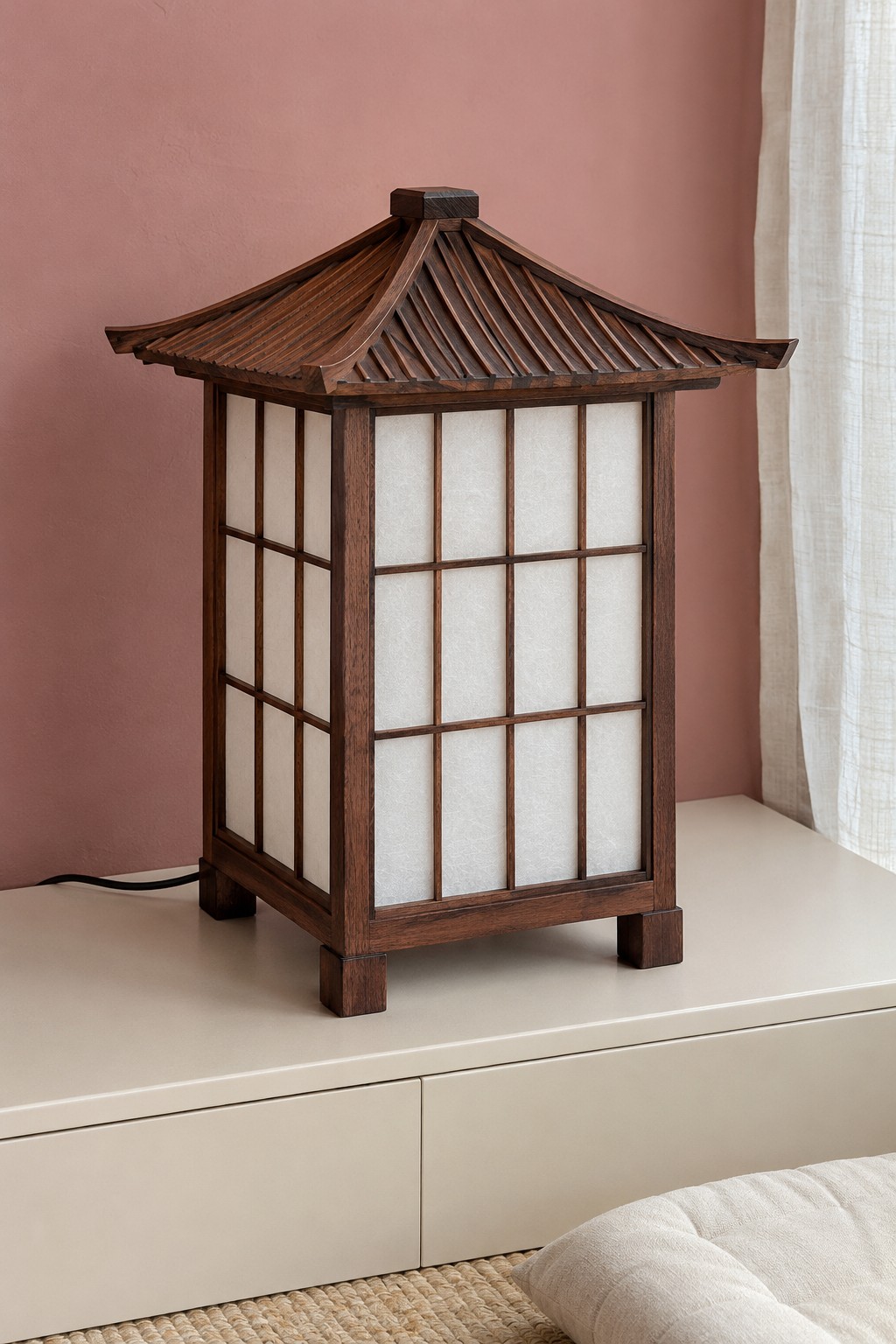
A lattice of thin wood behind white paper is the most recognizable Japanese lamp shape, and the curved roof turns it into a small piece of architecture for a bedside table or an entry console. It reads as warm and grounded in a room with linen bedding and natural wood, and it gives off a gentle light that never glares.
The grid, called kumiko, is made from thin strips of straight grained basswood or pine. Cut a notch halfway through each strip at every crossing so the pieces lock flat, then glue the grid into the corner posts with wood glue. Shoji paper goes on the inside face with rice paste, smooth side out. Make the roof as a separate lid so you can lift it to change the bulb: a plywood square with eaves cut from solid wood at each corner and rows of thin slats glued side by side for the ribbed look. A dark walnut stain makes the paper look even whiter.
2. Mountain Silhouette Hexagon Lantern
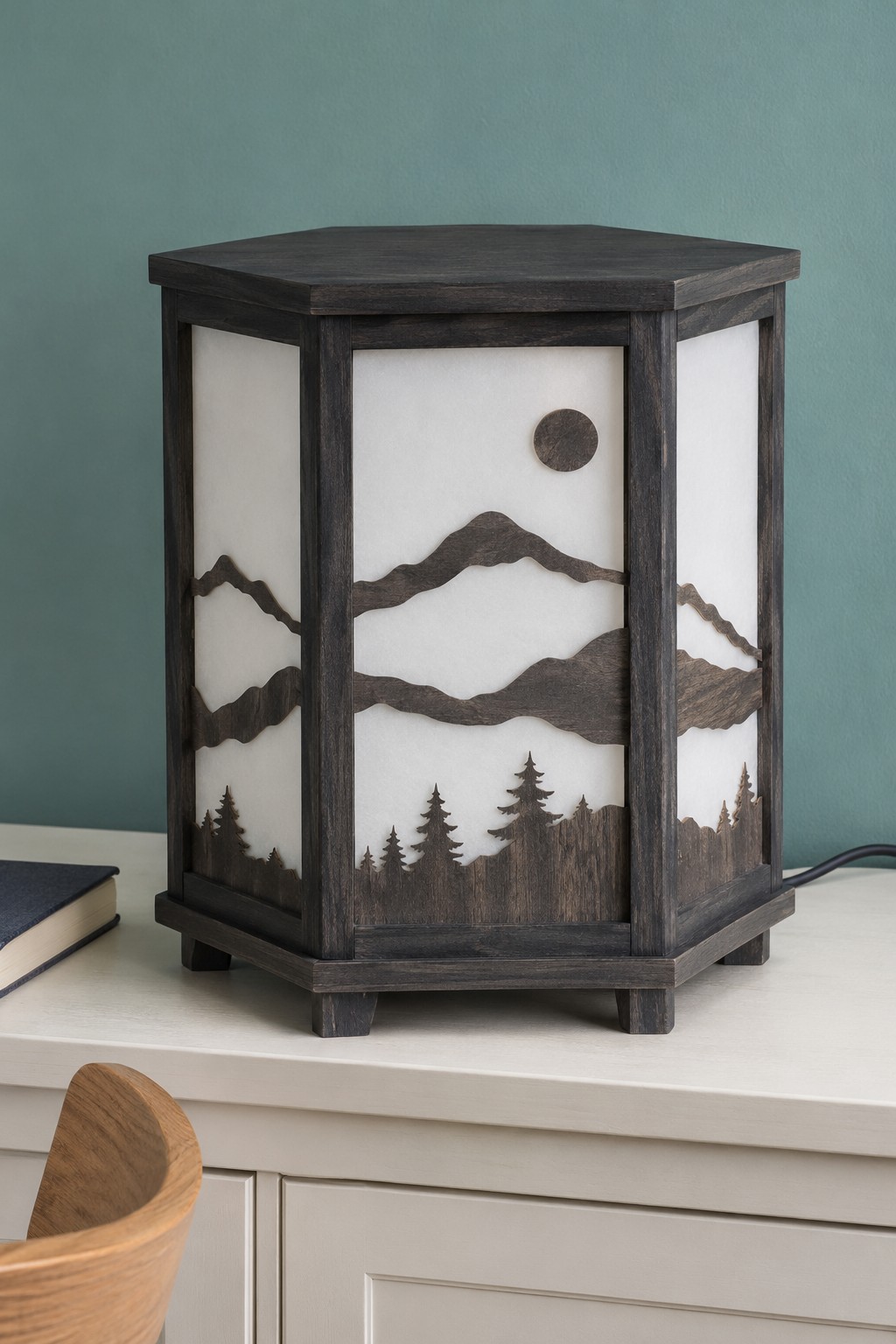
Instead of painting the scene, this lantern builds it in wood. Ridges, pines and a small moon stand out in dark silhouette against the light, so the lamp looks like a quiet evening landscape even when it is switched off. It suits a study, a reading chair or a teal or sage wall where the dark frame can stand out.
Cut the mountain layers from 3 mm plywood with a scroll saw or coping saw, making each ridge a slightly different height so they overlap with real depth. Stain them before assembly, then fix them to frosted acrylic panels with small dots of clear two part epoxy. For the hexagonal frame, the rails meet at 120 degrees, so each end is cut at 30 degrees. A solid lid and short feet finish it, and the feet leave a gap under the lantern for the cord.
3. Mount Fuji Hexagon Lantern With a Painted Lid
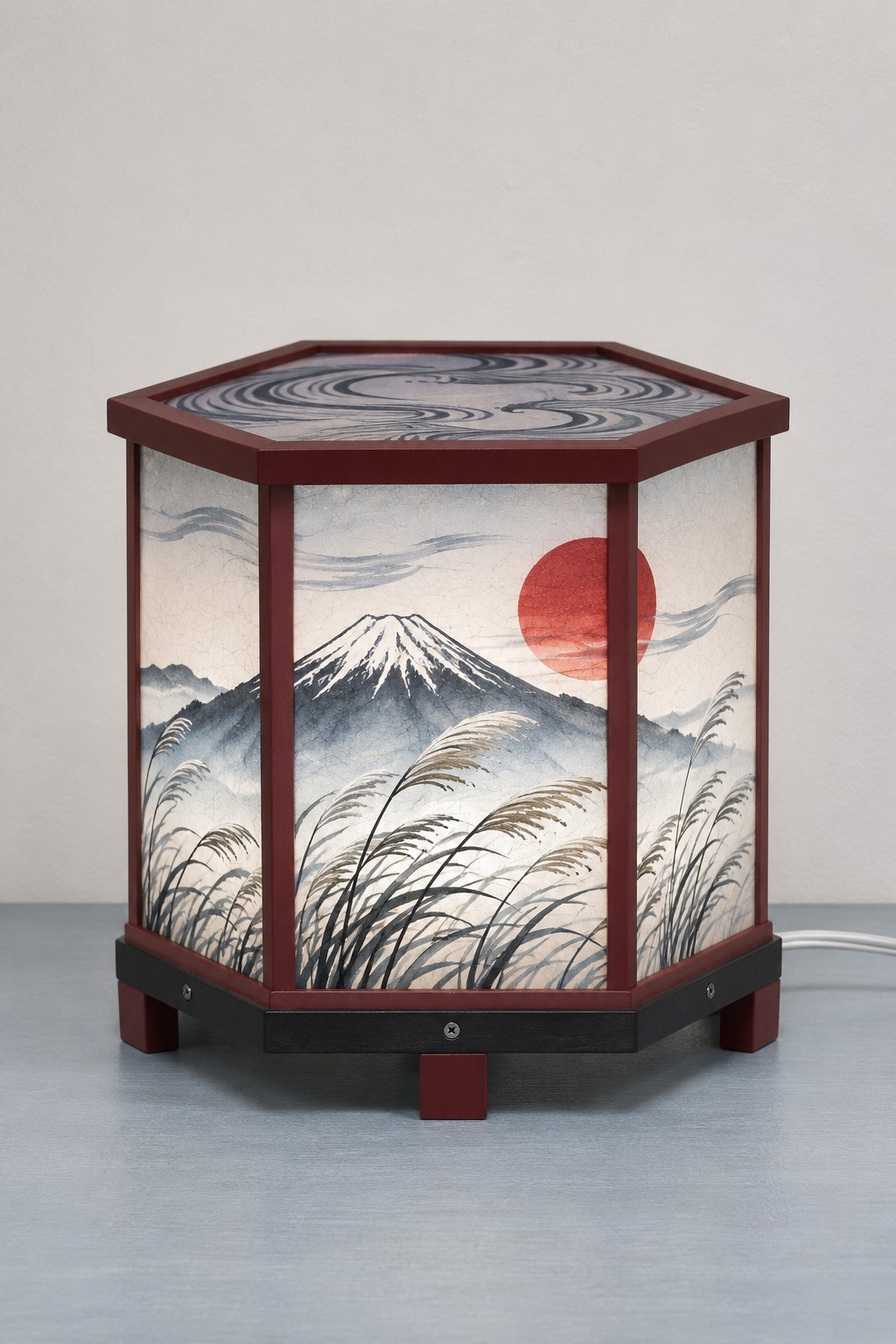
Silver grass, called susuki, is tied in Japan to autumn moon viewing, and pairing it with Fuji and a red sun gives this lamp a seasonal, almost ceremonial character. In a living room it works as a conversation piece on a low cabinet, and the ink grays keep it from feeling too busy next to neutral furniture.
The top panel is what makes it different. Rather than a solid lid, it is a frame filled with washi painted with flowing water lines, so the light shines upward through the pattern as well. Paint the side scene with diluted ink and a single red accent, keeping most of the paper pale. A bottom ring held on with screws rather than glue lets you reach the socket later without tearing a panel.
4. Teal Scroll Hexagon Lantern
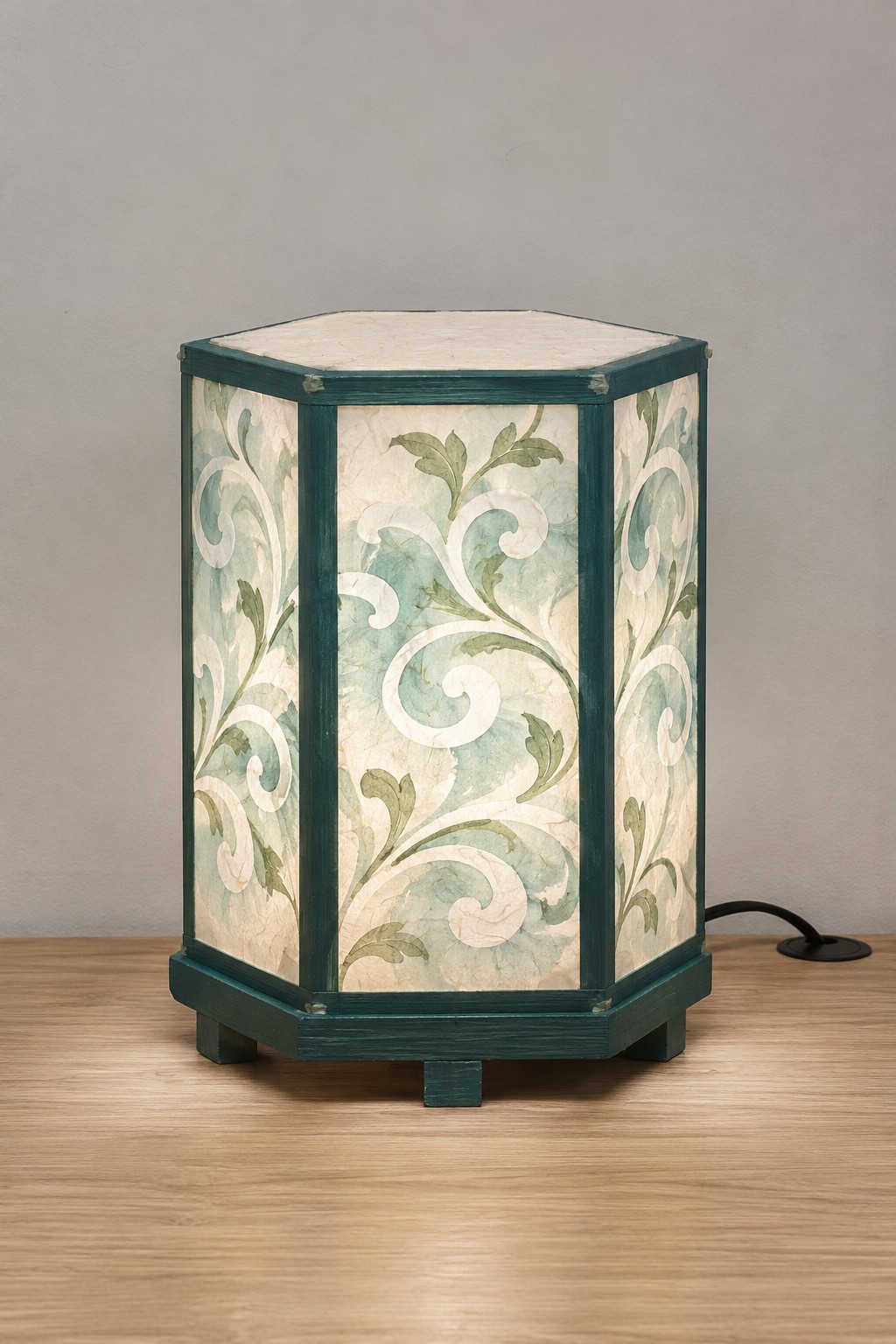
The scrolling vine pattern is a classic Japanese textile motif known as karakusa, and here it softens a sturdy hexagonal frame into something airy and fresh. Teal and leaf green bring the lamp close to plants and natural textures, so it sits well on a sideboard with a few potted ferns nearby.
The pattern does not have to be painted freehand. Cut one scroll as a stencil from acetate, lay it on unryu paper and dab watered teal acrylic through it with a sponge, then add the leaves with a small brush in a second green. The visible fibers in the paper break up the stencil edges so the print looks handmade rather than mechanical. Paint the frame in a matte teal and give the feet the same color to keep the outline clean.
5. Wisteria Lantern With a Raised Roof
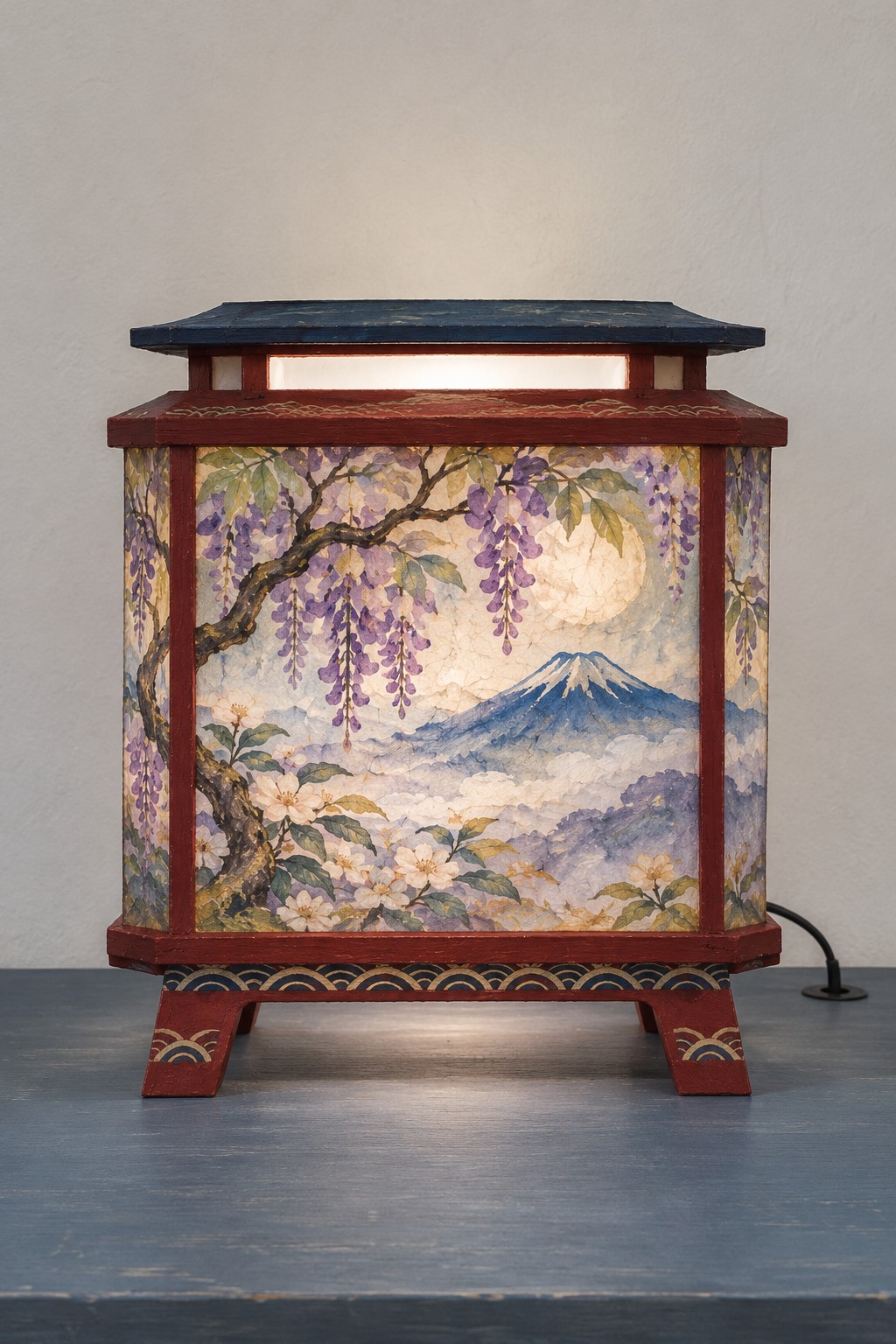
The roof here floats on short posts above the box, leaving a thin band where light escapes toward the ceiling. That gap is practical as well as pretty: it lets warm air out of the top. The painted scene is rich, so place the lamp where it can be the main event, such as a console in a hallway or a dresser with little else on it.
To make the landscape run around the corners without a break, paint it on one long strip of washi, then cut it into panels and glue them in order. The wave pattern on the legs is seigaiha, overlapping arcs that you can mark with a compass and fill in with a fine brush. A satin finish on the red frame gives a lacquered look without real lacquer.
6. Tall Andon With Koi and Maple Panels
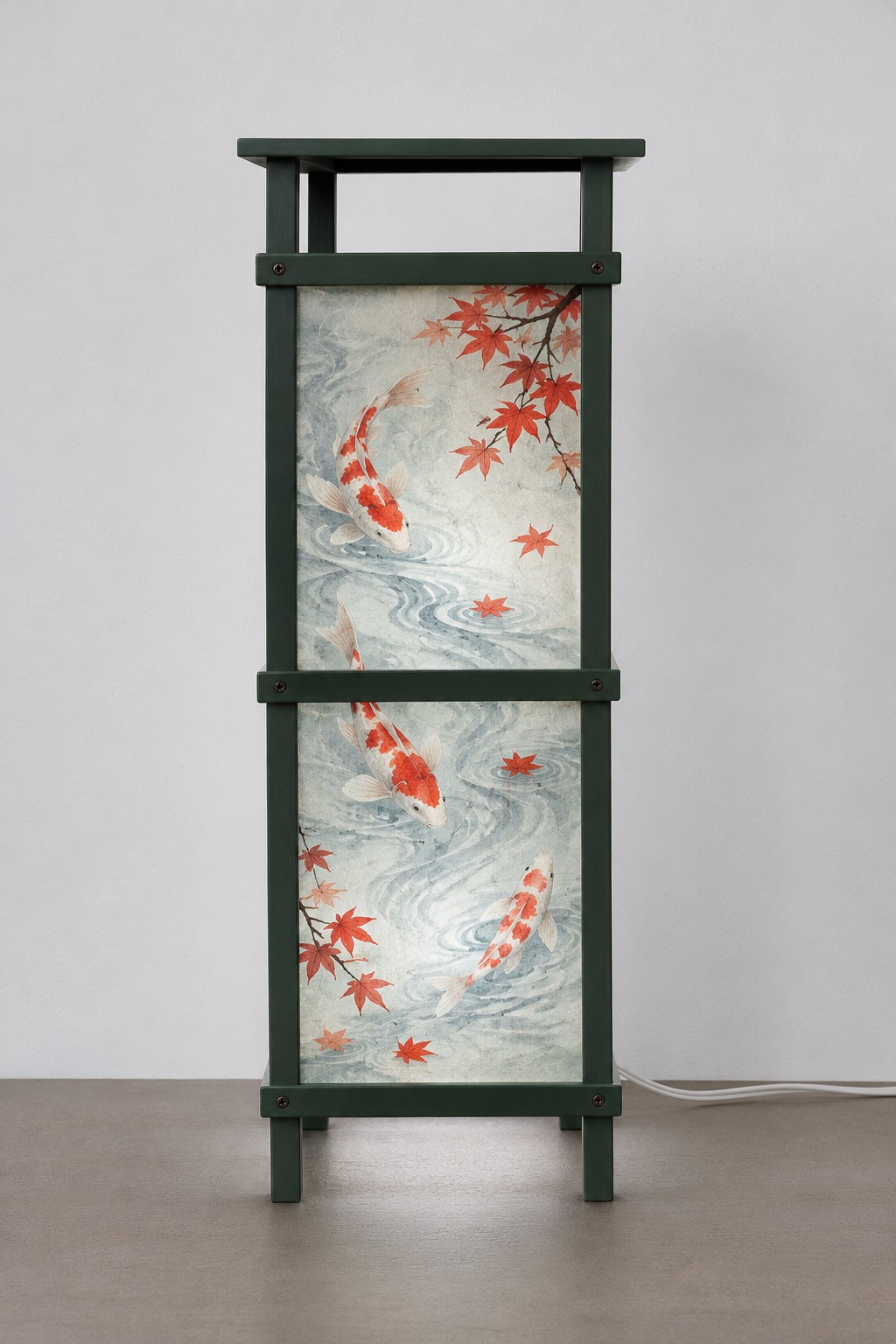
An andon is the traditional standing paper lamp of Japanese homes, made to sit on the floor beside a low seat. Its height makes it ideal for a corner next to a sofa or a floor cushion, where a table lamp would be lost. The koi and maple scene suggests a pond in autumn, and the dark green frame keeps the colors from turning sweet.
The crossbars are screwed rather than glued, and the round screw heads become part of the design. Leave the top section open as a small shelf for a light object. Because the lamp is tall and slim, widen the feet slightly or add weight to the base so it cannot tip if someone brushes past.
7. Navy Slatted Lantern With Wave Accents
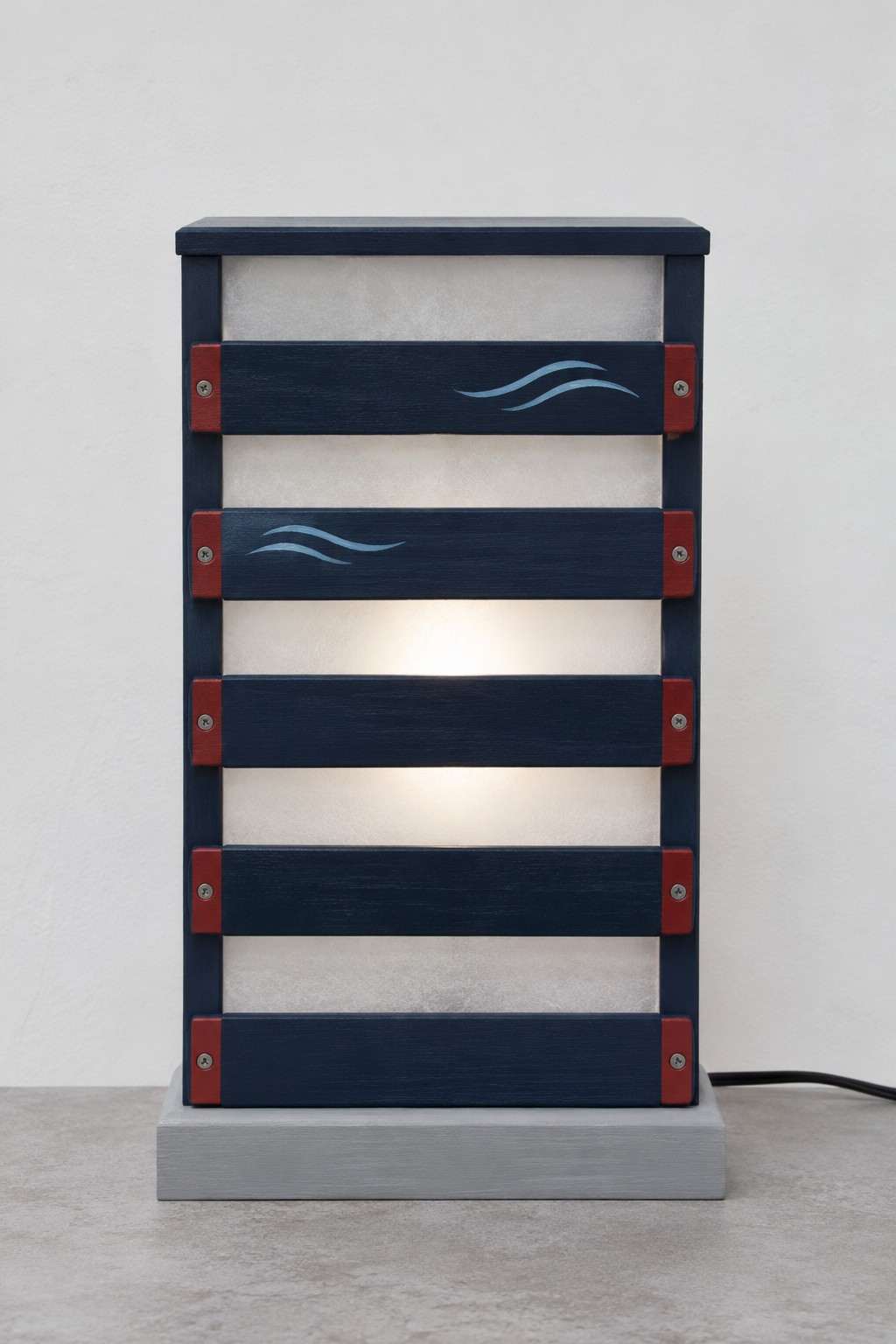
This is the most Scandinavian design in the group. Wide slats cover most of a frosted panel, so the light comes out in horizontal bands that feel orderly and restful. Navy and red is a classic pairing in Japanese indigo textiles, and two tiny wave strokes are all the decoration it needs. It looks at home in a hallway, a boy's room or a modern living room.
Behind the slats you can use frosted acrylic or a laminated shoji paper, which shrugs off fingerprints and small knocks better than plain washi. Paint the slats before assembly and screw each one to the side posts through a small red block. The blocks hide the end grain and keep every gap exactly even.
8. Barrel Lantern With Curved Wooden Ribs
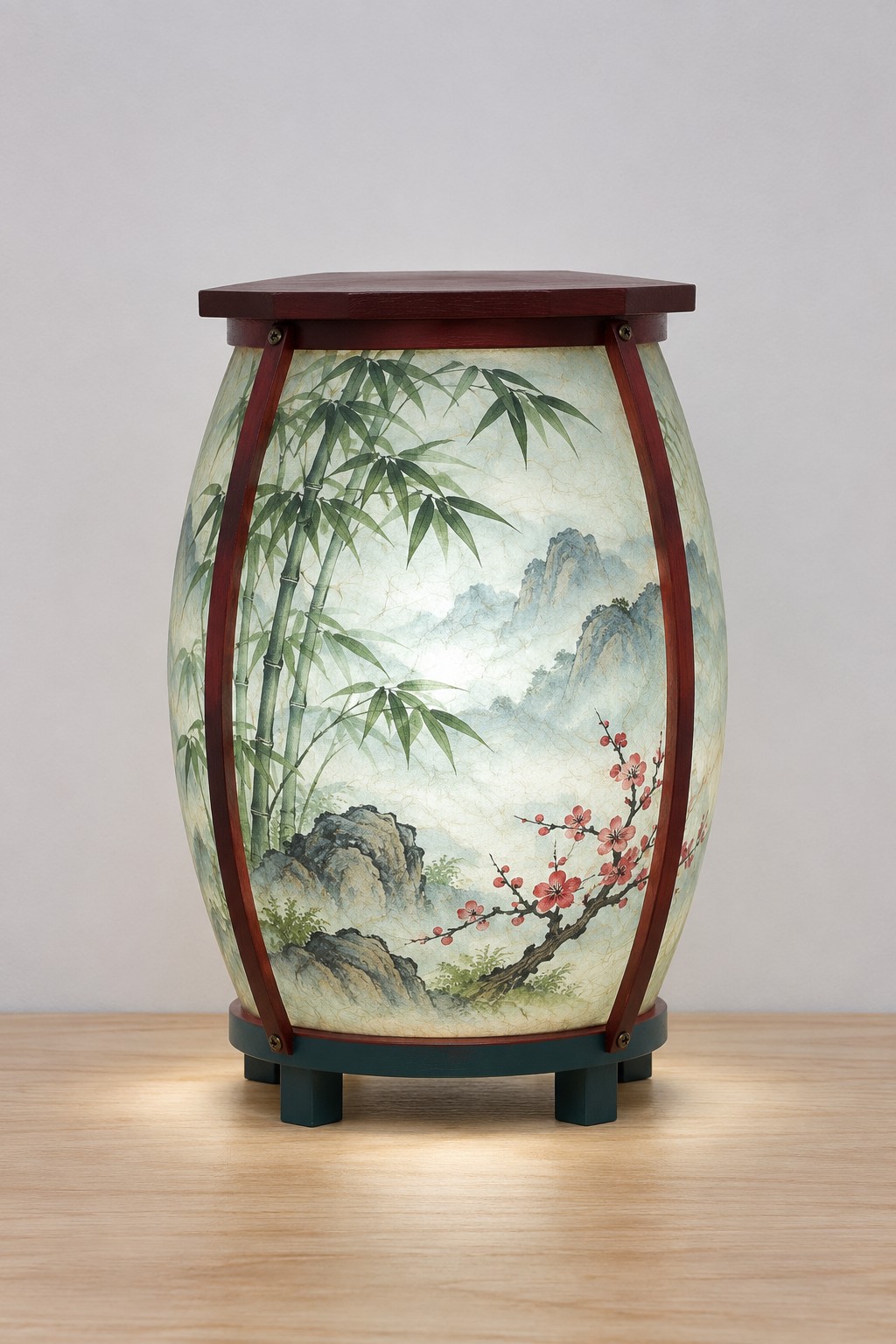
The rounded barrel shape gives a softer profile than a box lantern and spreads light evenly to every side, which makes it a good choice for the middle of a room, such as a coffee table or a kitchen island shelf. The misty ink landscape keeps the mood quiet, while the plum branch adds a small touch of color.
A flat sheet of paper cannot curve in two directions at once, so the barrel itself is either a ready made barrel shaped paper lantern or a papier mâché shell of thin washi layers formed over a mold. The four outer ribs are thin wooden strips bent to the same arc, either steam bent or glued up from thin layers over a curved form, then screwed to the top and base. Paint the scene on the shell before the ribs go on.
9. Torii Gate Lantern
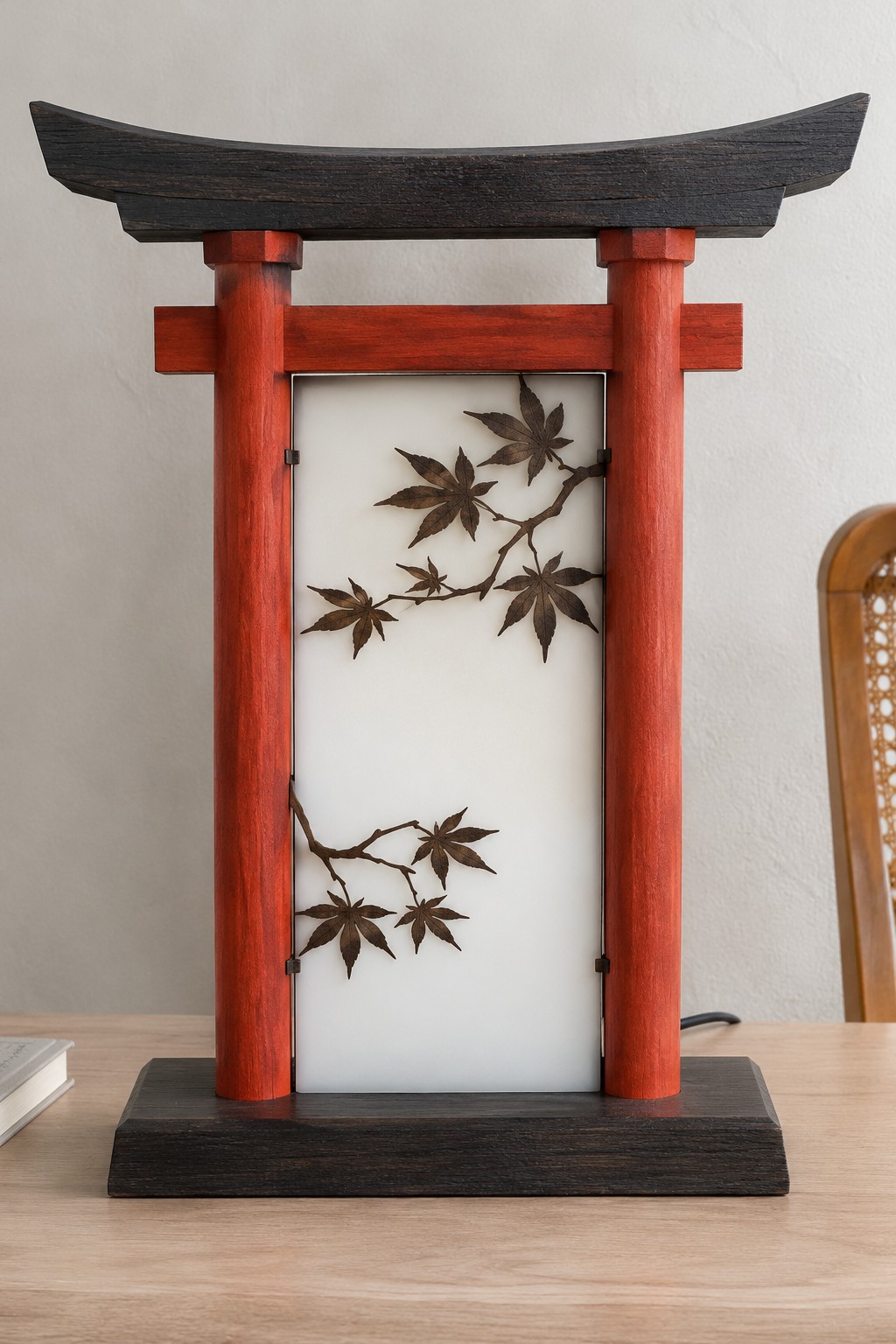
The torii is the gateway to a Shinto shrine, so this lamp carries a strong sense of entrance and stillness. It looks best somewhere quiet and uncluttered, such as a meditation corner or the end of a hallway, where the vermilion can stand against a pale wall.
Use thick dowels for the posts, a flat bar for the crossbeam and a curved top beam cut from solid wood, sanded and stained near black. Real maple leaves, pressed flat until fully dry, can be sealed under a sheet of thin washi on an opal acrylic panel, where they read as dark silhouettes once the light is on. Small clips at the corners hold the panel so it can slide out.
10. Zigzag Folding Screen Lantern
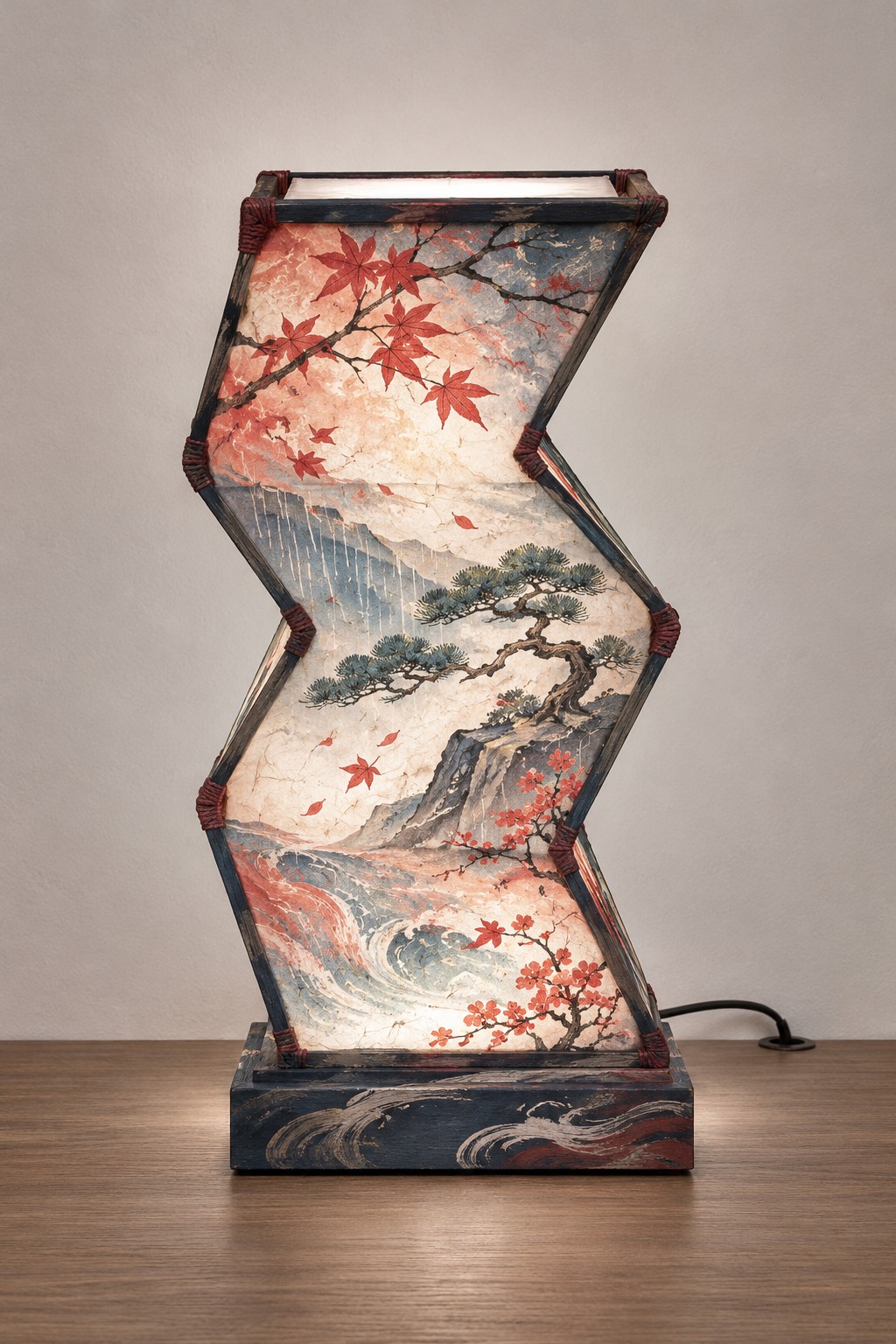
Folding the panels into a zigzag means every face catches the light at a different angle, so the painting looks layered and alive. The tall, narrow shape fits a narrow shelf or a windowsill, and the scene of maple, pine and waves works almost like a vertical scroll.
Paint the whole scene on one long sheet first, then fold it. Thin wooden strips glued along each fold keep the creases sharp, and tying them at the corners with red cord adds both strength and a decorative accent. A square top frame and a solid base hold the zigzag at a fixed width so it cannot spread over time.
Bamboo, Rattan and Woven Frames
11. Ink Pine Bamboo Cylinder
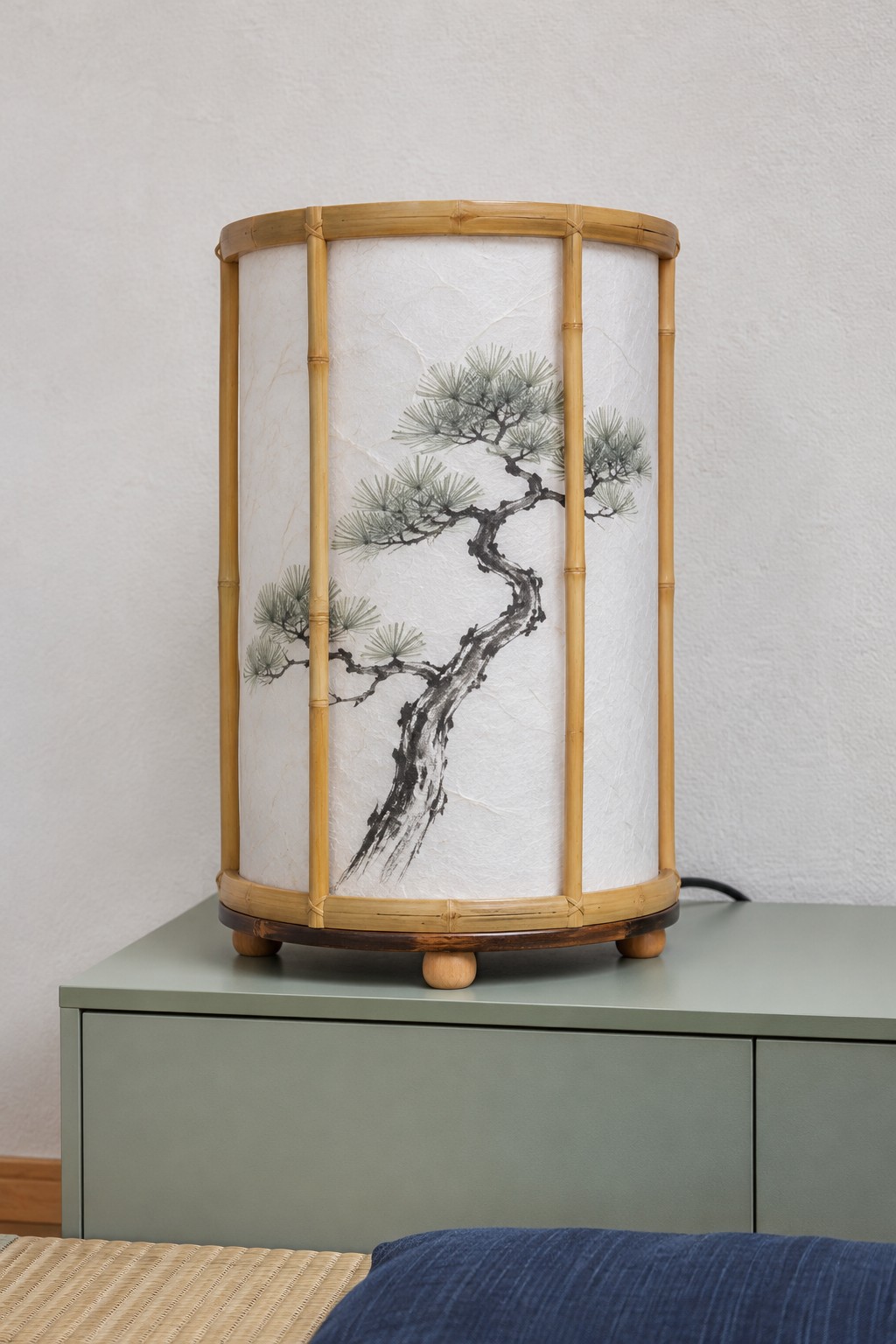
If you want one lamp that sums up Japandi, this is it: pale bamboo, white paper and a single pine in ink, with nothing extra. It disappears into a neutral bedroom by day and gives a warm glow on a nightstand at night. Our Japandi bedroom ideas show the kind of room it belongs in.
The rings at top and bottom are bamboo strips soaked in water, bent around a round form and joined with an overlap. Sand the canes where they touch the rings, glue, then lash each joint for strength. Paint the pine on a flat sheet of kozo paper with sumi ink before you wrap it, and practice a few branches on scrap first, since ink spreads quickly in unsized paper.
12. Hexagonal Bamboo Lantern With a Bent Handle
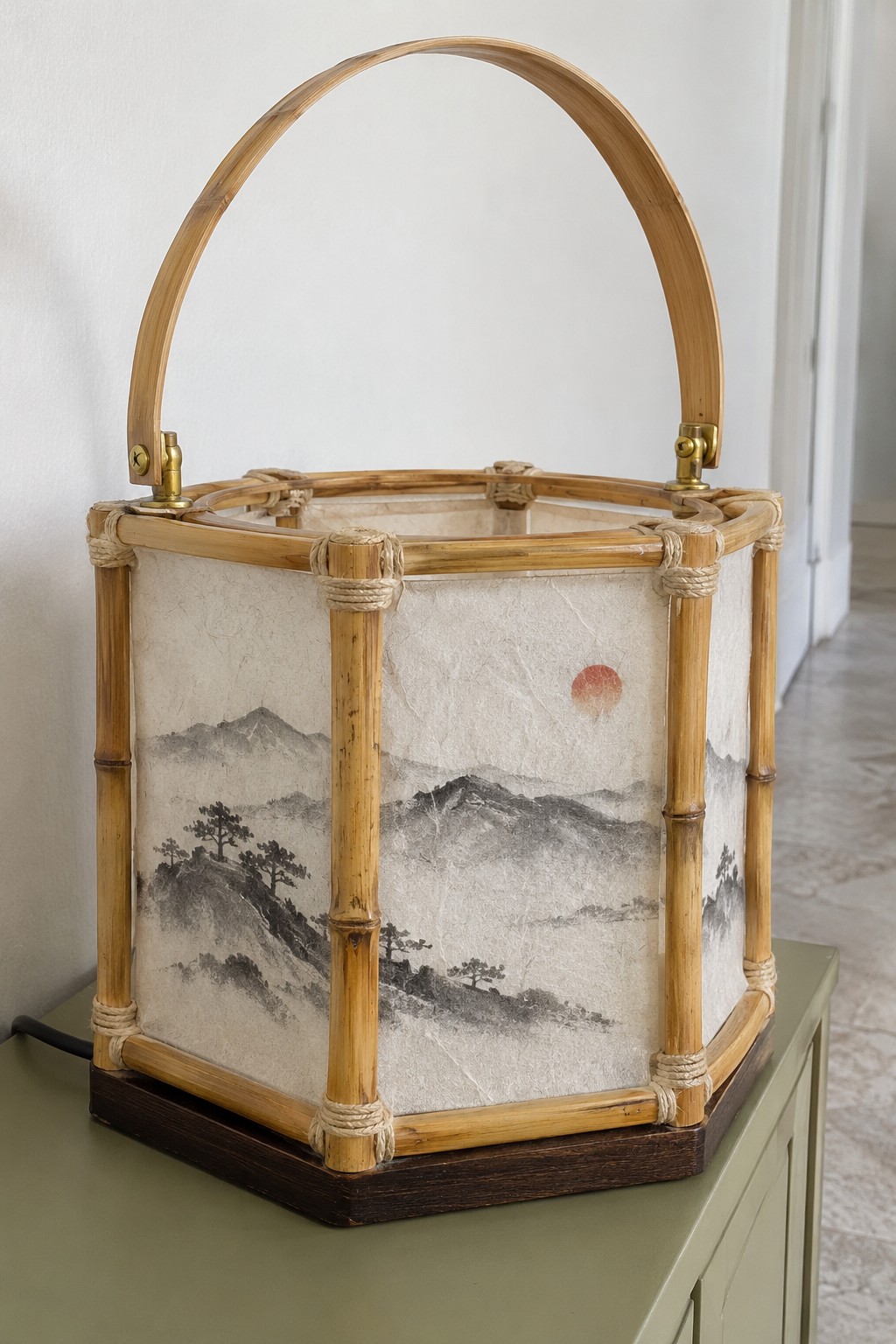
The arched handle recalls the old portable lanterns once carried at night, and it gives the lamp a relaxed, rustic character. Set it on a bench or a low shelf in a living room with jute rugs and woven baskets and it will look as if it has always been there.
Bend the handle by warming a bamboo strip with a heat gun, moving the heat constantly so it does not scorch, then clamp it to a curved form until it cools. The corners are tied with jute twine over glued joints, and the handle swings on small brass pivots. Treat the handle as decoration and lift the lamp from its base, since the cord and the bulb weight sit low.
13. Bamboo Cage Over a Round Paper Lantern
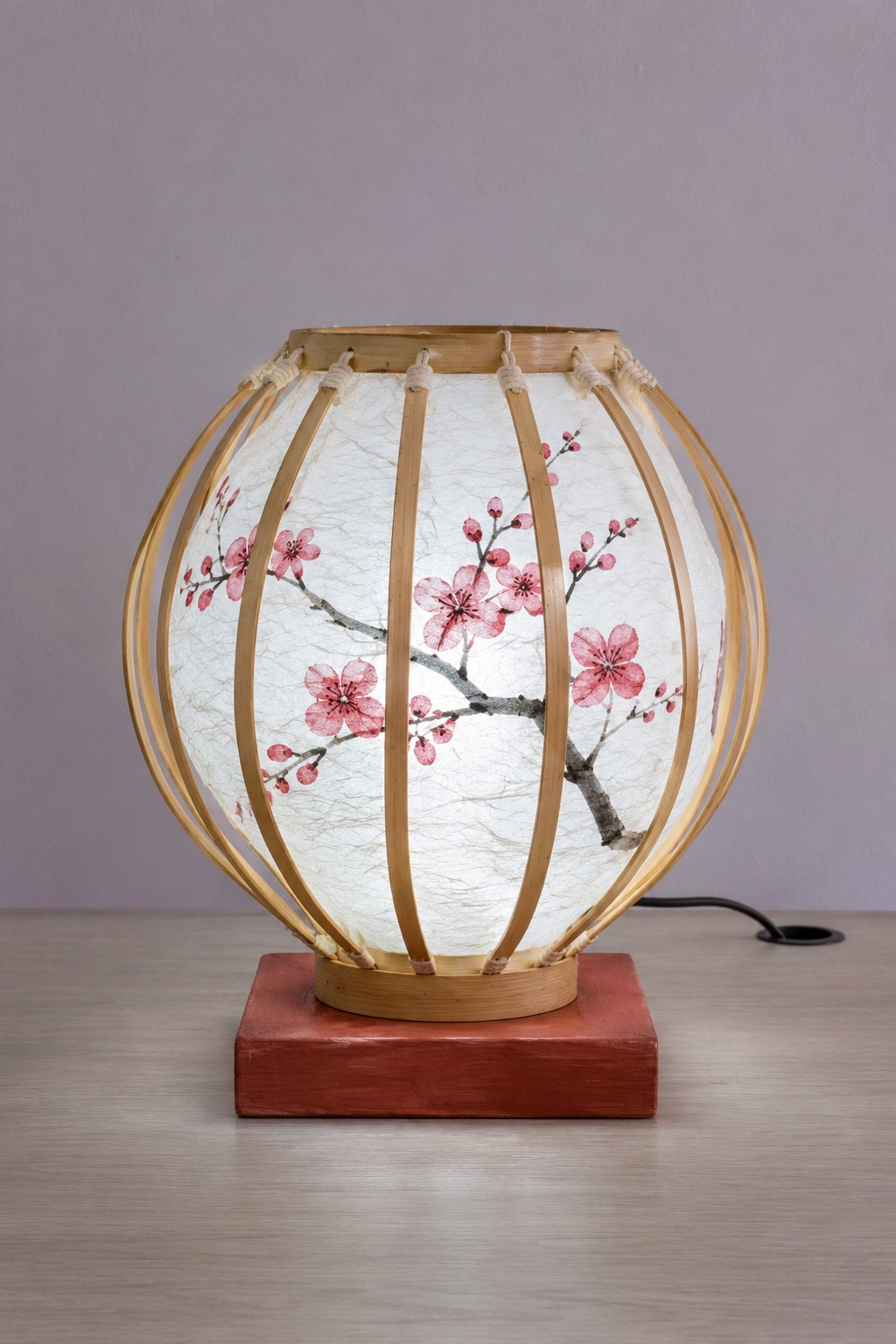
A plain paper lantern becomes much sturdier with a cage of bamboo around it, and the curved strips throw a rhythm of fine lines across the glow. It is a good option for a child's room or a busy shelf, because the cage takes the knocks instead of the paper.
Soak thin bamboo strips until flexible, then tie the ends to a top ring and a bottom ring with waxed linen thread so they bow outward evenly. Paint the cherry branch on the lantern with watercolor before you set it inside. The red base can be a simple block of pine painted with a dry brush so a little wood grain shows through.
14. Rattan Frame Shade With Iris Panels
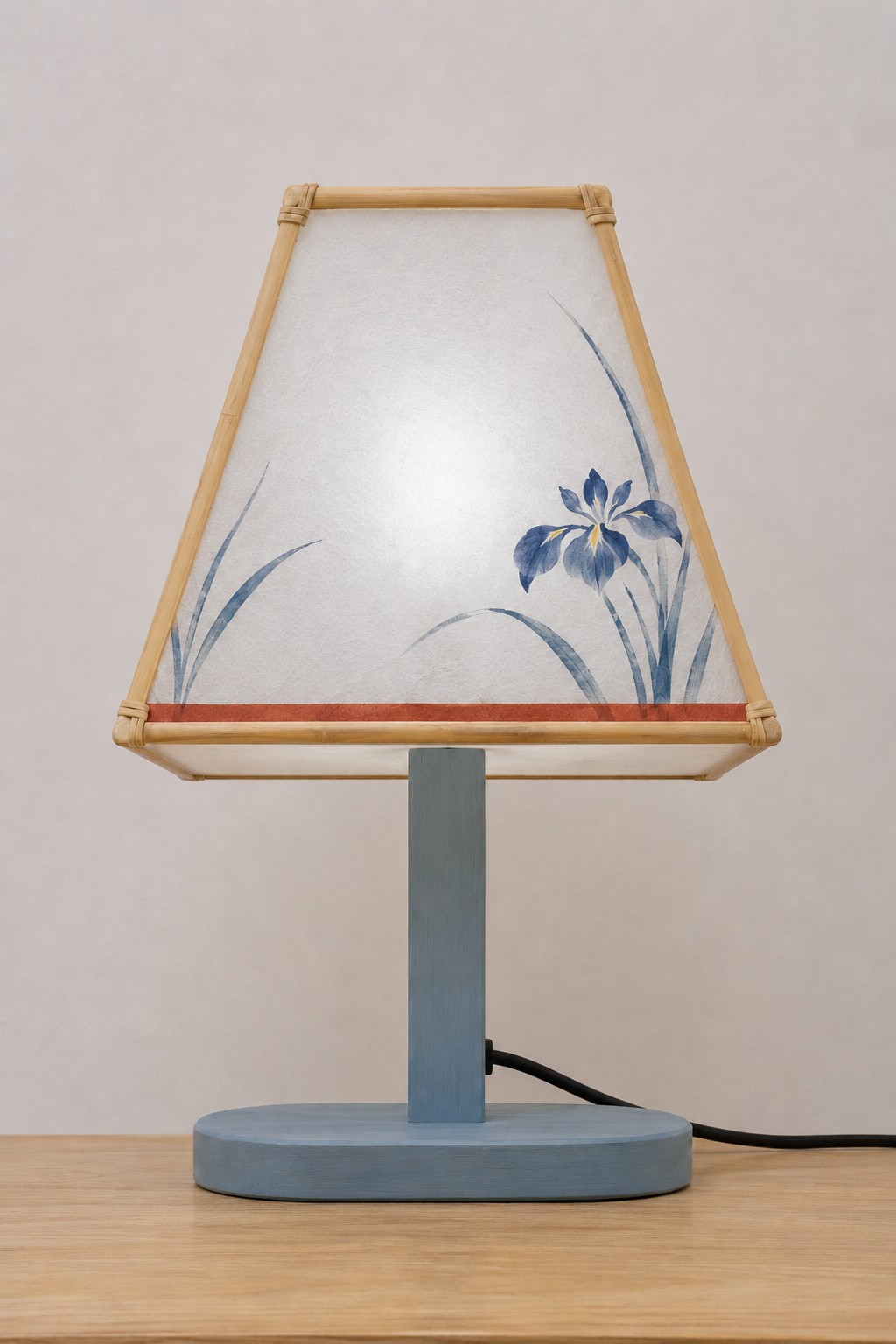
Iris marks early summer in Japan, and its tall, simple leaves suit a shade with straight sides. The shape is a familiar table lamp outline, which makes it easy to place in any living room or office, while the blue base and coral band add a quiet bit of color.
The corners are wrapped with cane binding, the same flat strip used on rattan furniture, which holds the poles firmly once it dries. Because rattan has a glossy skin, sand where the paper will be glued. Paint the iris lightly at the lower edge of each panel and leave the upper half clear, so the light passes through without shadows near the bulb.
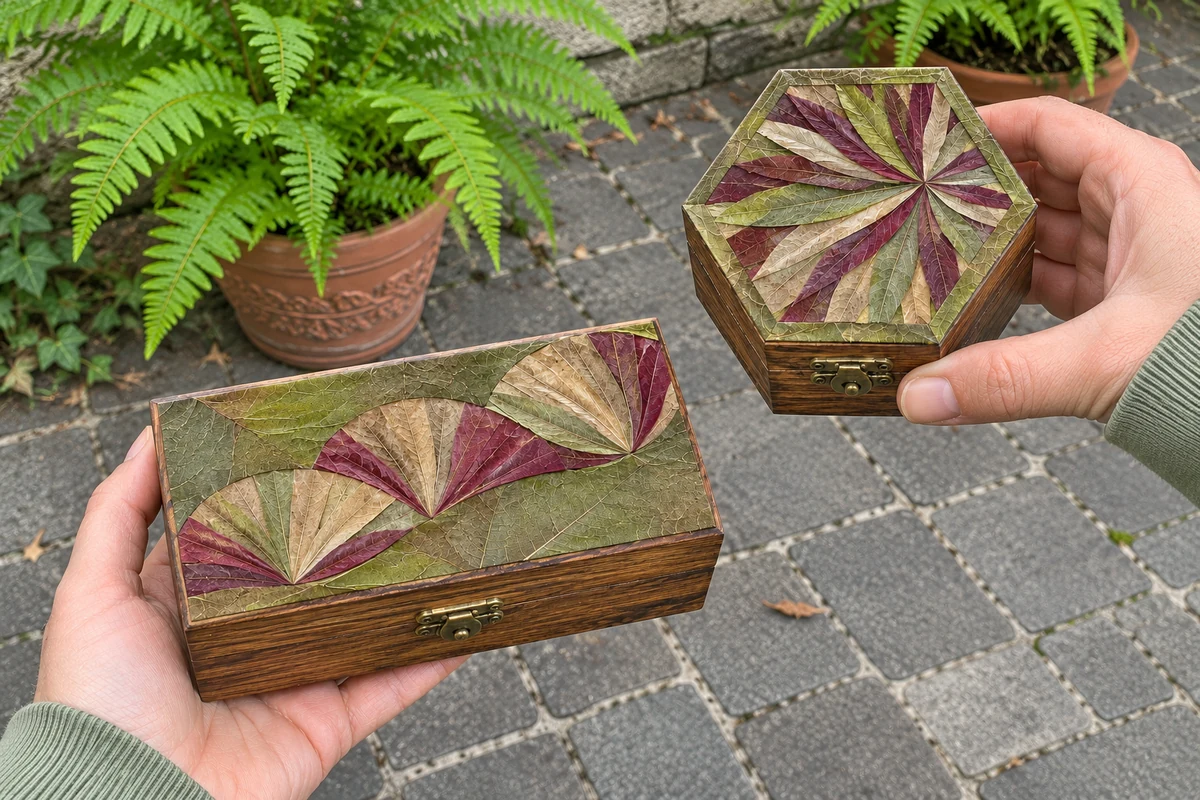
15. Pressed Maple Leaf Dome
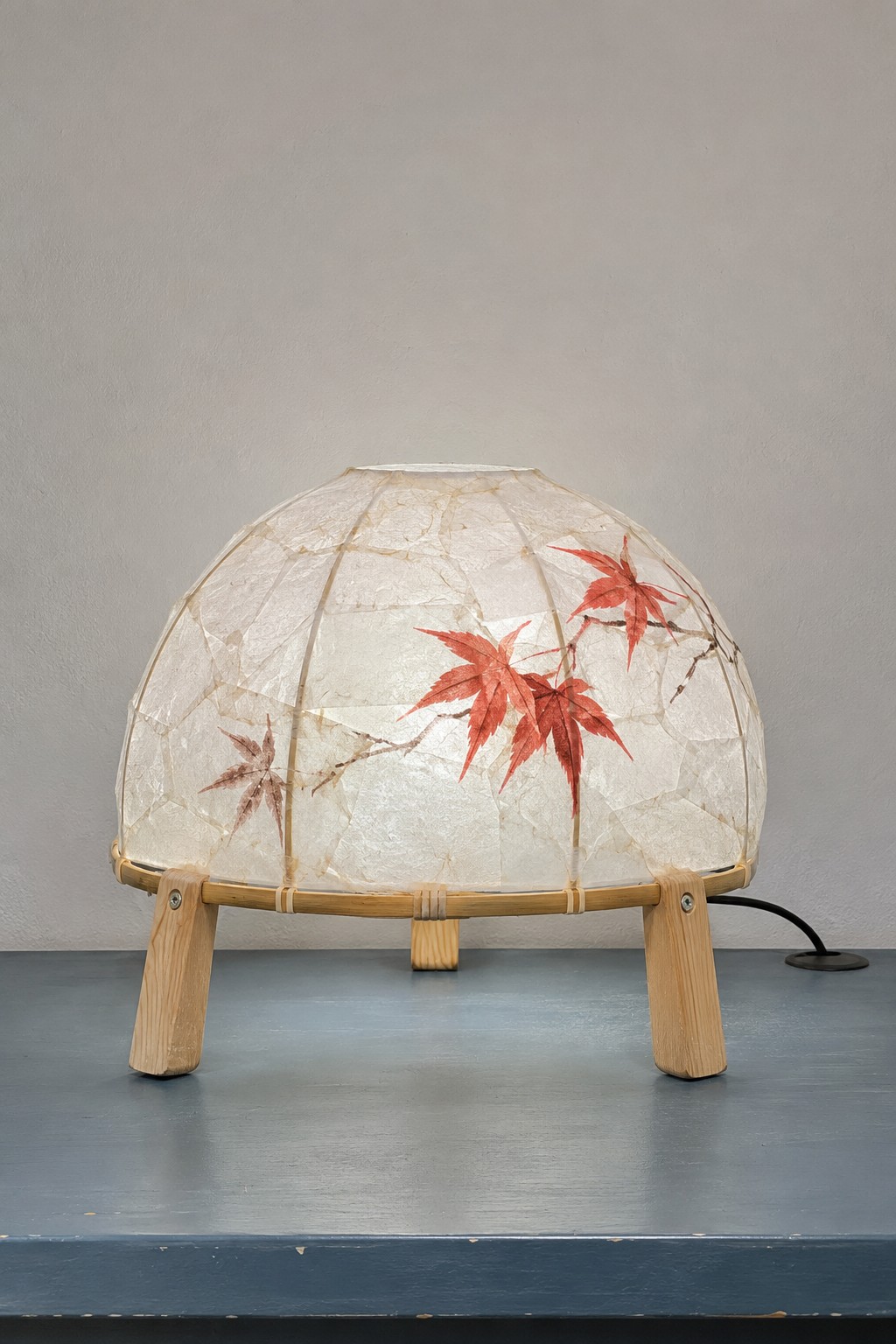
Real leaves sealed inside paper give an effect no paint can copy, with veins and edges that look sharper as the light grows behind them. The low dome sits close to the table, so it works on a dining sideboard or a hall table as a quiet autumn accent. For more ways to use what falls in the garden, see these leaf crafts for home decor.
Press the maple leaves in a heavy book for two to three weeks, until they feel completely papery. Build the dome over a plastic wrapped bowl with torn pieces of thin washi and wheat starch paste or diluted white glue, laying the leaves between the first and second layers. Once dry, lift it off the mold, glue it over thin bamboo ribs and tie the ribs to a ring set on four splayed legs.
16. Kagome Basket Lamp
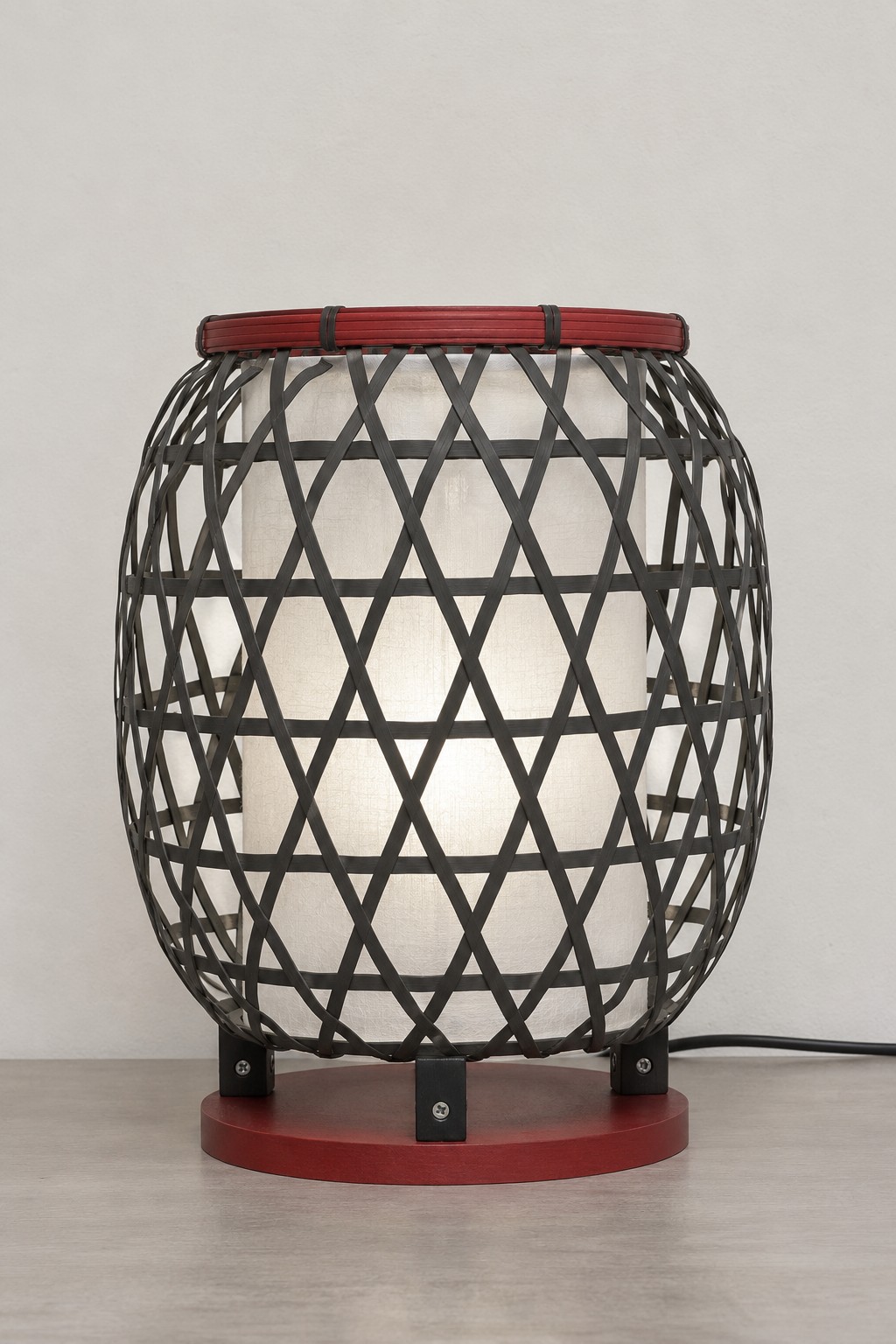
Kagome is a traditional Japanese basket weave in which strips run in three directions and leave open triangles and hexagons. Placed over a pale inner shade, the weave shows up as a strong dark lattice, so this lamp has a graphic, modern look that pairs well with black metal and light oak.
You can weave the basket yourself if you know the pattern, or start from a finished open weave bamboo basket. Inside, a plain fabric drum shade keeps the light even and keeps the bulb well away from the bamboo. Charcoal paint covers the bamboo more reliably than stain because of its waxy skin. Small metal brackets screw the basket to a round base finished in red.
17. Wave Hat Shade on a Folding Arm
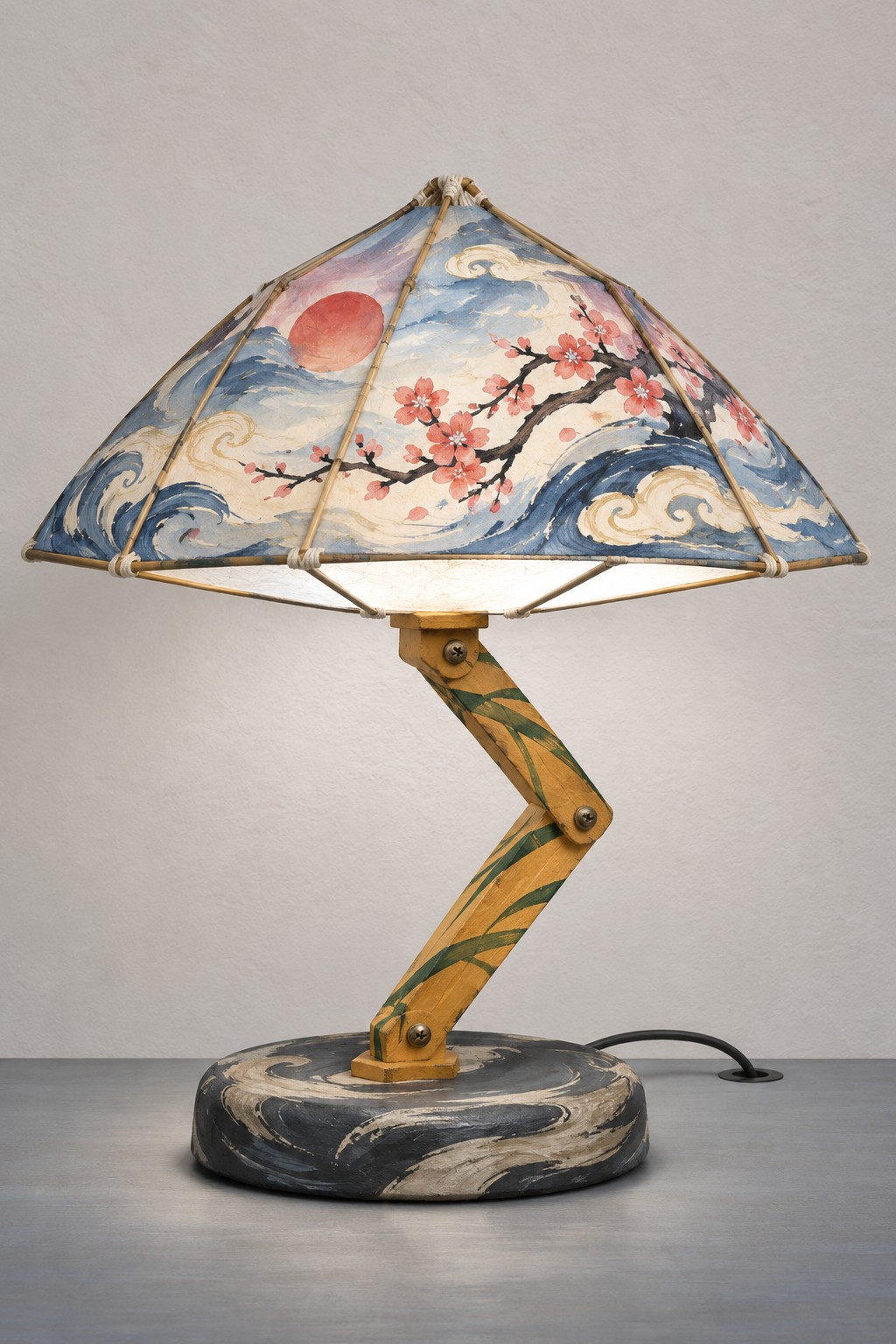
The wide shade recalls a traditional conical hat, and the rolling waves echo Edo period woodblock prints. Because the shade is broad and shallow, it throws light down onto the surface below, making this a lively choice for a desk or a craft table.
The arm is three flat wooden pieces joined with bolts, and using knob nuts instead of plain nuts lets you change the angle. Lash the bamboo ribs together at the top and tie each one to the rim, then glue the painted washi over them with rice paste. Keep the paint thinner near the center, where the bulb sits closest.
18. Spiral Ribbon Lantern
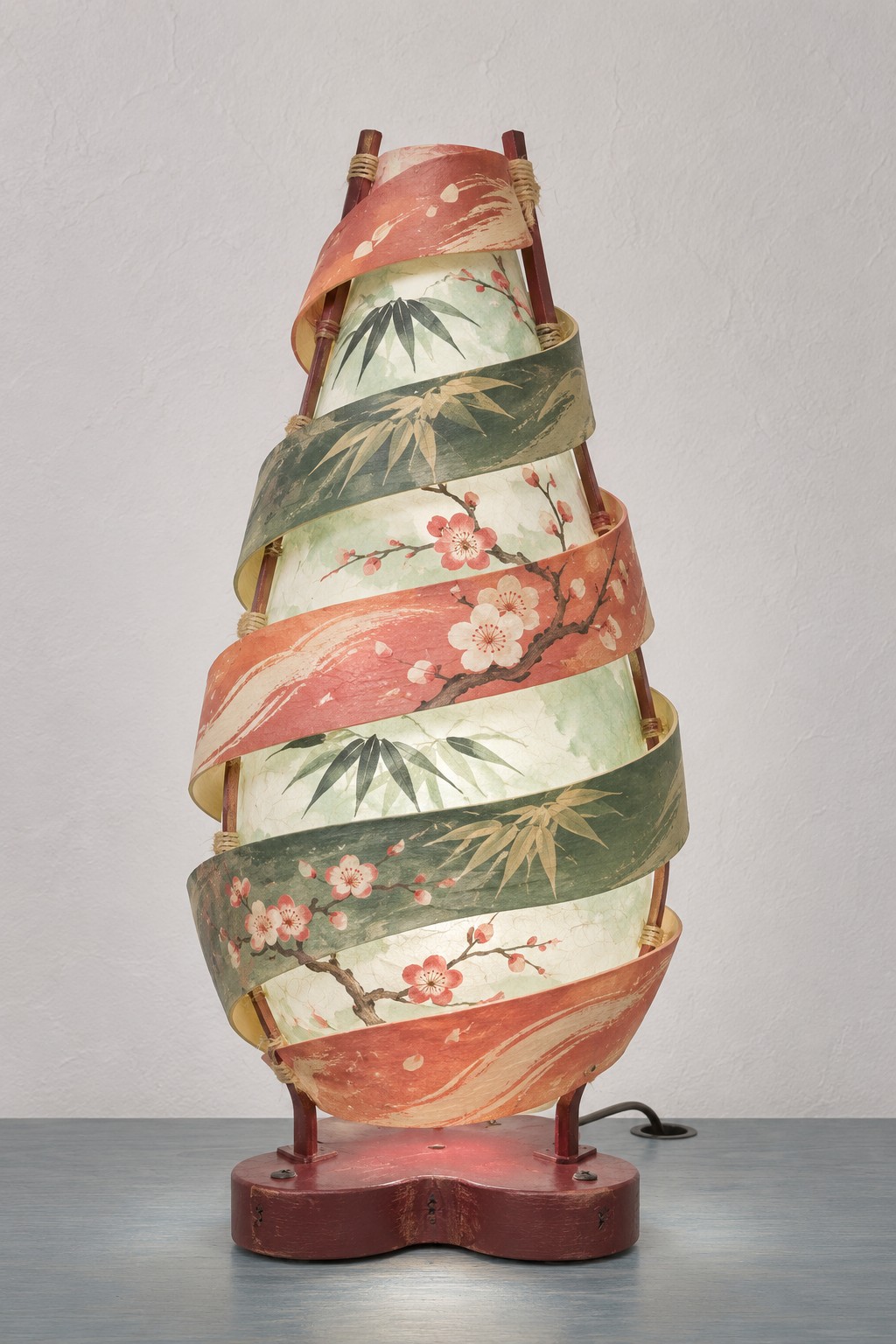
Two layers make this lantern: a pale inner cone and a painted band that spirals around it. Through the gaps you see one layer behind the other, so the lamp changes as you walk around it. It is sculptural enough for an empty corner of a living room.
The ribbon must hold its curve, so laminate the painted washi onto thin lampshade styrene before winding it. Four dowels set into the base act as a cage, and the band is tied to each one with rattan cane at the crossing points. The inner cone can be the same styrene backed paper, rolled and joined with a narrow overlap.
19. Cord Wrapped Teal Shade
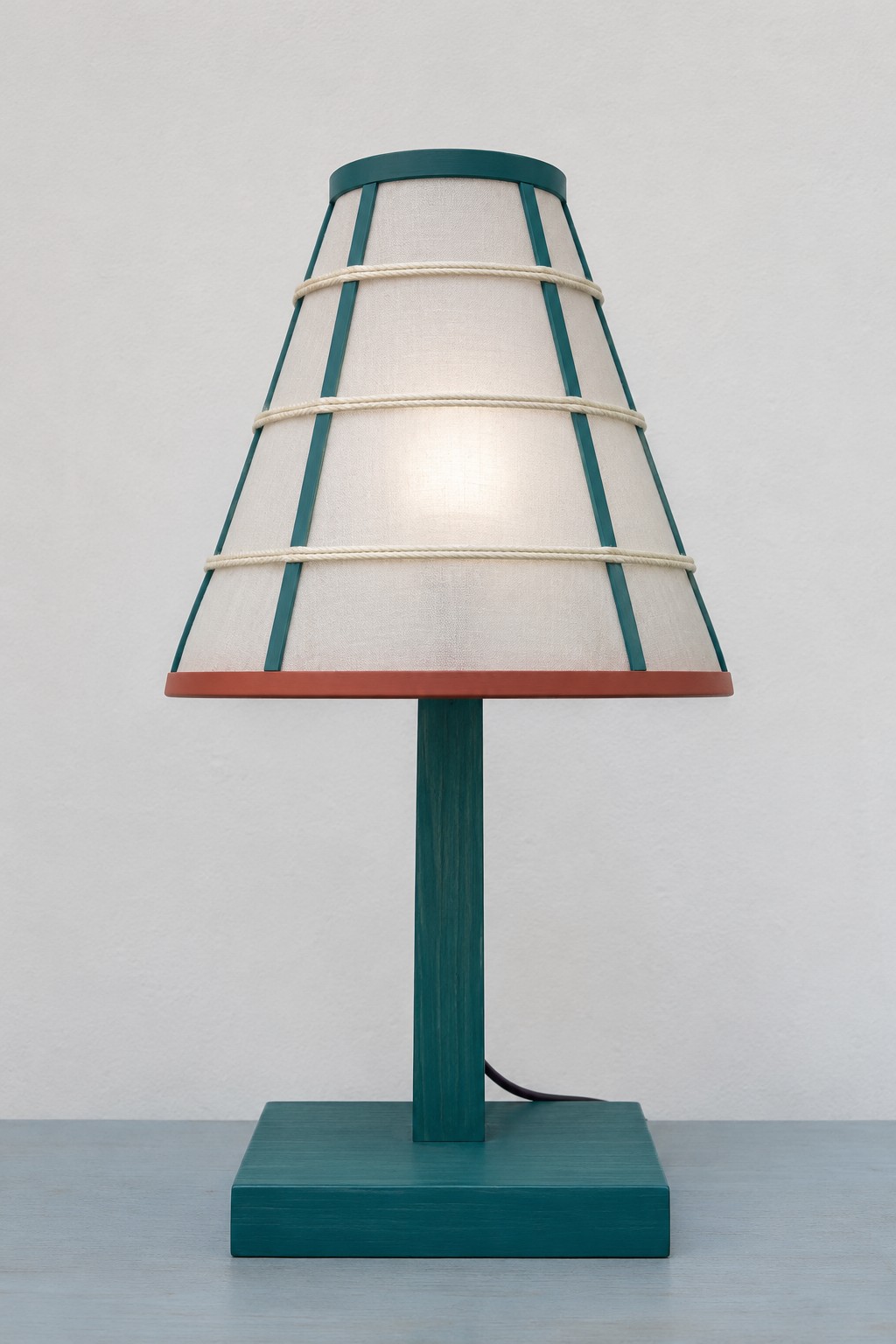
This one starts from a plain tapered shade, which makes it the easiest project in the whole collection. Vertical strips and wrapped cord give it the look of a bamboo frame, while the solid teal and coral lean toward Scandinavian color blocking. It is a good fit for a child's room or a bright home office.
Glue thin painted wooden or bamboo strips down the shade at even spacing with a strong craft glue, then wrap white cotton cord around it at three heights, fixing the ends inside the shade where they will not show. Paint the bottom rim coral. The square post and base can be bought as a plain lamp kit and painted to match.
Round Paper Lanterns Painted by Hand
20. Stacked Chrysanthemum Lanterns
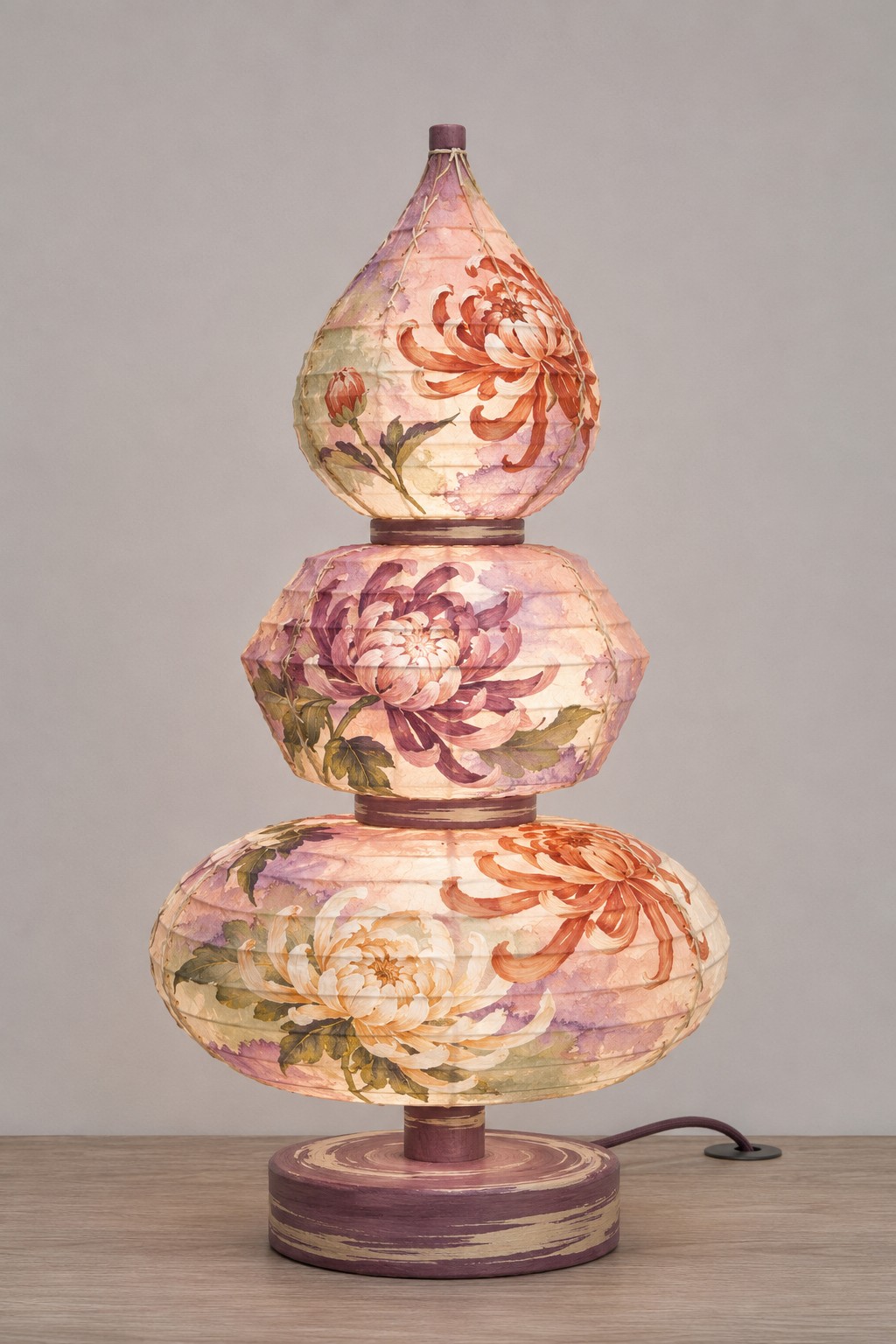
Stacking three lanterns of different shapes creates a gourd silhouette, an old symbol of good luck in Japan. With chrysanthemums in dusty purple and coral, the lamp has a romantic, festive air, a natural fit for a bedroom with blush tones or a dining corner set for guests.
A threaded lamp rod runs through the center, with painted wooden collars between the tiers to keep them apart. Each tier can hold its own slim LED bulb, or a warm white LED string can run through all three. Paint the flowers with watercolor, letting the color follow the ribs of the lantern, and finish the base with a dry brush so pale streaks of wood show through.
21. Hydrangea Oval Lantern on Bamboo Legs
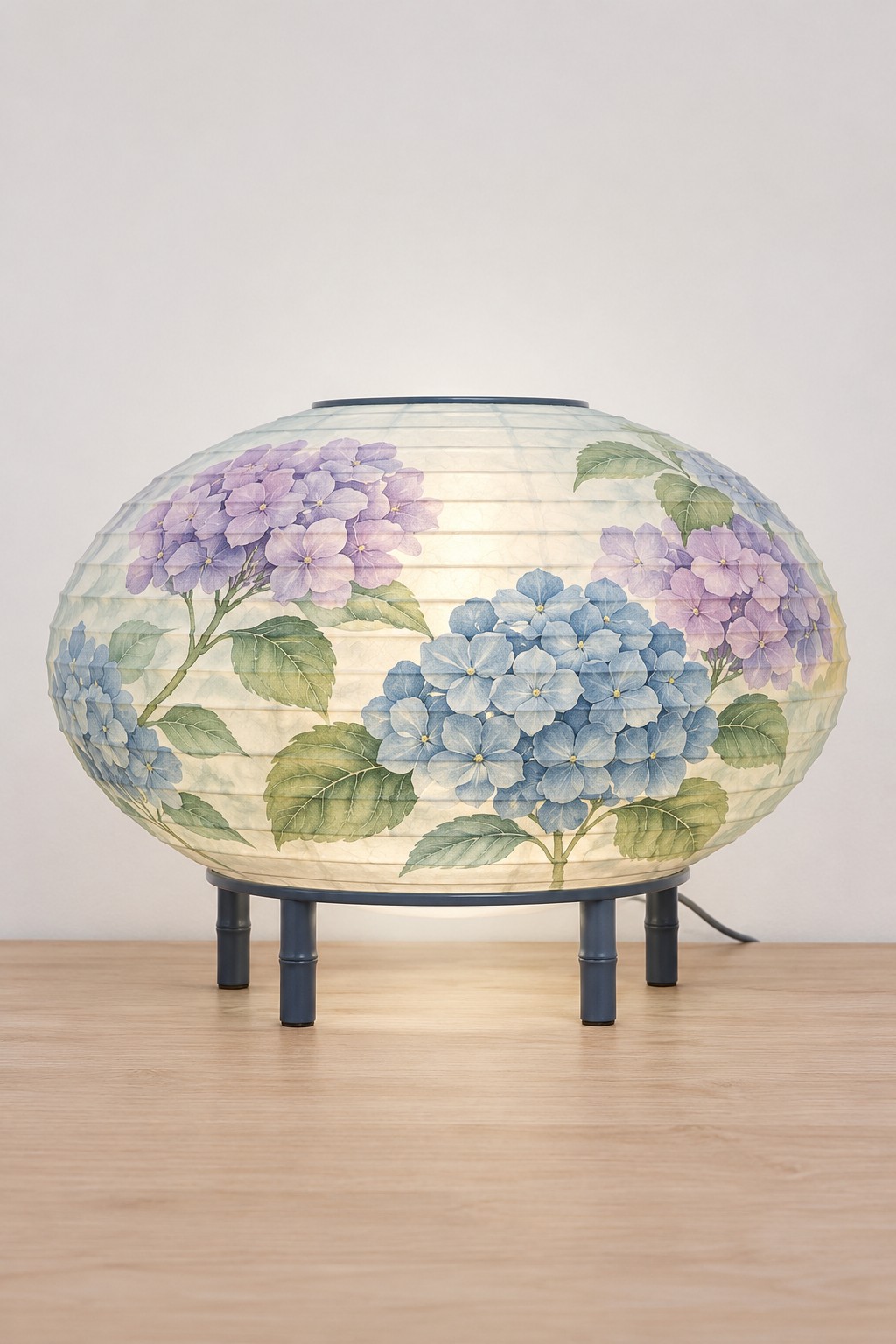
Hydrangeas bloom during the rainy season in Japan, and their blue and lilac clusters bring a fresh, cool mood to a room. The flattened oval sits low and wide, which makes it ideal for a long credenza or the space under a television where a tall lamp would block the view.
Build each flower head from many small four petal shapes in two or three shades of blue, rather than one big blob of color. The stand is a painted ring with four short legs, and turning a small groove around each leg gives them the look of bamboo nodes. The lantern simply rests in the ring, so it lifts off for a bulb change.
22. Lobed Lantern With an Autumn Stream
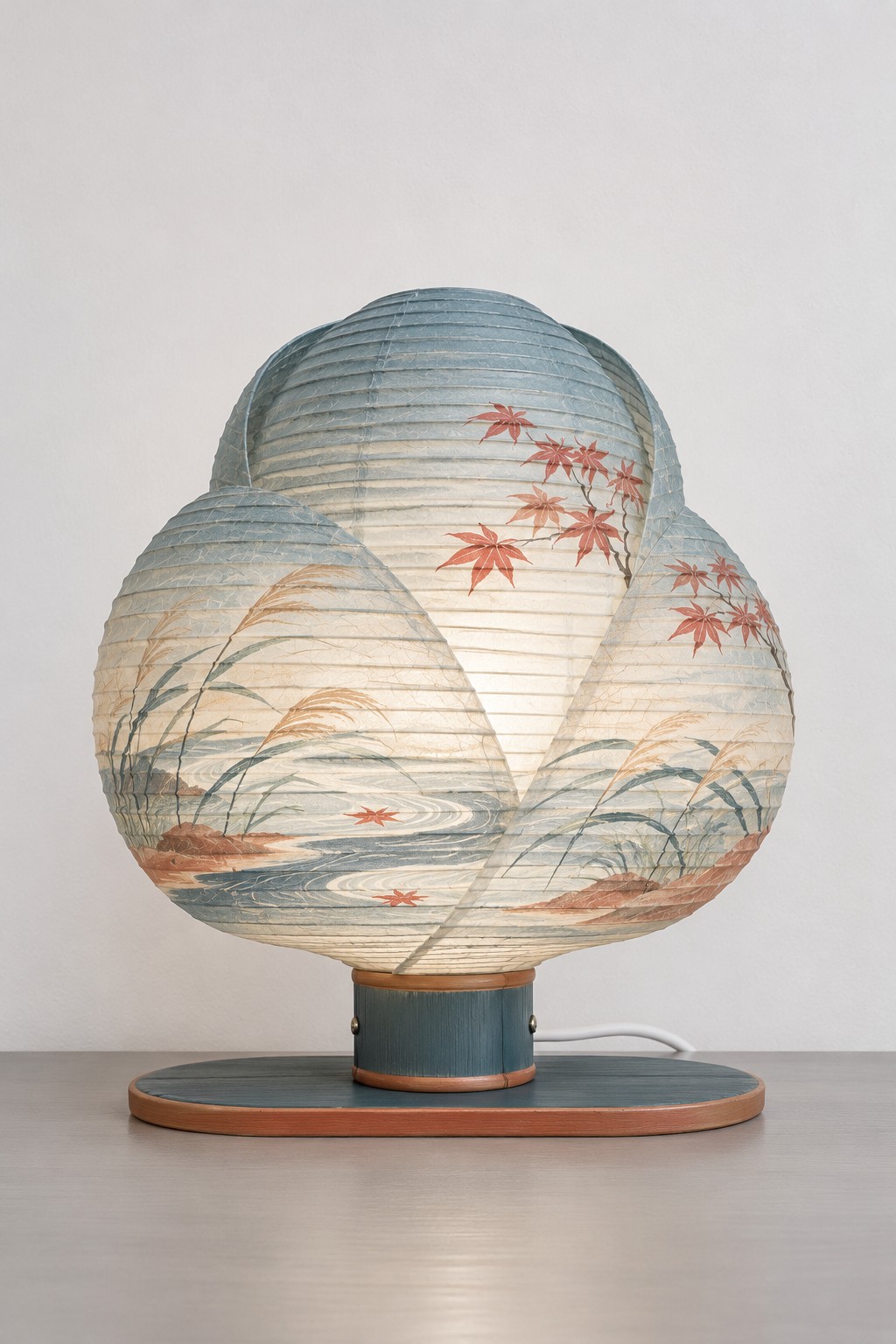
The overlapping lobes catch light and shade at their seams, so the lantern has a sculpted, flower bud look even before you add any painting. A stream with drifting maple leaves suits the shape, since the water lines can flow from one lobe to the next. It sits nicely on a bedroom dresser among pale blue and peach tones.
Start from a lobed paper lantern rather than trying to build the ribs yourself. Paint the stream first in very pale blue, then add grass and leaves on top once it is dry. Glue a short painted wooden collar to the oval base to hold the lantern upright and hide the socket.
23. Pear Shaped Lantern With Plum Blossom
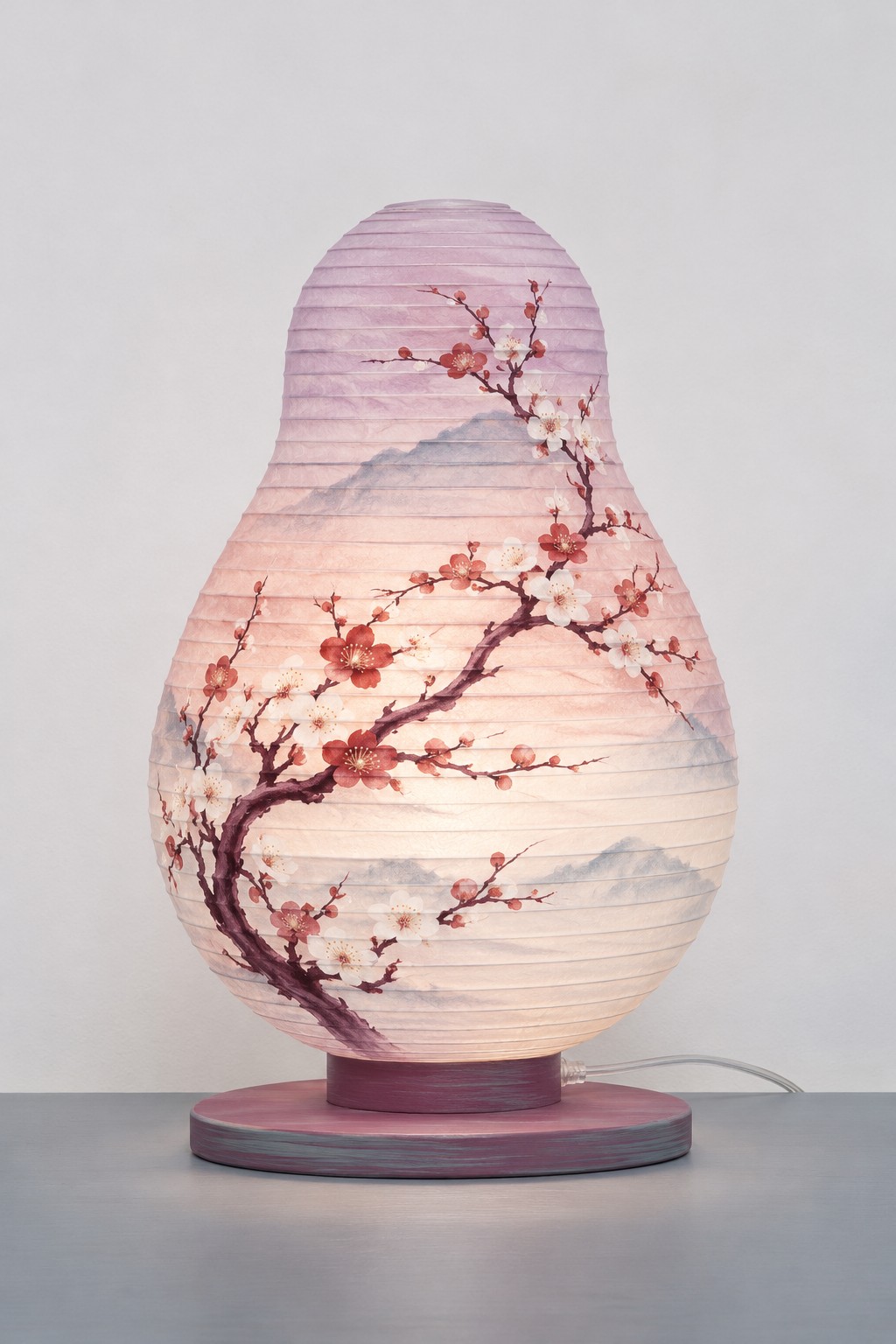
Plum blossom opens in late winter, often while snow is still around, so it stands for resilience and early hope. A single branch climbing a lavender lantern makes a gentle bedside light, especially in a room with mauve or dusty pink linens.
Wash the background color first with very diluted paint, working from the top down so any drips blend into the next band. Paint the branch in one confident movement with a dark plum brown, then dot the blossoms in two colors. A round base with a raised center collar keeps the lantern stable and centered over the bulb.
24. Floating Pine Lantern on an L Stand
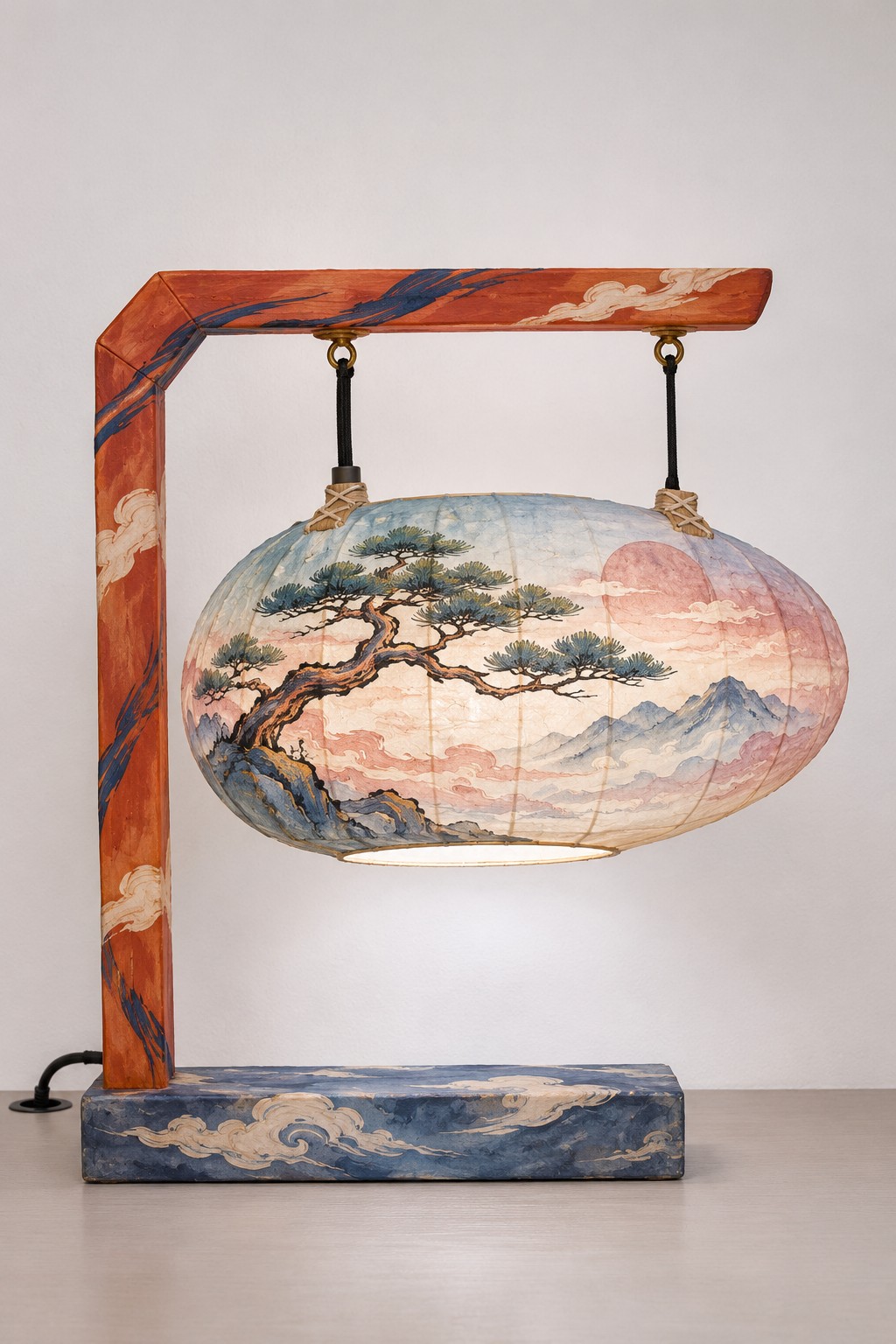
Hanging the lantern from an arm lifts it off the table, so it seems to float. That makes it a great piece for a sideboard or a wide shelf, where the space under it stays open. The pine and pink sky suggest dawn, bright and hopeful. If you prefer lanterns hung from the ceiling, our DIY chandelier and pendant light designs have plenty more.
The stand is two boards joined in an L and set into a heavy base, which needs to be long enough to balance the weight at the end of the arm. Two brass eye screws hold the cords, and a small wrap of twine where each cord meets the lantern spreads the load on the paper. The electrical cord drops from the arm to the socket inside.
Fans, Screens and Flat Panel Lamps
25. Half Open Fan on an Oak Base
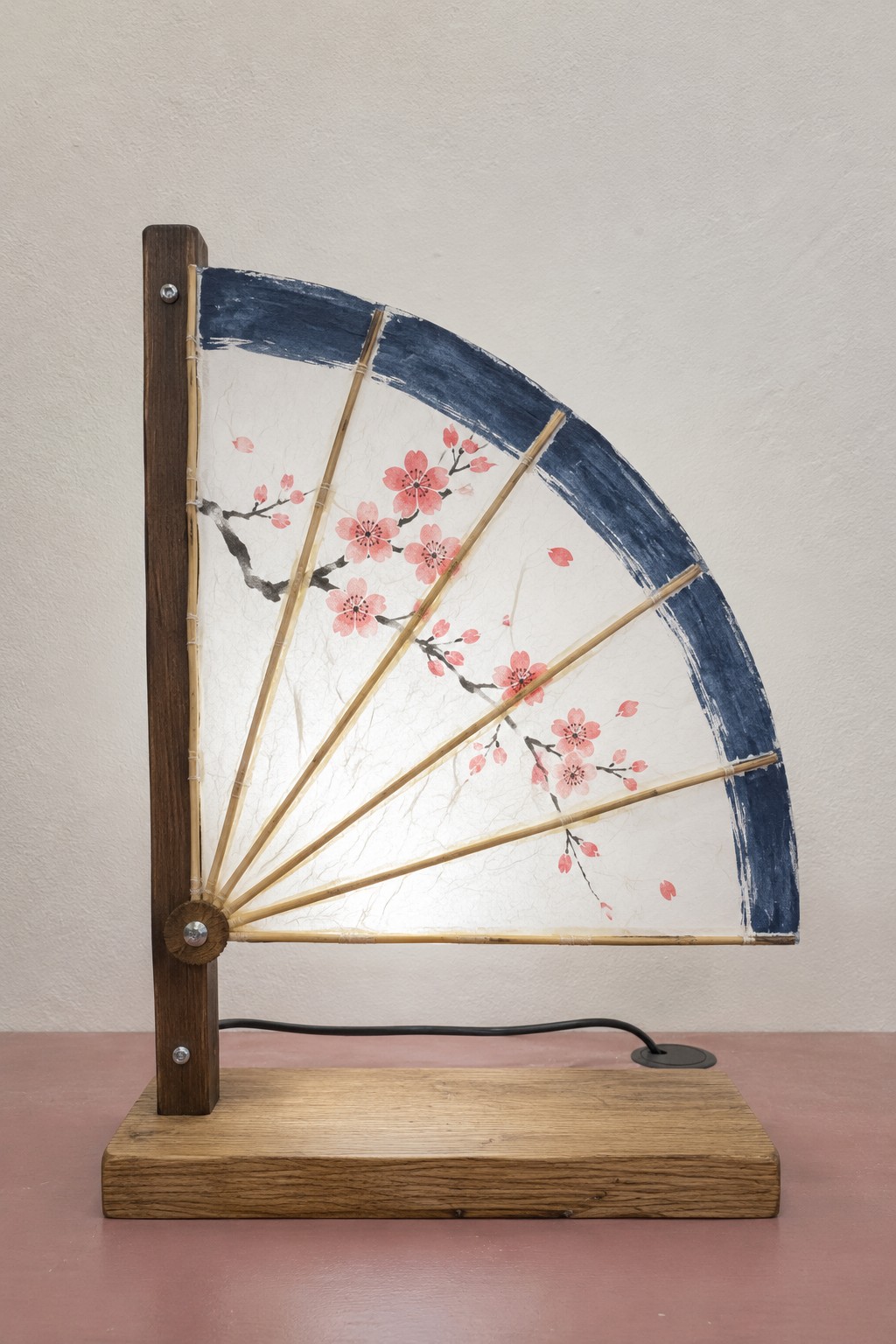
A folding fan held half open on a post makes a lamp that looks graceful from the front and almost disappears from the side. It works as an accent light on a shelf, on a piano or on a hall table, where it adds a touch of color without taking much space.
Use a large paper fan with sturdy bamboo ribs, and fix its pivot to the post with a bolt and a wooden washer so the fan holds its angle. The light comes from behind: a short LED strip or a small socket on the back of the post, aimed at the paper. Paint the border band with a dry, wide brush for a loose, textured edge.
26. Wisteria Paper Medallion
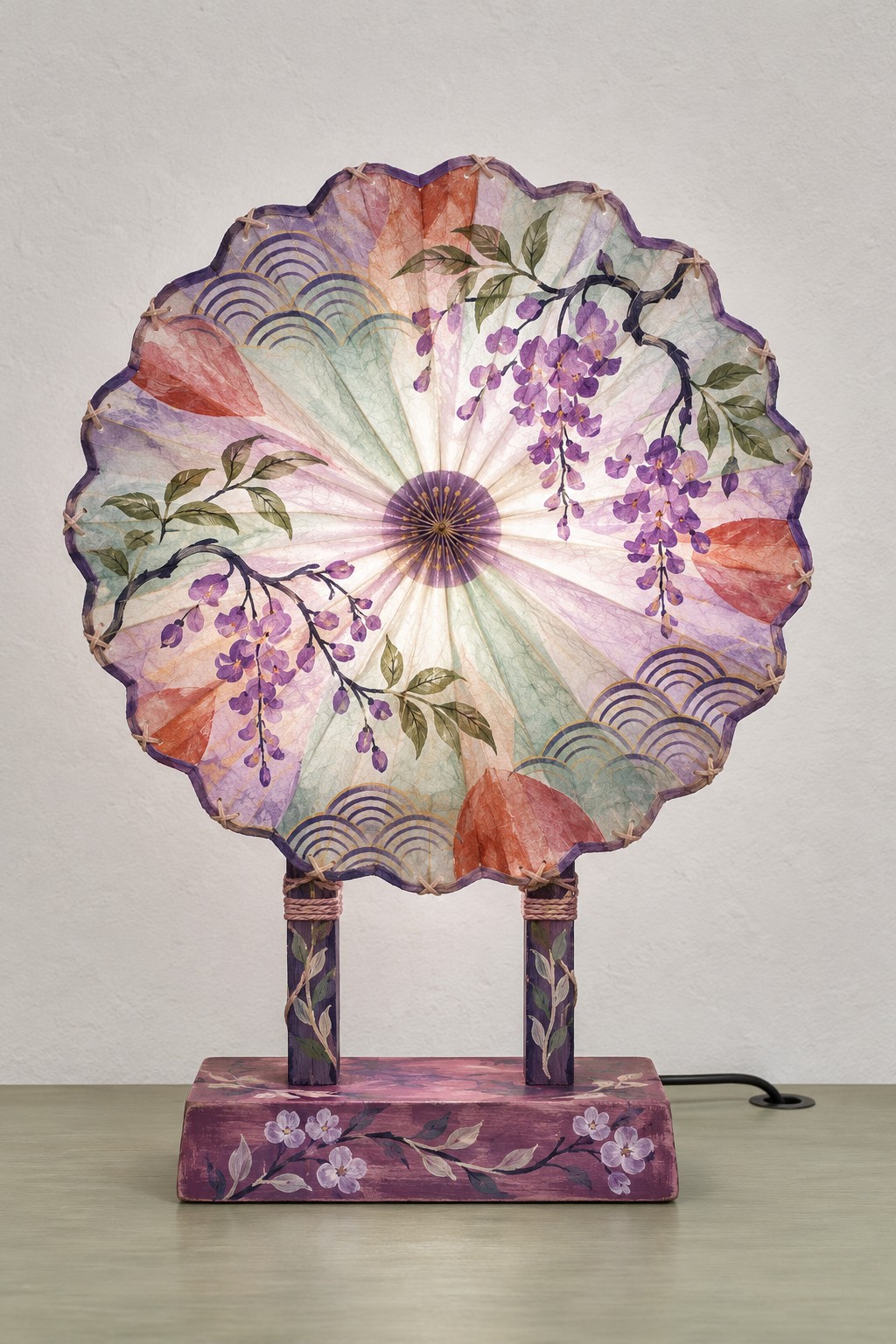
Pleats radiating from the center make this disc glow in fine stripes, like light through a paper parasol. Wisteria hangs across it in sweeping lines, so the lamp suits a feminine bedroom or a vanity corner in lilac and sage.
The medallion is made the same way as a paper rosette: fold a long strip of washi like an accordion, cut the outer edge into scallops, join the ends into a ring and press it flat. Paint before folding so the color lines up across the pleats. Laced cord at the edge keeps the scallops in place, and the disc stands on two painted posts with a light fixed behind it.
27. Two Panel Byobu Screen Lamp
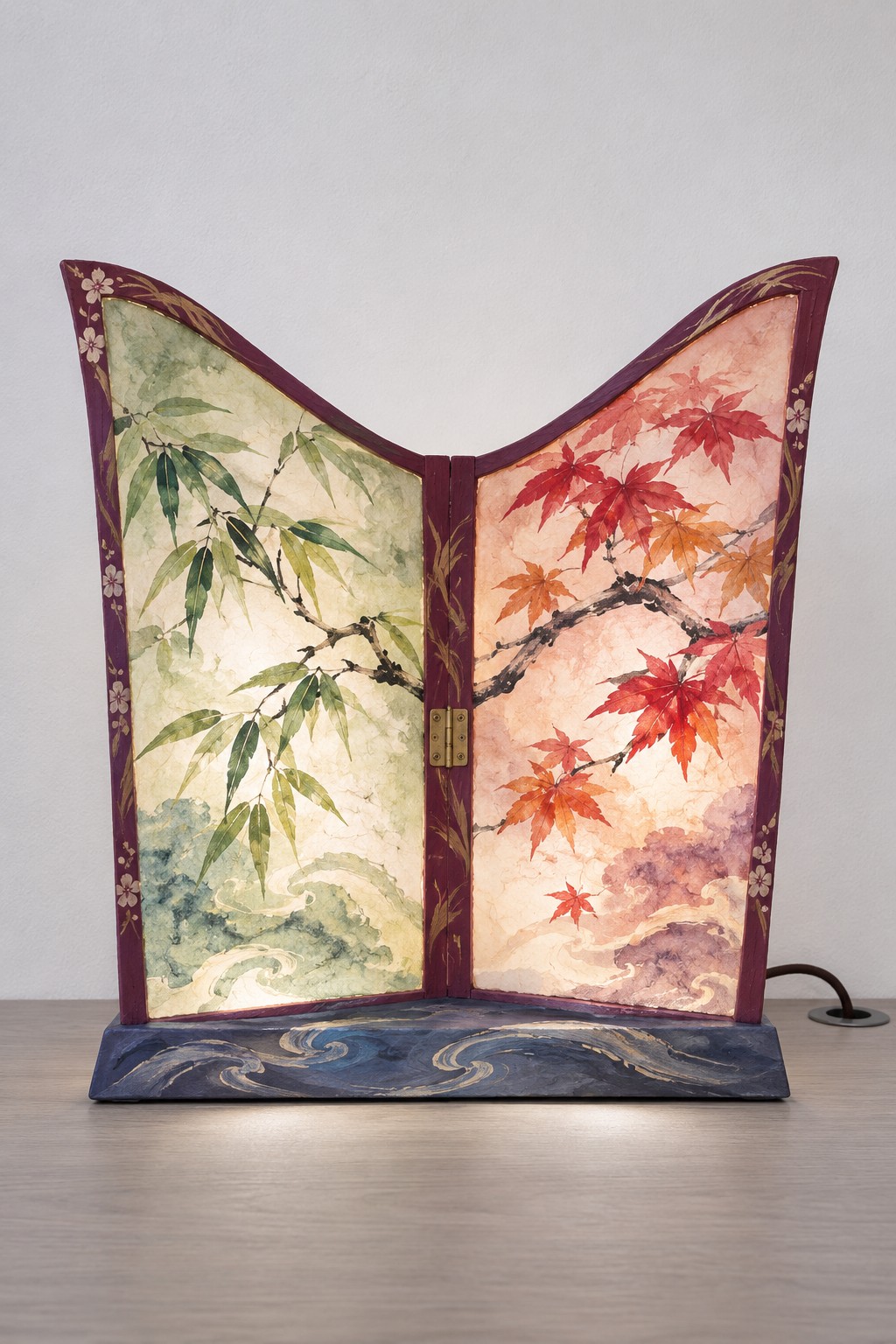
Japanese folding screens, called byobu, have long been used to divide rooms and show seasonal paintings. Here two panels hinged together show bamboo on one side and autumn maple on the other, so the lamp tells a little story of the year. It works beautifully on a low console as a backdrop light.
Build each panel as a wooden frame filled with washi, flaring the tops outward so the pair forms a V shape. A small brass hinge joins them at the center, and the base holds them at a fixed angle so the lamp cannot fold shut. Place the light inside the V, where it is hidden from the front.
28. Pleated Fan With Pine and Red Sun
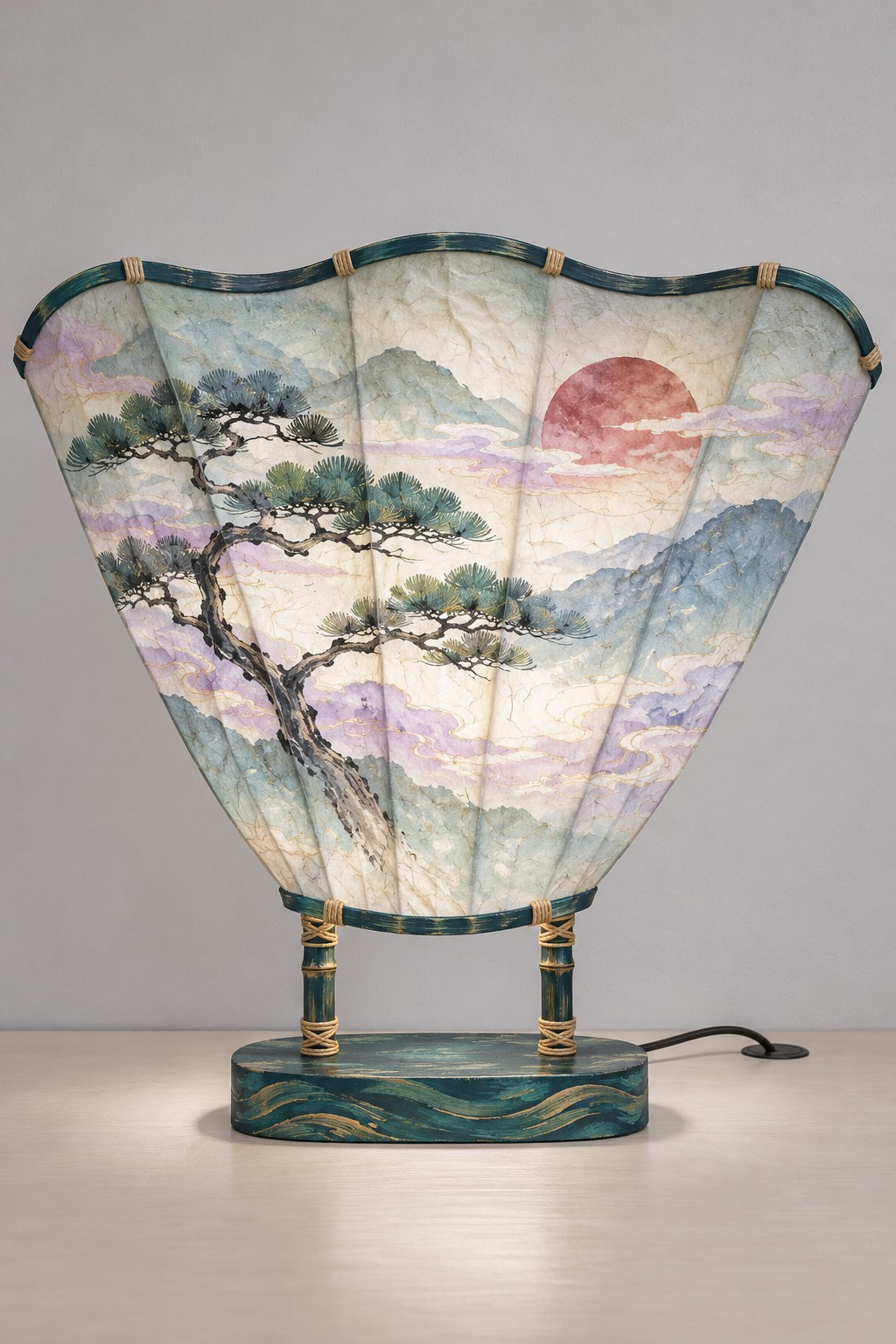
A broad fan of pleated paper reads like a landscape panel, and the pine with a rising sun is one of the most loved themes in Japanese painting. Pastel clouds keep it airy, so it fits a living room that mixes white walls with teal or sage accents.
Fold a large sheet of strong washi into deep pleats and cut the top edge into gentle waves. A split bamboo strip glued and tied along that edge keeps the pleats open, and the bottom is gathered into a small wooden rail. Two short bamboo posts lashed with twine connect it to the base.
29. Plum Blossom Cloud on a Twisted Trunk
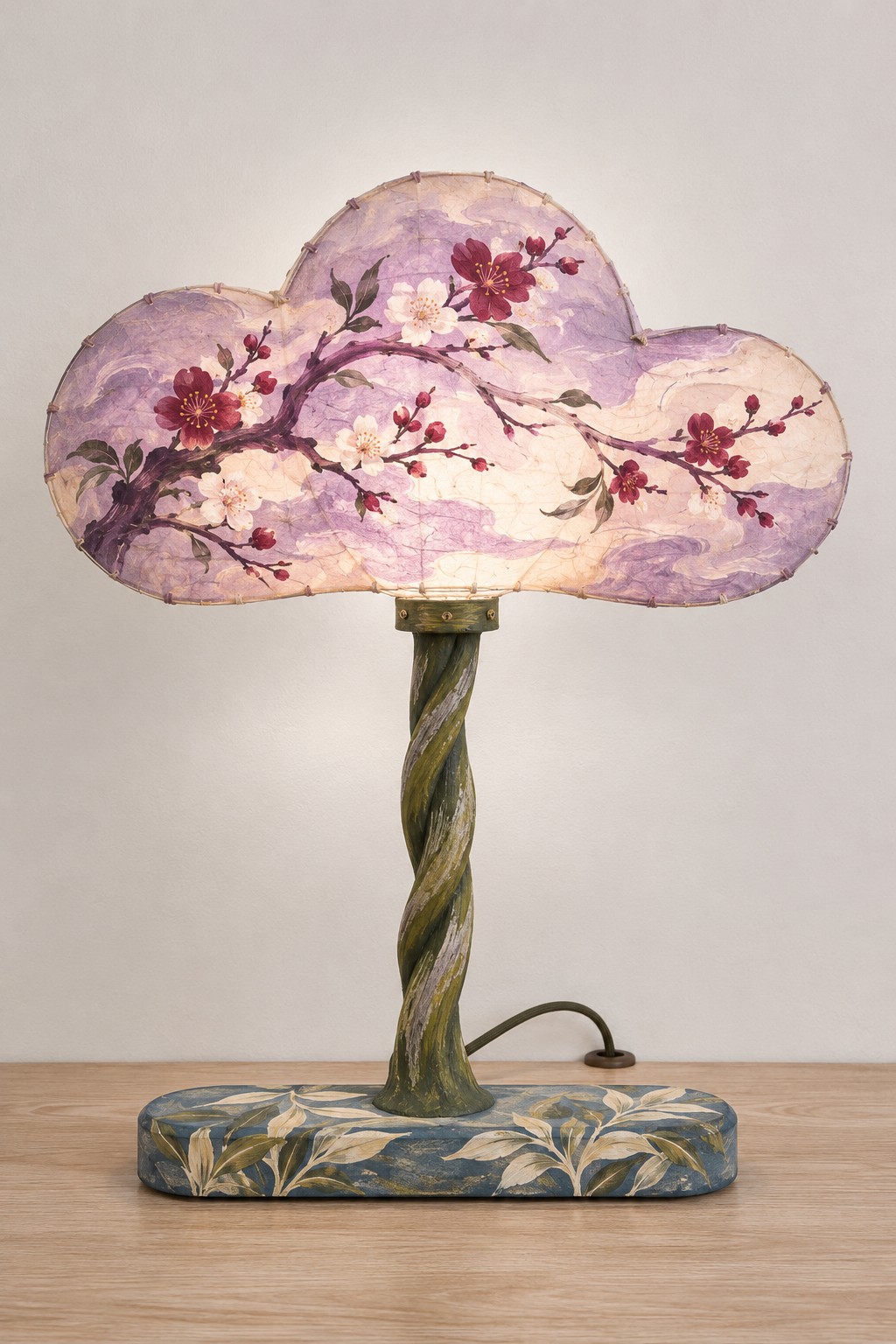
The cloud shaped panel brings to mind a tree crown, and the twisted stem completes the picture of a small flowering tree on your table. Children love its storybook look, and in a nursery or a playroom it makes a calm night light.
A barley twist spindle, sold as a table or stair part, makes an easy trunk; paint it in greens and grays with a dry brush for a bark texture. The panel is a cloud shaped frame of bent wire or thin plywood with washi on both faces, laced along the edge with cord. Put the light between the two faces so both sides glow.
30. Koi Drum Lantern in a Crescent Cradle
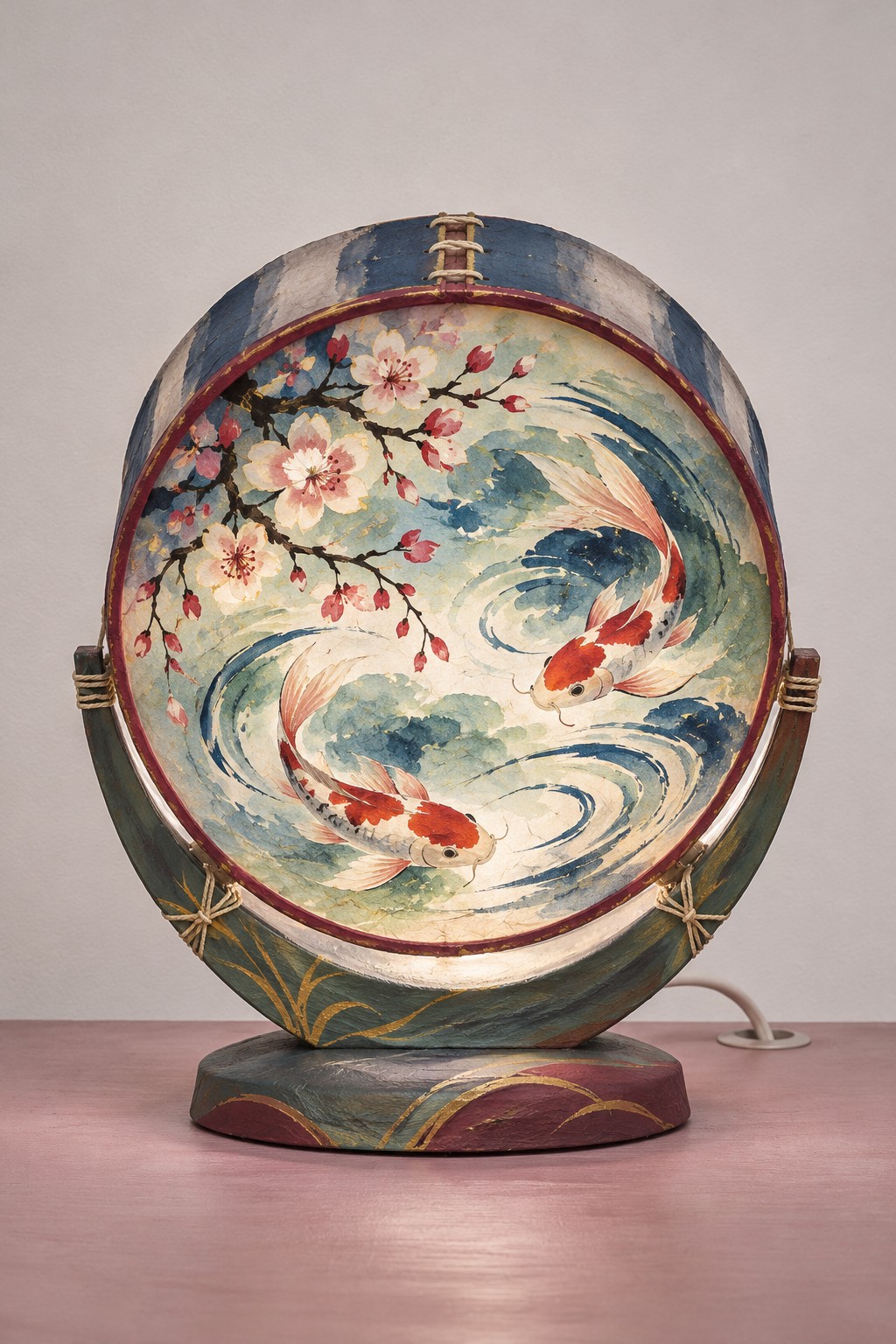
Koi stand for perseverance and good fortune in Japan, and the round frame turns the painting into a window onto a pond. The lantern stands upright like a small drum, so it is meant to be seen from the front, on a sideboard or at the end of a desk.
Make the drum from two wooden hoops with washi on both faces and a paper band around the side, then lace cord across the top in the style of a taiko drum. The crescent cradle is cut from plywood and tied to the drum with twine. Paint swirling water around the koi rather than filling the background, so the light stays bright.
31. Seigaiha Moon Disc
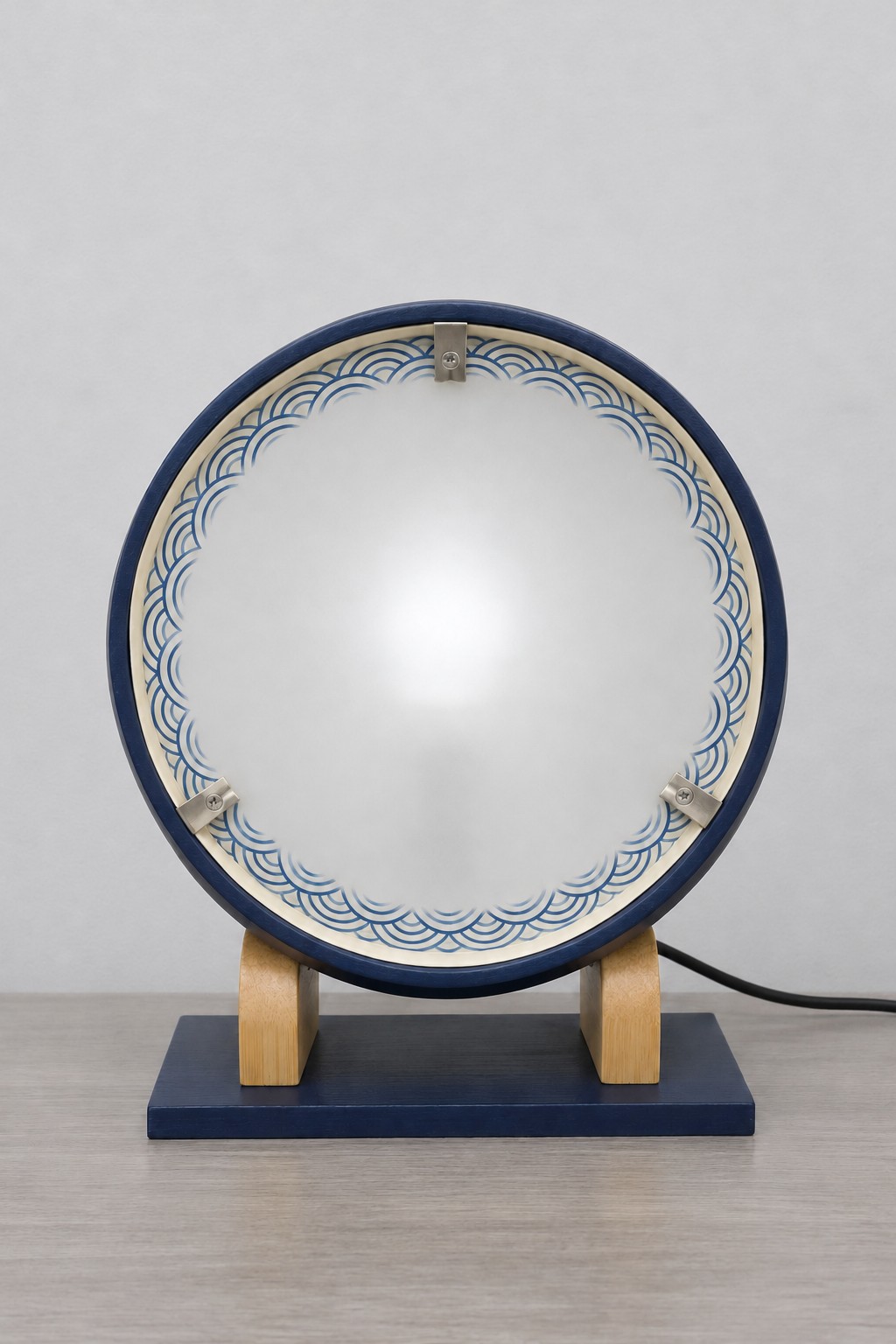
A glowing circle on a stand reads as a full moon, and the thin wave border is just enough pattern for a minimalist room. In navy and pale wood it bridges Japanese and Scandinavian style perfectly, and it makes a soothing light for a bedside or a reading nook.
Use a bent plywood ring or a large wooden hoop painted navy, with a frosted acrylic disc held in place by small metal clips. Stencil the seigaiha arcs onto a cream paper ring that sits just inside the hoop. Two curved bent wood supports hold the disc upright, and a flat LED panel or a small socket sits behind it.
32. Shippo Oval Ring
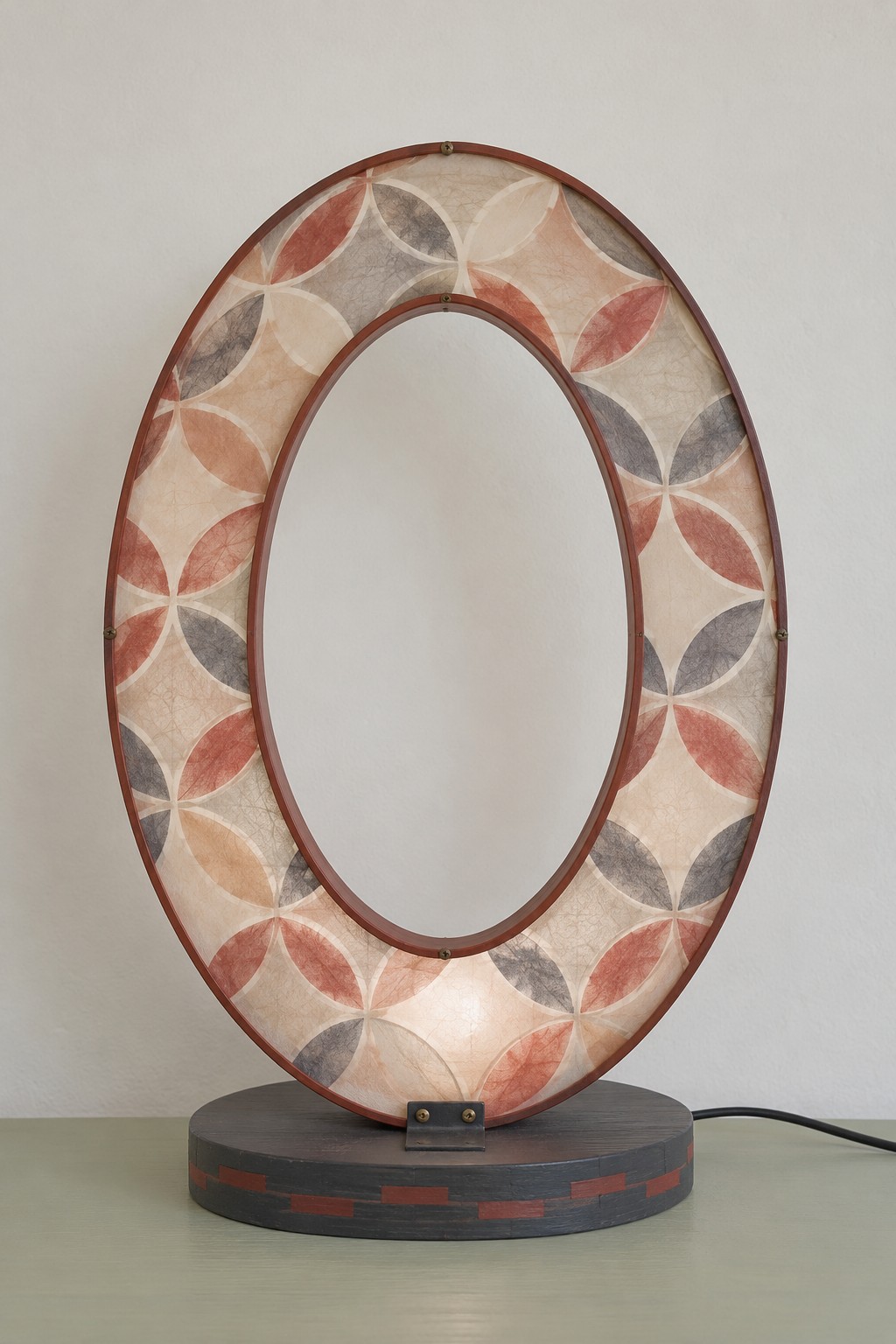
Shippo is a pattern of overlapping circles named after the seven treasures of Buddhism, and its endless linked rings stand for harmony and connection. Wrapped around an open oval, it makes a sculptural lamp that frames the wall behind it, a beautiful piece for an entryway.
The ring is built from two pairs of oval hoops, an outer one and an inner one, with paper panels on the front and back faces and a band around the edges. Draw the circles with a compass, then cut the petal shapes from tinted papers in rust, gray and peach and glue them in place. A light hidden in the lower curve lifts the glow through the whole ring.
33. Wisteria Ribbon Helix
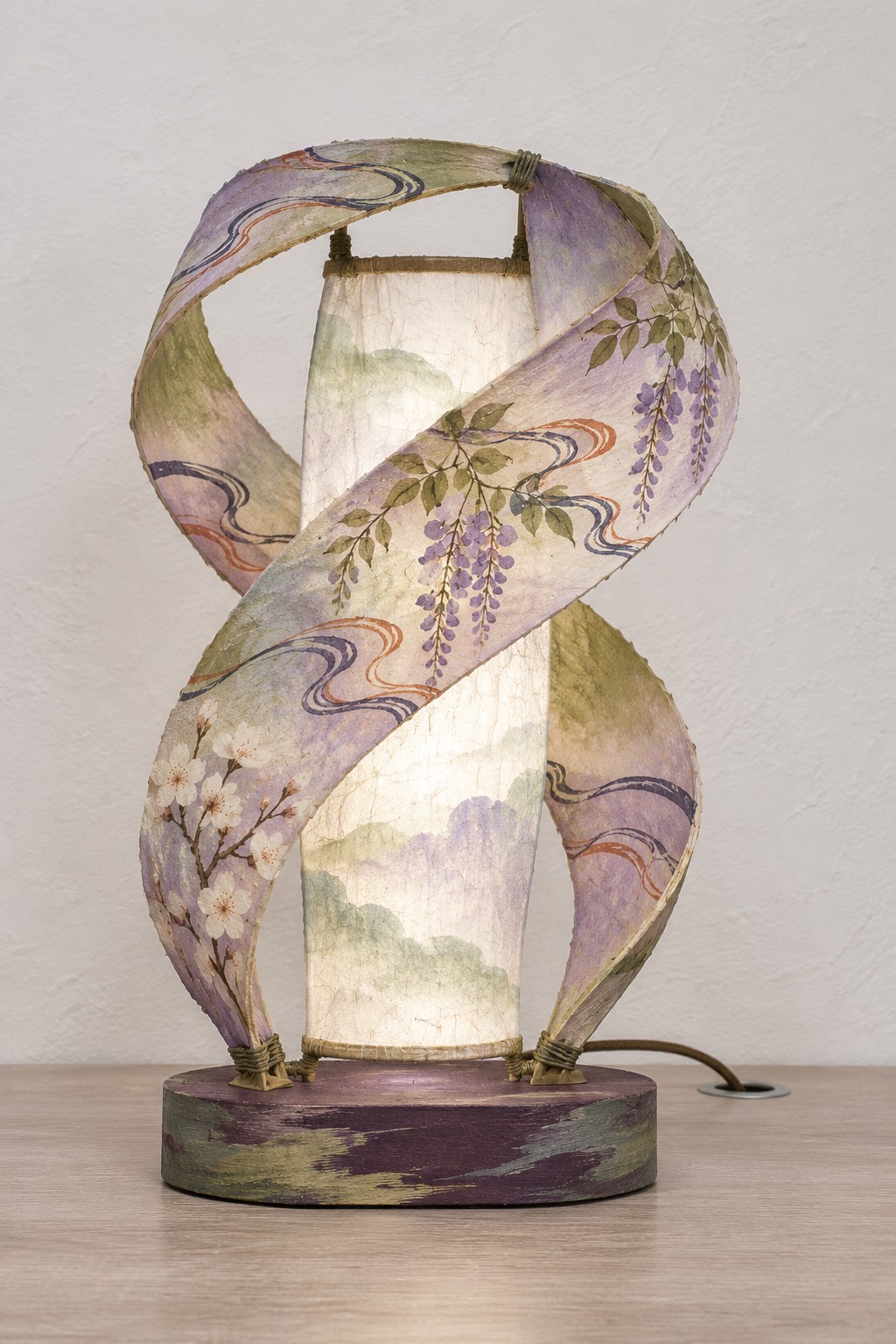
Two ribbons twist around a glowing core, giving the lamp movement from every angle. Lilac and green keep the shape gentle rather than dramatic, so it suits a bedroom or a reading corner with pale walls.
Laminate the painted washi strips onto thin styrene so they keep their curve, then fix each end to the base and the top of the inner cylinder. Binding the ends with thread over a dab of glue gives a neater finish than glue alone. The inner cylinder is a simple washi tube on two small dowels.
34. Cherry Blossom Cube on Its Point
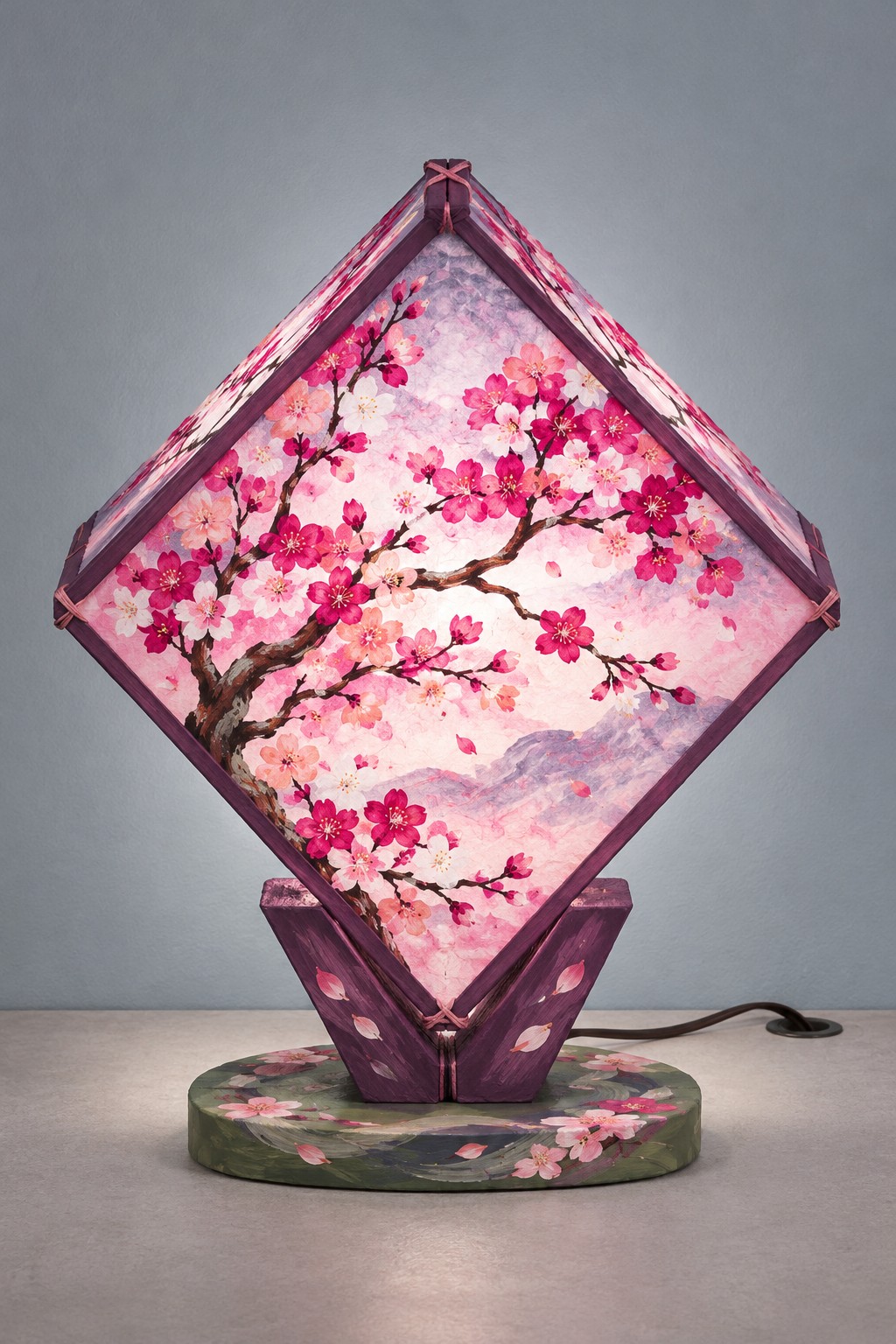
Turning a cube onto its point makes a simple lantern look dynamic. Vivid cherry blossom over a lilac sky brings spring indoors, a fun pick for a teenager's room or a creative studio.
Build a square frame from thin strips, cross lash each corner with pink cord over the glue, and fill the faces with painted washi. The V shaped cradle must hold the cube firmly, so screw it to the base and line it with felt to stop slipping. The socket sits in the cradle with the bulb pointing up into the cube.
Linen, Stitching and Cloth Shades
35. Stitched Linen Cone on a Stone Base
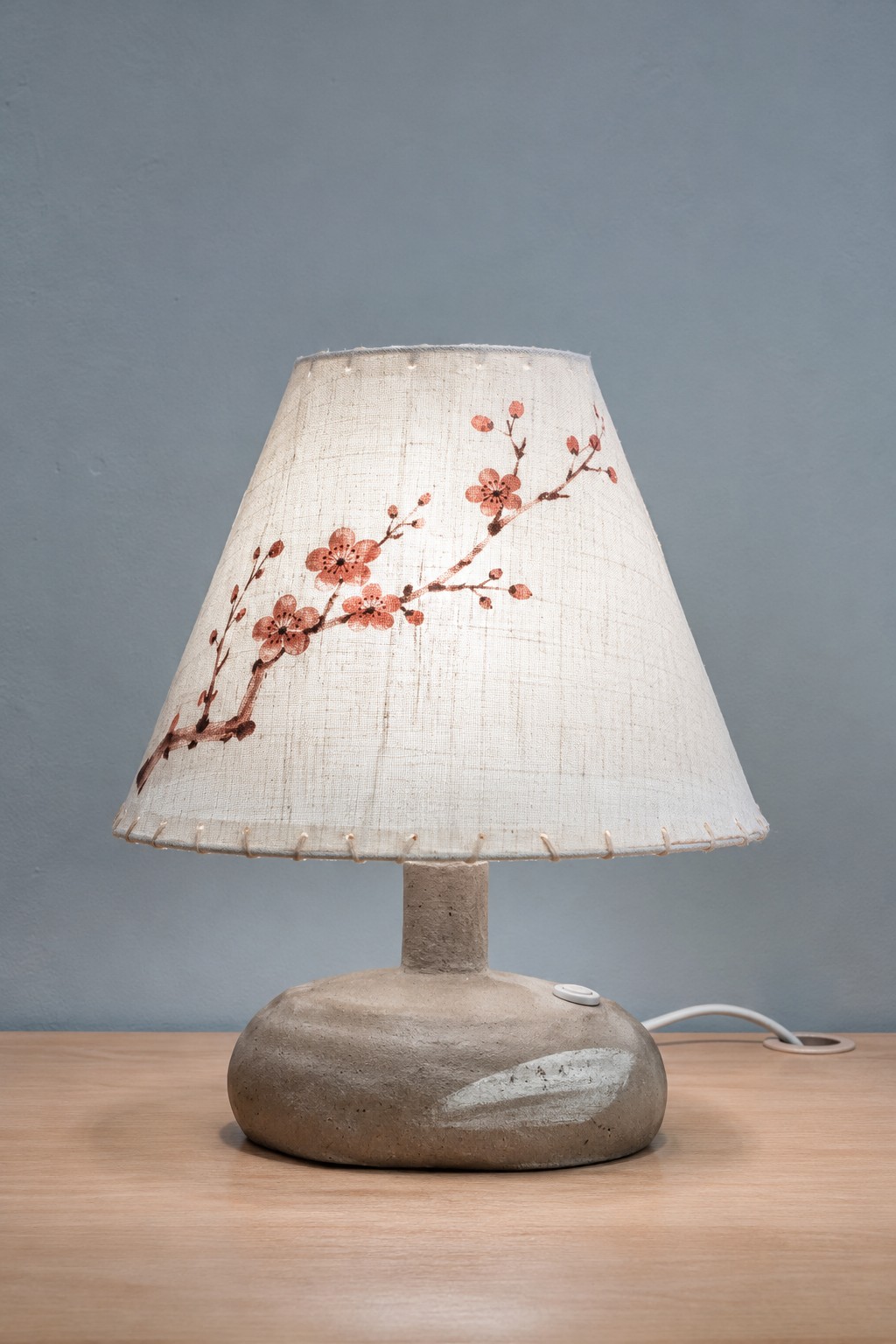
A heavy pebble shaped base and a linen shade with visible stitching look natural and handmade, very much in the wabi sabi spirit. It is an easy lamp to live with, on a side table, a nightstand or a kitchen shelf.
The base can be cast in concrete in a flexible mold or built from air dry clay around a weighted core, with a channel for the cord and a push switch. Our air dry clay ideas cover the basics if you go that way. For the shade, press linen onto lampshade styrene, wrap it on the rings, and whip stitch over the rims with cream thread. Paint the plum branch on the linen before assembly.
36. Sashiko Pillow Lamp
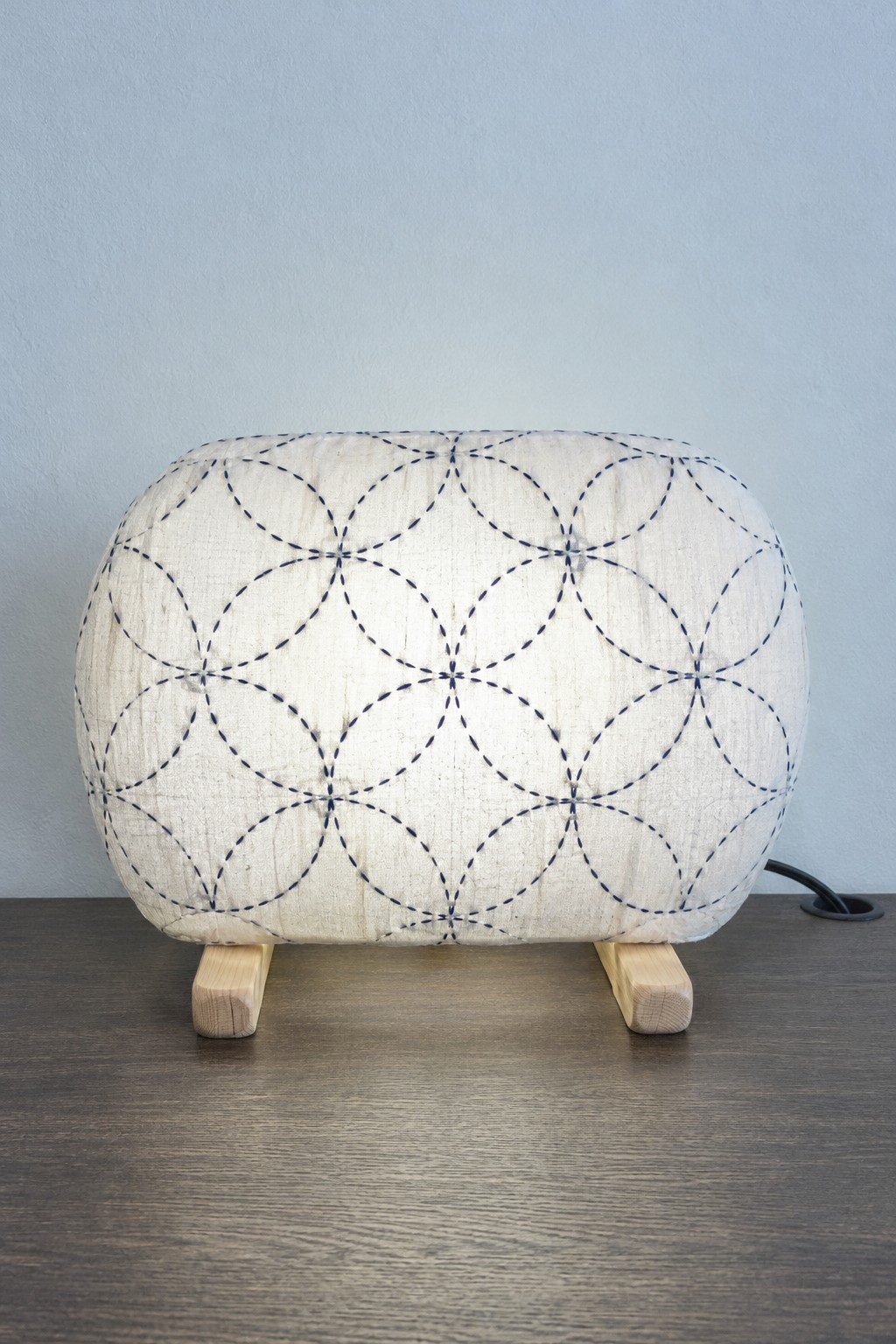
Sashiko is Japanese running stitch embroidery, first used to strengthen work clothes, and the overlapping circle pattern here is the same shippo motif seen earlier, done in thread. The pillow shape looks cozy and slightly playful, just right on a bench, a bedroom floor or a low shelf.
Stitch the pattern on flat linen with sashiko thread before you mount it, marking the circles with a template and a washable marker. Stretch the finished cloth over a rounded frame of bent wire or thin bent wood, with the bulb well inside so the fabric never touches it. Two small runners of pale pine lift it off the surface and let air circulate underneath.
37. Asanoha Bow Shade on a Clay Bottle
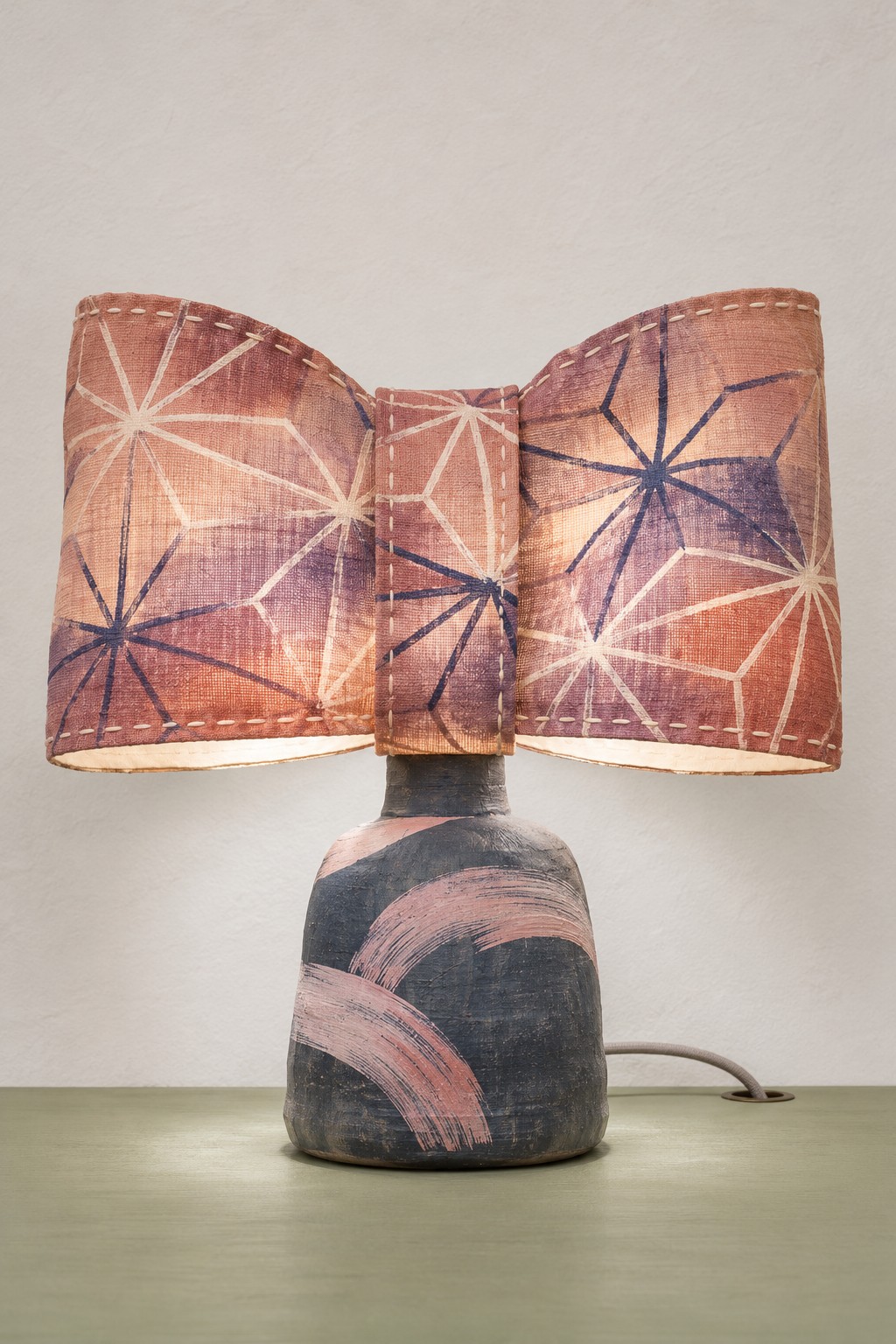
Asanoha, the hemp leaf pattern of six pointed stars, was traditionally used on children's clothes because hemp grows fast and strong. Folded into a bow, it turns a table lamp into something cheerful, a lovely choice for a girl's bedroom or a dressing table.
Each loop of the bow is linen backed with styrene, curved and joined at the center with a narrow wrapped band. Running stitches along the edges add a handmade finish. The base is a clay bottle shape painted navy with loose pink strokes. Place the bulb in the open space between the loops, never pressed against them.
38. Hourglass Linen Lantern
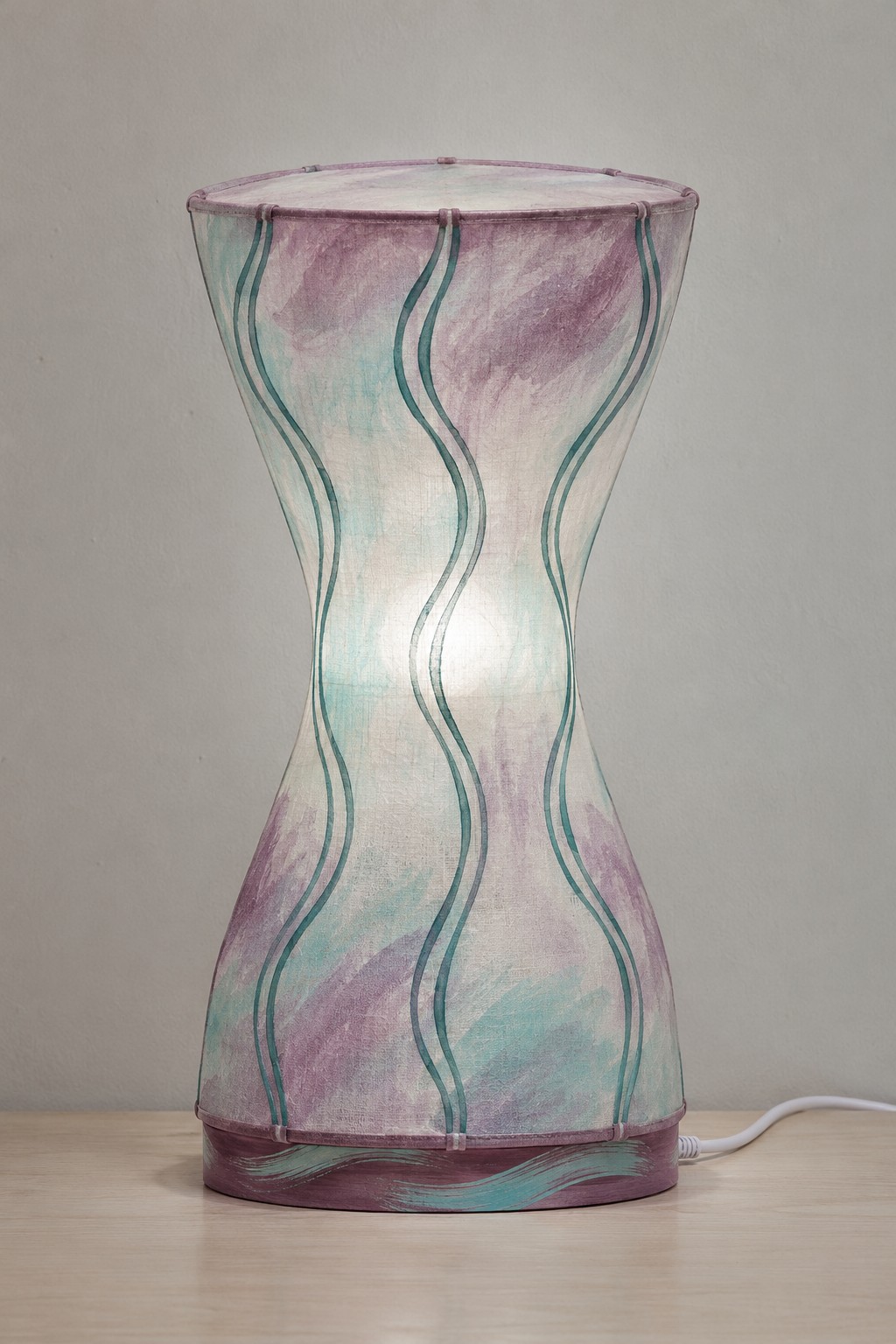
The narrow waist gives this lantern a soft, curvy outline, and the wavy lines make the light seem to ripple. Teal and violet watercolor washes suit a bedroom or a study with cool tones.
Stretch linen over a frame with a top ring, a bottom ring and curved ribs that pinch in at the middle, then stitch the fabric to the rings. Paint the washes with fabric paint or acrylic mixed with textile medium, working while the cloth is lightly damp for softer edges. The wavy lines go on last with a fine brush.
39. Noren Banner Lamp
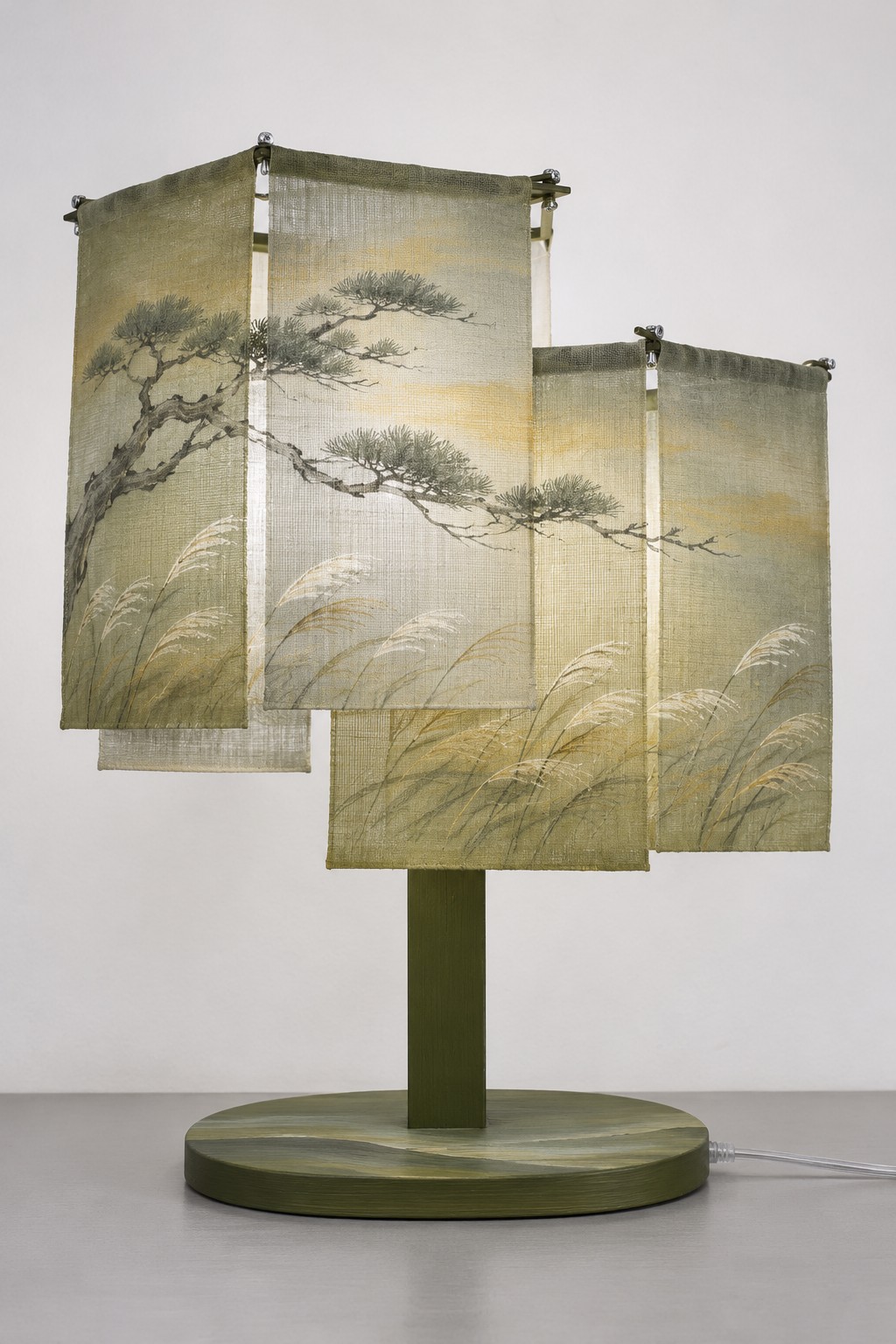
Noren are the split fabric curtains hung in Japanese doorways, and these small panels borrow that idea. Hung at two heights, they overlap like layers of mist, and the loose weave lets the light filter through. It is a good choice for a calm living room with olive and natural tones.
Paint the pine and grass across all the panels as one scene, then cut and hem them. Each panel hangs from a thin rod with small clips, and the rods sit on a frame at the top of the post. A slim paper tube around the bulb keeps the fabric away from it and hides the light source.
40. Iris Gauze Bench Lamp
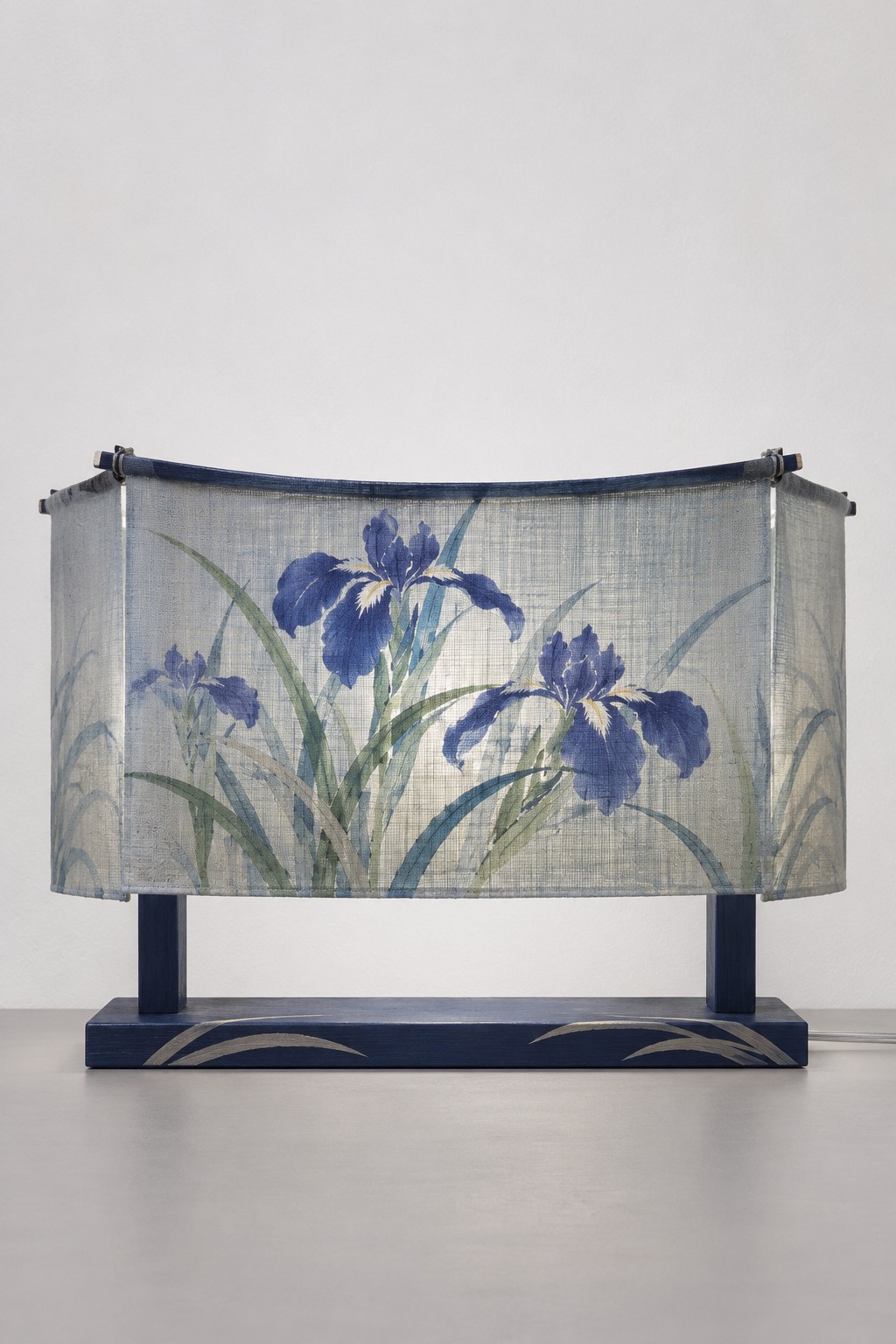
A wide, low lamp is very useful in rooms where a tall one would block a window or a mirror. The sheer gauze makes the iris look like a watercolor, and the curved top rail adds a hint of a temple roof. It looks especially good on a long console behind a sofa.
Stretch a sheer, open weave fabric over a long frame and paint the irises with diluted acrylic and textile medium, so the color stays light. Light a wide shade like this with an LED strip or two small LED bulbs spaced apart, rather than one bulb in the center, so the glow is even from end to end.
41. Sumi Painted Linen Scroll Lamp
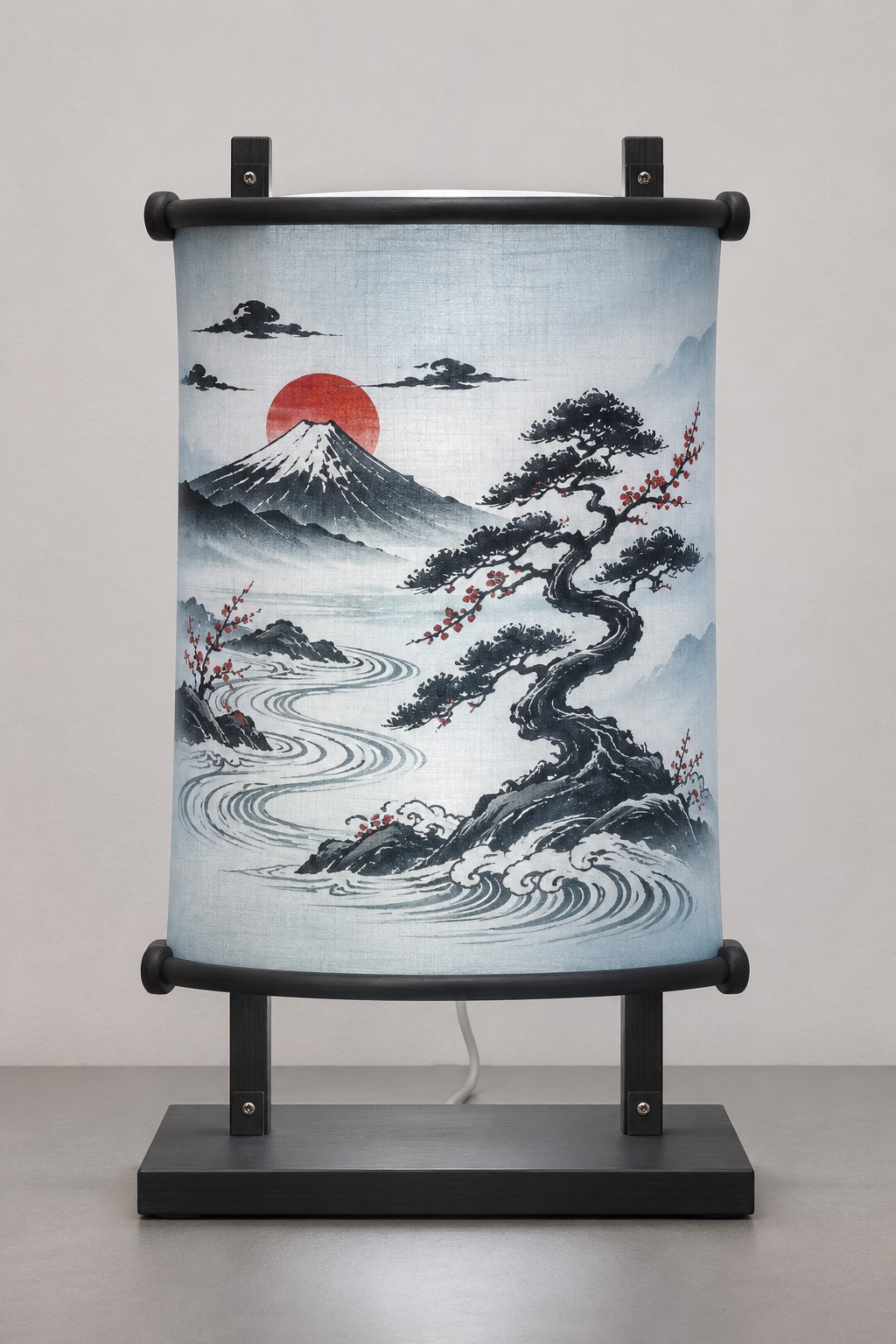
Black ink on pale linen gives this lamp the look of a hanging scroll, and the small red sun is the only color. It pairs well with black frames and dark wood, which makes it a strong choice for a home office or a modern living room.
Back the linen with styrene and roll it into a cylinder held between two rings. The rings are screwed to four posts that rise from the base, so the shade is fixed and the bulb sits safely in the center. Paint with ink thinned to several grays, and save the darkest black for the pine trunk and the rocks.
42. Furoshiki Wrapped Cube
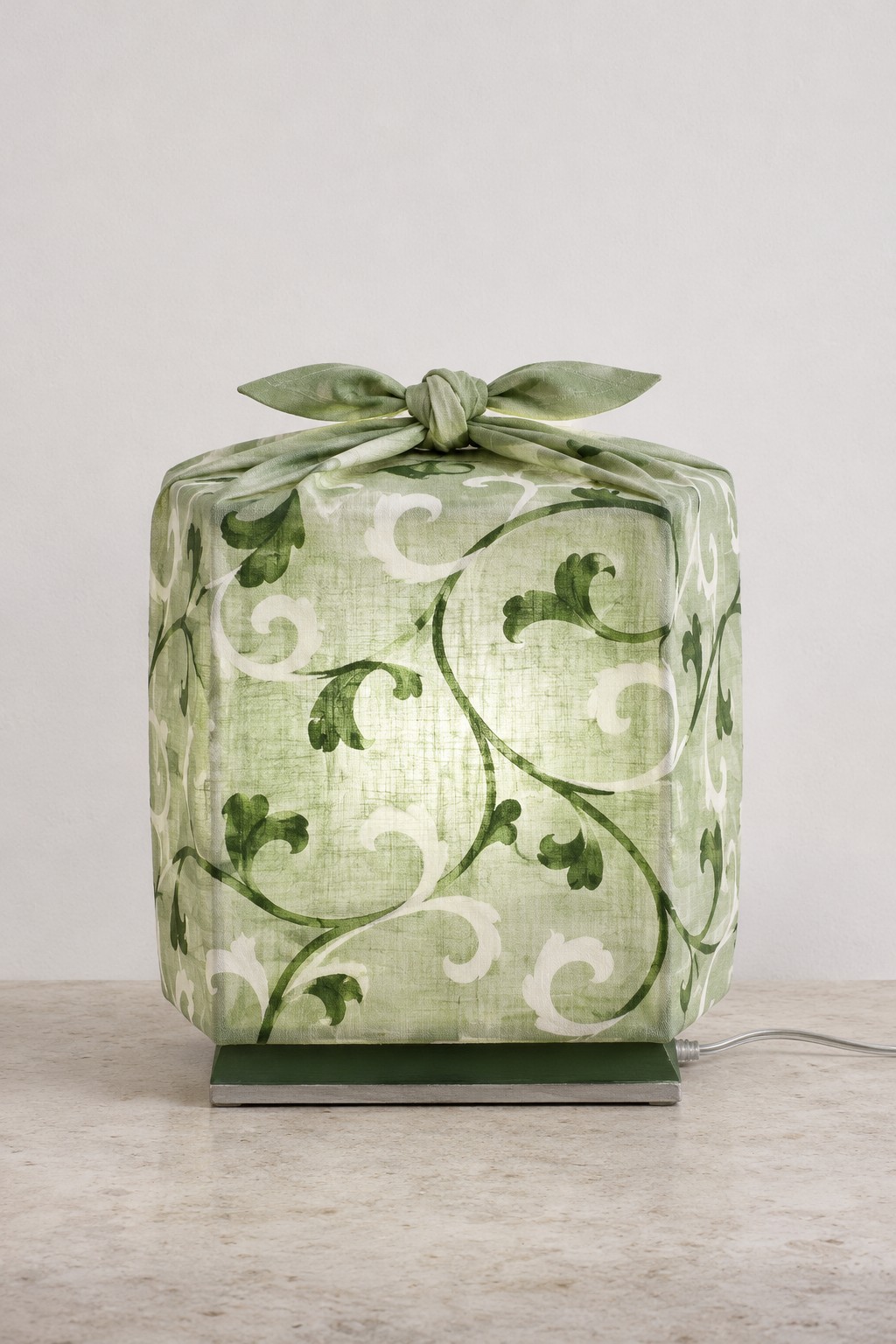
Furoshiki is the Japanese square wrapping cloth used to carry and gift almost anything. Wrapped around a cube lamp, it makes the light look like a present, with a knot on top that adds a sweet, playful touch. It is a quick and charming idea for a bedroom or a guest room.
Start with a cube frame lined with styrene or a ready made cube lantern, and wrap it with a cotton furoshiki, tying the two corners on top into a knot. The cloth must sit on the frame, never on the bulb, and the lamp needs an LED bulb only. Because the cloth comes off in seconds, you can change it with the seasons.
Arms, Branches and Hanging Shades
43. Wisteria Shade on a Sculpted Vine
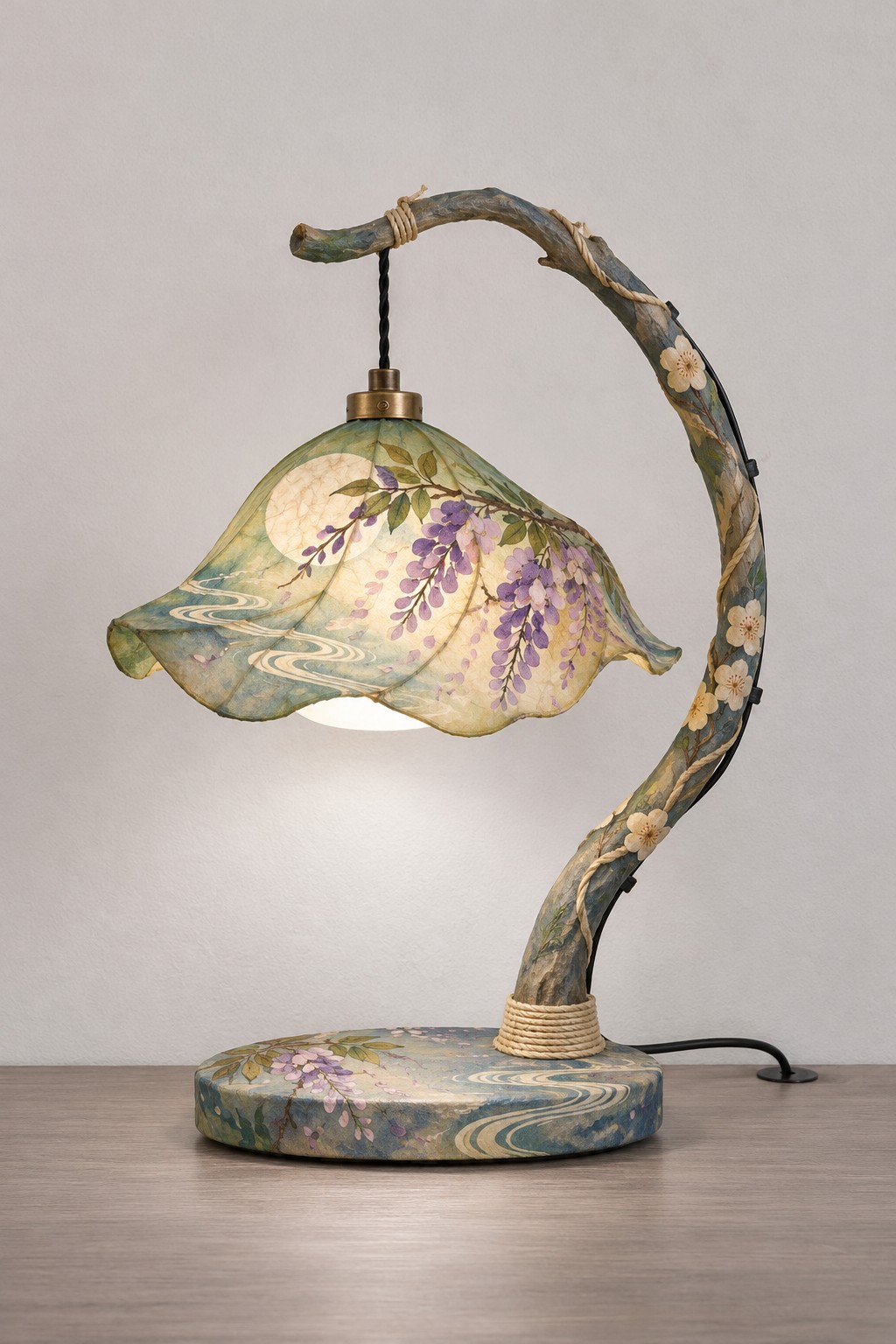
A curving vine holding a single ruffled shade makes this lamp look like a branch caught in a breeze. It brings a fairytale mood to a bedroom or a reading corner, and the green and violet tones suit spaces with plenty of plants.
The arm is sculpted from papier mâché or clay over a bent metal rod, which also gives it the strength to hold the shade. Let every layer dry completely before painting. The ruffled shade is shaped from damp washi layers over a bowl, with the edge pressed into waves while wet. The cord runs along the back of the arm in small clips.
44. Twin Iris Bells on a Forked Stem
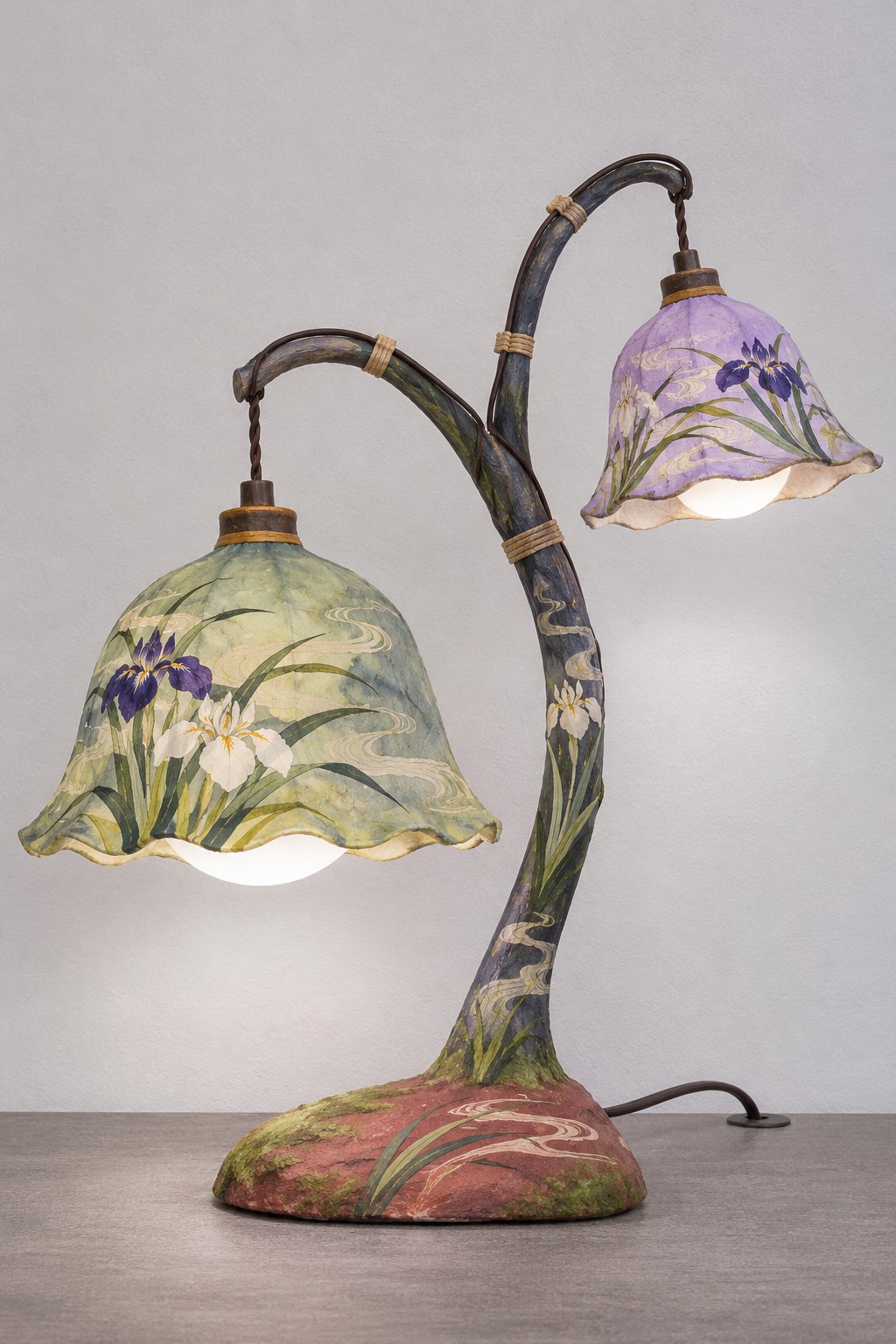
Two bell shades at different heights act like flowers on one stem, giving both a main light and a softer accent from a single base. The mossy rock at the bottom makes it look as if it grew from the ground, a lovely detail on a nightstand or a desk.
Form the bells over a bell shaped mold from thin layers of washi and paste, then paint the iris with watercolor. The stem is a branched metal rod covered in papier mâché, and the base is a heavy core shaped into a rock and painted with green and rust tones. Each shade needs its own cord and socket, so plan the cord paths before you start sculpting.
45. Maple Star Shade on a Real Branch
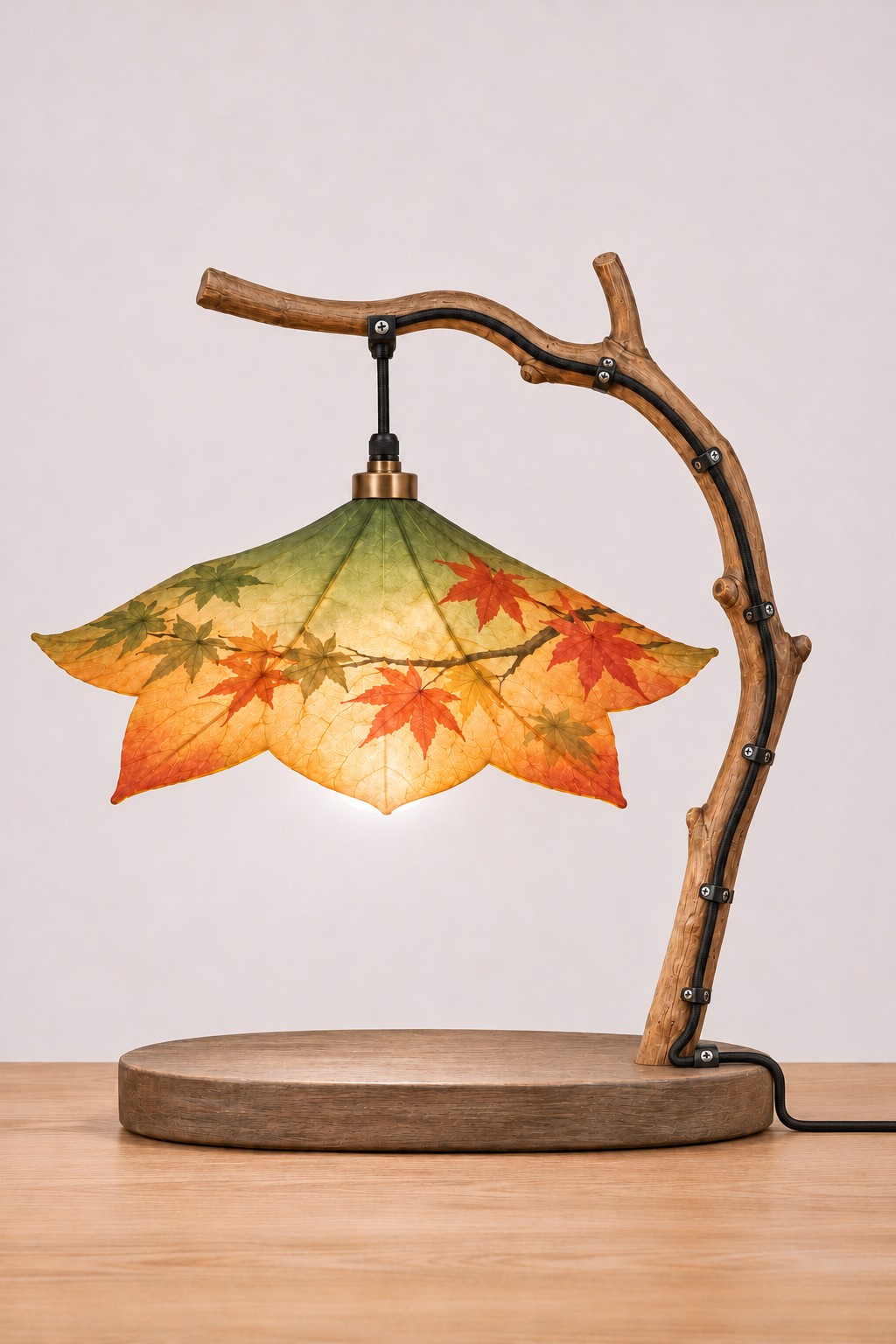
A real branch brings the outdoors in more honestly than any carved stem, and the star shaped shade looks like a leaf about to fall. The green to orange fade hints at early autumn, a cozy accent for a desk, a hall table or a cabin style living room.
Choose a seasoned branch, remove loose bark, sand it and seal it. Fix it into a thick base with a long screw and glue, and make sure the base is heavy enough to balance the hanging shade. Run the cord along the branch with small insulated clips. The shade is washi stretched over an umbrella like frame of thin wire ribs, with one rib running out to each point, then washed in green and orange and painted with maple leaves.
46. Hexagon Lantern Under a Black Steel Arch
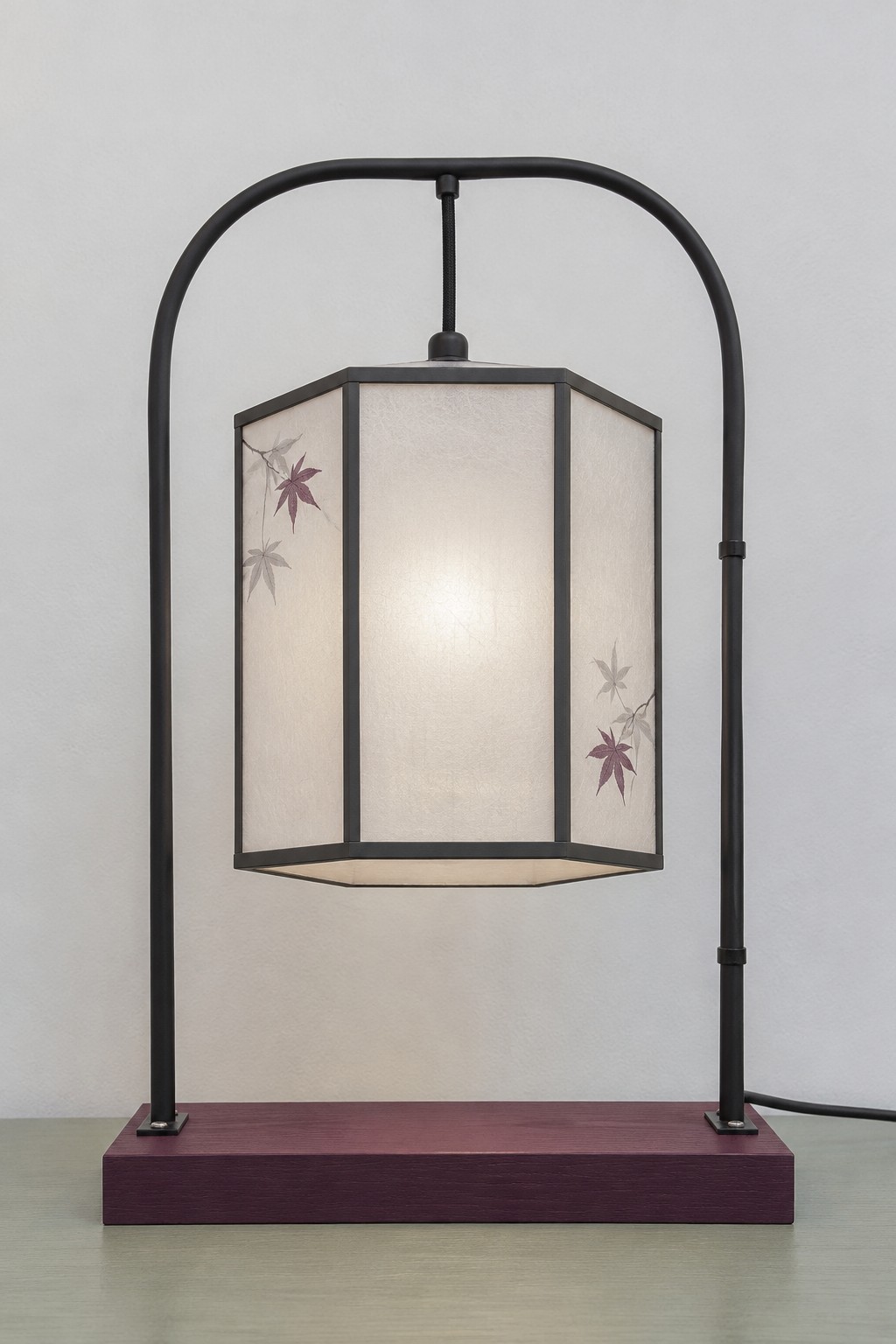
A thin black arch and a paper lantern hung inside it look light and modern, with just a few pale maple leaves for decoration. The design fits a Japandi living room with black accents, or a bedroom where you want a light that looks almost weightless.
Bend steel rod or a metal tube around a curved form, then screw the feet to a stained base with small flanges. The lantern frame is made from thin strips painted black, lined with washi. Paint the leaves very lightly so they look like shadows. The cord hangs from the arch and runs down one leg in neat clips.
47. Plum Panel Under a Bamboo Arch
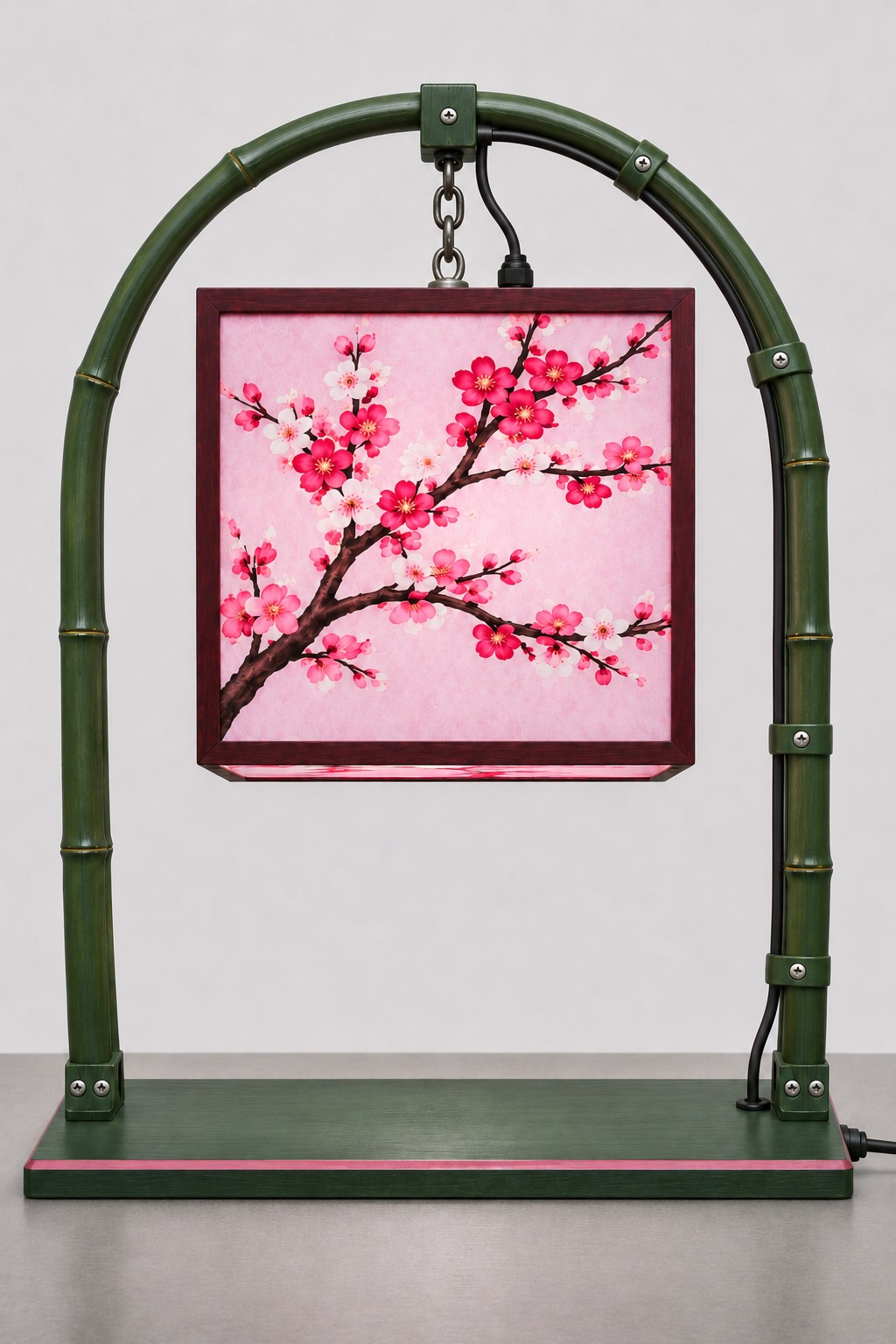
This is the colorful sister of the previous idea. A green bamboo arch frames a square lantern filled with vivid plum blossom, a cheerful combination for a playroom or a bright entryway.
Make the arch from two bamboo canes warmed with a heat gun and clamped around a curved form until they cool, then join them at the top with a wooden block. A short chain carries the lantern, while the cord runs separately along the arch in clips. Paint the canes green, or keep them natural if you want a quieter look.
48. Ensō Drum on an L Shaped Stand
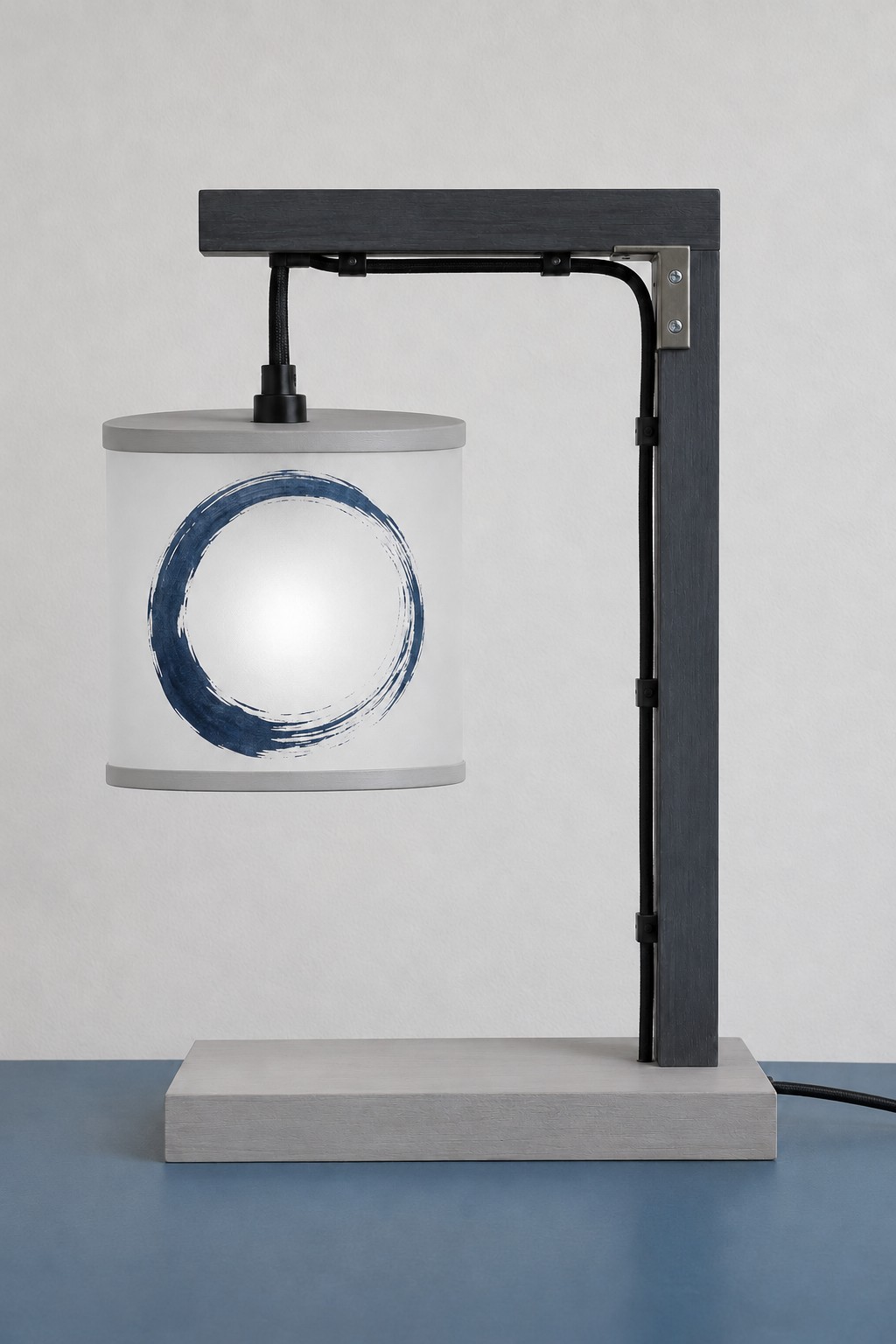
The ensō is a circle painted in one brushstroke in Zen practice, a symbol of completeness and of the beauty of imperfection. One indigo circle on a white drum is all this lamp needs, and the gray stand keeps it minimal. It is a great desk lamp for a calm workspace.
Paint the circle on the flat shade material before rolling the drum, and paint it in one movement without going back over it. That slight unevenness is the point. Join the L stand with a metal corner plate at the top for strength, and clip the cord down the back of the post so it stays out of sight.
49. Maple Cone on a Gooseneck Arm
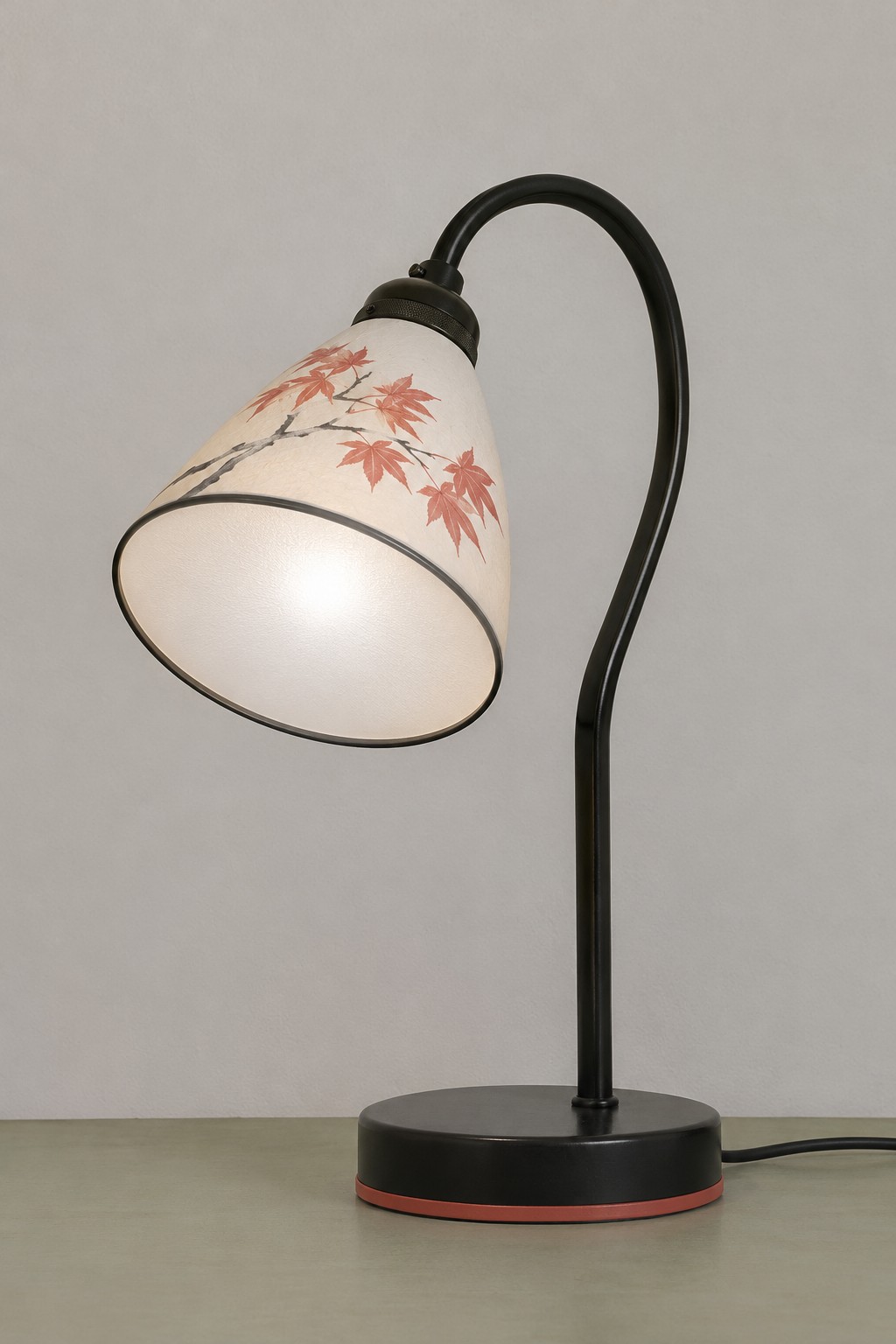
Adding a painted paper shade to a simple gooseneck lamp gives you an adjustable reading light with real character. Red maple on cream paper is warm and autumnal, ideal next to an armchair. More ideas for that corner are in our reading room decoration ideas.
Make a cone template from paper, cut it from styrene backed washi and join the seam with a narrow overlap. Bind the top and bottom edges with thin black tape to match the arm. The base gets a coral painted edge, a small detail that ties it to the color of the leaves.
Bases Borrowed From Jars, Pots and Plants
50. Frosted Globe on a Plum Blossom Jar
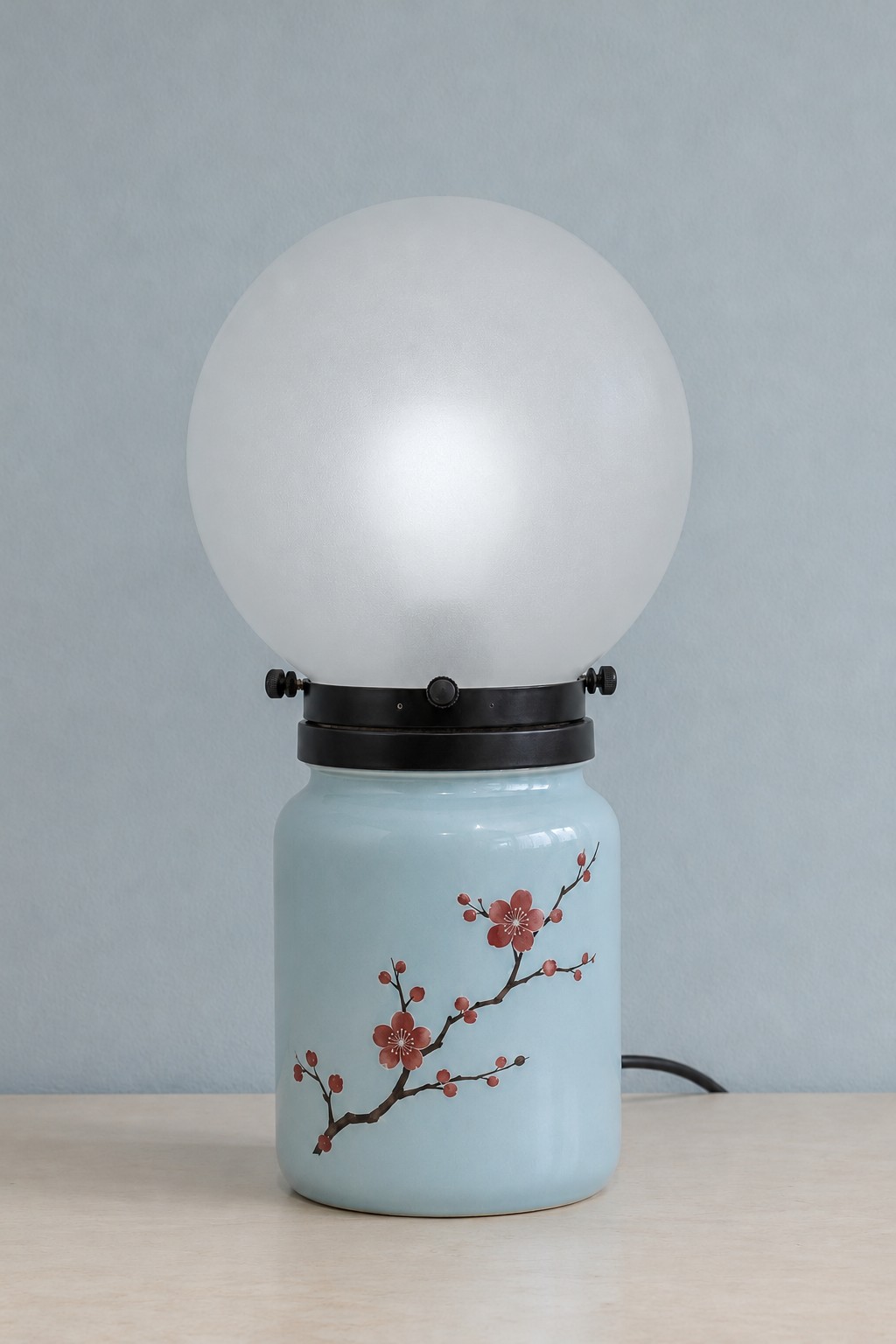
A celadon blue jar with a single plum branch recalls Japanese porcelain, and the frosted globe adds a round, even glow. It is a clean, elegant lamp for a bedside table or a dressing table. If you enjoy jar projects, our mason jar crafts have more ideas.
A bottle or jar lamp kit fits through a hole in the lid and holds the socket. The black ring is a standard globe holder with thumbscrews, so match the globe to its fitter size before you buy. Paint the plum branch with an enamel paint made for glass or ceramic, and cure it exactly as the label says.
51. Seigaiha Shade on a Flowerpot
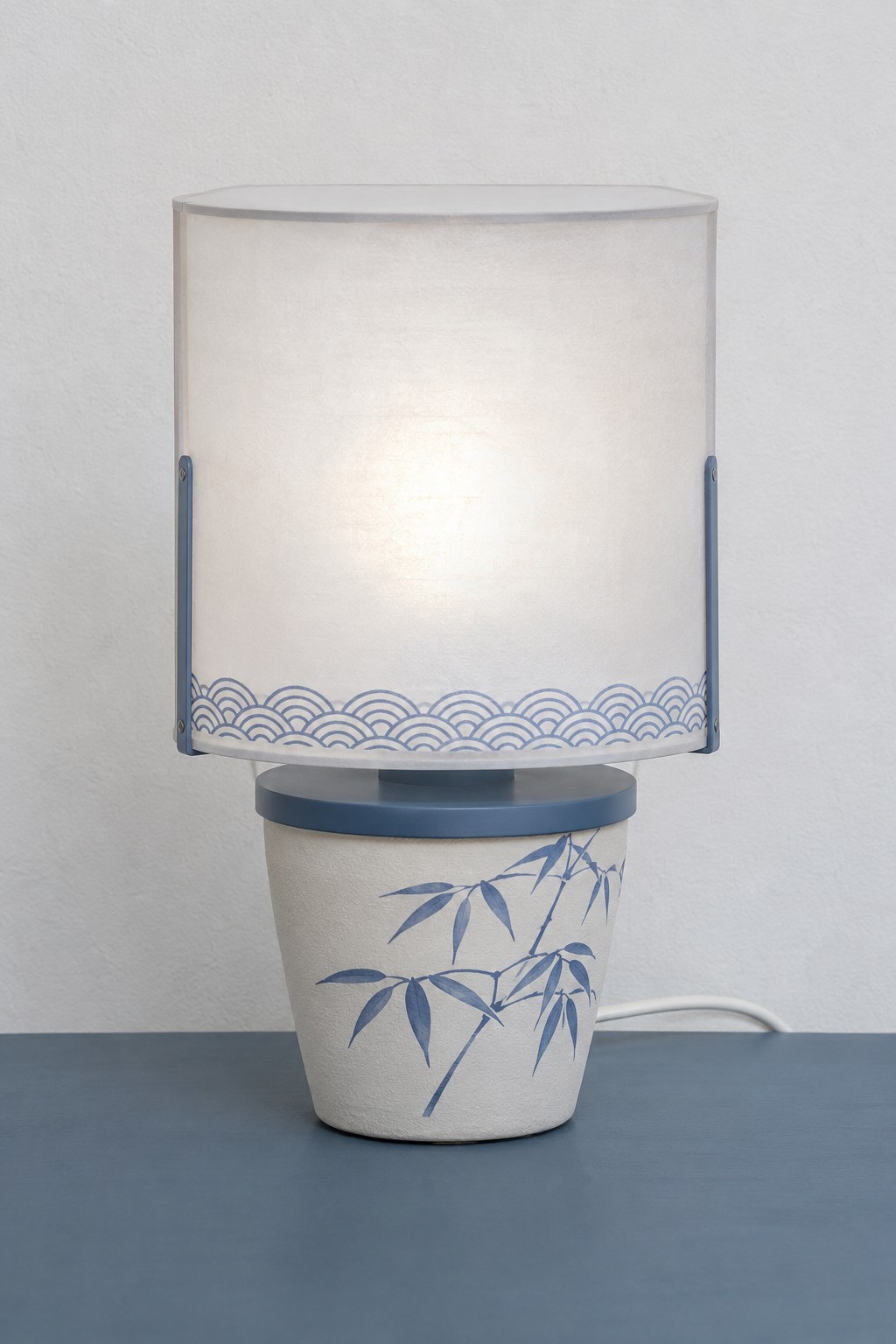
A plain ceramic flowerpot makes a surprisingly good lamp base, and blue bamboo leaves turn it into a piece that looks like hand painted pottery. The blue and white palette is fresh and timeless, easy to place in a kitchen, a hallway or a bedroom.
Cap the pot with a wooden disc fixed to a lamp pipe, and run the cord through the drainage hole or a small hole drilled low in the side with a tile bit. A few cups of gravel in the bottom stop the lamp from tipping. The shade is paper on styrene with the seigaiha border printed or stenciled, held by thin painted strips.
52. Lotus Bud on a Bamboo Stem
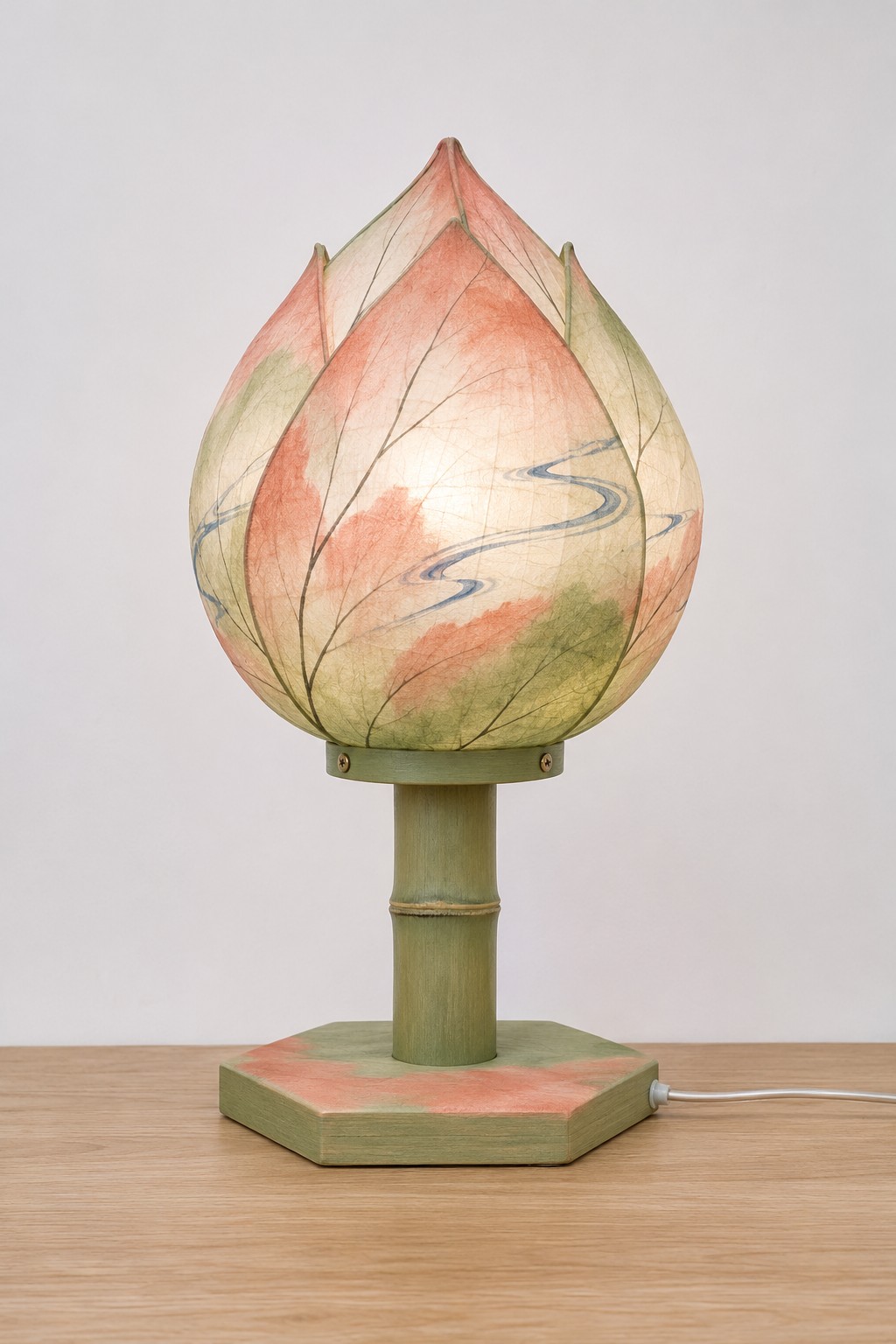
The lotus rises clean from muddy water, so it has long been a symbol of purity and calm. A bud shaped shade on a bamboo stem makes a gentle, meditative lamp for a yoga corner, a bedroom or a quiet desk.
Each petal is cut from thin washi and layered over a bud shaped frame, overlapping like a real flower. The fine veins can come from skeleton leaves pressed under the paper, or from a paper that already has leaf fibers in it. Wash the petals in coral and green and add a thin blue water line. The bamboo look on the stem comes from a wooden dowel with grooves and a twine wrap at each node.
Safety Notes for Handmade Lamps
Handmade lamps are as safe as the care that goes into them, and a few habits cover most of the risk.
Use LED bulbs only, and never put a candle inside a paper, cloth or wooden lantern. Keep the bulb away from the shade, and after the first hour of use, check that the shade feels only slightly warm. If any part feels hot, choose a lower wattage bulb or give the shade more space around the bulb.
Buy the electrical parts ready made and never cut into a cord to shorten it. Do not pinch the cord under feet or bases, do not staple through it, and fix it with insulated clips. Make sure a cord passing through a hole in wood, ceramic or metal cannot rub on a sharp edge. Unplug the lamp before changing a bulb or working on it.
Tall lanterns, lamps with long arms and lamps that hang from a frame need a heavy base so they cannot tip over. In homes with small children or pets, keep cords out of reach and place lamps where they cannot be pulled down.
Spray adhesives and spray paints are extremely flammable, so use them outdoors or in a well ventilated room, away from any flame or heat. Wear gloves, safety glasses and a dust mask when mixing concrete, because wet cement can burn the skin. Wear eye protection when cutting bamboo or using a heat gun, since bamboo splinters easily and the gun gets very hot.
If you finish a base with linseed oil or Danish oil, the rags can heat up and ignite on their own as they dry. Lay them out flat outdoors until they are completely dry, or put them in a metal can filled with water and a tight lid.



Leave a Reply