
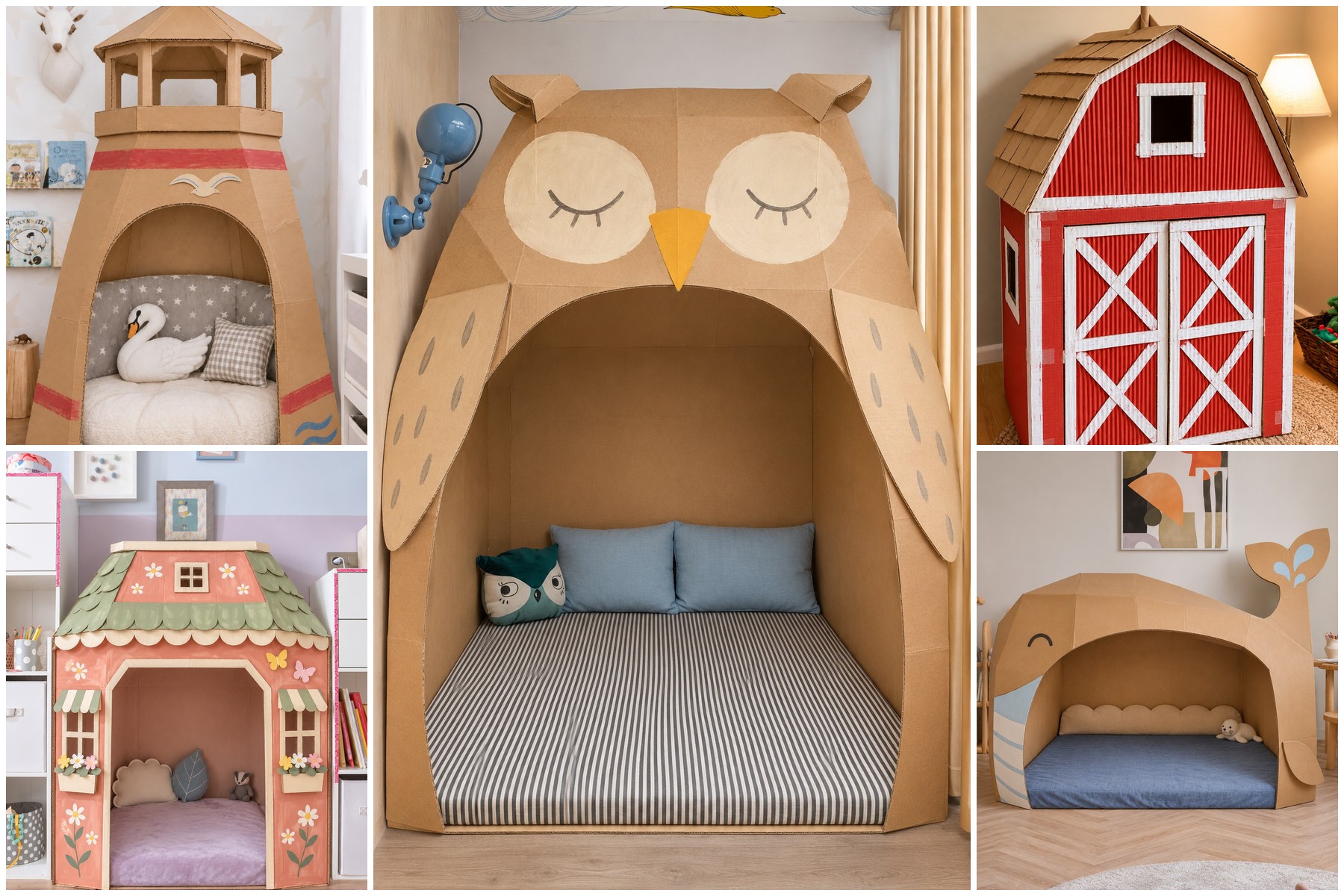
A big appliance box has a short life as packaging and a much longer one as a hideout. Cut a doorway, slide a floor cushion inside and it becomes the place a child drags every book, plush toy and blanket they own. The designs below push that idea further: an owl with sleepy eyes, a whale with a scalloped bolster, a lighthouse with an open lantern room, a red barn, a castle with a working drawbridge and a holiday cottage that glows from the windows.
Some are reading nooks shaped around a mattress, others are closed playhouses with doors that swing and shutters that open. All of them use plain corrugated cardboard, glue, tape and paint, so the cost stays low and a tired design can be recycled once your child outgrows it. Before the ideas, here is what decides whether a cardboard build stays standing for a week or for a year.
Table of Contents
- How Cardboard Playhouses Are Built
- Start with the right boxes
- Cut, score and bend with the flutes in mind
- Choose glue and tape for each job
- Paint in thin coats
- Animal Faces and Friendly Characters
- 1. Sleepy Owl That Fills a Corner
- 2. Smiling Whale With a Curled Tail
- 3. Octopus With Tentacles at the Door
- 4. Robot With Round Eyes and Big Feet
- Shapes Borrowed From Nature
- 5. Acorn Cap Over a Corduroy Mattress
- 6. Seashell Shelter With White Edges
- 7. Sunflower Petal Arch
- 8. Rainbow Arch Hideaway
- 9. Windmill Cottage With Painted Sails
- Adventure Vehicles and Landmarks
- 10. Lighthouse With an Open Lantern Room
- 11. Mail Plane Seen Nose On
- 12. Rocket With a Door That Opens
- 13. Yellow Banded Submarine
- 14. Camera With a Round Lens Doorway
- Painted Cottage Nooks
- 15. Daisy Cottage With a Striped Awning
- 16. Mint House With a Pink Shingled Roof
- 17. Coral Cottage With Butterflies
- 18. Canal House With a Stepped Gable
- 19. Whitewashed House With a Blue and Green Scale Roof
- 20. Open Gable Nook With Coral Waves
- 21. Bright Yellow House With Painted Shapes
- 22. Night Sky House With a Star Window
- 23. Minimal House Frame With a Lime Back Wall
- 24. Natural House With a Linen Curtain
- Playhouses With Doors, Shutters and Rooftops
- 25. White Cottage With Pink Scalloped Shingles
- 26. Kraft Brick Cottage Drawn With a Marker
- 27. Red Barn With a Rooster Weathervane
- 28. Half Timbered Cottage With Lattice Windows
- 29. Leaf Roof Cottage With a Round Green Door
- 30. Three Row Houses in Patterned Paper
- 31. Playhouse Covered in Children's Drawings
- 32. Treehouse on Tube Stilts
- Castles, Theaters and Seasonal Houses
- 33. Castle With a Rope Drawbridge
- 34. Igloo Built From Cardboard Blocks
- 35. Puppet Theater With Red Velvet Curtains
- 36. Gingerbread House With Peppermint Candies
- 37. Snowy Holiday Cottage With Glowing Windows
- Choosing the One That Fits Your Child
- Safety Notes for Cardboard Playhouses
How Cardboard Playhouses Are Built
Start with the right boxes
Boxes from fridges, washing machines, sofas and wardrobes are the best source, because they give you large panels without a seam in the middle. Look at the cut edge: double wall board, with two wavy layers inside, is noticeably stiffer than ordinary single wall shipping boxes and is worth saving for walls, roofs and floors. Single wall board is fine for shutters, roof shingles, flowers and other trim. Use boxes that are dry and clean, and pull out any staples before you start.
Measure the mattress, cot mattress or floor cushion first and build the shell around it, leaving a little gap on each side so bedding slides in easily. For a reading nook, the doorway only needs to be tall enough for a child to sit up inside, which keeps the structure lower and more stable.
Cut, score and bend with the flutes in mind
Cutting is an adult job. A sharp utility knife with a fresh blade, a metal ruler and a cutting mat or scrap board underneath give clean edges in one pass instead of ragged ones in five. For a fold, press a line into the board with a blunt tool such as a dry ballpoint pen or the back of a butter knife, then bend along it. Folds that run across the hidden flutes are stronger than folds that drop into a flute channel, so plan corners that way when you can.
Curves work the other way round. Arches, tunnels and round towers bend smoothly when the flutes run parallel to the bend; rolling the board over the edge of a table, pressing a little as you go, softens it enough to form a gentle curve. Domes, like the whale, octopus and igloo below, are not bent at all. They are assembled from many flat panels joined at slight angles, which is why they look faceted.
Choose glue and tape for each job
Hot glue is the quickest way to join cardboard. It sets in about half a minute, so it suits tabs, corners and small details like flowers, ears and window frames. A low temperature glue gun is kinder to fingers and still bonds paper and board well. For large flat joins, such as doubling up a wall panel for strength, white PVA glue or wood glue gives a stronger bond: spread it thinly, press the pieces together under weight, and leave it overnight before you stand on, lean on or paint the joint.
Water activated paper tape, the brown gummed tape used for sealing parcels, is excellent on seams. Once moistened, its adhesive soaks into the board fibers, and it accepts paint, which plastic packing tape does not. Triangles of board glued into inside corners, as you can see at the base of the windmill, stop a tall shell from leaning.
Paint in thin coats
Cardboard is paper, and water makes it swell and curl. Seal the surface first with a thin coat of gesso, white acrylic paint or PVA glue thinned with a little water, then add color in two or three light coats rather than one heavy one. Acrylic craft paint and water based wall paint both work; a thin layer of acrylic is usually dry to the touch within twenty minutes. Paint panels while they lie flat where possible, and let everything dry completely, ideally overnight, before bedding goes inside. Patterned paper or fabric glued on with decoupage medium is an alternative to paint, but give it a full day to dry.
Animal Faces and Friendly Characters
Rounded animal shapes look difficult, but most of them are made from many small flat panels rather than bent board. Once you understand that trick, the owl, whale and octopus below are all within reach.
1. Sleepy Owl That Fills a Corner
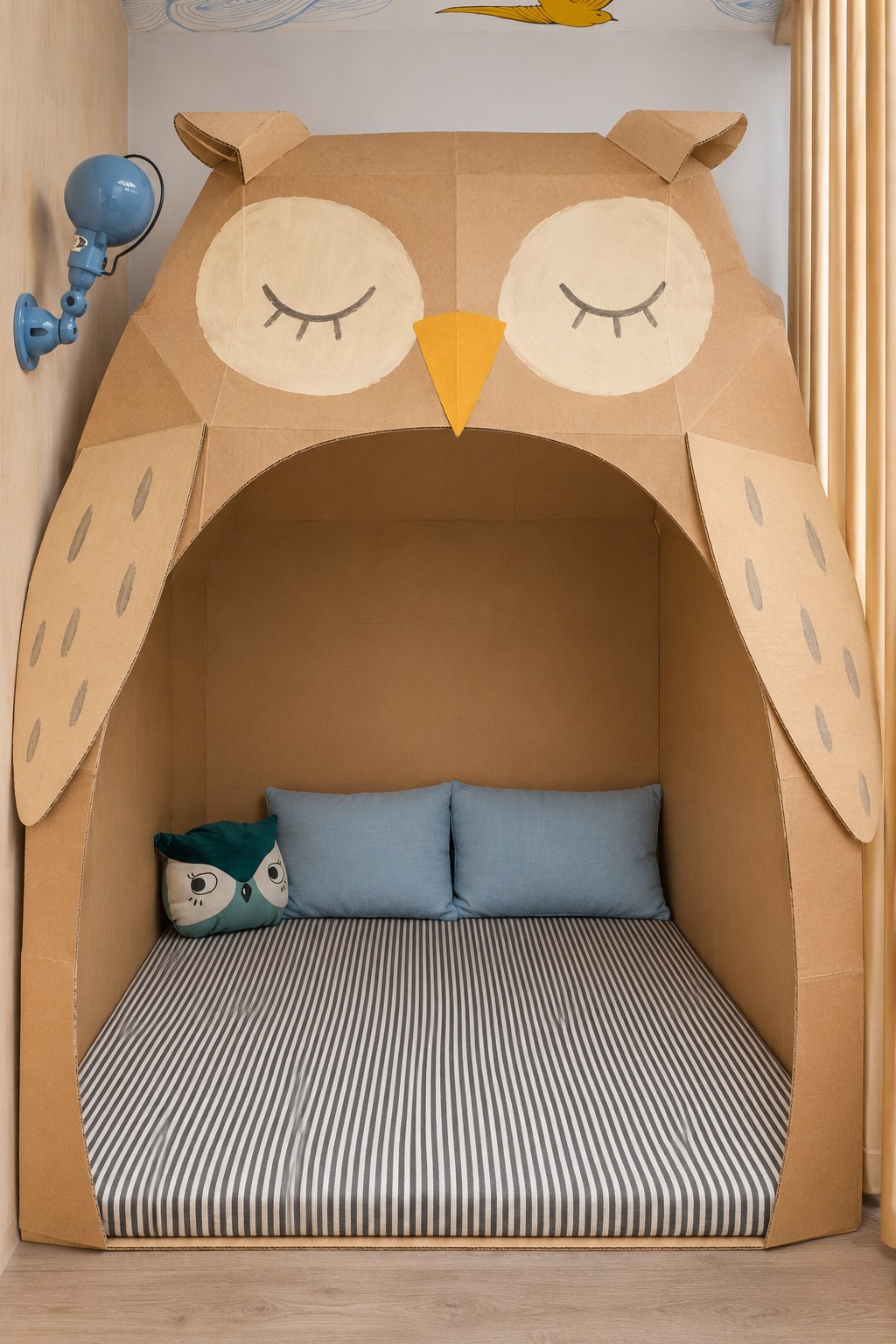
Look at the owl's head and you will see it is not one curved sheet. It is a cluster of flat triangles and trapezoids joined edge to edge, which gives the face its soft, faceted look. Before cutting big sheets, make a small paper version, number every facet, then scale each piece up onto board. Tape the seams from the inside first, then run a line of glue along the outside joints.
The ear tufts are two short strips scored down the middle and folded into a ridge, glued to the top corners. The eyes are cream painted circles with lashes drawn in dark grey, and the beak is a yellow card triangle glued over the seam between them, which hides that joint neatly. The wings are separate panels fixed to the outside of the body along their top edge only, so they stand slightly away like real wings; paint the grey feather marks before you attach them. The floor plan has angled front corners, so the shell slides deep into an alcove.
2. Smiling Whale With a Curled Tail
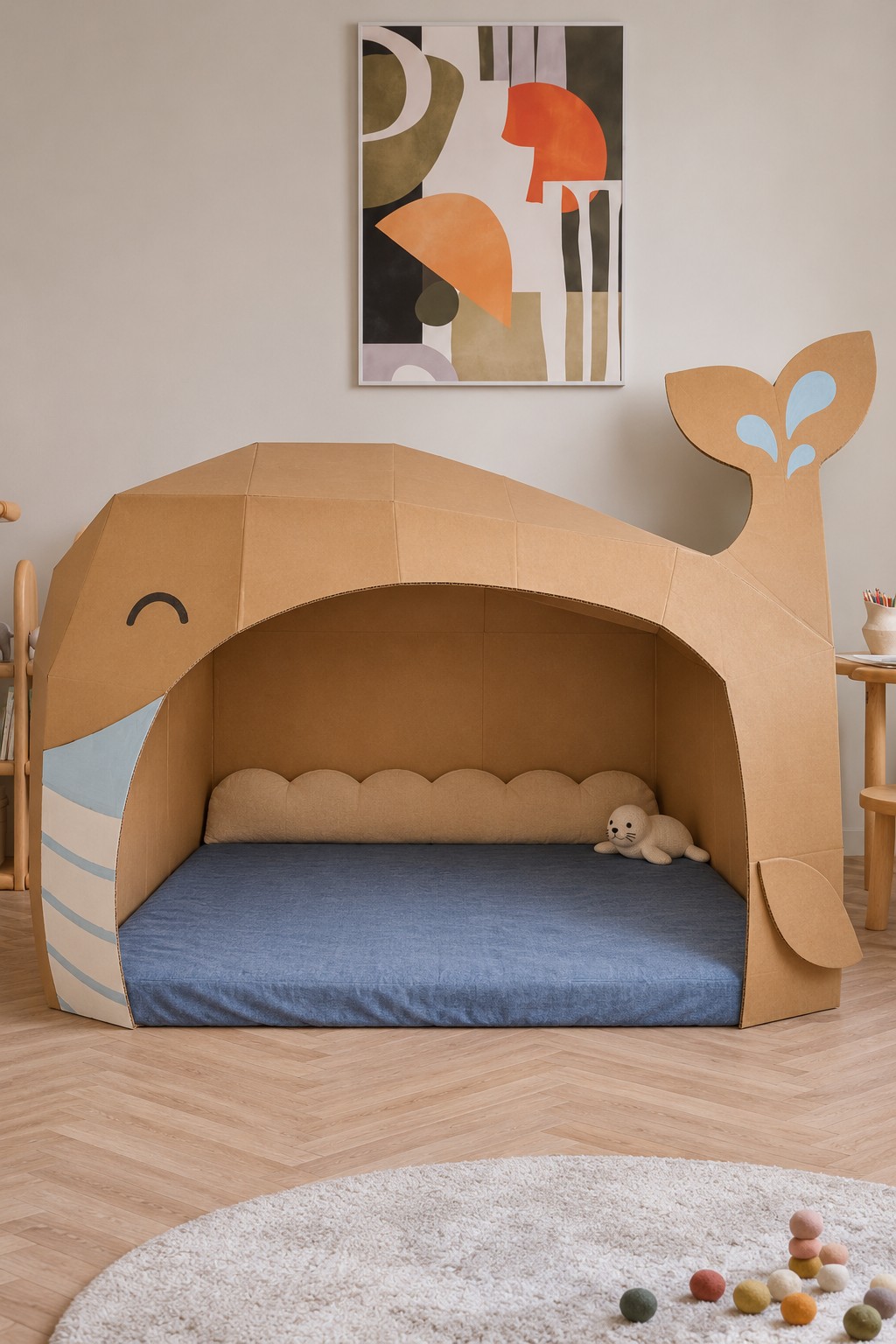
The whale's body is built in rows of trapezoid panels, each row a little narrower than the one below, rising to a rounded back. Build the rows from the floor up and tape each one to the row beneath before starting the next. Cut the doorway only after the shell is complete; the solid panels hold the shape while you work.
The tail is one flat cutout standing upright at the back, glued against the last row and braced from behind with a triangle of board. The side flipper is another flat piece glued low on the body at an angle. The pale blue and cream throat stripes and the blue water drops on the tail are painted on before those panels go on, and a single curved line makes the smile. Inside, a long bolster against the back wall turns the floor mattress into a lounger.
3. Octopus With Tentacles at the Door
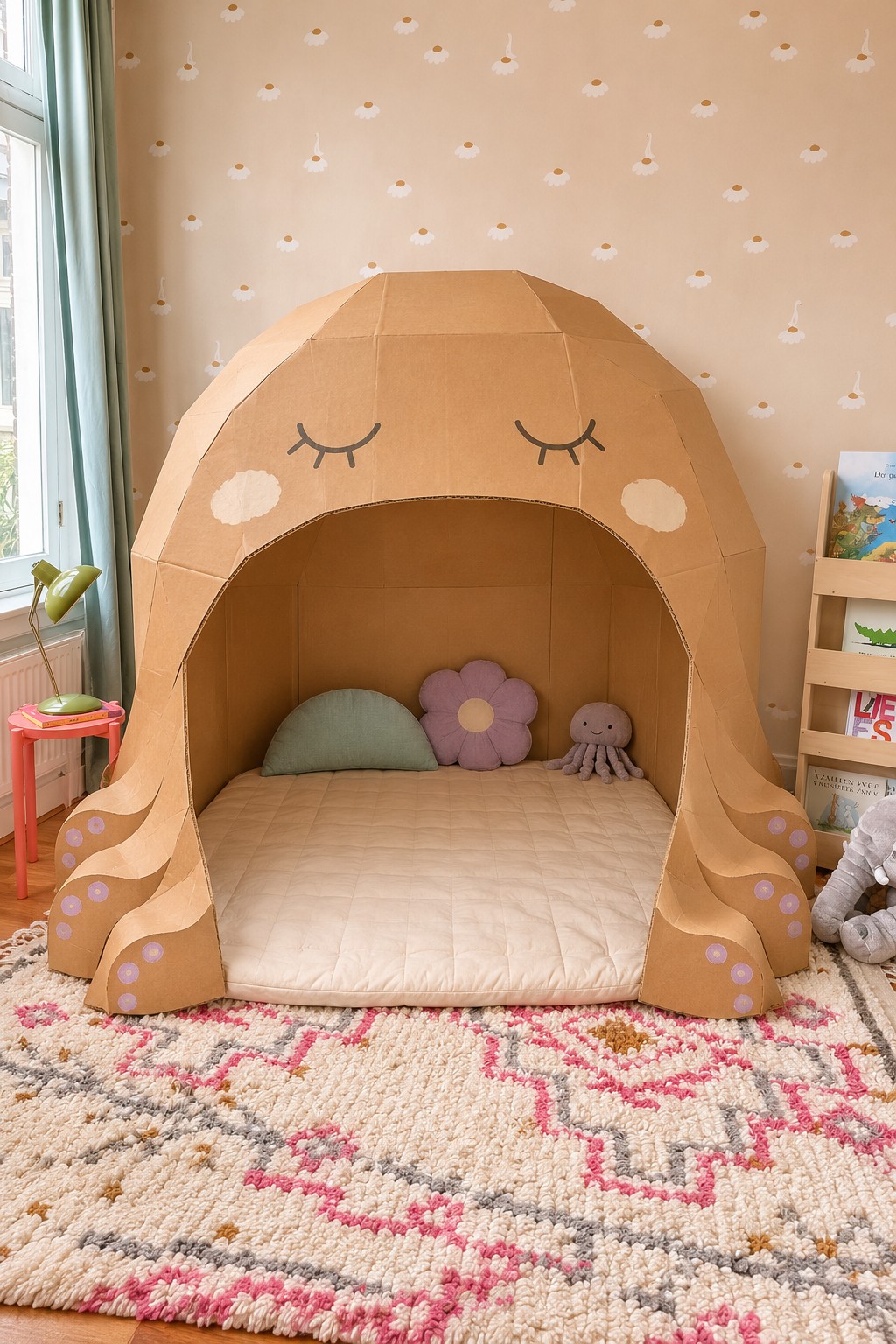
The head is a faceted dome made the same way as the whale, but its sides come down to the floor on either side of the opening. The tentacles are the clever part. Each one is a long side strip bent into a curl and closed with a narrow top strip, so it becomes a hollow curved channel that rolls out onto the rug. To get a smooth curl, press score lines across the strip every few centimeters and bend it gradually.
The lilac suckers are painted as circles with a slightly darker center once the tentacles are fixed. The cheeks are cream circles and the closed eyes are painted with a fine brush. Keep the tentacles low and wide: besides looking playful, they work as feet that steady the dome.
4. Robot With Round Eyes and Big Feet
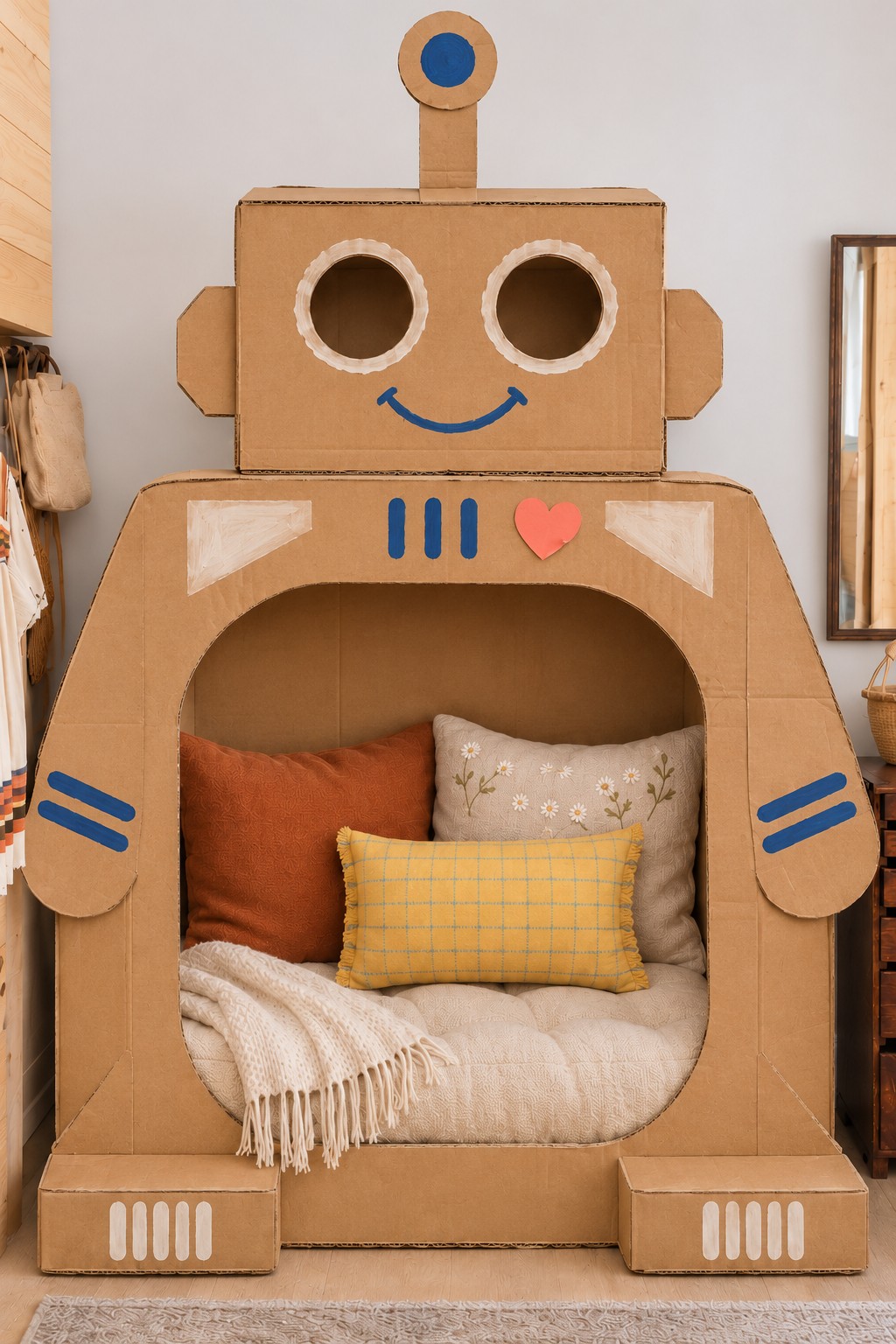
This robot is a stack of boxes, which makes it a good first build. The head is a closed box, and you can still see its taped flaps on top. The body is a large front panel with a rounded opening, backed by a box shell. The feet are two shallow boxes glued to the base, and the arms, ears and antenna are flat cutouts glued to the sides and top.
The eyes are holes cut right through the head and lined with a ring of board turned so its cut flutes face outward, then dry brushed white for a ribbed rim. Use masking tape as a guide when you paint the blue stripes and white vent lines, so the edges stay straight, and glue on a small coral heart cut from card.
Shapes Borrowed From Nature
These nooks rely on a strong outline, such as a scalloped cap, a wavy shell or a ring of petals, cut from a single front panel and backed by a simple shell.
5. Acorn Cap Over a Corduroy Mattress
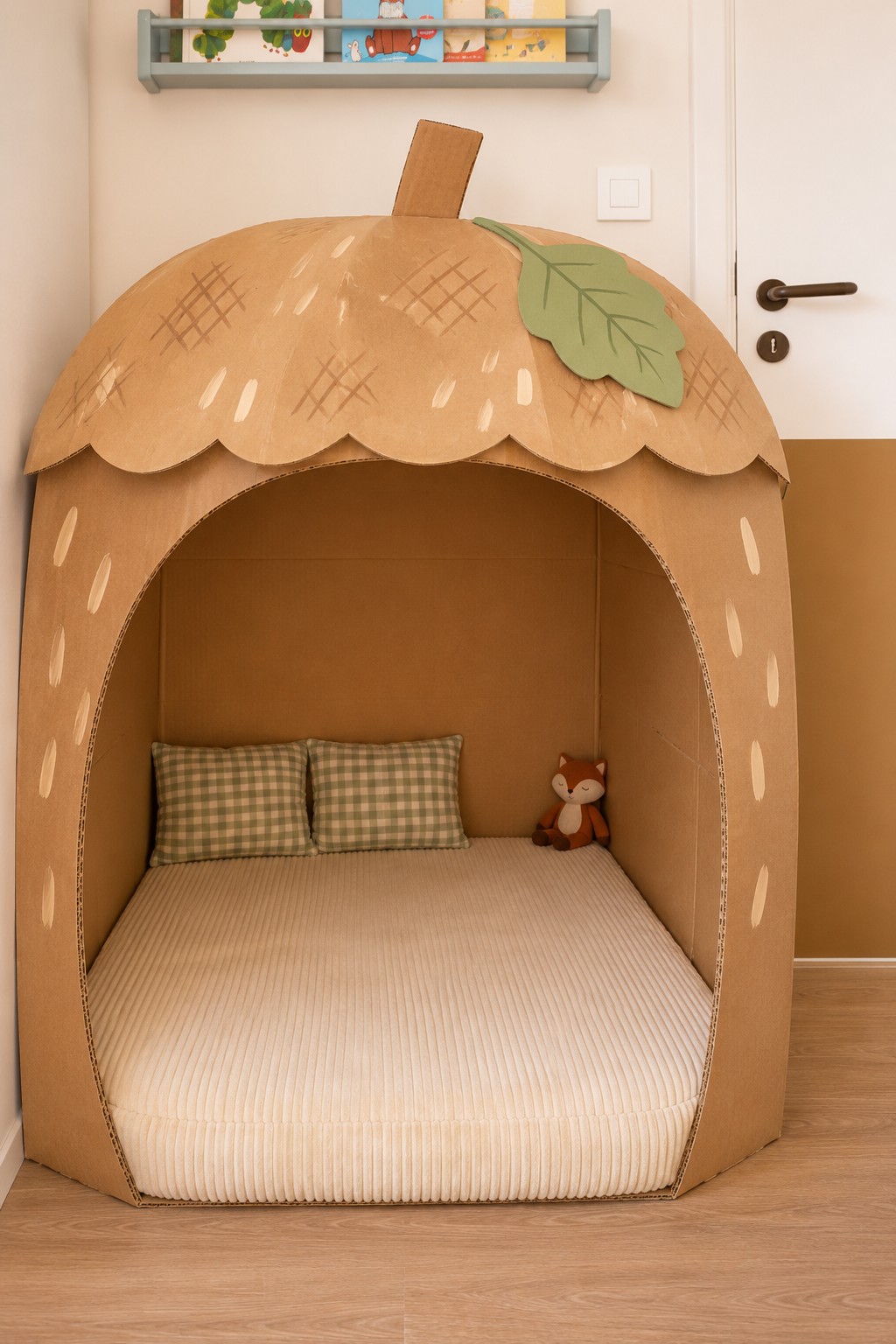
The acorn is two parts: a body with gently curved sides and a separate cap that overlaps it like a lid. The cap is made of several curved panels joined with vertical seams, and its lower edge is a strip cut into large scallops that hangs over the body. Trace around a dinner plate along the strip to make every scallop the same size.
The stem is a short strip folded in half and pushed into a slot at the top. The crosshatching on the cap is drawn in brown marker, and the cream dashes on the cap and body are quick strokes of a small flat brush. The leaf is thin green card with veins drawn on, glued at one end only so it lifts a little.
6. Seashell Shelter With White Edges
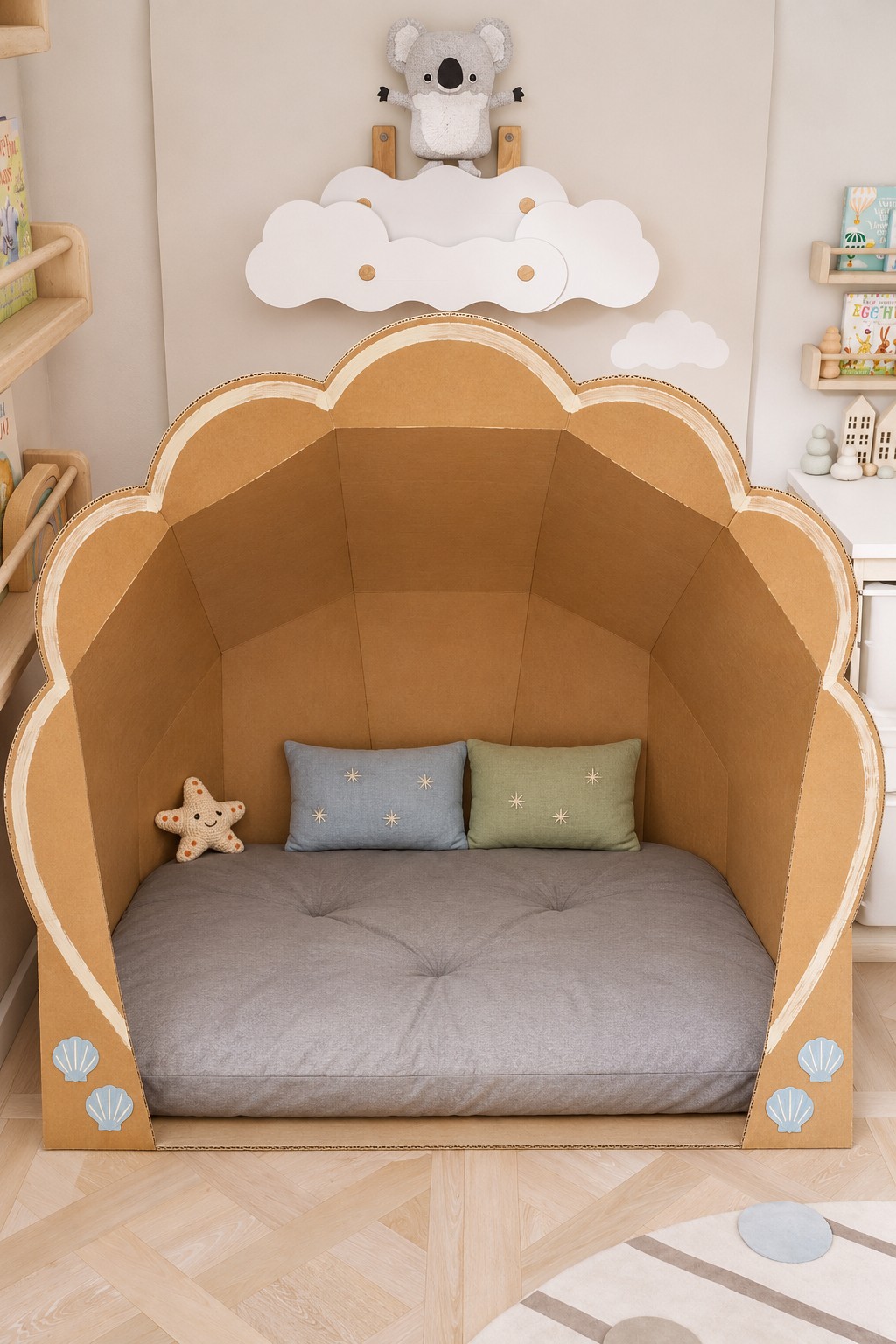
The front of this shell is one large panel with a wavy top edge. Behind it, the walls and ceiling are a fan of long tapering panels that meet at slight angles, like the ribs of a real scallop shell. Cut the fan panels as narrow trapezoids, tape them edge to edge on the inside, then glue the shaped front panel over their ends.
A white line dry brushed along the outer curve hides the cut flutes and makes the outline crisp. The small shells at the lower corners are card cutouts painted pale blue, with a few lines drawn in for ribs.
7. Sunflower Petal Arch
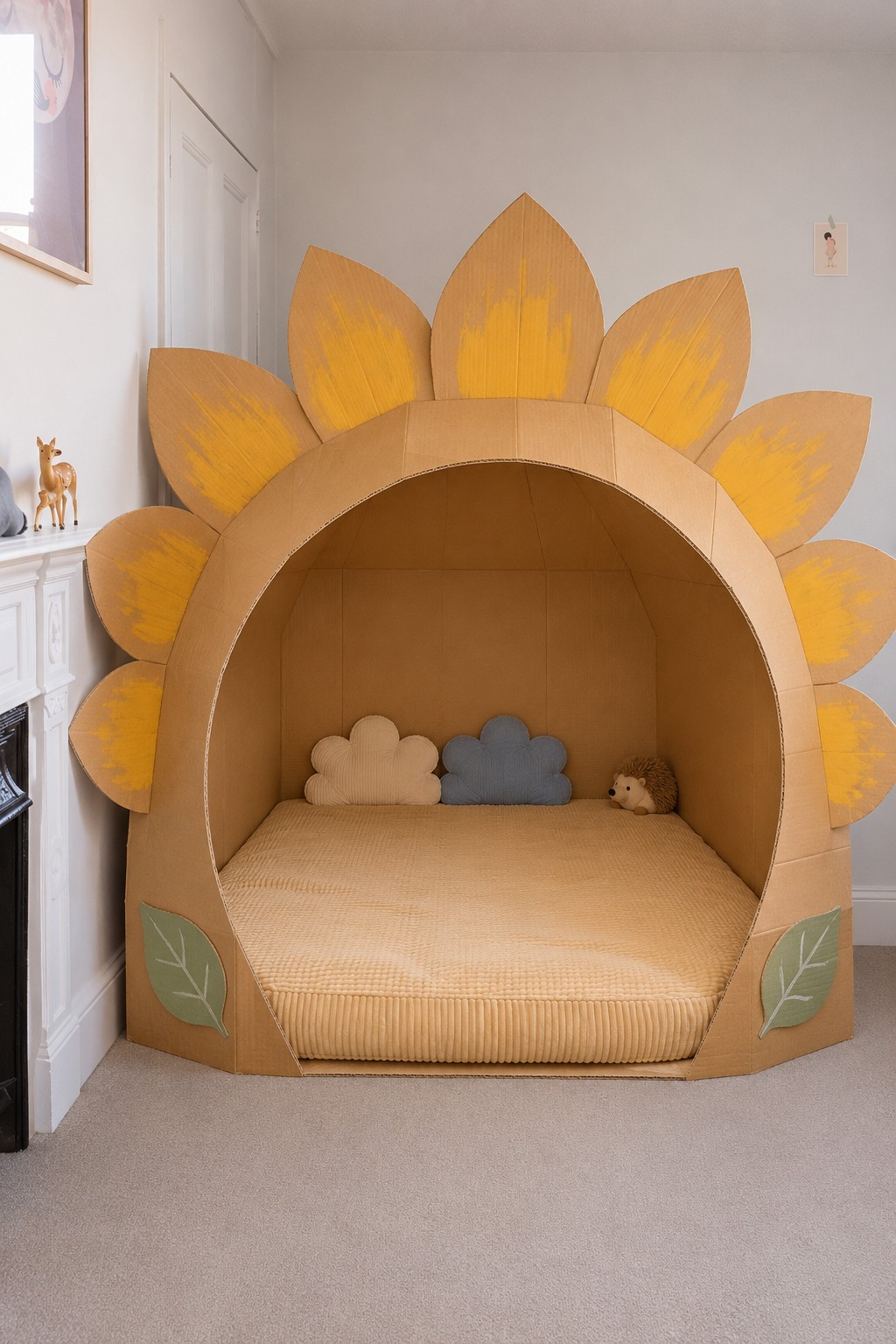
This design is built in two layers. The structure is a round opening framed by a deep ring of short board segments, which gives the arch thickness and stops it from bending. The petals are separate pointed shapes cut from thinner board and glued behind the ring so they fan out all around it. Fix the petals last, once the frame stands, so you can space them evenly.
Each petal is dry brushed with yellow from the base outward, leaving the brown tips showing. Inside, faceted panels form a rounded ceiling. The two green leaves at the base are card cutouts with veins painted in white. If you have a fireplace, choose another corner; cardboard and paper petals should stay well away from heat.
8. Rainbow Arch Hideaway
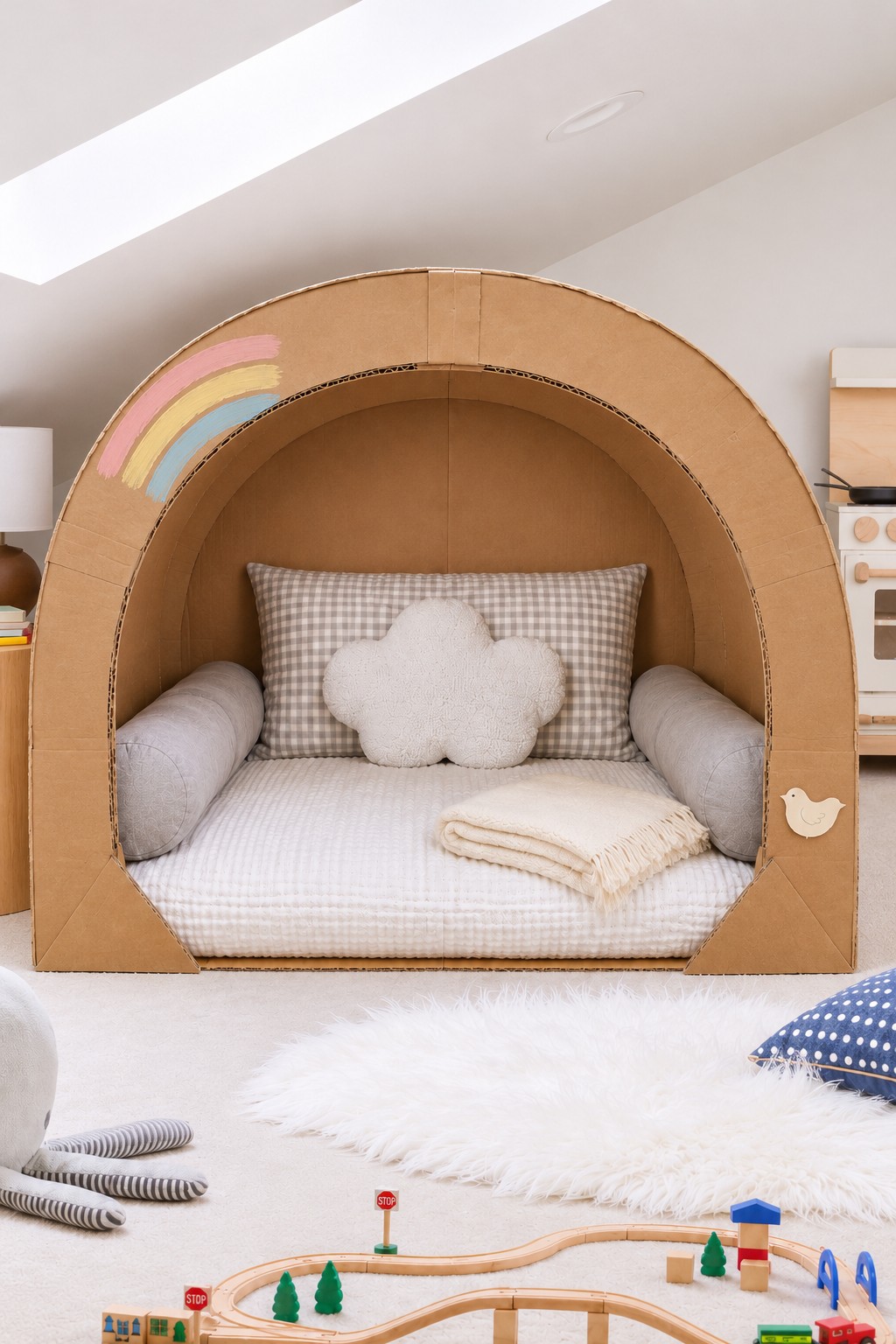
The front is a wide arch made of several curved segments joined at the top, and behind it a deep inner band turns the arch into a hood. A back panel closes it off. Bend the inner band with the flutes running across its width so it curves without kinking, and tape it to the back of the arch before gluing.
Two triangles of board glued inside the bottom corners keep the curve upright, a simple brace worth copying in any arched design. The rainbow is drawn in three soft chalky stripes, and a small bird cut from thin wood or card sits beside the opening. A low design like this fits under a sloped ceiling; for more ways to use an awkward roofline, browse these attic room themes.
9. Windmill Cottage With Painted Sails
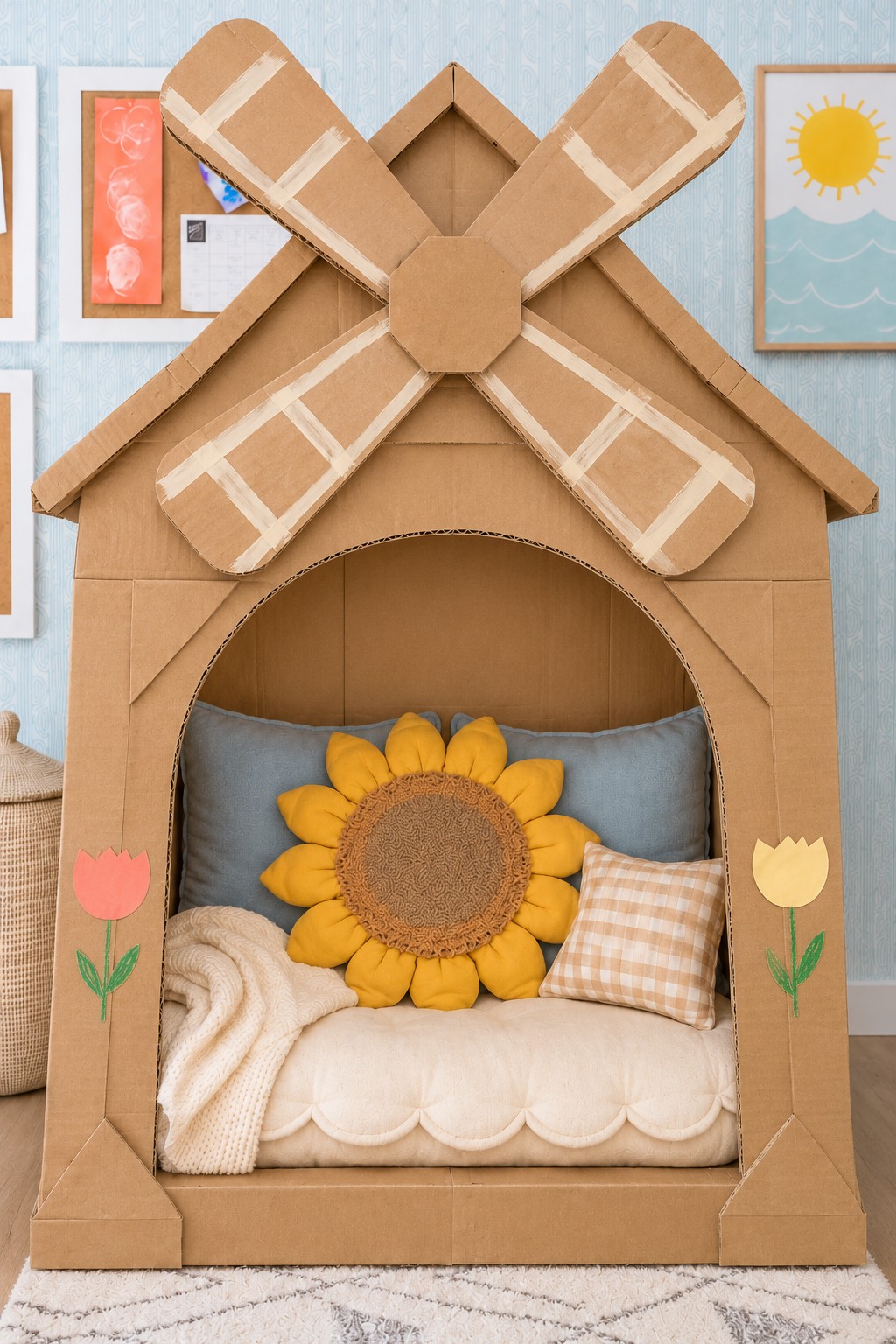
Under the sails is a simple gable house with an arched doorway. The sails are four long paddles with rounded ends, laid in two crossing pairs and held at the center by an octagonal hub glued on top. The cream lattice lines are painted across each sail with a dry brush. Glue the sails to the roof panel and to each other, and add a second hub behind the roof if children are likely to tug on them.
Notice the triangles at the lower corners of the front: they are corner braces that keep a tall front panel square. The tulips are paper cutouts with stems drawn in colored pencil.
Adventure Vehicles and Landmarks
Vehicles and towers are built from repeated shapes. Cut one panel, use it as a template for the rest, and the build goes much faster.
10. Lighthouse With an Open Lantern Room
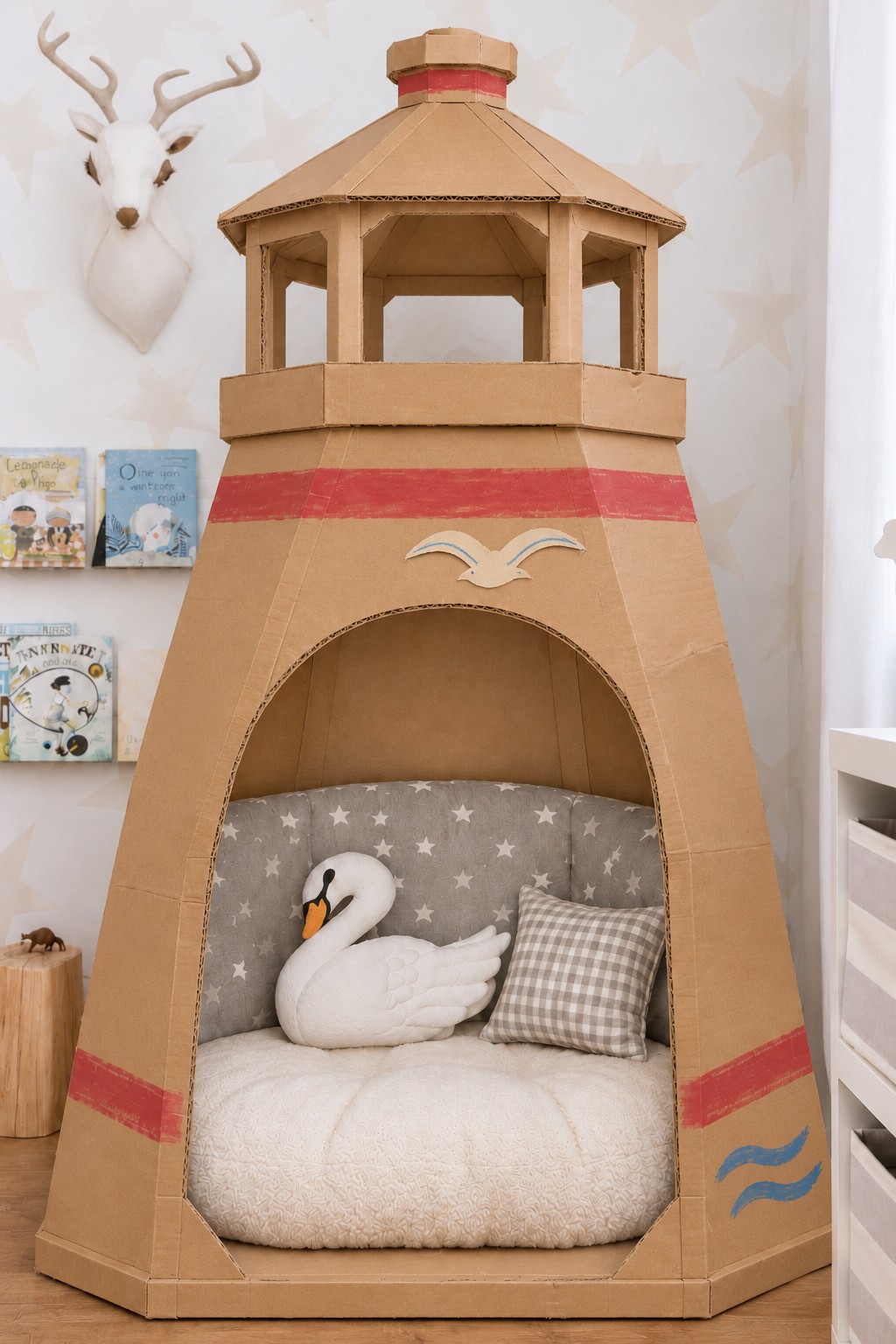
The tower has eight sides and tapers toward the top, so every side is the same trapezoid. Cut one, trace it seven more times, and tape the eight into a ring. An eight sided strip wrapped around the bottom forms the plinth.
The lantern room sits on a short eight sided band. Its posts are narrow strips folded into an L shape for stiffness, and its roof is eight small triangles meeting at a point, topped with a little drum that carries a red band. Make these top parts from thin single wall board so the tower is not top heavy, and stand it with its back to a wall. The red bands are dry brushed, the seagull is a card cutout with a blue line along its wings, and the waves are two painted strokes.
11. Mail Plane Seen Nose On
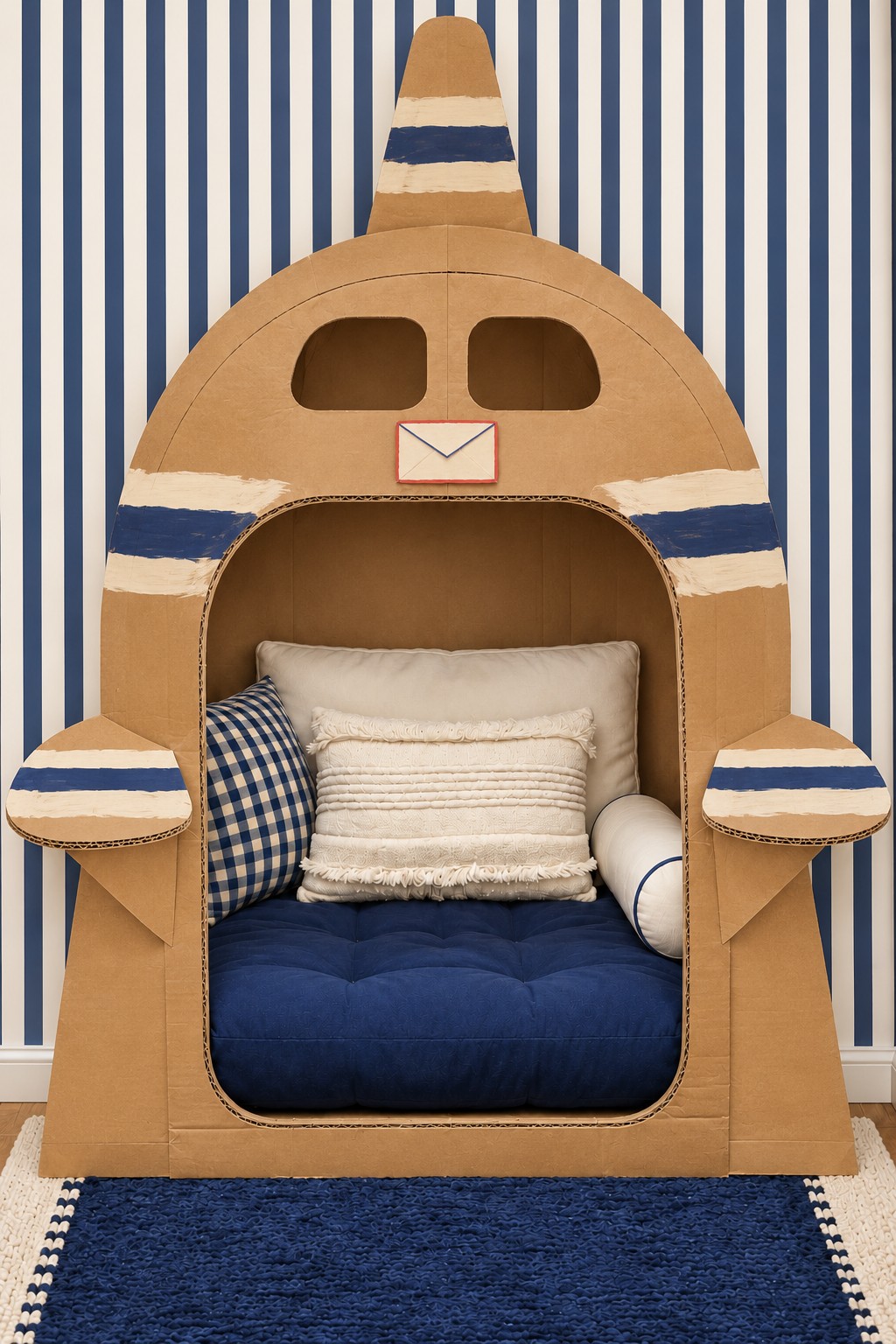
The front is one shaped panel with a rounded top, two cockpit windows cut with rounded corners and a large doorway. The tail fin is a separate tapered panel standing up behind it. The wings are rounded paddles sticking straight out from the sides, each resting on a triangle of board glued underneath, which is what stops them from drooping.
The stripes are dry brushed in navy and cream, so the brown board shows through like weathered paint. The envelope is a small card rectangle with a red border and a drawn flap. The wings sit at a child's head height, so round off their corners well.
12. Rocket With a Door That Opens
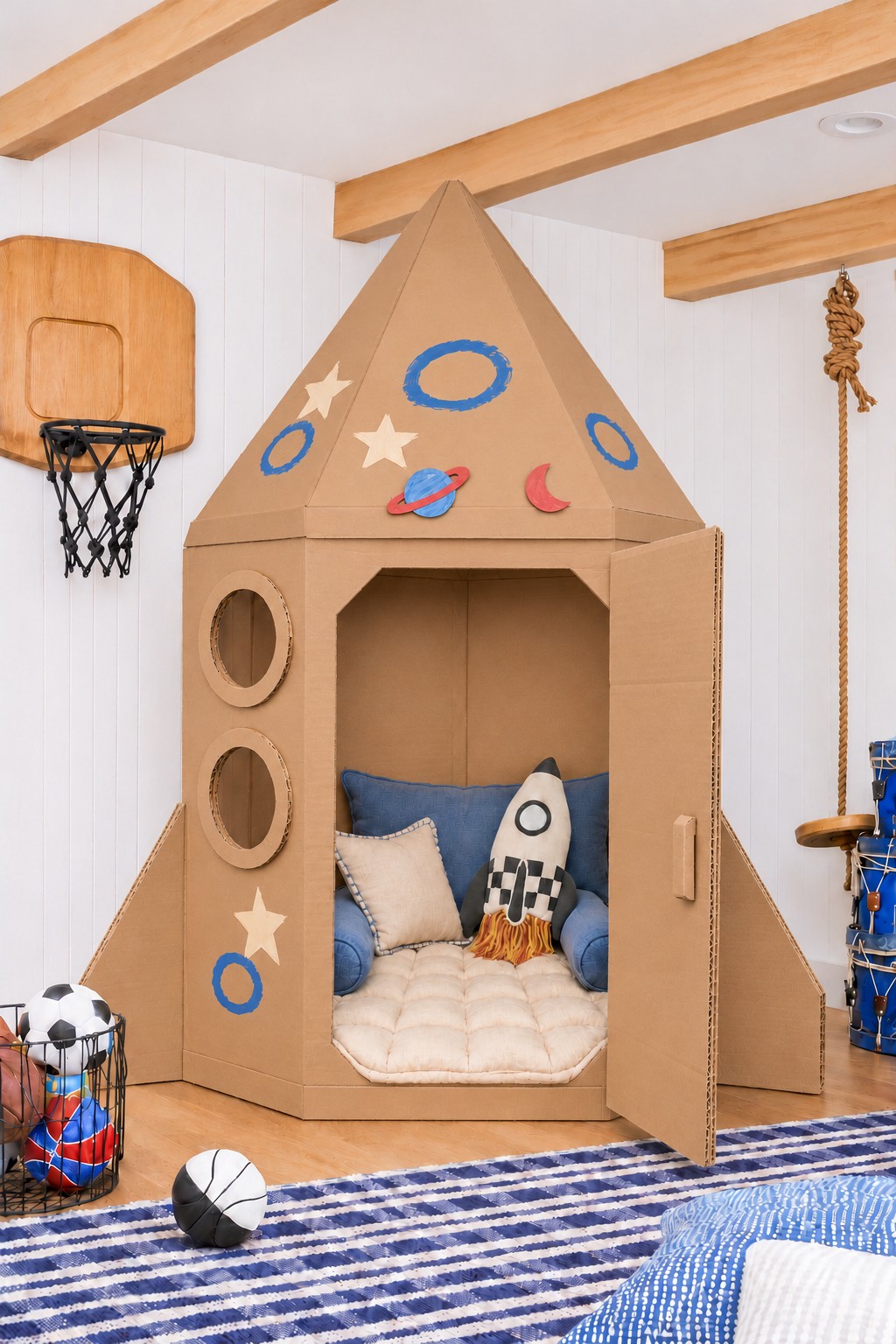
The body has six sides, and the nose cone is six triangles meeting at a point, resting on a narrow six sided collar. The portholes are round holes framed with rings of board; glue two rings together for each window so the frames look thick.
The door is one face of the hexagon, cut along the top and one side and folded open on the other side, with a folded strip glued on as a handle. Run paper tape along both sides of that fold so it does not tear. The fins are flat triangles glued to the outside faces and resting on the floor. The stars and the ringed planet are layered card cutouts, and the blue rings are painted freehand.
13. Yellow Banded Submarine
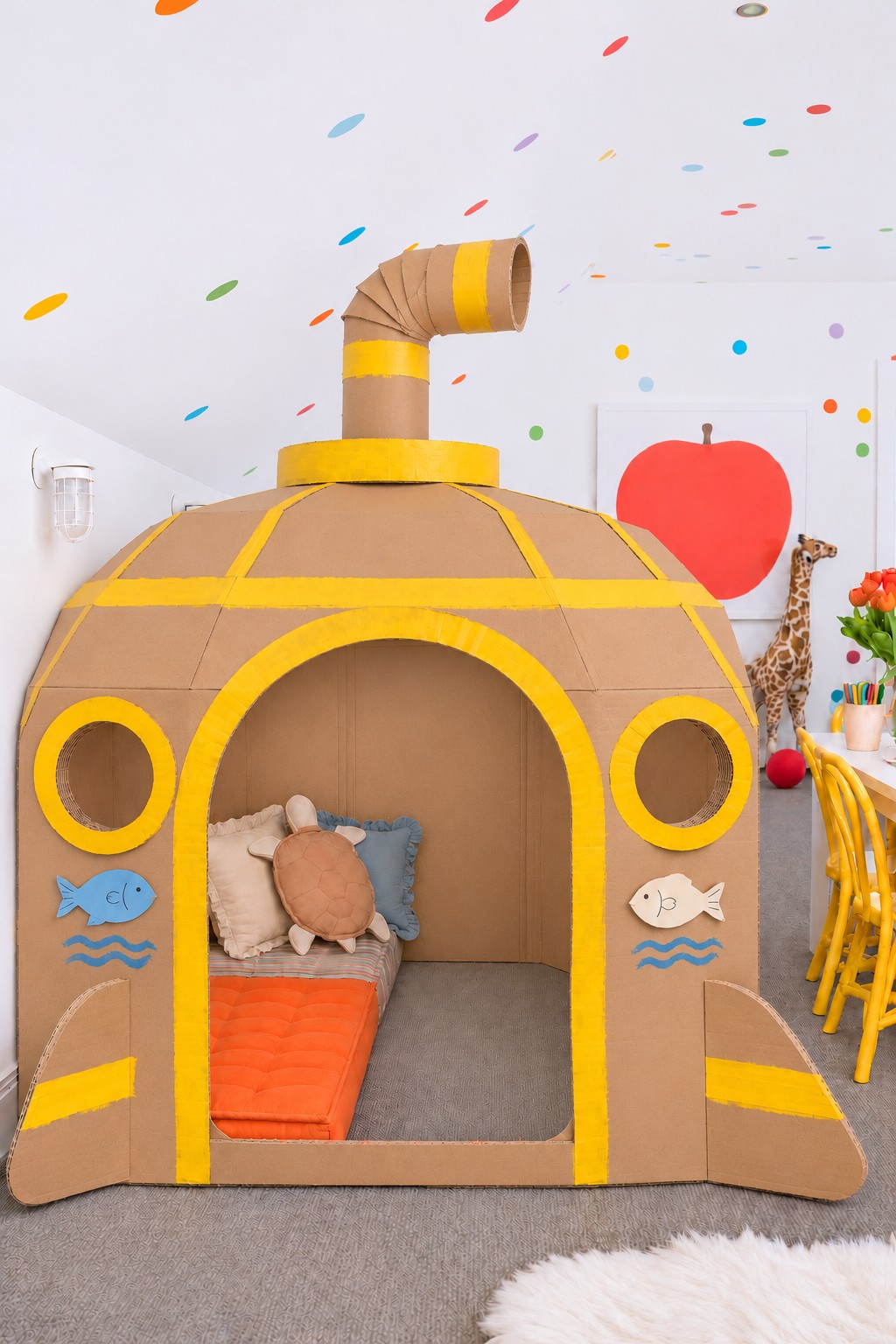
The hull is a faceted dome made from bands of panels, and every seam between the bands is covered by a yellow strip. That is the real trick here: the bright bands hide the joints and give the submarine its character at the same time. Paint the strips before gluing them on and you avoid careful edging later.
The portholes have a sleeve of board fitted inside each hole, so they look deep. The periscope is a cardboard tube with an elbow built from short angled sections glued together, standing on a wide yellow ring. Two fins flare out at floor level, the arched doorway is edged with a doubled strip, and the fish are card cutouts with faces drawn on.
14. Camera With a Round Lens Doorway
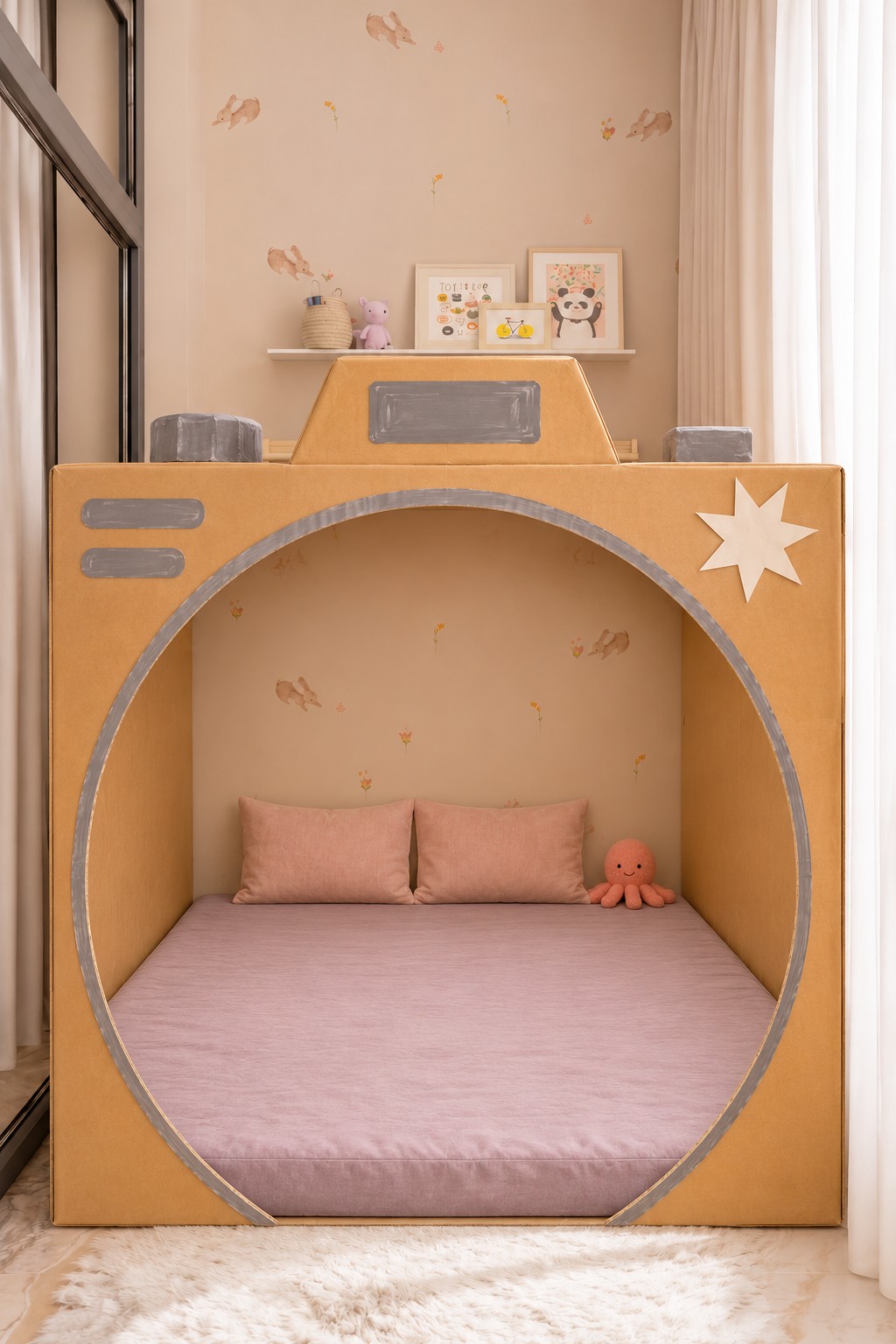
This is a single large box with its back left open and pushed against the wall, so the room's wallpaper becomes the inside of the nook. The lens is a big circle cut through the front, and its raw edge is covered with a thin strip of card bent around the curve and painted grey.
On top, a small box with sloping sides makes the viewfinder, and two short blocks painted grey become the dials. The grey bars on the front are painted, and the star is cut from thin wood or card. Draw the circle with a string and pencil compass and cut it in short strokes, keeping the blade upright.
Painted Cottage Nooks
A house outline is the classic shape. The details that make each one convincing are layered frames, roof edges and shingles, all cut from leftover board.
15. Daisy Cottage With a Striped Awning
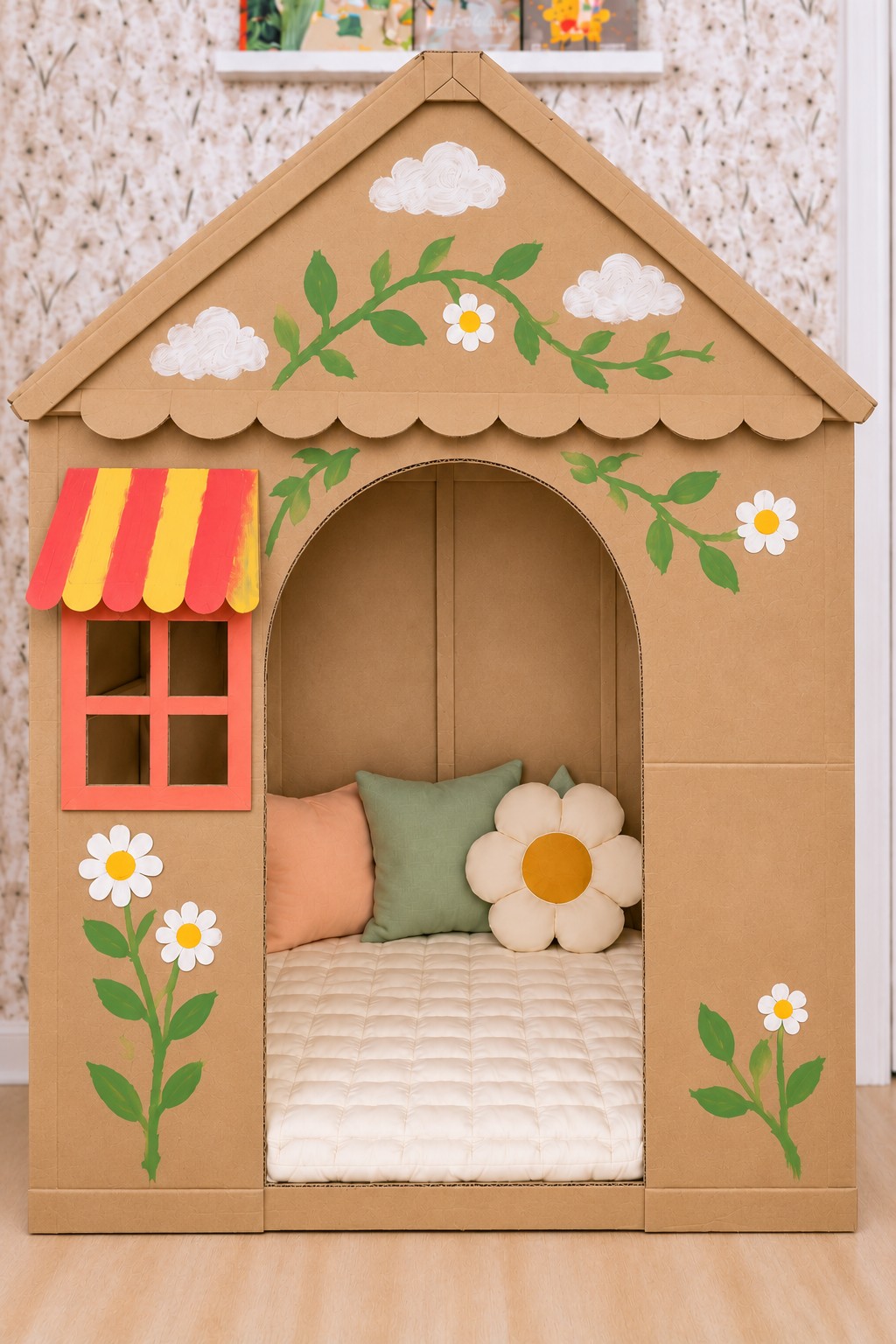
Look at the roof: two separate panels overhang the walls, a folded strip caps the ridge, and a strip cut into scallops runs under the eaves. Every outside edge of the walls is wrapped with a folded strip of board, which protects the corners and gives the house a finished look.
The window is cut through first, then a coral painted frame with crossbars is glued on top. The striped awning is a scalloped strip bent outward above it. The daisies are white card cutouts with yellow centers, while the stems, vines and clouds are painted, the clouds in thick dabs of white.
16. Mint House With a Pink Shingled Roof
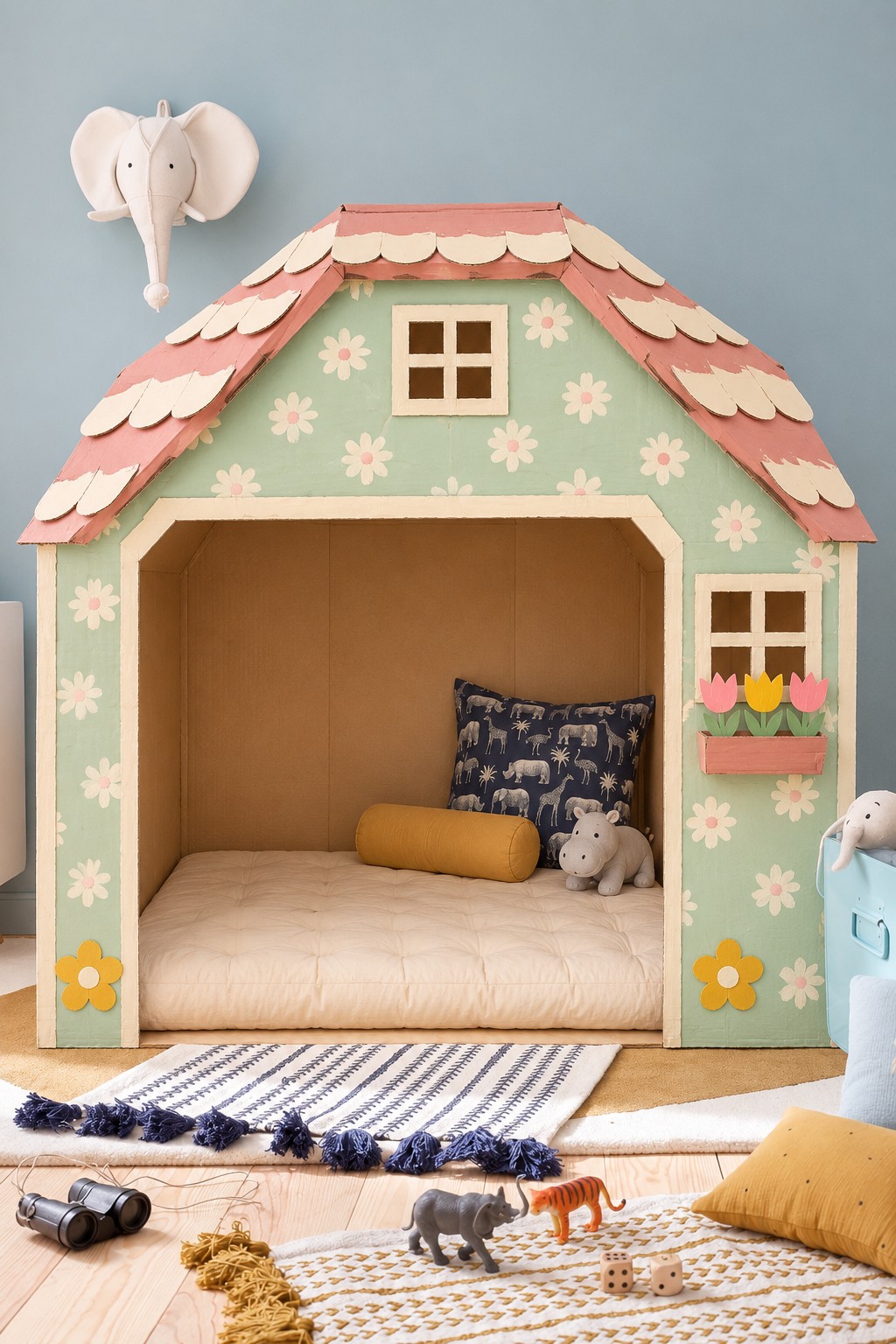
The roof has two slopes on each side, a steep lower one and a gentler upper one, plus a flat strip along the top. Rows of cream scallop strips are glued over the pink paint, each row overlapping the one below, starting from the bottom edge.
The doorway has angled top corners and is framed with cream strips. The windows are framed openings with crossbars, and the window box is a small open box glued under the side window, filled with tulip cutouts. Paint the mint walls and the daisies first, then glue on all the trim, so the edges stay clean.
17. Coral Cottage With Butterflies
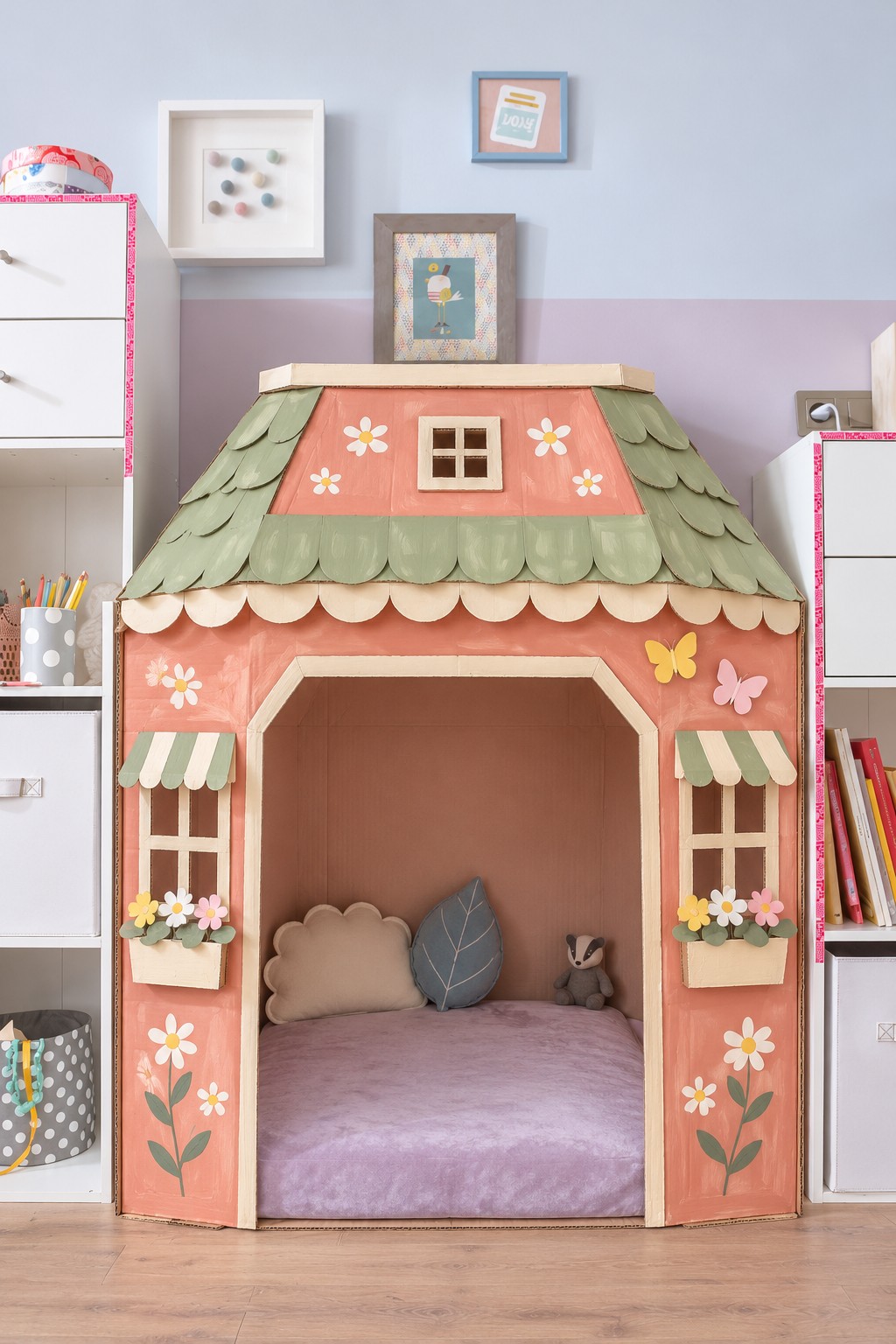
This cottage has a mansard roof: a flat top, sloping sides and a sloping front with its own small window. The side slopes and the lower edge are covered with sage scallop shingles, and a cream scallop strip runs along the eaves.
The windows are framed openings with crossbars, topped with striped scalloped awnings, with window boxes of paper daisies below. The butterflies are card cutouts, and the daisies on long stems are painted. Painting the inside a darker coral than the outside makes the opening look deeper.
18. Canal House With a Stepped Gable
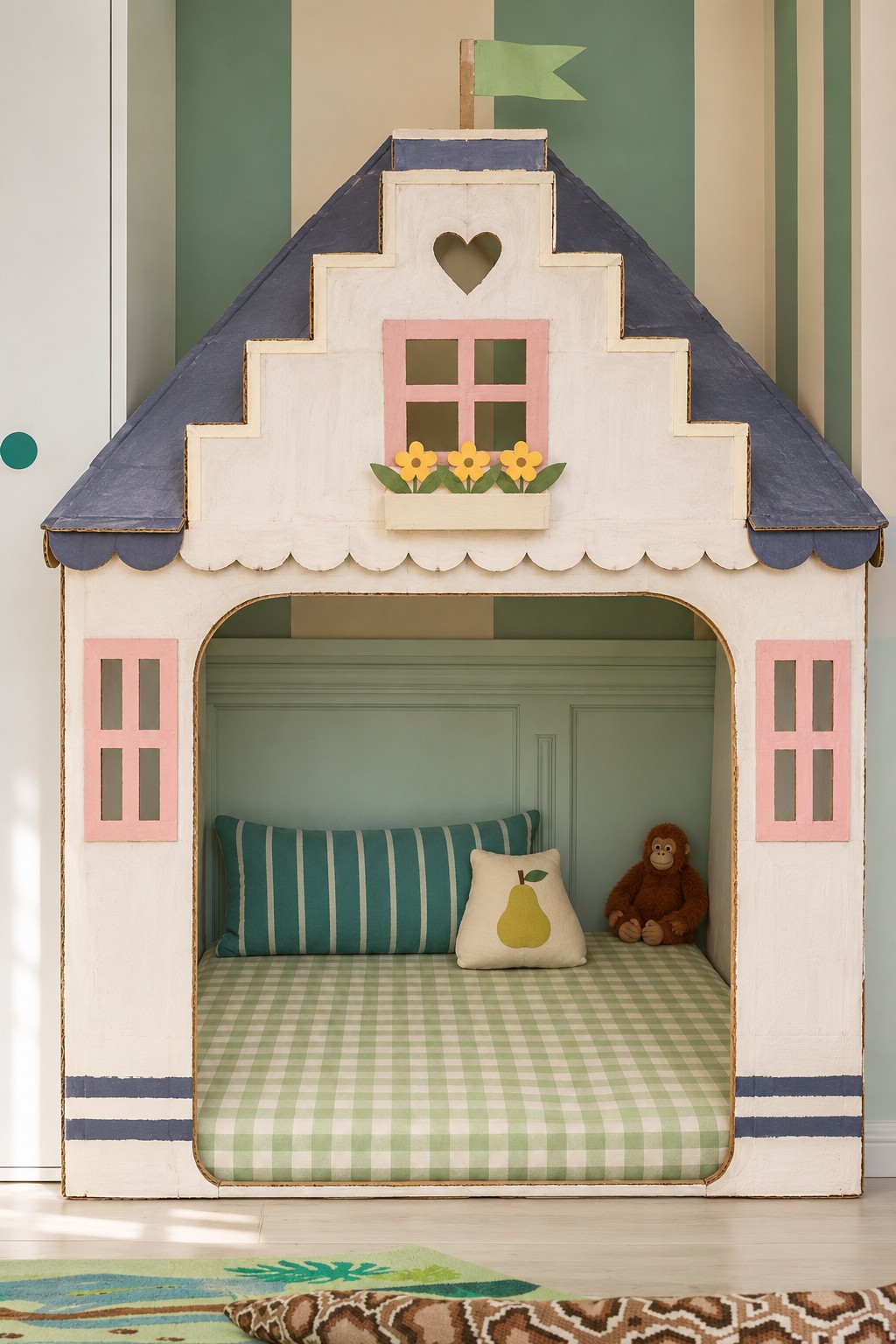
The stepped gable is a separate front panel laid over the navy roof, and each step is outlined with a cream strip so it stands out. A scalloped strip in navy and cream runs along the eaves. The heart is cut right through the top step, and the flag is a small card pennant on a stick.
The house has no back panel. It stands against the room's wall, which saves a large sheet of board. The windows have pink frames, the upper one with a box of yellow card flowers, and two navy stripes are painted along the base.
19. Whitewashed House With a Blue and Green Scale Roof
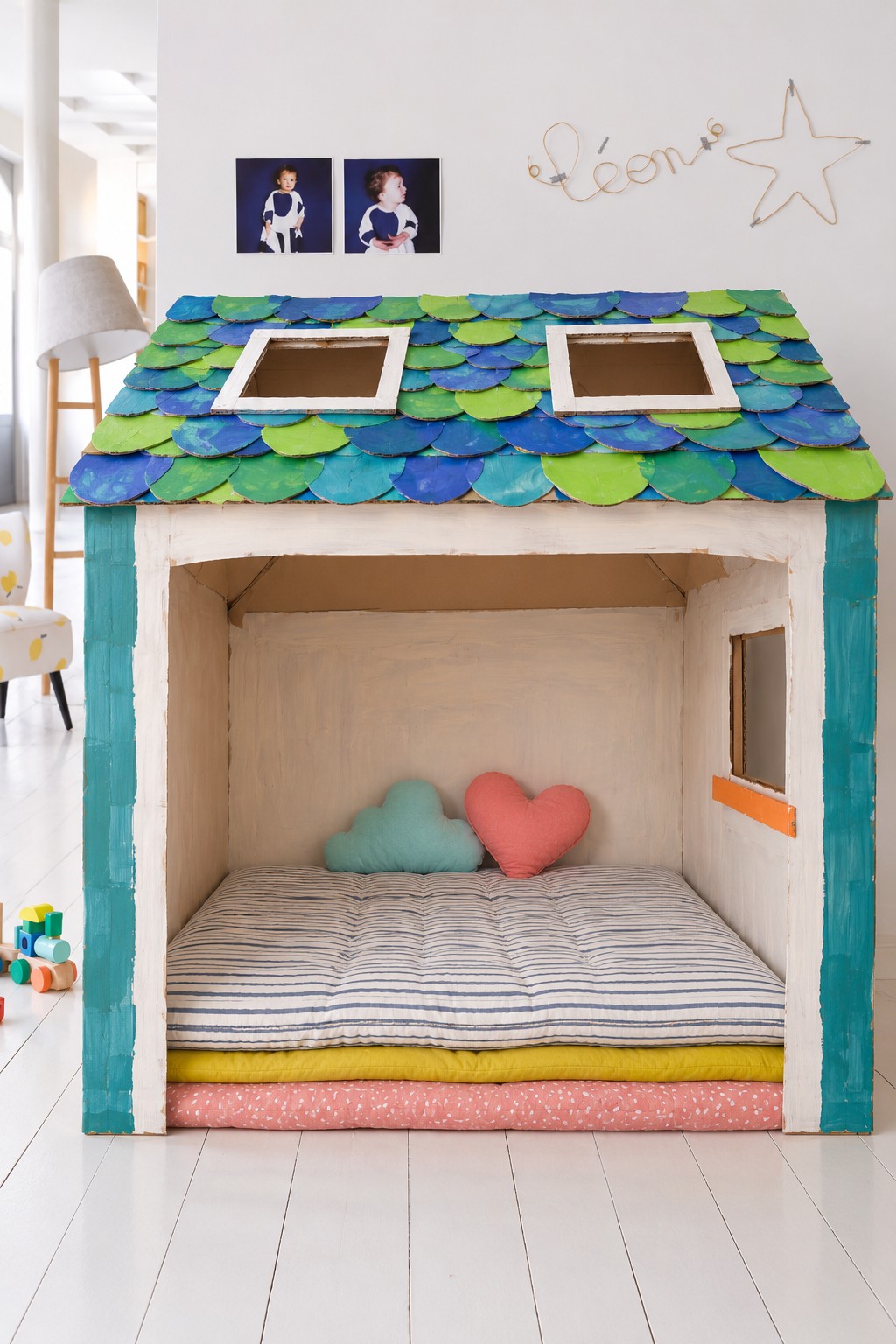
The roof shingles are circles cut from board, painted in blues and greens and glued in overlapping rows from the bottom up. Two square openings cut into the roof are framed with white strips and act as skylights.
The walls are painted white, inside and out, in thin uneven coats, and the corner posts are painted teal. A side window has an orange sill strip. Trace a cup to cut the circles; children can paint them while an adult builds the house.
20. Open Gable Nook With Coral Waves
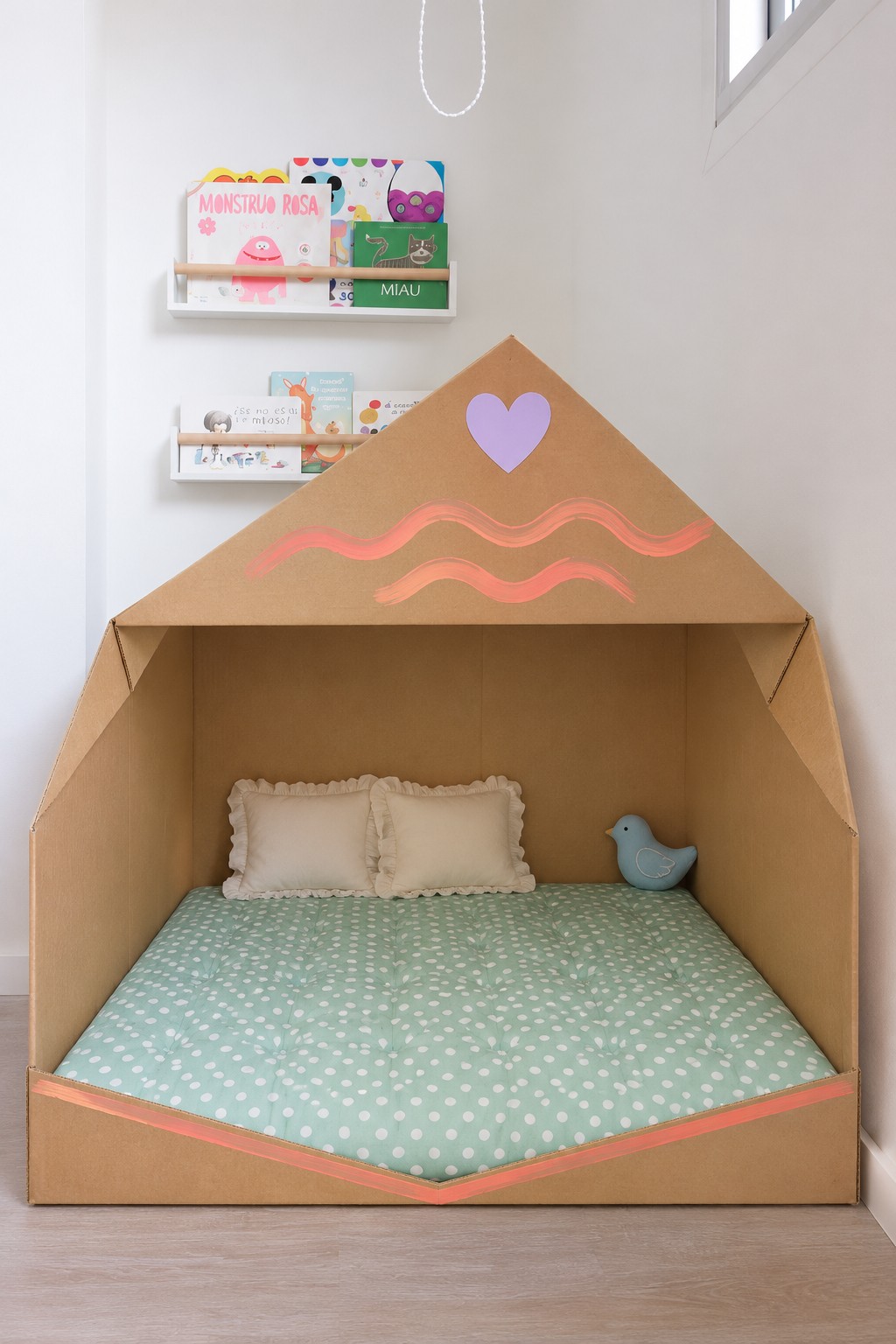
This nook is a large box with the front cut away. A triangle on top forms the gable, and the roof slopes fold back from it. The sides stay full height, and the front is cut down to a low V shaped lip that keeps the mattress in place.
The coral wavy lines and V stripe are painted with a loose brush, and the heart is a lilac card cutout. It is the quickest build in this collection, a good one to try first.
21. Bright Yellow House With Painted Shapes
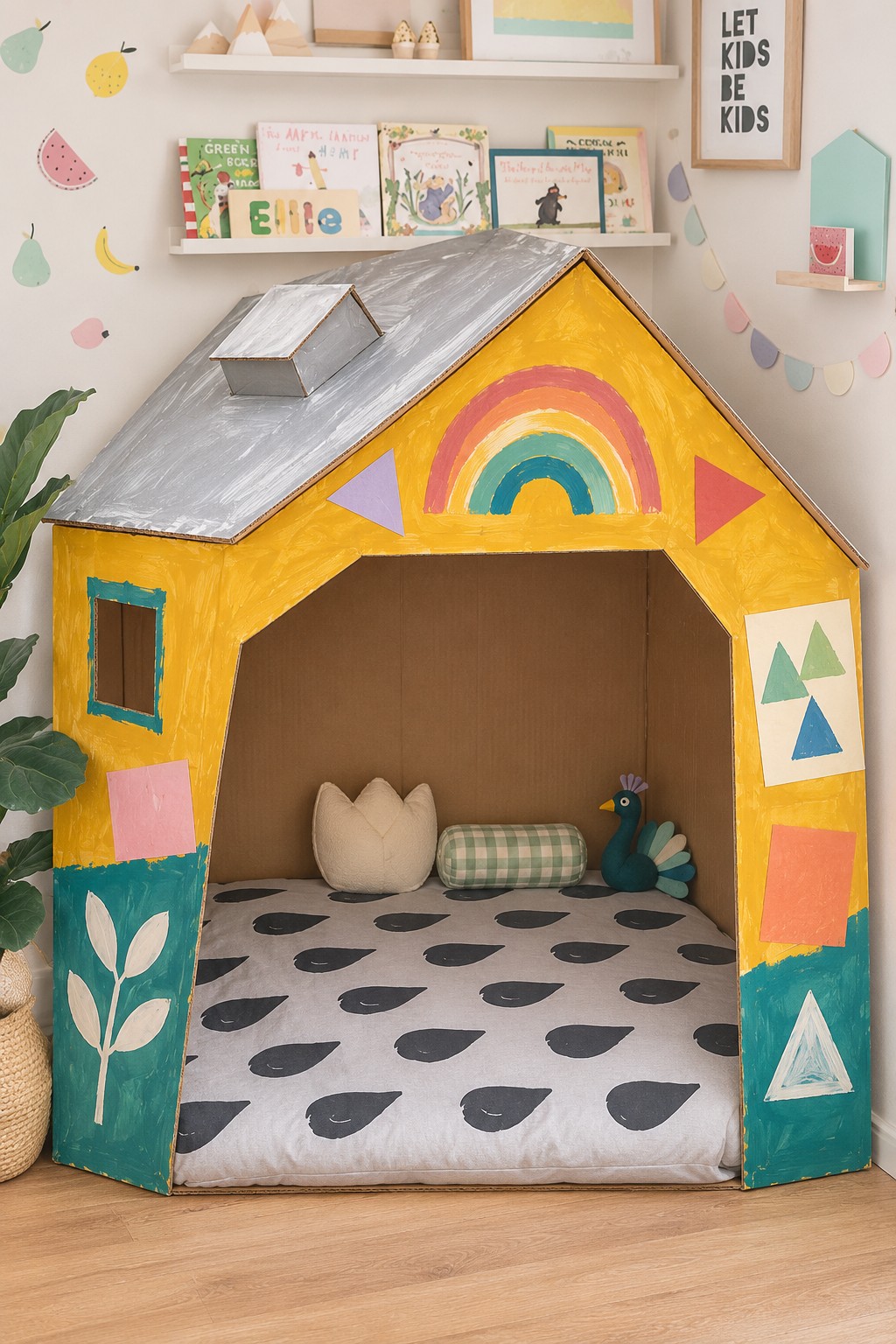
The roof is painted with silver paint, and a small box painted silver sits on top as a chimney. The walls are painted yellow with visible brush marks. Both lower corners are blocked in teal, one with a cream leaf and the other with a pale triangle.
The other shapes are painted on separate squares of paper or card and glued on, which lets children paint them flat at a table. The small window is cut and framed with teal paint, and the side walls angle inward so the house fits a corner.
22. Night Sky House With a Star Window
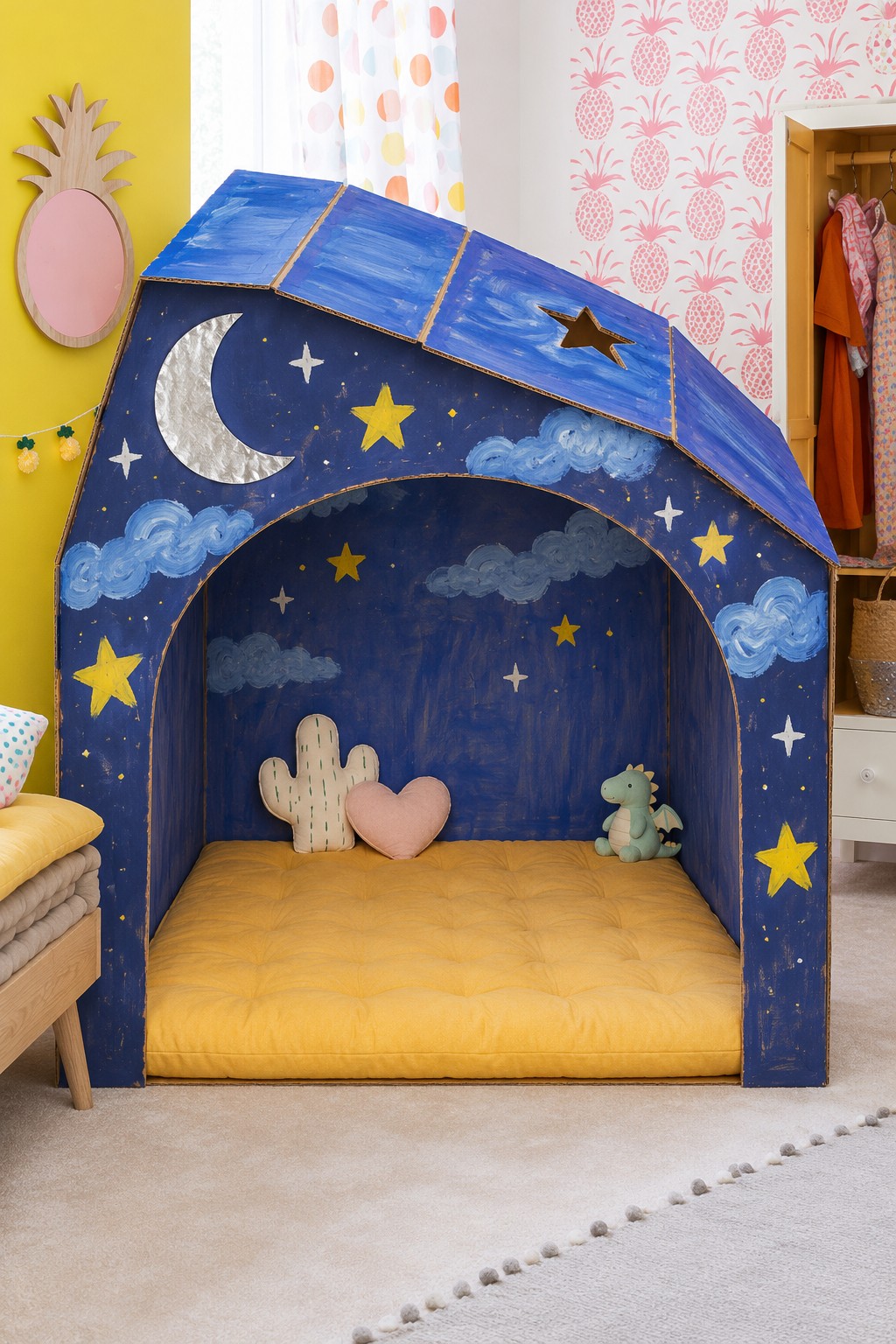
The roof is made of four panels joined at angles to form a curve, and a star is cut right through one of them. The whole house is painted deep blue inside and out, with lighter blue strokes for texture. Clouds are swirled on with a light blue brush, and stars are painted in yellow and white.
The moon is crinkled kitchen foil glued over a card crescent. Smooth the foil gently so the crinkles catch the light. Dark blue also hides fingerprints far better than white.
23. Minimal House Frame With a Lime Back Wall
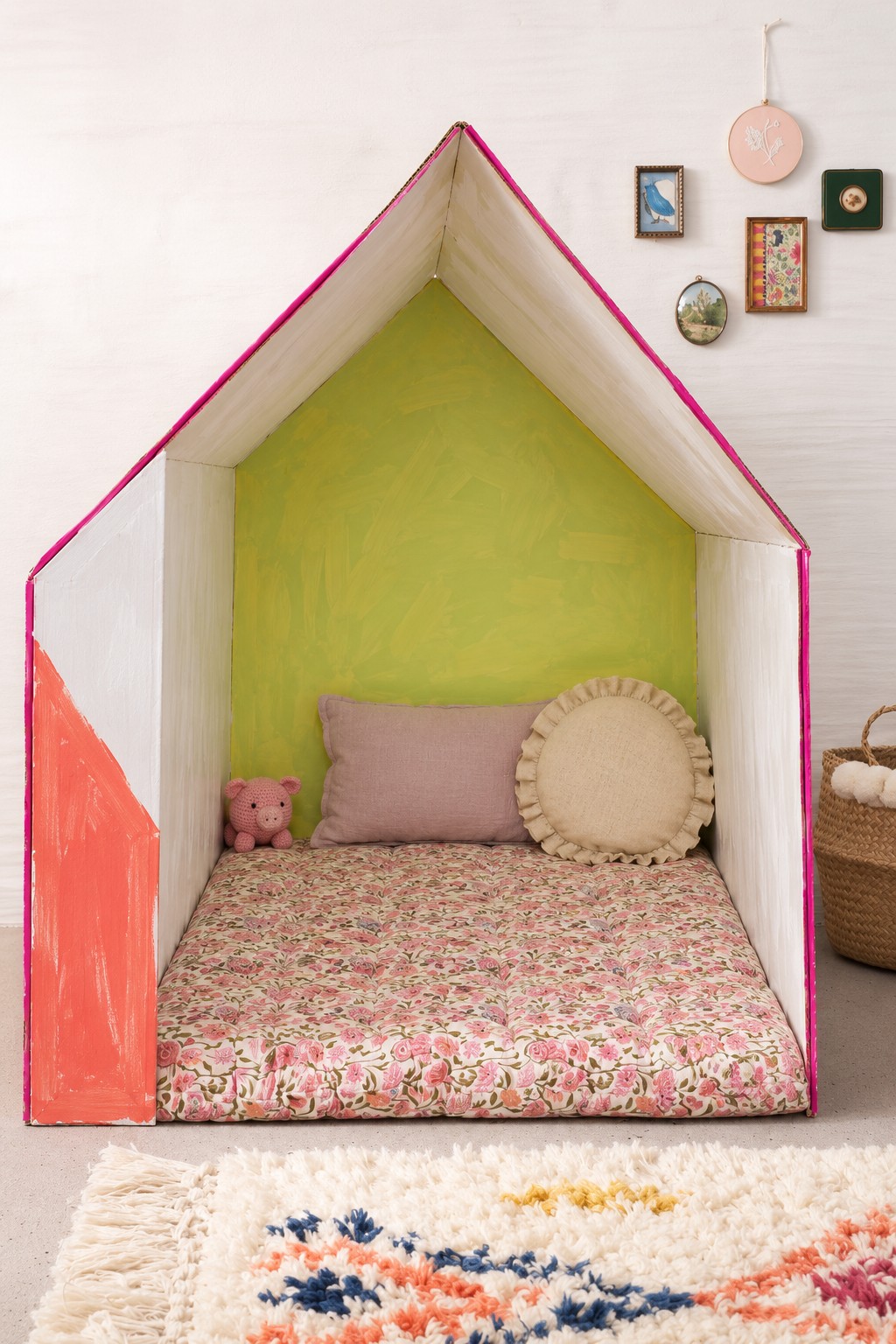
This is a frame rather than a house: two side walls and two roof slopes cut from one long strip and folded into a house outline, with a back panel behind. The edges are finished in hot pink, with tape or paint.
To fold the outline from one strip, press four fold lines across the flutes, at the two wall corners and the two eaves, and glue the back panel inside to lock the angles. The inside is painted white with visible brush strokes, the back panel lime green, and a coral block is painted on one side wall. Because it is so open, it is easy to move and clean around.
24. Natural House With a Linen Curtain
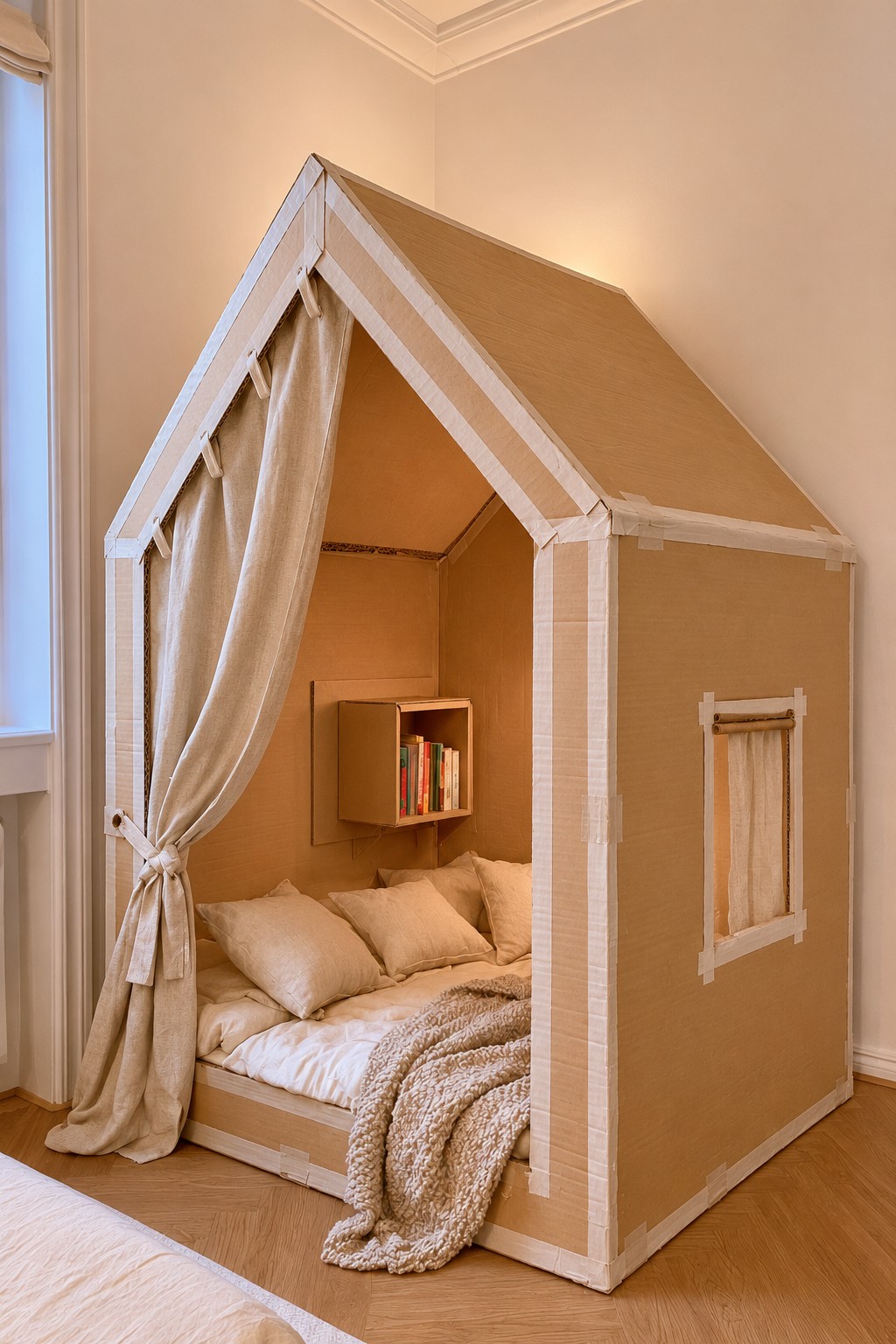
The house stays plain kraft, but every edge and corner is covered with white paper tape, which hides the flutes and gives a neat outline. The curtain hangs over wooden pegs pushed through the front edge of the roof, and is tied back with a knot.
The side window is framed with white tape and has a small curtain on a dowel rod. A small open box glued to the back wall becomes a book shelf, and a low frame holds the mattress. For more reading corner ideas, these reading room decoration ideas are worth a look.
Playhouses With Doors, Shutters and Rooftops
These houses are closed on all sides, with doors that open and windows to look through, so they suit pretend play more than napping. Most of them start as one large appliance box with a roof added on top.
25. White Cottage With Pink Scalloped Shingles
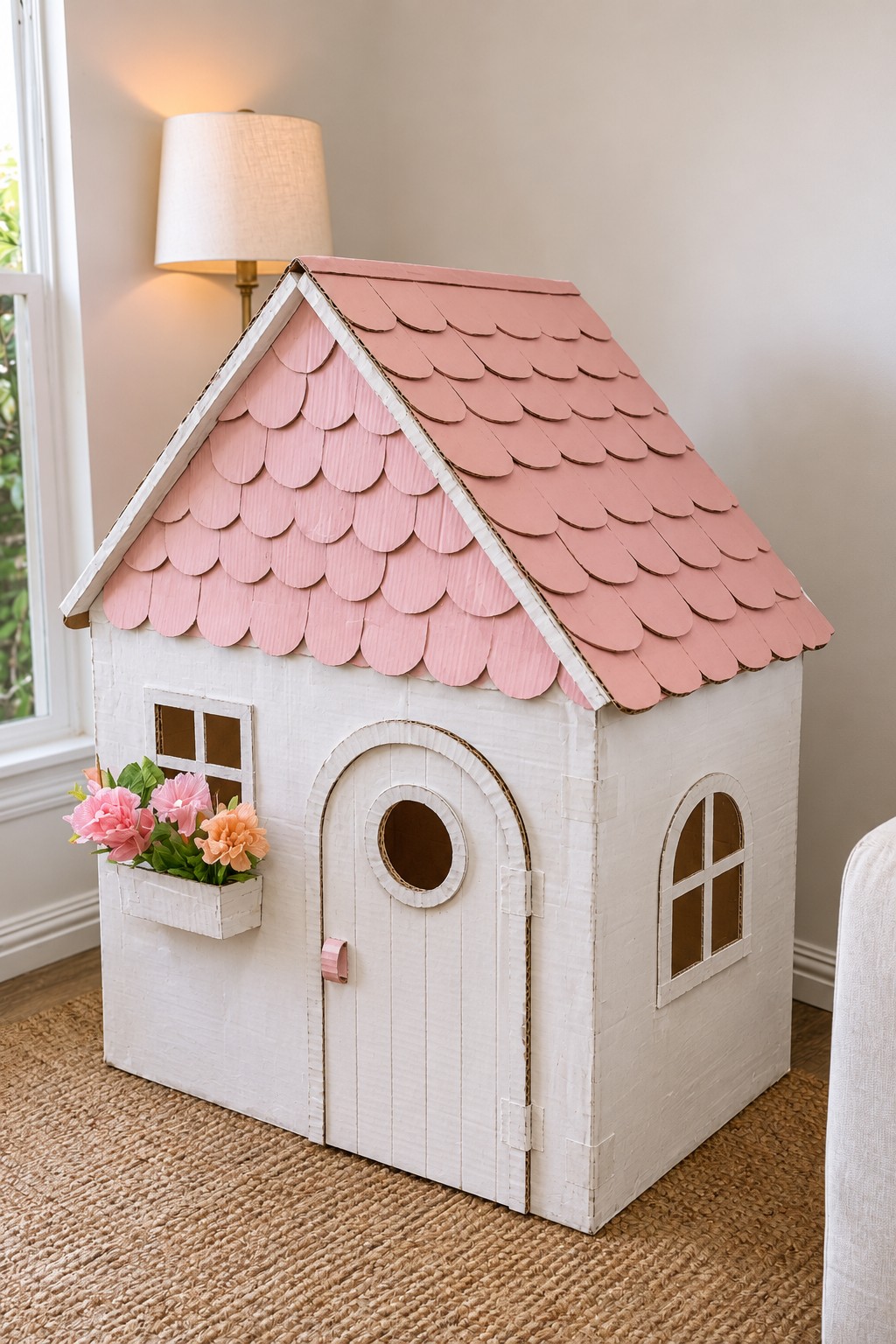
Each shingle is a small rectangle of corrugated board with one rounded end, and you can still see the ribs of the board through the pink paint. They are glued in rows from the eaves upward, every row shifted half a shingle so the joints never line up. Cut them in batches: stack two or three thin sheets, trace one template and cut them all at once. White strips folded over the ridge and along the roof edges cover the raw flutes.
The door is a separate panel with grooves pressed into it for planks, and it swings on two small cardboard tab hinges glued to the frame. A ring of board frames its round window, and a narrow strip bent into an arch frames the doorway. The window box is a little open box painted white and filled with crepe paper flowers, and the arched side window has a raised frame with crossbars. A white base coat over the whole house hides any printing on the boxes.
26. Kraft Brick Cottage Drawn With a Marker
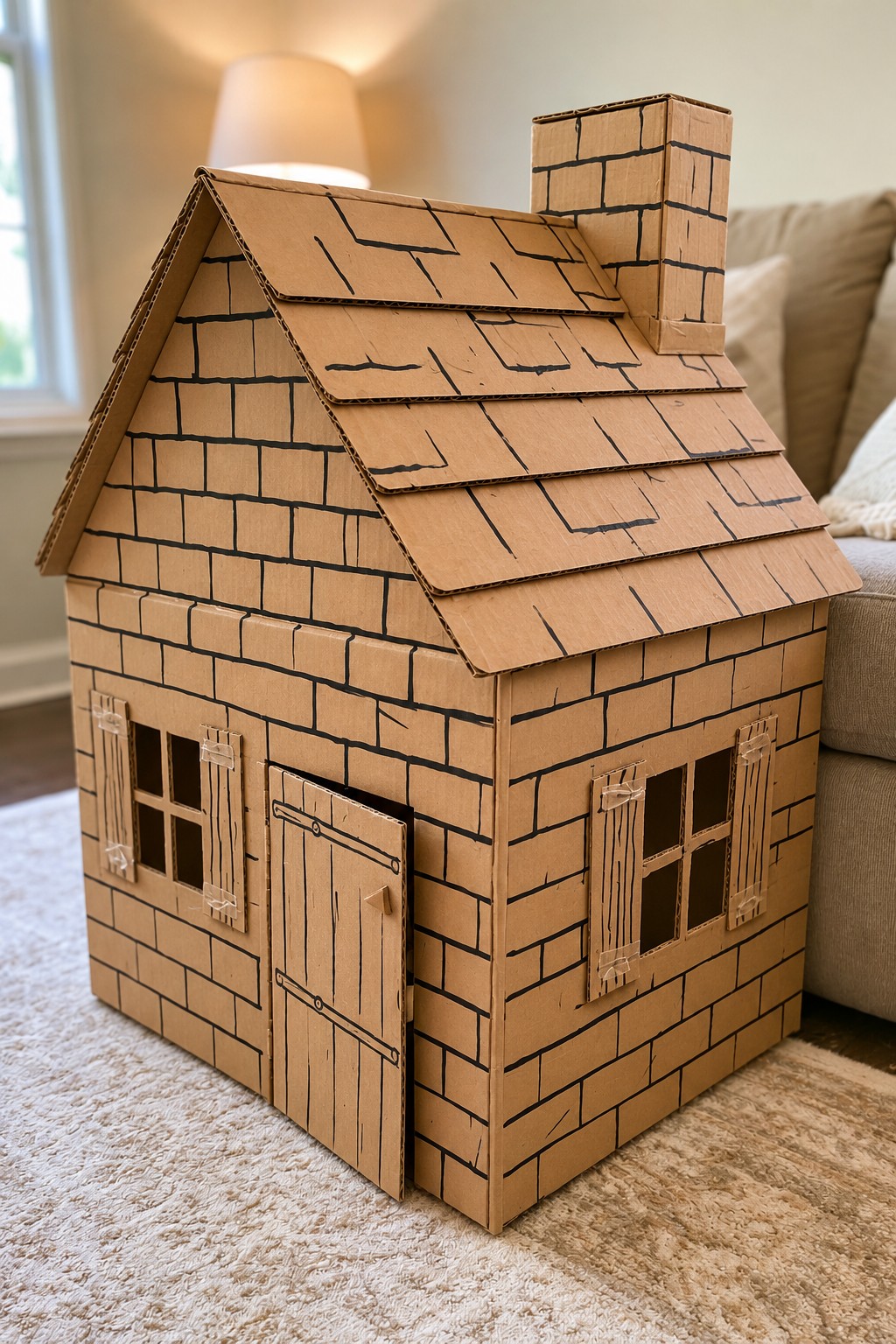
No paint here: bricks and shingles are drawn with a thick black marker straight onto the board. The roof is made of long overlapping strips, each glued so its lower edge covers the top of the strip below, which gives real depth and shadow. The chimney is a tall narrow box with a notch cut at its base so it sits neatly on the sloping roof.
The door is cut on three sides and opens on the uncut fourth side, with wood grain, hinges and a small triangle handle drawn or glued on. The shutters are flat strips taped beside each window with clear tape, so they flap open. When you cut the four window panes, leave the cross in the middle standing as the window bars. Stagger the drawn bricks from row to row, as real bricks are laid, and the wall looks convincing at once.
27. Red Barn With a Rooster Weathervane
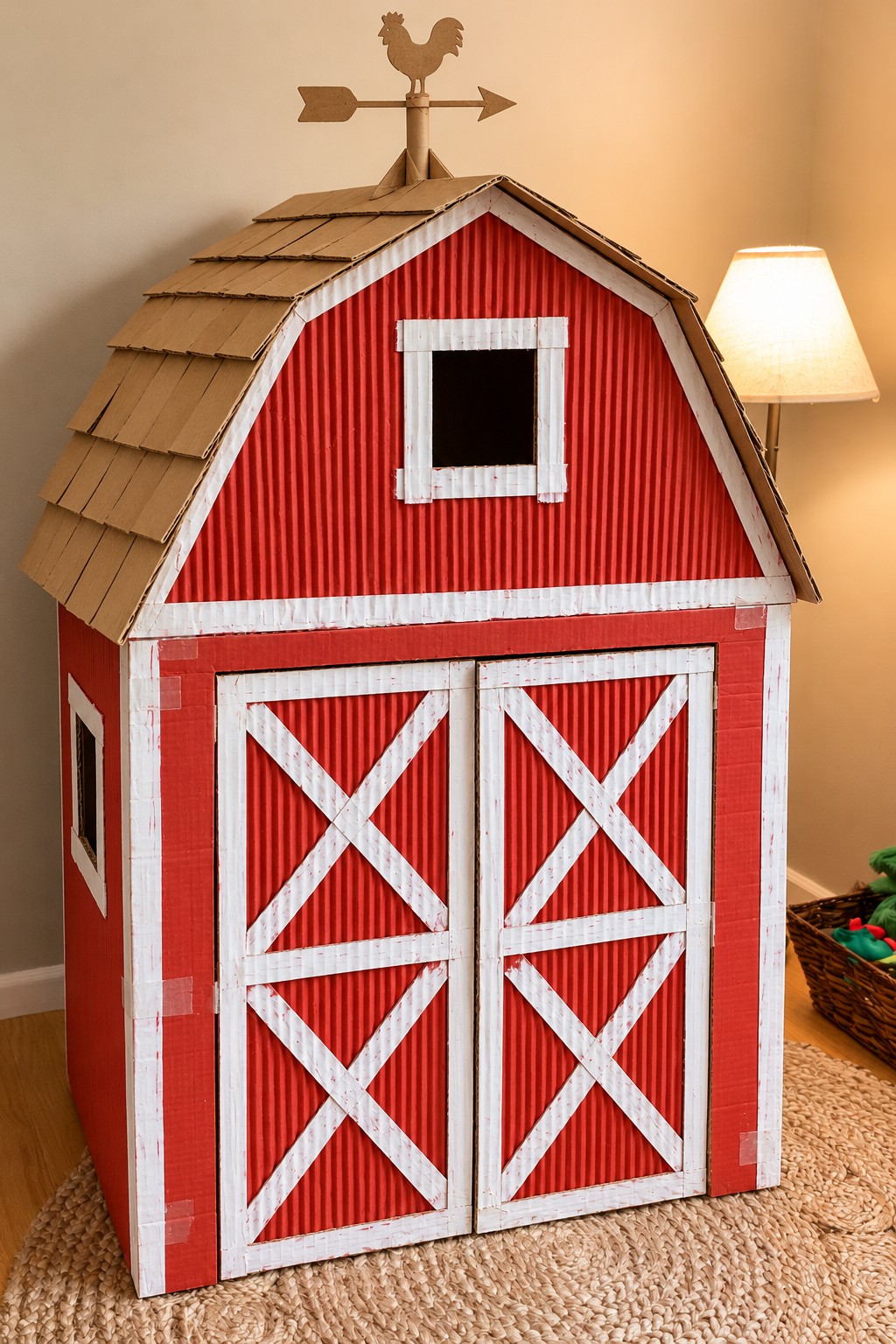
The barn roof has two slopes on each side, a steep lower one and a gentler upper one, covered with rows of shingle strips cut into tabs. The red walls have a fine vertical rib. You can get it by dampening the top paper layer of the board, peeling it away and painting the exposed flutes with a nearly dry brush, or simply by gluing red corrugated craft paper over flat board.
White strips frame every edge and form the X braces on the double doors; white paper tape is a quick shortcut, since it goes on straight and needs no painting. The two doors are separate panels that meet in the middle. The rooster weathervane is cut from flat board, fixed to a short tube post and steadied at the base with small triangle braces.
28. Half Timbered Cottage With Lattice Windows
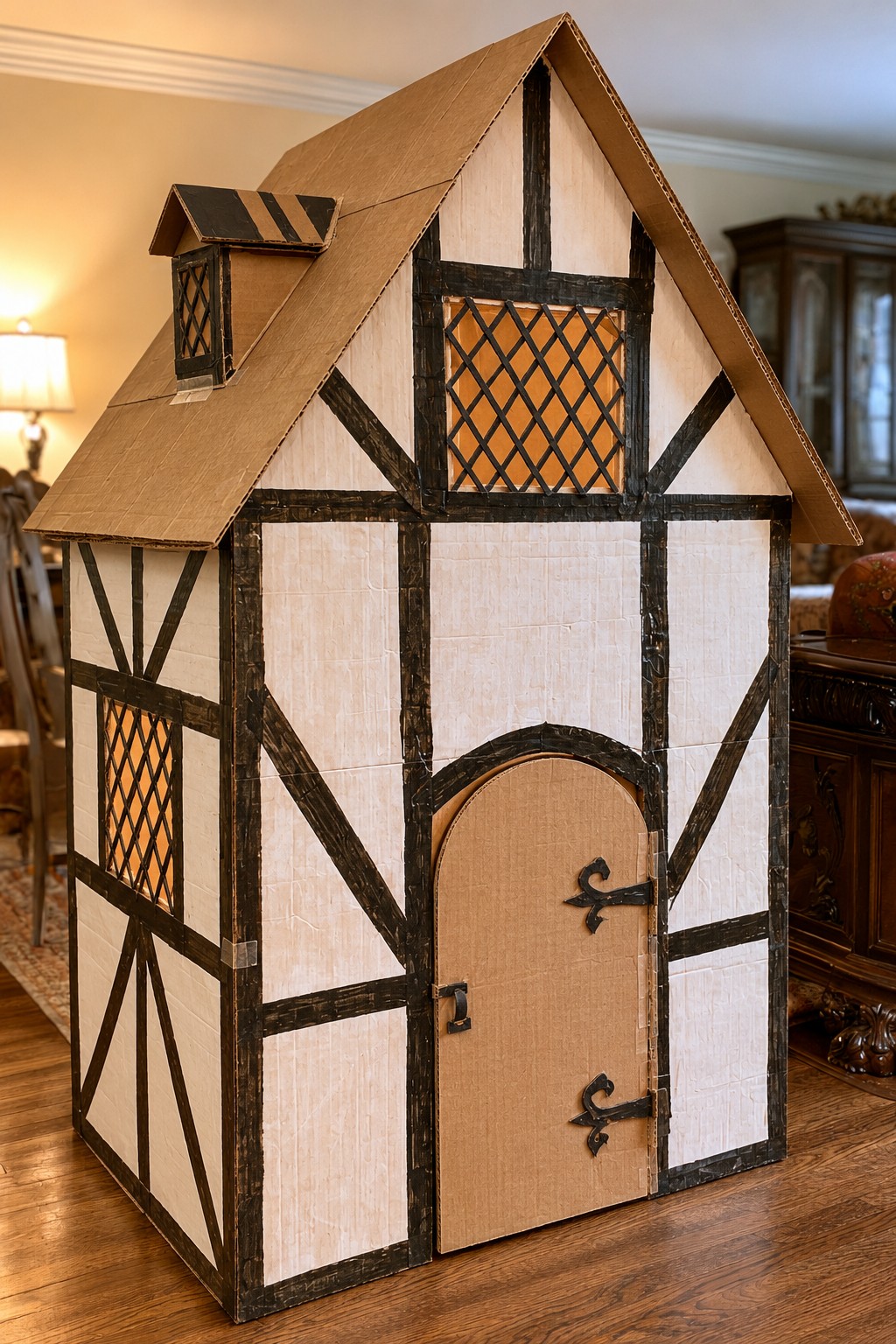
The walls are covered in cream, either paper glued on or two thin coats of paint, and dark strips laid in uprights, crossbars and diagonals form the beams. Sketch the beam pattern in pencil on all sides before gluing anything, because the strips need to meet neatly at the corners. Strips of board painted dark brown work well, and you can rough them up with a dry brush for a wood texture.
The windows are thin dark strips glued in a diamond lattice over orange translucent paper, which glows when light passes through. The door is an arched panel hinged on one side with tape, with scrolled hinges cut from card and painted black, plus a small handle. The dormer is a little box fixed to the roof slope with its own tiny roof and a matching lattice window.
29. Leaf Roof Cottage With a Round Green Door
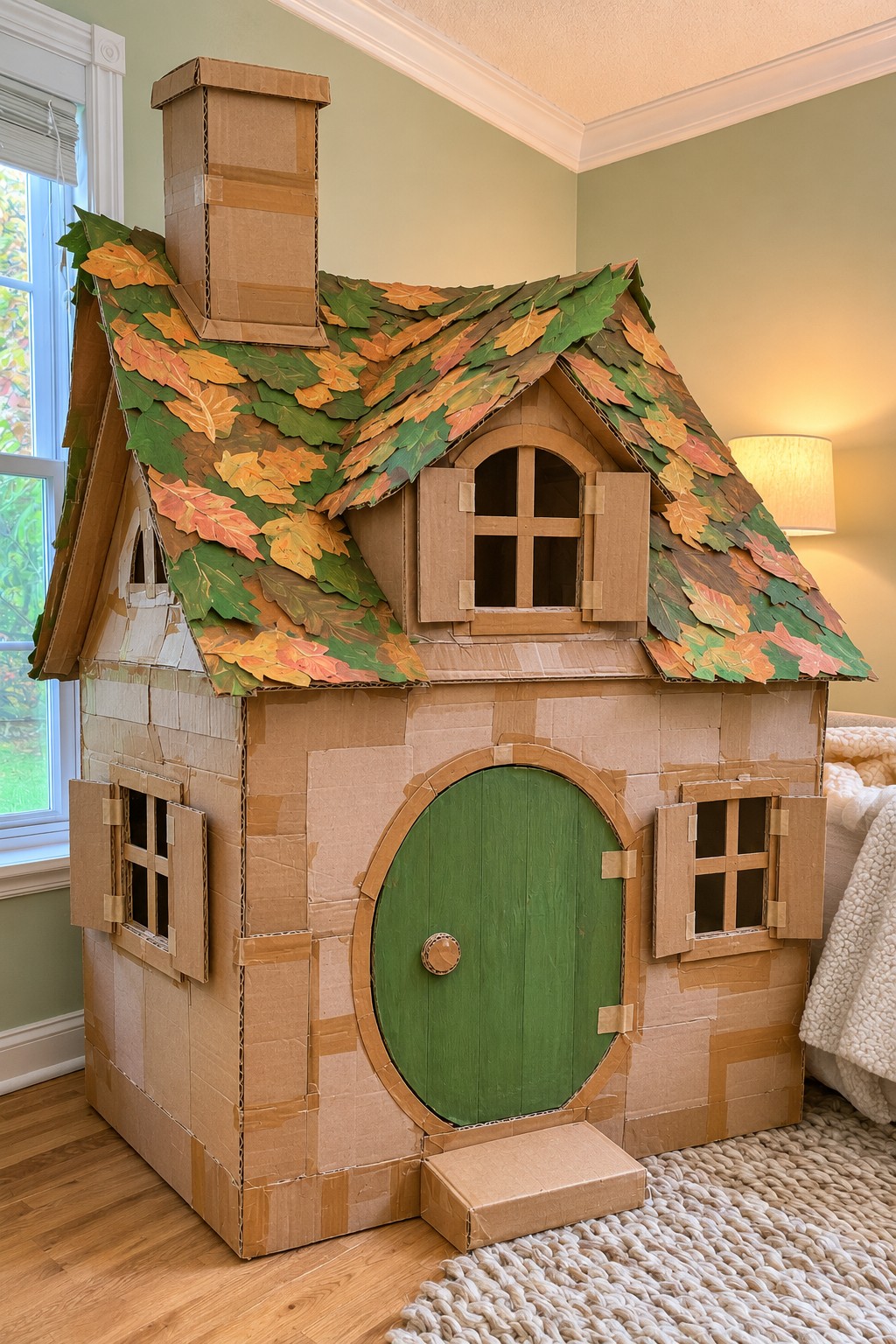
Here the tape is part of the look. The walls are covered with a patchwork of brown paper tape and board offcuts, which reads like rough stonework, so mismatched boxes and visible joins are no problem. The round door is painted green with plank lines, framed with a doubled ring of board, and hinged with strips of brown tape. Its knob is two or three discs of board glued in a stack.
The roof is thatched with paper leaves, painted in greens, oranges and yellows and glued in overlapping rows from the bottom edge upward. A dormer with an arched window and taped shutters sits on the roof, and the chimney is a tall box wrapped in tape. A small closed box in front of the door makes the step.
30. Three Row Houses in Patterned Paper
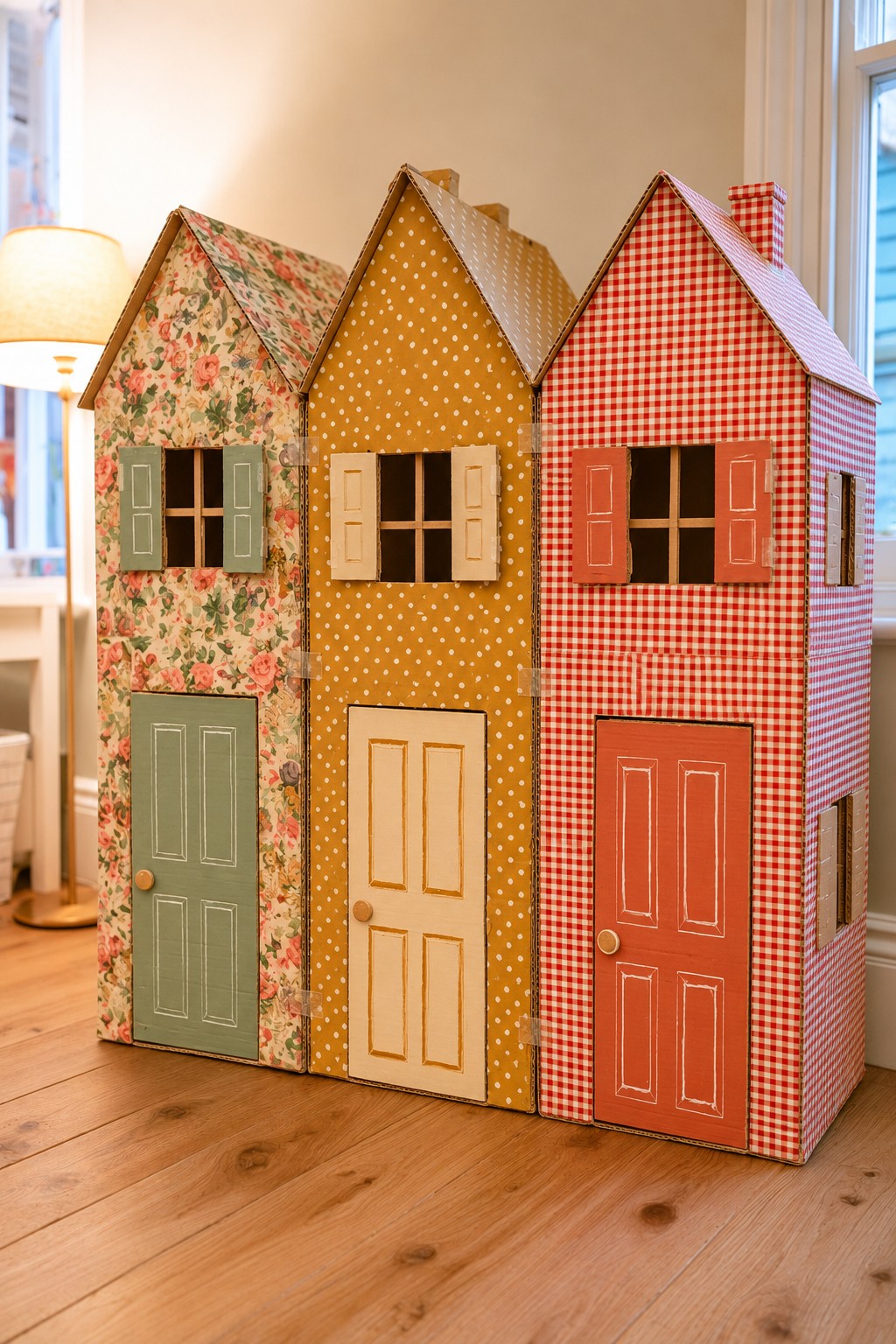
Each house is a tall narrow box with a gable top, covered in its own patterned paper: roses, polka dots and gingham. The three are joined side by side with short pieces of clear tape along the seams. To cover the board, spread decoupage medium or thinned white glue, smooth the paper from the center outward to push out bubbles, and let it dry for a full day.
The shutters and doors are separate card pieces painted in solid colors, with panel lines pressed in using a blunt pencil. The shutters open on clear tape hinges, and the doors have small wooden knobs. Tiny boxes on the roofs act as chimneys. Because the houses are tall and narrow, stand the row against a wall.
31. Playhouse Covered in Children's Drawings
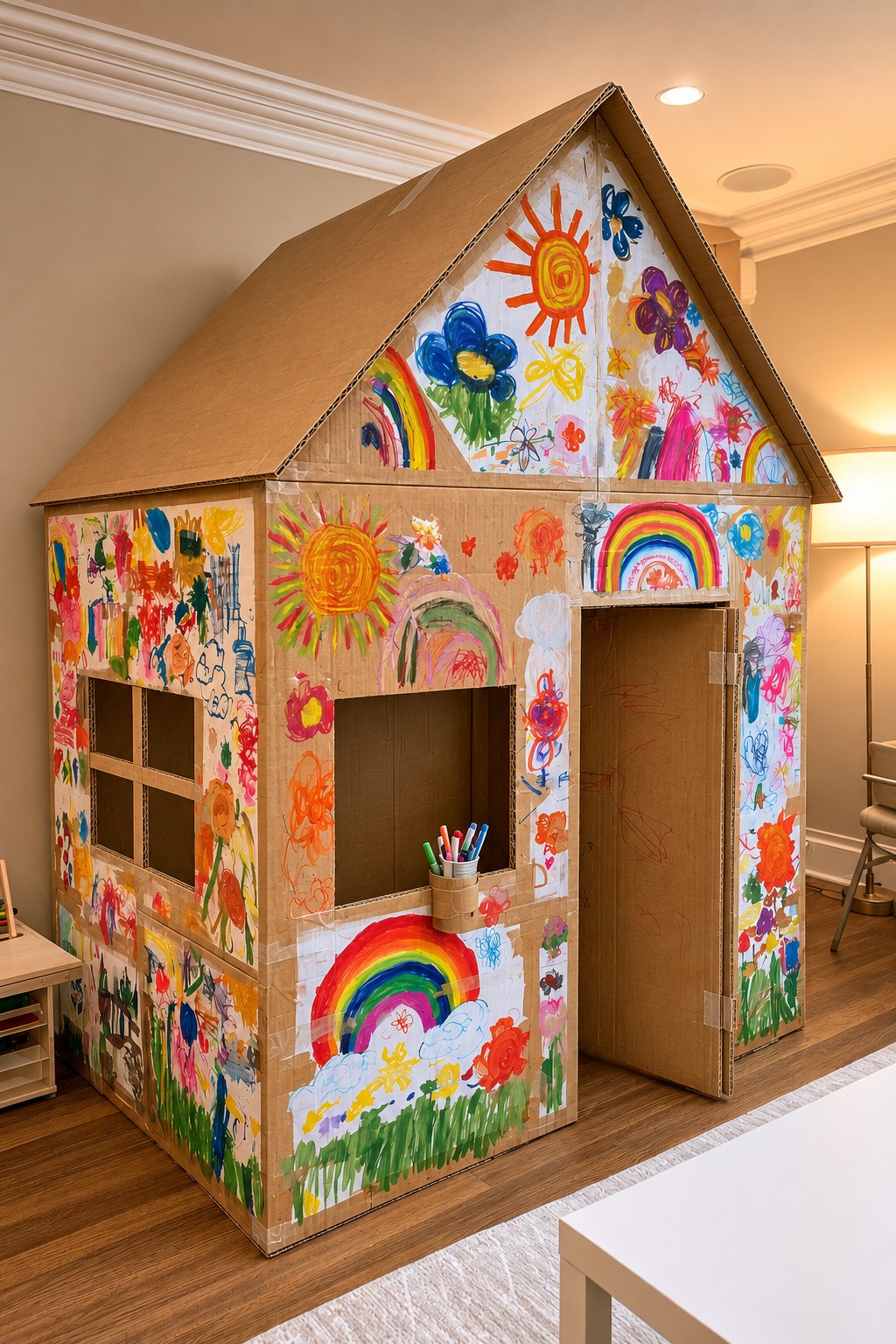
The house itself is plain: a large box with a two slope roof, a door that opens on clear tape hinges and windows with the crossbars left in. The decoration is up to the children. Some drawings are made on sheets of white paper taped or glued to the walls, others straight onto the board with markers and crayons.
A short piece of cardboard tube glued under the window holds the pens, so drawing can carry on any time. White paper gives brighter colors than brown board, so glue a few sheets where the most important pictures will go. When the walls are full, tape new paper on top and start again.
32. Treehouse on Tube Stilts
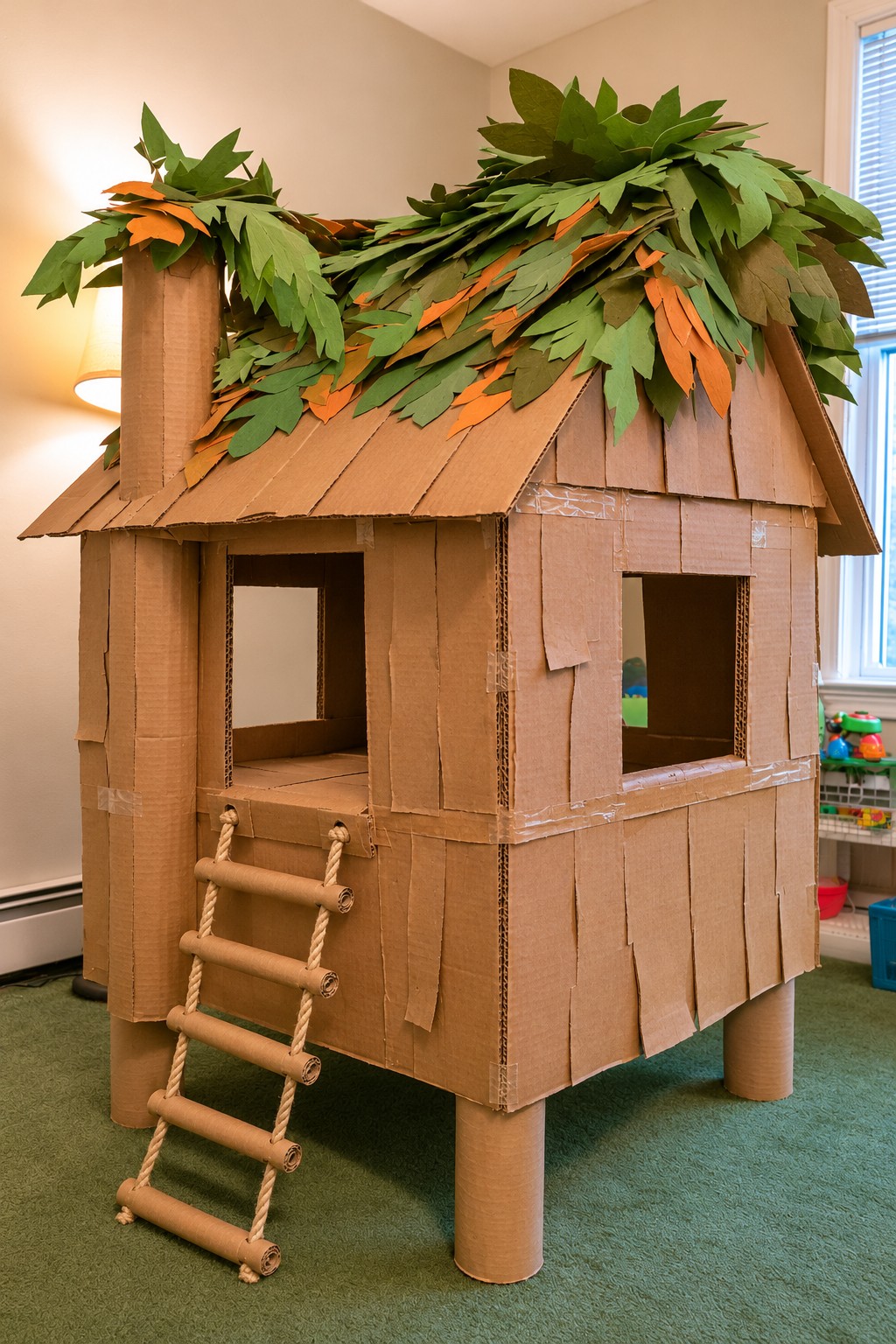
Thick cardboard tubes form the legs and the chimney, and the house is a box sitting on top of the legs. The walls are clad in strips of board cut with slits along one edge and glued in overlapping rows, which gives a rough plank look. The roof is piled with green and orange paper leaves glued in layers.
The ladder is rope threaded through holes in short rolled cardboard tubes, with a knot under each rung, and its top end passes through holes in a doubled strip at the doorway. A cardboard floor on tube legs cannot carry a child's weight, so treat this version as a stage for toys and puppets, or build the same leafy house at floor level for children to play inside.
Castles, Theaters and Seasonal Houses
These builds give children a setting for their games, from a fortress with a drawbridge to a theater stage and a winter cottage.
33. Castle With a Rope Drawbridge
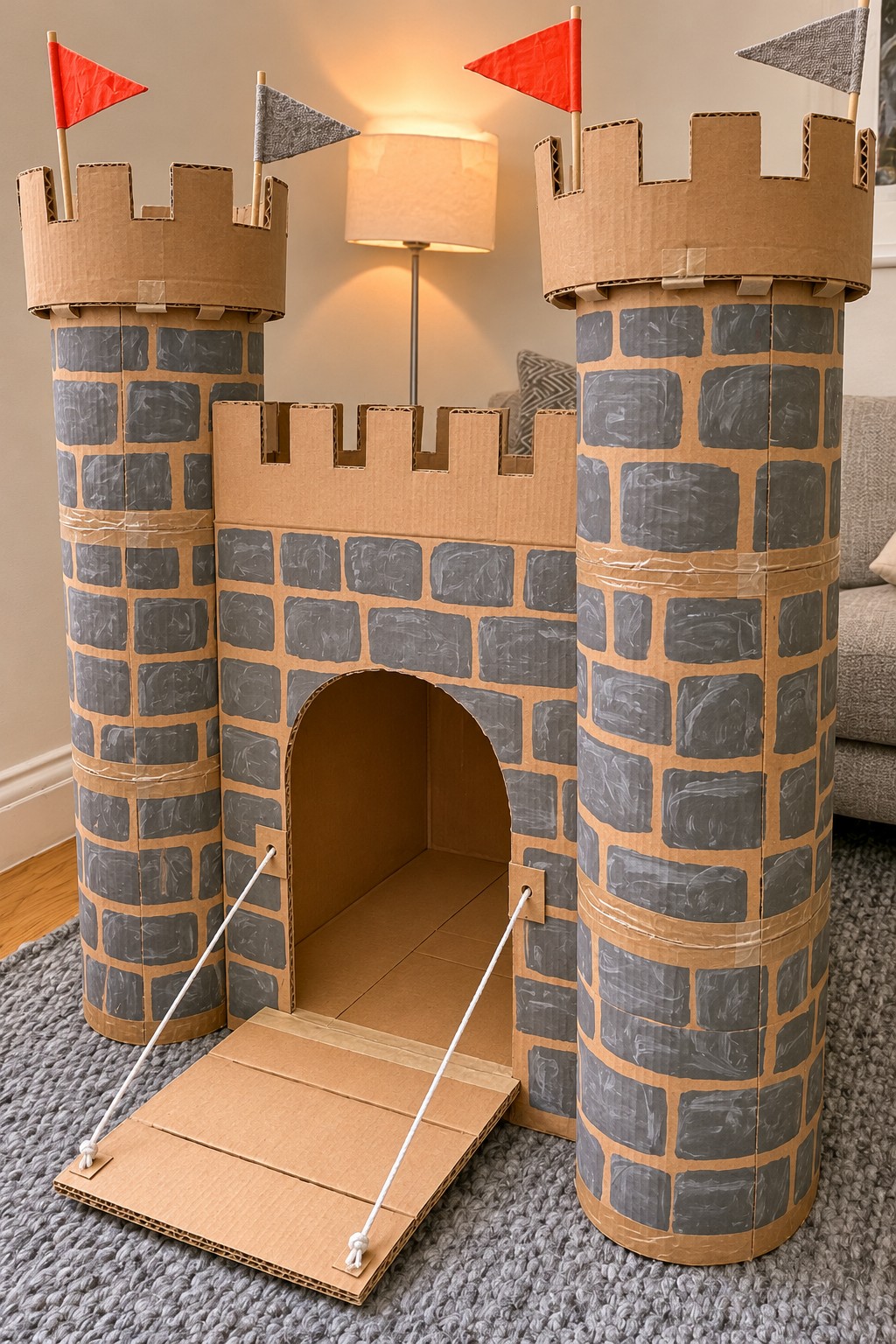
The towers are tall tubes rolled from large sheets with the flutes running up and down, so the board curves without cracking. Bands of packing tape hold them closed. The battlements are separate rings of board with square notches cut along the top, fixed to the towers with short tape tabs. The gatehouse is a box with the same notches cut into its top edge and an arched opening.
The stones are painted grey and scrubbed lightly with white, leaving brown gaps as mortar, which is quicker than drawing every joint. The drawbridge is two layers of board glued together. Its cords pass through holes in small card squares glued on the gatehouse wall and are knotted under card washers on the bridge. The flags are fabric triangles glued to wooden skewers pushed into the battlements.
34. Igloo Built From Cardboard Blocks
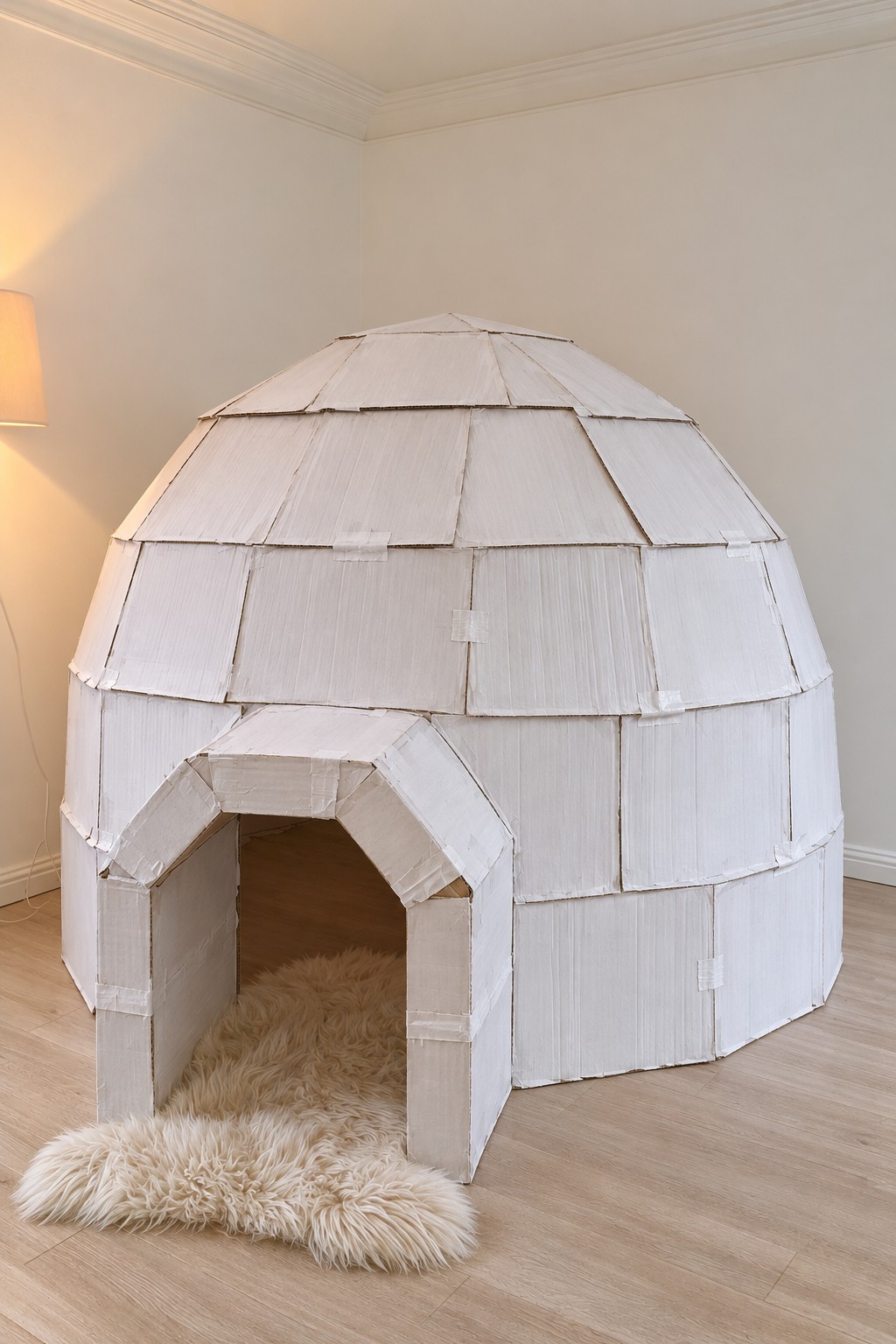
The dome is built from rings of rectangular panels. Each ring leans a little further inward than the one below, and the panels get narrower toward the top. The rows overlap like snow blocks and are joined with small pieces of clear tape. Paint the panels white while they are still flat, and the dome goes up without drips.
The base ring is made of flat panels standing upright, which keeps the dome steady. The tunnel is five flat panels: two upright sides, two angled pieces and a flat top, taped at each joint. Put a soft rug inside, as here, since the floor of an igloo is usually just the carpet.
35. Puppet Theater With Red Velvet Curtains
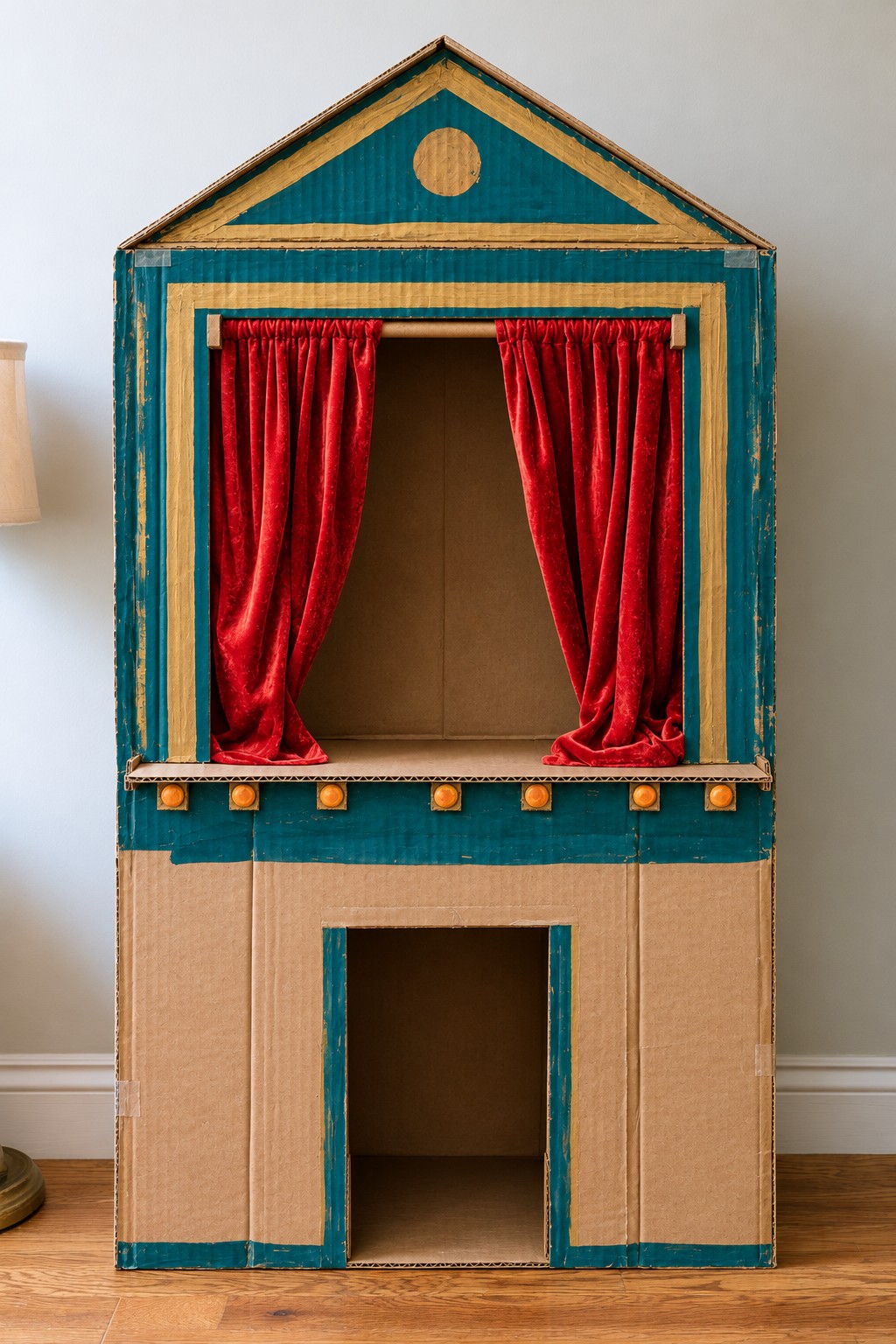
A tall box is the whole theater. The stage window is cut high in the front, and a wooden dowel rod rests on two small blocks glued at its ends, carrying two velvet curtains gathered on the rod. A strip of board glued below the window forms the stage ledge where puppets can rest.
The teal and gold trim is painted in bands, and the triangular top has a painted circle in the middle. The row of small orange domes under the ledge, each on a square of card, plays the part of footlights. Wooden beads or painted bottle caps glued firmly in place give the same effect. A door cut low in the front lets the puppeteer crawl inside.
36. Gingerbread House With Peppermint Candies
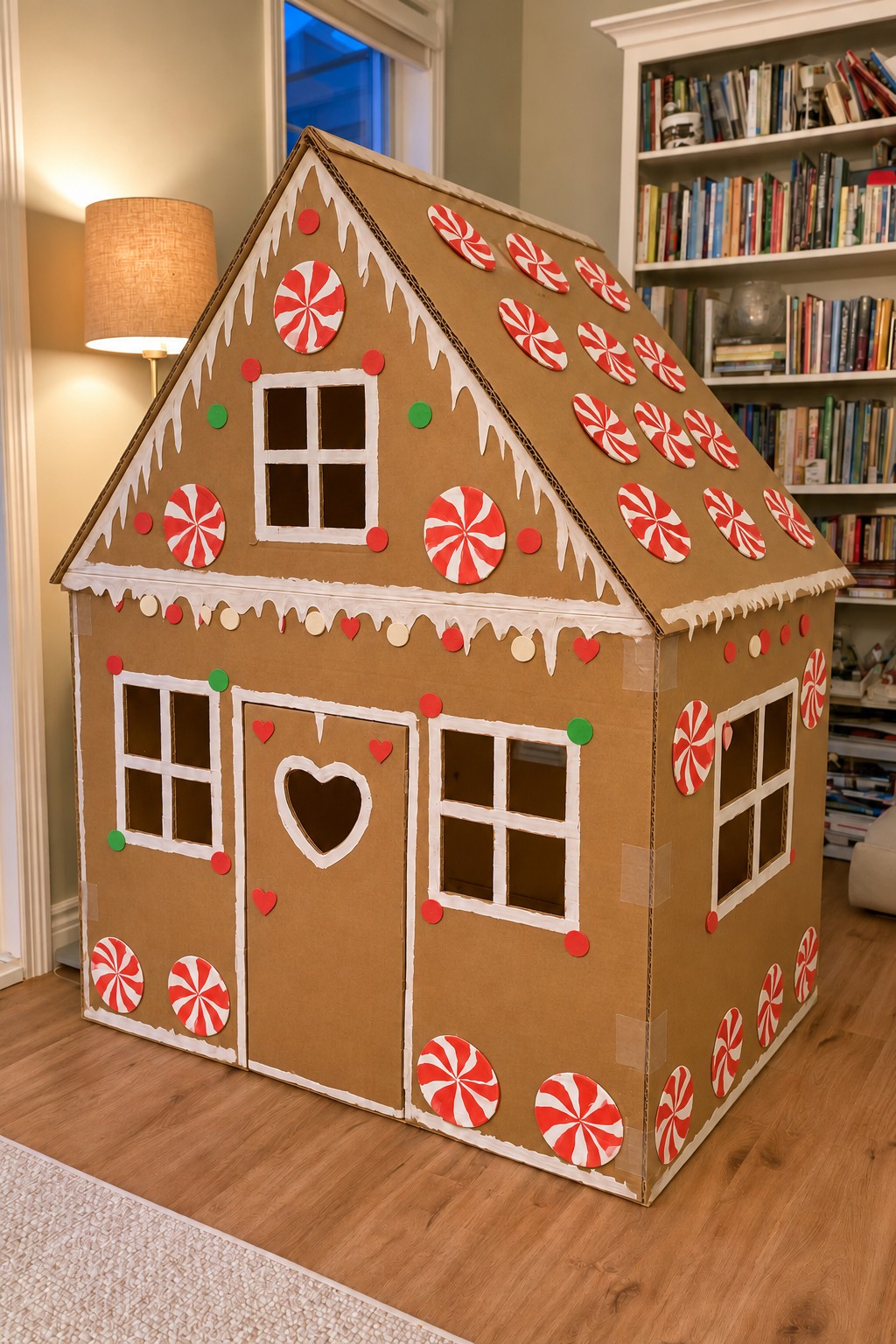
Kraft board already has the color of gingerbread, so this house is decorated rather than painted. The icing is thick white acrylic applied along the eaves and around windows and door in wavy lines, letting a few drips run down. The peppermints are card discs painted white with red swirls, and the small red and green dots and hearts are card cutouts.
The windows are cut with their crossbars left standing and outlined in white, and the door has a heart shaped window cut into it. Clear tape holds the corners, so you can flatten the house after the holidays and store it for next year.
37. Snowy Holiday Cottage With Glowing Windows
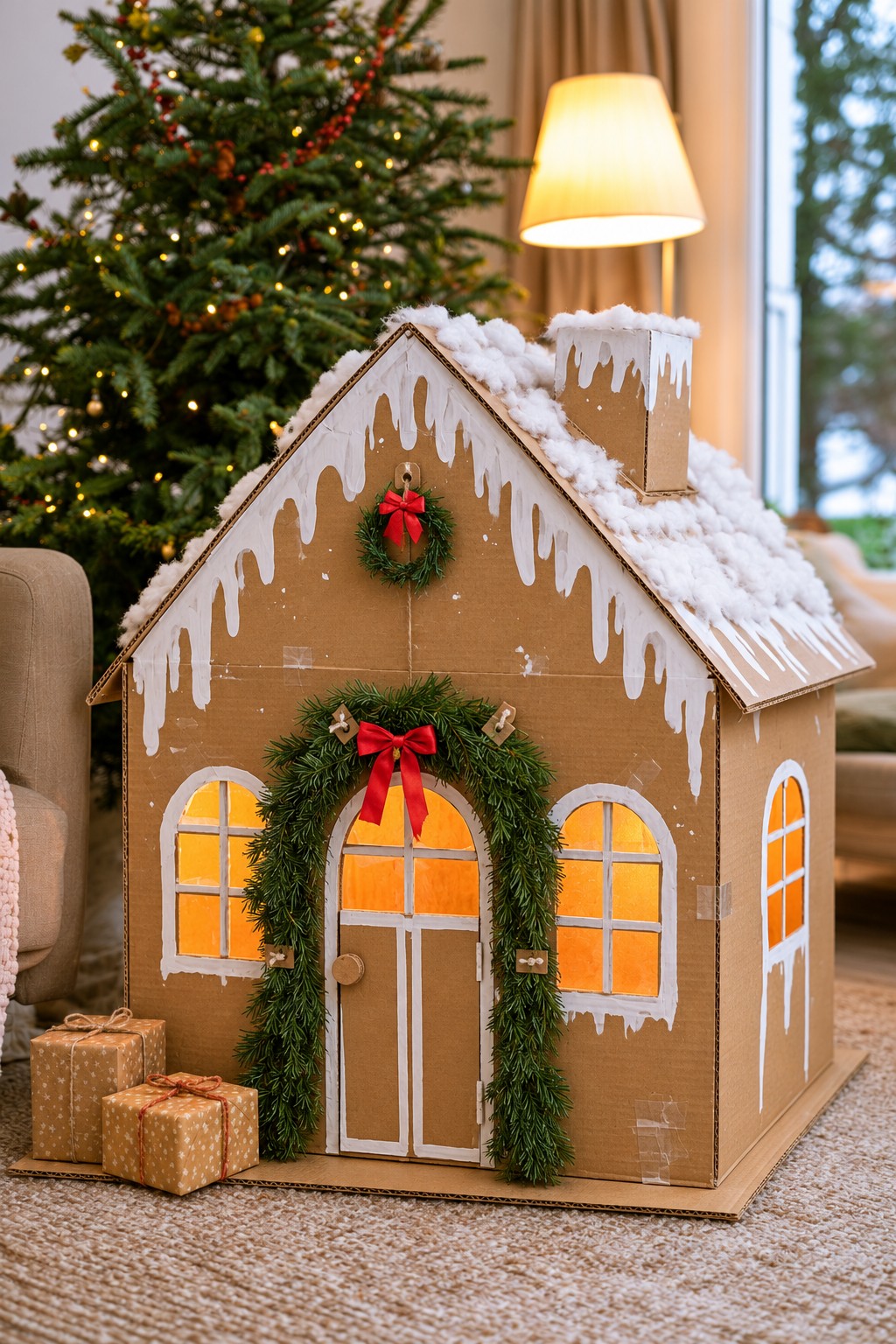
The snow is cotton wool or polyester fiberfill glued in clumps along the roof and chimney, and the icicles are painted in thick white paint. The garland and wreath hang from small card tabs glued to the walls and tied with twine, so they come off easily. The house sits on a larger flat sheet of board that keeps it steady.
The windows have white painted frames with orange translucent paper glued behind them, and a battery LED string light inside makes them glow. Never use a candle or a plug in lamp in a cardboard house, especially one with cotton snow on the roof. The door is an arched panel hinged with tape, and the chimney is a box with a notch cut so it sits on the roof.
Choosing the One That Fits Your Child
Think about what your child will do inside before choosing a design. A reader needs a mattress and good light, a pretend player needs a door and a window, and an artist needs blank walls. Nooks with an open front, like the owl or the whale, are easiest to keep clean, while closed houses like the barn or the castle are better for imaginative games.
A cardboard house is also a great way to try a theme before committing to it in a whole room. For more ideas on decorating around it, browse these storybook children's bedroom ideas, or if you want permanent options in other materials, compare them with these indoor playhouse and play nook ideas. Leftover boxes can also become smaller toys; these DIY cardboard toys use the same cutting and gluing techniques.
Safety Notes for Cardboard Playhouses
Cardboard catches fire easily and burns fast, and so do paper leaves, fabric curtains and fluffy fiber snow. Keep every playhouse well away from fireplaces, heaters, radiators and lamps with hot bulbs, and never use candles inside or near one. If you want light inside, choose battery operated LED lights that stay cool, and pick ones with a battery compartment closed by a screw. Small button batteries are very dangerous if a young child swallows them, so keep spares out of reach.
Utility knives and hot glue guns are for adults. Cut on a mat, keep fingers behind the blade, retract it every time you put it down, and unplug the glue gun as soon as you finish. Children can join in with painting, drawing and gluing paper decorations with white glue.
For children under three, avoid small parts that could come loose, such as buttons, beads or bottle caps; paint those details instead. Keep ropes and cords short and fixed at both ends with no loops, and remove them for toddlers. Cardboard roofs and raised floors cannot carry a child's weight, so teach children not to climb on them, and push tall designs against a wall so they cannot tip.
Keep the playhouse dry. Damp cardboard loses its strength and can grow mold, so if it gets wet from spills or a damp room, let it dry fully or recycle it and build a new one.



Leave a Reply