
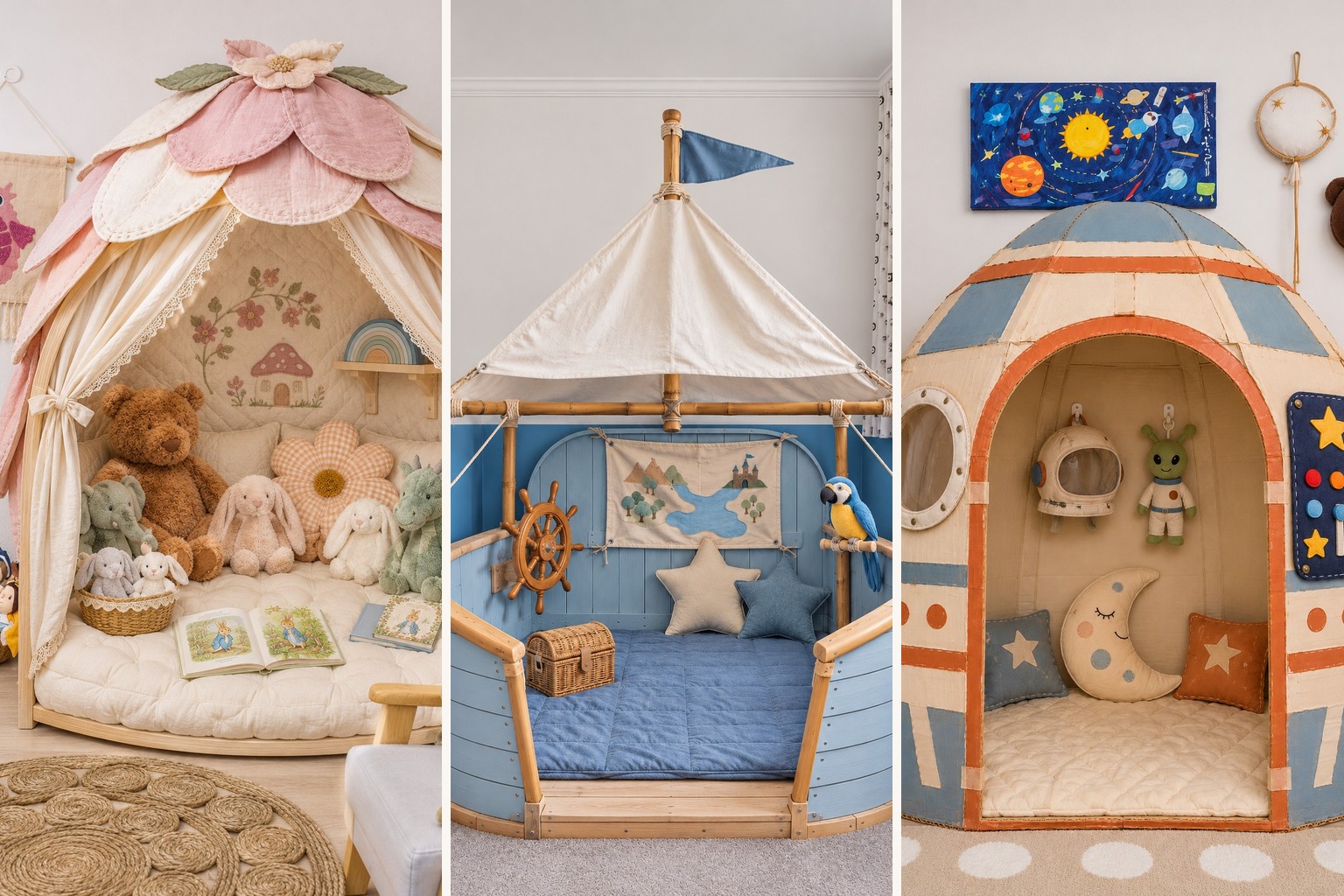
A playhouse inside a bedroom does something a toy box never manages. It gives a child a place of their own, with a doorway to duck through and walls that make a small world feel closed and safe. Children tend to read longer, stay in pretend play longer and settle down faster when they have a corner like that, and parents gain one spot where cushions, books and favorite toys collect instead of spreading across the floor.
The 37 indoor playhouse and play nook ideas below are grouped by what children actually do inside them: quiet reading hideaways, natural dens, upcycled builds, pretend shops, little stages, game corners and adventure themes. A few are fabric canopies you can sew over a weekend, many are wooden frames that need a drill and a saw, and some begin as a cardboard box, a stack of milk crates or a pile of outgrown jeans. If you are still planning the room as a whole, these kids room ideas for play, storage and learning help with the wider layout. Read the short guide first, because the right frame, the right glue and enough curing time matter more than whichever theme wins in the end.
Table of Contents
- Before You Build: Size, Frames, Glue and Curing Times
- Size it for sitting, not standing
- Choose a frame that suits the room
- Match the glue to the material
- Paint early and let it cure
- Make every fabric part removable
- Quiet Reading Hideaways
- 1. Gingham Cottage Canopy with an Embroidered Fairy
- 2. Ceiling Hoop Canopy for a Window Corner
- 3. Cane Webbing Book Nook with Rope Netting
- 4. Felt Patchwork Reading Corner
- 5. Storybook A Frame Cottage with Picture Ledges
- 6. Flower Petal Canopy Full of Plush Friends
- 7. Puzzle Foam Tile Tent
- Natural and Woodland Dens
- 8. Woven Willow Dome with Felt Vines
- 9. Reed Beach Hut with a Fishing Game
- 10. Bamboo Pony Stable
- 11. Leaf Canopy with a Woodland Animal Shelf
- 12. Soft Stone Cave for Dinosaur Explorers
- Upcycled and Low Cost Builds
- 13. Painted Cardboard Cottage
- 14. Cardboard Space Rocket with a Control Panel
- 15. Milk Crate Vet Clinic
- 16. Pallet Market Stall and Puppet Stand
- 17. Dresser Drawer Garage with a Workbench
- 18. Denim Patchwork Art Studio
- Pretend Play Shops and Workplaces
- 19. Cork Wall Post Office
- 20. Felt Letter Kiosk
- 21. Felt Cottage Doll Nursery
- 22. Pretend Laundry Corner with a Washing Machine
- 23. Mission Control Corner House
- 24. Airplane Cabin with a Baggage Belt
- Little Stages for Puppets, Costumes and Shadows
- 25. Folding Screen Puppet Theater
- 26. Dress Up Stage with Sheer Curtains
- 27. Shadow Puppet Theater Nook
- Game Corners
- 28. Mini Bowling Alley Playhouse
- 29. Mini Golf Pergola
- 30. Patchwork Tent with a Bean Bag Toss
- 31. Strawberry Canopy Train Station
- Adventure and Discovery Themes
- 32. Pirate Ship Reading Boat
- 33. Soft Block Castle
- 34. Geodesic Dome Observatory
- 35. Moon Pod with a Dollhouse Table
- 36. Shape Learning Gazebo
- 37. Dragon Den Wooden Cube
- Choosing the Right Nook for Your Child
- Safety Notes for Indoor Playhouses
Before You Build: Size, Frames, Glue and Curing Times
Size it for sitting, not standing
Children use a play nook mostly sitting or lying down, so floor area matters more than height. A footprint of about 90 by 120 cm (3 by 4 feet) holds a floor cushion and a friend, and an inside height of 120 to 140 cm lets a preschooler stand without making the structure tall and top heavy. Keep doorways at least 60 cm wide so an adult can reach in with a book or a blanket.
Choose a frame that suits the room
Planed pine battens of roughly 44 by 44 mm (about 2 by 2 inches), joined with wood screws and PVA wood glue, make a light and rigid frame for most of the wooden builds here. Drill a pilot hole wherever a screw lands near the end of a batten so the wood does not split, round over every edge with sandpaper, and add metal corner brackets wherever a joint carries a roof. Birch plywood of 12 to 18 mm is the right sheet for cut shapes such as arches, gables and scalloped tops. Fabric canopies need far less: a bentwood hoop, a few bamboo poles or a sturdy curtain rod is enough, since the fabric itself weighs very little.
Match the glue to the material
Wood to wood joints take PVA wood glue. Clamp or screw them, give the glue 30 to 60 minutes before you remove the clamps, and then leave the frame unloaded for a full 24 hours, which is how long the bond needs to reach its real strength. Felt or fabric appliqués on fabric stay soft and flexible with a permanent fabric glue; press them flat under a heavy book while they set and check the label before the first wash, because only some fabric glues are made to survive the machine.
Felt onto wood or cardboard grips fastest with hot glue. A low temperature gun is kinder to synthetic felt, which can scorch, and it remains an adult tool. Cork sheet onto plywood is a job for contact cement spread thinly on both faces and left until it feels tacky before the two surfaces meet; wet glues soak into cork and make it swell. Cardboard joints hold with PVA craft glue or hot glue, and a strip of paper tape or fabric tape over each seam keeps the corners from tearing open after a few weeks of play.
Paint early and let it cure
Use water based primer and paint on wood, plywood and cardboard. Most latex and acrylic paints feel dry in about an hour and take a second coat after around four hours, yet they need two to four weeks to cure to full hardness. Finish painted pieces several days before they move into the bedroom, keep a window open while the smell fades, and expect the surface to scuff easily during its first weeks of use.
Make every fabric part removable
Hang curtains on a dowel with tab tops or rings, and attach canopy covers with ties or hook and loop strips so they come off for washing. Prewash cotton, linen and canvas before you cut anything, otherwise the panels shrink after the first wash and no longer fit the frame.
Quiet Reading Hideaways
A reading nook works when it is soft, a little enclosed and keeps books where a child can see their covers. Light from a nearby window or a wall lamp outside the structure is better than any bulb tucked inside the fabric. The same calm, book loving mood can stretch across a whole room with these reading room decoration ideas.
1. Gingham Cottage Canopy with an Embroidered Fairy
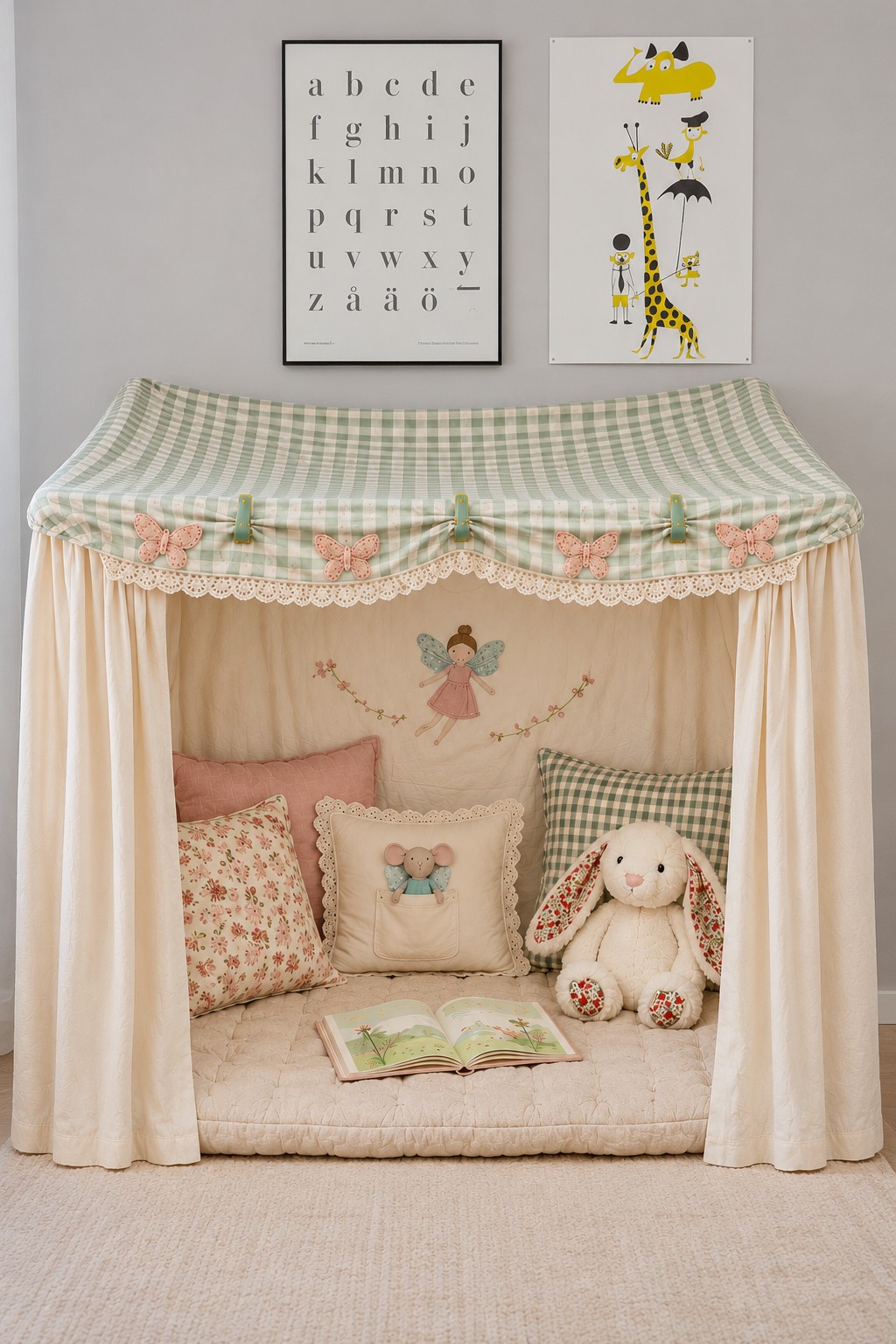
A cream fabric house with a soft green gingham roof turns a plain stretch of wall into a cottage without a single board on show. That softness is the point: it suits toddlers and preschoolers who like to burrow in with a stuffed bunny, and it blends quietly into a neutral nursery. Pink butterfly appliqués along the roof edge and an embroidered fairy on the back panel give the eye something gentle to rest on.
The cover drapes over a simple rectangular frame of battens or a bought tent frame. Sew the roof as a separate piece with its own valance so it can be swapped for another print later, and finish the hem with cotton lace. Hand embroidery works beautifully for the back panel, but machine stitch any appliqué that small fingers are likely to pick at.
2. Ceiling Hoop Canopy for a Window Corner
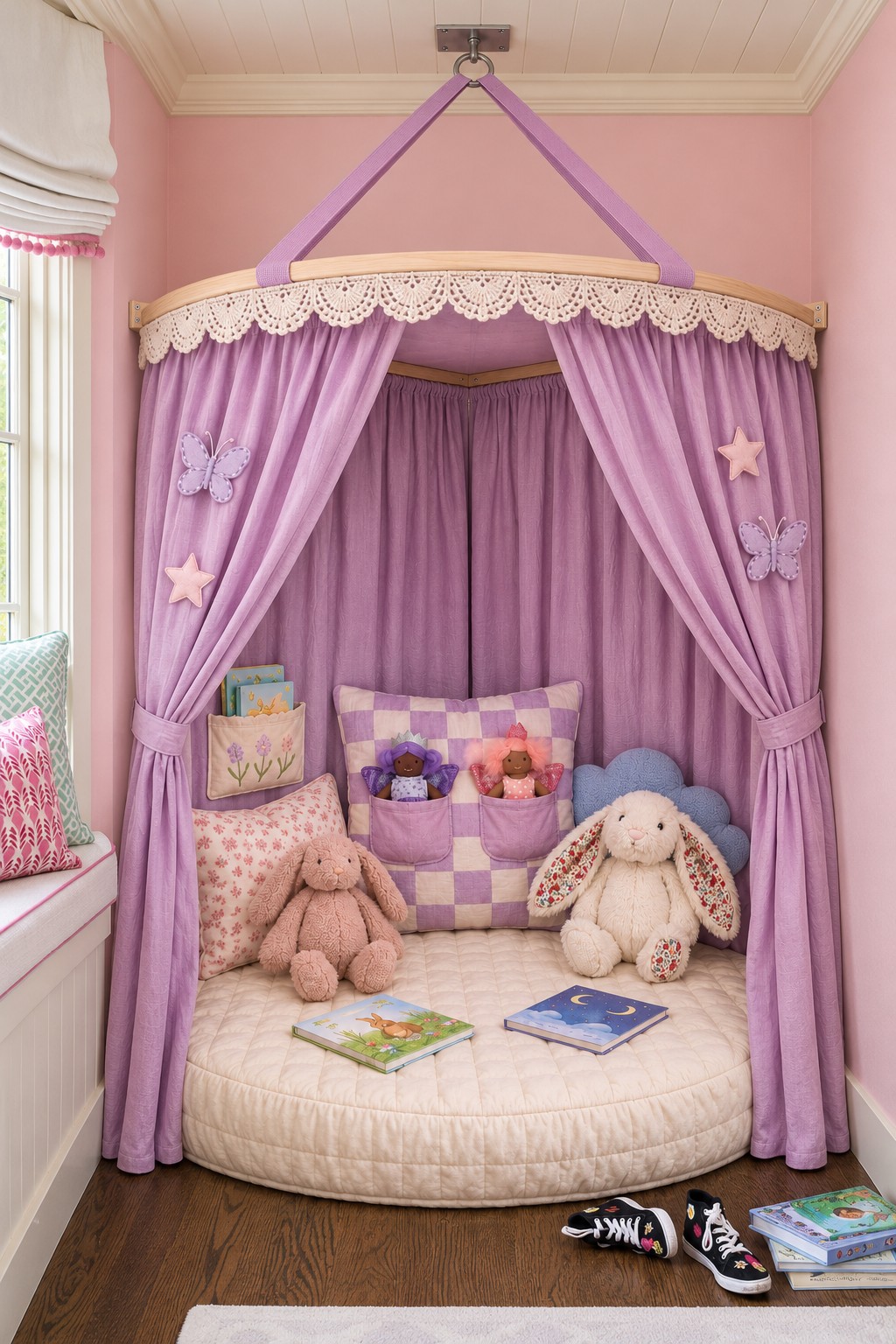
When floor space is short, hang the hideout instead of building it. A half round wooden hoop, suspended by a fabric strap from a single ceiling point, carries lavender curtains that fall around a round floor cushion and close off the corner. The two walls of the room become the back of the nook, so the whole project costs little more than fabric and a few fittings, and it sits happily beside a window seat.
Screw the ceiling hook into a joist through a pilot hole, never into plasterboard alone, and fix the straight edge of the hoop to the walls with small brackets so it cannot swing. Sew a rod pocket at the top of each curtain to slide over the hoop, edge the valance with crochet trim, and add felt butterflies and stars with fabric glue. Tiebacks hold the curtains open neatly, and a pocket stitched to one panel keeps a couple of books within reach.
3. Cane Webbing Book Nook with Rope Netting
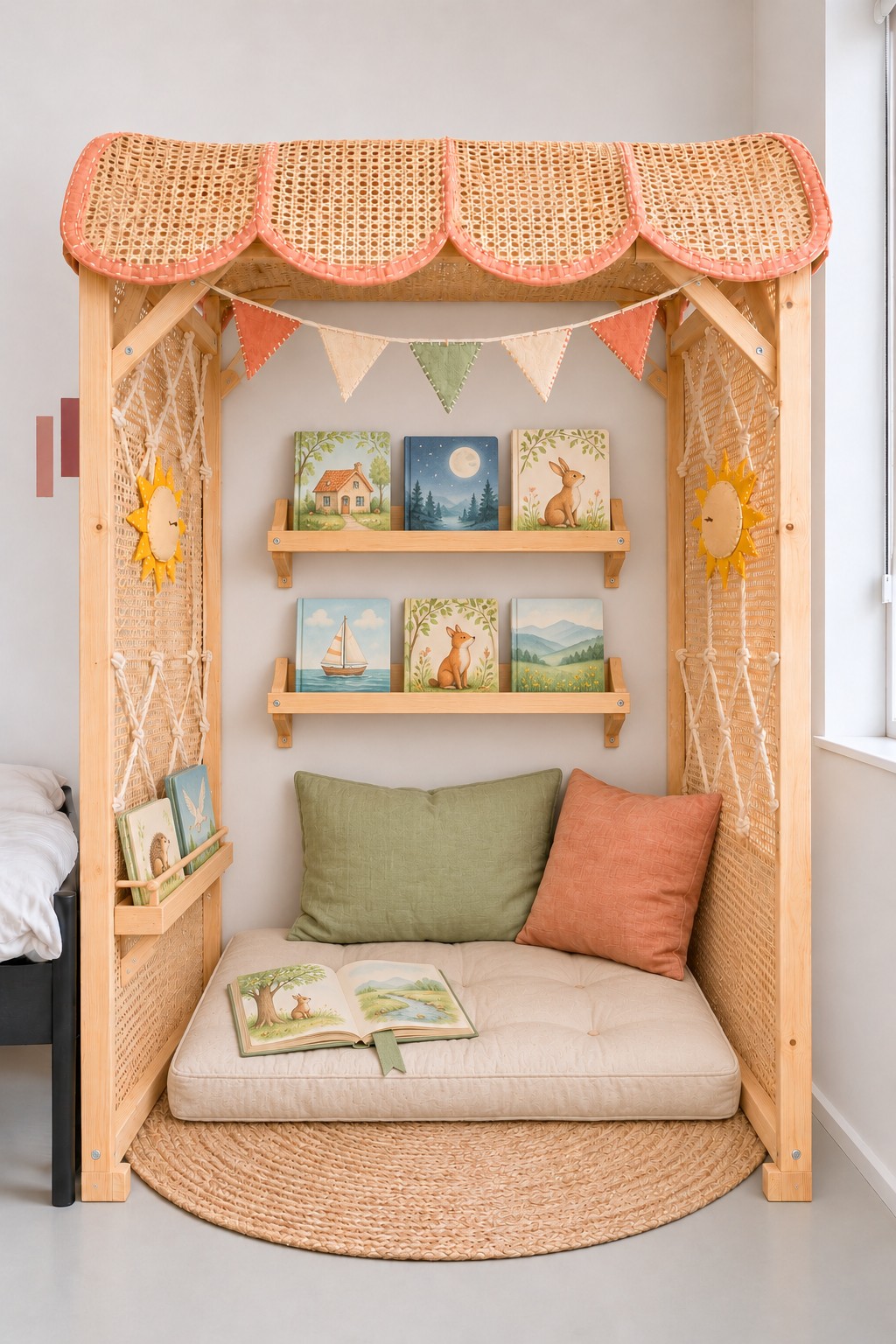
This open frame proves that a reading corner can feel sheltered without hiding the child. Pine posts carry a scalloped roof of cane webbing bound in coral fabric, and the sides combine cane with macrame rope netting that lets light pass through. Two book ledges on the back wall and a third fixed to the post show covers instead of spines, so the books themselves become the decoration.
Soak cane webbing in warm water for about half an hour before stretching it; as it dries it shrinks and pulls tight across the frame. Staple it to the back of the frame and hide the staples under a fabric binding. Ledges about 8 cm deep with a raised front lip keep picture books upright, and felt suns plus a fabric bunting finish the sunny, warm palette.
4. Felt Patchwork Reading Corner
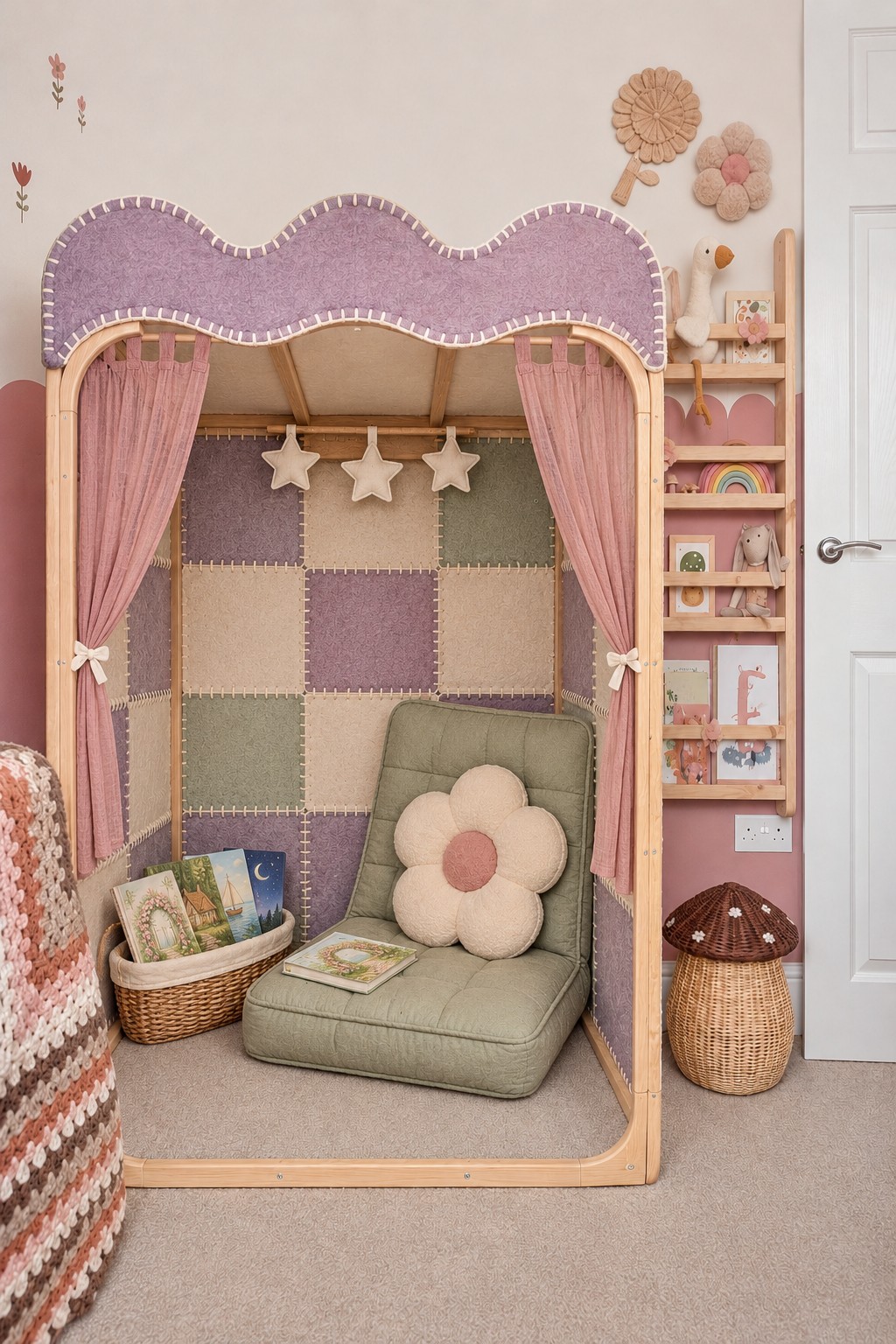
Squares of thick felt in lilac, sage and cream, edged with a contrasting blanket stitch, line a rounded wooden frame like a quilt you can lean against. Felt absorbs sound, so this corner is noticeably quieter than the rest of the room, which makes it a good fit for an older child who likes to read alone. A wavy felt pelmet, three felt stars on a dowel and pink curtains tied with bows keep the look soft.
Cut the squares from felt 3 to 5 mm thick, blanket stitch around each one, then fix them to thin plywood backing boards with spray adhesive before screwing the boards inside the frame. Wool or wool blend felt pills far less than thin craft felt. A folding floor chair gives proper back support, something a flat cushion never quite manages during a long chapter.
5. Storybook A Frame Cottage with Picture Ledges
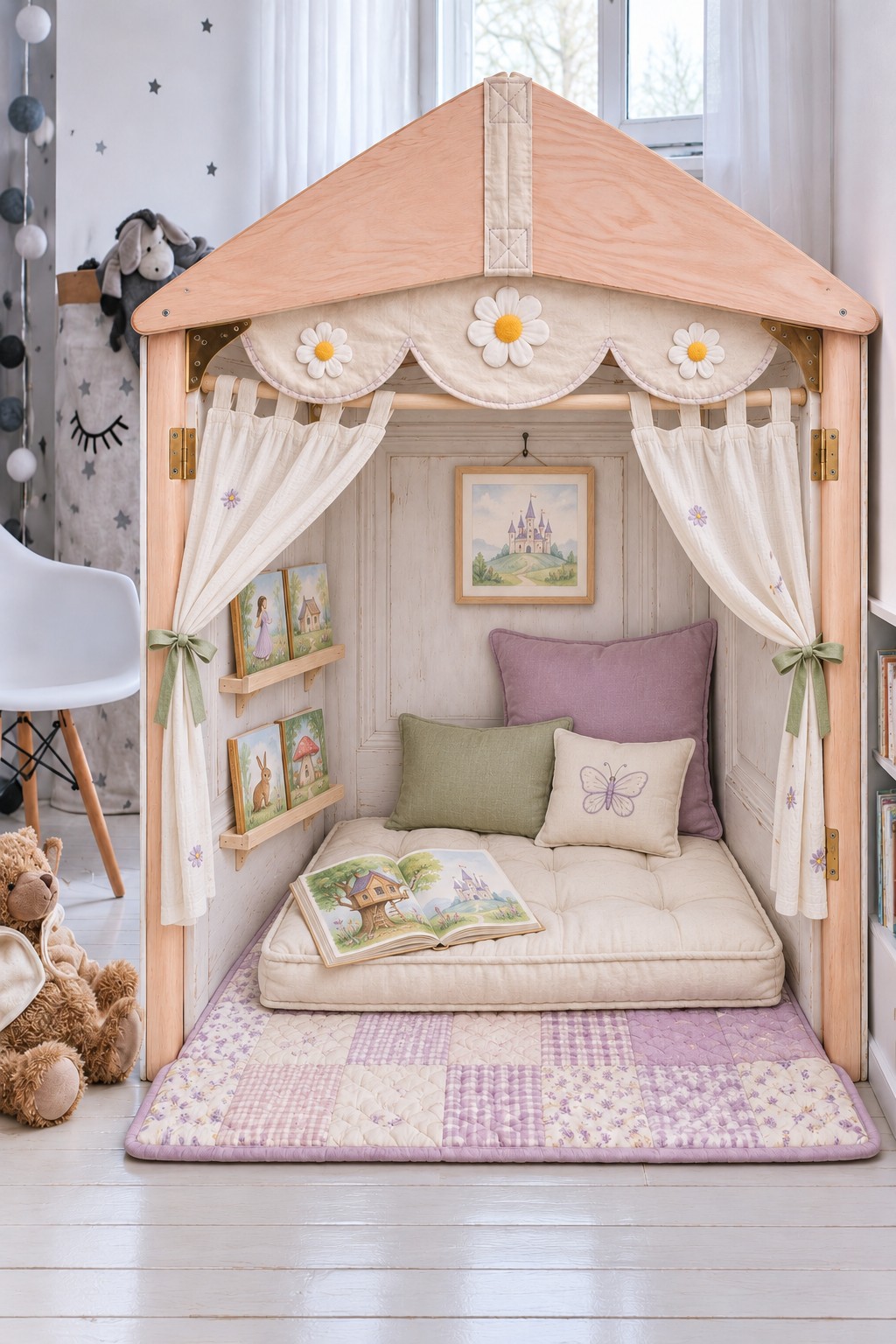
A blush stained plywood gable, a scalloped valance dotted with fabric daisies and sheer embroidered curtains turn a narrow alcove into the first page of a fairy tale. Small picture ledges on the side wall and a framed castle print make the inside feel like a tiny room rather than a box. If the rest of the bedroom follows the same story, these storybook children's bedroom ideas carry it further.
Two plywood roof panels meet over a pair of upright posts, braced at the eaves with brass brackets, and the brass hinges on the side posts add a cottage detail of their own. Seal the plywood with a water based stain and clear coat and let it cure before the curtains go up. A patchwork quilt laid in front of the opening pulls the nook into the room and protects the floor.
6. Flower Petal Canopy Full of Plush Friends
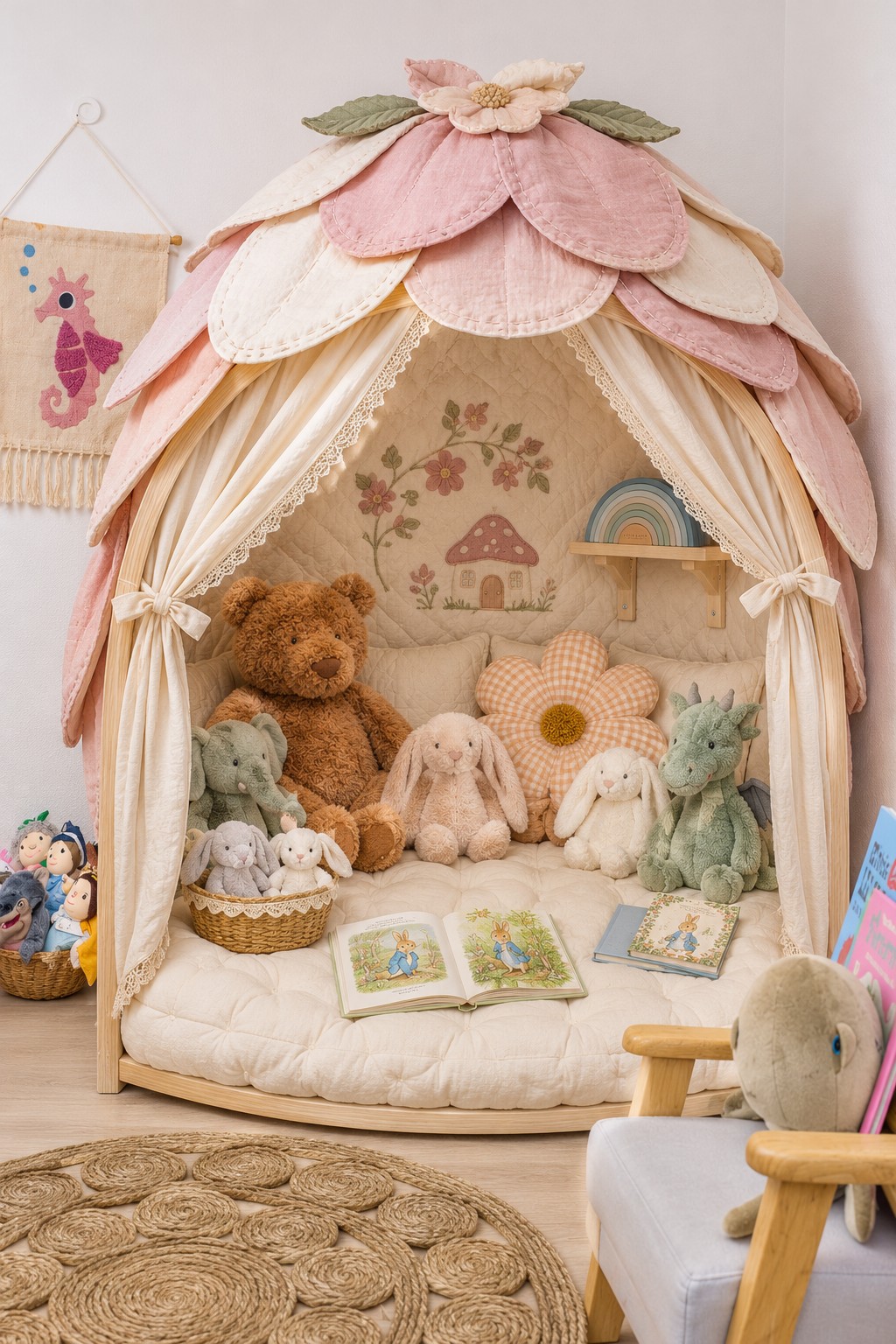
Overlapping quilted petals in blush and cream form the roof of this canopy, crowned with a fabric flower, so the whole nook reads as a blossom from across the room. Inside, a quilted back panel embroidered with a mushroom house and a deep mattress leave space for an entire collection of soft toys, which is exactly how many small children like to read: surrounded by an audience.
Each petal is two layers of cotton with thin batting between them, stitched around the edge and quilted with a few lines. Sew them in rows onto a fabric dome stretched over a bentwood frame, starting at the bottom so every row overlaps the one below. The same layering technique, on a much smaller scale, appears in these felt flower decorations if you want matching pieces for the wall.
7. Puzzle Foam Tile Tent
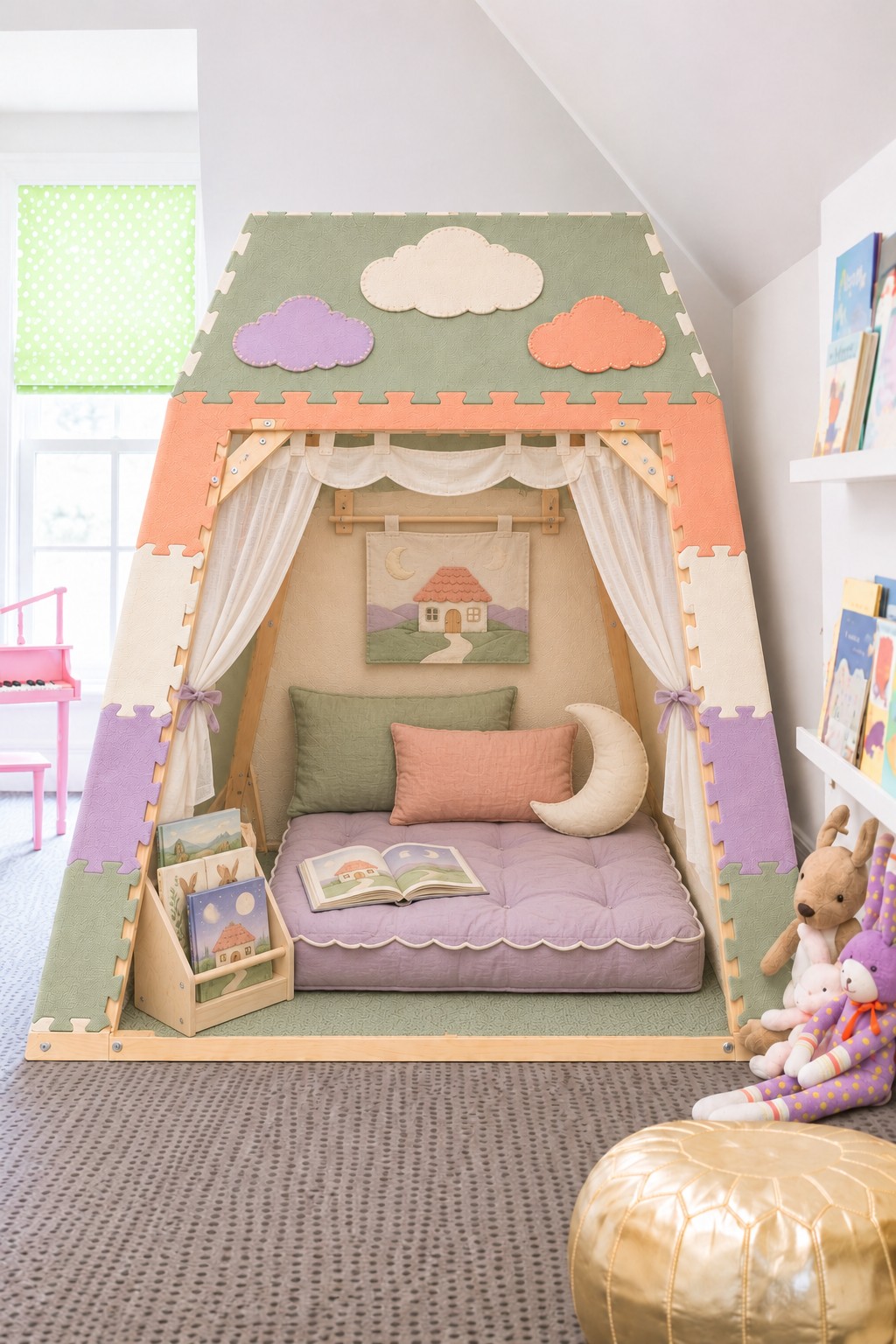
Interlocking foam floor tiles, the kind sold as play mats, become the walls of this A frame tent. Their jigsaw edges turn into a playful border in peach, cream, lilac and sage, felt clouds float across the roof, and the foam keeps every surface soft to bump into. The low triangular shape slips neatly under a sloping ceiling, a handy trick if you are working on one of these attic room themes.
Build a timber A frame and screw the tiles to it with wide washers under the screw heads so the foam cannot tear, or use hook and loop strips for a cover that lifts off. Lay the colors out on the floor first and fix nothing until the pattern pleases you. Sheer curtains on a dowel soften the opening, and a padded mattress with scalloped trim makes the floor as inviting as the walls.
Natural and Woodland Dens
Wicker, bamboo, reed and leaf shapes bring the outdoors into a bedroom and age gracefully, because natural textures look even better slightly worn. They also sit comfortably beside wooden toys, linen and muted colors.
8. Woven Willow Dome with Felt Vines
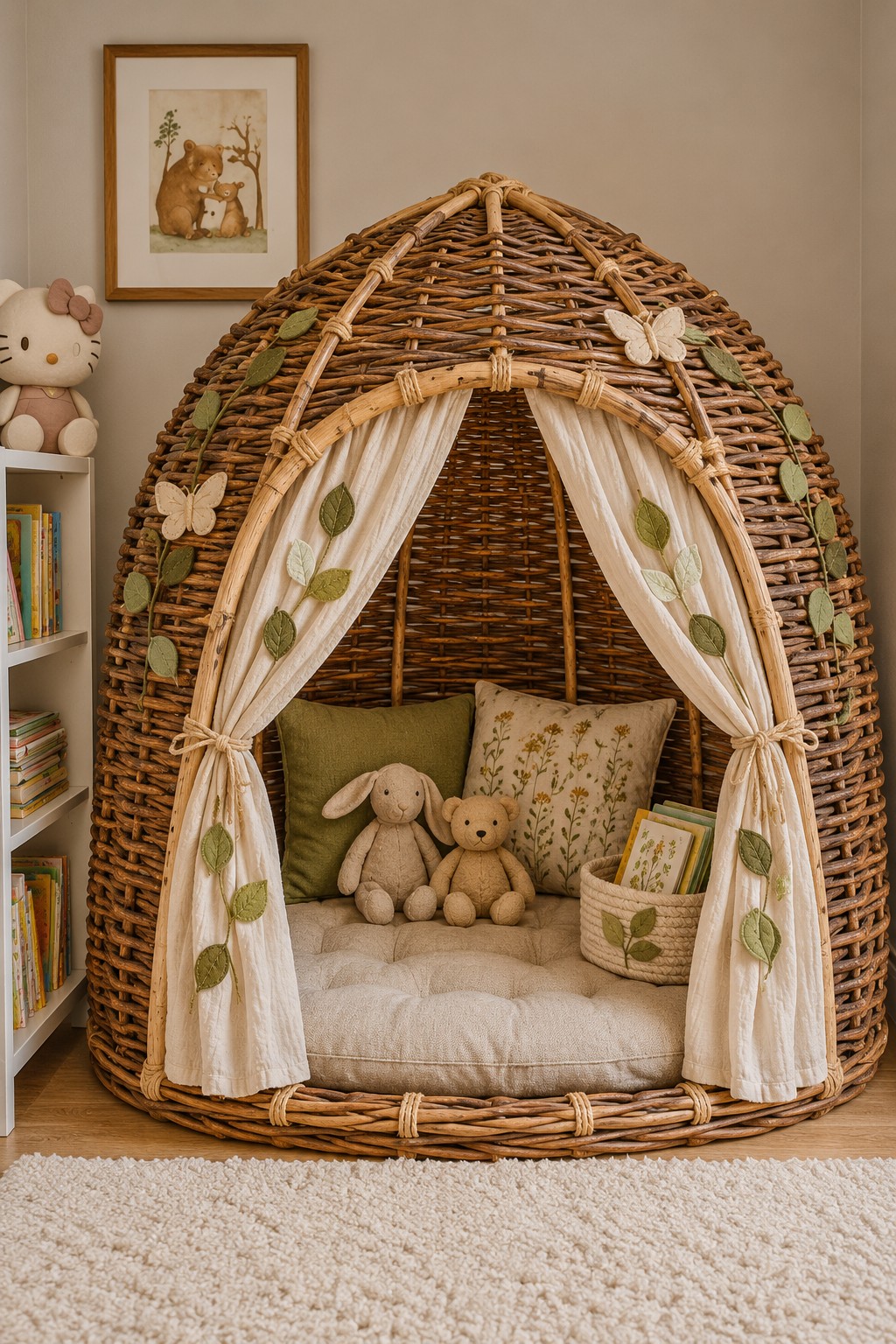
A tall dome of woven wicker feels like a nest a child can climb into. Linen curtains tied back with jute, felt leaf garlands climbing the frame and a couple of felt butterflies keep the decoration light so the weave stays the star. It adds a strong organic texture to a room furnished in white and pale wood, and it looks just as good when nobody is playing in it.
Large woven domes are usually bought from basket makers or sold as hanging chair shells; weaving one at home means working willow rods around a cage of thicker rods and lashing the joints with cane, which is slow but deeply satisfying. Check the inside for broken ends and trim them flush, then rub beeswax over any rough patch. A thick floor cushion and a small basket of books are all it needs.
9. Reed Beach Hut with a Fishing Game
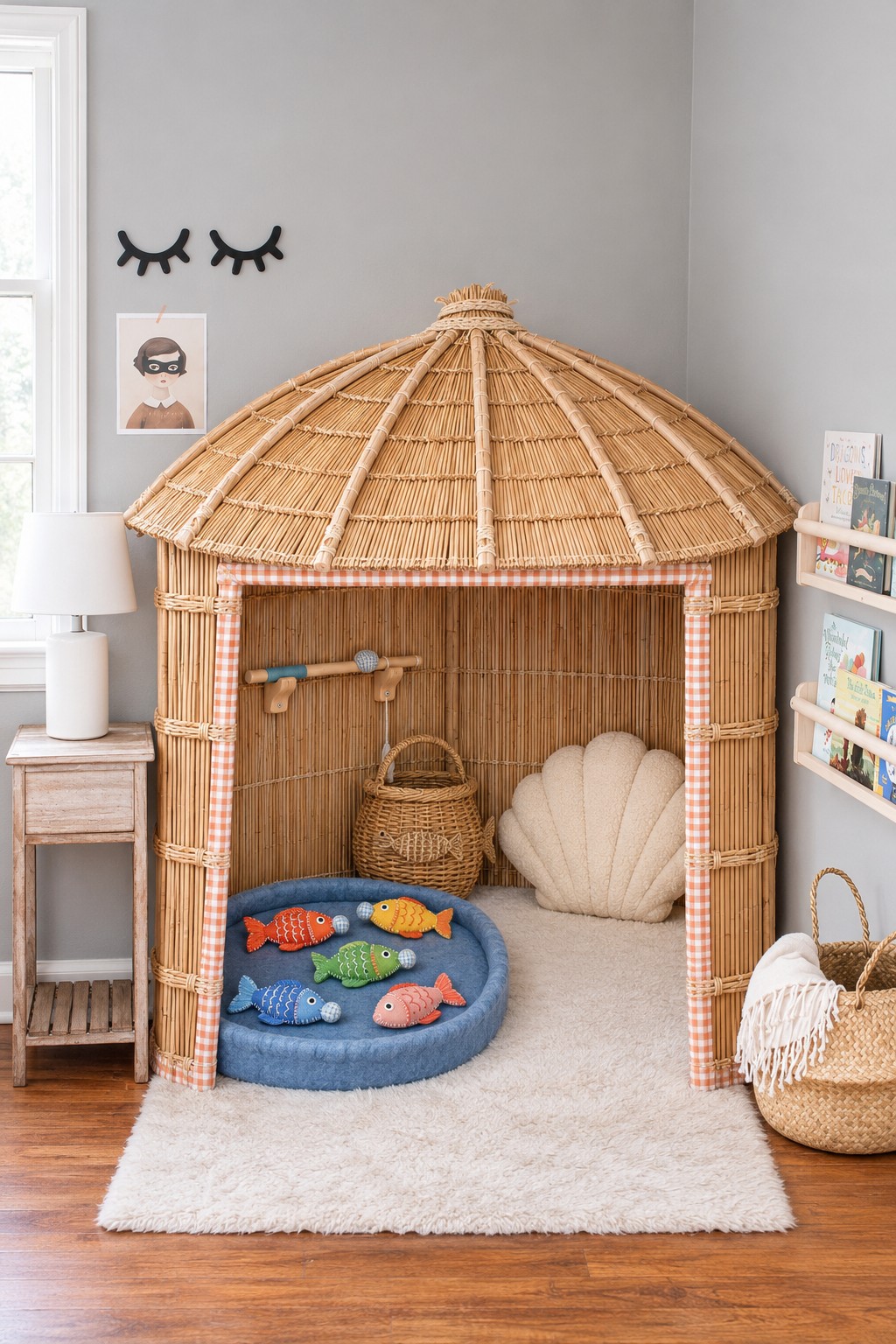
Reed walls and a thatched cone roof give this corner hut the easy feel of a beach shelter. A gingham binding trims the doorway, a shell shaped cushion leans against the wall and a shallow felt pond holds fabric fish waiting for the little rod hanging on its pegs. It turns a quiet corner into a simple game that toddlers return to again and again.
Reed fencing, sold in rolls for gardens, wraps easily around a timber frame and can be stapled on from the inside, while the roof can be a ready made reed umbrella top. Bind every cut edge with fabric tape, because cut reed ends scratch. A hook on the rod and fabric loops on the fish work just as well as magnets; if you do use magnets, sew them deep inside the fish so they can never work loose.
10. Bamboo Pony Stable
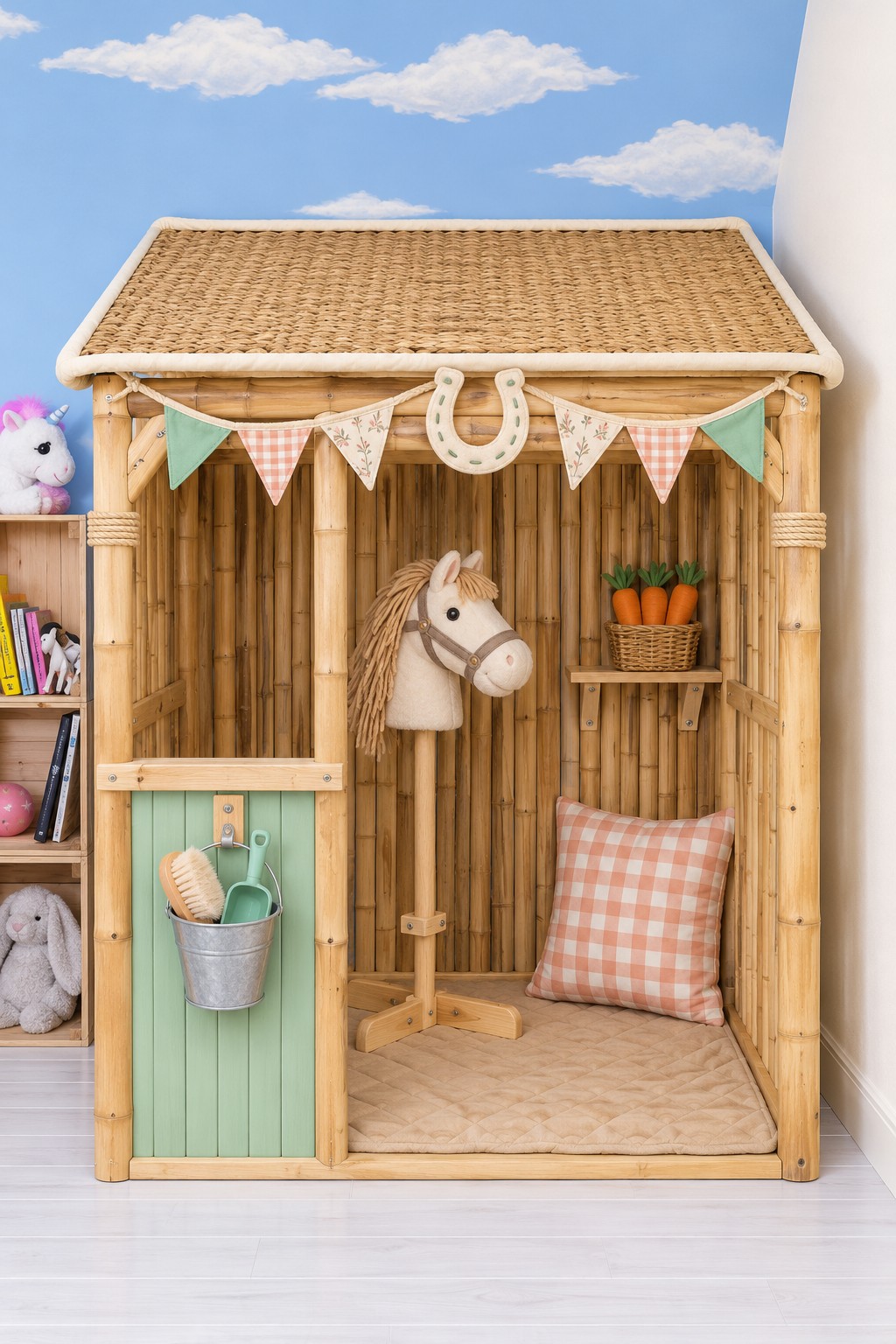
For a horse loving child, this stable delivers the whole routine: a hobby horse in its stall, a grooming bucket with a brush, felt carrots on a shelf and a horseshoe above the door. Thick bamboo poles form the frame, thinner poles line the walls and a woven seagrass roof sits on top, while a mint green half door gives it the unmistakable look of a real stall.
Bamboo splits easily, so wrap masking tape around each drilling spot, drill a pilot hole at medium speed and keep screws away from the very ends of a pole. Rope lashings at the corners are both structural and decorative. A quilted mat on the floor keeps the hay strictly imaginary and the riding comfortable.
11. Leaf Canopy with a Woodland Animal Shelf
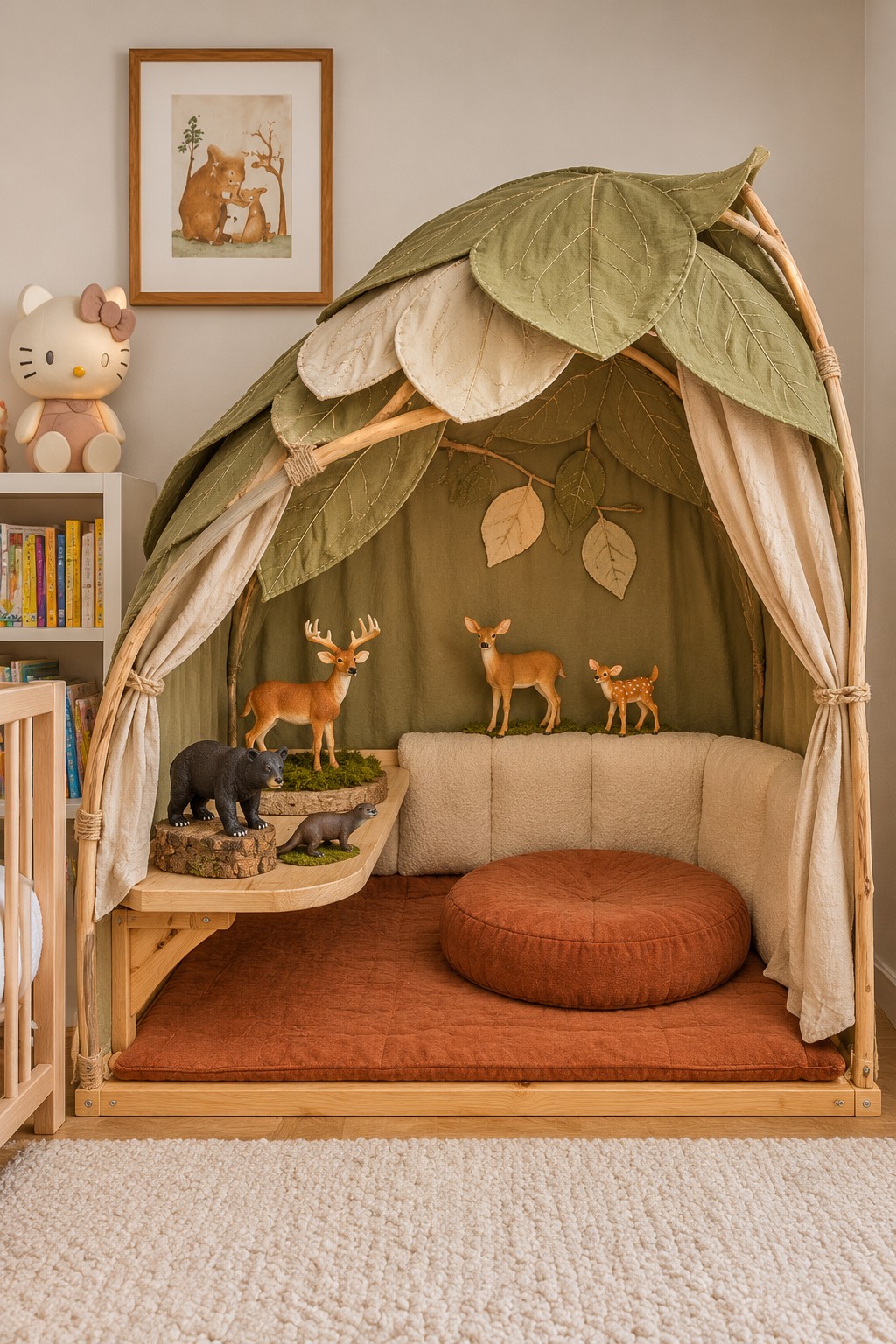
Large fabric leaves layered over a curved wooden frame create a canopy that looks like the edge of a forest. Inside, a moss green back panel, a curving shelf of animal figures standing on wood slices and a terracotta floor cushion build a quiet woodland scene. It suits children who line up their figures and invent long stories for them.
Cut each leaf from two layers of cotton or felt and machine stitch the veins; a layer of stiff interfacing inside helps the leaves hold their shape without anything hard or sharp. Tie or stitch the leaves to the frame instead of gluing, so the canopy stays washable. A shelf at sitting height, fixed to the frame with brackets, keeps the figures off the floor where they get stepped on, and a scrap of felt moss on each wood slice gives every animal its own little base.
12. Soft Stone Cave for Dinosaur Explorers
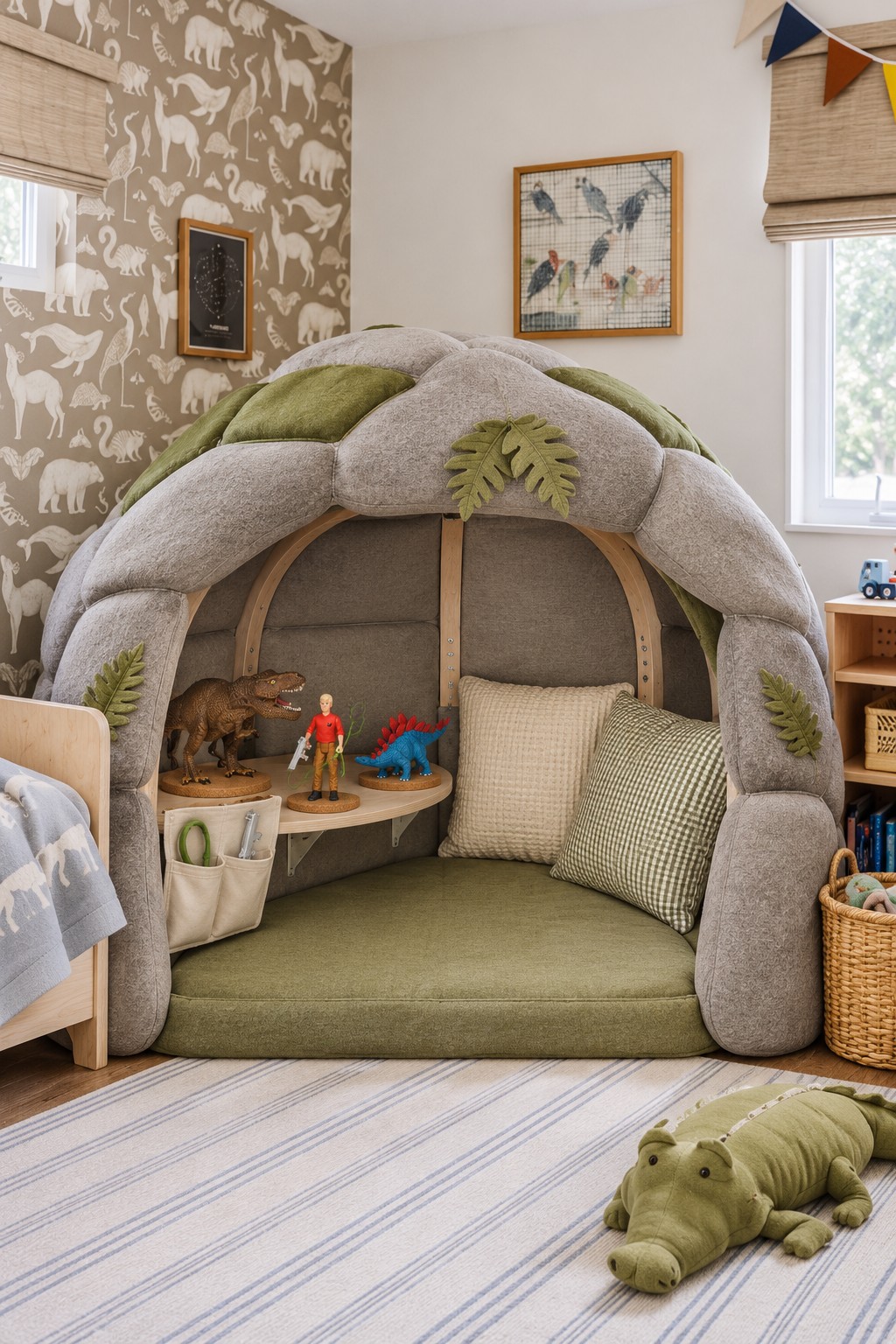
Padded grey cushions shaped like boulders, patched with green moss and felt ferns, arch over a wooden frame to form a cave that is soft from every side. On a curved shelf, dinosaur figures stand on cork rounds beside a small explorer, and canvas pockets hold field tools for the next expedition. The grey and olive palette blends with natural wood furniture and an animal print wallpaper.
Each boulder is a fabric tube stuffed with polyester fiberfill and sewn shut, then tied to the bentwood arches with fabric ties so it can be removed and washed. A nubbly bouclé or textured upholstery fabric reads convincingly as stone. Cork rounds under the figures stop them sliding and protect the shelf finish.
Upcycled and Low Cost Builds
Some of the most loved playhouses begin as packaging or leftovers. Cardboard, pallets, crates, old drawers and worn jeans cost little, can be repainted when interests change, and make good shared projects with older children. If that kind of making appeals, these recycling projects for kids are a natural next step.
13. Painted Cardboard Cottage
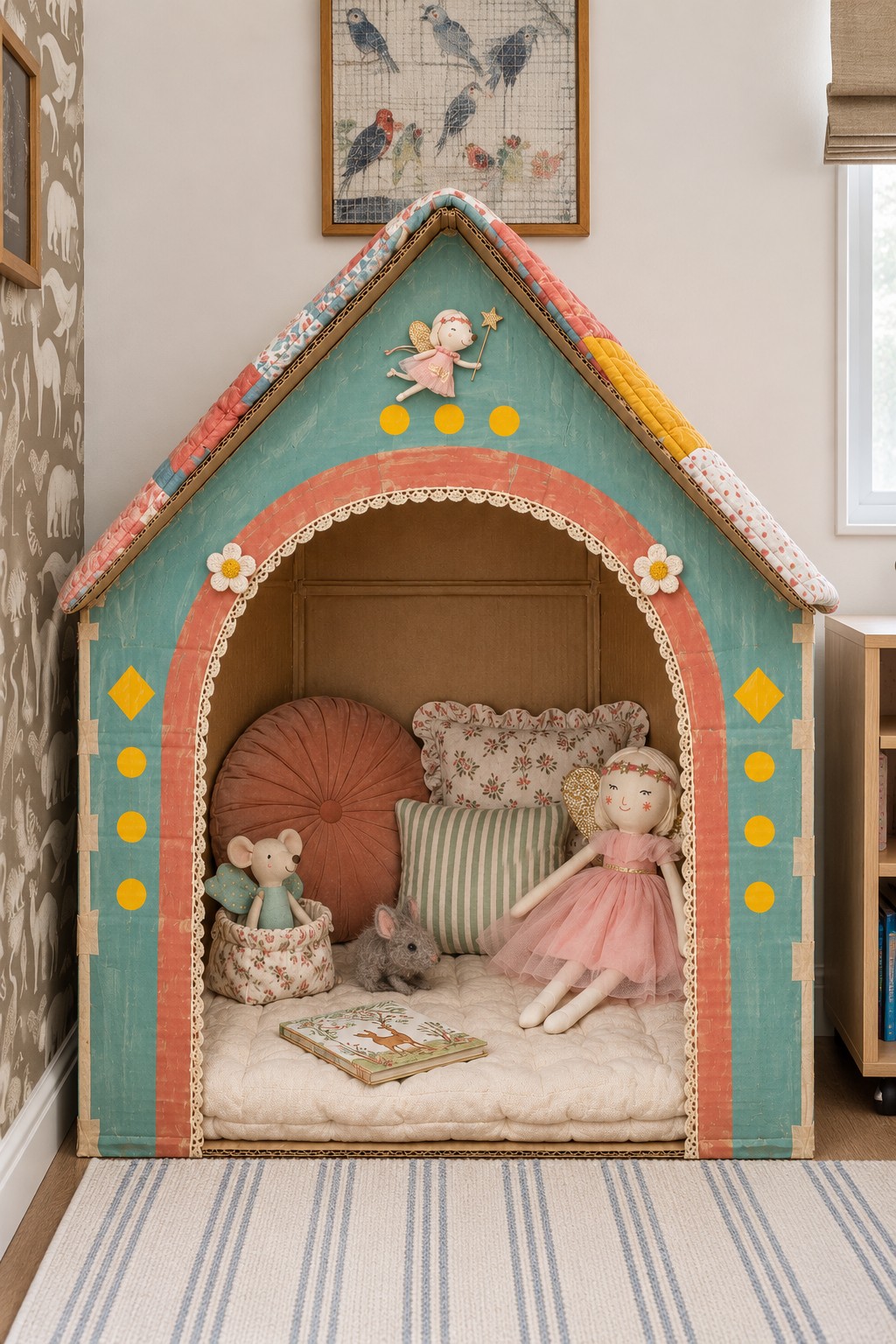
A large appliance box becomes a cottage with a pitched roof, a coral arched doorway on a teal front, yellow dots and diamonds, and a patchwork fabric roof. Crochet trim around the arch hides the cut cardboard edge and makes the whole thing look finished. It is a weekend project, cheap enough to replace when it wears out, and a very satisfying painting job for a preschooler.
Use double wall corrugated cardboard if you can find it, and reinforce the inside corners with extra cardboard strips glued with PVA. Prime with a coat of white acrylic or emulsion so the colors sit evenly, then paint. Fix the fabric roof with spray adhesive and finish its edges with fabric tape. More ideas in the same humble material are collected in these DIY cardboard toys from boxes and tubes.
14. Cardboard Space Rocket with a Control Panel
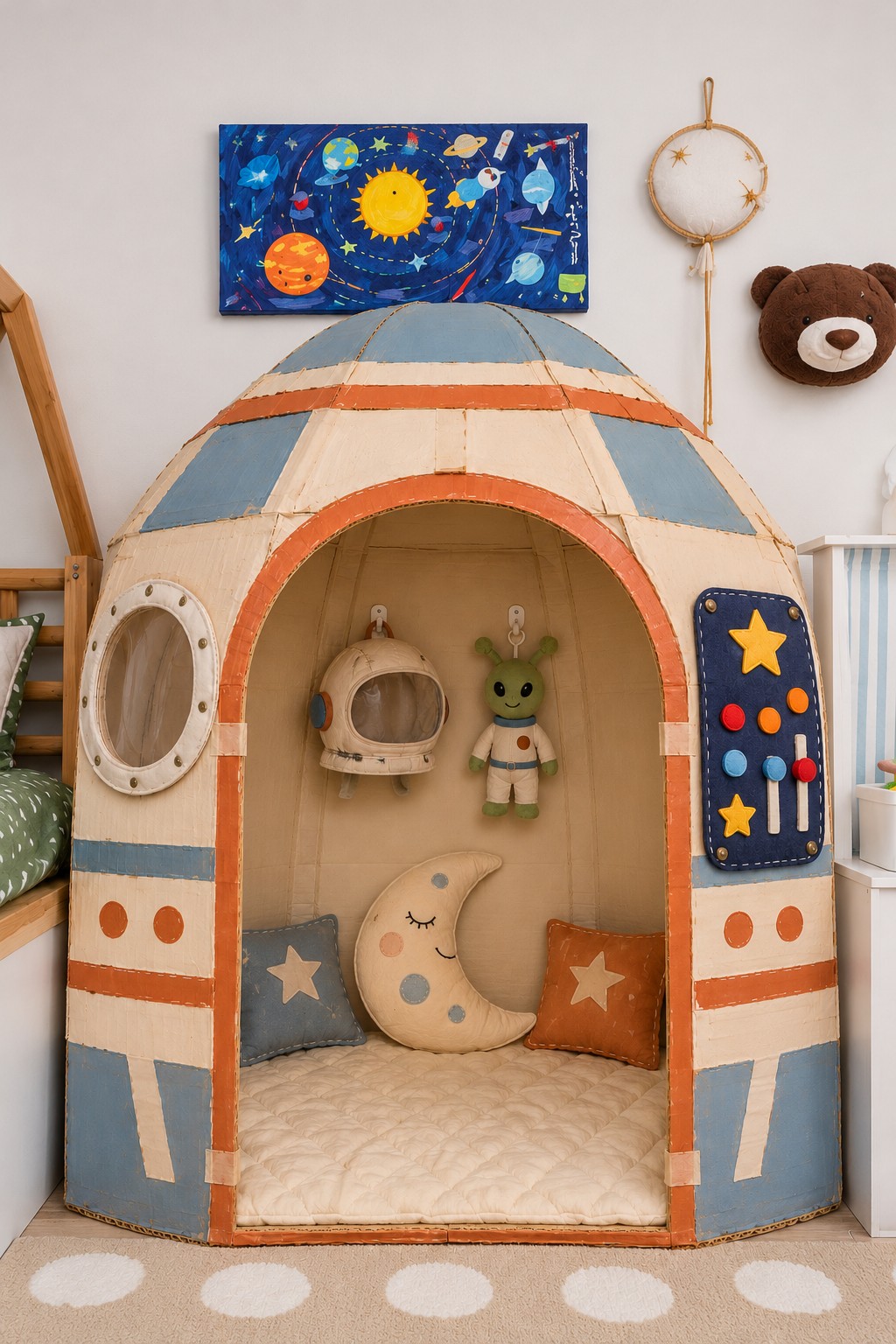
Curved cardboard panels painted cream with blue and orange bands form a rocket nose a child can sit inside. A porthole window, a felt control panel with buttons, two sliders and stars, a hanging astronaut helmet and a small alien plush make it a launch pad for long stories. Placed under a space print on the wall, it anchors a whole theme on its own.
- Cut eight to ten tapered panels from large boxes and join them edge to edge with paper tape on both sides.
- Glue the panels over a few curved cardboard ribs so the dome keeps its shape.
- Frame a clear plastic disc with a thick cardboard ring for the porthole.
- Build the control panel on a separate felt covered board with hook and loop on the back, so it can be removed or swapped.
15. Milk Crate Vet Clinic
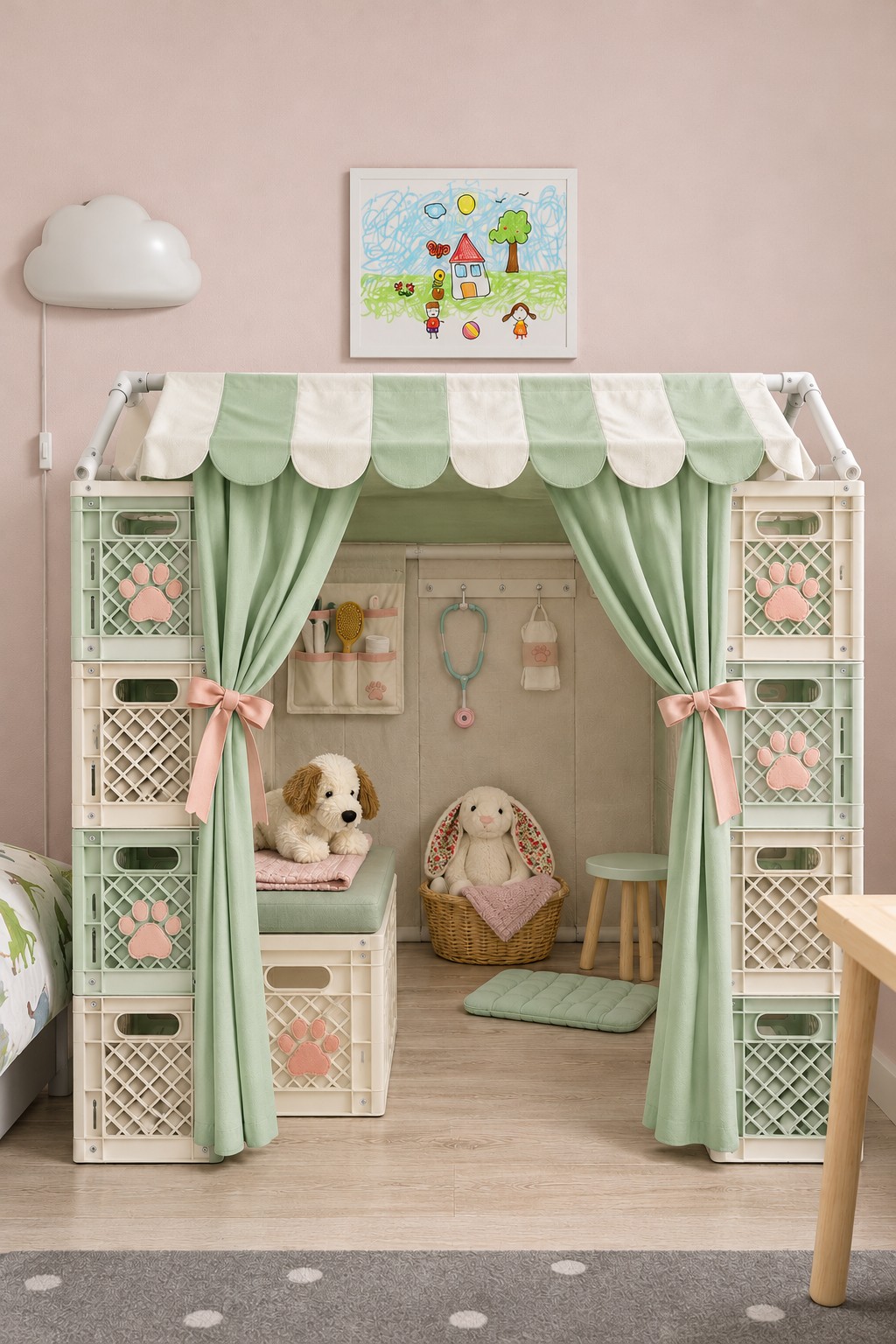
Stacked plastic crates form the walls of this animal clinic, with pink paw appliqués on the crate fronts, green curtains caught back with bows and a scalloped awning on a light pipe frame. Inside, a stethoscope and a small medical kit hang on the back wall, a toy puppy rests on a cushioned crate bench and a bunny waits in its basket. Animal lovers play here for long stretches, and the crates quietly double as toy storage.
Join the crates with cable ties at no fewer than three points on every touching side, or bolt them together with washers for a permanent build, and keep the stacks low and wide. White plastic pipe with corner connectors makes a light roof frame that needs no tools. Trim each cable tie tail flush with side cutters, because a snipped end left long is sharp.
16. Pallet Market Stall and Puppet Stand
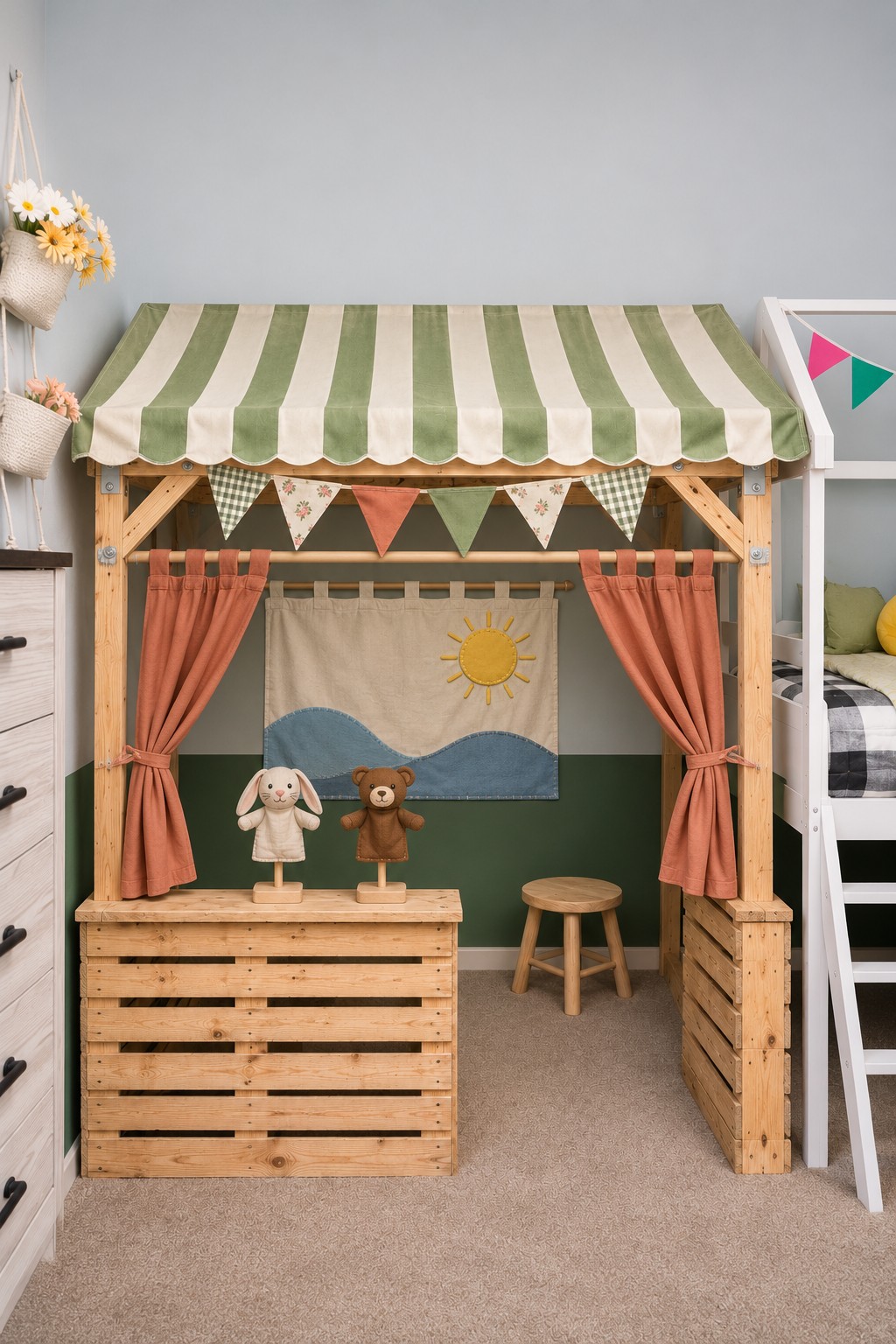
Pallet boards build a counter and a side wall, braced timber posts hold a scalloped green and cream awning, and rust colored curtains frame a fabric banner with a sun rising over waves. With two hand puppets on stands at the counter, the stall works as a market one day and a puppet show the next. The raw wood and soft stripes suit a calm, natural style room.
Choose only heat treated pallets stamped HT, never chemically treated ones, then sand every board and round over the edges before assembly. Screw the pallet sections to the posts and tie the posts together with a crossbar under the awning so the frame stays square. For more ways to put pallets to work inside the house, these indoor pallet projects are worth a look.
17. Dresser Drawer Garage with a Workbench
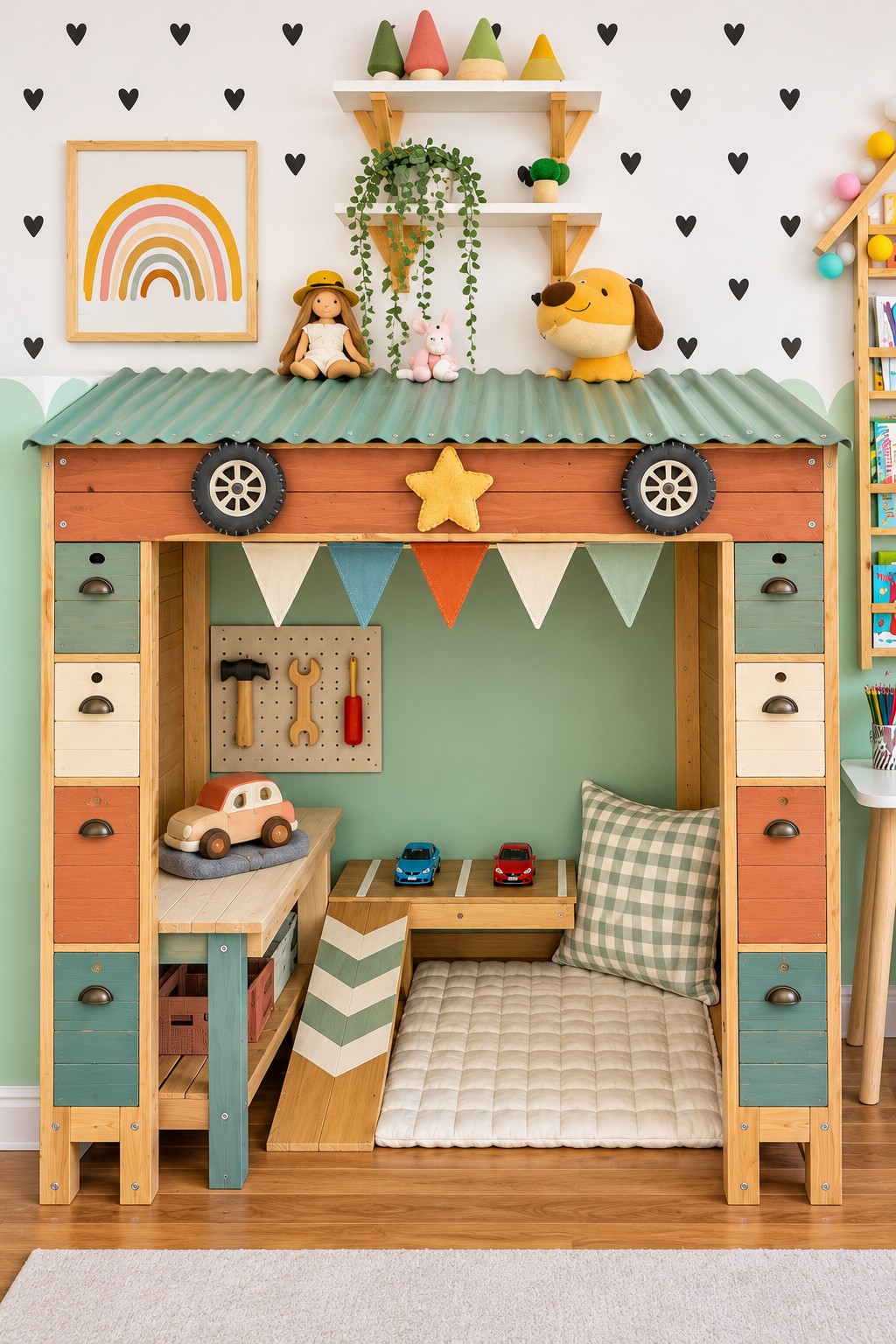
Old drawers painted rust, teal and cream, stacked into two columns, form the walls of a little garage where every drawer still opens. A corrugated metal roof, two toy tires on the fascia and a bunting under the beam set the scene, while a pegboard of tools, a workbench, a striped ramp and parking slots for toy cars keep busy hands occupied. The flat roof doubles as a display shelf for dolls and plush toys.
Screw the drawer cases to a pair of vertical posts on each side, keep the original cup handles, and replace any missing drawer bottoms with thin plywood. Cut corrugated sheet with tin snips while wearing gloves, then file the cut edges and cover them with a wooden strip or a U shaped trim so no raw metal is exposed.
18. Denim Patchwork Art Studio
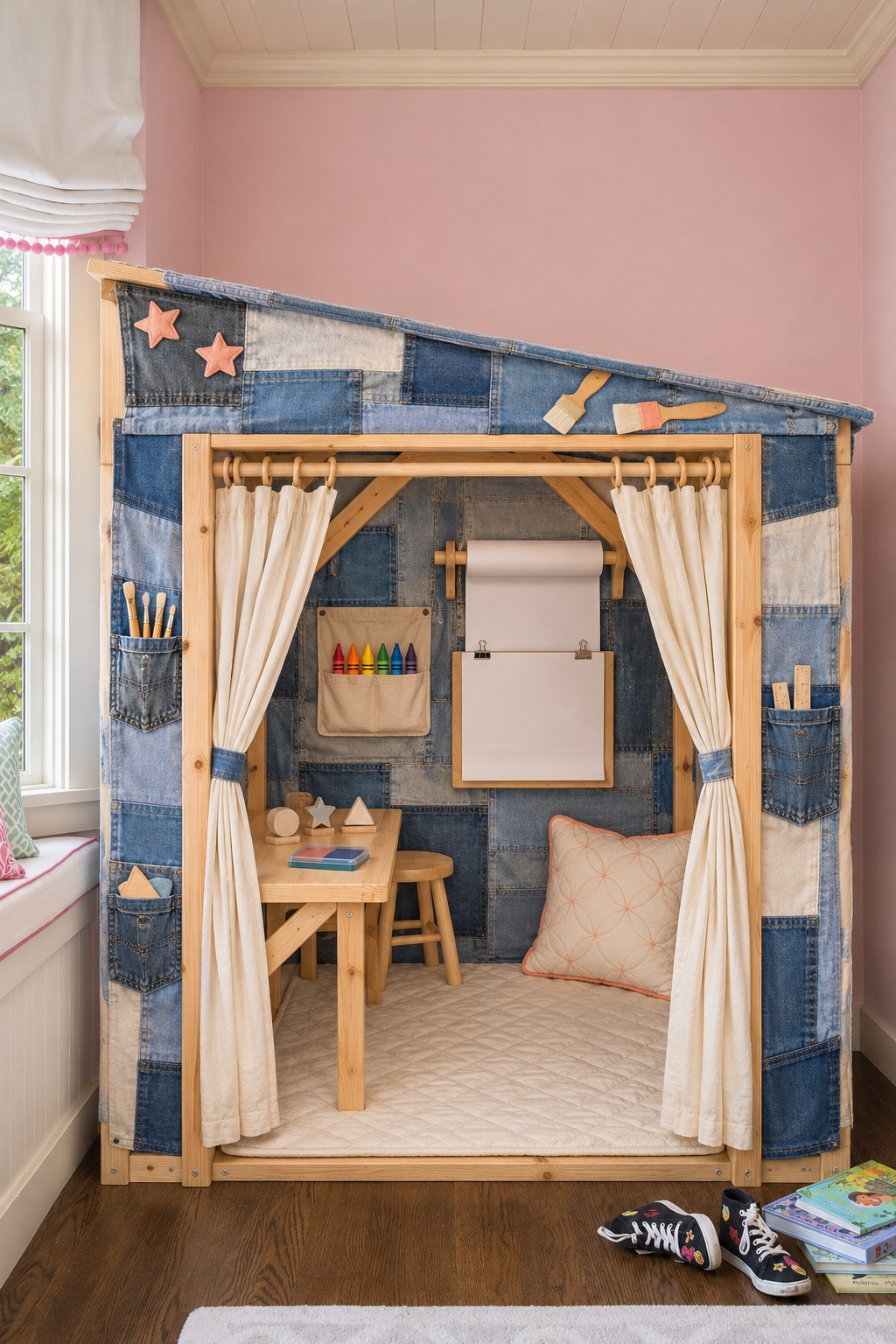
Squares cut from old jeans in every shade of blue cover a wooden frame with a slanted roof, and their back pockets become ready made holders for brushes, rulers and paper shapes. Inside, a paper roll, a crayon caddy and a small table turn the hideout into an art studio. Denim hides marks well, which matters in a corner where paint and crayons live.
Sew the squares into large panels with a denim needle, then staple the panels to the frame from the inside with an upholstery staple gun. Cut each pocket with a generous margin of fabric around it so it can be stitched on securely. Cream cotton curtains on rings soften all that blue and close the studio when the day is done.
Pretend Play Shops and Workplaces
Children copy the jobs they see around them, and a playhouse with a counter, a window or a few props gives that role play a proper stage. Keep props sized for small hands and store spares in baskets inside the structure so the game can start again tomorrow.
19. Cork Wall Post Office
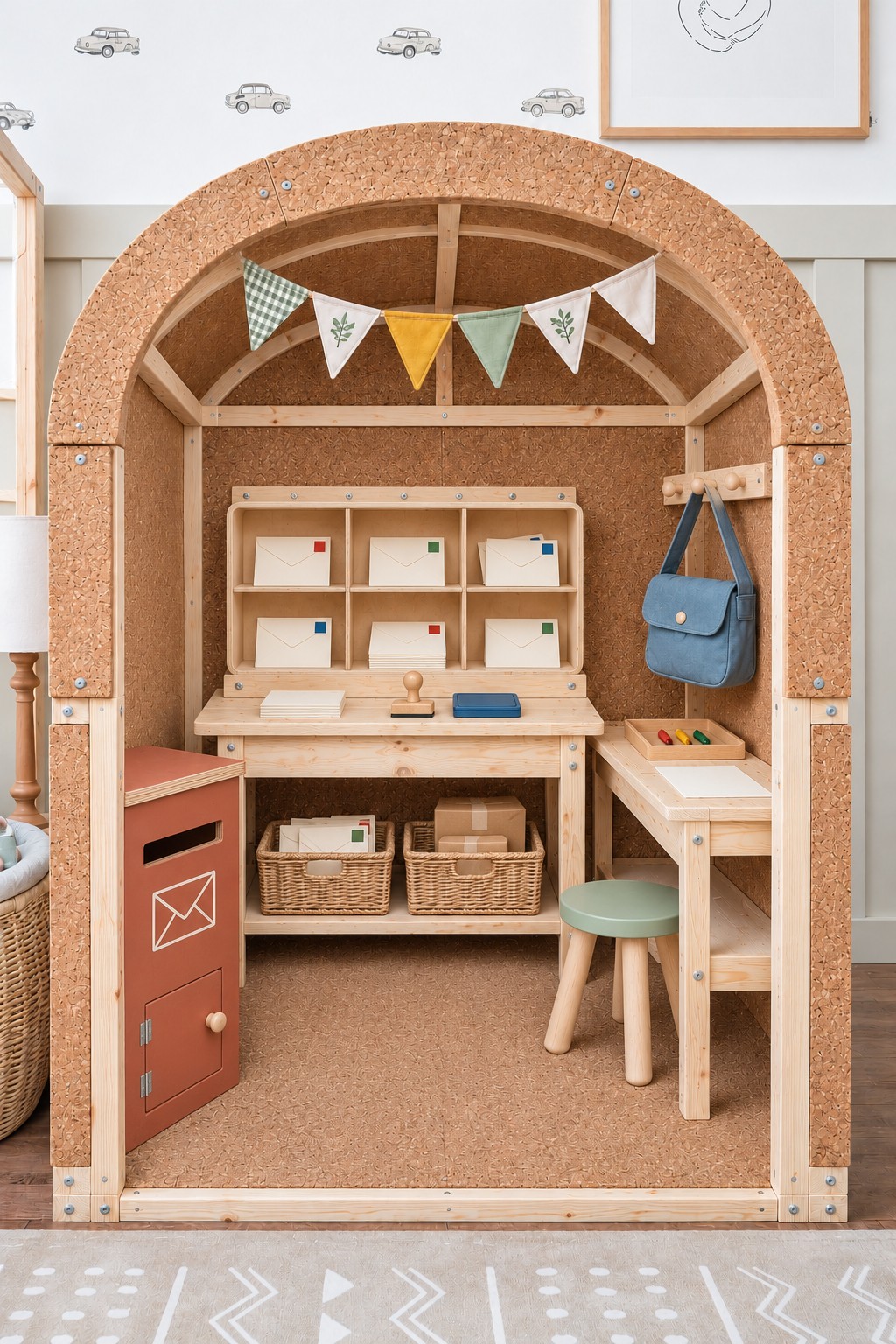
Thick cork panels screwed to a pine frame make the arch and walls of this post office, and the warm brown surface works as one giant pinboard. A sorting shelf holds envelopes marked with colored stamps, a wooden stamp and ink pad wait on the counter, a satchel hangs on a peg and a red post box stands by the door. Sorting letters by stamp color is an early learning game in disguise.
Use agglomerated cork board at least 10 mm thick, bonded with contact cement to plywood backing, and screw through it with large washers where it meets the frame. Metal mending plates at the joints, left visible here, are honest and strong. A child sized desk along the side wall adds a second station for writing addresses and drawing stamps.
20. Felt Letter Kiosk
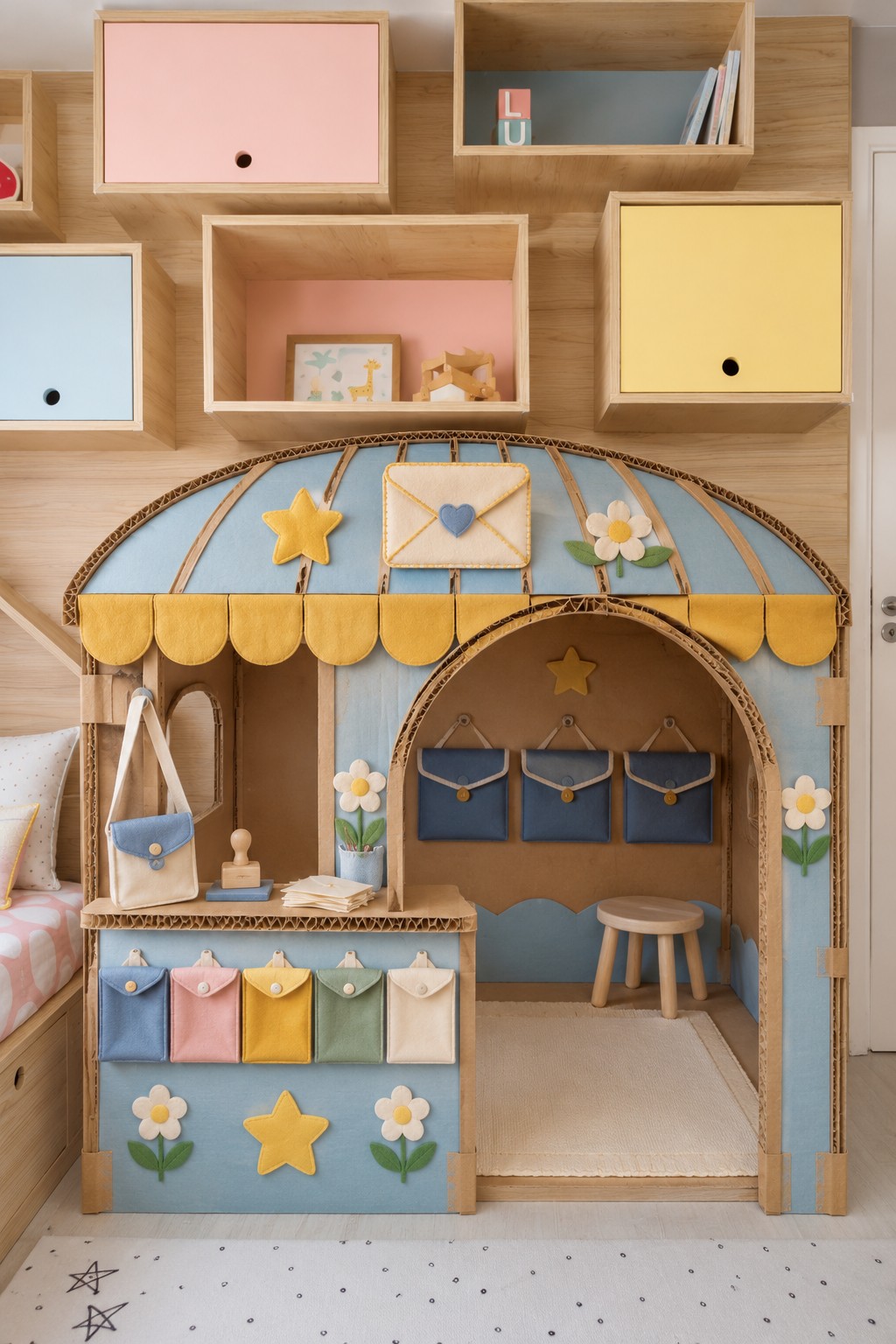
Where the cork post office is about sorting, this kiosk is about sending. A cardboard shopfront in pale blue with a yellow scalloped felt awning, felt flowers and a row of colored envelope pockets on the counter invites children to write, fold and post notes to siblings and parents. Three navy mail pockets inside the arch wait for deliveries, and a felt bag hangs ready for the rounds.
Each pocket is two layers of felt stitched on three sides with a buttoned flap, then glued to the front with hot glue. Cover every cut cardboard edge with a matching paper tape so it does not fray. Laminate a few name labels for the pockets so the family mail system can run for months.
21. Felt Cottage Doll Nursery
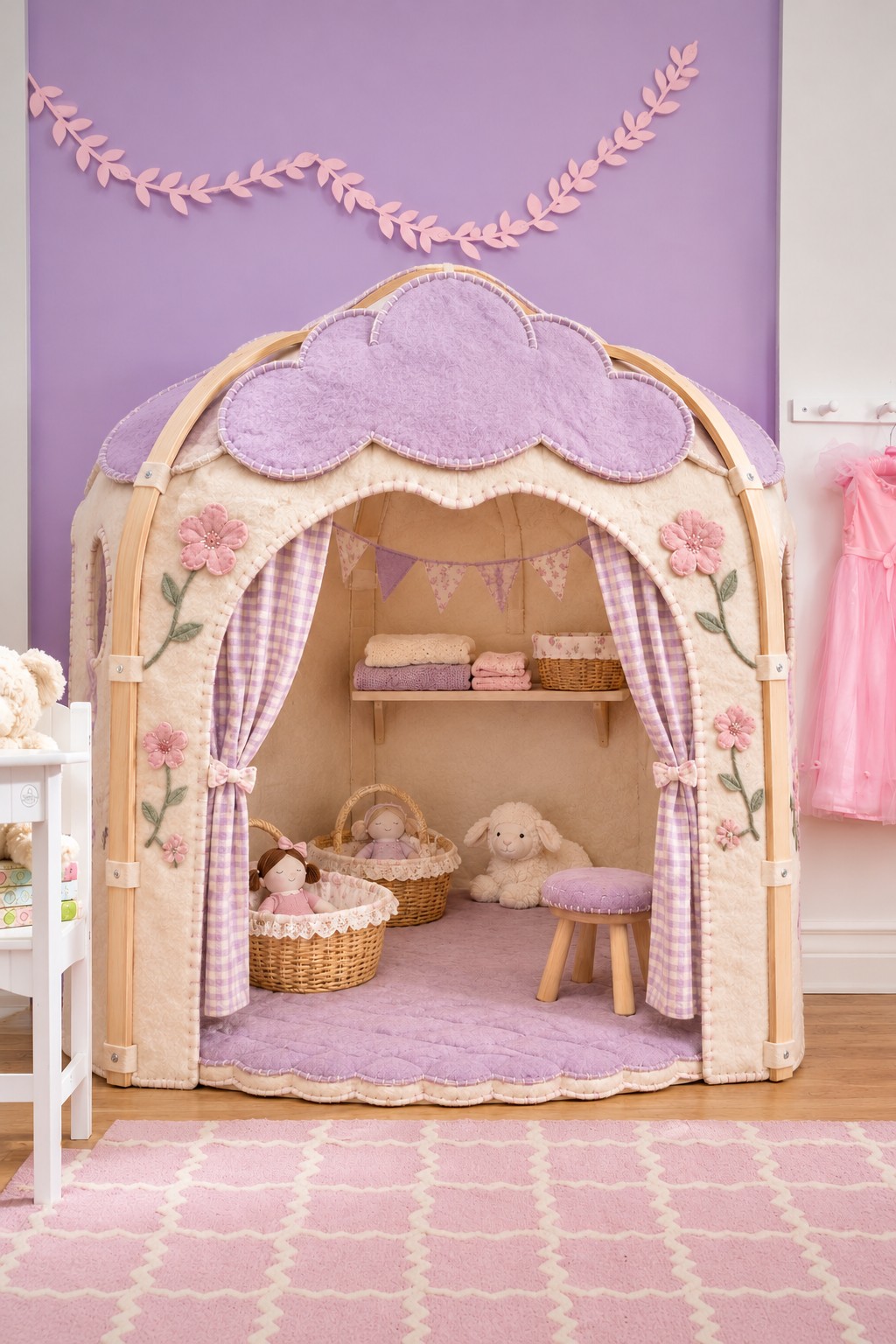
Cream wool felt panels embroidered with pink flowers stretch between arched bentwood ribs, and a lilac felt cloud sits on top like a roof. Gingham curtains with little bows open onto a doll nursery with basket beds, a cushioned stool, a lamb plush and a shelf of folded doll blankets. Caring for dolls is one of the earliest kinds of pretend play, and a setting like this makes it feel important.
Blanket stitch the felt panels around their edges and lace them to the ribs so they stay removable. Mount the shelf high enough that a child can sit beneath it, and fix it across two ribs rather than one. A lilac rug and a matching wall color make the nook look built in.
22. Pretend Laundry Corner with a Washing Machine
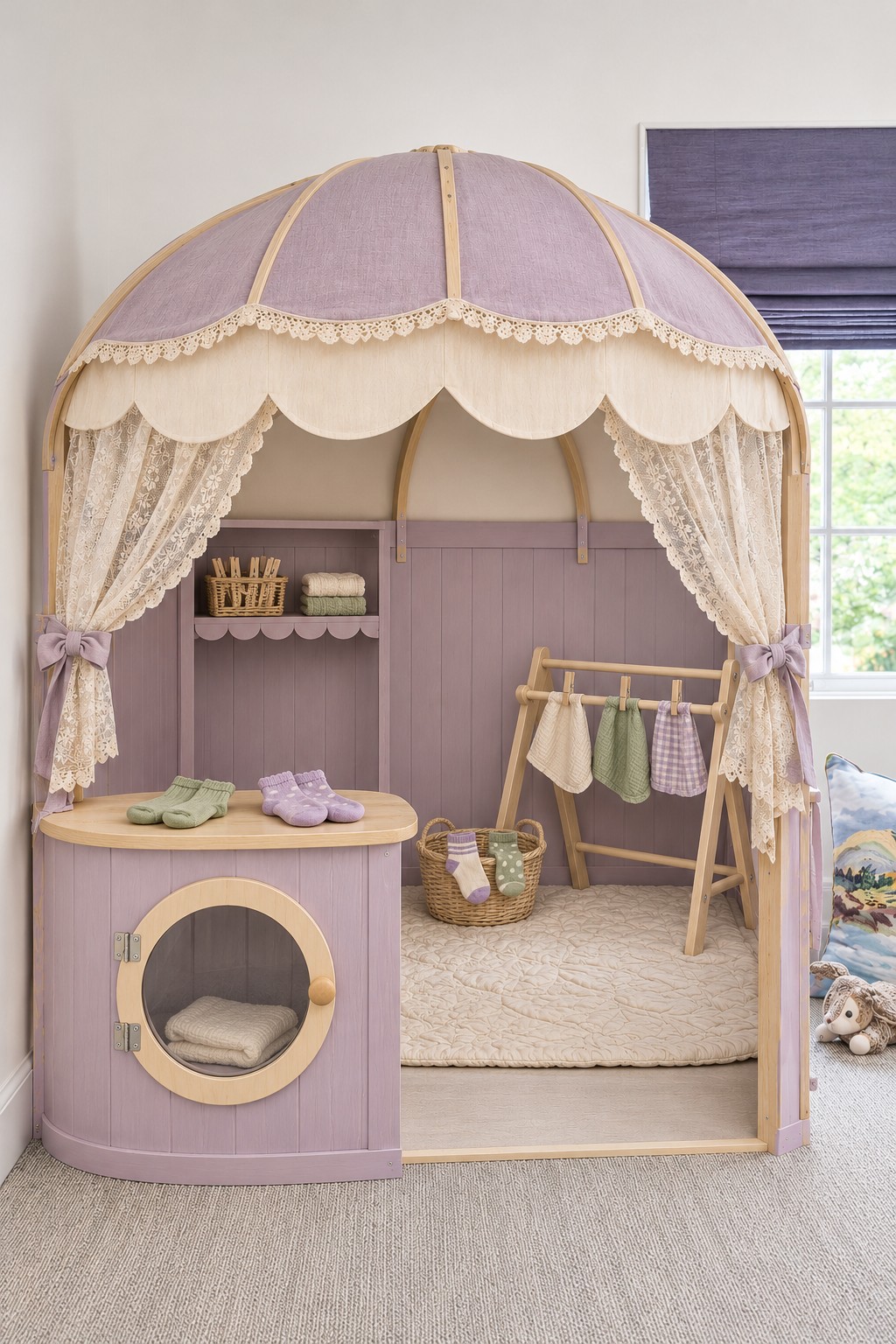
An arched wooden frame with a lilac fabric dome and lace curtains shelters a pretend laundry: a cabinet with a round porthole door, a small drying rack hung with tiny clothes, socks on the counter and folded cloths on a shelf. Children love copying household routines, and pairing socks turns out to be surprisingly absorbing for a three year old.
Build the machine from plywood, cut the round opening with a jigsaw, frame it with a plywood ring and add a hinge and a wooden knob; a ball catch holds the door closed without pinching. Round the cabinet corners and paint it in a soft color. Real wooden clothes pegs on the rack add a fine motor task that feels like grown up work.
23. Mission Control Corner House
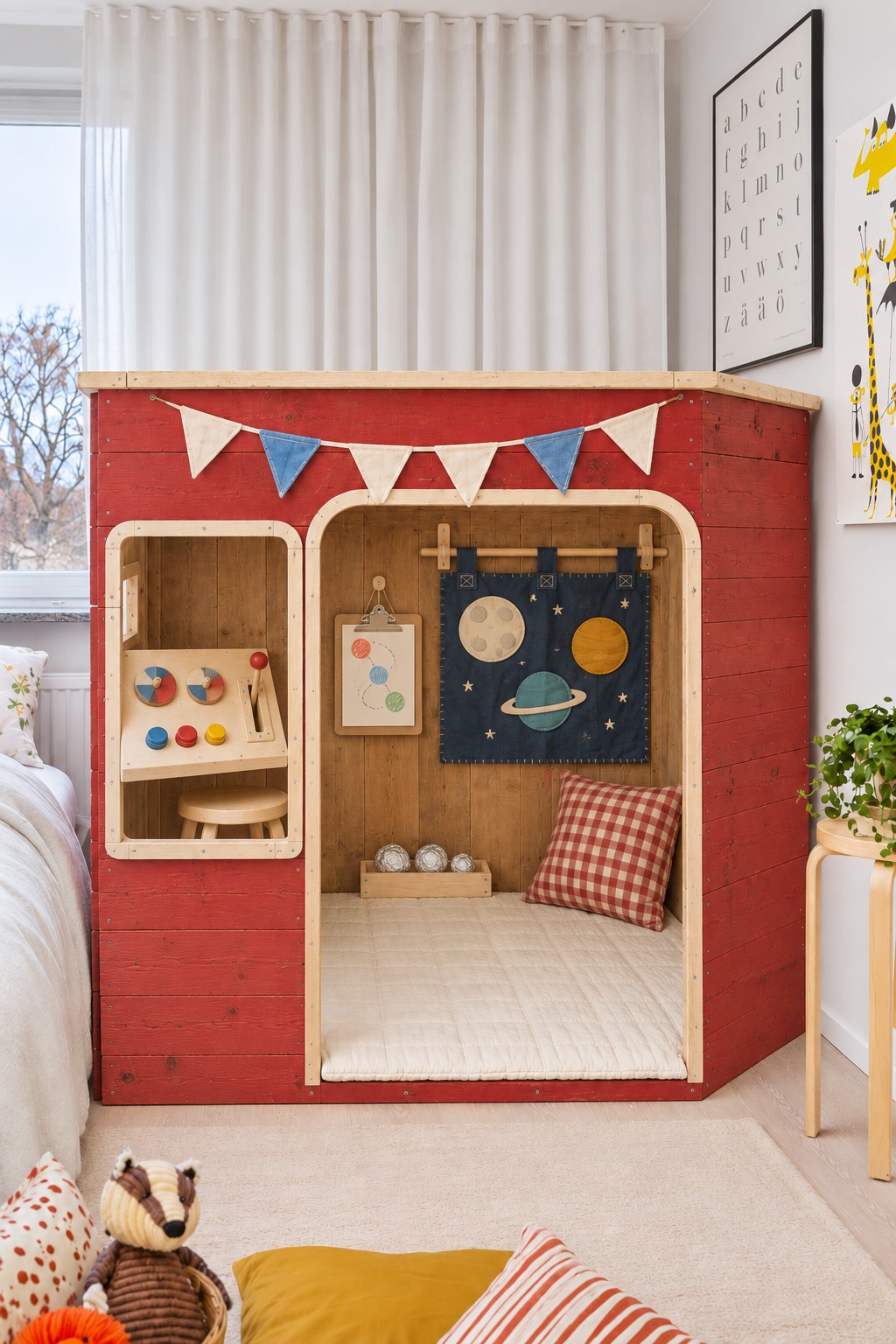
Red painted planks outside and warm wood inside make this corner house look like a small cabin, but its window holds a control panel with spinning dials, push buttons and a lever. A felt banner of planets and a clipboard flight plan on the back wall complete the mission control. Because it fits into a corner with an angled front, it uses less floor space than its size suggests.
Screw boards or tongue and groove cladding to a timber frame, and paint the outside before assembly so the inside stays natural. The panel is a slanted plywood board with turned wooden dials on bolts so they spin, chunky buttons glued on, and a lever moving in a routed slot. Round the corners of the window opening with a jigsaw and sand them smooth, because children lean on that ledge constantly.
24. Airplane Cabin with a Baggage Belt
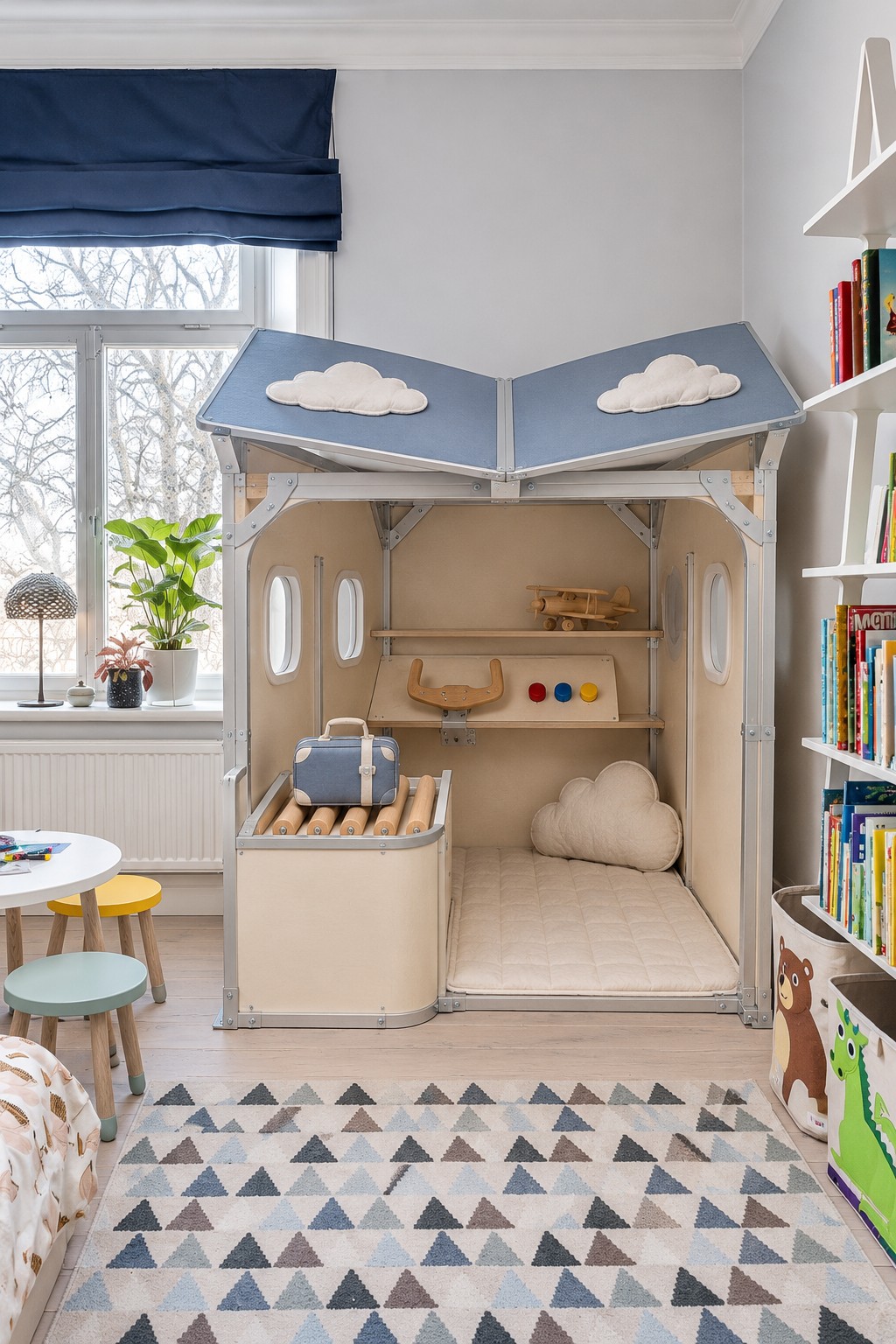
Wing shaped roof panels with felt clouds, oval porthole windows and a cockpit shelf with a wooden yoke and buttons make this nook feel ready for takeoff. The clever extra sits by the door: a baggage belt of wooden rollers in a metal tray, where a toy suitcase can slide in for check in. Inside, a long mattress and a cloud cushion turn into cabin seats for a long flight or a short nap.
This frame is aluminum profile joined with gusset plates, which suits a modern room, though timber battens work just as well. Line the walls with painted plywood or hardboard, cut the portholes with a jigsaw and edge them with a rounded trim. Run each roller on a dowel through holes in the tray sides so it turns freely under the luggage.
Little Stages for Puppets, Costumes and Shadows
A stage gives children an audience and a reason to tell a story out loud. Each idea here pairs a performance window with a hideout behind it, so shy performers have somewhere to retreat between acts.
25. Folding Screen Puppet Theater
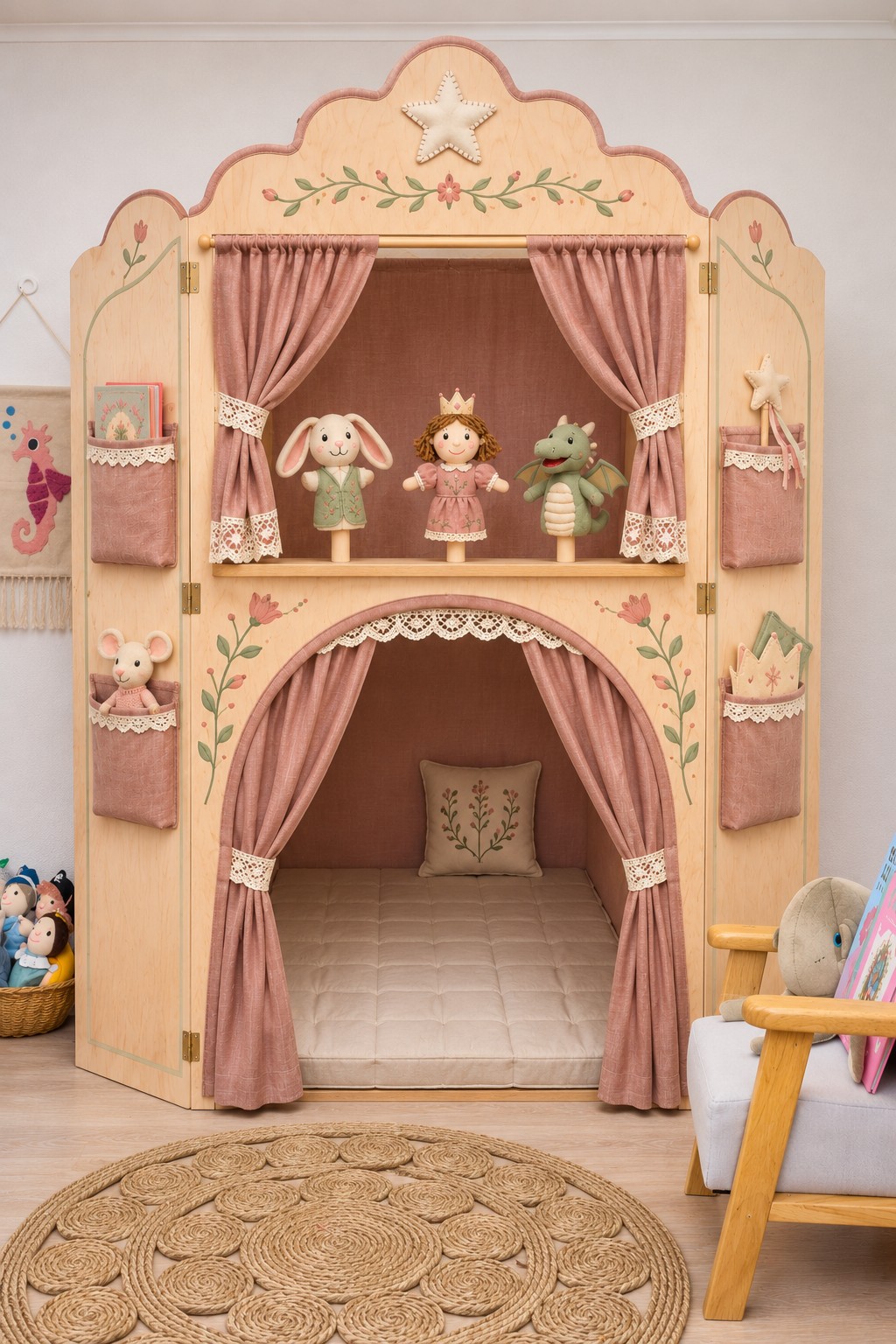
Three plywood panels joined with hinges open into a theater with a scalloped crown, painted vines and tulips, and a padded star at the top. The upper window holds a shelf for hand puppets framed by gathered curtains, while the arched space below becomes a cushioned hideout. Fabric pockets on the side panels keep puppets and books ready between shows.
Cut the outline from 12 mm birch plywood with a jigsaw and sand the edges until they feel soft. Fit three hinges to each joint, set the side panels at an angle so the screen stands on its own, and still fix it to the wall with a bracket so it cannot fold or tip during an energetic performance. Paint the motifs freehand or with stencils in water based acrylic, then seal with a clear coat.
26. Dress Up Stage with Sheer Curtains
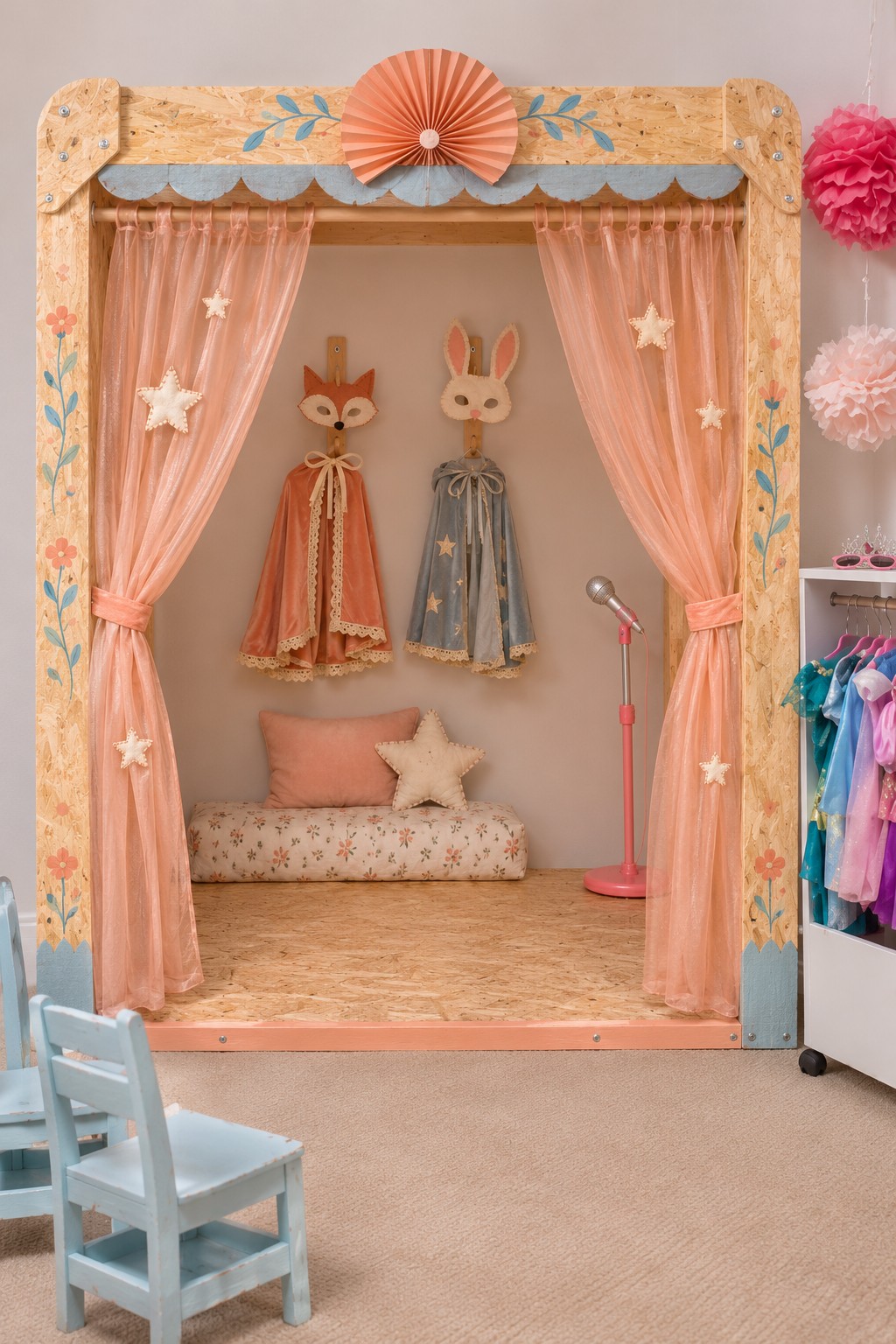
An OSB frame with its chipped texture left on show is painted with folk flowers and a scalloped pelmet and crowned with a paper fan rosette. Peach sheer curtains dotted with felt stars open onto a stage where capes and animal masks hang on pegs and a toy microphone stands ready for the opening number. A rail of costumes and two small chairs for the audience complete the theater.
OSB is inexpensive and strong but rough, so sand every edge thoroughly and seal the panels with a clear water based varnish to stop splinters and loose chips. Hang costumes at a child's shoulder height so they can dress themselves without help. Sheer fabric lets daylight through and keeps the stage bright even with the curtains closed.
27. Shadow Puppet Theater Nook
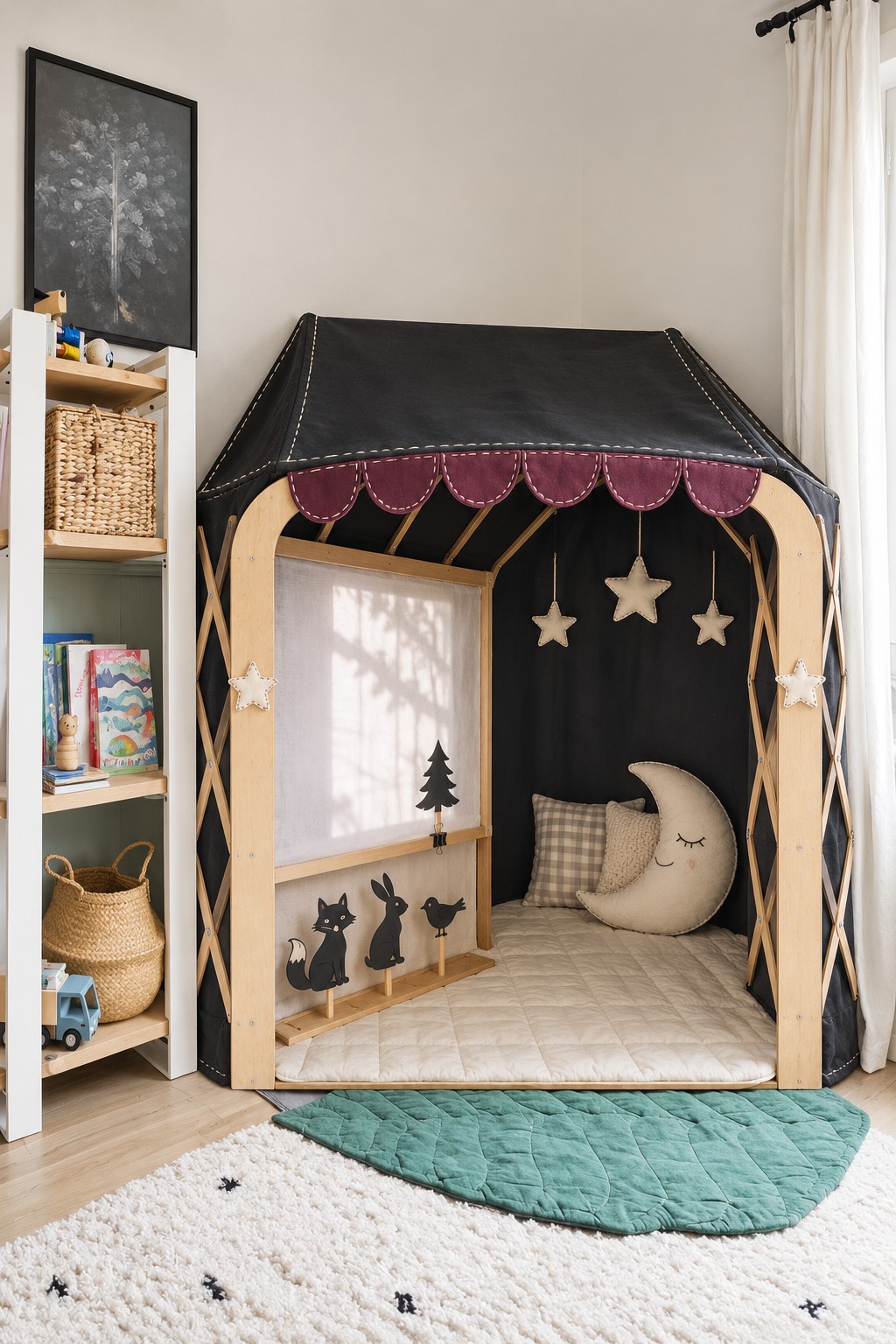
A dark fabric tent over a light wooden frame with lattice sides creates a perfect setting for shadow shows. A white screen fills one side, black silhouettes of a fox, a rabbit and a bird stand on sticks in a slot below it, and a pine tree rises above them. Felt stars hang from the ceiling and a moon cushion holds a seat for the audience.
Stretch white cotton or muslin tightly over a frame so the shadows stay crisp. Cut silhouettes from black card or thin plywood and glue them to flat sticks or dowels. Light the show from behind with a battery LED lamp, which stays cool and is the only kind of light that belongs near a fabric tent.
Game Corners
A play nook can also host a game that needs a strip of floor. These ideas work best in larger bedrooms, playrooms or basements, and these basement play area ideas show more ways to set up game zones.
28. Mini Bowling Alley Playhouse
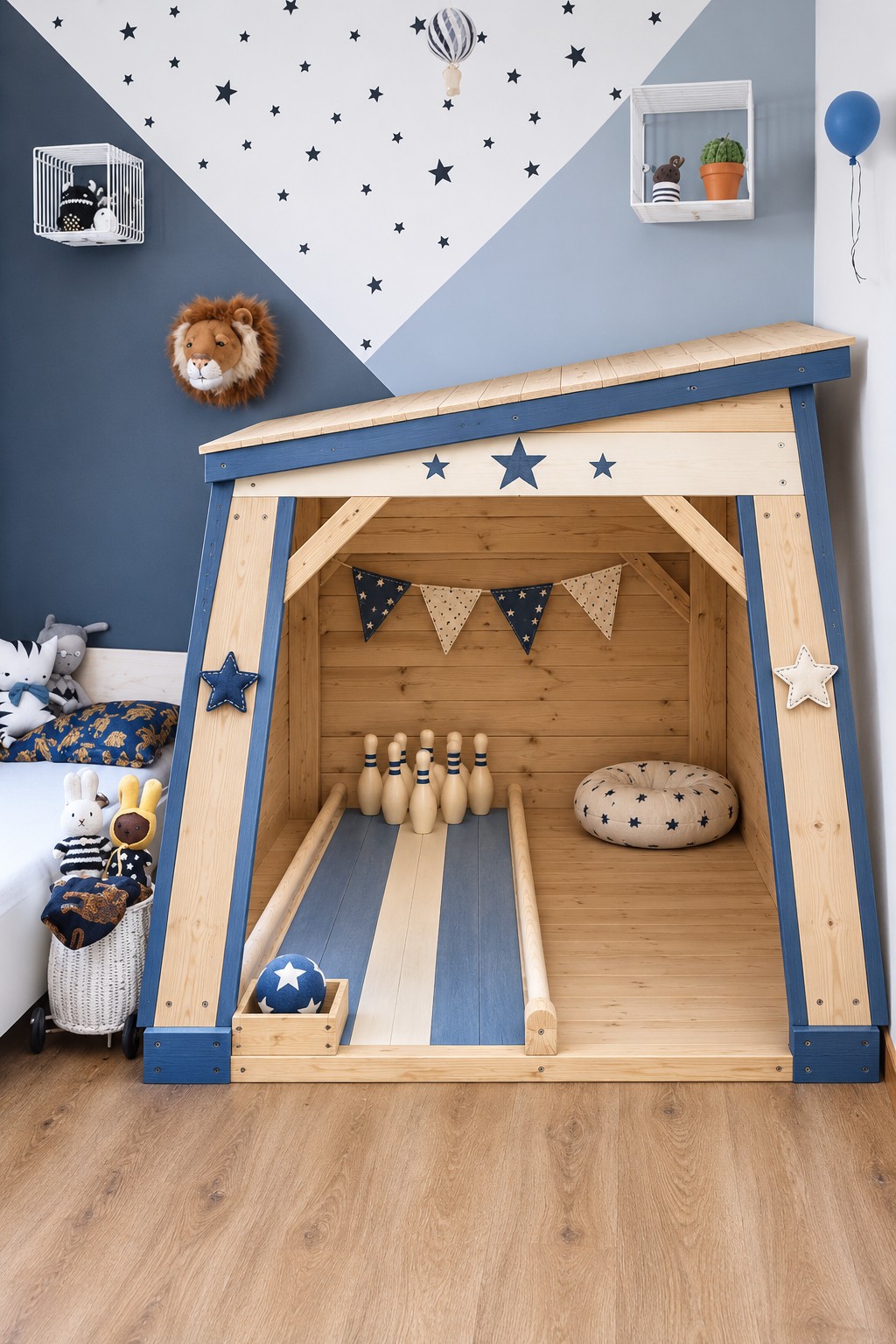
A slanted roof playhouse in natural pine with navy trim and stars hides a bowling lane painted in blue and white stripes. Dowel rails act as gutters on both sides, wooden pins stand at the far end and a box at the front holds the ball. A bunting overhead and a star printed cushion make it feel like a party corner.
Build the lane as a long plywood board with dowel rails glued and screwed along both edges, and finish the back with a raised board so pins do not roll under the bed. A soft ball suits younger players. Fix the playhouse frame to the wall, as children lean on it while they wait their turn.
29. Mini Golf Pergola
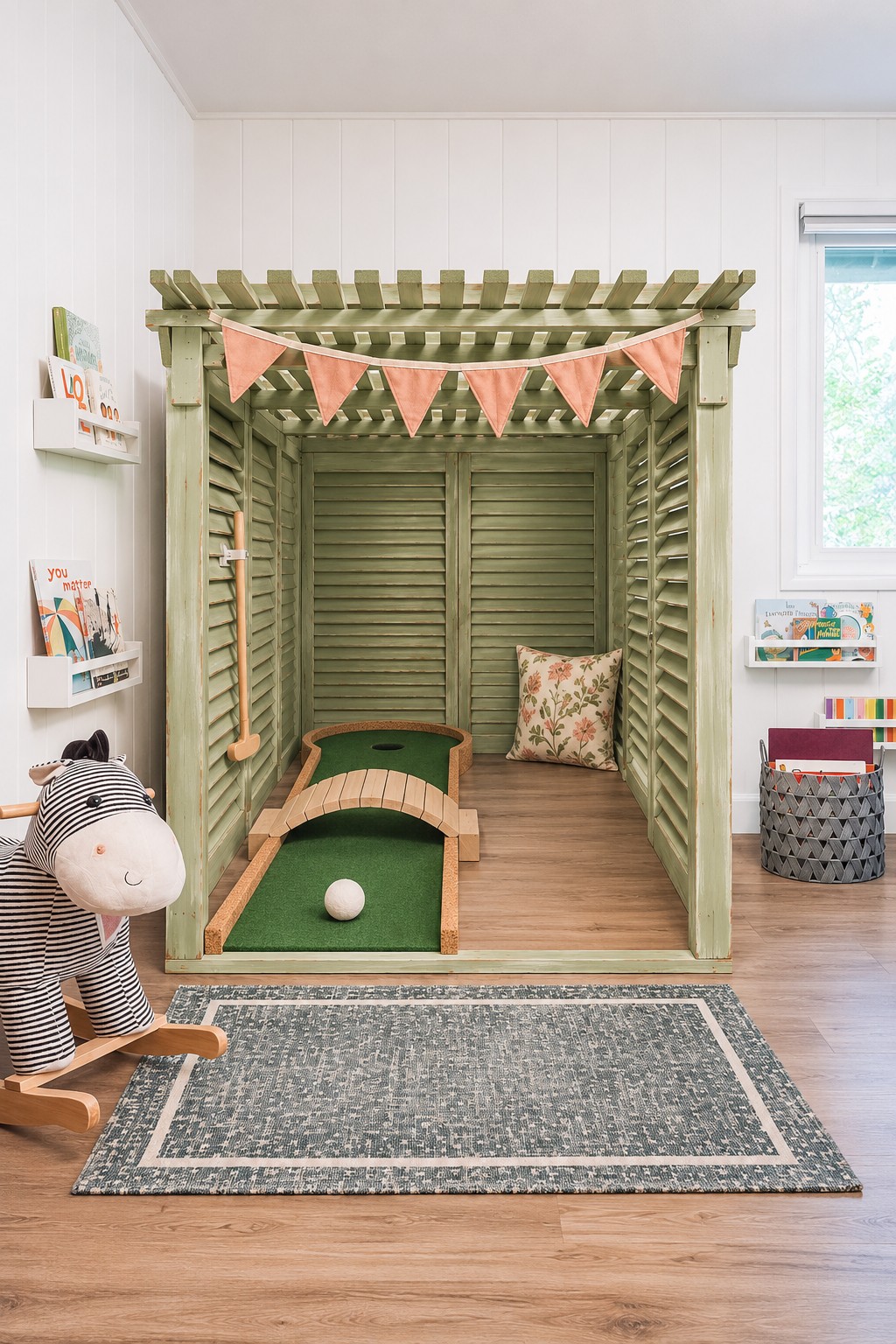
A sage green pergola with louvered sides and a slatted roof frames an indoor putting green, complete with a small arched bridge and a hole at the far end. A putter hangs on the post and a floral cushion invites a break between rounds. It is a quieter game than most, and grown ups tend to join in.
Fix artificial turf to a plywood base with carpet adhesive, or with double sided carpet tape if you might move it later, and edge it with wooden strips to keep the ball on course. The bridge is two curved plywood sides with slats between them. Indoors, use a soft practice ball and a short putter sized for small players.
30. Patchwork Tent with a Bean Bag Toss
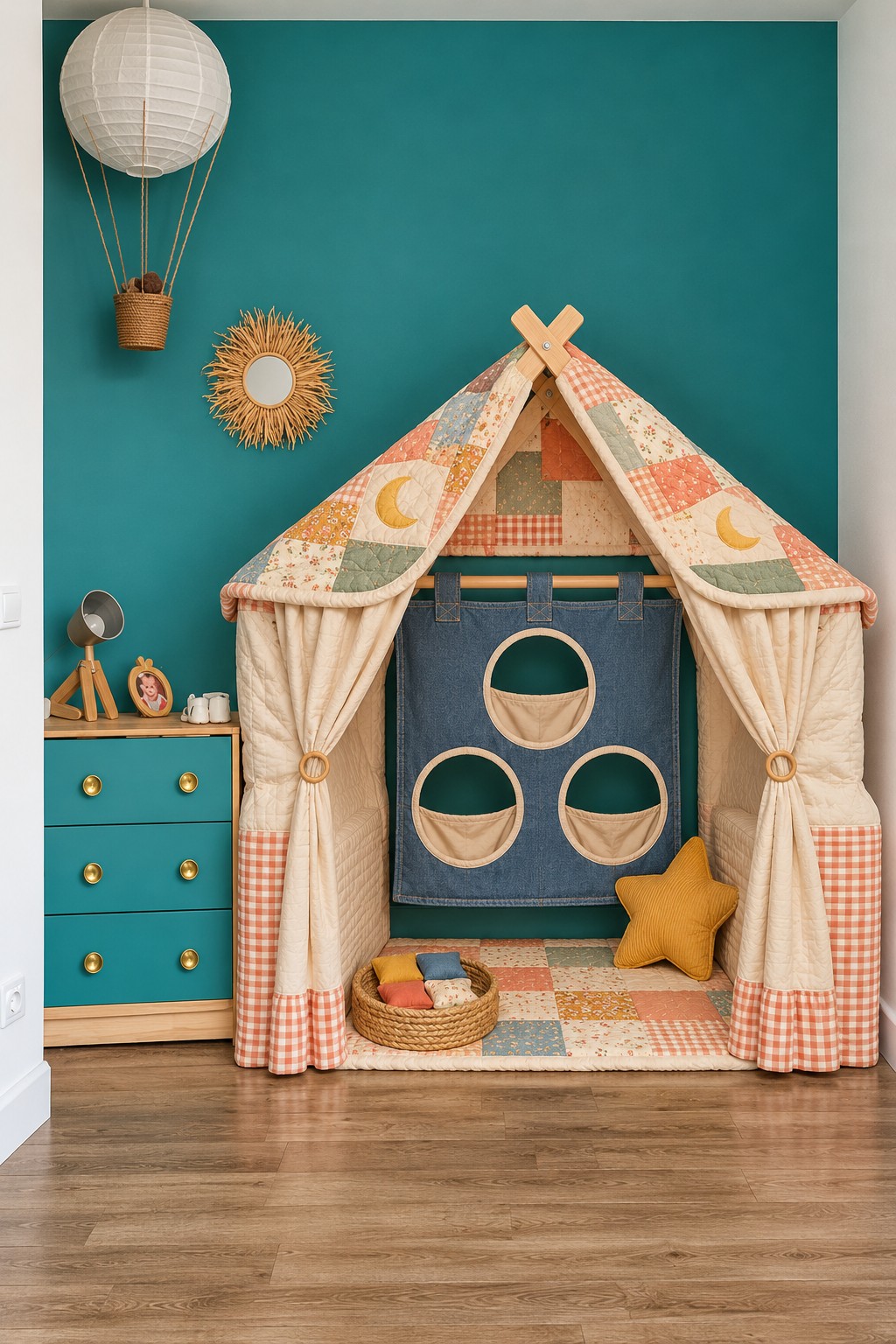
A quilted patchwork tent on a wooden frame, its crossed poles peeking out at the top, hangs a denim panel with three round openings across the back. Children throw bean bags through the holes, then crawl in to collect them from the basket. Gingham hems, moon appliqués and wooden ring tiebacks link it to the teal wall and the patchwork floor mat.
Cut the holes in the denim panel, finish them with bias binding and sew a fabric pocket behind each one to catch the bags. Make the bean bags from scrap cotton filled with dried beans or plastic pellets, and stitch every seam twice. Hang the panel by tabs on a dowel so it lifts off for washing.
31. Strawberry Canopy Train Station
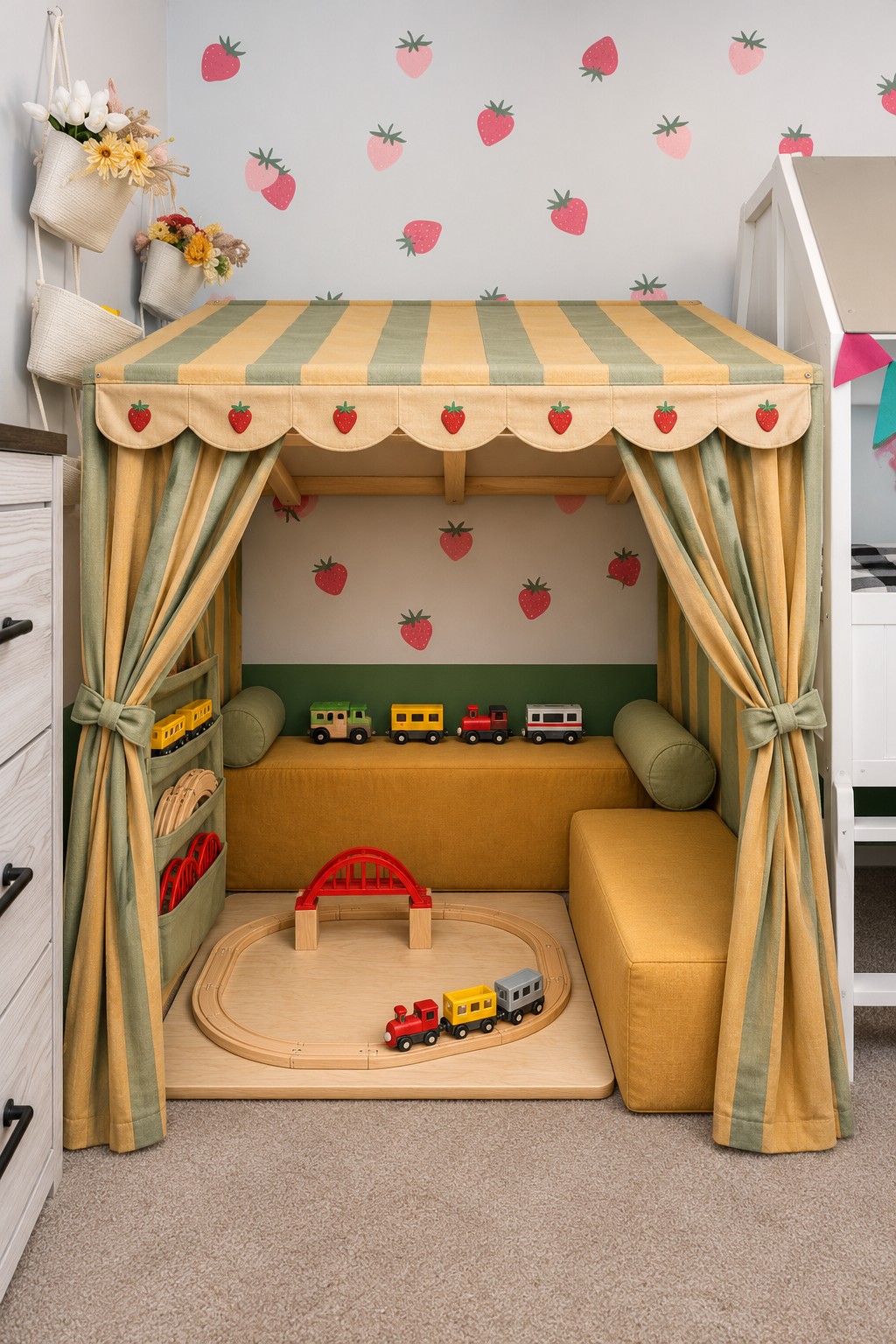
A striped green and yellow canopy, its scalloped valance dotted with strawberry appliqués, frames a low mustard bench and a raised platform for a wooden train track. Wall pockets sewn into the curtain hold spare track and carriages, so everything lives in one place. Strawberry decals on the walls carry the theme beyond the canopy.
The platform is plywood on a low batten frame, which lifts the track off the carpet and stops small pieces vanishing into the pile. Upholstered foam blocks with zipped covers make a bench that can be washed after snack time. Sew the curtain pockets from the canopy fabric so they blend in rather than look added on.
Adventure and Discovery Themes
Ships, castles, stars and shapes give children a story to step into. These designs suit kids who like to imagine, explore and learn with their hands.
32. Pirate Ship Reading Boat
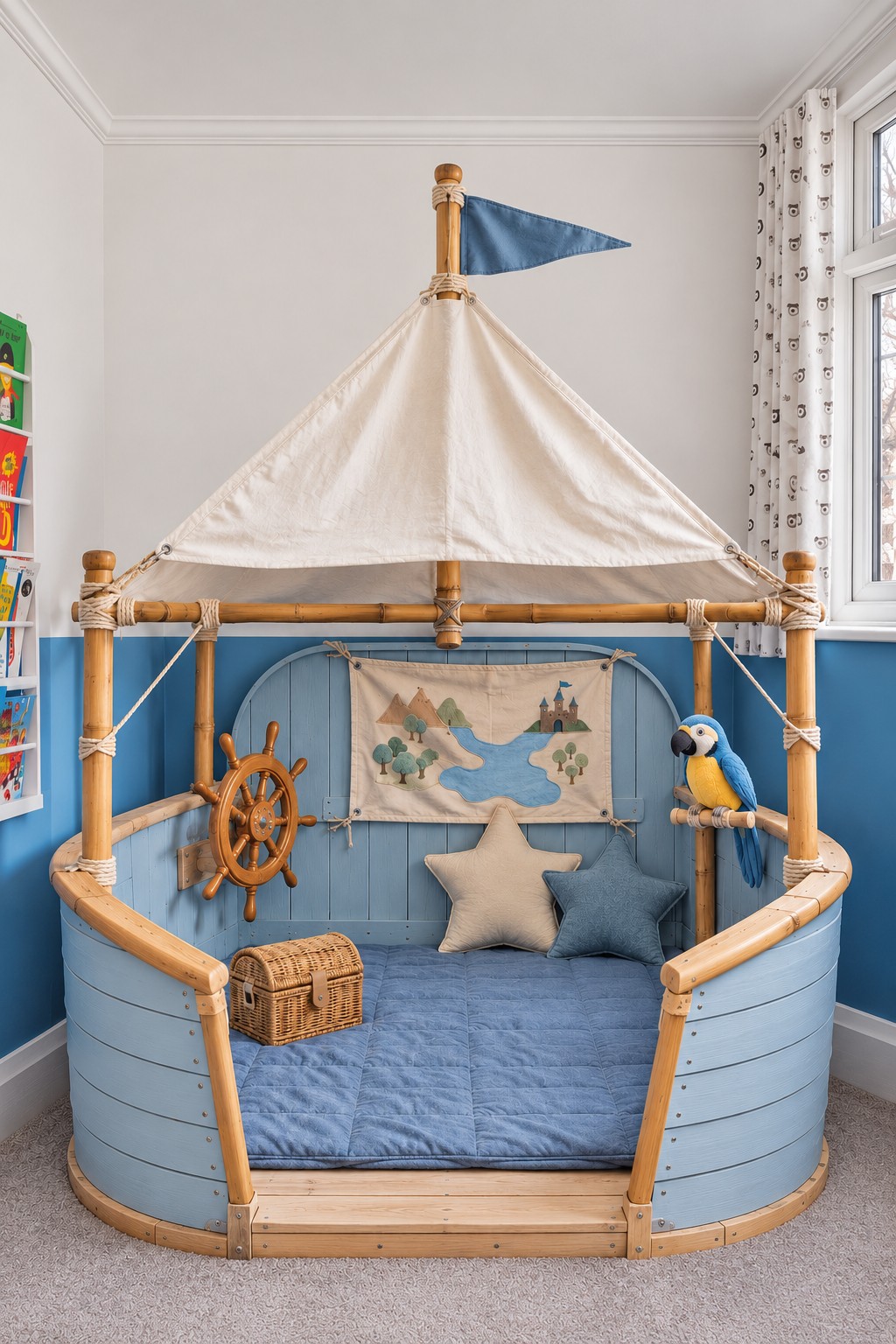
A blue painted wooden hull with natural wood rails, a canvas sail stretched from a bamboo mast and a pennant flag on top turn a corner into a ship's deck. A steering wheel, a woven treasure chest, a parrot on its perch and a map banner supply the props, while a quilted blue mattress fills the hull for reading, napping and long voyages.
Bend thin plywood around curved formers for a rounded hull, or angle straight panels toward the bow for an easier build. Lash the bamboo joints with rope and tie the sail to the rails through eyelets. Keep the mast short and solid so nobody is tempted to climb it.
33. Soft Block Castle
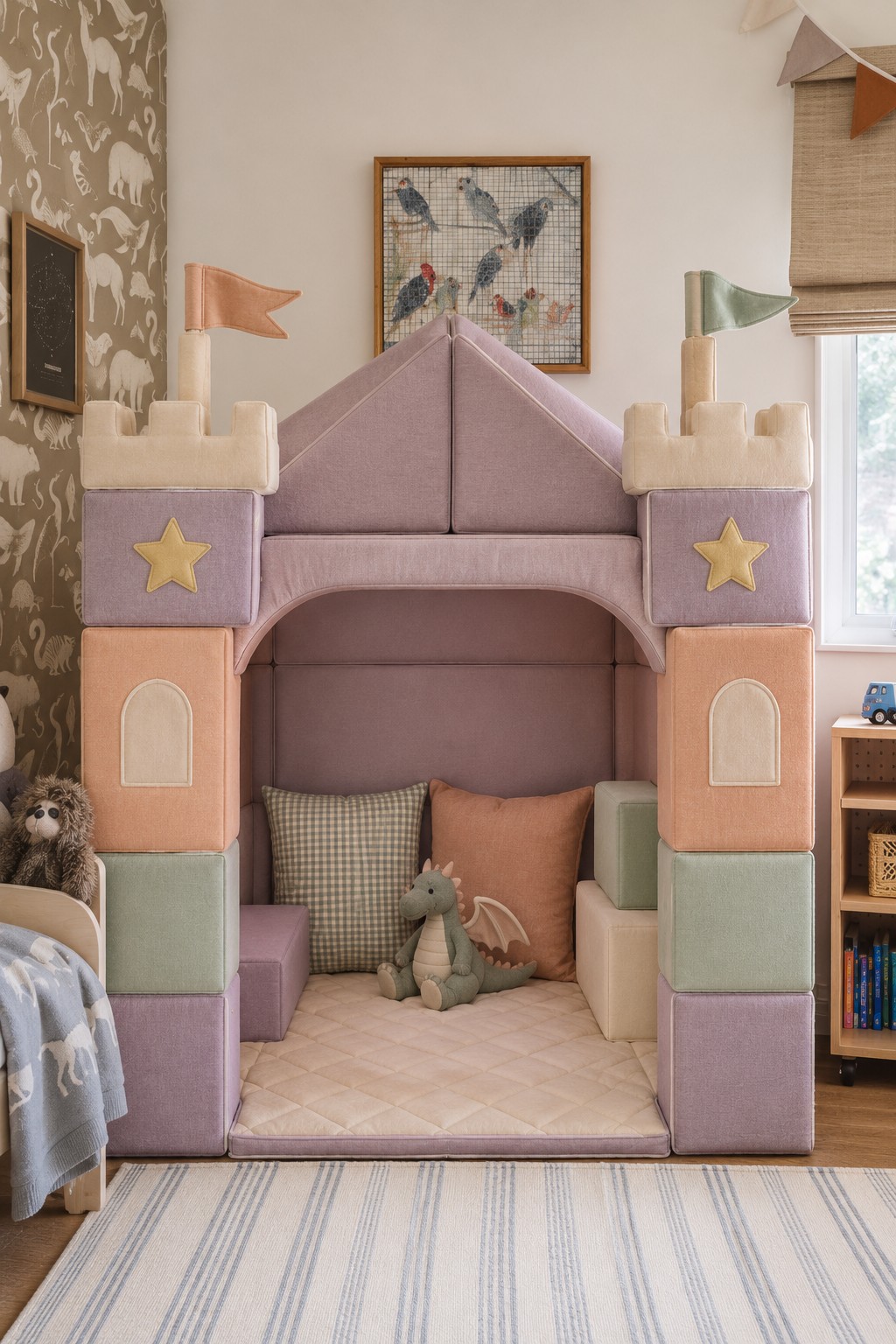
Upholstered foam blocks in lilac, peach and sage stack into a castle with turrets, battlements, felt stars and arched windows, with a fabric flag on each tower. Because every piece is soft, children can rebuild the walls themselves, and the castle turns into a fort, a bridge or a sofa as the game changes.
Cut high density foam to block sizes and give each block a zipped cover in a hardwearing upholstery fabric. Choose foam certified for low chemical emissions. A quilted floor mat in matching colors defines the inside and cushions any tumbles.
34. Geodesic Dome Observatory
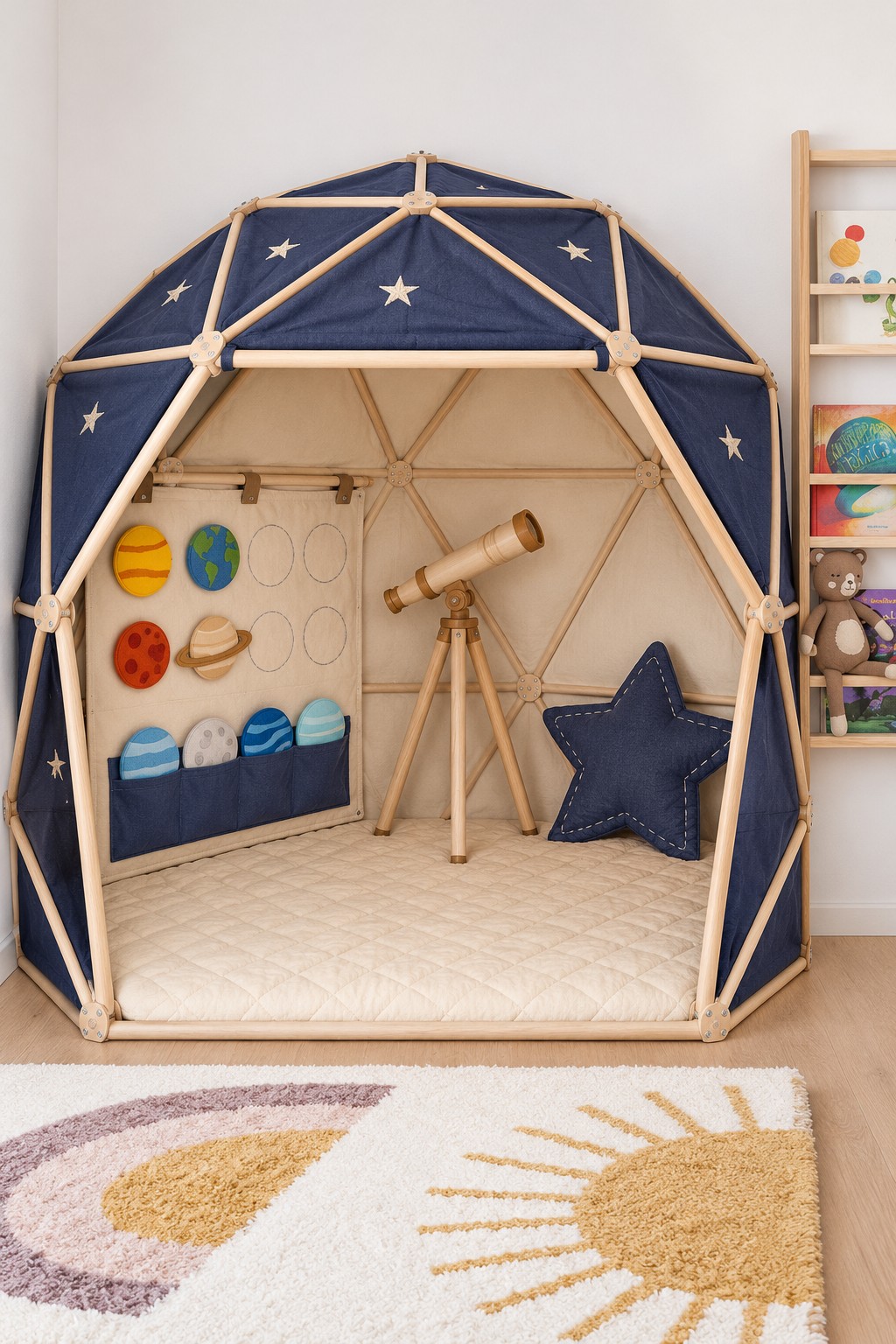
A geodesic dome of wooden struts and round hubs, covered in navy fabric scattered with stars, becomes a small observatory. Inside, a telescope stands on its tripod and a felt planet board invites children to match each planet to its outline. A star cushion and a quilted floor make it a comfortable place to talk about space.
Dome kits come with struts and hubs ready cut, though you can cut dowels to length and join them with plywood hubs. Sew the cover in triangular panels that follow the struts and fasten it with ties or hook and loop. Once covered, treat the dome as a hideout rather than a climbing frame, and set it on a non slip mat.
35. Moon Pod with a Dollhouse Table
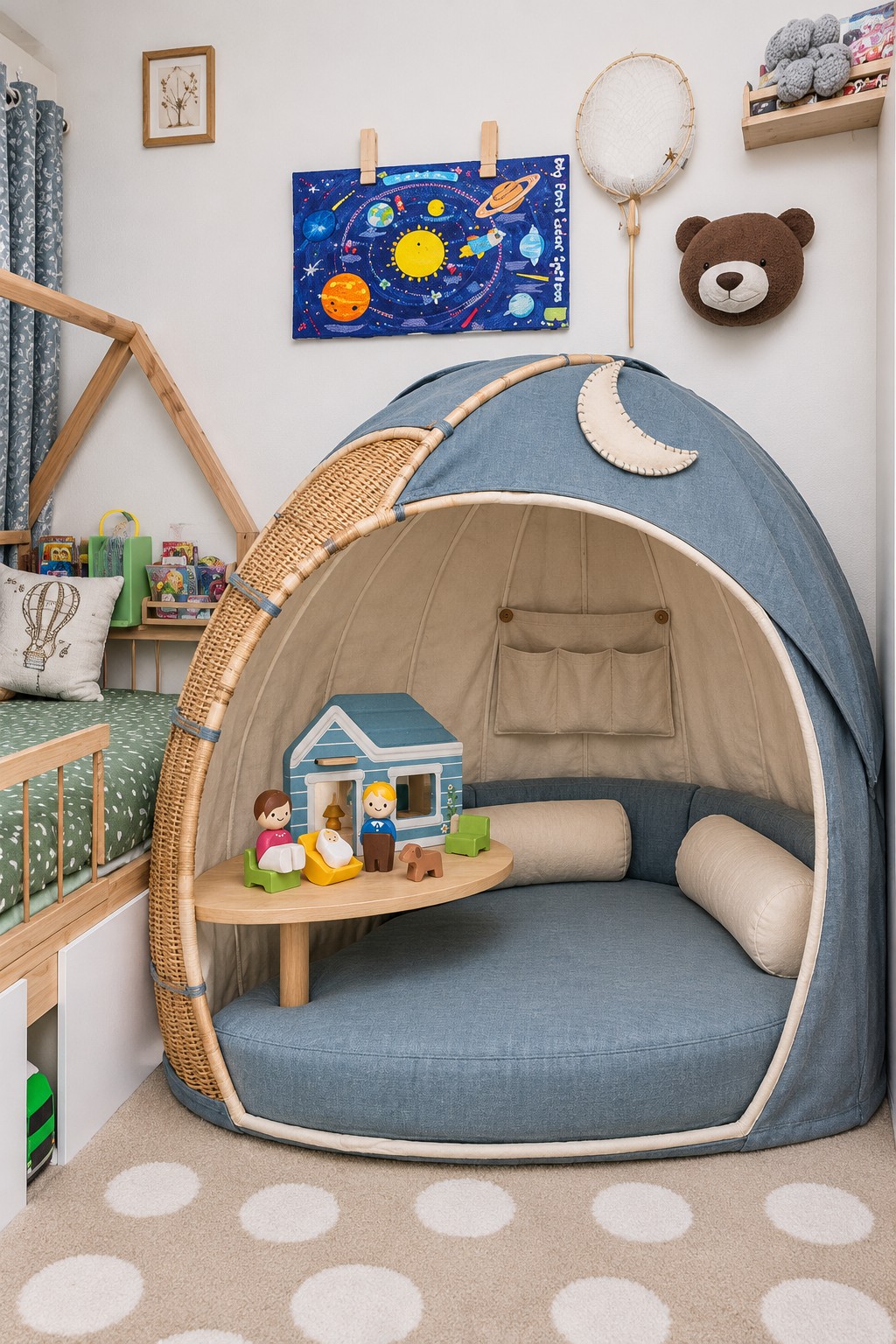
A rounded pod with a woven rattan rim and a blue fabric shell, marked with a cream crescent moon, wraps around a deep cushioned seat. A small table fixed inside holds a wooden dollhouse and its figures, and canvas pockets on the inner wall keep the pieces tidy. It feels like a cocoon, which suits a child who needs a quiet place to calm down after a busy day.
Pods like this are usually bought, but you can make one by stretching fabric over two bentwood hoops joined with ribs and binding the front ring with rattan. Use a thick seat cushion and bolsters for proper support. Fix the table with a bracket that holds it level even when elbows lean on it.
36. Shape Learning Gazebo
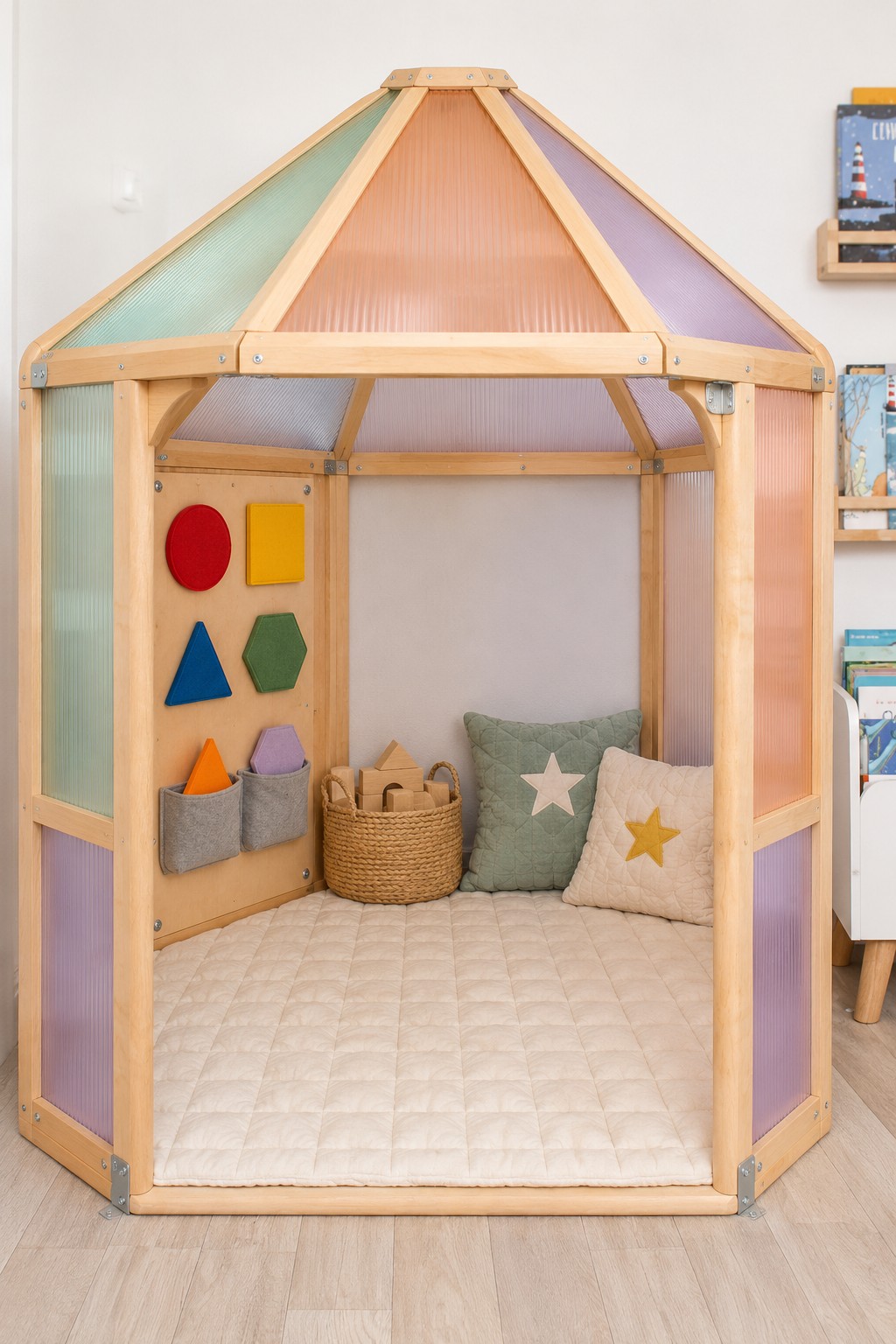
A hexagonal wooden gazebo with translucent ribbed panels in mint, peach and lilac lets softly tinted light into the play space. One plywood wall holds felt shapes in red, yellow, blue and green, with spare shapes waiting in felt pockets, so children can name, match and rearrange them. A basket of blocks and a quilted mat make it a calm learning corner.
Cut polycarbonate sheet with a fine tooth saw, or score thin sheet with a sharp knife, and keep the protective film on until the end. Screw it to the frame through slightly oversized holes with washers, which gives the plastic room to expand. Glue hook and loop dots to the backs of the felt shapes so they stick and peel off easily, and brace the frame corners with metal brackets.
37. Dragon Den Wooden Cube
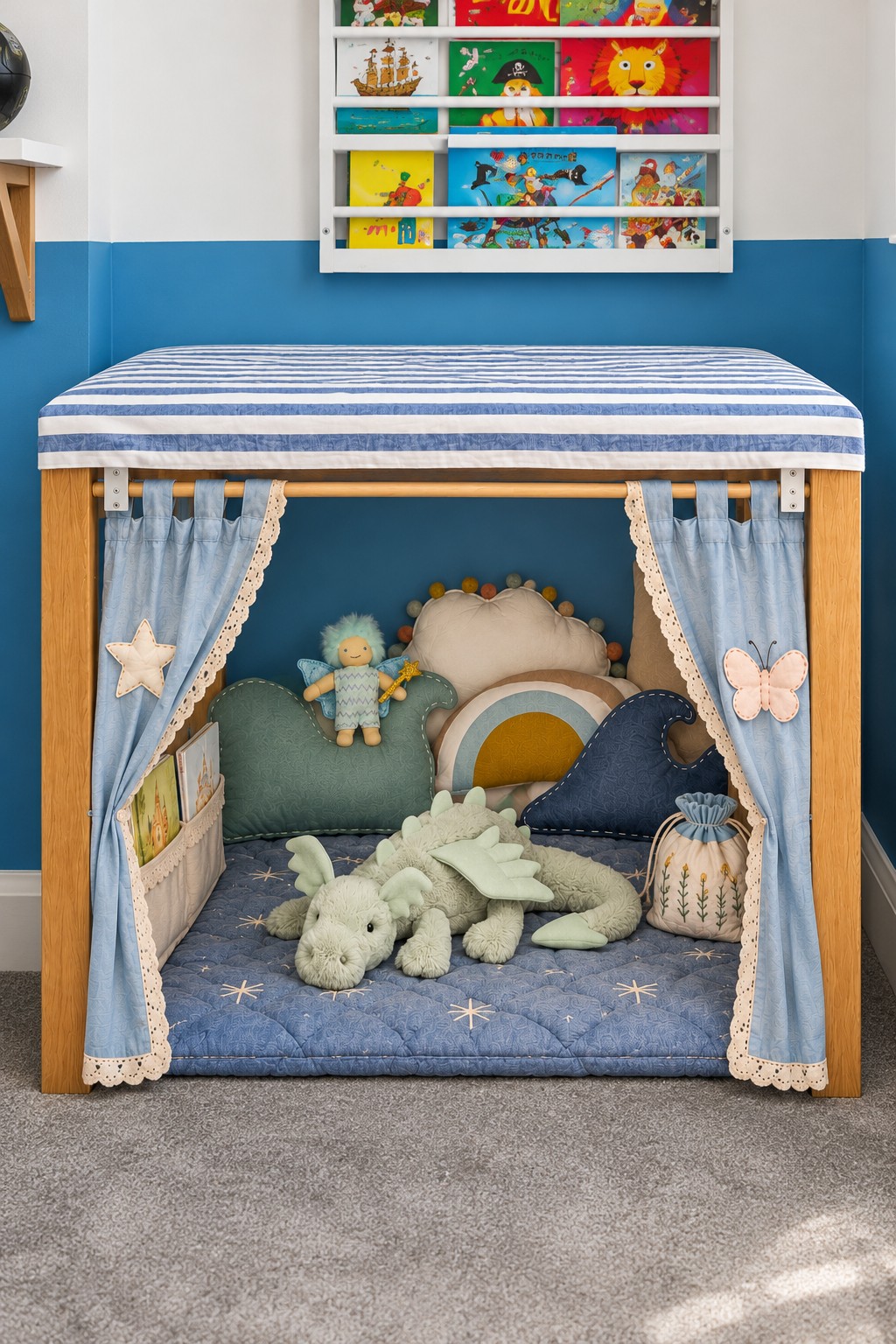
A simple solid wood frame with a padded striped roof and tab top curtains edged in crochet lace becomes a den for a large plush dragon. Cloud, rainbow and wave cushions line the back, a pocket on one curtain holds books, and a star quilted mat covers the floor. It is the easiest wooden build in this list and suits almost any theme, because the cushions and curtains carry the whole story.
Four posts and a top frame joined with corner brackets make the base, and a sheet of plywood topped with foam and fabric stapled underneath becomes the padded roof. Hang the curtains on a dowel resting in brackets so they slide easily. Stitch the felt stars and butterflies onto the curtains rather than gluing them, since those panels will be pulled many times a day.
Choosing the Right Nook for Your Child
Watch how your child already plays before picking a theme. A child who builds forts out of sofa cushions will love the soft castle or the stone cave; one who hides with a pile of books needs a quiet canopy, not a bowling lane; and a child who narrates everything will get the most from a stage or a shop counter. Leave space to change the story later: curtains, cushions and props are easy to swap, while the frame can stay for years.
Safety Notes for Indoor Playhouses
Anything tall, top heavy or hinged should be fixed to the wall with brackets or anti tip straps screwed into studs. That includes folding screens, crate stacks, corner houses and any frame with shelves, because a child pulling on a curtain or climbing a ledge can bring an unanchored structure forward. Ceiling hooks belong in a joist, never in plasterboard alone.
Keep cords, ribbons and loops short. Curtain ties, bunting strings and fabric straps should never form a loop large enough for a child's head, and a playhouse belongs well away from window blind cords. Canopies and loose fabric are for supervised play, not for an infant's sleep space.
Small parts such as buttons, beads, felt shapes, toy figures and wooden pegs can choke children under three. Stitch appliqués on firmly, check them often and keep small props in a higher basket when a toddler shares the room. Magnets used in fishing games or felt boards must be sealed inside so they cannot come loose, because swallowing two or more magnets can cause serious internal injury and needs emergency care.
Fabric burns, so keep every playhouse away from heaters, fireplaces, candles and hot lamps, and use only battery LED lights or cool LED strings inside it. Sand all wood edges, countersink screw heads, file and cap cut metal, trim cable ties flush, and check bamboo, reed and wicker regularly for splinters or broken ends. Hot glue guns, contact cement and power tools stay with adults, used in a ventilated room, and painted pieces should have time to cure before play begins. Once a month, tighten screws, hinges and hooks and look over every seam.


Leave a Reply